

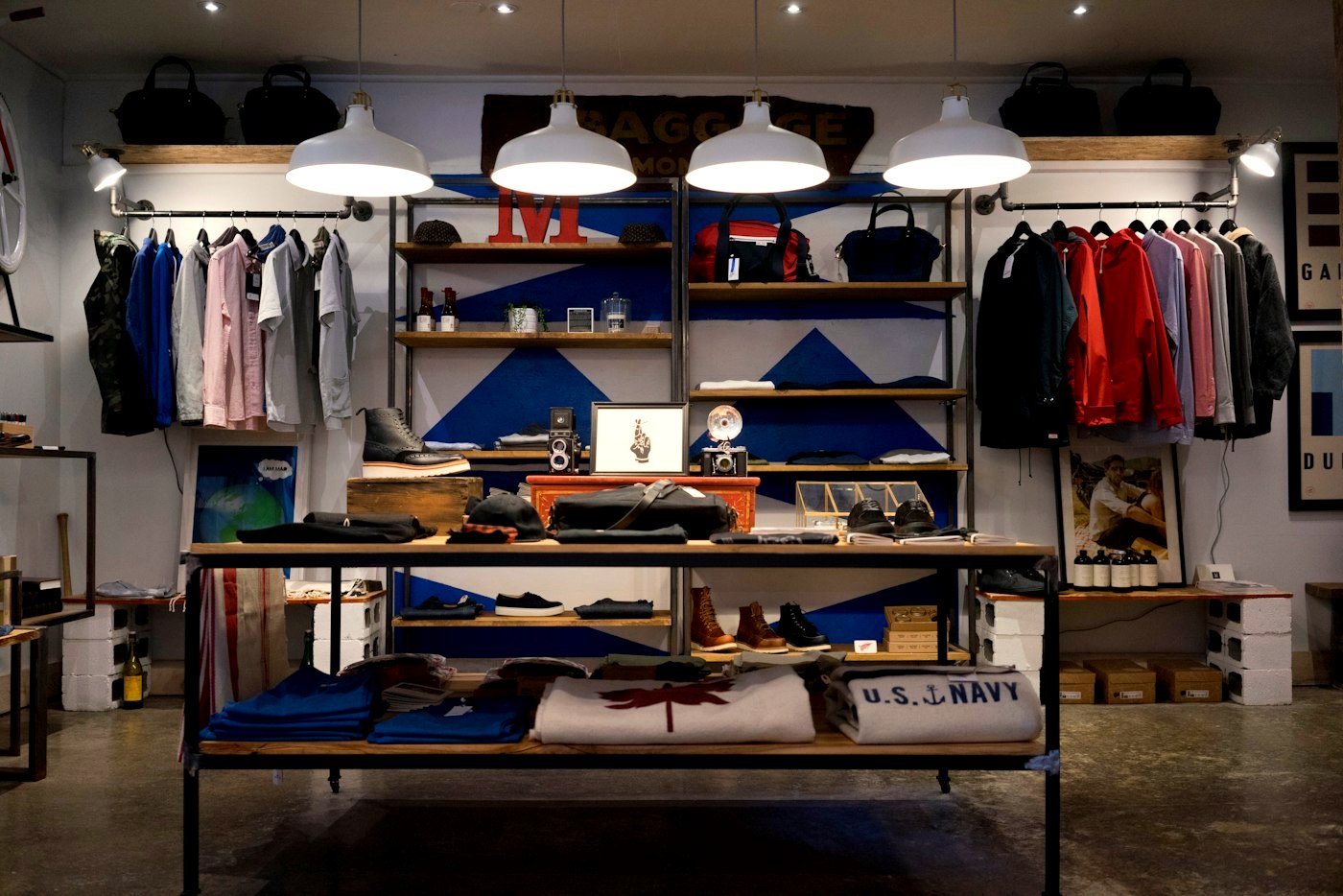
The retail rail, graded. Eight merchandising master's degrees ranked on what they teach, where they plug a student in, and what the whole degree costs. The rail in this frame is a class frame, photographed as one; no school in this ranking is pictured or implied.
Checked and updated October 2026
The short version: a merchandising master's is a shorter, cheaper purchase than a design degree, and a more vocational one: it is bought to do a specific job, the buying office's job of assortment, numbers and consumer insight, so this ranking grades it the way the job is graded, on curriculum, access, outcomes and price. The winner is LIM College (86/100, derived), the school this family's design index sent home: its one-year MPS in midtown Manhattan is the only degree here whose core is the merchandising toolkit itself. Second is the University of North Texas (80), an analytics degree at a public price of about $16,300 for a Texas resident. Kent State (78) takes third with the whole-industry master's. And the famous name sent home is FIT, the design index's winner, whose own graduate list contains no merchandising master's at all. Every score on this page is derived, not audited: this family is new, and it says so wherever a number appears. Scores follow our published methodology.
Every program is scored out of 100 on five rows, adapted from the audit rows this magazine uses for brands and printed here so the arithmetic can be argued with: curriculum 30, industry access 25, outcomes record 20, value for tuition 15, format honesty and flexibility 10. Curriculum grades what is actually taught against the buying office's toolkit: buying and assortment planning, retail math and analytics, consumer insight. Industry access grades the working industry within reach of the classroom: employers, internships, a retail economy, a fashion capital. Outcomes record grades what a graduate demonstrably leaves with. Value for tuition divides the teaching by the bill. Format honesty and flexibility grades how plainly a school publishes its format and its price, and how a working student can actually move through the degree: online or in person, full or part time, the real length of the thing. One rule governs the whole page: only master's degrees whose core is merchandising are ranked. A school whose fashion master's is a management degree, or a design degree, or a famous name with no merchandising program behind it, is answered honestly in prose and not seated in the table.
Beside every score sits this page's original data: the tuition ledger. Graduate schools publish tuition in different units, per credit, per year or as a whole-degree total, and rankings usually hide the mismatch; the ledger prints each school's own unit, with the basis labelled, and multiplies out to the whole degree wherever the school publishes enough to do the sum. The spread is narrower than the design index's ten-to-one, and the story is different: the cheapest complete degree here costs about $16,300 and the dearest $55,836, and the distance between them buys format and postcode more than teaching. Read the ledger before the ranking; the ranking makes more sense after it.
The tuition ledger
Tuition as published by each school, on the basis stated, and the tuition total across the degree at that rate. Fees, housing and materials are excluded throughout, and every school adds them; the ledger compares the figures all eight publish, each in its own unit, rather than forcing one unit onto schools that do not use it.
| School | Tuition, as published | Basis, as published | Tuition across the degree |
|---|---|---|---|
| LIM College | $1,282 a credit | Graduate per-credit rate, 2026-27, the same on campus and online; the degree requires 30 credits | $38,460 (30 credits at the published rate) |
| University of North Texas | Published as a degree total | The university's published estimate of total tuition for the online degree, Texas resident; 30 credit hours; non-resident tuition is higher | About $16,300 (Texas resident) |
| Kent State University | Published as a degree total | Kent State Online's published approximate total tuition for the online degree; 30 credit hours | About $18,900 (online) |
| SCAD | $977 a credit hour | Graduate per-credit-hour rate, 2026-27; the degree requires 45 quarter credit hours | $43,965 (45 credit hours at the published rate) |
| Drexel University | $1,190 a credit | Per-credit rate as published for the online program; 45 quarter credits; an annual online program fee of $125 sits on top | $53,550 (45 credits at the published rate) |
| Oklahoma State University | $622 a credit | The IDEA consortium's published common price per graduate credit, 2025-26; the online option requires 36 credits | $22,392 (36 credits at the common price) |
| Academy of Art University | $1,551 a unit | Graduate per-unit rate for domestic students, fall 2026 to summer 2027; international students pay $1,857 a unit; the degree requires 36 units | $55,836 (36 units at the domestic rate) |
| Iowa State University | $12,194 a year (resident) · $30,876 (non-resident) | Graduate tuition per year, 2026-27; the degree typically runs two years | About $24,388 (resident) · $61,752 (non-resident), two years at the published rates |
The ranking at a glance
Scores follow the five rows above and are derived on this page. The reasoning for every line, and the limit on every figure, is in the entry below it.
| School | Score | Degree | City | The call |
|---|---|---|---|---|
| LIM College | 86 (derived) | MPS in Fashion Merchandising and Retail Management | New York, and online | The winner: the buying office's own degree, finished in a year |
| University of North Texas | 80 (derived) | MS in Merchandising and Consumer Analytics | Denton, Texas, and online | The analytics degree at a public price |
| Kent State University | 78 (derived) | Master of Fashion Industry Studies | Kent, Ohio (online from fall 2026) | The whole-industry master's: thesis or practicum |
| SCAD | 73 (derived) | M.A. in Luxury and Brand Management | Savannah and Atlanta, and online | The luxury end of the table, brand-side by design |
| Drexel University | 68 (derived) | MS in Retail & Merchandising | Online, from Philadelphia | The working retailer's online degree |
| Oklahoma State University | 67 (derived) | MS in Design, Housing and Merchandising (Retail Merchandising Leadership) | Online, from Stillwater, Oklahoma | The consortium degree: one price, no residency split |
| Academy of Art University | 61 (derived) | M.A. in Fashion Merchandising | San Francisco, and online | The portfolio degree at the table's highest unit price |
| Iowa State University | 59 (derived) | MS in Apparel, Merchandising, and Design | Ames, Iowa, and hybrid distance | The research route: merchandising as scholarship |
The Top Five
1. LIM College: the winner
Best for: the student who wants the buying office itself, in the city where the buying offices are, in one year. Degree: MPS in Fashion Merchandising and Retail Management, 30 credits, on campus in midtown Manhattan or fully online, STEM-designated; full-time students finish in three semesters. Tuition: $1,282 a credit for 2026-27, the same rate on campus and online, $38,460 across the degree. Score: 86/100, derived on this page, and labelled derived wherever it appears.
Curriculum 27/30 · Industry access 24/25 · Outcomes record 17/20 · Value for tuition 9/15 · Format honesty and flexibility 9/10
LIM wins this index for the reason it was sent home from the design index: the college teaches the business of fashion and nothing else, and at master's level that focus produces the most merchandising-specific curriculum on this page. The catalog core is the job description written as coursework: Fashion Merchandising, Fashion Retail Management, Merchandising Metrics and Advanced Spreadsheet Modeling in two parts each, Technology in Fashion Merchandising and Management, then an internship in the field or a course in developing and exercising influence, and a capstone. After the core, the student declares one of the four specializations the college publishes: Buying and Operations Management, Product Development and Sourcing, Sustainability in Fashion, or Fashion and Lifestyle. A student who wants the supply side instead can take the college's sibling master's in global fashion supply chain management, which counts as a strength of the institution rather than a distraction from this degree. The access row stops one short of full marks only because the online cohort shares the degree but not the postcode: the college's buildings stand at East 45th Street and on Fifth Avenue, inside the industry's home neighbourhood, and the internship course spends that advantage. The deduction that remains is the price, a private one, and the value row reflects it. Verdict: start here. For a student certain the buying office is the destination, this is the most direct degree in the country: one year, one city, the whole toolkit, priced to the credit.
2. University of North Texas: the analytics degree
Best for: the student who wants the data half of merchandising, at a state university price, without moving. Degree: MS in Merchandising and Consumer Analytics, 30 credit hours, on campus in Denton or fully online, STEM-designated; the standard pace is a year and a half to two years, and the university publishes an accelerated online route that can finish in a year. Tuition: about $16,300 for the whole degree for a Texas resident, the university's own published estimate; non-resident tuition runs higher. Score: 80/100, derived on this page.
Curriculum 26/30 · Industry access 15/25 · Outcomes record 15/20 · Value for tuition 14/15 · Format honesty and flexibility 10/10
North Texas has rebuilt the merchandising master's around the skill the industry now hires first, and its catalog reads like an analytics team's job board: Data Analytics I and II, Consumer Analytics and Data Visualization, Merchandising Analytics for Retail Buying Strategies, Social Media Analytics, and Consumer Insights Using Data Analytics, with Digital Merchandising among the electives. The same department runs a second master's, in Merchandising and Digital Retailing, for the student who wants the channel rather than the numbers. The university's own online program page names the employers hunting this skill set, Walmart, Lowe's, Neiman Marcus, Fossil, JCPenney and CVS Health among them, and the Dallas-Fort Worth retail economy behind the Denton campus is a real one, which is why the access row is respectable rather than coastal. What North Texas does not have is a fashion capital, and its outcomes record, while pointed at the fastest-growing corner of the field (see the specializations section below), is younger than the degree's ambition. The format row takes full marks: two honest formats, an accelerated option, a published whole-degree price, and the cheapest serious degree on this page. Verdict: the value pick, and not a compromise pick. For a Texas resident it is close to unanswerable; for everyone else it is the benchmark the private schools have to beat.
3. Kent State University: the whole-industry master's
Best for: the student who wants to study the fashion industry as a whole system, and to leave with research an employer has already argued with. Degree: Master of Fashion Industry Studies (M.F.I.S.), a minimum of 30 credit hours over two years, on the Kent campus, with the fully online format beginning in fall 2026. Tuition: about $18,900 for the online degree, the approximate total Kent State Online publishes for it. Score: 78/100, derived on this page.
Curriculum 23/30 · Industry access 18/25 · Outcomes record 15/20 · Value for tuition 13/15 · Format honesty and flexibility 9/10
Kent State's master's refuses the art-or-business split the school itself criticizes, and the curriculum is the refusal: Research Methods in the Fashion Industry, Fashion Systems Thinking, The Global Consumer in the Fashion Industry, a required practicum, and electives that run from Fashion Industry Merchandise Management to Sustainable Supply Chain and Life Cycle Assessment and Circular Economy Strategies. The culminating work is the degree's signature: a thesis or practicum capstone whose research-based solution to an industry problem is tested against feedback from an industry partner, which is a stronger outcomes mechanism than a placement claim. The curriculum row is where the breadth costs marks on a merchandising table: buying and analytics are strands here, not the spine, and a student who wants the buying office's toolkit pure should look at the two degrees above this one. The access row prices Kent, Ohio honestly and credits the school's study-away machinery, its New York City studio and Florence, which the practicum can use. At an approximate published total under $19,000 online, the value row is the best available to a student who does not qualify for North Texas's resident rate. Verdict: the thinking degree at a working price. Choose it to understand the industry entire, and to graduate with a defended piece of work rather than only a transcript.
4. SCAD: the luxury end of the table
Best for: the student aiming at the luxury houses, where merchandising is practised as brand management at very high price points. Degree: M.A. in Luxury and Brand Management, 45 quarter credit hours, in Savannah and Atlanta and online through SCADnow; SCAD describes the program as the first master's of its kind. Tuition: $977 a credit hour for 2026-27, $43,965 across the degree. Score: 73/100, derived on this page.
Curriculum 22/30 · Industry access 19/25 · Outcomes record 16/20 · Value for tuition 8/15 · Format honesty and flexibility 8/10
This seat needs its reasoning printed, because the degree is merchandising-adjacent and this index does not pretend otherwise. Luxury is the one tier of the trade where the brand half of the discipline is the discipline: what SCAD teaches, in its own course list, is the merchandising of rarity, through The Art of Luxury, Global Distribution for Luxury Brands, Supply Chain Management in the Global Marketplace, Advertising Luxury and a final project, with an internship or a SCADpro collaborative project alongside. SCAD's published record of those collaborations names the tier the degree aims at: Hermès, L'Oréal, Kendra Scott and Ernst Benz. Scored as a buying-office degree it would fail the curriculum row; scored as what it is, the only master's here built entirely for the luxury end of the assortment, it takes fourth. The deductions are the distance from core buying and analytics, which the 22 reflects, and a price that buys Savannah and Atlanta rather than a fashion capital. Verdict: the right degree for a narrow, real destination. If the ambition is a luxury house's brand or distribution team, nothing else on this page aims there; if the ambition is a buying office, the three degrees above this one are straighter lines.
5. Drexel University: the working retailer's degree
Best for: the retail professional already employed, who needs the credential to move from the floor, or the assistant's desk, into the buying and merchandising office. Degree: MS in Retail & Merchandising, 45 quarter credits (about 30 semester credits), delivered online by the Westphal College through Drexel University Online. Tuition: $1,190 a credit as published for the program, $53,550 across the degree, before the program's annual online fee. One limit, printed rather than hidden: Drexel publishes its online tuition per program and revises it by year, and partner schedules differ from the standard rate; the figure stands as the rate published for this program at this check and will be re-read at this family's first audit. Score: 68/100, derived on this page.
Curriculum 24/30 · Industry access 14/25 · Outcomes record 16/20 · Value for tuition 6/15 · Format honesty and flexibility 8/10
Drexel's curriculum is the most complete retail syllabus on this page after LIM's: Retail Merchandising, Retail Lifestyle Product Analysis and Forecasting, Retail Brand Storytelling, Retail Store Technology and Visual Display, Retail Supply Chain Analysis, Selling Techniques and Strategies, a leadership seminar and a course called The Inclusive Retail Leader, closing in a research project or thesis. The program is directed by Joseph H. Hancock II, whose own record, published by the university, runs through management and merchandising roles at The Gap, L. Brands and Target, and the teaching leans practitioner throughout. The outcomes row is helped by evidence of the most concrete kind a school can publish: the university's own graduate-student profiles include an online student in this program hired as a buyer at Burlington while still enrolled, after a decade in retail. What holds the degree at fifth is the combination of an online-only format, which caps the access row however good the faculty's connections, and a private per-credit price that produces the second-highest total on the page for a degree with no campus for its students to maintain. Verdict: the professional's degree. For a working retailer whose employer reimburses tuition, its completeness argues for it; paying the full rate out of pocket, the same student should price North Texas first.
The program in Drexel's graduate listings →
The Middle of the Table
6. Oklahoma State University: the consortium degree
Best for: the student who wants a public, practitioner-facing merchandising master's online, at one published price that does not ask where they live. Degree: MS in Design, Housing and Merchandising; the online option is Retail Merchandising Leadership, 36 credit hours, non-thesis, taught through the IDEA consortium of public universities (formerly Great Plains IDEA); a Merchandising option with thesis and non-thesis plans runs on campus in Stillwater. Tuition: $622 a credit at the consortium's published common price for 2025-26, $22,392 across the online degree; the on-campus option bills at the university's standard graduate rates instead. Score: 67/100, derived on this page.
Curriculum 22/30 · Industry access 12/25 · Outcomes record 12/20 · Value for tuition 12/15 · Format honesty and flexibility 9/10
Oklahoma State's catalog states the online degree's purpose plainly: to strengthen the retail industry's supply of consumer research skills and analytics-driven problem solving. The consortium model is the degree's character. Courses are drawn from merchandising faculty across the member universities, the plan of study is built with an adviser around a minimum of 21 credit hours in the department, and the price is the consortium's common price, the same for every student wherever they live, which is the most transparent pricing arrangement on this page. The deductions are the other side of the model: no single campus's industry to walk into, no fashion city at the end of the street, and a published outcomes record thinner than the degree's practical intent deserves. The curriculum row reflects a solid merchandising core assembled across institutions rather than one faculty's designed sequence. Verdict: the quiet public option. A working retailer outside the coastal states, paying their own way, gets a real merchandising master's here for less than half the Academy of Art's total, and the consortium's price honesty is a practice the rest of the table could copy.
The program at Oklahoma State →
7. Academy of Art University: the portfolio degree
Best for: the student who learns by making deliverables and wants a final portfolio, not a thesis, at the end. Degree: M.A. in Fashion Merchandising, 36 units (33 in the major, 3 of graduate liberal arts), about two years, on campus in San Francisco and online; a longer M.F.A. in Fashion Merchandising and Management sits beside it. Tuition: $1,551 a unit for domestic students, fall 2026 to summer 2027, $55,836 across the degree; the university's published annual estimate at 18 units is $27,918, and international students pay $1,857 a unit. Score: 61/100, derived on this page.
Curriculum 22/30 · Industry access 13/25 · Outcomes record 12/20 · Value for tuition 5/15 · Format honesty and flexibility 9/10
The Academy's M.A. replaces the thesis with a final portfolio review, and its courses are built as work product: Fashion Business: Product Planning and Sourcing, which teaches assortment planning, pricing and product mix; Fiber and Function, a hands-on textiles course; Visual Merchandising: Image and Brand; and a professional practices course that ends in a portfolio and interview preparation. The M.F.A. sibling adds the buyer-simulation course, Merchandising Principles, in which the student creates a retail business through seasonal financial planning, assortment planning, vendor negotiation and inventory management; a student set on the buying office should compare the two degrees' course lists before choosing the shorter one, because the most merchandising-specific course in the school sits in the M.F.A. The deductions are the arithmetic and the address. At $1,551 a unit this is the most expensive degree on the page per unit of teaching, and San Francisco's fashion industry, while real in retail and technology-adjacent commerce, is not New York's. The format row is genuinely strong: honest ways to study, in person or online, at a published unit price, in a defined two-year shape. Verdict: a workmanlike degree at a luxury price. The teaching is practical and the portfolio is a sensible graduation requirement; the bill is what ranks it seventh.
The program at Academy of Art →
The Rest of the Field
8. Iowa State University: the research route
Best for: the student whose destination is scholarship, a museum, extension work or a doctorate, with industry as the second door rather than the first. Degree: MS in Apparel, Merchandising, and Design, 30 credits with a thesis or 36 without, on campus in Ames or by hybrid distance with one or two short on-campus summer sessions; the university's own published median time to the master's is 1.8 years. Tuition: $12,194 a year for Iowa residents and $30,876 for non-residents, 2026-27, which comes to about $24,388 resident or $61,752 non-resident across two years. Score: 59/100, derived on this page.
Curriculum 18/30 · Industry access 10/25 · Outcomes record 12/20 · Value for tuition 11/15 · Format honesty and flexibility 8/10
Iowa State is seated last, and the entry should say plainly what last means here: a respected research degree that answers a different question from the one this index asks. The Graduate College's own program page lists the specializations as consumer behavior; creative, technical and functional design; merchandising, management and entrepreneurship; and history, social psychology and cultural studies, which is to say merchandising is one of four directions in a department built for scholarship. The university's online program page is equally plain about destinations, naming museums, cooperative extension and business and industry, in that order. For the student headed to a doctorate or a museum's textile department, this is arguably the best-prepared route on the page, and the ranking's rows are simply not their rows. For the student headed to a buying office, the curriculum is research methods and inquiry where the degrees above teach metrics and assortment planning, and Ames prices access accordingly. The resident price is a genuine bargain and the value row credits it; the non-resident total, $61,752, is the highest figure in the ledger and buys the same library. Verdict: the scholar's degree, honestly labelled by its own university. Take it for research, teaching and the museum world; do not take it as a vocational shortcut into retail.
Sent home: FIT
One famous name is not ranked, and the reason is printed on the college's own website. Readers of this family's design index will feel the symmetry: the school that won that ranking is sent home from this one, and the school sent home there, LIM, wins here. FIT's School of Graduate Studies publishes seven graduate programs: Fashion and Textile Studies: History, Theory, Museum Practice; Visual Arts Management; Exhibition and Experience Design; Fashion Design; Illustration; Cosmetics and Fragrance Marketing and Management; and Global Fashion Management. There is no master's degree in merchandising among them. The nearest, Global Fashion Management, is by the college's own account a management degree, built for established professionals moving into greater managerial responsibility, and management degrees belong to a later index in this family, not to a merchandising table. Nothing about this is a criticism of the college, which is the industry's own school and remains the first name in American fashion education. But this index ranks degrees that teach buying, analytics and consumer insight, and a ranking that seated FIT would be ranking a reputation instead of a program. A score requires a curriculum, so FIT is seated in the list as the skip and not scored. Verdict: skip it for merchandising, and note the standing invitation: the day FIT launches a merchandising master's, it starts as the program every other school on this page has to beat.
Below the line
Two more names are answered in prose, with their reasons printed. FIDM is the closed door. The Los Angeles school became part of Arizona State University in 2023 and closed on March 31, 2025, graduating its final class that year; a degree no reader can apply for cannot be ranked as a recommendation. Its graduate business offer was in any case an MBA built from general management, finance and analytics courses with a single luxury brand management course, a management degree rather than a merchandising one, so FIDM would have faced the borderline question even while open. Parsons is the borderline itself. The New School's MPS in Fashion Management, 30 credits in one year in New York, is a real and serious program, and the university's own description of it is the ruling: it prepares students to lead business and management innovation and transformation in fashion. That is the management side of the house, and this index seats the merchandising side; Parsons belongs, and will be graded, in the family's fashion management ranking. A third absence deserves a line: the European luxury masters, at ESSEC, Polimoda and IFM among others, sit outside this index's scope, which is American master's degrees; they are a different decision, priced in a different currency and structured for a different industry, and they deserve their own page rather than a footnote.
The specializations, ranked on career leverage
Every program above sells specializations, and the specialization does more to decide a graduate's first job than the school's name does, so this page ranks the five the degrees on it actually offer, on the only evidence that outlasts a brochure: the published labor data. The figures are the US Bureau of Labor Statistics', from the Occupational Outlook Handbook, current edition, read for this page: median pay for May 2025 and projected employment growth for 2025 to 2035, for the occupation each specialization feeds. One distinction runs the ranking: growth is not the same as credential leverage. A specialization ranks high here when the master's itself is part of what employers pay for, not only when the occupation is expanding.
| Rank | Specialization | The occupation it feeds | Median pay, May 2025 | Projected growth, 2025-35 |
|---|---|---|---|---|
| 1 | Consumer analytics and consumer insight | Market research analysts | $78,760 | 7% |
| 2 | Supply chain and sustainability | Logisticians | $82,320 | 18% |
| 3 | Digital merchandising and e-commerce | Advertising, promotions and marketing managers (combined category) | $165,780 | 6% |
| 4 | Brand management | Advertising, promotions and marketing managers (combined category) | $165,780 | 6% |
| 5 | Visual merchandising | No dedicated Handbook profile; the nearest ladder is buyers and purchasing agents | $81,670 (combined purchasing category) | 6% |
1. Consumer analytics and consumer insight ranks first because it is the one specialization where the Bureau itself attaches a premium to the degree: its profile of market research analysts, an occupation with about 82,000 openings a year, notes that some employers require or prefer a master's degree. The work, turning transaction and survey data into assortment and pricing decisions, is also the work every ranked program is rebuilding around: it is North Texas's entire degree and the metrics half of LIM's core. It is the specialization least tied to a single employer or city, since every retail chain of size now keeps an analytics team.
2. Supply chain and sustainability ranks second on the fastest growth in the table: logisticians, the occupation that runs sourcing, movement and delivery, are projected to grow 18 percent over the decade, at a median of $82,320, and fashion's version of the job carries the industry's sourcing and disclosure pressures with it. LIM runs a whole sibling master's in global fashion supply chain management, and Kent State teaches sustainable supply chain and circular economy as named electives, which is the market confirming the data. It ranks below analytics for one reason: employers hire logisticians on experience and a bachelor's degree as readily as on a master's, so the credential leverage is thinner even though the growth is faster.
3. Digital merchandising and e-commerce ranks third. The assortment now lives online, and the specialization is the daily practice of the digital shelf: search placement, product pages, conversion, and the endless re-ranking of what a site shows first. Its senior end prices at the manager tier in the table, the combined category of advertising, promotions and marketing managers, at a median of $165,780, and the degrees teach it directly: North Texas through its digital merchandising and digital retailing courses, LIM through its technology core and e-commerce supply chain elective. It sits third because the skills are also certified cheaply outside degrees, in platform and vendor credentials, which caps what a master's can charge for them.
4. Brand management ranks fourth: the highest ceiling in the section and the fewest doors into it. It feeds the same combined manager category as the row above, so the pay figure is shared, but fashion brand roles are filled on experience and portfolio far more than on credentials, they concentrate in the luxury tier, which is why SCAD can build a whole degree at that end, and the combined category's 6 percent growth averages a growing marketing side against a shrinking promotions side. A brand management master's pays best as the second credential of an experienced marketer, not the first credential of a new graduate.
5. Visual merchandising ranks last, and the ranking is about credentials, not craft. The Handbook gives the specialization no occupation profile of its own, which is itself the finding: retailers hire and train display and presentation talent at store level, promote it on the work itself, and reserve their credential premiums for the analysts and buyers above it in this table. The buying ladder it supports is healthy, the combined purchasing category of purchasing managers, buyers and purchasing agents pays a median of $81,670 and grows 6 percent, but that ladder rewards the analytics and buying skills ranked first and third here. LIM still teaches Principles of Visual Merchandising and Kent State teaches Visual Presentation in the Fashion Industry, and rightly: learn it as a course inside a degree, not as the degree's reason to exist.
The degree arithmetic
Rankings argue in scores; households argue in totals, so here is the totals argument on the ledger's own figures, assumptions printed. The cheapest complete degree here, North Texas for a Texas resident, costs about $16,300 in tuition. The dearest, the Academy of Art at its domestic rate, costs $55,836. The difference, $39,536, would fund the North Texas degree twice over with change, and the spread, about three and a half to one, is far narrower than the design index's ten to one: graduate merchandising is a smaller, more vocational market, and its prices behave like it. Residency is the largest single lever on the page: Iowa State's two totals, $24,388 and $61,752, differ by $37,364 on nothing but an address, and North Texas's resident estimate is the foundation of its second place. Time is the second lever. LIM and the accelerated North Texas route finish in about a year; Kent State, the Academy and Iowa State run about two, and a year of earlier earnings is worth more than most of the gaps in the ledger. The arithmetic holds one absence: the school that anchors the cheap end of every New York table, FIT, has no degree to sell on this one, which is why the value story here is written by the Texas and Ohio publics instead. A master's is a garment bought once and worn for a career. Buy it the way the industry buys cloth: by the record, at the printed price, with the arithmetic done before the fitting, not after.
The Bottom Line
Judged on what can be checked, the table splits into three honest groups. The trade degrees, LIM, North Texas and Drexel, teach the buying office's job itself, and they take first and second place between them. The industry degrees, Kent State, Oklahoma State and Iowa State, teach the industry as a system to be studied, at public prices, and they hold the middle and the honest end of the table. The brand end, SCAD and the Academy of Art, sells the image side of the discipline at private prices, and each is worth its seat only for the student whose destination is genuinely there. Over the whole page sits the mirror this family did not plan and now would not trade: the design index's winner is this index's skip, and its skip is this index's winner. Reputations are level-wide; curricula are not. Score the degree named on the tin, at the printed price, on its own record.
How to choose among the eight
Three data-team rules. First, decide which side of the trade the degree is for. The buying office and the analytics team point to LIM, North Texas and Drexel, the three programs whose cores are metrics, assortment and consumer data. The industry entire, studied as a system, points to Kent State and Oklahoma State. Research, museums and the doctorate path point to Iowa State, and the luxury brand side points to SCAD and, for the portfolio-minded, the Academy of Art. Second, run your own ledger. Every figure on this page is a published rate before aid, employer reimbursement and residency are applied, and on this page those three move real prices more than any ranking does: residency alone swings Iowa State by $37,364, and a retailer's tuition benefit can invert the private schools' order entirely. Compare written offers against this page's rows. Third, read the course list, not the brochure. A merchandising master's is its curriculum and nothing else: count the courses with numbers in them, metrics, analytics, planning, modeling, and count the courses with leadership in the title, and the ratio tells you which job the degree is actually for faster than any ranking, including this one. The companion rankings in this family, of fashion management degrees next, follow as their own indexes, held to the same rule: only the degree named on the tin, scored on its own record. Scores, prices and program facts on this page are re-checked on the rolling cadence in our methodology. When a school changes its tuition, its curriculum or its degree list materially, its line here moves, and the move is noted.
FAQ
What is the best fashion merchandising master's degree?
LIM College's MPS in Fashion Merchandising and Retail Management, at 86 out of 100, derived. It is the only program on this page whose core is the merchandising job itself: merchandising metrics, advanced spreadsheet modeling, fashion merchandising and retail management, with an internship or capstone built in, taught in midtown Manhattan and finished in one year. The price is published to the credit, $1,282 a credit for 2026-27, which puts the whole 30-credit degree at $38,460. North Texas teaches the analytics half of the job as well as anyone and charges a Texas resident about $16,300; no other school combines the full buying-office toolkit, the postcode and a one-year finish.
What is the cheapest fashion merchandising master's?
The University of North Texas, for a Texas resident. The university's own published estimate for the online MS in Merchandising and Consumer Analytics is about $16,300 in tuition for the whole 30-credit degree. Kent State's online Master of Fashion Industry Studies is next, at an approximate total of $18,900 as published by Kent State Online, and Oklahoma State's online Retail Merchandising Leadership option comes to $22,392 at the consortium's published common price of $622 a credit for its 36 credits. All three are public prices, before fees; residency is what moves them, and non-resident totals at the public universities run higher.
Is a fashion merchandising master's worth it?
At the analytics and supply end of the trade, the published labor data supports it, with a condition attached. The US Bureau of Labor Statistics projects employment of market research analysts to grow 7 percent from 2025 to 2035 and notes that some employers require or prefer a master's degree for those roles; logisticians, the supply chain occupation, are projected to grow 18 percent over the same decade. The condition is the specialization and the price. A master's buys the most where employers credential the work, in consumer analytics and supply chain, and the least in visual merchandising, which retailers still train in store. Bought for the right specialization at a public price, the degree earns its keep; bought as a general polish at the top private price on this page, $55,836, the arithmetic gets thin.
What is the difference between a merchandising degree and a fashion management degree?
Merchandising is the assortment: what to buy, in what depth, at what price, in which sizes and stores, and what the numbers did afterward. Management is the organization around the assortment: strategy, leadership, brand and business transformation. The difference decides seats in this index. Parsons' MPS in Fashion Management describes itself, in the university's own framing, as leading business and management innovation and transformation in fashion, so it is answered in prose rather than ranked here, and FIT's business master's, Global Fashion Management, is a management degree for established professionals. A program earns a seat in this ranking when its core curriculum teaches buying, analytics and consumer insight, not only the management of the people who do those things.
Why is FIT not ranked?
Because there is no merchandising master's to rank. FIT's School of Graduate Studies publishes seven graduate programs: Fashion and Textile Studies, Visual Arts Management, Exhibition and Experience Design, Fashion Design, Illustration, Cosmetics and Fragrance Marketing and Management, and Global Fashion Management. The last is a management degree, and none of the seven teaches the buying office's curriculum of merchandising, analytics and consumer insight. FIT won this family's design ranking outright, at 92, and the school sent home there wins this one; on a merchandising table, FIT's own degree list leaves it nothing to score, so it is seated as the skip, unscored.
Which merchandising specialization has the best career outlook?
Consumer analytics, on this page's reading of the Bureau of Labor Statistics' Occupational Outlook Handbook. Market research analysts earned a median $78,760 in May 2025, with employment projected to grow 7 percent from 2025 to 2035 and about 82,000 openings a year, and the Bureau notes that some employers require or prefer a master's degree for the work. Supply chain runs it close and grows faster: logisticians are projected to grow 18 percent, at a median of $82,320. The full ranking of the five specializations, with the published figure behind each, is in the specializations section of this page.