
The alternative question, graded properly: the benchmark is in the ranking, at its own list price, and every challenger has to beat it on a published record, not on a vibe. The photo bank holds no sport sunglasses product photography, so the hero is a coast frame in hard outdoor light, captioned as the scene it is, and the cards below run on stand-in frames and scenes, each captioned as what it is. The harvest list for this shelf: a wraparound frame on a runner at dawn, a shield lens at a velodrome fence, a pair face down on a boat deck beside a coil of line.
Checked and updated November 2026
The basis: an Oakley alternative has to prove three things on its maker’s own page: a lens material with a printed UV standard, a frame that stays put under sweat, and a price that embarrasses the benchmark without lying about what it is. The benchmark: the Oakley Holbrook, graded and seated fifth at 71, $184 for the standard Prizm form and $237 polarized. The winner: the Tifosi Swick polarized at 81 and $59.95, a third of the benchmark’s price, with a lifetime warranty the benchmark does not match. The skip: the ALDO Tervetes at 36, a $20 cycling-inspired shield whose maker’s page publishes no UV standard and no lens material at all. In between: a true wraparound at $79, a lifetime-warranted alpine frame at $98, a golf shield carried by its replacement programme at $124, and the $30 cult pair finishing one point behind the benchmark it undercuts by $154.
First, the benchmark, and what beating it takes
Most alternatives pages grade the famous name in absentia, at a price nobody checks, against challengers graded on their brochures. This page seats the benchmark in the ranking, so the reader can watch it lose. The Oakley Holbrook’s published record, from the maker’s own store, is this: a lightweight O Matter frame, the house’s nylon, with metal icon and rivet accents; Plutonite lenses, the house’s polycarbonate, which the maker states filter out 100% of UVA, UVB and UVC and harmful blue light up to 400 nanometres, the protection built into the material rather than coated onto it; Prizm lens tuning, the maker’s claim of enhanced colour, contrast and detail; a three-point fit; and a 6-base lens geometry, which is a polite way of saying the frame is nearly flat across the face. The list price for the standard Prizm form is $184. Polarization is an option, and the polarized form lists at $237. Those two figures are the bar every card below had to clear: list above $184 and you are not an alternative at all, which is why one respected house is rested in the honesty section rather than ranked.
So the proof an alternative owes is specific. On the lens: a named material and a printed standard, UV400 or 100% UVA and UVB, with polarization standard rather than sold back as an upgrade wherever the sport is glare. On the frame: a grip system with a name, rubber or hydrophilic contact points, an anti-bounce claim the maker will print, because a sport frame that migrates down a sweating nose is a lifestyle frame wearing a costume. On coverage: a wrap, a shield, or an honest admission of a flat 6-base shape, priced as what it is. And on the record behind the pair: a warranty with published terms and, where the maker is serious, replacement lenses sold as a programme, because sport sunglasses live the life that breaks sunglasses. The five rows below grade exactly that, and the benchmark’s own card shows where the famous record is deep, the lens document, and where it is thin: coverage, sizes, and a value row that $184 against injected nylon cannot win.
Below the field sits the tier this category runs on, and it is named here because the skip at the bottom of the page is its respectable face. The unbranded wrap, sold at fuel stations, market stalls and a thousand identical listings, wears a UV sticker nobody audits, a lens of unstated material, and a hinge that is a pin through soft plastic. Costed the way this page costs everything, at a season of service before the coating peels or the arm gives up, two or three pairs a year is $24 to $36 annually: more per year than the winner on this page at $7.49, more than the lifetime-warranted Sunski at $9.80, for protection that exists only as a sticker. The cheap pair is not cheap. It is a subscription, paid in pairs, and the $20 shield sent home below is what that tier looks like when a fashion house puts its name on it and still publishes nothing.
One boundary before the cards. This page is the sport child of Verdict Card No. 20, the fashion ranking, and its standings stand exactly as published there: the Moscot Lemtosh at 85, the Randolph Aviator at 84, the Ray-Ban Wayfarer at 80, the Sunski Dipsea at 67 and the Versace Medusa Biggie sent home at 35. Nothing here re-grades them. One house appears in both rankings, Sunski, with two different pairs, and its card below prints both numbers side by side so they can never be blurred. Fit questions, face shape first and sport second, start at the Face-Shape Decoder and the wearing brief at How to Wear Sunglasses.
How the scores work
Every pair is scored out of 100 on the same five rows the sunglasses family has used since Card No. 20, read for sport, and the rows are printed on every card so the reader can re-weight them and keep the evidence.
Frame & lens, 30 points. Read for sport, this row grades the lens before the frame: the lens material named by its maker, the UV standard printed beside it, UV400 or 100% UVA and UVB as the floor, an impact record where the maker publishes one, and whether polarization is standard or a paid step. A maker who prints the material earns more than a maker who prints an adjective. A maker who prints neither earns the floor, and one card below collects it.
Construction & hinges, 20 points. The frame material as published, the grip system, nose pads that are rubber, hydrophilic or adjustable rather than moulded hope, and the hinge as engineering. Sport kills hinges with sweat, salt and one-handed removal at speed; a published mechanism outscores a silhouette.
Fit & coverage, 20 points. Wrap and shield geometry at the top, the flat lifestyle shape graded as itself, sizes or a published fit range, weight where the maker prints it, and the stay-put evidence: anti-bounce systems, grip coatings, adjustable contact points. Coverage is protection; the row pays for it.
Value, 15 points. The price graded against the benchmark seated in this ranking, $184 standard and $237 polarized, and against what the record shows for the money. A published standard at $30 earns nearly everything. A famous name at $184 has to argue, and its card prints the argument.
Longevity & repair, 15 points. The warranty read as a published claim with published limits, lifetime terms at the top, replacement lenses and parts sold as a programme beside them, and the honest middle: a one-year term, printed, outscores silence. The row exists because sport sunglasses are the pair most likely to be sat on, dropped on rock and left on a car roof, and the houses below divide exactly on whether they planned for it.
The rows sum to the score. Maker’s figures are labelled the maker’s figures in the table further down, warranty terms included, and every price on every card was read on the maker’s own store for this ranking, with the capture limits printed in the honesty section rather than smoothed over.
Seven pairs and a benchmark, ranked
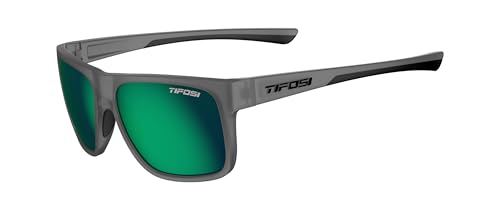
Tifosi Swick (polarized)
The Winner · The Sport Specialist's Answer
$59.95 polarized at Tifosi Optics
The call: the winner is the pair built by the house that makes nothing but sport eyewear, and it wins the way this page wants things won, on the published record: shatterproof polycarbonate lenses with 100% UVA and UVB protection printed on the maker’s own page, a plant-based Thrive frame at a published 26 grams, hydrophilic nose pads, an anti-bounce fit system, and a lifetime warranty against manufacturer defects. Sixty dollars, polarized, a third of the benchmark’s price, ten points clear of it.
Read the card the way the rows read it. The lens row of 23 is earned on specification: the material is named, the standard is printed as 100% UVA and UVB, the lenses are described as shatterproof and scratch-resistant, and polarization, which the benchmark sells as a $53 step up, is the form graded here at $59.95, with the standard-lens form standing on the same page from $25. Construction of 16 credits the named systems over adjectives: an integrated hinge designed never to pull hair, hydrophilic pads that grip harder as they get wet, and the maker’s Glide fit technology, an anti-bounce claim printed where a buyer can hold the house to it. Fit of 16 is the honest ceiling of a lifestyle-sport shape: the fit is published as medium to extra-large and the weight at 26 grams, but the coverage is a flat sport frame’s, not a wrap’s, and the Blenders below out-covers it.
The longevity row of 12 prices the warranty as published, limits included: lifetime against manufacturer defects for the original owner, wear and scratched lenses excluded, and replacement lenses and nose and ear pieces sold on the maker’s own store, which is the programme that turns a scratched lens from a new pair into a part. Prescription forms of the same frame stand on the maker’s site for the reader whose sport runs on corrected vision. Eight years at $7.49 a year is the cheapest honest year on this page, and it belongs to the winner, which is the whole economics of the category in one line: the specialist house charges least per year because it built the pair to be repaired and warranted, not replaced.
Blenders Pacer
The Wrap · Full Coverage at $79
$79 at Blenders Eyewear
The call: the coverage buy, and the runner’s answer in the field: a true wraparound single-lens frame, the maker’s premium PureBlend lens in polarized form as standard, 100% UVA and UVB protection printed on the product page, adjustable nose pads and temple tips, $79. If the sport is speed in bright open country, this is the shape the benchmark’s flat 6-base frame cannot answer, and the fit row of 18, the highest on this page, says so.
The lens row of 23 matches the winner’s on a different argument. PureBlend is the house’s own premium lens line, a maker’s claim and graded as one, but the checkable facts stand beside it on the page: polarized, 100% UV protection stated twice over, scratch resistance claimed in plain words, and a wraparound geometry that keeps light, dust and debris off the eye from the sides, which no flat frame at any price on this page does. The maker’s own fit guide prints the faces it suits, round, oval and heart, and the size as medium to large, with the frame measured at 140 millimetres: published fit evidence, graded as such. Construction of 15 credits the adjustable contact points, nose pads and temple tips that can be tuned rather than merely coated, against a hinge the maker does not specify, which this page grades as unspecified, as always.
Where second place is lost is the record behind the pair. The warranty standing on the maker’s store is a one-year limited term, the honest middle of this field, and no replacement-lens programme stands beside it, so a scratched PureBlend lens is a new pair at $79 rather than a part. Five years at $15.80 a year is still less than half the benchmark’s annual cost, and for the runner or rider whose first requirement is coverage, the trade is printed plainly: the widest shield of light in the field, on the field’s shortest paper. Buy it for the shape. Keep the case it ships with, because the lens is the pair.
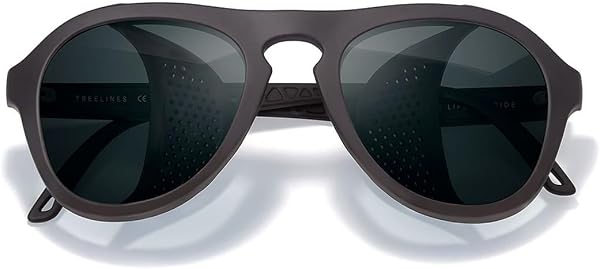
Sunski Treeline
The Alpine Frame · Coverage With a Lifetime Warranty
$98 at Sunski
The call: the maximum-coverage pair in the field and the second lifetime warranty on the page: a medium-large alpine frame with removable magnetic side shields, polarized polycarbonate lenses, 100% UVA, UVB and UV400 blocking printed by the maker, a published pass of the FDA basic impact test, and the house’s Forever Warranty behind it, at $98. It is the pair for snow, water glare and high places, and it finishes third because the benchmark question is a sport question, not only a mountain one.
Two Sunski numbers now stand on this site and they are printed together here so they can never be confused. The Sunski Dipsea stands at 67 on Verdict Card No. 20, graded on that page’s fashion basis, acetate and glass above it and its recycled resin frame graded as itself. The Treeline is a different pair, an alpine tool with shields, darker lens options and a coverage brief, scored fresh here on this page’s sport basis at 77. The ten-point gap is the difference between the two briefs and the two objects, stated in the open rather than blended into a house number, because this site does not keep house numbers. The lens row of 22 grades the Helio polarized polycarbonate and the fullest published UV line in the field, UVA, UVB and UV400 named together, with the impact-test pass printed as the maker’s claim, which is what it is.
Fit of 17 is coverage doing its work: the shields block the side glare that a flat frame admits, they remove magnetically when the light drops, perforations are the maker’s answer to fogging, and extra-dark lens options, up to glacier-dark tints, stand on the page for the reader whose sport is altitude. The deductions are printed too. The frame is the maker’s recycled SuperLight resin, graded as an injected-class material as it was on Card No. 20, and the alpine shape is a commitment off the mountain: nobody needs side shields at a café. Longevity of 13 is the Forever Warranty graded as published, lifetime cover on the frames with replacement lenses sold at a fraction of a new pair, the same programme that made its cheaper sibling the per-year bargain of its own page. Ten warranty-backed years at $9.80 a year.
Shady Rays Talon Elite
The Golf Shield · Carried by Its Replacement Programme
$124 at Shady Rays
The call: the specialist’s specialist, a semi-rimless golf shield whose lens is deliberately half-polarized so a golfer can still read a green, carried into fourth by the strongest aftercare document in the field: lost and broken replacements included, up to two pairs in the first 24 months for a processing fee, beside a limited lifetime craftsmanship warranty. At $124 it is the dearest alternative here, and its card makes the money argue.
The published record is unusually complete, and the rows pay for completeness. The frame is named as TR-90, the flexible nylon the serious end of this field builds with, in a matte black semi-rimless form with a rimless bottom for an unobstructed downward view. The lens specification is printed to a standard the benchmark does not reach on its own page: semi-polarized, 100% UV protection, anti-scratch and shatter-resistant, hydrophobic and oleophobic coatings, and the light transmission stated as a number, 16 percent VLT. Construction of 15 credits the adjustable rubber nose pads with sweat channels, the dual-injected rubber temple tips and a named hinge, double snap pin. Fit of 15 grades a medium-to-large wraparound tuned to one sport’s head movements rather than every sport’s, which is a real specialisation and a real limit, printed as both.
The deductions are the lens choice and the price. Semi-polarization is a golfer’s instrument and a generalist’s compromise: on water or a wet road it leaves glare in play by design, and the materials row of 21 prices the design honestly against five fully polarized rivals. Value of 9 is $124 against a $59.95 winner; what rescues the card from lower is longevity, the replacement programme graded as published, fee and two-pair cap included, which converts the likeliest golf-course losses, a pair off a cart, a pair under a shoe, from a repurchase into a claim. Six years at $20.67 a year. Buy it if your sport is golf and your history with sunglasses is a casualty list. Everyone else is paying for a programme the winner’s warranty nearly matches at half the money.
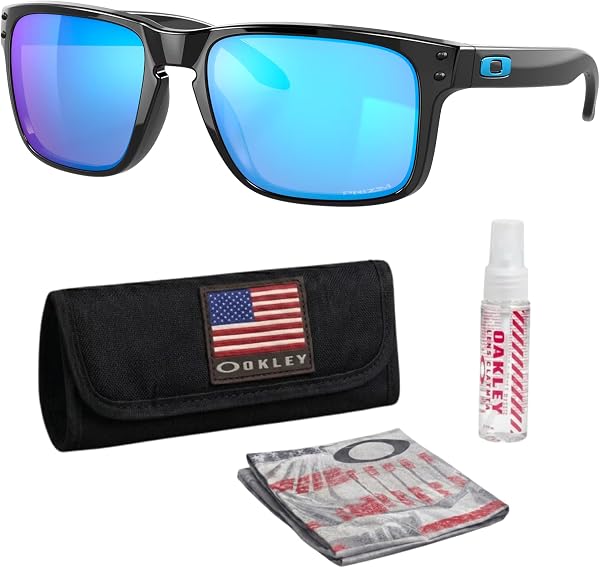
Oakley Holbrook
The Benchmark · The Deepest Lens Document, Seated Fifth
$184 at Oakley
The call: the benchmark, graded like everyone else, finishes fifth, and the shape of its card is the page in miniature: the highest lens score in the field, a mid-field everything else, and a value row of 6 that $184 for an injected nylon frame cannot argue with. The Holbrook is a good pair of sunglasses. It is simply not the pair its price describes, and four cheaper pairs on this page are the evidence.
Credit first, in full, because the lens document deserves it. Plutonite is the maker’s polycarbonate, and the claims printed for it are the deepest on this page: filtering of 100% of UVA, UVB and UVC and harmful blue light up to 400 nanometres, the protection intrinsic to the material rather than a coating that can wear away, an impact record the house publishes against ANSI Z87.1 testing, and Prizm tuning on top. Materials of 25 is the field’s top row and it is not close. The frame is O Matter, the house’s lightweight nylon, with metal rivets and icons, a three-point fit, and construction of 15 respects a frame that has survived a decade and a half of production without a reputation for falling apart. Replacement lenses are sold by the maker, which the longevity row credits at 11 beside a limited warranty whose published term is two years against defects, shorter paper than two cheaper rivals carry for life.
Now the deductions, and they are the alternative question itself. The Holbrook is a 6-base frame: nearly flat, lifestyle coverage, no wrap, no shield, no grip system beyond the fit geometry, in a single standard fit. As sport equipment it is out-covered by every pair ranked above it. Polarization, standard at five of seven ranked pairs here including the $30 pair in sixth, is a step up the ladder to $237, a $53 charge for the filter the field includes. And the value row is arithmetic, not attitude: the two pairs directly above it on this page offer a lifetime warranty or a replacement programme at $124 and $98; the pair directly below it offers a printed UV400 standard and polarization at $30. Eight years at $23 a year. Buy the Holbrook for its lens record and its shape, with your eyes open. Do not buy it believing the money bought sport coverage, because the ranking you are reading is the list of pairs it bought instead.
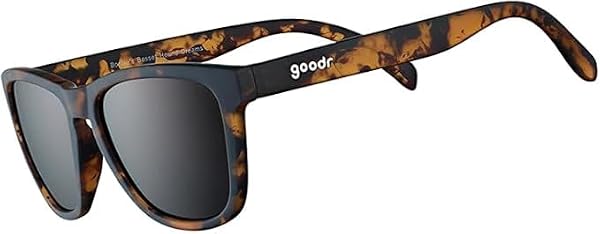
goodr OG
The $30 Cult Pair · One Point Behind the Benchmark
$30 at goodr
The call: the pair the running world actually buys, finishing one point behind a benchmark that costs six times its price: polarized lenses with UV400 protection and 100% UVA and UVB blocking printed on the maker’s own page, a grip-coated frame sold on a no-slip, no-bounce promise, and a one-year warranty that covers frame breaks in normal use. Thirty dollars. The value row of 15 is the only perfect row on this page, and it is not a courtesy.
The deductions are printed with the same care as the credit, because this pair’s record has a hole in it and the hole has a name: the maker’s product page never states the lens material. The frame is described as a premium polymer and the lenses by their properties, polarized, UV400, scratch-resistant in the maker’s words, but the material line that Tifosi, Sunski, Shady Rays and the benchmark all print is absent here, and the materials row of 19 grades the absence rather than assuming the obvious candidate. Construction of 13 credits the grip coating and the snug medium fit the whole running category copied, against an unspecified hinge and a single size: the OG is one medium frame, and a large head is directed to the maker’s bigger sibling lines rather than served by this one. Coverage is a flat lifestyle shape’s, which fit of 14 states plainly.
Longevity of 9 is the one-year warranty graded exactly as published: defects and frame breaks during normal use are covered, lens peeling and delamination are named in the covered column, which is franker than most, and one replacement is the limit of the promise. Cost the pair at three years, $10 a year, against the benchmark’s $23 a year over eight, and the comparison that ends every argument about this pair writes itself: the goodr’s standard is printed where the buyer can read it before paying, and the benchmark’s extra $154 buys the lens document, not a better year. For training miles, gloveboxes and the pair that lives in the gym bag, this is the correct purchase on this page. For a decade of service, the winner’s lifetime paper is two rows up.
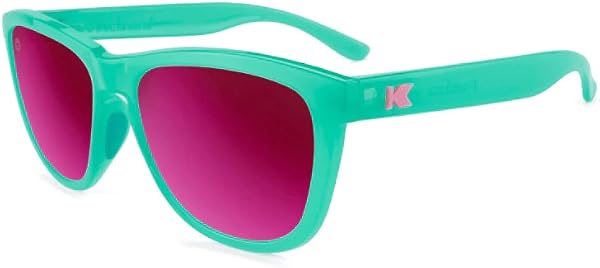
Knockaround Premiums Sport
The Honest Budget Pair · A Thinner Paper Trail
$38 at Knockaround
The call: the San Diego budget house’s sport form of its classic frame: polarized lenses, full UV400 protection, embedded rubber nose pads and a rubberized finish, at $38. It does nearly everything the goodr above it does, and it finishes four points behind it, because on this page the record is the product, and Knockaround publishes less of one.
What is published is real. The UV400 line is printed as full protection, the lenses are described by the maker as impact-resistant and FDA compliant, a claim with a regulator’s name in it that the page repeats as the maker’s wording, and the sport conversion of the base frame is genuine: rubber nose pads embedded in the frame rather than glued on as an afterthought, a rubberized finish for grip, and the frame measured and printed, 51 millimetres tall and 142 wide, recommended for medium faces. Value of 14 is $38 for a polarized, printed-standard pair, a figure only the goodr beats. Fit of 13 prices the shape honestly: this is a rounded lifestyle frame with sport contact points, coverage a step behind the goodr’s running-tuned fit and two steps behind the wraps above.
What is not published is the rest of the card. The lens material is not named on the maker’s product page, the second unnamed lens in the field, and the materials row of 18 sits one point below the goodr’s for the company it keeps. No hinge specification stands on the page. And where the goodr prints a one-year warranty with its covered and uncovered columns spelled out, no warranty term or replacement programme stands on the Knockaround product page read for this ranking, so longevity of 9 rests on the house’s general reputation rather than a document, and this desk grades documents. Three years at $12.67 a year. A good pair at a fair price, out-papered by the pair eight dollars cheaper: that is the whole of the case, and it is enough to finish seventh.
ALDO Tervetes
The Skip · A Shield With Nothing Behind It
Sent home · $20 at ALDO
The call: sent home. The Tervetes is a $20 shield from a fashion shoe house, sold in its maker’s own words as modern and cycling-inspired, and its product page, read entire for this ranking, is the emptiest document in the field: one material line, Smooth Synthetic, which names neither what the frame is made of nor what the lens is made of, and no UV standard, no polarization claim, no impact claim and no warranty term anywhere on the page. Every other pair here, down to the $30 pair in sixth, prints its protection where a buyer can hold the maker to it. This one prints a silhouette.
Be precise about the charge, because the page is. Nothing here says the Tervetes fails to block UV light; fashion sunglasses sold in the United States generally meet a baseline whether or not the copy mentions it. The charge is that the maker will not say so, in a category where saying so is the entire product. A shield shape is a coverage promise, the largest promise a frame can make, and the page behind this one supports it with a sustainability badge and the word bold. The fit row of 12 credits the coverage the shape genuinely gives, the only row on the card with anything to grade. Construction of 8 and materials of 7 grade a record consisting of the words Smooth Synthetic. Value of 5 is the coldest arithmetic on the page: $20 is the lowest ticket here and the worst buy, because the $30 pair above it purchases a printed standard, polarization and a named warranty, and the extra ten dollars is the entire price of a record.
The card’s link goes to the maker’s own page deliberately, so the reader can perform the same check this desk performed: read it entire, search it for a standard, and find the sustainability badge where the specification should be. Costed at a generous single year, the Tervetes runs $20 a year, more than the winner, the lifetime-warranted Sunski and the goodr, for a pair whose protection is an inference. The shield is not the scam; the silence is. When ALDO publishes a lens material and a UV standard for this frame, this desk will grade the new record gladly. Until then there is nothing here to grade but the shape, and 36 is what a shape alone earns.
The numbers, side by side
Maker’s figures, read on the makers’ own pages for this ranking, with claims labelled as claims: where a maker publishes a warranty, its published scope travels with it, and where a maker publishes nothing, the table prints that instead of a guess.
| Pair | Price | Lens, as published | Polarized | Warranty, as published |
|---|---|---|---|---|
| Tifosi Swick (polarized) | $59.95 (standard lens from $25) | Shatterproof polycarbonate; 100% UVA / UVB | Standard at this price | Lifetime vs defects; replacement lenses sold |
| Blenders Pacer | $79 | PureBlend, the maker’s premium lens; 100% UVA / UVB | Standard | One-year limited, as published on the maker’s store |
| Sunski Treeline | $98 | Helio polarized polycarbonate; 100% UVA / UVB / UV400; FDA basic impact test passed, maker’s claim | Standard | Lifetime (Forever Warranty); replacement lenses sold |
| Shady Rays Talon Elite | $124 | Semi-polarized Colorush GOLF; 100% UV; 16% VLT; shatter-resistant, coated | Semi, deliberate, for golf | Lost & broken replacements, max 2 in 24 months, fee applies; limited craftsmanship warranty |
| Oakley Holbrook (the benchmark) | $184 ($237 polarized) | Plutonite polycarbonate; 100% UVA / UVB / UVC and blue light to 400nm, maker’s claim; impact record vs ANSI Z87.1 | Paid step up | Two-year limited vs defects, as published; replacement lenses sold |
| goodr OG | $30 | Lens material not named on the maker’s page; UV400, 100% UVA / UVB | Standard | One year, defects and frame breaks in normal use |
| Knockaround Premiums Sport | $38 | Lens material not named on the maker’s page; full UV400; impact-resistant, FDA compliant in the maker’s wording | Standard | No term published on the product page read |
| ALDO Tervetes (the skip) | $20 | Not published: no lens material, no UV standard | Not published | Not published |
Read the warranty column as the field’s dividing line. Two houses warranty for life and sell the lenses separately, and they finish first and third. One house replaces lost and broken pairs for a fee and finishes fourth on the strength of it. The benchmark offers two years and its own replacement lenses, and the two budget pairs offer a year and silence respectively. And the skip offers nothing at all, in writing, which is the most honest thing about its page and the reason it is last.
Cost per year, in the open
The table divides each price by a stated working life for its record, printed beside the figure: lifetime-warranted pairs costed inside a decade rather than at the lifetime their makers promise, the benchmark at eight years, the mid-field at their warranty’s neighbourhood, the budget pairs at three, and the skip at a generous single year, its record publishing no basis for a longer one. The gas-station tier is included unranked, at the replacement cadence its failure rate imposes.
| Pair | Price used | Stated life | Cost per year |
|---|---|---|---|
| Tifosi Swick (polarized) | $59.95 | 8 years | $7.49 |
| Blenders Pacer | $79 | 5 years | $15.80 |
| Sunski Treeline | $98 | 10 years, warranty-backed | $9.80 |
| Shady Rays Talon Elite | $124 | 6 years | $20.67 |
| Oakley Holbrook (the benchmark) | $184 | 8 years | $23.00 |
| goodr OG | $30 | 3 years | $10.00 |
| Knockaround Premiums Sport | $38 | 3 years | $12.67 |
| ALDO Tervetes (the skip) | $20 | 1 year, generously | $20.00 |
| The gas-station tier (not ranked) | $12 | One season, two to three pairs a year | $24 to $36 |
The table’s shape is the category’s confession. The cheapest year belongs to the winner, because a lifetime warranty and a parts programme stretch a mid-priced pair across a decade. The dearest ranked year is the benchmark’s, at three times the winner’s figure. And the $20 skip, the lowest ticket on the page, costs more per year than the winner, the Sunski and the goodr, while publishing nothing at all: in sport eyewear, the record is the product, and the record is what the money is for.
Which one to buy
The best alternative, full stop: the Tifosi Swick polarized at 81 and $59.95. The deepest cheap record in the field, a lifetime warranty, and a third of the benchmark’s price. Buy the polarized form; the standard lens from $25 is the same frame with the filter removed, and the filter is the point.
The coverage buy: the Blenders Pacer at 78 and $79. The only true wraparound among the leaders, adjustable at the nose and temples. Runners and riders whose sport is open sky start here.
Snow, water and altitude: the Sunski Treeline at 77 and $98. Side shields, glacier-dark options and a lifetime warranty. Remember its sibling’s separate standing: the Dipsea is 67 on the fashion ranking, a different pair graded on a different brief.
Golf, with a casualty history: the Shady Rays Talon Elite at 72 and $124. The semi-polarized lens is a golfer’s instrument, and the lost and broken programme is the field’s best answer to a pair’s likeliest deaths.
The benchmark, with eyes open: the Oakley Holbrook at 71 and $184. The finest lens document here, bought for the record and the shape, not for coverage, and not polarized until $237.
The least money honestly spent: the goodr OG at 70 and $30. A printed standard, polarization and a frank one-year warranty. It finishes one point behind the benchmark and $154 ahead of it, and for training miles it is the correct answer.
The other budget door: the Knockaround Premiums Sport at 66 and $38, for the reader who prefers its shape and accepts its thinner paper. Fit itself is ruled by the Face-Shape Decoder, worn well by How to Wear Sunglasses, and the fashion side of the family, acetate, glass and the $58 pair that embarrasses fashion houses, is ranked entire at Verdict Card No. 20. The full method behind these scores is on the methodology page.
As an Amazon Associate, YoungCotton earns from qualifying purchases made through Amazon links on this site.
How we know: the honesty section
The scores are this desk’s own, computed on the basis printed above from maker-published materials, lens standards, dimensions and warranty terms, read on the makers’ own pages for this ranking in November 2026. Five disclosures specific to this page.
First, the benchmark’s capture. Oakley’s store would not render its product page to this desk’s reader, so the Holbrook’s figures stand on the maker’s published record as indexed from oakley.com itself: the $184 standard Prizm form and the $237 polarized form, the O Matter frame material and the Plutonite filtration claims, with the two-year warranty term standing on the published retail record and labelled as such wherever it is graded. If Oakley’s page opens to a future check and reads differently, the card will be corrected in the open, as this site corrects. Second, the rested house: Roka was checked and not seated, because this page’s first rule is price. Its current performance line on its own store starts at $190, above the benchmark, and runs to $280; the only cheaper doors are prior-generation models. A house that costs more than the benchmark is many things, but it is not an affordable alternative, and it is rested rather than graded down for a price it never hid.
Third, two configurations are graded as named, not as families. The Tifosi card grades the Swick’s polarized form at $59.95; the same frame stands on the maker’s page with a standard lens from $25, and both figures are printed on the card and in the table. The Sunski card grades the Treeline at its standard $98; one final-sale colourway stood at $69 on the maker’s page at check time, printed here rather than graded, because a clearance price is not a list price. Fourth, Amazon doors stand only where a standing Amazon US listing for the exact pair was verified for this ranking: the Tifosi, the Sunski, the benchmark, the goodr and the Knockaround carry them. The Blenders and the Shady Rays carry none, no verified listing for the exact pair standing at check time, and the skip carries none by definition. No Amazon price is printed anywhere on this page, and no star rating is reproduced.
Fifth, photography. The bank holds no sport sunglasses product photography and no frame in this field is pictured as itself: the hero is a coast scene in hard light, and the three card frames are a cyclist, a running shoe and a boot on wet rocks, each captioned as the scene it is and never as the product. The skip’s card runs without a frame at all, because the desk owns no honest picture of a shield it would not sell you. Where a maker’s own fit note and the Decoder agree, the card prints both; where a pair fights a face shape, the Decoder’s pages are linked from the briefs above and govern.
Questions, answered
What is the best affordable alternative to Oakley sunglasses?
The Tifosi Swick in its polarized form, 81 out of 100 at $59.95: shatterproof polycarbonate lenses with 100% UVA and UVB protection published on the maker’s own page, a plant-based Thrive frame at 26 grams, hydrophilic nose pads, an anti-bounce fit system, and a lifetime warranty against manufacturer defects with replacement lenses sold separately. It beats the benchmark seated on this page, the Oakley Holbrook at 71 and $184, by ten points at a third of the price. The Blenders Pacer follows at 78 for the reader who wants a true wraparound, and the Sunski Treeline takes third at 77 on coverage and a lifetime warranty.
Are cheap sport sunglasses actually protective?
The honest ones are, and the test is publication, not price. Every ranked pair on this page has a maker who prints the protection on its own product page: UV400 or 100% UVA and UVB, a named lens material, and in the benchmark’s case a published impact record. The pair sent home at the bottom of this page costs $20 and its maker’s page prints no UV standard and no lens material at all, only the words Smooth Synthetic. A $30 pair with the standard printed beats a $20 pair with nothing printed, every time, because the printed claim is the one a maker can be held to.
Is the Oakley Holbrook still worth buying?
At $184 it scores 71 on this page, fifth of seven ranked pairs, and the card prints both halves of that verdict. Its lens document is the deepest in the field: Plutonite polycarbonate filtering 100% of UVA, UVB and UVC and harmful blue light up to 400 nanometres, with the house’s impact testing referenced to ANSI Z87.1, all of it the maker’s published claims. What the price does not buy is coverage, sizes or value: the Holbrook is a 6-base lifestyle frame, not a wrap, polarization is a step up to $237, and four cheaper pairs outscore it. Buy it for the lens record and the shape. Do not buy it as sport equipment and expect the alternatives to feel like a downgrade.
Should sport sunglasses be polarized?
For glare off water, wet roads and snow, yes, and on this page polarization is standard at five of the seven ranked pairs, including the $30 pair in sixth. The benchmark is the exception that charges for it: the Holbrook’s polarized form lists at $237 against $184 standard. The one deliberate half-measure is the Shady Rays Talon Elite, whose semi-polarized golf lens keeps some reflected light in play so a golfer can read a green; its maker prints the choice and the 16 percent light transmission beside it, which is what an honest exception looks like. What polarization never does is add UV protection; that is a separate, published line on every card here.
How much should a pair of sport sunglasses cost per year?
The per-year table on this page divides each price by a stated working life, and the spread is the argument. The winner costs $7.49 a year over eight years, because a lifetime defect warranty and sold replacement lenses stretch a $59.95 pair. The lifetime-warranted Sunski costs $9.80 a year and the $30 goodr costs $10 a year over three. The benchmark costs $23 a year over eight. The sent-home $20 shield, costed at a generous single year, costs $20 a year for a record that publishes nothing: more per year than the winner at $7.49, the Sunski at $9.80 or the goodr at $10. The warranty and the printed standard are the price, in both directions.
Why was the ALDO Tervetes sent home?
Because its maker’s own product page, read entire for this ranking, publishes nothing a buyer can check. The Tervetes is sold as a cycling-inspired shield at $20. Its page prints one material line, Smooth Synthetic, which names neither the frame material nor the lens material, and it prints no UV standard, no polarization claim, no impact claim and no warranty term anywhere on the page. Every other pair on this page, including the $30 pair, prints its standard where a buyer can hold the maker to it. A shield shape is a promise of coverage; a page that will not state what the lens is or what it blocks has not made the promise this page can grade. It is scored 36 on the record as published, and the verdict box prints the capture basis.
Seven pairs, one benchmark seated in the open, and a winner that costs a third of it. The lens is the headline; the published standard is the product; read both.
Checked and updated November 2026