

The one frame in the bank with sunglasses actually on a face, already the hero of Verdict Card No. 20, and printed here for what it is: a fitted pair in street light, worn in its register. The bank holds no sunglasses product photography at all, and the care section prints that gap with the harvest list, rather than dressing a clear-lens portrait as this page's subject.
Checked and updated October 2026
The ruling, up front: sunglasses are a measurement before they are a style, and every other sentence on this page is a consequence of that one. A frame answers three things, in a fixed order. Its width answers the face’s width, the measurement our Face-Shape Decoder already takes and prints. Its lens answers the light, the glare off water and wet roads, the altitude of the sun, the hour, with full UV blocking as the floor under every answer and not a feature. And its shape answers the face’s geometry, countering the face’s lines and never echoing them, the Decoder’s lead rule carried here entire. A frame is therefore fitted like a shoe, not picked like a colour: measured, tried against the numbers, and only then judged in the mirror. The man who reverses the order, who picks the colour and the silhouette first and lets the fit be whatever the box contained, is wearing the category’s commonest failure, a good pair in the wrong size, and no photograph of it will ever look the way the advertisement did. This brief prints the numbers law first, the geometry second, the lens third, and the style, the shape register, the rooms and the looks after all three, because that is the order the object itself is decided in. On scores: the buying is ranked and finished elsewhere, at Verdict Card No. 20, whose rulings this page cites as law and does not re-derive.
This brief: the decisive rule · the numbers law · the face geometry · the lens record · the shape register · the rooms and hours · the looks · the ruling · the mistakes · care and our photography
The decisive rule: a measurement before a style
Every other article in this family begins with a garment that can be forgiven a size. A knit gives. A trouser is hemmed. Even the suit, the wardrobe’s strictest garment, is altered into its fit by a tailor after the purchase, which is why How to Wear No. 04 can print a fit order and send the reader to have it executed. Sunglasses allow none of it. The frame arrives finished, in the size it was moulded or soldered in, and the face it must fit is the one body part no tailor can adjust. Between those two fixed facts, the whole subject lives, and it is a subject of millimetres. Two millimetres of lens width is the difference between the size runs our ranking prints, the Wayfarer’s 50, 52 and 54. One millimetre of bridge is the difference between a pair that rests on the nose and a pair that rests on the cheeks. The category knows this, which is why every serious pair carries its dimensions printed on its own body, a courtesy no shirt or shoe extends, and then the trade proceeds to sell the object as a photograph, a silhouette, a famous face, as if the numbers on the arm were a stock code. This brief’s decisive rule reverses the trade’s order. Sunglasses are a measurement before they are a style: the frame’s width answers the face’s width, the lens answers the light, and the shape answers the face’s geometry, so a frame is fitted like a shoe, not picked like a colour.
The shoe comparison is exact, and it is worth printing why. A shoe is the wardrobe’s other finished object that meets an unalterable body part at a hard interface, and nobody buys shoes by colour first: the size is settled, the fit is tested against the foot’s behaviour over a day, and only inside the sizes that fit does taste get a vote. The sunglass purchase fails, in the wild, in precisely the ways a colour-first shoe purchase would. The pair bought for its silhouette slides down a nose it was never measured for, and is pushed back up forty times a day until the gesture becomes the wearer’s tic. The pair bought for its famous outline stands proud of a narrow face at both temples, reading as costume jewellery at conversational distance. The pair bought in a hurry at an airport, in the one size the kiosk stocks, pinches behind the ears by the second hour of the flight, and the headache is blamed on the travel. Every one of those failures is a measurement failure wearing a style’s clothes, and every one of them is preventable at the till, in ninety seconds, by the numbers law in the next section. The mirror is not dismissed by any of this. The mirror is promoted: it becomes the last court instead of the first, judging between the two or three pairs the numbers have already admitted, which is the only judging it was ever good at.
The scored record under the rule stands at Verdict Card No. 20, and this brief cites it as the family cites its Cards, as law for the pages that follow it. The Card graded seven pairs on frame and lens materials, construction and hinges, fit ruled by the Decoder, value, and longevity and repair, and its podium is the wearing system’s bench: the Moscot Lemtosh Sun at 85, Italian acetate, real glass, a seven-barrel hinge and four sizes, $370 at Moscot, the best-made pair and the deepest size run among the acetates; the Randolph Aviator at 84, soldered metal and mineral glass, a lifetime warranty on its solder joints, four sizes from 52 to 61 millimetres, $285 in its plain glass and $345 polarized; the Ray-Ban Original Wayfarer Classic at 80, $191, the pair the Card names as the one that works on the most faces, graded exactly as it is built today. Below them the honest cheap answers stand where the Card put them, the Warby Parker Aarons at 78 and $95, real acetate and a five-barrel hinge, and the Sunski Dipsea at 67 and $58, polarized with a lifetime warranty; the Persol 714 Folding at 72, impeccable materials carrying an $89 fold; and the Card’s skip, the Versace Medusa Biggie VE4361 at 35, a $384 list price on an injection-moulded nylon frame, which this brief’s mistakes section returns to, because the skip is what a colour-first purchase looks like with the receipt kept. No pair is scored here. The system below is printed so any frame, ranked or not, can be fitted, ruled and worn by it.
The numbers law: three figures on the arm, three measurements on the face
The law has two halves, and the first is printed on the object. Inside the temple arm of every serious pair stands a three-figure block: lens width, bridge width, temple length, in millimetres, in that order. The lens width is the lens measured across its widest point. The bridge is the gap between the lenses, the span the nose must carry. The temple is the arm’s length from its hinge to its tip, the figure that decides whether the ear holds the pair or the pair hangs from the nose alone. The block is the maker’s own fitting document, stamped at the factory, and the trade’s habit of treating it as a model code is the first thing this brief refuses: those numbers are the product’s measurements of itself, published on the product, and a buyer who cannot read them is shopping unarmed in the one category that arms him for free. Read them against the sizes the ranking prints and they stop being abstract at once. The Wayfarer’s three sizes are three lens widths, 50, 52 and 54, one silhouette in three fittings. The Aarons is a 47 millimetre lens on a 135 millimetre frame, and its card’s fit deduction, wide faces should measure before they order, is those two numbers stated as a warning. The Randolph’s four sizes run 52 to 61, the widest run in the field, because a military pattern is fitted to a population and not to a photograph. The Lemtosh’s four sizes begin at 46. The numbers are the range of human faces, printed in advance, and the buyer’s job is to find his own face’s place in them.
The second half of the law is the face’s own record, and the site already keeps it. The Face-Shape Decoder takes three measurements with a soft tape: face length, hairline to the bottom of the chin; forehead width, temple to temple at the widest point; jawline width, the widest point of the jaw. Sunglasses fitting adds nothing to that list, because the frame’s front is ruled by the same widths the Decoder already prints: the widest of the face’s measurements, forehead, cheekbones or jaw, whichever the shape is named for, is the width the frame must answer. Ruled, as this brief’s own extension of the Decoder’s oval line, and marked as such: the frame’s total front width lands at that widest measurement or a millimetre or two inside it, and never beyond it. The Decoder prints the rule for oval faces, avoid frames much wider than the face itself, and the Card repeats it as at the face’s own width; this brief generalizes the sentence to every shape, because the physics does not change with the geometry: a front standing proud of the face at both temples reads as a size up and behaves as one, sliding and sitting crooked, while a front well inside the width pinches at the temples and makes the head larger by contrast around it. Between the two failures stands a tolerance of about two millimetres, which is the whole fitting. The lens width and the bridge, the block’s first two figures, sum to most of the front’s width; the buyer adds his pair’s two figures, compares the sum with his widest measurement, and knows before the mirror whether the pair is his size or his costume.
Two more figures complete the law, one from each half of the record. Lens height is the oblong face’s figure: the Decoder’s guidance for the long face is taller, deeper lenses that break up the length, so on that shape the lens’s depth is a fitting measurement and not a style preference, and a shallow lens on a long face fails the numbers law however famous its outline. Temple length is the forgotten figure: too short, and the arm ends before the ear’s hold, the pair carried on the nose alone and sliding under its own weight, the failure the Card prints on the Lemtosh, whose glass is heavy and which will travel south over a long day on a low bridge, the maker selling a metal-nose-pad version for exactly that face; too long, and the arm’s tip presses past the ear and the pair rocks on its bridge. The fitting tests close the section, printed as this brief’s own bench practice and marked as such. Look down and shake the head once, gently: a fitted pair stays, a sliding pair has failed its width or its bridge, and no adjustment of the temples cures a wrong block. Smile fully: if the cheeks lift the frame, it sits too low or too wide. Wear the pair for ten minutes in the shop if the shop allows it: pressure behind the ear at minute ten is a too-narrow frame announcing itself, and temples do not break in like leather, because acetate and metal are not broken in by pain, they are bent by an optician or they are the wrong size. The numbers first, the tests second, the mirror last: the law in one line, and the whole of it executable before any money moves.
The face geometry: the pairings, carried entire
Width settles whether a pair fits. Geometry settles whether it flatters, and on geometry this site has already ruled, in a system older than this page and wider than eyewear: the Face-Shape Decoder rules the same seven shapes for haircuts, frames and collars, and Verdict Card No. 20 graded its whole field against the Decoder’s matrix. This section carries those pairings exactly, because a wearing brief that quietly re-derived its own geometry would contradict the haircut on the same head. The lead rule is the Decoder’s and the Card’s, in their words: frames counter your lines; they never echo them. A face is a set of lines, curved or angled, long or balanced, widest at one of three stations, and the frame’s work is to supply what the lines lack and to refuse what they already have in excess. The table prints the pairings as the Decoder’s matrix and the Card’s fit section state them, one row per shape, with the Card’s named citizens seated where the record seats them.
| The shape | The frame it takes | The frame it refuses | The record’s citizens |
|---|---|---|---|
| Oval: length near one and a half times width, nothing dominant | Most shapes, at the face’s own width; medium-width soft rectangles and gentle rounds keep the balance | Frames much wider than the face itself | The Lemtosh’s rounded square, whose maker’s own fit note names oval first; the balanced default has the widest menu, and its only law is width |
| Round: length close to width, lines curved | Angular rectangles, wider than they are tall, the frame supplying the straight lines the face does not draw | Round frames, which repeat the face’s lines back at it | The Wayfarer’s trapezoid, angular and wider than tall by design; the Aarons’ rounded profile is this shape’s named pass in the Card |
| Square: forehead and jaw close in width, angles at the jaw | Round and oval frames, the counterweight that takes the edge off the jaw | Sharp rectangles, which repeat the angle already there | The Lemtosh again, counters square on the Card’s own reading; the Dipsea’s round frame serves this shape by the same rule |
| Oblong: length at 1.6 times width or beyond | Taller, deeper lenses that break up the length | Small, narrow frames, which get lost and leave the length unchallenged | The Randolph’s teardrop, the deepest coverage in the ranked field, in sizes to 61mm |
| Heart: forehead the widest line, chin narrowing | Lighter, bottom-weighted or oval frames, keeping the balance low | Heavy browline frames, which stack more presence on the widest line | The Wayfarer passes here by staying light at the brow; the aviator is the shape’s caution, widest at the top, and the Card prints the warning on its card |
| Triangle: jaw the widest line, forehead the narrowest | Top-accented frames, browlines included, putting width where the face lacks it | Bottom-heavy and narrow frames, which leave the jaw unopposed | The browline form is this shape’s flatterer, the one shape the Decoder seats it on; the exception that proves the lead rule |
| Diamond: cheekbones widest, forehead and jaw narrower | Oval and softly curved frames, or light rimless styles, that do not compete with the cheekbones | Very narrow frames, which disappear inside the face’s widest line | The Lemtosh’s soft curves again, and the Aarons’ rounded profile, this shape’s second named home in the Card |
Two standing orders from the Decoder govern the table’s use, and both are carried with it. Between two shapes, style for the one your jaw votes for: most faces land between two rows, neighbouring rows share most of their answers, and the jawline is the tiebreak because it is the line a beard redraws and the line a frame’s lower rim answers. And measure with the beard you actually wear, the hub’s own instruction, because a fuller beard can move a face a step toward square or triangle, and a pairing chosen against a clean-shaven measurement is a pairing for a face that no longer reports for duty. One pair comes closest to ignoring the geometry, and the Card names it because a default is required: the Wayfarer’s trapezoid, angular and wider than tall with softened corners, serves round faces by the rule, oval faces by width, square faces by its curves at the lower rim, and heart faces by staying light at the brow. It is the pair to buy blind, and it is ranked third rather than first because the Card grades construction beside silhouette. Blind buying remains what it is, a default for a gift or an emergency, and this brief’s reader, who has a tape and two minutes, is not its audience.
The lens record: the light answered in order
The frame’s width answers the face and its shape answers the geometry. The lens answers the light, and it answers in a strict order, because the lens’s duties are not equal. The first duty is protection, and it is a floor, not a feature: 100% of UVA and UVB blocked, on every pair, at every price. The Card prints the sentence and this brief repeats it as law, because the category’s cheapest trick is to sell the floor as an upgrade, a UV claim on a sticker at the gas-station tier that nobody audits, while serious makers print the figure plainly, as Sunski prints 100% UVA, UVB and UV400 on a $58 pair. A pair that cannot state its UV figure in print has failed the lens record before its tint is discussed, whatever its frame is made of. The second duty is the material, and the Card’s order stands: glass is the clarity and scratch champion, which is why the three highest materials scores in the ranking are glass, Moscot’s and Persol’s real glass and Randolph’s mineral glass ground to camera-lens standards, at the costs of weight and shatter risk; CR-39 is the honest middle, lighter with clarity close behind glass, the Aarons’ lens; polycarbonate is the impact pick for sport and the optical last place of the three, its rows the playing field’s rather than the tailored wardrobe’s. The third duty is the tint, the colour and its light, and here the record is thinner, so this brief marks its own ground as it goes.
The colours, ruled by the light they answer. Grey is the neutral: it dims the world without recolouring it, the tint for hard midday light and for any wearer who wants the scene left as it is, and it is the record’s printed colour on the ranking’s skip, whose lenses are plastic, unspecified beyond grey, a reminder that a correct colour redeems nothing about a lens. Green is the record’s colour: the G-15 green glass the Wayfarer has carried since the Bausch & Lomb original, Moscot’s Calibar Green, Randolph’s AGX green, a slight warming of contrast inside a neutral read, and the tint with the longest service in the tailored register. Brown and amber are this brief’s own extension, marked as such: the contrast tints, which deepen the difference between road and verge, water and sky, and earn their rows in variable light, the overcast-bright day and the low sun, at the price of recolouring the scene more than grey or green do. A wearer buys one first pair in grey or green, the neutral answers, and adds brown when his light asks for it, which is the same order the wardrobe buys everything else in: the neutral first, the specialist second, the fashion tint, the mirrored and coloured lenses of the season, last and knowingly, as costume with a UV floor.
Polarisation is a function, not a premium word, and the Card’s ruling is carried entire. A polarizing filter cuts the reflected band off flat surfaces, water, a wet road, snow, that a plain tinted lens only dims, and where that band is the light’s main event the difference is not subtle. Everywhere else it buys nothing: it adds nothing to UV protection, which is the floor with or without it; it can dim phone and dashboard screens at the wrong angle; and the houses price it as if it were a material, standard at Sunski for $58, a configurator choice at Warby Parker, a paid step up at Moscot and at Ray-Ban, and at Randolph a $60 step, the polarized Aviator at $345 against the plain pair’s $285. Ruled as the Card rules it: buy it for the boat and the long drive, skip the upcharge for city shade, and never let a seller present the filter as the protection itself. The gradient licence, this brief’s own, closes the record. A gradient lens, dark at the top and lightening downward, is licensed where the wearer’s light is genuinely two lights: the drive, bright sky above and a shaded dashboard below; the page or the screen read outdoors. It is refused as the tailored pair and as the only pair, because its fade is a visible design gesture the dressed register does not make, and because the man caught by hard overhead light in his gradient pair owns a lens that answers a light he is not standing in. The gradient is a second pair’s licence, like brown, and the order of purchase is the order of the duties: protection, material, the neutral tint, then the specialists.
The shape register: four forms, ruled by register
Inside the sizes that fit and the geometry that flatters, the silhouette finally gets its vote, and it votes by register: each of the four standing forms carries a social range the way this family’s shoes and collars do, and the register, not the wearer’s enthusiasm, decides where the form may go. The trapezoid, the Wayfarer class, is the citizen. Angular, wider than tall, softened at the lower rim, it is the one form that stands beside tailoring outdoors without arguing with it, in black or tortoise acetate at the sizes the Decoder sends, and it covers more of the map than any other shape: the arrival, the drive, the terrace, the off-duty hour, in the Card’s grading at 80 for the original and with the Lemtosh’s rounded-square refinement of the same idea at 85 above it. Its register ceiling is the rooms section’s, not the shape’s: no form is licensed indoors or at the ceremony, and the trapezoid’s virtue is that it never asks to be. The aviator is the instrument. A teardrop of metal and glass built to a military specification, widest at the top with the deepest coverage in the field, its register is motion: the drive, the boat, the travel day, the open road’s whole geography, where its bayonet temples and its coverage are engineering and not attitude. With tailoring it stands in the travel and day rows only, and on heart faces it carries the Card’s printed warning entire, the widest-at-the-top shape on the shape whose forehead is already its widest line. The round frame is the soft note. The counterweight to the square jaw and the diamond’s companion, in acetate it is the creative register’s citizen, the form that lowers an unstructured outfit’s temperature by exactly the curve it adds, and its refusal is the Decoder’s: on a round face it echoes, and echoing is the one failure the lead rule names.
The browline, the club form, is the dressed vintage register, and the most conditional of the four. Top-accented by construction, a heavy brow over a light lower rim, it concentrates its presence on the forehead’s line, which is why the Decoder seats it on exactly one shape as a flatterer, the triangle, whose narrow forehead is the lack the form supplies, and refuses it on the heart face, whose forehead is the excess the form would stack. In register it stands nearest tailoring of the soft forms, a mid-century office ghost in acetate and metal, licensed in the creative and dressed rows on the faces the geometry admits, and refused as a default: it is the form most often bought as a period costume, and a costume is a colour-first purchase in period dress. Below the four forms, two shapes are refused a register entire, and their refusals are printed here so they cannot be negotiated as tastes. The sport wrap is refused with tailoring and outside its field entire in this brief’s rows: a curved shield engineered for peripheral coverage at speed, whose geometry fights every row of the Decoder’s table by wrapping past it, and which under a jacket reads as equipment that forgot to be put away. Its rows are the field’s and the water’s, in the kit made for them. The oversized fashion frame is refused as a form, not a size: a silhouette whose width is its statement spends the numbers law at the till, standing proud of every face it is sold to, and its ranked citizen is the Card’s skip, the Medusa Biggie at 35, whose medallion temples are the tell. A frame is fitted like a shoe. The oversized frame is a hat worn at eye level, and it is judged as one.
The rooms and hours: where no pair is licensed
The ceilings in this family are printed in rooms, and sunglasses, an article worn on the face itself, meet the strictest ceilings of any brief in the series, because the face is the one surface every room is owed. Indoors is refused entire. The pair comes off at the door, in the restaurant, the office, the gallery and the shop alike, not as etiquette decoration but on the pairing’s own logic: a lens is an answer to light, and a room’s light is not the sun’s, so the object indoors is no longer doing its job and is doing another one instead, interposing a surface between the wearer and everyone addressing him. The man who keeps his sunglasses on through a conversation is asking the room to talk to his eyewear, and rooms grade it as they grade the loafer carried into the uniform’s rows in No. 63, as a signal declined. The exceptions are not this brief’s to license and are printed as boundaries: a medical sensitivity to light is medicine, ruled by doctors and not by desks, and the passage through a bright lobby is a carry, the pair in the hand or in its case, on the way to the door it will be worn out of. The evening rule is the same law at the day’s other end: the pair comes off at dusk. A tint’s warrant is the light, and when the light goes the warrant expires; sunglasses worn after dark read, without exception available to the wearer, as costume or as concealment, and a wardrobe that trades in neither leaves them in the case from the first streetlight.
The formal ceiling is absolute, and it is inherited. Black tie refuses sunglasses entire, at every hour the light could plead: the evening’s uniform covers the face’s terms as it covers the shirt’s, and no register of frame, not the Lemtosh at its most sober, is licensed inside it. The ceremony’s terms are the host’s, on the principle No. 62 prints for the open collar and No. 65 for the square: a wedding’s outdoor hour licenses the drive and the arrival, and the pair is off for the ceremony itself and for the photographs, because a guest’s face in the record of the day is owed uncovered; the sombre room, the funeral and its family of occasions, refuses the dark lens on the same ground and the mirrored lens absolutely, in the mistakes below. The uniform’s rooms close the ceilings, as they close every brief that inherits them: where the suit is a uniform, in the court and the strict proceeding, the face is uncovered as the dress is complete, and No. 08’s sentence, carried through this family’s ceilings, stands in its eyewear form: if the room asks for your face, the sunglasses are not the loophole. What the ceilings leave is not a small map. It is the whole outdoors of the dressed and off-duty day, the street, the road, the water and the terrace, which is the territory the object was built for, and inside it the fitted pair at its register is not a compromise with formality. It is the day’s correct article, worn in the hours that license it and carried in the case, like every other ruled article in this family, through the ones that do not.
The looks: four assemblies the brief licenses
| Setting | The assembly | The pair and the fit | The judgment |
|---|---|---|---|
| The tailored arrival | Navy or grey suit, white Oxford, the dressed shoe of No. 63’s rows; the pair worn through the street and the arrival, then cased at the door | The trapezoid in black or tortoise acetate, the Wayfarer at 80 or the Lemtosh at 85, at the Decoder’s size for the face | The citizen form in its register: the one shape that stands beside tailoring outdoors without arguing, and the case in the breast pocket as the outfit’s finishing act |
| The long drive | Linen or unstructured jacket, open collar, the travel day’s whole register | The Randolph Aviator at 84, polarized at $345 bought as a function for the road’s glare; bayonet temples sitting where acetate arms loosen | The instrument in its element: coverage and the filter earning their price in the one room, a moving one, where both are duties |
| The creative middle | Unstructured jacket, knit or Oxford, soft trousers; the office’s licensed rows in daylight | The round acetate, the Lemtosh’s form on square and diamond faces, grey or green glass; the soft note the outfit is built around | The curve doing deliberate work: one soft article against the jacket’s ease, the geometry’s counterweight worn as the day’s style |
| Water and the off-duty day | Swim, boat and terrace dress; the pair that will actually be carried, dropped and sat near | The Sunski Dipsea at 67, $58, polarized standard, warranted for life; replacement lenses under $20 when the day wins | The honest cheap answer in its rows: the function complete, the price survivable, the pair present because it can be lost, which is why it gets worn |
The ruling
Fit sunglasses the way shoes are fitted, and the category’s failures mostly retire. Read the three-figure block on the arm before the mirror: lens, bridge, temple, against your face’s own three measurements, the front landing at your widest width or a breath inside it, the depth answering your length, the temple reaching the ear with the pair carried on nose and ears together. Take the geometry from the Decoder entire, frames countering your lines and never echoing them, the jaw voting between shapes, the beard you wear doing the measuring with you. Answer the light in its order: full UV blocking as the floor under every pair and never an upgrade, glass for clarity, CR-39 for the honest middle, grey or green as the first tint, polarisation bought as a function for water and the long road and refused as a premium word for city shade. Choose the form by register, the trapezoid as the citizen, the aviator as the instrument, the round frame as the soft note, the browline on the one shape it flatters, and refuse the wrap beside tailoring and the oversized frame anywhere. And keep the ceilings: off indoors, off at dusk, off at the ceremony and under black tie, carried in the case through every room that is owed a face. Ruled so, a pair of sunglasses stops being the photograph it was bought from and becomes what the numbers always said it was: an instrument, fitted to one face, answering one light at a time.
Where the wearing goes wrong
The oversized fashion frame on a narrow face. The numbers law’s capital failure, and the wild’s commonest sighting: a silhouette bought for its statement, standing proud of the face at both temples, sliding on its bridge, its wearer pushing it up by the front like a visor. It is charged first because it is two mistakes compounded, a width failure dressed as a style choice, and the fashion industry sells it on purpose, one size, photographed on the one face it fits. The Card’s skip is its ranked citizen, a $384 medallion frame whose width is its logo’s billboard. The fix is not a smaller statement. It is the block read before the till, and the statement made, if it must be made, inside the size that fits.
The sport wrap with tailoring. The register failure in its purest form: a curved shield built for peripheral coverage on a field, worn under a jacket because the sun was out at lunch. The wrap does not merely clash with tailoring’s register, it fails the geometry first, wrapping past the face’s width the table rules, a shape no row of the Decoder admits, and then fails the register second, reading as equipment that was never put away, the commute’s helmet left on at the desk in eyewear form. Its rows are the field’s, the water’s and the road’s at speed, in the kit built for them, and the tailored day’s answer to the same sun is the citizen form, fitted, in the case by the door.
The mirrored lens in a sombre room. The mirror is the one tint that answers the room instead of the light, returning to everyone present their own faces, and in a sombre room, the funeral, the memorial, the difficult appointment, it returns the room’s grief to itself at the exact moment the wearer owes the room his eyes. The dark lens there is already a borderline this brief’s ceilings settle against the wearer; the mirror removes the borderline. It has its rows, the water and the high glare it was coated for, and they are all outdoors and none of them are occasions. A man is read, in the rooms that matter most, by whether he can be met, and the mirror is the one lens that makes meeting impossible in both directions at once.
The gas-station subscription. The Card names the tier and this brief repeats the charge, because the pair at the fuel counter is the colour-first purchase stripped of even a colour’s excuse: twelve dollars for an unaudited UV sticker, lenses that scratch within weeks, an injected frame that warps in a hot car, a pin for a hinge. Costed honestly, at a season’s service and replaced two or three times a year, the tier runs $24 to $36 a year, more than the $58 Sunski’s $5.80 warranty-backed year and more than the $95 Warby Parker’s $19, for the worst optics in the category and protection taken on faith. The cheap pair is not cheap. It is a subscription, paid in pairs, and its real price is the one thing the floor exists to protect, the eyes it was bought for.
The colour bought first. The quiet failure under the loud ones: the tint chosen because it photographed well, amber for a grey city, a fashion mirror for a tailored life, a gradient as the only pair, each a lens answering a light its wearer does not stand in, bought before the block was read and the geometry consulted, so that even its size is a guess wearing a preference. The order of the lens record is the fix, and it costs nothing: the floor, the material, the neutral tint, the specialists after, inside a frame the numbers admitted. Taste is not demoted by any of this. Taste is what is left, legitimately, once measurement has done the work taste was never able to do, which is the whole argument of the brief the reader has just finished.
Care, honestly, and our photography
The care of a fitted pair is the care of its measurements, because everything that ruins sunglasses ruins the fit first. The case is the article’s home: a hard case, carried, in the breast pocket or the bag, and the pair goes into it at every door the rooms section prints, because a frame’s enemies are compression and abrasion, a pocket’s keys, a bag’s weight, a seat taken without looking. The cloth is microfibre, clean, and nothing else: the shirt tail and the napkin grind the day’s dust across the lens in circles, glass forgiving it longest and plastic not at all, and a lens is rinsed or blown clear before it is wiped, the cloth itself washed and retired when it stops being soft. The on-head habit is refused as craft, in this brief’s plainest sentence: sunglasses are not stored on the head. The pushed-up pair is stretched at the temples a fraction at a time, the width law undone by the wearer’s own hand over a summer, until the fitted frame fits the top of the head and slides on the nose it was measured for; hair’s oils take the lenses, the arms take the strain at their thinnest point, and the gesture reads, at every age the wardrobe covers, as a pair being worn nowhere. The collar hang is refused on the same evidence, a frame swinging from a placket, stretching, dropping, and sitting against buttons. Heat closes the rota: a parked car’s dashboard is the injected frame’s warp and no friend to acetate either, and the pair that lives in the car lives in its case in the glovebox, or it is the Sunski’s rows it belongs to, the warranted pair bought to survive exactly that life.
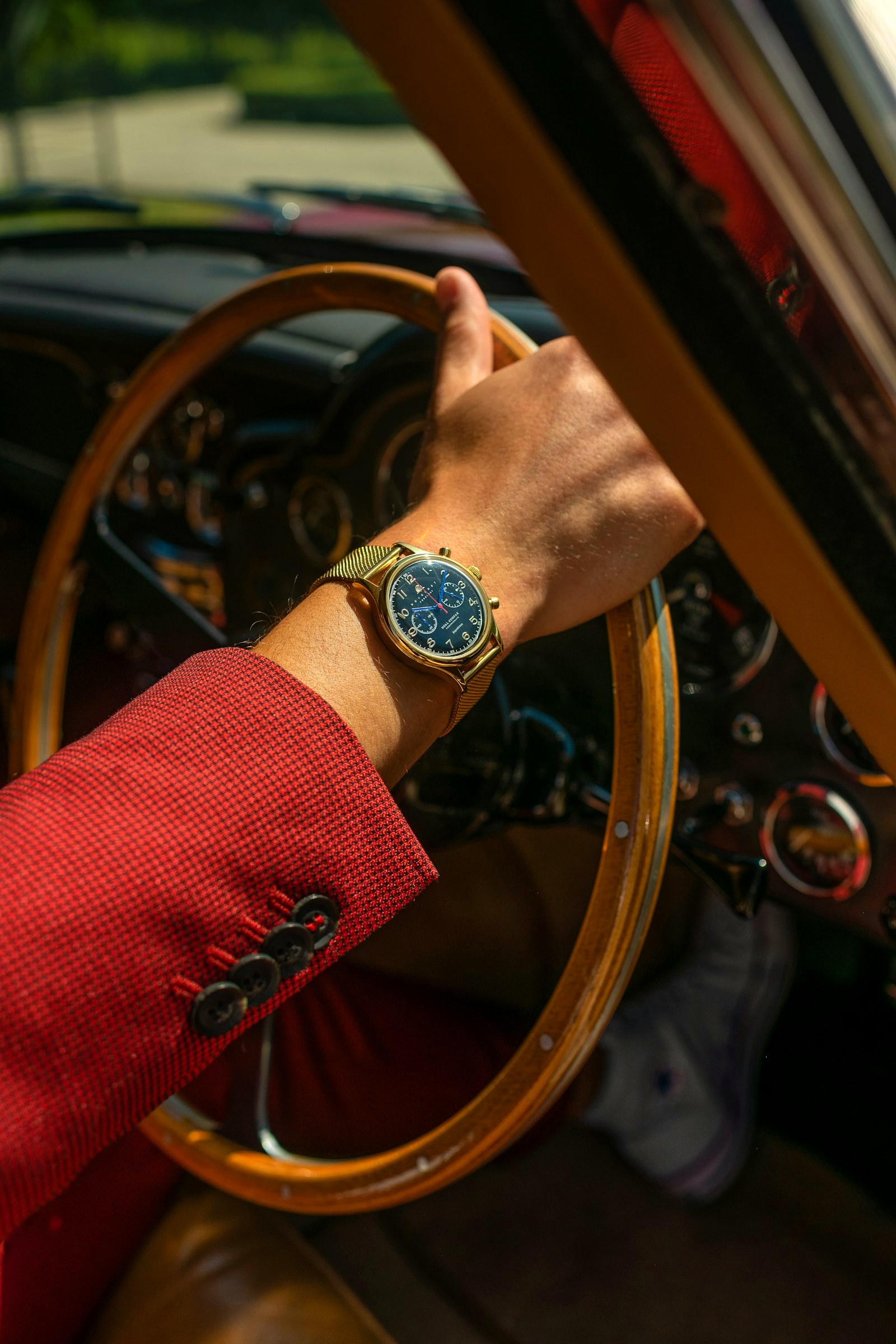
The photography, stated plainly, because this page’s subject is the bank’s thinnest after the loafer’s. The bank holds exactly one true sunglasses-on-face frame, the leather-jacket portrait that stands as this page’s hero: CREDITS-logged, already the hero of Verdict Card No. 20, the same frame the face-shape spokes reject for their pages, correctly, because sunglasses hide the face a face page exists to read. The figure in the shape register is the Card’s own Randolph frame, a wrist at a vintage wheel in driving light, captioned for what it shows. No sunglasses product photography exists in the bank: no ranked pair is photographed on this page or on the Card, whose own portraits are clear-lens optical frames used as shape stand-ins and captioned as stand-ins, a discipline this page inherits rather than relaxes. The extensions this brief prints beyond the standing record are marked where they stand and gathered here once: the total-width ruling generalized from the Decoder’s oval line, the fitting tests, the brown and amber tints, the gradient licence, and the shape register’s room assignments; everything else, every score, pairing and price, is the Card’s and the Decoder’s, cited as theirs. The harvest list this page is waiting for, carried from the Card’s own: first, a Wayfarer-class trapezoid worn in street light; second, an aviator on a driver, the instrument on a face in its register; third, a folding frame mid-fold; fourth, a round frame on water; fifth, sunglasses resting on a folded knit, the off-duty hour’s still life.
Questions, answered
How do sunglasses sizes work?
Every pair carries its size as a three-figure block printed inside the temple arm: lens width, bridge width, temple length, in millimetres, in that order. The lens width is the lens at its widest point, the bridge is the gap the nose carries, and the temple is the arm from hinge to tip. Read against the face's own three measurements, the ones our Face-Shape Decoder takes, the block stops being a code and becomes a fitting: the lens width and bridge together set the front's total width, the temple sets whether the arm reaches the ear with length to spare or falls short and pulls. A pair in the wrong block is the wrong pair at any price, which is why the numbers are read before the mirror is consulted.
How wide should sunglasses be for my face?
The frame's front should land at your face's widest measurement or a millimetre or two inside it, never beyond it. Your widest measurement is one of the three our Face-Shape Decoder takes: forehead, cheekbones or jaw, whichever your shape is named for. A front that stands proud of the face on both sides is not a bold frame, it is a frame a size up, and it will slide, sit crooked and read as costume. A front well inside the width reads pinched and makes the head larger by contrast. The ranked pairs print their evidence: the Warby Parker Aarons is a 47 millimetre lens on a 135 millimetre frame and its card limits it accordingly, while the Randolph Aviator runs four sizes from 52 to 61 millimetres because one width cannot fit every face.
Which sunglasses suit my face shape?
The Face-Shape Decoder's pairings, carried exactly: frames counter your lines and never echo them. Round faces take angular rectangles, wider than they are tall. Square faces take round and oval frames. Oblong faces take taller, deeper lenses that break up the length. Heart faces take lighter, bottom-weighted or oval frames and pass on heavy browlines. Triangle faces take top-accented frames, browlines included, the one shape a browline flatters. Diamond faces take oval and softly curved frames, or light rimless styles. Oval faces can wear most shapes at the face's own width. The hub takes two minutes and a tape if you have not measured, and the sunglasses ranking grades every pair against this same matrix.
Are polarized sunglasses worth it?
As a function, yes, where the function is wanted; as a premium word, no. Polarization cuts the reflected band off flat surfaces, water, a wet road, snow, that a plain tinted lens only dims, and the difference there is not subtle. It adds nothing to UV protection: every pair in our ranking blocks 100% of UVA and UVB rays with or without it, because full UV blocking is the floor, not a feature. It can dim phone and dashboard screens at the wrong angle. And the houses cannot agree on its price: it is standard on the $58 Sunski in our ranking, a configurator choice at Warby Parker, and a paid step up at Moscot, at Ray-Ban and at Randolph, where the polarized Aviator lists at $345 against the plain pair's $285. Buy it for the boat and the long drive. Skip the upcharge for city shade.
Can you wear sunglasses with a suit?
Outdoors, in the street and on the arrival, yes: the fitted acetate frame in black or tortoise is tailoring's licensed companion in daylight, the way the loafer is its licensed informality under the terms our loafer-with-a-suit brief prints. Indoors, no, in any register: the pair comes off at the door and is carried in its case, because a room is owed a face. At the ceremony and under black tie, no again, on the ceilings this family prints for its other removals: where the code asks for the dressed face, sunglasses are not the loophole. And the shape register matters as much as the fact: the sport wrap with tailoring is refused entire, a piece of field equipment arguing with a jacket, whatever the light outside is doing.
Can you wear sunglasses indoors or at night?
No, and the two refusals are one rule: a tint is an answer to light, and where the light has gone, the answer reads as something else. Indoors, a dark lens asks everyone in the room to talk to a surface instead of a face, and the wearer spends the conversation as the one person not fully present. At night and after dusk the same pair stops being eyewear and becomes costume or concealment, neither of which a grown wardrobe trades in. The narrow exceptions are not style questions and this brief does not rule them: a medical sensitivity to light is medicine, and the walk through a bright lobby is a carry, the pair in the hand or the case, not a wearing.
Glass or plastic lenses: which are better?
Glass is the clarity and scratch champion, which is why the three highest materials scores in our sunglasses ranking are glass: Moscot and Persol fit real glass, and Randolph grinds mineral glass to camera-lens standards. Its costs are weight, which a low nose bridge feels by the hour, and shatter risk. CR-39 plastic is the honest middle, lighter, with clarity close behind glass; it is what the Warby Parker Aarons wears. Polycarbonate is the impact pick for sport and the optical last place of the three. What none of them may skip is UV protection: 100% UVA and UVB blocking is the floor under every lens on this page, not a feature a maker may charge for.
What sunglasses should I buy first?
The pair our ranking names as the one that works on the most faces: the Ray-Ban Original Wayfarer Classic, 80 out of 100 at $191, acetate with the G-15 glass lens, in the size the Decoder sends you to. Its trapezoid is angular and wider than tall for round faces, softened at the lower rim for square, light at the brow for heart. The best pair outright is the Moscot Lemtosh Sun at 85 and $370, real glass, a seven-barrel hinge and four sizes. The water and glovebox answer is the Sunski Dipsea at 67 and $58, polarized and warranted for life. And the pair to refuse at any discount is the ranking's skip, the Versace Medusa Biggie at 35: a $384 list price on an injection-moulded nylon frame, the logo tax itemised.
Next
The family this brief completes stands around it: the Face-Shape Decoder hub, the parent record, whose three measurements, seven shapes and decision matrix this page takes as premises entire, and whose spokes go shape by shape, round, square, oblong, heart, triangle, diamond and oval; Verdict Card No. 20, the sunglasses ranking, the buying this brief refuses to re-derive, where the Lemtosh’s 85 and the skip’s 35 were earned; and the removal briefs whose ceilings this page inherits, No. 62, a suit without a tie, No. 63, loafers with a suit, No. 64, a tie and No. 65, a pocket square, the pairing and furnishing briefs of the dressed wardrobe, each ruling its article’s rooms as this one rules the face’s. The brief before this one stands at No. 65; the series began with the cardigan and the full run lives in the How to Wear index. How every score behind those pages is built stands on our methodology page.