

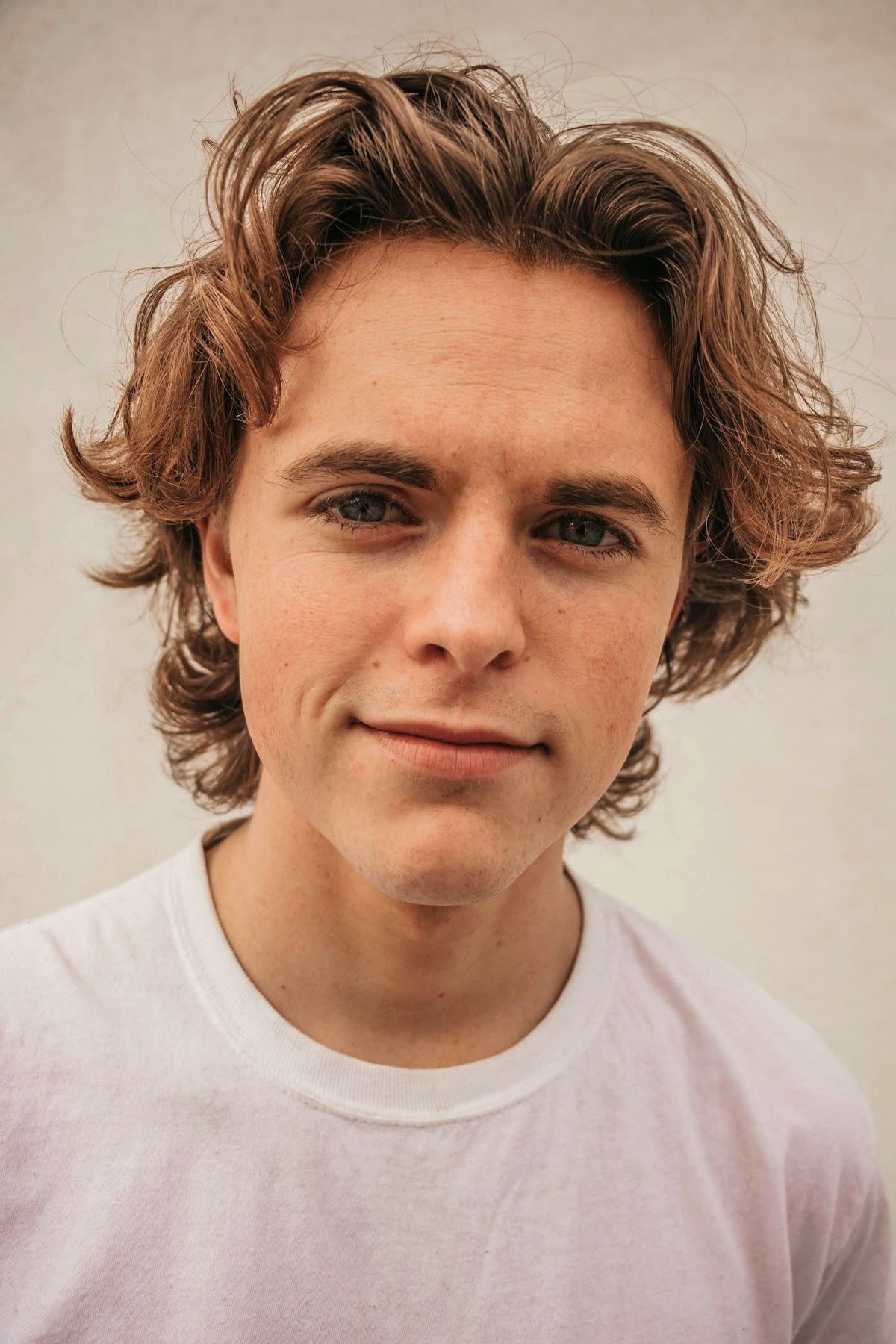
The oval brief in one frame: the length running ahead of the width, no feature in charge of the outline, and the hair kept in proportion, textured and moderate, so the balance the tape found is the balance the eye gets.
Checked and updated October 2026
The short answer: your length runs about one and a half times your width and no feature dominates, so this page has no correction to sell you. Its job is conservation: every good decision keeps the proportions the tape found, and every bad one spends them. Hair: the widest menu of any shape (textured crop, middle part, curtains, side part, longer styles), with one caution about height. Frames: most shapes, sized to your face. Beard: a free choice, kept even. Collars: all of them, spread and button-down alike. The decision table below is the whole system for your shape on one screen. If you have not measured yet, start with the Face-Shape Decoder hub: three measurements, two minutes, and this page is either confirmed as yours or ruled out honestly.
In this guide
Confirm it is oval
The full method lives on the Decoder hub; here is the short version, because this shape is decided by three readings taken together. Take the three hub measurements (face length, forehead width, jawline width) with your hair pushed back, note your widest feature among forehead, cheekbones and jaw, and then look at the jaw itself. Oval reads like this: the length runs to about one and a half times the widest width; the three widths sit in a similar range, so no single feature is widest by any margin worth styling against; and the jaw curves softly into a chin that is rounded, neither pointed nor squared off. Ratio, balance and curve together are the whole identification: a longer outline in proportion, with nothing in charge of it.
The confusions worth ruling out. Oval or round: the same curves at a different length, and the hub puts both among the two most common outcomes in fitting practice. On a round face the length and the width run close to equal; on yours the length pulls ahead to about one and a half times. Measure, divide, and let the ratio route you: near one is the round page and its height-building answers, near one and a half is this page and its wider menu. Oval or oblong: the other end of the same axis. An oblong reading starts at about 1.6 times the width or beyond; yours sits at about one and a half, with the same nothing-dominant balance. The distinction is worth the tape because the haircut answers differ on height, as the table below shows. Oval or diamond: the most common confusion in the whole system, as the diamond page states from its side. Compare the three widths. If the cheekbones stand clearly alone as the widest line, with the forehead and the jaw both stepping in from them, it is diamond, and that page's forehead help applies. If the three widths sit in a similar range and no feature dominates, it is oval, and it is this page.
Two things to judge honestly. First, fullness moves: the hub FAQ notes that a borderline round face can read oval after significant weight change, because the bone structure stays while the outline's fullness goes. Style for the face you have now, and re-measure after a major change rather than styling from an old photo. Second, judge the shape with the beard you actually wear: a fuller beard redraws the jawline, and the hub explains how it can move a reading one step toward square or triangle. The guidance on this page is proportion, not grading: an oval face is not a better face, it is a balanced one, and balance is a starting point with its own short list of ways to be spent.

Haircuts: the widest menu, one caution
Every other page in this series hands its shape a short list, because every other shape has a proportion to protect or a line to counter. Yours has neither, and the hub says so plainly: this is the widest menu of any shape. That freedom is real, and it has exactly one caution attached, which the hub names and this section will keep returning to: piling on height stretches an oval toward oblong. Everything else here is refinement, choosing among good answers by your hair type, your hairline and your morning, rather than by correction.
Textured crop: the default. Texture through the top at a moderate length does nothing dramatic in any direction, which on this shape is the highest compliment a haircut can earn: the proportions arrive at the mirror exactly as the tape left them. Middle part and curtains: the symmetry pair. A middle part splits the forehead evenly, and curtains frame both sides of the face in matching lengths. Symmetry costs a balanced face nothing, because there is no wide or narrow line for the part to expose, and the pair are the natural home of the longer, softer styles this shape carries well. Side part: the tidy version. One diagonal across the top, deliberate without arguing with anything underneath it; it is the menu's answer for offices and occasions, and it asks the least upkeep of the longer options. Longer styles: genuinely open. Worn down, length at the sides adds a little to the face's read of length, and at a ratio of one and a half the outline can afford it, because nothing concentrates at a single line while it happens.
With care: height on top, kept in proportion. A moderate quiff or honest volume sits inside this shape's menu; the oblong page says from its side that an oval can take height on top, and it can, in proportion. The hub's caution is about the pile, not the lift: height built past proportion lengthens the read toward the 1.6 line and spends the ratio that made the face oval. Slicked-back styles live here too. They show the entire outline at once, every line of it, and on this shape that is a legitimate choice because there is nothing the outline needs to hide; just know they are the most lengthening of the tidy styles, for the same reason. Fights your shape: height piled on until the read turns oblong; width planted at one line only, a heavy straight fringe with full sides that makes the forehead the widest line and manufactures a heart reading on a face that did not have one; and the cover-up combination, long hair and a full wide beard grown together until neither the forehead nor the jaw can be read at all, which is covered again at the mistakes.
Say this to your barber
"Keep it in proportion: texture through the top, nothing piled high and nothing widened at one level. My face is balanced, so the cut's job is to leave the balance where it found it." Three sentences, and the appointment becomes a conversation about taste, which is where this shape gets to have it.
The oval decision table
This table expands the oval row of the hub decision matrix into the full working version for this shape, compiled by our data team from standard barbering and eyewear fitting practice and re-checked on the same cadence as the hub. It is the one object to screenshot from this page: four decisions, each with the answer, the careful version, and the one that fights your shape. Read the fights column first; on this shape it is the short one, and it is nearly the whole page.
| Decision | Works | With care | Fights your shape |
|---|---|---|---|
| Haircut | Almost all: textured crop, middle part, curtains, side part; longer styles | Height on top kept in proportion; slicked-back styles that show the whole outline | Height piled on until the read turns oblong; width planted at one line only; long hair and a full beard grown together until the proportions cannot be read |
| Frames | Most shapes; medium soft rectangles; gentle rounds | Angular rectangles at medium width; stronger top lines (definition the face does not need, at an honest size) | Frames much wider than your face; extreme top- or bottom-weighted styles that plant a widest line where none exists |
| Beard | Short beard kept even; stubble; clean-shaven | A fuller beard kept even and in proportion (it walks the read a step toward square, a direction, not an error) | A beard grown wide at the jaw until the jaw is the widest line; a long pointed beard that spends length the ratio did not budget |
| Collar | All: spread, point, button-down | Band collar in summer (it removes the question); the very wide spread (open to this shape, and the loudest collar line there is, so a taste call) | No structural fights; the errors here are corrections, a collar bought to lengthen or widen a face that needs neither |
How the four rows connect: none of them is correcting anything. The hair keeps the proportions it was handed, the frames sit at the face's own width, the beard stays even, and the collar is chosen by the shirt and the occasion. The with-care column is where this shape lives: not a list of warnings, but the boundary between taste and excess, which is the only boundary an oval face has to mind.
Glasses: most shapes, your width
Frames are where this shape's freedom is widest and its one rule is simplest. The hub's answer is that most shapes work, and the two it names, medium-width soft rectangles and gentle rounds, work for the same reason: they keep the balance. A soft rectangle lends a little structure without inventing an angle worth arguing with, and a gentle round follows the outline's own curves at a modest size. Angular frames are a taste choice here rather than a correction; at a medium width they add definition the face does not need and do not fight anything while they do it. What decides the purchase on this shape is not the outline on the shelf. It is the width on your face.
The sizing law: let the frame run at about the width of your face, and stop there. The hub's one named caution for this shape is frames much wider than your face, and the reason is the whole page in miniature: an oversized frame plants a widest line at your temples, on the one face in this system that did not have a widest line. The trend-sized frame spends your defining asset to make its own point. Fights your shape: the much-wider-than-face frame, and the extremes of weight, a heavy browline that stacks presence at the forehead or a strongly bottom-weighted style that loads the jaw line, either of which manufactures a dominant feature where the tape found none. Sunglasses follow the same rule as glasses: the shapes you like, at your width.

Beards: the free decision
On most shapes in this series the beard has a job: lending an angle, adding length, keeping width off a line. On yours it has none, and that makes it the freest decision on the page. Short and kept even, stubble, clean-shaven, or a fuller beard kept in proportion all leave the balance intact, because none of them changes which line of the face is widest or spends length the ratio cannot spare. Choose by the face you want to present, the job you do and the upkeep you will actually keep, in that order or any other.
Know the one mechanic, because the hub states it for every shape: a fuller beard can move a face one step toward square or triangle. On a round face that step is a correction, and on an oblong it is a risk; on yours it is a direction. A substantial beard makes the jaw read stronger and the outline a degree more angular, and if that is the read you want, it is chosen on purpose, with the tape's blessing. Fights your shape: a beard grown wide at the jaw until the jaw becomes the widest line of the face, which manufactures the triangle reading wholesale rather than stepping toward it; a long pointed beard, which spends length the one-and-a-half ratio did not budget and pulls the read toward oblong from below; and growth left uneven, long at one line and thin at another, which is how a free decision turns into an accidental dominant feature. The maintenance rule follows: whatever you grow, keep it even. On this shape the beard's edges are where proportion is kept or lost.

Collars: everything is open
The collar column is the shortest answer in this system, and the hub gives it in one line: everything is open, spread and button-down alike. The spread collar that the round and diamond pages pass on, because it echoes a widest line those faces cannot afford to repeat, is available to you in its full width, because there is no widest line here for it to echo. The point collar and the button-down sit just as quietly. So the collar decision on this shape is not a shape decision at all: it is made by the shirt, the tie or its absence, and the occasion, and the collar column in practice is the Oxford shirt, scored in our Oxford ranking.
Two honest notes inside the freedom. First, open is not the same as obliged: the very wide spread is the loudest collar line there is, and wearing it is a taste call about the outfit, not a rule about your face. Second, the only collar errors available to this shape are corrections: the narrow point bought to lengthen a face that needs no lengthening, the stiff tall collar worn as armour against a problem the tape never found. A solution shopping for a problem will manufacture one, which is this page's whole argument in a single purchase. Keep the collar in scale with the face's length, match it to the shirt, and let the decision be ordinary.

The five mistakes oval faces make
1. The height pile. The most common one, because the tall quiff and the built-up pompadour are the default cuts of the moment. On this shape every extra centimetre on top is added to the longest measurement you own, and enough of it stretches a one-and-a-half read toward the oblong line, which is the hub's one named caution for oval hair. Height in proportion is on the menu; the pile is the mistake. 2. The oversized frame. Frames much wider than the face are the hub's one named caution for this shape's eyewear, and they fail by the page's central logic: they plant a widest line at the temples on the one face that did not have one. The same frame at your own width is a good frame. 3. Covering the balance. Long hair and a full wide beard grown together until neither the forehead nor the jaw can be read. Each is fine alone on this shape; grown together to their extremes, they put the proportions, which were the entire asset, under upholstery. 4. Correcting a problem you do not have. Importing another shape's rules as commandments: the round page's height, the oblong page's width at the sides, the square page's softening. Corrective styling applied to a balanced face manufactures the very imbalance it fears. Those pages are for the faces the tape assigns them to. 5. Assuming oval without measuring. Oval is the shape men guess, because it is the balanced default the other shapes are described against, and a guess is not a measurement. Diamond is the shape most often misread as oval, and a round face can read oval after a significant weight change, as the hub FAQ notes. Three tape measurements on the hub take two minutes and settle which page is actually yours.
The Oval Rule
Keep the proportions. Moderate everything, widen nothing, pile on nothing, and let taste make the decisions that correction makes on other pages. Oval is not the best face shape, and this page will not call it one: balanced is a description, not a ranking, and every shape in this system has its own logic and its own good answers. Yours is simply the shape whose styling law is conservation, because the outline arrived already in proportion, and the only way to lose with it is to spend that.
FAQ
What is an oval face shape?
A face whose length runs to about one and a half times its widest width, with no single feature dominating: the forehead, cheekbones and jaw sit in a similar range, the jaw curves softly, and the chin is rounded rather than pointed or squared. It is one of the two most common outcomes in fitting practice, and it is the balanced shape the other six in this system are described against.
Is my face oval or round?
Length separates them. On an oval the length runs to about one and a half times the width, with no single feature dominating. On a round face the length and the width run close to equal. Both are curved shapes with no hard angles, so the tape decides: measure the length, measure the widest width, and divide. Near one and a half is oval; near one is round, and the round page's height-building answers apply there instead.
Is my face oval or oblong?
Compare your face length with your widest width. Around one and a half times, with no dominant feature, is oval. At about 1.6 times or beyond, the reading is oblong. The haircut answers differ on height (an oval can take height on top in proportion, and an oblong should not pile it on), so the ratio is worth the two minutes with the tape.
What haircut is best for an oval face shape?
Almost any of them, which is the honest answer and the useless one, so here is the working version: a textured crop, a middle part, curtains, a side part and longer styles all sit well on this shape, because none of them has a proportion to fix. Choose by your hair and your morning, not by correction. The one caution is height: piled on past proportion, it stretches the read toward oblong.
What glasses suit an oval face shape?
Most shapes, sized to your face: medium-width soft rectangles and gentle rounds keep the balance the tape found, and angular frames are a taste choice rather than a correction. The one sizing law is width. Frames much wider than your face plant a widest line at your temples on the one face that did not have one, so keep the frame inside the face's own width.
Should an oval face shape grow a beard?
If you want one. The beard is a free decision on this shape: short and even, stubble, a fuller beard kept in proportion, or clean-shaven all leave the balance intact. Know the one mechanic: a fuller beard walks a reading one step toward square or triangle, so a big beard is a direction chosen on purpose, not an accident. What fights the shape is a beard grown wide at the jaw or long at the point, which manufactures a widest line or spends length the ratio did not budget.
Next
This page is Spoke No. 06 of the Face-Shape Decoder, and the Decoder hub is its front door: the full measurement method, the other six shapes, and the complete decision matrix live there, and the per-shape series continues from it shape by shape. Its sibling spokes solve the neighbouring problems: the round page, which shares your curves at a shorter length (near one is theirs; near one and a half is yours, and their hair builds the height your ratio already has), the oblong page, which owns the far end of the same axis (a length of about 1.6 times the width or more is theirs, and piling on height is how an oval borrows their problem), the diamond page, this shape's great confusion (their cheekbones stand clearly alone as the widest line; on yours the three widths sit in a similar range and nothing stands alone), the square page, where the same even widths arrive with angles doing the talking at the jaw and hairline, and the triangle page, where the jaw is the widest line of the face (on yours no line is widest, which is the whole definition). And the final spoke, the heart page, where one feature does dominate: the forehead is the widest line and the jaw narrows to a defined chin, so their work is balancing a strong line where yours is conserving an even one. Sizing is the other half of fit: our Shoe Size Conversion Chart is Decoder Utility No. 01 and ends the other guessing game. And for the collar column in practice, the shirts it applies to are scored in our Oxford shirt ranking, with the cloth behind them explained in what is an Oxford shirt?