

The subject itself, worn: a striped shirt and a dotted tie at the size the outfit is judged at, the bank's one frame in which a tie reads, carried here under the cross-page sharing our credits log records. No frame in the bank shows a knot being tied, a grenadine's weave, or a rail of ties, and the care section prints that absence rather than dressing another garment as this one's evidence.
Checked and updated October 2026
The ruling, up front: a tie is a measurement before it is an ornament, and it is graded at three stations before it is graded at all. Its width answers the lapel: 8 centimetres at the blade against a standard lapel, the ruling our tie ranking prints, with the skinny register under 7 centimetres starving the knot and the wide register at 9 and over licensed only by wide lapels. Its length answers the waistband: the front tip lands at the belt line, the blade behind it shorter, the standard tie 147 centimetres long and the corrections printed for the tall frame, the short frame and the knot that consumes length. And its knot answers the collar: the four-in-hand the default, the half-Windsor the licensed step up, the full Windsor reserved for the wide cutaway and refused in the button-down entire. A tie that fails any of the three measurements is wrong no matter how beautiful the silk, because the measurements are read first, at the throat, which is where this outfit, like its tieless counterweight on No. 62, is finally judged. On scores: no garment is scored here. The numbers quoted are the tree’s, Verdict Card No. 40’s above all, cited as what they are.
This brief: the decisive rule · the width law · the length law · the knot species · the collar table · cloth and season · colour and pattern · the rooms · the looks · the mistakes · care and our photography
The decisive rule: three measurements, read before the silk
This brief has a counterweight, and the two pages are one argument read from its two ends. How to Wear No. 62 rules the suit with the tie removed, and its law is a succession: the tie did three jobs, it drew the outfit’s one vertical line, it held the collar’s architecture under tension, and it banked a measurable quantity of formality at the throat, and the open collar works only where the shirt inherits all three. This page rules the outfit with the tie present, and its law is the succession’s mirror. The tie that does those three jobs is not any tie. It is a tie measured for them, because each of the jobs is performed at a dimension: the line is drawn by a blade of a width the eye can follow, the tension is applied by a knot of a size the collar can hold, and the formality is banked by a length that ends where the outfit’s architecture says it ends, at the waist. A tie of the wrong width draws its line in the wrong weight and the chest’s proportions go with it. A knot of the wrong size either starves in the collar’s V, leaving the tension unapplied and the points unmanaged, the precise failure No. 62’s collar law exists to prevent from the other side, or overfills it and bends the architecture it was hired to hold. And a tie of the wrong length banks its formality at the wrong station, above the belt like an afterthought or below it like an apology. The three failures are the three jobs undone, which is why this brief rules the measurements before it mentions a colour: the silk is the last thing read in a tie, and the first three things are numbers.
So the decisive rule is printed as the brief’s title states it. A tie is a measurement before it is an ornament: its width answers the lapel, its length answers the waistband, its knot answers the collar. Answers is the operative word, and it is literal in all three cases. The width is not chosen; it is replied, to a lapel that is already hanging on the jacket the tie will be worn with, and a wardrobe of one lapel width takes one tie width across the rail, which is why the tie rail of a man whose tailoring changes eras is a museum and the rail of a man whose tailoring holds its line is a system. The length is not chosen either; it is replied, to a torso, a trouser rise and a knot, three facts about the wearer and his habit that between them consume a fixed quantity of silk and leave a fixed remainder to hang, and the bespoke tie exists, at the head of this site’s own ranking, precisely because the remainder is a measurement and not a taste. And the knot is replied, to a collar whose spread was cut by a shirtmaker before the tie was bought, so that the man choosing a knot is not expressing himself but completing a dimension the shirt began. The reciprocal charge of the family’s pairing briefs applies entire: the stations are read together. A perfect knot on a tie three centimetres too short is a claim the belt line contradicts; a perfect length in a width from another decade is money spent below a failure at the lapel. The man who wears the tie well has understood that he has not chosen an accessory. He has finished three measurements the rest of the outfit left open, and the finishing shows.
The scored record under the law is the tree’s, and for this garment it is unusually direct, because the tie is one of the few articles in the tailored wardrobe this site has graded as an object. Verdict Card No. 40 ranked the tie shelf on the makers’ published records, and its doctrine is the one this brief’s cloth section is built on: weave over print, down the whole table, a tie graded on whether its pattern is in its cloth or on it. Its winner is the Sam Hober grenadine at 91, a bespoke tie cut to the wearer’s length, width and knot shape, in grenadine silk woven in Como over a pure wool interlining, a winner whose very form is this brief’s thesis in commercial dress: the highest-graded tie on the site is the one sold as three measurements before it is sold as a pattern. The Card’s width and length rulings are adopted here as law entire, 8 centimetres and 147 centimetres, printed in its own questions and repeated below in their sections, because a measurement settled on the evidence of a whole shelf is not re-derived by a wearing brief. Its sent-home case is printed for the cloth section’s use: a $79.99 seven-fold whose maker would not name its fabric, graded as a document and dismissed as one. The suits stand at Verdict Card No. 64, the Spier & MacKay Core Suit at 85, and the shirts at the Oxford Verdict ranking, the Kamakura at 93. Nothing here is scored; those numbers are the records of the garments the tie is measured against, and what they establish for this page is that every party to the throat, the suit, the shirt and the tie itself, has been bought and graded on its own evidence. What remains is the wearing of the measurements, which is this page’s jurisdiction entire.
The width law: 8 centimetres against the lapel
The width is measured at the blade’s widest point, and it is ruled against the lapel because the two are read together in a single glance down the jacket’s front: the lapel’s edge runs from the gorge to the button, and the tie hangs in the V the lapels frame, and the eye grades the blade’s width as a proportion of the frame it hangs in. The standard is 8 centimetres, about three and an eighth inches, matched to a standard lapel, the ruling Verdict Card No. 40 prints in its own questions and this brief adopts: a tie of 8 centimetres, the width Drake’s and Shibumi cut as their standards, against the lapel of ordinary width that the ordinary suit is cut with, the two dimensions in the same family and the front of the outfit in proportion. The working band around the standard is settled by the same proportion. A tie answers its lapel to within about a centimetre: a lapel at the narrower end of the current cut, seven and a half to eight centimetres at its widest, takes a tie of seven and a half to eight; a lapel at the fuller end takes eight to eight and a half. Build enters by the same door, a broad chest under a full lapel carrying the band’s top, a narrow frame under a slim lapel its bottom, and in both directions the reply is to the jacket in the wardrobe, not to the tie in the shop window, which is the section’s one practical sentence: a man buys ties against the lapels he owns.
The two registers outside the band are ruled as eras, because width is the fastest-dating measurement in the outfit and both of them are dates worn as widths. Under 7 centimetres is the skinny register, the width of the early sixties and the late two-thousands, and it is refused as a default under tailoring on a mechanical ground before a fashionable one: a narrow blade builds a narrow knot, and a narrow knot cannot fill a collar’s V, so the skinny tie starves the very station the tie exists to tension, and its wearer has paid for the tie’s line and declined its tension. In its own register, the narrow lapel, the slim cut, the casual rows, it is a period instrument and reads as one. Worn under a standard lapel it reads as an accident of two decades colliding at one throat. Nine centimetres and over is the wide register, the seventies’ inheritance, and its licence is printed as narrowly as the skinny’s refusal: wide lapels license it, the peak lapel and the double-breasted form, whose fronts carry more cloth and more architecture than the single-breasted notch, and a fuller frame under them. Against a standard notch lapel the wide tie overwhelms its frame, the blade reading as an apron where a line should be, and the outfit dates itself at the throat before the cloth is read. The law compresses to the Card’s arithmetic: the standard is 8, the skinny starves the knot, the wide belongs to the wide lapel, and a tie rail built on the standard outlives the eras because it was never built on one.
The length law: the tip’s station is the belt line
The length is judged at one point, the front blade’s tip, and its station is fixed: the tip lands at the belt line, touching the buckle’s top or covering it to its middle, the blade’s point arriving at the waistband the outfit is built around. The station is not a preference, and its reason is architectural. The tie is the chest’s vertical line, No. 62’s inventory, and a line is read by where it ends: ended at the belt, it ends at the outfit’s own horizontal, the waistband where jacket, shirt and trouser all meet, and the column from throat to waist reads complete. Ended short of it, the line stops in the shirt’s field, a stroke abandoned mid-chest, and the eye is left holding an unfinished column and a visible gap of shirt between silk and belt, which is the short tie, the mistakes section’s first entry and the wild’s commonest measurement failure. Run past it, the line overshoots the architecture and hangs over the trouser’s front, where it reads not as length but as carelessness with a longer budget. The tolerance at the station is a centimetre or two of the buckle’s face. It is not a hand’s breadth in either direction, and it is measured standing, in the shoes and trousers of the outfit, because sitting spends length the mirror does not report.
The blade behind is governed by the same knot, and its law is a comparison: the back blade is shorter than the front, two to five centimetres shorter as the working band, and it never outruns it. The narrow blade’s office is to be the front blade’s ballast and its keeper’s tenant, riding in the keeper loop or behind the label the maker sews for the purpose, invisible in the outfit’s reading. A back blade that hangs level with the front is a warning that the knot took up too little, and a back blade longer than the front is the failure entire, the tail outrunning the line it serves, read at every turn of the body as a second, thinner tie worn by mistake. The corrections are printed for the frames the standard does not fit, and they are corrections of the tie, never of the knot’s station, because a knot tied higher or lower to make a rail-length tie fit has moved the failure from the tip to the throat. The standard tie is 147 centimetres, 58 inches, Card No. 40’s figure, and it lands the tip at the belt on most frames. The tall frame, and the frame whose knot is a Windsor, which consumes length in its own building, five to eight centimetres more than a four-in-hand spends, takes the long tie, about 155 to 160 centimetres. The shorter frame takes the short tie, near 140. The high-rise trouser shortens the drop and is answered from the same table, a fact the rise’s revival has made a working one again. And the bespoke tie is the correction’s final form, the Sam Hober at the head of the ranking being cut to the wearer’s length outright, which is this section’s whole doctrine sold as a service: the length is a measurement, and the best-graded tie on the site is the one that treats it as one.
The knot species: sized to the collar, tied on purpose
The knot is the tie’s working part, the station where its width and length are both spent and its tension applied, and the species divide by size, because size is what the collar reads. The four-in-hand is the default, and its default status is earned on three grounds. It is of medium size, filling the V of most collars on most ties without argument. It carries a slight asymmetry, the knot leaning a degree off the vertical, which reads at the throat as ease rather than error, the one imperfection the dressed outfit licenses at its most formal station. And it spends the least length of the species, which keeps the standard 147-centimetre tie honest on the most frames. A man who ties one knot ties this one, and the rest of the section is the printed exceptions to a rule that covers the wide middle of the wardrobe entire. The half-Windsor is the licensed step up: a symmetric triangle, medium-large, built for the wider spread collar whose V the four-in-hand leaves with a gap at its sides, and for the finer, thinner tie, the light silk whose four-in-hand comes out starved, the half-Windsor’s extra wrap supplying the volume the cloth does not. Its symmetry is its register: it reads more deliberate than the default, which is its virtue at the dressed end and its stiffness at the casual one.
The full Windsor is the reserved form, and its reservation is printed with both its licence and its refusals. It builds the widest, most substantial knot of the species, a broad triangle that fills a wide collar entire, and it is licensed where that is what the collar asks: the wide cutaway, the spread cut back toward the horizontal, in a tie of light-to-medium silk that needs the knot’s volume to arrive at size. Its refusals are two and both are mechanical. It is refused with thick cloth, the grenadine, the wool and cashmere ties, the heavy twills, because their own bulk overbuilds the knot past any collar’s room, a Windsor in grenadine being two volumes multiplied into a fist. And it is refused in the narrow collars entire, the point and the button-down, whose Vs have no width to give it, the knot spreading their points outward in the failure the collar table names. A fourth species stands in the margin and is printed for completeness: the Pratt, the Shelby, tied inside-out to finish with a clean, medium, symmetric knot and a flat lie against the band, licensed wherever the half-Windsor is, and preferred by men whose ties twist, the inside-out start being its small engineering. The dimple is craft, not luck, and it is ruled here because it is the knot’s most misread detail. The pinch below the knot, the small fold of silk centred under it, is made at the tightening, the blade pinched between finger and thumb as the knot is drawn up to the collar, and whether it holds is a construction fact before it is a dexterity one: a tie with a real interlining and a fold that can take a crease holds its dimple all day, and a flimsy tie loses it by the door, which is one of the things Verdict Card No. 40’s weave-and-construction grading was measuring without naming it. The dimple is not required. A knot without one, well-sized and well-seated, is a finished knot. But a dimple that stands at evening is evidence the tie and the hand were both up to the station, and rooms that read knots read it.
The collar table: which collar licenses which knot
The knot answers the collar, and the answering is printed as a table because the pairings are finite and each has a ruling. The collar law itself is shared with No. 62 and is inherited, not re-derived: the collar is the garment at the throat, its band’s height and its points’ cut deciding what the station can hold, and the collar that No. 62 licenses open, standing and framing, is the same collar this brief licenses knotted, the two outfits grading the one architecture from opposite sides. A collar too soft to stand open is too soft to hold a knot’s tension either, and the collapsed button-down fails both briefs for the one reason.
| The collar | The knot | The width | The ruling |
|---|---|---|---|
| Spread, moderate | Four-in-hand, or half-Windsor for the wider spreads | The standard 8 centimetres | The dressed default entire: the V is cut for a knot of real size, the points frame it without crowding, and the pairing is the one every other row is a variation of |
| Cutaway, wide spread | Half-Windsor, or the full Windsor in light silk | Standard, never skinny | The widest V the wardrobe cuts, and the only collar that asks the Windsor’s volume; the skinny tie is refused outright here, its knot starving in a frame built for a larger one |
| Point | Four-in-hand; the half-Windsor at the most | Standard to narrower, seven and a half to eight | The narrow V’s pairing: the points run close and nearly parallel, the knot between them is small by architecture, and a Windsor’s spread has nowhere to go but against the points themselves |
| Button-down | Four-in-hand only, kept slim | Standard | The American register: buttoned points and a small, neat knot, the Oxford’s home pairing; the fat knot is refused entire, because a knot that pushes buttoned points outward has broken the collar’s one mechanism, and No. 62’s condition rides along, the points buttoned and crisp or the shirt is retired from both outfits |
| Band collar | None | None | Refused entire, from both briefs at once: no points, no V, no seat for a knot, a collar that has resigned the throat’s architecture before the tie is offered; the band collar’s rows are its own garments’, elsewhere in the wardrobe |
Two disciplines close the table, both inherited and both enforced harder here because the knot advertises them. The collar’s stays and band are the knot’s foundation: a spread collar worn with its stays out does not frame a knot, it leans on it, and the points curl by noon in the failure No. 62 names the wandering collar, which under a tie reads worse, because the knot holds the centre while the points escape, an architecture failing around a fixed point. And the knot is seated at the band’s top, drawn up until it covers the collar band’s button and sits in the V’s apex, with no gap of band showing above it and no shirt button visible below the points’ meeting: a knot worn low, a centimetre of band and button exposed above it, is the tied outfit’s equivalent of No. 62’s count drift, a measurement nobody chose, read by every room as the day winning. The test compresses to the mirror’s one glance: the knot fills its V, touches neither point with force, shows no band above it, and the dimple, if the tie can hold one, stands centred under it.
Cloth and season: weave over print, texture as a licence
The cloth is graded after the measurements, and its law is Verdict Card No. 40’s doctrine entire: weave over print. A tie’s pattern is either in its cloth, woven into the silk’s structure, where it holds its depth at every distance and every light, or on its cloth, printed onto a finished surface, where it reads flat at the distance outfits are actually judged at and cheaper at every distance. The Card graded the shelf on that axis and this brief wears the grading as a ruling: the woven tie is the dressed default, the printed tie the licensed economy, and the novelty print, the pattern that is neither woven structure nor honest print but a joke at the throat, is refused in the mistakes section by name. Silk is the cloth’s default fibre and its grades are the makers’ own printed ones, adopted here as the Card prints them: the twill’s diagonal rib, the satin’s smooth face for the evening rows, the repp’s woven stripe, and at the head of the family the grenadine, garza grossa and garza fina, an open gauze weave from Como whose texture is its entire pattern, the cloth the ranking’s winner is cut from at 91 and its runner-up at 83, the Shibumi Firenze garza fina, a three-fold hand-rolled tie at €145, printed here because two of the table’s top three seats are one weave is a finding about the weave, not about the houses.
The grenadine is the texture licence, and the knit tie is its casual form. Texture is the third instrument at the throat, after colour and pattern, and it is the one that spends neither: a solid grenadine does a pattern’s work, giving the eye a surface with events in it, while remaining, for the budget section that follows, a plain tie, which is why it is the system’s escape and the ranking’s winner in one cloth. The knit tie carries the same licence at a lower register: a knitted silk with a squared end, its texture coarser and its reading deliberately stepped down one notch from the woven tie’s, licensed in the travel rows and the creative and summer rows under tailoring, and licensed over denim as the one tie No. 61 admits there, in both cases as a decision. Season rules the rest of the rail. Wool and cashmere ties are the cold months’, their matte, dry surfaces answering flannel and tweed in the division of labour the turtleneck brief prints for its own pairing, the tailoring’s texture answered by the tie’s, and a wool tie’s knot is built one species down, the cloth’s bulk being part of its volume, the four-in-hand doing in wool what the half-Windsor does in silk. Linen and cotton ties are the summer’s, worn with the linen and fresco suits of No. 04’s summer row, their creases and slubs being the season’s texture exactly as the suit’s are. And the fold construction closes the section, because it is the cloth’s hidden half: the three-fold is the standard build, the seven-fold the luxury one, a blade cut from a single square of silk folded on itself, and Card No. 40’s sent-home case stands as the construction’s caution, a $79.99 seven-fold whose maker would not name its fabric, graded down as a document: the fold count is a claim like any other, and a maker who prints the folds and not the fibre has told the buyer the tie’s arithmetic and withheld its material.
Colour and pattern: the budget and the scale rule
Colour is graded last of the tie’s own properties, and its ground rule is a comparison: the tie is darker than the shirt. The throat’s order is a light field, the shirt, carrying a darker line, the tie, and the inversion, a tie lighter than its shirt, advances the line until it reads as an interruption rather than an order, the one arrangement the dressed rows refuse. On that ground the standing combinations are the wardrobe’s ordinary citizens and need no invention: the navy tie on the white and pale blue shirts, the dressed default; the burgundy tie as the dark suits’ warm note, the same third colour the loafer brief licenses at the floor, admitted at the throat on the same terms, deep enough to read as a decision; the dark green and the charcoal tie at the register’s quiet end; and the silver-grey tie reserved to the evening and ceremony rows, where its paleness is licensed by the hour rather than refused by the rule, a light tie being an evening instrument the way a dark one is a day’s. The tie’s colour answers the suit second and the shirt first, because it hangs on the shirt’s field and inside the jacket’s frame, and a tie chosen against the suit alone, the blue tie specced to the navy suit without reference to the shirt between them, is the colour failure the mistakes section does not list only because the budget failure crowds it out.
Pattern is governed by the family’s standing prose, carried here entire because the tie is where the prose is spent. The budget: one pattern at a time among shirt, suit and tie, two as the licensed maximum, the third station held plain. A checked suit over a striped shirt over a dotted tie is not three decisions but one argument, and the outfit’s register collapses under it no matter how fine each piece is alone, because pattern is the loudest property at every station it occupies and the eye sums loudness without discounting for quality. The scale rule governs the licensed two: their scales must differ. A fine shirt stripe takes a broad tie pattern or a plain tie; a wide suit check takes a small neat tie pattern or a plain tie; and two patterns of the same scale, the pinstripe suit under the pin-dot’s cousin at the same spacing, merge at reading distance into a vibration neither garment printed, the failure named here so it can be recognised in the mirror, where it presents as a faint sense that the outfit is buzzing. The grenadine and the knit stand outside the arithmetic as the cloth section prints them, texture being the budget’s licensed exemption: a solid grenadine over a striped shirt in a checked suit spends nothing and settles everything, which is the practical reason the woven solid is the rail’s working tie and the ranking’s winner. The rule for the man who owns one sentence of this section is the budget’s: when in doubt, plain tie, and let the woven cloth be its pattern.
The rooms: required, licensed, and refused by register
The rooms are printed in three classes, in the family’s standing form, and for this garment the classes run in the opposite direction to its counterweight’s: No. 62’s barred rooms are this brief’s home ground. The required rooms are the uniform’s and the ceremony’s. The strict boardroom, the court, the proceeding where the tie is still the uniform of the business: there the tie is not an ornament under discussion but a signal of subordination to the room’s purpose, No. 60’s and No. 62’s ceiling read from the wearing side, and the ruling is No. 08’s sentence inverted without alteration: if the room requires a tie, the tie is worn, and worn to this brief’s full standard, because a required garment worn badly is a declined signal with extra steps. The ceremony’s rows stand beside them on the courtesy’s terms: where a host’s code asks for the tie, the guest’s agreement is the dress as written, and the wedding’s formal rows take the tie as their grammar entire. In the required rooms the measurements are at their strictest, the standard width, the tip at the belt, the knot at the collar’s size, because the room is grading compliance and compliance is read in exactly those numbers.
The licensed rooms are the wide middle entire, the office rows, the dinners, the evening events, the client floors and the formal lunches, where the tie is the default finish of the suited outfit and this brief’s laws are simply the outfit’s ordinary discipline kept well. In those rooms the tied suit at its best is what No. 62 prints of its own outfit in the same rows: frequently the best-judged outfit present, because every term of it is a decision the room can read. The refused rooms are refusals of register, not of rule, and they are printed so the tie is not carried one room too far in the other direction. The denim rows refuse it as a default, on No. 61’s ruling: the tie over jeans argues the outfit upward against its own cloth, the knit tie alone licensed there as texture. The roll neck’s rows refuse it by substitution, No. 60’s pairing having struck the shirt and tie together, and a tie cannot be added to an outfit whose collar has no seat for it. And the deep casual rows, the camp collar’s and the tee’s, refuse it as the band collar refuses it, for want of the architecture the garment is measured against: the tie is tailoring’s instrument, and outside tailoring’s rooms it is not informal or formal. It is unhoused.
The looks: four assemblies the brief licenses
| Setting | The assembly | The tie and the knot | The judgment |
|---|---|---|---|
| The required form | Charcoal or navy boardroom worsted; white poplin shirt, moderate spread; black Oxfords | Navy grenadine at 8 centimetres; four-in-hand or half-Windsor by the collar’s spread; tip at the buckle, back blade shorter in the keeper | The uniform kept entire: No. 62’s barred room from the wearing side, the ranking’s winning cloth doing the uniform’s work at its plainest |
| The office standard | Navy or mid-grey suit, unstructured or fresco; pale blue Oxford, button-down points buttoned and crisp | Burgundy woven twill; four-in-hand only, kept slim under the buttoned points; standard width and length | The American register at its best: the collar table’s conditional row with its condition met, the outfit the wide middle runs on |
| The summer form | Linen or fresco suit in stone or light grey; white linen or Oxford shirt; suede loafers per No. 63 | Knit tie in navy or brown, or a linen tie in a deep solid; four-in-hand; the length law unchanged by the season | The texture licence in its rows: the tie stepped down one deliberate notch with the cloth, a decision the room reads as the season’s |
| The evening form | Dark navy or midnight suit, the darkest short of black tie; the whitest poplin shirt, cutaway collar, stays in; black Oxfords polished | Dark grenadine grossa or a silver-grey woven silk; half or full Windsor by the cutaway’s width, in light silk only; dimple standing | The reserved knot in its one room: the collar table’s widest V filled by the species reserved for it, the repayment No. 62 spends elsewhere paid here in the garment itself |
The ruling
Wear the tie as three measurements and then as an ornament. The width answers the lapel: 8 centimetres against the standard lapel, the skinny register refused for starving the knot, the wide register licensed only by wide lapels. The length answers the waistband: the front tip at the belt line, the blade behind it two to five centimetres shorter and kept, the standard 147 centimetres corrected for the tall frame, the short frame and the knot’s own consumption, never by tying the knot at the wrong station. The knot answers the collar: the four-in-hand the default, the half-Windsor the licensed step up, the full Windsor reserved for the wide cutaway in light silk and refused in the button-down and with thick cloth entire, the dimple made at the tightening and held by the tie’s construction or not at all. Cloth by weave over print, grenadine and knit as the texture licences, wool and linen by their seasons; colour darker than the shirt; pattern under the budget and the scale rule. Keep the tie in its rooms, required in the uniform’s and the ceremony’s, licensed across the wide middle, and out of the rows that refuse it by register. Ruled so, the tie is not the suit’s decoration. It is the suit’s three open measurements, finished, and it shows.
Where the tie goes wrong
The short tie. The capital failure, and the length law’s reason for existing: the tip ending in the shirt’s field, two, five, ten centimetres above the waistband, the chest’s vertical line abandoned mid-column and a gap of shirt standing where the outfit’s architecture should close. It is charged first because it is the commonest and the most diagnostic: it announces that the tie was bought by its pattern and never measured against a torso, the one fact about the wearer the garment most needed to know. The fix is a longer tie or a smaller knot’s arithmetic, from the length table, and it costs less than the tie did.
The fat knot in a button-down. The collar table’s refusal worn in the wild: a Windsor, or a four-in-hand built from a thick tie and a heavy hand, stuffed between buttoned points until the points bow outward and the collar’s one mechanism, the buttoned point lying flat, is broken by its tenant. It fails twice at once, the knot oversized for its V and the collar destroyed in the housing of it, and it is the mistake of a man who chose his knot by its name’s prestige rather than by the collar’s dimensions, which is the decisive rule’s whole charge in one throat.
The novelty print. The pattern that is a joke: the cartoon, the logo field, the seasonal gag, worn at the one station where the outfit keeps its seriousness in reserve. It is refused on the cloth law’s ground rather than on taste’s, because its failure is documentary before it is aesthetic: its pattern is neither woven structure nor honest print but an announcement, and an announcement at the throat converts the tie from the outfit’s line into its caption, the wearer labelled by his own hand at the exact point No. 62 calls the outfit’s most-judged junction. A man is entitled to his humour in every other article he owns. The tie’s four inches are where the room reads his intentions, and the intentions are the outfit’s.
The starved knot and the gap. The skinny tie, or any narrow blade, tied in a spread or cutaway collar and leaving a visible gap at each side of the knot, the collar’s V unfilled and its tension unapplied, the points standing unmanaged around a knot too small to manage them. It is the width law’s failure read at the knot’s station, and its mirror stands beside it in the same paragraph because they share one cause, the knot and the collar never measured against each other: the knot worn low, a centimetre of band and the collar’s button showing above it, the tie’s tenant slipped down its own V. Both are cured at the mirror in ten seconds and diagnosed in one glance, which is the definition of a measurement failure rather than a style position.
The blade behind outrunning the blade in front. The back blade hanging level with the front or below it, the narrow end swinging free of the keeper at every turn. Small, and read constantly, because it moves: the eye catches the second, thinner tie the outfit appears to be wearing behind the first, and the length law’s whole settlement, tip at the belt, reads as an accident that happened to land well. It is the signature of a tie tied by its front alone, its length never audited as a pair, and it belongs in this list because the length law is a law about two blades, not one.
Care, honestly, and our photography
The tie’s care is the care of a folded silk object whose shape is its whole construction, and it begins the moment it comes off. Untie it, every night, by reversing the knot’s own steps. The two forbidden economies are leaving the knot tied, which sets the crease into the interlining until the knot’s station is a permanent wrinkle, and pulling the blade through the knot to undo it, which drags the silk’s face against its own fold and wears the exact four inches the outfit displays. A tie untied properly and hung or rolled recovers overnight from the knot’s compression, the wool interlining doing the recovering, which is the interlining’s second job after holding the dimple. Rest it as shoes are rested: two to three days between wearings, because the fold that gives the blade its roll and the knot its body is a structure under load while the tie is worn, and a tie worn daily flattens into a ribbon by the season’s end, its knot shrinking as its body goes, until the width law is being applied to a tie that no longer has the width it was bought at. Storage is by the same logic: rolled from the narrow end, loosely, in a drawer, or hung on a rail that lets the blade hang straight, never folded in quarters and never left knotted on a hook, the two storages that print their creases at the knot’s station and the blade’s middle respectively. The blade is never ironed flat: heat and pressure kill the rolled edge the maker sewed, and a crease is steamed out at a distance or hung in a steamed room, and spots on silk are blotted and taken to a cleaner who is told it is a tie, the construction being easier to ruin in a press than in a decade of wearing.
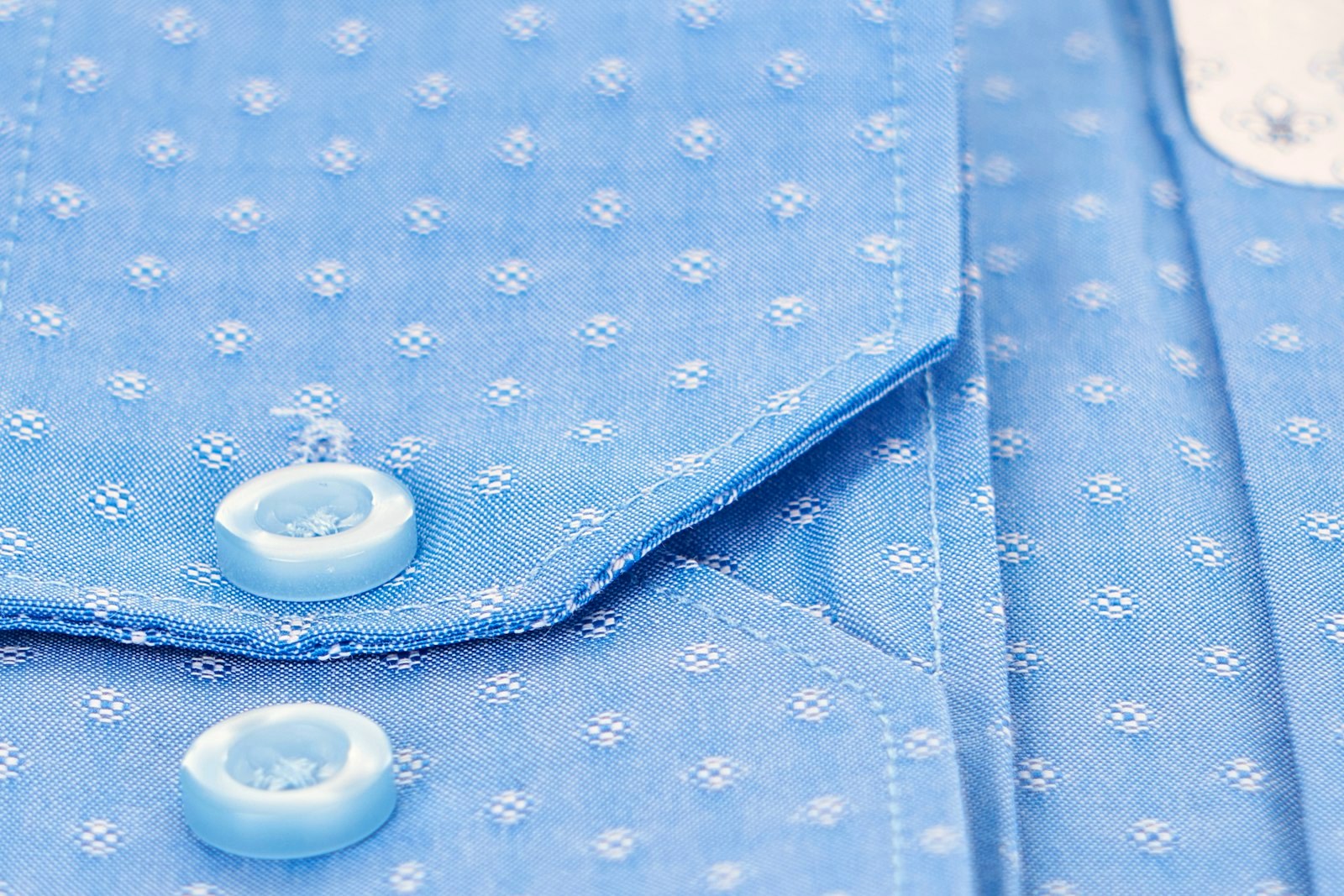
The photography, stated plainly, because this page’s exact subject is the bank’s thinnest after the loafer’s. The bank holds exactly one frame in which a tie reads at size, the striped shirt and dotted tie that stands as this page’s hero: CREDITS-logged, already the hero of the performance dress shirts page and of the Brooks Brothers page, one frame carrying the garment for the site the way the loafer’s one frame carries its class. The figure in the collar section is the collar itself at close range, the detail frame No. 62 grades by, the knot’s seat rather than the knot. No frame in the bank shows a knot being tied or standing in a collar at working distance, no frame shows a grenadine’s weave or a knit tie’s squared end, no frame shows a rail or a drawer of ties, and no frame has been captioned as showing any of them. The harvest list this page is waiting for, in order: first, the knot at working distance, a four-in-hand standing in a spread collar with the dimple set, the collar section in one frame; second, the cloth column, a grenadine’s open weave at macro range beside a knit tie’s squared end, the texture licences side by side; third, the length law photographed, the tip at the belt line with the back blade in its keeper, the outfit from throat to waist in one exposure.
Questions, answered
How do you wear a tie with a suit?
As a measurement before you wear it as an ornament. Three measurements decide the outfit before colour or pattern are read: the tie's width answers the jacket's lapel, the standard being 8 centimetres against a standard lapel, as our tie ranking prints; the tie's length answers the waistband, its tip landing at the belt line with the blade behind it shorter; and the knot answers the collar, sized to fill the collar's V without spreading its points or starving inside them. A tie that passes all three is then graded on cloth and colour. A tie that fails any one of them is wrong in a way no silk can repair, because the failure is read first, at the outfit's most-judged junction, the throat.
How wide should a tie be?
Eight centimetres, about three and an eighth inches, at the blade's widest point, matched to a standard lapel: that is the ruling our tie ranking prints and this brief adopts. The width is a proportion before it is a number, the tie answering the lapel it hangs beside, and the settled band runs from about seven and a half to eight and a half centimetres on ordinary frames. Under 7 centimetres is the skinny register, a fashion width that starves the knot, because a narrow blade cannot build a knot wide enough to fill a collar's V. Nine centimetres and over is the wide register, licensed by wide lapels, the double-breasted and peak-lapel forms, and read as an era's costume anywhere else. Width dates faster than any other measurement in the outfit, which is why the standard is a ruling and not a trend.
How long should a tie be?
Long enough for the front blade's tip to land at the belt line, touching the buckle's top or covering it to its middle, and no longer. A tip that ends above the waistband is the short tie, the outfit's commonest measurement failure; a tip that travels past the belt toward the fly is the long tie, the same failure at the other end. The blade behind is shorter than the blade in front, two to five centimetres shorter as the working band, held in the keeper loop, and a back blade that outruns the front is a knot that took up the wrong length. The standard tie is 147 centimetres, 58 inches, as our tie ranking prints, and it suits most frames; tall frames, high-rise trousers worn the other way, and the length a Windsor knot consumes are the printed corrections, answered with a longer tie, about 155 to 160 centimetres, or a shorter one near 140, never with a knot tied at the wrong station to make the rail fit.
Which tie knot should I tie?
The four-in-hand, as the default: a knot of medium size with a slight asymmetry that reads as ease, filling most collars on most ties, and the knot this brief sends every reader to first. The half-Windsor is the licensed step up, a symmetric triangle of medium-large size, for the wider spread collars and for finer, thinner ties whose four-in-hand comes out starved. The full Windsor is the reserved form, a wide and substantial knot licensed only where the collar is a wide cutaway with the room for it and the tie's cloth is light enough to need the volume, and refused with thick cloth, grenadine and wool among it, whose own bulk overbuilds it, and refused entire in a point or button-down collar, which has no room to give it. The knot is sized to the collar's V: a gap at the knot's sides is a starved knot, and points pushed outward are an overfed one, and both are read before the silk is.
Which collar goes with which tie?
The spread collar takes the four-in-hand or the half-Windsor and the standard 8-centimetre width, and is the dressed default. The cutaway takes the half or full Windsor, its V the widest the wardrobe cuts, and refuses the skinny tie outright, whose knot cannot fill it. The point collar takes the four-in-hand and a standard-to-narrower blade, its narrow V having no room for a Windsor's spread. The button-down takes the four-in-hand only, a slim knot under buttoned points, the American register entire, and refuses the fat knot entire, because a knot that pushes buttoned points outward has failed the collar it sits in. The band collar takes nothing: it has no points and no V, the knot has no seat in it, and it is refused for a tie as it is refused under the open-collar suit on How to Wear No. 62, the two briefs sharing one collar law from opposite sides.
What are the rules for matching a tie's pattern to a shirt and suit?
Two, and they are the family's standing prose for dressed outfits. The budget: one pattern at a time among the three stations, shirt, suit and tie, with two as the licensed maximum and the third held plain, because a third pattern spends the eye's whole allowance and the outfit starts to argue with itself. And the scale rule, which governs the licensed two: the patterns' scales must differ, a fine stripe under a broad check, a small neat pattern over a wide stripe, because two patterns of the same scale merge at reading distance into a vibration neither garment intended. The tie is darker than the shirt as the default ground rule, and the solid woven tie, the grenadine above all, is the system's escape: a texture that does the pattern's work at the throat while spending none of the pattern budget, which is why it stands at the head of our tie ranking.
Are knit ties and grenadine ties formal enough for a suit?
The grenadine is not merely formal enough; it is this site's highest-graded tie species, the woven silk our tie ranking puts first at 91 in its bespoke form, its texture woven in rather than printed on, and it carries the boardroom and the evening entire. The knit tie is the licensed informal: a texture instrument, squared at the end, that steps a suited outfit down exactly one deliberate notch, licensed in the travel rows our suit brief prints, knit tie or none, and across the creative and summer rows, and refused as an accident, a knit tie is a decision or it is a mistake. Over denim the positions reverse, as How to Wear No. 61 rules: the tie is refused as the default over jeans and the knit is the one tie licensed there, as texture. Cloth changes a tie's register; it never changes its measurements, which this brief rules first.
Has Young Cotton ranked ties?
Yes, and this page rules the wearing of what that page graded. Verdict Card No. 40 ranked the tie shelf on the makers' published records, weave over print down the whole table: its winner is the Sam Hober grenadine at 91, a bespoke tie cut to the wearer's length, width and knot shape, in grenadine silk woven in Como, and its sent-home case is a $79.99 seven-fold whose maker would not name the tie's fabric. The Card grades ties as documents and objects; this brief grades none, and rules the three measurements, width, length and knot, against the lapel, the waistband and the collar, which are the terms on which any tie on that Card, or off it, is actually worn.
Next
The family this brief completes stands around it: How to Wear No. 62, a suit without a tie, the counterweight, whose succession law this page mirrors, the tie’s three jobs there inherited by the collar and here performed by the garment itself, under the measurements this brief prints; How to Wear No. 60, the turtleneck with a suit, the neighbouring removal, whose ceilings are this brief’s required rooms read from the other side; How to Wear No. 04, the suit, whose fit order and outfit matrix license the knit tie in the travel row and print the summer rows this brief’s cloth section wears; How to Wear No. 61, a blazer with jeans, whose tie ruling this brief carries, the tie refused as denim’s default and the knit licensed there as texture; and the pairing before this one, No. 63, loafers with a suit, the formality scale met at the ankle where this brief meets it at the throat. The buying behind the brief is scored at Verdict Card No. 40, where the Sam Hober grenadine’s 91 and the width and length rulings were earned, at Verdict Card No. 64, where the Core Suit’s 85 stands, and at the Oxford Verdict ranking, where the Kamakura’s 93 heads the shelf the collar table is drawn from. The full series lives in the How to Wear index, and how every score behind those pages is built stands on our methodology page.