

One half of the pairing, captioned as exactly that: the turtleneck itself, in How to Wear No. 08's own frame, carried here under the cross-page sharing our credits log. The bank holds no frame of the pairing entire, no roll neck under a suit in any register, and the care section prints that absence rather than dressing a shirted suit as this outfit.
Checked and updated October 2026
The ruling, up front: a turtleneck under a suit is not a sweater added to tailoring; it is the shirt and the tie removed together and replaced by one garment, and it is judged on both of their jobs at once. It follows that the pairing has one governing variable, and it is not the colour, the cloth or the cut: the gauge is the formality. The roll must be finer than the suit’s cloth is formal, fine merino or a fine cashmere blend at the high-gauge end, because the moment the knit reads as a sweater the outfit collapses from tailoring-with-a-roll into tailoring-with-knitwear, and no colour law can rescue it. Inside that law this brief rules the materials against each other, holds the colour darker than the suit or tonal and never brighter, with black under charcoal and navy as the standing combinations, runs the fit as a base layer’s rather than a sweater’s, and prints the two ceilings the pairing cannot argue its way past: the boardroom and the wedding. On scores: no garment is scored here. The one number quoted is the precedent’s, Verdict Card No. 05’s winner, cited as what it is.
This brief: the decisive rule · the material rulings · the colour law · the fit law · the ceilings · the looks · the mistakes · care and our photography
The decisive rule: the roll replaces the shirt and the tie, so the gauge is the formality
Every brief in this family has a rule that decides its garment, and the pairing’s rule is a substitution. When a man wears a roll neck under a suit, he has not softened the suit’s uniform. He has struck two of its components, the shirt and the tie, and installed a single garment in their place, and that garment is therefore graded on the whole of what it replaced: the shirt’s smoothness against the jacket, the tie’s vertical order down the chest, and the collar line both of them drew at the throat. What does that grading, in practice, is the gauge. A shirt is a fine, flat cloth, and a tie is a narrow, finished strip; the space they occupied is the most finished space in the outfit. A knit that enters it must arrive at the same finish or be read as a coarser thing smuggled into a finer room. A fine-gauge roll, knitted tight and smooth, its stitches invisible at conversational distance, sits in that space as an equal: the lapel closes over a surface as calm as a shirt front, and the collar stands at the throat with the tie’s decisiveness and none of its noise. A mid-gauge or chunky knit in the same space is a sweater, and a sweater under a suit is not an outfit with a lower formality. It is two outfits in dispute, the tailoring arguing ceremony and the knit arguing the weekend, at exactly the point of the body where the eye settles first.
So the law is stated as a comparison, because the comparison is how it is applied in front of a wardrobe: the roll must be finer than the suit’s cloth is formal. The smoother and harder the suit, the finer the roll it demands. A polished worsted suit, sharp-shouldered, cut close, is the most formal cloth in the pairing’s licence, and it takes the finest roll the wardrobe holds, the high-gauge end where the stitches vanish. A softer cloth, flannel with its brushed nap, tweed with its fleck, a brushed worsted between them, is a step less formal itself, and it licenses the roll exactly one step down the gauge ladder in reply, which is why How to Wear No. 08 prints the pairing’s standing conditions as a soft-shouldered suit in a cloth with some texture: the textured suit is not a taste preference. It is the suit whose own finish leaves the roll room to be a knit and still be the finer-or-equal surface. Run the comparison the other way and the failures explain themselves. The chunky fisherman roll under a slim blazer, the mistakes section’s first entry, is a gauge crime before it is anything else: the coarsest knit in the wardrobe installed in the finest space in the outfit. The law also explains why the pairing photographs so unevenly in the wild. Two men in black rolls and grey suits can be wearing different outfits entire, one graded by this law and passing, the other failing it invisibly until the photograph is enlarged, because gauge is a property the eye reads before the mind names it.
The precedent the law rests on is scored, and it is printed here as the pairing’s exhibit. Verdict Card No. 05 ranked the turtleneck shelf, and its winner is John Smedley’s Cherwell at 85, a merino roll neck from the Derbyshire house that has knitted the garment longer than anyone. The house’s own record, printed on Brands Like No. 22, where Smedley stands at 79 as a house, is knitwear at 24 to 30 gauge, and that page prints the 30-gauge merino as sliding under a blazer like a shirt with warmth. That sentence is this brief’s law in its commercial form: at 30 gauge the knit has crossed into the shirt’s register, and the pairing works at exactly the point where the crossing happens. Nothing in this brief is scored, and the Cherwell’s 85 is cited as a garment score, on a turtleneck Card, for the one proposition it proves better than any other garment on that shelf: the roll that belongs under tailoring is the roll knitted finest. Buy toward that end of the ladder and every other ruling in this brief becomes easier to obey.
The material rulings: fine merino, licensed cashmere, and the casual species
Fine merino is the pairing’s default fibre, and its virtues are mechanical before they are luxurious. Merino knits to the finest gauges the trade runs, which is the law’s first demand; it holds a collar’s fold or roll at its set height through a day’s wearing, which is the fit law’s demand; and its surface is smooth enough that a lapel slides over it and sits, rather than gripping the knit and riding. It is also the fibre of the scored precedent, the Cherwell’s merino at 85, and the fibre the Derbyshire record is built on. A man buying one roll for this pairing buys fine merino, in black first, and has obeyed the material ruling entire. Everything else in this section is a qualification of that sentence, not a rival to it.
Cashmere is licensed, at fine gauge, with its condition printed. A fine cashmere roll, or a cashmere and merino blend knitted fine, brings a softness the pairing can carry and a surface even calmer than merino’s, and in the evening rows it is the register’s luxury form. The condition is the law’s, and it is absolute: fibre never rescues gauge. Cashmere is marketed at every gauge including the very coarse, and a chunky cashmere roll under a suit fails exactly as a chunky merino roll fails, with a larger receipt. Cashmere also asks more of its owner than merino does: it pills where the jacket rubs it, at the chest and the side, and it relaxes at the collar sooner, so its place in the rotation is the occasion end, the dinner and the evening rows, with the merino carrying the weekly wear. The blend is the working compromise the trade itself prints, cashmere’s hand at merino’s discipline, and bought fine it is the one alternative this brief seats beside the default without a warning attached.
Cotton rolls are graded as the casual species of the family, and under a suit they are refused. The cotton knit is a real garment with its own honest rows, the spring evening, the layer under an open jacket, the roll worn with denim where its matte, dry hand belongs. The pairing is not among its rows, for three reasons the material itself supplies. Cotton has no warmth to contribute, and this pairing is a cold-weather instrument whose shirt-substitute is expected to work as insulation as well as surface. Cotton relaxes as it is worn, and the place it relaxes first is the collar, so the outfit’s most visible point is the cotton roll’s first failure, arriving by mid-afternoon. And cotton’s surface, however finely knitted, reads beside tailoring as a jersey’s, the long-sleeved tee’s register, which demotes the suit it stands inside. The ruling is therefore the material section’s only refusal: under tailoring, the roll is a wool knit, merino or the licensed blends, and the cotton roll keeps the casual wardrobe it is genuinely good in.
One boundary closes the section, because the gauge law can be misread as a licence to go thin rather than fine. Fine is a knitting property, not a thinness. A flimsy knit, loosely tensioned, its stitches open when the cloth is stretched across the chest, fails the law from the other side: the surface must be dense and calm, the collar’s rib holding its edge, the body opaque against the skin under a lamp. The test is the hand and the light. Draw the knit across the knuckles: if the stitches separate into a net, it is a summer garment wearing a winter silhouette. Hold it to a window: if the light comes through the body in patches, the suit’s lapel will find the same patches. The fine rolls that pass, the Smedley class, are dense at their fineness, which is precisely the expensive part of their knitting, and the reason the Card’s winner costs what it costs.
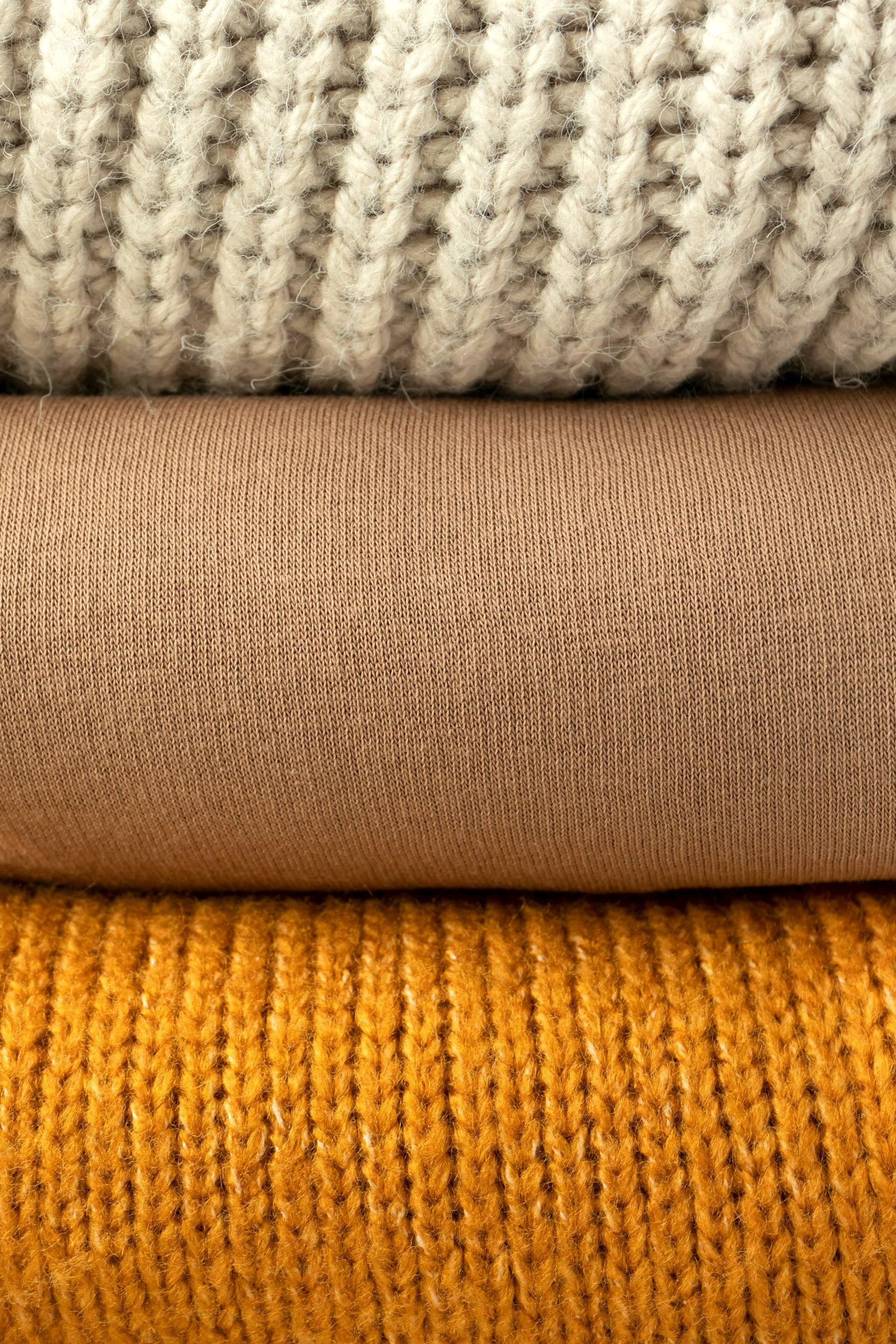
The colour law: darker than the suit, or tonal, and never brighter
The roll occupies the chest’s centre, the exact ground a shirt and tie divide between them into a light field and a dark line. Everything about the pairing’s colour follows from that occupation. The roll is the outfit’s ground, never its accent, and a ground obeys the law stated in the questions above: darker than the suit it stands inside, or tonal with it, and never, in any combination this brief licenses, brighter. A darker roll recedes, and in receding it does the shirt-and-tie’s work by other means, giving the suit’s cloth and cut the whole of the eye’s attention and holding the chest as one calm, dark column from throat to waist. A brighter roll advances, and the outfit inverts: the knit becomes the subject, the suit becomes its frame, and tailoring demoted to a frame reads as a costume’s jacket, worn to set off the sweater. The law is not a preference for dark colours. It is the pairing’s optics, and it grades combinations rather than garments: the same roll is licensed under one suit and refused under another, by the comparison alone.
The standing combinations are the family’s, printed by No. 08 and seated here as the law’s working table. A black roll under a charcoal suit is the pairing’s first form, the darkest ground under the darkest licensed cloth, the evening register at full strength. A black roll under a navy suit stands beside it, the black and the navy near enough in value to read as one column and far enough in hue to keep the tailoring legible, the combination the office rows use most. A charcoal roll under a mid-grey suit is the tonal form, ground and cloth in one family, the pairing at its quietest and the hardest to fault in a photograph. A deep navy roll under a grey suit completes the table, the day register’s version, softer than black’s stance and governed by No. 08’s navy logic entire: better with brown shoes and daylight, slower to show its age. Every licensed combination shares the table’s shape: the roll at or below the suit’s value, the hues near or identical, and the contrast, where there is any, supplied by texture, the flannel’s nap against the knit’s smoothness, rather than by brightness.
The law’s consequence for cream is printed plainly, because cream is where the pairing’s admirers most often break it. Off duty, against dark denim and under an open coat, the cream roll is one of the family’s best looks, and No. 08 prints its risk there as a staining risk, collar grime and sunscreen on the family’s least forgiving colour. Under a suit, the objection is different and prior: a cream roll is brighter than every suit in the standing table and brighter than almost every suit in any wardrobe, so it violates the colour law before the staining question is reached, advancing out of the chest and turning the tailoring into its frame. The cream roll’s tailored licence is the exception that defines the rule’s edge, under a suit lighter than itself, the pale summer cloths, where the comparison can still be obeyed, and those suits are outside this pairing’s cold-weather register entire. In the rows this brief governs, cream stays off duty, and the reader who loves it owns it for the weekend columns of No. 08’s matrix, where it is licensed and superb.
Pattern is refused in one paragraph, because the law has already refused it. The roll under a suit is a plain knit. A marled yarn, a flecked Donegal, a rib wide enough to read as stripes at distance: each introduces into the chest’s ground the variation the shirt-and-tie supplied in an ordered form, a tie’s pattern over a shirt’s calm, and the knit supplies it in an unordered one, texture without grammar. The suit’s cloth may carry the outfit’s pattern, a chalk stripe, a check, a herringbone’s quiet geometry, and the roll answers it with plainness, which is the division of labour the pairing is built on: the tailoring speaks, the ground holds. Where both speak, neither is heard, and the outfit joins the mistakes section’s catalogue by a door this paragraph exists to close in advance.
The fit law: a base layer’s discipline, a collar’s grip
The roll under a suit is worn as a base layer, and the phrase is a discipline rather than a description. A sweater is a garment with its own ease, its drape and drop, worn as the outermost statement of its outfit. A base layer is a garment worn to be built on: close, smooth, and finished at its visible points, because everything above it assumes its surface. The body of the roll is therefore worn the way the shirt’s body is worn: near the torso without strain, its hem tucked into the trousers or falling to a clean, straight finish where the jacket’s closure covers the question, and with no surplus cloth anywhere for the jacket to close over. The half-tuck is refused here on No. 08’s ruling, repeated because the pairing tempts it most: it reads undecided, and on a silhouette whose one statement is at the neck, an undecided waist is a second statement arguing with the first. The closed-jacket test from the questions above is the section’s working instrument. Button the suit over the roll and look once: the lapels lie flat over the knit, the collar stands inside their V without crowding it, the chest shows no strain lines radiating from the button, and the knit’s surface inside the V is as calm as a shirt front. Any failure in that list is a fit failure, and none of them is cured by a better colour.
The collar carries the outfit, so the collar’s fit is the law’s centre. The neck must grip and must hold its height. Grip first: the fold of a turtleneck, or the roll of a roll neck, should sit against the neck all the way around, close enough to hold its line and loose enough to be forgotten by the wearer within a minute of putting it on, and the test is temporal rather than visual, because a collar is worn for a day, not for a mirror. Height second: the folded turtleneck lands where No. 08’s fold-once ruling puts it, flat and even, its top edge clean; the roll neck rolls as it was knitted to roll, never dragged up tall and never flattened into a fold it does not own; the mock neck, at half height, is the family’s kindest frame and the pairing’s licensed concession to the short neck, seated by No. 08’s height ruling entire. What none of the three may do is slump. A collar that has relaxed, lost its rib’s spring and fallen into soft folds against the throat, is the pairing’s first visible failure and its most common one, because it happens at the exact point the outfit asks the eye to land, and it converts the tie’s replacement into a scarf’s impression. The slump is a buying fact before it is a wearing one: collars relax by construction, the rib’s yarn and tension deciding in the first season how the fifth season looks, which is the longevity argument inside the Card’s scoring and one more reason the precedent at 85 is a fine-gauge house’s garment.
Two smaller laws close the section. The sleeve ends at the wrist as a shirt cuff does, its rib showing below the jacket’s sleeve by the shirt cuff’s own margin or not at all: a knit cuff swallowing the hand under tailoring reads as a sweater’s sleeve in a shirt’s seat, the gauge law’s failure at the outfit’s other visible edge. And the pairing is a one-layer chest: nothing goes over the roll inside the suit, no waistcoat arguing a third register into the V, and nothing goes under it that can print through it, because a fine knit at this gauge shows a vest’s edge and a t-shirt’s seams as clearly as it shows its own stitches’ absence. The base layer is the base. What it stands on is skin and what stands on it is the suit, and the outfit’s cleanliness is that simplicity, kept.
The ceilings: the boardroom, the wedding, and the rooms between
A pairing this strong invites its admirers to over-promote it, so this brief prints its ceilings as rulings, in the open, rather than leaving them to be discovered in the wrong room. The roll under a suit is formal-adjacent: it is the most formal thing knitwear does, and it is not formal. Its licence covers the wide middle of a dressed life, the office rows where a shirt without a tie reads as deliberate, the evening event, the dinner, the gallery, the ceremony-adjacent occasions where the dress code is a standard rather than a uniform. In all of those rooms the pairing is not a compromise with the shirt. It is frequently the strongest outfit present, because its simplicity is total in a way a shirt and tie, assembled from three decisions, rarely achieves. The ceilings are the rooms outside that middle, and there are two of them, and they are refused for different reasons.
The boardroom ceiling is a uniform’s. The strict boardroom, the court, the proceeding, the rooms where the tie persists, persist because the tie there is not decoration: it is the uniform of the proceeding, the signal that the wearer has subordinated his taste to the room’s business. The roll neck declines that signal while keeping the suit that carries it, and the room reads the decline correctly, as a man keeping his own register inside a collective one. No. 08’s sentence is the ceiling’s whole text: if the room requires a tie, the turtleneck is not the loophole. The sentence is not a snub to the pairing. It is the pairing’s own honesty about what it is: an outfit whose entire argument is the removal of the tie cannot then be smuggled into the rooms where the tie is the point. The man whose calendar is mostly those rooms is ruled for plainly in the questions above: he owns the shirt wardrobe, and this pairing is his evening strength, worn where its argument is the room’s argument too.
The wedding bar is a courtesy’s. A wedding’s dress code differs from a boardroom’s in its author: it is set by the couple, for their day, and the guest’s shirt and tie are a form of agreement with it, the small ceremony of dressing as asked. The roll under a suit at a wedding keeps the tailoring and renegotiates the agreement, and however well it obeys this brief’s gauge and colour laws, it reads at the reception as the one guest who edited the invitation. So the bar is printed without the boardroom’s exception: in the wedding’s formal rows the pairing does not go, and the single licence is the invitation’s own, a stated no-tie code, under which the combination obeys every law in this brief and arrives as what the couple asked for. The evening rows around weddings, the dinner the night before, the party after the day, are the pairing’s ground entire, and a man ruled out of one afternoon and licensed for the whole weekend around it has lost nothing the outfit was for.
Between the licence and the ceilings stands the office, and it is ruled here rather than in its own section because it is the ceiling question in its daily form. No. 08’s office ruling stands entire and this brief adopts it: fine gauge, dark or neutral colour, a clean collar and tailored trousers read deliberate in any room that allows a shirt without a tie, and in a good number of stricter rooms besides. What this brief adds is the pairing’s version of the same ruling: the suit raises the office licence rather than lowering it, because the roll alone with trousers asks the room to grade a substitution, while the roll under a suit presents the room with a complete outfit whose only missing pieces are the ones it visibly chose to remove. The failures are No. 08’s list, unchanged: the chunky roll, the stretched or shiny collar, and jewellery over the knit, which the mistakes section takes up in the pairing’s own terms.
The looks: four assemblies the brief licenses
| Setting | The assembly | The roll | The judgment |
|---|---|---|---|
| The evening fixture | Charcoal suit, soft-shouldered, in flannel or a brushed worsted; black polished shoes; nothing at the collar | Fine merino roll, black, folded once and gripping | The pairing’s first form: the darkest ground under the darkest licensed cloth, one dark column from throat to shoe, the outfit the ceilings sections license for every evening row |
| The office rows | Navy suit in a textured cloth, brown shoes in the day register, the trousers’ break kept per No. 04 | Fine roll, black or deep navy, at the finest gauge the wardrobe holds | The shirt substitute at full strength inside tailoring: the combination No. 08’s office ruling licenses, raised by the suit from a substitution to a complete outfit |
| The tonal register | Mid-grey suit, grey flannel’s nap against the knit’s smoothness, black shoes | Fine roll, charcoal, tonal with the cloth | The pairing at its quietest: contrast supplied by texture alone, the combination hardest to fault in a photograph and the one the colour law was written from |
| The cold-weather dinner | Dark suit in tweed or a heavy flannel, a clean suede boot in the colder rows, the overcoat of No. 20 over all of it outdoors | Fine cashmere blend roll, black or charcoal, at the rotation’s occasion end | The licensed luxury form: cashmere’s softness spent where the pairing is an event rather than a uniform, over cloth textured enough to leave the roll its one step of room |
The ruling
Wear the roll under a suit as the shirt and tie’s replacement, and grade it as both: finest gauge first, merino or the licensed fine blends, the colour darker than the cloth or tonal with it and never brighter, black under charcoal and navy as the standing forms. Fit it as a base layer, the collar gripping at its set height, the body clean under the closed jacket, and add nothing at the neck. Keep it in its rooms, the office rows, the evenings, the dinners, and out of the two rooms printed above it, the boardroom whose uniform it declines and the wedding whose agreement it would renegotiate. Ruled so, the pairing is the most complete outfit the cold half of the year offers: one garment doing two garments’ work, and doing it, at the right gauge, better than either did alone.
Where the pairing goes wrong
The chunky fisherman under a blazer. The gauge law’s capital crime, and the commonest way this outfit fails in the wild: a heavy, cabled or ribbed roll, an off-duty garment of real merit in its own rows, installed under tailoring, where its stitches shout across the lapel’s line and its collar erupts out of the jacket’s V like a scarf that lost its way. Both garments are diminished in the one outfit, the knit reading as a mistake and the blazer as its victim. The chunky roll’s company is the open coat and the weekend, ruled at No. 08 entire; under a closure, fine gauge or nothing.
The roll that slumps. The collar bought without grip, or worn past its rib’s life, fallen into soft folds at the throat by the second hour. It is the pairing’s saddest failure because everything else can be right, the gauge, the colour, the cloth, and the outfit still reads as tired at the one point it asked the eye to land. The defence is at the buying: a collar’s spring is a construction fact, tested in the shop by stretching the rib once and watching it return, and priced into the precedent the Card scored at 85.
Jewellery over the roll. A chain worn over the knit, at the collar the outfit has made its whole statement. No. 08 refuses it in the office and this brief refuses it in the pairing entire: the roll’s claim is that the neck needs nothing, and a chain over it is a footnote arguing with the text, in metal, at the throat. Anything worn at the neck goes under the knit, where it is the wearer’s business, or goes without.
The brighter roll. The cream, the burgundy, the pale grey roll under a dark suit, bought as a lift and worn as an inversion, the knit advancing out of the chest and the suit demoted to its frame. The colour law is a comparison and it is graded in the shop, against the suit it will actually stand inside, not against the rail it hung on. A roll that cannot be worn darker or tonal with any suit its owner owns is a roll for another outfit.
The boardroom smuggle. The pairing worn into the uniform’s rooms on the argument that it is nearly formal, nearly being the word the room grades. The ceiling section prints the refusal and its reason; the mistake is listed here because it is the one failure of judgment rather than of cloth, and the most expensive, since it is paid in the room’s currency rather than the wardrobe’s.
Treating the chest as a layer cake. The waistcoat over the roll, the cardigan under the jacket over the roll, the scarf kept on indoors tucked into the V: each addition re-opens the question the pairing exists to close, which is what stands between the skin and the suit. The answer is one garment. An outfit arguing otherwise is the shirt, tie and waistcoat’s outfit, and it should be worn as that, well, rather than as this one, badly.
Care, honestly, and our photography
The pairing’s care is the collar’s care, because the collar is where the outfit lives and dies. Fold the turtleneck’s collar down before the sweater goes on, No. 08’s ruling, so the fold is never dragged over the head and stretched a fraction wider every wearing; let the roll neck settle as knitted rather than arranging it. Store the knit folded, never hung by its neck, which draws the collar’s rib down under the garment’s own weight across a summer. Rest a fine roll a day between wearings, as the knit briefs rest all their fine gauges, and keep the black roll’s known taxes in view, the lint it shows at conversational distance and the fade toward charcoal a season of washing brings, both printed by the Card and neither a surprise to the reader who bought the good one on purpose. The suit’s care is No. 04’s entire and unchanged by what stands inside it, with one addition of the pairing’s own: a fine knit leaves less on a jacket’s lining than a shirt’s starch and studs do, and the rotation of two rolls, black and charcoal, will carry the pairing’s whole calendar for most wardrobes.
The photography, stated plainly, because this page’s exact subject is absent from our bank. The bank holds no frame of the pairing itself: no roll neck under a suit, in any cloth, colour or register, and no frame of a turtleneck under a blazer that this page could caption as the outfit it rules. The hero is therefore the knit half of the pairing, the turtleneck’s own frame from No. 08, carried under the cross-page sharing our credits log and captioned as the half it is; the one figure in the materials section is the bank’s gauge macro, the stitches the law grades; and the figure below is the suit’s half, a banked spare in our credits never placed before this page, a dark suit at street register in warm light. No frame of a shirted suit has been captioned as this pairing, and none will be: the two halves stand at either side of the subject, and the page says so. The harvest list this page is waiting for, in order: first, the pairing entire at street level, a fine black roll under a charcoal suit, the collar inside the lapels, the outfit’s whole argument in one frame; second, the collar-and-lapel meeting at close range, the V of a closed jacket over a folded roll, the fit law photographed; third, the tonal form, charcoal on mid-grey, in flat daylight, the quietest combination given its portrait.

Questions, answered
Can you wear a turtleneck with a suit?
Yes, and it is the combination this brief exists to rule. The turtleneck replaces the shirt and the tie together, so it is judged as both: it must be fine-gauge, in black, charcoal or deep navy, worn under a soft-shouldered suit in a cloth with some texture, flannel, tweed or a brushed worsted. The governing law is the gauge: the roll must be finer than the suit's cloth is formal, because a knit that reads as a sweater under tailoring has failed before colour or fit are even discussed. How to Wear No. 08 rules the turtleneck entire; this brief rules the pairing.
What gauge turtleneck goes under a suit?
The finest you own. Gauge is the formality in this outfit: a high-gauge fine knit, the class John Smedley knits at 24 to 30 gauge in Derbyshire, reads at conversational distance as a garment in the shirt's register, smooth under the lapel and flat at the collar. A mid-gauge knit reads as a sweater worn with a suit, which is a different and lesser outfit, and a chunky gauge is refused outright. The finer the suit's cloth, the finer the roll it demands: a smooth worsted takes the finest roll in the wardrobe, and only a textured cloth, flannel or tweed, licenses a step down the gauge ladder, and never more than a step.
What colour turtleneck goes with a suit?
Darker than the suit, or tonal with it, and never brighter. The roll is the outfit's ground, not its accent: it sits where a shirt and tie would divide the chest into light and pattern, and a bright roll in that seat reverses the tailoring, pulling the eye to the knit and demoting the suit to a frame. The standing combinations are the family's: a black roll under a charcoal suit and under a navy suit, a charcoal roll under a mid-grey suit, a deep navy roll under a grey suit. The law's consequence for cream is printed in the colour section: a cream roll is brighter than almost every suit in the wardrobe, so under tailoring it is barred by the same law that licenses it off duty.
Merino, cashmere or cotton under a suit?
Fine merino first: it knits to the finest gauges, holds the collar's fold, and is the fibre of the pairing's scored precedent, John Smedley's Cherwell roll neck, which won Verdict Card No. 05 at 85. Cashmere is licensed at fine gauge and in merino blends, where its softness is a luxury the outfit can carry, but fibre never rescues gauge: a chunky cashmere roll is a chunky roll, refused like any other. Cotton rolls are graded as the casual species of the family: a cotton knit has no warmth to offer the pairing, relaxes at the collar through a wearing, and reads beside tailoring as a long-sleeved tee's relative. Under a suit, the cotton roll is the one fibre ruling with no appeal.
How should a turtleneck fit under a suit?
As a base layer, not as a sweater. The collar's fold or roll must grip the neck cleanly and hold its height all day, neither slumping into folds nor strangling; a collar that has relaxed is the outfit's first visible failure, at the exact point the eye lands. The body is worn close and smooth, tucked into the trousers or falling to a clean straight hem, with no bulk for the jacket to close over and no half-tuck, which How to Wear No. 08 rules reads undecided because the silhouette's one statement is at the neck. The test is the closed jacket: buttoned, the lapels must lie over the knit with no ridge of collar above them and no strain across the chest.
Can you wear a turtleneck and suit to a wedding?
Not as a guest in the wedding's formal rows, and this brief prints the bar rather than leaving it to taste. A wedding's dress code is a sentence about the couple's day, and the shirt and tie are its grammar; the roll neck under a suit is an outfit that declines that grammar while keeping its tailoring, which reads as a negotiation the occasion did not invite. The licensed rooms are the ones the ceiling section prints: the evening event, the dinner, the gallery and office rows where no tie is the stated uniform. At a wedding where the invitation itself specifies no tie, the combination obeys the colour and gauge laws entire, in black or charcoal, and even then it is the invitation that licenses it, not the outfit.
Does a turtleneck and suit work in a boardroom?
It tops out below the boardroom, and the ceiling is the pairing's honesty. The combination is formal-adjacent: it reads deliberate and finished in any room where a shirt without a tie is read the same way, and in the creative and commercial rows that is most rooms. The boardroom in its strict form, the court, the rooms where the tie is still the uniform of the proceeding, are above its ceiling, and How to Wear No. 08's sentence governs them: if the room requires a tie, the turtleneck is not the loophole. The man whose calendar is mostly those rooms owns the shirt wardrobe and wears this pairing in the evening rows where it is the strongest outfit he has.
What shoes go with a turtleneck and suit?
The suit's own shoes, because the outfit changes the chest and nothing below it. The roll neck simplifies everything above the waist and buys no licences below it: the trouser keeps its break, the shoe keeps the suit's register, a polished leather shoe or a clean suede boot in the colder rows, and nothing casual arrives to argue with the tailoring. The common failure is symmetry of effort, a man who has made the modern decision at the collar making a relaxed one at the ground, and the outfit reads as two decisions rather than one. How to Wear No. 04 rules the suit entire, shoes included, and this brief changes none of it below the chest.
Next
The family this brief completes stands around it: How to Wear No. 08, the turtleneck, the parent brief, whose collar definitions, fold-once ruling and office sentence this page builds on and whose matrix seats the roll off duty; How to Wear No. 04, the suit, the tailoring entire, whose cloth and shoulder rulings supply this pairing’s other half; and How to Wear No. 03, the blazer, the pairing’s single-jacket form, where the fine roll’s register was first printed on this site. The buy itself is scored at Verdict Card No. 05, where the Cherwell’s 85 was earned on cloth, gauge and wear, and the knitwear family the roll belongs to is indexed in types of sweaters. The full series lives in the How to Wear index, and how every score behind those pages is built stands on our methodology page.