
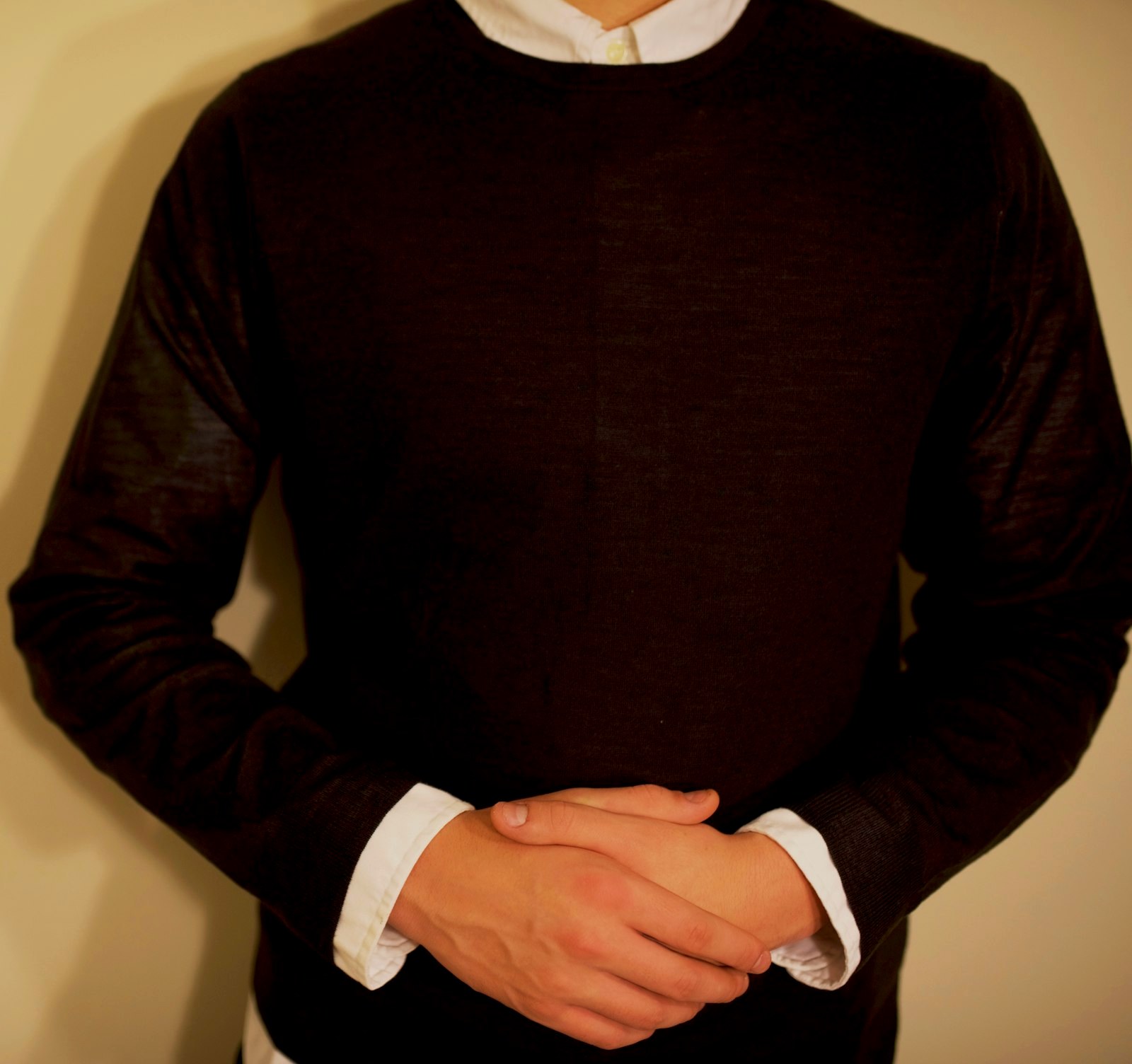
The fine crew neck at work: one of ten types on the ladder, and the most layered garment in the drawer. The index exists because sweater, like jacket, is one word covering very different garments.
Checked and updated October 2026
The ruling, up front: there are ten types of sweater that cover a man's whole year, and each is defined by three things: its neckline, its yarn, and how it opens or closes. This page indexes all ten and scores each for formality and warmth from one to five, with the yarn classes each type is honestly knitted in and the one buying rule that decides it. The V-neck and the roll neck top the formality ladder at four; the fisherman tops the warmth ladder at five and sits at the bottom of the other one. Own across both ladders, not along one rung of either.
On this page: the index, the office knits, the neckline family, the open and layered knits, the deep-winter knit, the yarns, the buying rule, questions.
The index: ten sweaters, two ladders
The scores are the data team's compiled judgement, built from neckline, gauge, yarn and how each type behaves in the rooms and weather men actually wear them in. As on the jackets index, the two ladders pull against each other: the knits that warm best, heavy lambswool cables, are the knits that read least formal, and the knits that read most formal, fine merino at a smooth gauge, insulate least. One difference is knitwear's own: gauge moves a type between rungs. A crew neck in fine merino and a crew neck in chunky lambswool are the same neckline and different garments, and the index scores the type in its standard gauge and says so where the gauge is the decision.
| Type | Yarn classes | Formality | Warmth | Its room | The one rule |
|---|---|---|---|---|---|
| Crew neck | Merino, lambswool, cashmere, cotton | 3 | 3 | Everywhere below a tie | The gauge decides the room: fine under a blazer, chunky is the weekend. |
| V-neck | Fine merino, cashmere, cotton blends | 4 | 3 | The office, over a collar | Buy it to layer over a shirt. Worn alone against skin, it reads unfinished. |
| Roll neck (turtleneck) | Extra fine merino, cashmere | 4 | 4 | Cold offices, evenings | The collar is the garment: it must stand, fold and stay folded. |
| Mock neck | Merino, cotton blends | 3 | 3 | Smart casual, under jackets | The roll neck's easier sibling. Buy it close: cheap yarn bags at the half collar first. |
| Cardigan | Merino (fine), lambswool (chunky) | 3 | 3 | The layer in the middle | Fine under tailoring, chunky as the top layer. The bottom button stays open. |
| Shawl-collar cardigan | Lambswool, wool blends | 3 | 4 | Evenings, weekends | It is a jacket substitute, not a layer. It goes over, never under. |
| Knit polo | Fine merino, knitted cotton | 3 | 2 | Summer evenings, smart casual | The collar must be knitted to hold its shape. A floppy collar is the cheap tell. |
| Quarter-zip | Merino, cotton, wool blends | 2 | 3 | Layered casual, travel | Knitted, not fleece. The fleece version is office merchandise; the knit is a sweater. |
| Fisherman (Aran) | Lambswool, wool | 1 | 5 | Deep winter, weekends | Buy the wool and the weight. A thin copy keeps the cables and deletes the warmth. |
| Sleeveless knit (sweater vest) | Merino, lambswool, cotton | 3 | 2 | Over a shirt, spring to autumn | A layer with the arms left to the shirt: close fit, over a collar, never worn alone. |
The office knits: V-neck, roll neck, the fine crew
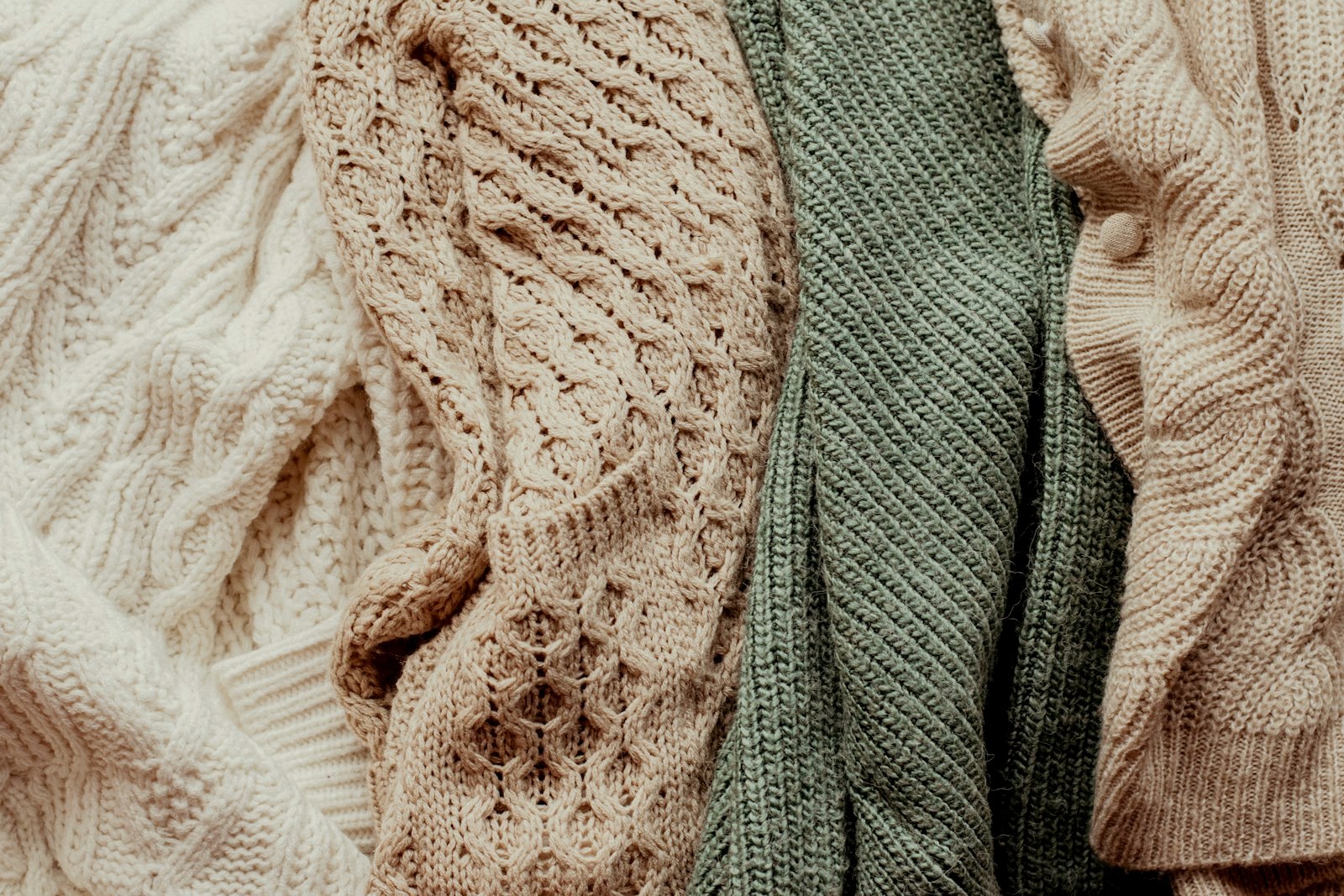
The V-neck is the office knit by design: its opening is a frame built for a shirt collar and a tie knot, and it is the only type on this index that looks better with more clothing under it than less. Its fall from fashion was a styling accident, not a design flaw: worn alone, deep and tight, it read unfinished, and the index's rule answers exactly that. Shallow to medium depth, fine gauge, over a collar, and it is the most correct sweater in a formal building. The roll neck is the office knit's evening twin, the one type that replaces the shirt entirely: a fine roll neck under tailoring or alone with trousers carries a cold room at formality four, the highest a garment with no collar structure can stand. The type is ranked, not just indexed, on this site: the six worth buying are scored in the turtleneck Verdict Card, where the John Smedley Cherwell wins at 85. The fine crew neck is the third office knit and the most forgiving: a round neckline that takes a collared shirt beneath it, the collar showing above the knit, and asks nothing of the wearer beyond the right gauge. The crew is ranked, not just indexed, on this site: the seven worth buying are scored in the crew-neck Verdict Card, where the John Smedley Lundy wins at 87.
The neckline family: crew, mock neck, knit polo
The crew neck in all its gauges is the drawer's citizen, as the Oxford is the shirt family's: the default against which the other types are specialisations. Chunky, it is the weekend sweater; fine, it is the office layer above; in cotton, it is the spring knit that covers the shoulder seasons. The mock neck is the roll neck with the commitment halved: a short stand collar, an inch or so of height, that gives the high-neck read without the fold, and suits the men the full roll neck overwhelms. It is judged harder than its sibling on yarn, because the short collar has nowhere to hide: when the yarn tires, the mock neck bags first and the garment reads tired with it. The knit polo is the warm-weather knit: a long-sleeved polo in fine merino or knitted cotton, a shirt's collar on a sweater's body, worn where a woven polo is too plain and a crew neck too warm. Its whole quality lives in the collar, which must be knitted with enough structure to sit like a shirt's. The short-sleeved woven original is indexed with its family in the shirt index.
The open and layered knits: cardigan, shawl collar, quarter-zip, sleeveless
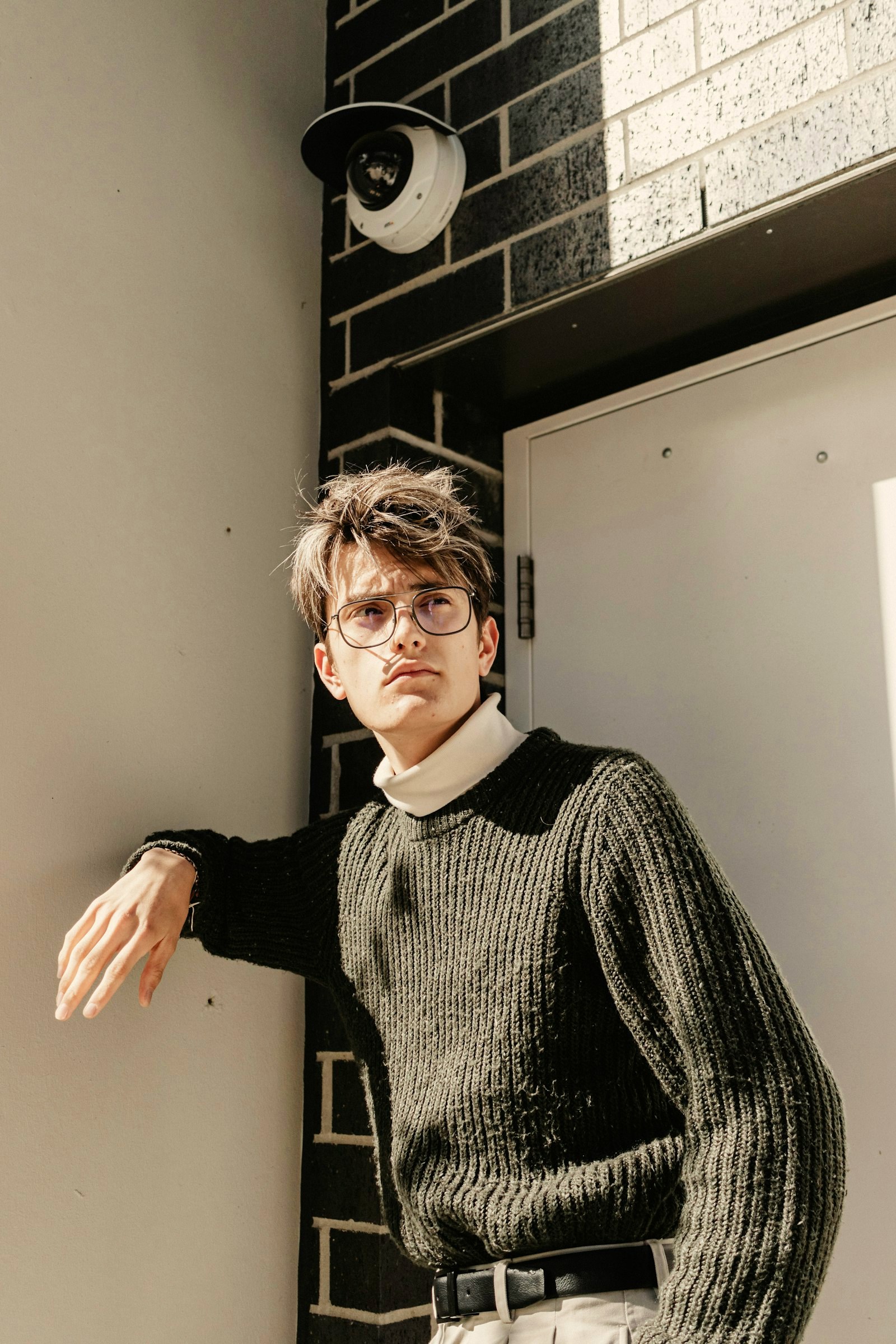
Four of the ten types exist to be opened, zipped or layered, and each has one job. The cardigan is the middle layer of the whole wardrobe, the only knit that can sit over a shirt and tie and under a coat in the same outfit, and its full brief, fits, button rule and outfit matrix, is How to Wear No. 01. The shawl-collar cardigan is the cardigan's outer form: a rolling collar, a heavier gauge, worn as the jacket of an evening rather than a layer inside one, warmth four, the warmest of the open knits. The quarter-zip is the modern layer, and the index scores it with a warning attached: in a knitted yarn, over a crew neck or a collared shirt, it is an honest sweater; in fleece it is conference merchandise, and the two share a silhouette and nothing else. The sleeveless knit, the sweater vest, is the oldest layer on this page and the most misread: over an Oxford or a dress shirt, close through the body, it is a formality tool that adds a storey without adding sleeves, which is why it returns every time tailoring loosens. Worn alone, or baggy, it reads as a costume in search of an argument.
The deep-winter knit: the fisherman
The fisherman, or Aran, is the warmth ceiling of knitwear and the only type on this index scored on weight: cables, diamonds and ropes knitted in lambswool or wool, trapping air in the pattern itself, warmth five, formality one, and entirely unbothered by the second number. It is a working garment from the Atlantic islands that earned its pattern the way the trench earned its belt, and it obeys workwear's law: the copy that keeps the look and drops the substance has missed the garment. A fisherman should have heft in the hand and wool on the fibre line. The thin acrylic version, cables printed shallow in a cloth that cannot warm, is this family's version of the printed souvenir jacket: the picture kept, the point deleted. Buy the weight, and the pattern is free.
The yarns: five fibres, one rule
Every type above can be knitted well or badly, and the difference is usually the yarn. Lambswool is the workhorse: warm, textured, a little rough, prone to pill early and then settle, the standard yarn of the chunky end of the index. Merino is the fine yarn: smooth, temperature-regulating, resistant to odour, able to knit to the gauges the office types require, the best wear-life per dollar in the drawer. Cashmere is the luxury yarn: the softest hand and the most warmth for the least weight, paid for in price and in lifespan, since it pills early and tires before a good merino does. Cotton is the cool yarn: heavy, smooth, honest in spring, and nearly useless wet or cold, which is a property, not a flaw. Blends are where the label reading matters: wool with a little nylon is a durability decision and a good one; acrylic anywhere near the front of the fibre line is a cost decision wearing wool's clothes. The one rule: read the fibre line in percentages. The first fibre named is the sweater. Everything after it is a footnote, and a cashmere blend that leads with wool is a wool sweater priced by its footnote.
The Sweater Ruling
The ladders: formality runs V-neck and roll neck 4, crew, mock, cardigan, shawl collar, knit polo and sleeveless 3, quarter-zip 2, fisherman 1; warmth runs fisherman 5, roll neck and shawl collar 4, the middle family 3, and the warm-weather knits at 2 by design. The rule: buy the yarn and the gauge before the colour, and the neckline for the room it will actually sit in. The wardrobe error: six versions of one type on one rung, usually six crew necks, leaving the office end and the deep-winter end of the drawer bare.
The one buying rule, and the drawer
Buy the yarn first, the gauge second, the neckline third, the colour last. That is the whole system in one sentence: the yarn decides the warmth, the lifespan and the hand; the gauge decides the formality; the neckline decides the room; and the colour decides nothing that matters after the first month. The drawer a man actually needs is five or six across the index: a fine crew neck as the default layer, one office neck, V-neck or roll neck, a cardigan for the middle of an outfit, one heavy knit for deep winter, and one warm-weather knit, polo or sleeveless, for the half of the year the others cannot cover. The layers that go under all ten live in the shirt index; the coats that go over them are indexed in the jackets index, whose layering storeys this drawer fills; the knit that goes under a blazer is governed by How to Wear No. 03; and the season's assemblies, knits scored piece by piece, are in the Fall Edit.
Questions, answered
What are the main types of sweaters for men?
Ten cover the whole drawer: the crew neck, the V-neck, the roll neck, the mock neck, the cardigan, the shawl-collar cardigan, the knit polo, the quarter-zip, the fisherman or Aran, and the sleeveless knit or sweater vest. Each is defined by its neckline, its yarn and how it opens or closes, and this page's index scores each one for formality and warmth from one to five, with the one buying rule that decides it.
What is the most formal type of sweater?
The V-neck and the roll neck share the top of this index at formality four, and in both cases fine gauge is the multiplier: a fine merino V-neck over a dress shirt and tie is office tailoring's standard partner, and a fine roll neck carries an evening the way a shirt cannot. Chunky versions of the same necklines fall two rungs, because formality in knitwear is a property of gauge as much as shape.
What is the warmest type of sweater?
The fisherman or Aran, warmth five on this index, in lambswool or wool knitted heavy with cables: the cables trap air and the yarn holds it, which is the same insulation logic as a puffer in a cloth that can sit at a table. Below it, the roll neck and the shawl-collar cardigan at four. The thin fashion copy of any of these deletes the very thing the warmth score is measuring.
Which sweater should you wear under a blazer?
A fine-gauge one, in a neckline that suits the shirt decision: a fine crew neck over a collared shirt, a V-neck when a tie is in the room, a fine roll neck with no shirt at all for the evening version. The gauge is the whole rule: the knit must sit inside the jacket's line without bunching at the arm or straining its button. Chunky knits go over or alone, never under. The full blazer brief is our How to Wear No. 03.
Is merino or cashmere better for a sweater?
Merino for most of the drawer: it knits finer, regulates temperature, resists odour and outlasts cashmere at a third of the price, which is why it is the office yarn. Cashmere is warmer for its weight and softer against skin, and it is the luxury pick where softness is the point, but it pills early and tires faster. Read blends by their first fibre: a cashmere blend that leads with wool is a wool sweater, priced by its footnote.
How many sweaters should a man own?
Five or six, spread across this index, cover a year: a fine crew neck, one office neck, a V-neck or a roll neck, a cardigan, one heavy knit for deep winter, a fisherman or a shawl collar, and one warm-weather knit, a polo or a sleeveless. The failure mode is six crew necks in six colours, which is one sweater bought six times. Buy the missing rung of the ladder, not another copy of the rung you already stand on.
Next
From the index to the briefs and rankings: the roll neck is ranked in the turtleneck Verdict Card; the crew neck is ranked in the crew-neck Verdict Card; the cardigan gets the full treatment in How to Wear a Cardigan; the blazer the knits go under is briefed in How to Wear a Blazer; the coats above the whole drawer are indexed in types of jackets; and the season's knit assemblies are scored in the Fall Edit.