
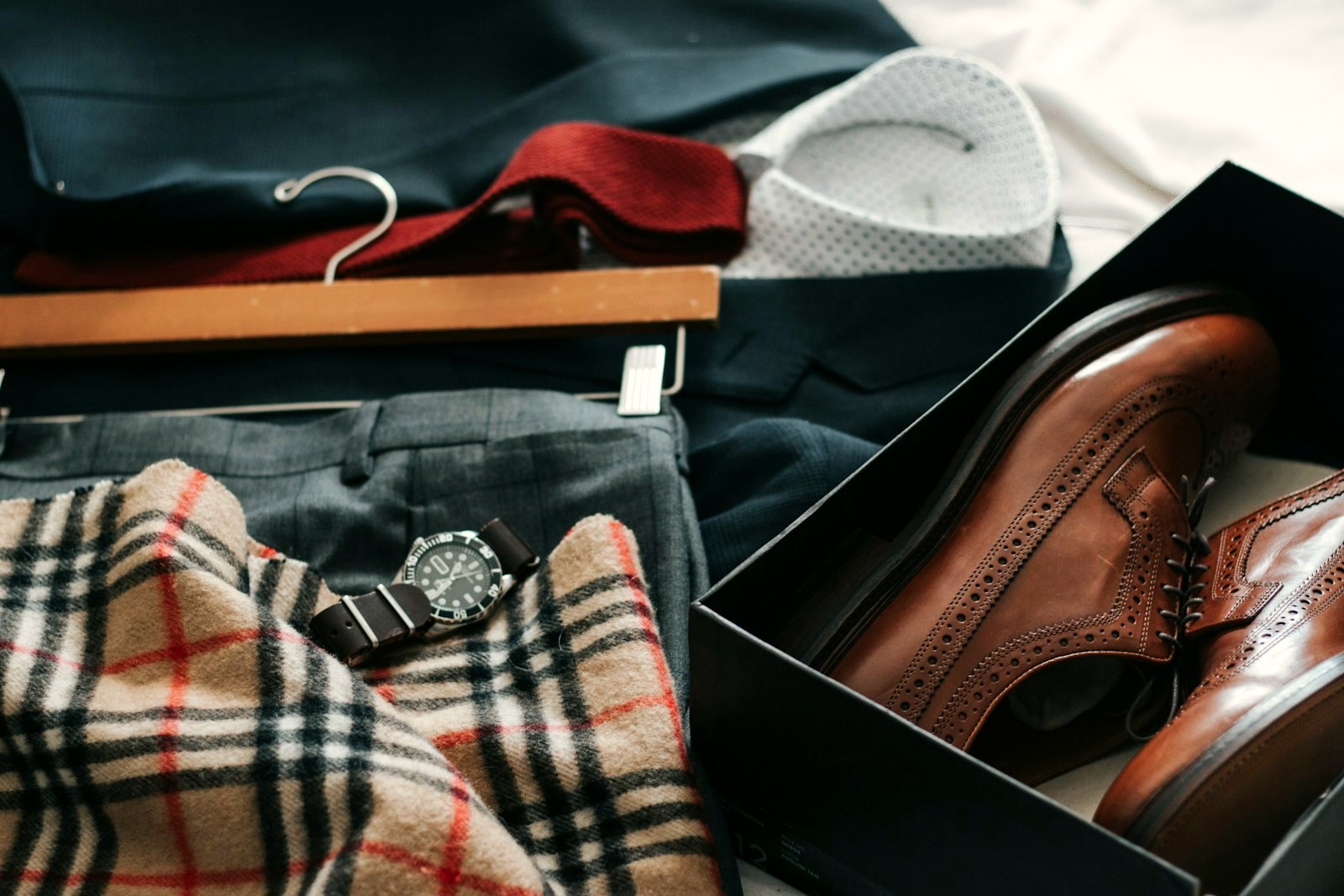
The blazer's natural assembly, laid flat: navy jacket, grey trousers, leather shoes. The colour break between jacket and trouser is the whole outfit in one frame.
Checked and updated October 2026
The ruling, up front: a blazer works when it is worn as a jacket that was born alone: cut to live without matching trousers, soft in the shoulder, textured in the cloth, with the fastening button at the natural waist, the bottom button open, and a sliver of shirt cuff showing at the sleeve. Most blazer failures are not fit failures or taste failures. They are identity failures: a suit jacket orphaned from its trousers, a blazer asked to do a coat's job, a sleeve swallowing the cuff it should be framing. This page prints the orphan rule and its tells, the fit rules, the cloth classes, the outfit matrix, and the four ways men ruin it.
On this page: the orphan rule, the fit rules, the five cloths, the outfit matrix, the mistakes, the buying note, questions.
The orphan rule, in full
Our jackets index prints the rule in one line: unstructured and unlined, or it is a suit jacket missing its trousers. Here is the rule in full, because it is the single most common tailored mistake a man can make, and it is made in good faith every day by men who own a suit jacket and a free evening.
A suit jacket is half of a garment. It was cut to be worn with trousers in the same cloth, and it carries the evidence on its body: a smooth worsted cloth with a fine hand and the faintest sheen; flap pockets; a padded, structured shoulder built by a tailor's canvas; buttons toned quietly to the cloth; and a full lining. A blazer is a whole garment, born alone, and it carries the opposite evidence: patch pockets, the clearest tell in tailoring, or flapped pockets set on a textured cloth; hopsack, flannel, cotton or linen with a visible weave; a soft or natural shoulder with little or no padding; horn or metal buttons that contrast with the cloth rather than match it; swelled lapel edges; and half a lining, a butterfly lining, or none at all.
The read is instant and nobody can switch it off. An orphan suit jacket over odd trousers reads as a suit whose trousers wore out, or a man who got dressed in the dark: the eye knows the jacket is half of something and spends the evening looking for the other half. A blazer over the same trousers reads as a decision, because it is one. If it came with trousers, it stays with them. That is the whole rule, and there is no styling around it.
The fit rules
Shoulder: the seam sits on the shoulder point, and in an unstructured blazer this rule has no appeal process. A structured jacket's padding can lend a shoulder the wearer does not quite have; a soft blazer's shoulder is the wearer's own, which removes tailoring's forgiveness rather than adding ease. A soft shoulder in the wrong size cannot be padded or pinched into place. The shoulder is bought, not tailored, so it is the first thing fitted and the last thing compromised.
Button stance: on a two-button blazer, the fastening button sits at the natural waist and is the only one fastened; on a three-button, the middle. The stance is where the jacket hinges over the trousers, and the bottom button stays open for the same reason it does on a waistcoat and a cardigan: a garment buttoned to its hem bells and strains, and the open last button is what lets it move like clothing. Length: the hem covers the seat and lands near the knuckle of a curled hand. Much shorter is a fashion cut, and fashion cuts date at the speed of fashion.
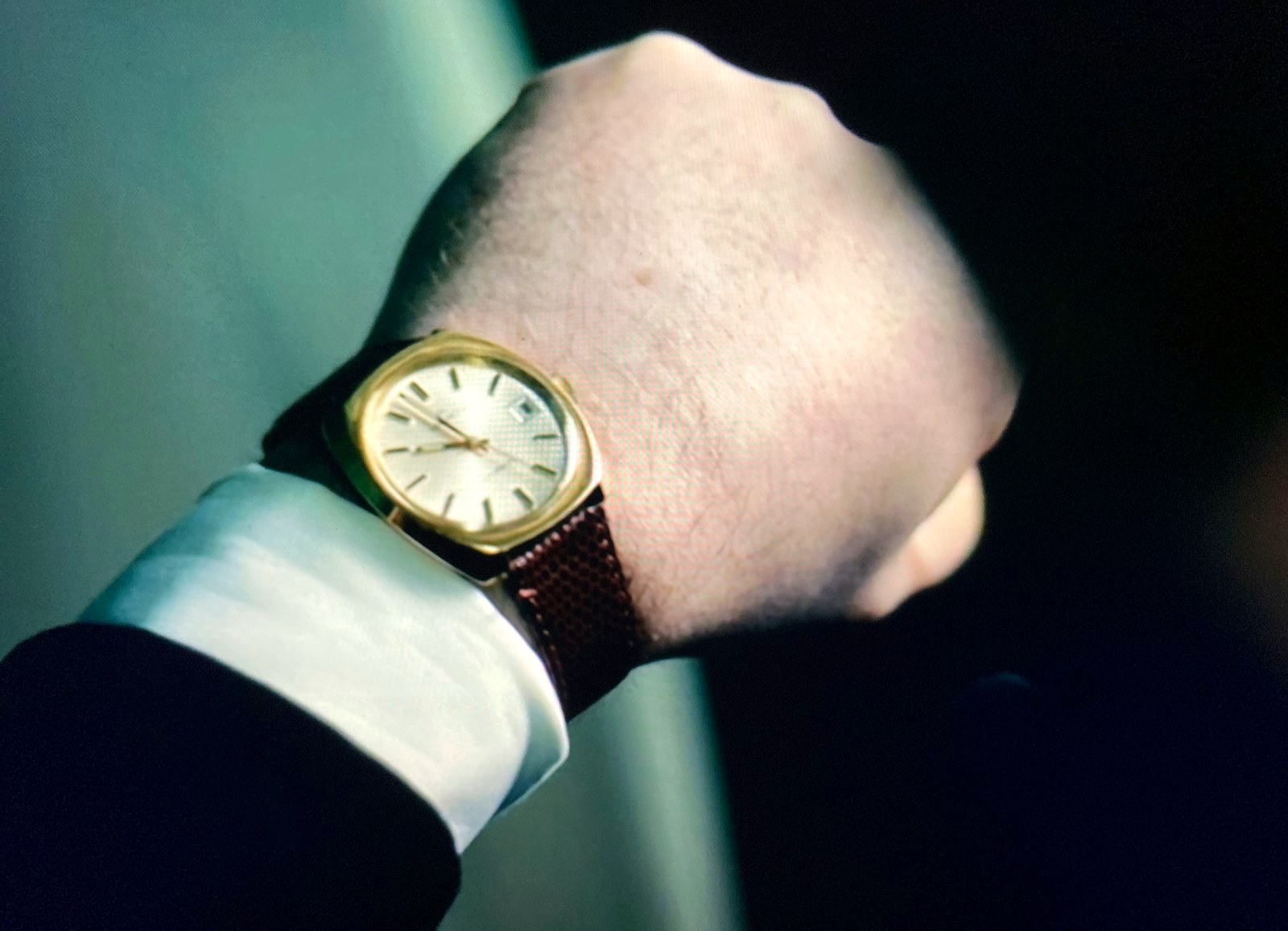
The sleeve rule: the blazer's sleeve ends at the wrist bone and shows a sliver of shirt cuff beneath it, roughly a centimetre, a quarter to half an inch. This is the tailoring rule, and it is the exact reverse of the trench coat's sleeve rule, for a reason worth printing: the trench covers the cuff completely because it is weather equipment, and rain should run off the coat rather than into the sleeve. The blazer is not weather equipment. It is tailoring, and tailoring shows its finished edges: the cuff is part of the assembly, the proof that the layers were chosen rather than collided. Through the body: the fastening button closes without the X of pulled cloth across it, and if the winter plan includes a fine knit beneath, per How to Wear No. 01, the size is bought for that plan honestly, in the shop, not discovered in January.
Five cloths wear the blazer's name
Most blazer failures after the orphan error are cloth errors: the silhouette is widely copied, and the cloth is where the real jacket separates from the photograph of one. A note on our own photography, printed because this page believes in saying so: our photo bank holds no honest blazer-on-body frame yet, so this brief runs on the flat-lay and the cuff rather than a borrowed model shot. The harvest list has the gap, named.
| Cloth | What it is | How it behaves | The ruling |
|---|---|---|---|
| Wool hopsack | An open basket weave in wool, matte and visibly textured | Breathes, resists creasing, shrugs off a day of wear; the texture is what makes it a blazer and not a suit jacket | The default. If a man owns one blazer, it is this cloth. |
| Wool flannel | A soft, matte, brushed wool, the winter weight of the family | Warmer and quieter; drapes softly, pairs with flannel trousers and fine knits | The winter buy. In charcoal it carries the evening row alone. |
| Cotton twill | A sturdy cotton in a diagonal weave, garment-washed in the softer versions | Casual by nature; creases honestly and softens with wear, which is its charm and its limit | The weekend cloth. Never the one for a formal room. |
| Linen | Flax, usually unlined or half-lined, cut soft | The coolest cloth in tailoring; wrinkles as it is worn, and the wrinkle is the texture, not a defect | The summer buy. Buy it relaxed, and let it crease. |
| Shiny polyester | Synthetic woven smooth and finished to photograph like worsted | Shines in daylight, breathes nowhere, pills at the cuff and the seat; worst of all, its smoothness reads as a suit jacket from across the room | The skip. It keeps the silhouette and deletes the cloth, then triggers the orphan read on top. |
The construction tells ride along with the cloth: patch pockets or textured flaps, as above; a half canvas or a fully soft front rather than fused stiffness; buttons with weight to them; and a lining that covers the shoulders and leaves the back to breathe. The type's place on the wider ladder, formality four and warmth two among all twelve jacket types, is set out in the jackets index, and the knits that go under it are indexed in the sweater index.
The outfit matrix
The data team's assemblies, by occasion. The constant in every row is the break: jacket and trouser differ in colour and texture on purpose, and the blazer is the most tailored element in the outfit, with everything under it a degree softer.
| Occasion | Blazer | Under | Below | Shoes |
|---|---|---|---|---|
| Office | Navy hopsack, half-lined | Oxford or dress shirt, tie optional | Grey flannel or tailored trousers | Leather oxfords or derbies |
| Evening | Navy or charcoal flannel | Fine crew neck or roll neck | Dark trousers | Chelsea boots or loafers |
| Weekend | Unstructured hopsack or cotton twill | Plain t-shirt or knit polo | Dark denim or chinos | Clean minimal trainers, or suede |
| Summer | Unlined linen or cotton | Camp collar or linen shirt | Linen trousers or chinos | Loafers, without socks or with invisible ones |
| Travel | Hopsack, the crease resister | Knit polo or an Oxford | Chinos | Shoes that can walk all day |
The office row leans on the Oxford deliberately, as the trench brief does: it is the blazer's oldest partner, and the eight worth owning are ranked in the Oxford Verdict ranking. The trousers in the office and evening rows are the tailored end of the chinos Verdict Card's family and its tailored neighbours; the chino itself carries the weekend and travel rows. The evening row's knit follows the sweater index: fine gauge under tailoring, always.

The Blazer Ruling
Orphan: born alone or not at all; if it came with trousers, it stays with them. Shoulder: yours, bought, never tailored into existence. Stance: fastening button at the waist, bottom button open. Cuff: showing, a sliver, always. Cloth: hopsack by default, flannel for winter, linen for heat; the polyester shine is the skip.
The mistakes
The orphan suit jacket. The smooth worsted jacket, separated from its trousers and worn over chinos in the hope that nobody notices the flap pockets, the padded shoulder and the sheen. Everybody notices, in the way everybody notices a sentence missing its second half. The fix is not a better trouser; it is a blazer, a garment that was born alone and carries the patch pockets and texture to prove it. The orphan rule at the top of this page exists because this is the mistake the whole brief is organised against.
The cruise-ship buttons read. Brass buttons on a navy blazer are the type's oldest uniform, and the buttons alone are not the mistake. The mistake is the full assembly worn at once: brass buttons, navy blazer, white trousers, deck shoes, at which point the outfit stops reading as dress and starts reading as the yacht club, a costume of leisure rather than the thing itself. Break one element and the read dissolves: horn buttons instead of brass, dark trousers instead of white, a textured cloth doing the talking. Keep the uniform's parts. Never wear the uniform.
The sleeve swallowing the cuff. A blazer sleeve that covers the shirt cuff entirely and ends halfway down the hand. It is the most common fit failure in this family because it hides in plain sight: the jacket looks merely soft until the eye reaches the wrist and finds the assembly's finishing edge missing. The sleeve rule above is one centimetre of cloth, and it is the difference between a man wearing tailoring and a man wearing his older brother's jacket. A tailor can shorten a sleeve for very little money. There is no excuse for this one to survive.
The blazer as coat. The blazer worn as the outer layer in real cold or real rain: no warmth to speak of, warmth two on the jackets index, no weather resistance in any of its cloths, and an outfit that reads underdressed rather than layered the moment the weather turns. The blazer is a middle storey. In winter it goes under a coat, the overcoat at formality five or the trench in the rain, and the man who tries to make it the roof of the outfit ends up cold in a good jacket, which is the worst of both garments.
The buying note: principles, not a ranking
An honesty note before the principles: this site has not ranked blazers. There is no blazer Verdict Card, and the desk will not borrow authority it has not earned, so what follows is the system a ranking would use, printed so it can be applied in any shop, including to jackets this site has never handled. Buy the shoulder first: soft or natural, in your size, fitted before anything else is discussed, because it is the one part of an unstructured jacket that cannot be altered into place. Buy the cloth second: hopsack by default, a named cloth with a visible weave, and read the fibre line out loud before trying anything on. Buy the lining for your climate: half-lined or unlined where summers are real, fully lined where the blazer must work through winter under a coat. Buy the stance: the fastening button at your natural waist, tested sitting down. On price, the honest shape of the market is a band rather than a figure: a blazer in a named cloth with honest construction usually starts in the low hundreds at US retail and climbs from there, and the jackets below that band are below it for reasons the fibre line and the shoulder will tell you. The type's standing among all twelve, and the coats that go over it, are in the jackets index; where the blazer hangs among the site's winners is mapped in the Body Map.
Questions, answered
How do you wear a blazer?
As a jacket that was born alone: a soft or natural shoulder in your size, the fastening button at your natural waist and the bottom button open, a sliver of shirt cuff showing at the sleeve, and cloth with texture, hopsack by default. Over it goes nothing; under it goes whatever the day requires, a shirt and tie for the office, a fine knit for the evening, a plain tee or a knit polo at the weekend. The blazer is the middle storey of an outfit, and it fails when it is asked to be a suit, a coat or a costume.
Can you wear a suit jacket as a blazer?
No, and the eye can tell even when it cannot say why. A suit jacket is half of a garment: smooth worsted cloth, flap pockets, a padded structured shoulder, buttons toned to the cloth, and a pair of matching trousers existing somewhere. A blazer is a whole garment: patch pockets or textured cloth, a soft or natural shoulder, horn or metal buttons that contrast, often half a lining or none. Worn over odd trousers, the orphan suit jacket reads as a suit whose trousers wore out. If it came with trousers, it stays with them.
Should a blazer show your shirt cuff?
Yes, a sliver of it, roughly a centimetre. The jacket sleeve ends at the wrist bone and the shirt cuff shows below it, the finished edge that proves the layers were chosen. It is the exact reverse of the trench coat's rule, and the difference is the job: the coat covers the cuff completely because it is weather equipment and rain should run off it, while the blazer is tailoring, and tailoring shows its edges. A blazer sleeve that swallows the cuff and half the hand is not a style. It is a size too big.
What trousers go with a navy blazer?
Grey flannel is the classic answer, and grey in any tailored cloth still leads. Chinos carry the casual rows, dark denim carries the weekend, and linen carries the summer. The rule underneath all of them is a break: the trousers must differ from the jacket in colour and texture clearly enough that nobody reads the outfit as a suit that missed. The one trouser that fails is navy that almost matches the jacket, which is the orphan read from below.
Can you wear a blazer with jeans?
Yes, and it is the blazer's best weekend row, under three conditions: the blazer is unstructured and textured, hopsack, flannel or cotton twill rather than a smooth worsted; the denim is dark and straight, with the colour break from the jacket kept wide; and the shirt position is filled by a knit polo, a plain tee or an untucked Oxford rather than a dress shirt and tie. The structured blazer over jeans is two outfits arguing. The soft one over dark denim is a decision.
Has Young Cotton ranked blazers?
Not yet, and this page will not pretend otherwise: there is no blazer Verdict Card on this site. What this page gives instead is the system a ranking would use, the orphan rule and its tells, the fit rules, the cloth classes in order and the outfit matrix, so any blazer can be judged before the ranking exists. On the jackets index the type itself stands at formality four, warmth two: the lightest formal layer a man owns, scored as one.
Next
The family this brief belongs to: all twelve jacket types indexed in types of jackets; the knits that go under it in types of sweaters; the layer beneath both in How to Wear a Cardigan; the coat that goes over it in How to Wear a Trench Coat; and the season's full grid in the Fall Edit.