
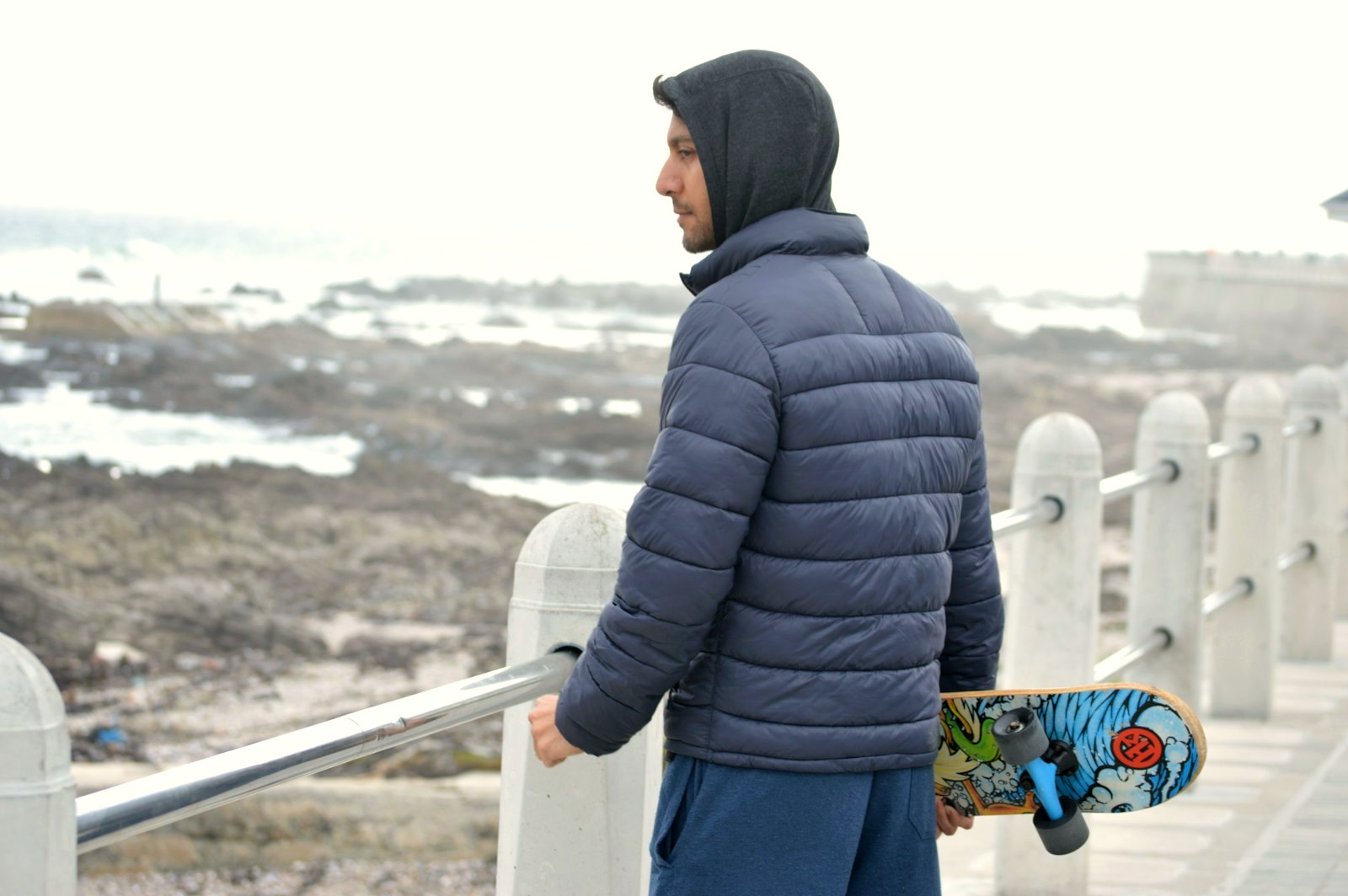
The puffer at work: one of twelve types on the ladder, and the warmest of them. The index exists because jacket, like shirt, is one word covering very different garments.
Checked and updated October 2026
The ruling, up front: there are twelve types of jacket that cover a man's whole year, and each is defined by three things: its cloth, its cut, and the weather it was built for. This page indexes all twelve and scores each for formality and warmth from one to five, with the season each type owns and the one buying rule that decides it. The overcoat tops the formality ladder at five; the puffer tops the warmth ladder at five and sits at the bottom of the other one; the trench coat, formality four and warmth two, is a rain instrument and is scored as one. Own across both ladders, not along one rung of either.
On this page: the index, the long coats, the work and field family, the short jackets, the weather equipment, the buying rule, questions.
The index: twelve jackets, two ladders
The scores are the data team's compiled judgement, built from cloth, silhouette, construction and how each type behaves in the rooms and weather men actually wear them in. The two ladders pull against each other by design: the cloths that insulate best, lofty nylon and down, are the cloths that read least formal, and the cloths that read most formal, smooth wool and gabardine, insulate least. Every jacket purchase is a position taken on that trade, and the table prints both numbers so the position is taken on purpose.
| Type | Cloth | Formality | Warmth | Its season | The one rule |
|---|---|---|---|---|---|
| Overcoat and topcoat | Wool, wool and cashmere | 5 | 4 | Late autumn through winter | Buy it to fit over a blazer; a coat that only fits over a t-shirt is a costume. |
| Trench coat | Cotton gabardine, bonded cotton | 4 | 2 | The wet shoulder seasons | Buy the cloth and the length, not the epaulettes. Gabardine first. |
| Blazer as jacket | Wool hopsack, cotton twill, unlined | 4 | 2 | Spring and summer evenings, mild autumn | Unstructured and unlined, or it is a suit jacket missing its trousers. |
| Pea coat | Heavy melton wool | 3 | 4 | Autumn through winter | The cloth should nearly stand up on its own. Soft melton is a sweater with buttons. |
| Harrington | Cotton twill, suede | 3 | 2 | Spring, mild autumn | The stand collar and the ribbed cuff decide it; everything else is a windbreaker. |
| Leather jacket | Lambskin, steerhide | 3 | 3 | Autumn and spring | Buy the hide and the hardware, in one style, cut close. Leather does not forgive. |
| Field jacket (M-65) | Cotton sateen, cotton and nylon | 2 | 3 | Spring and autumn, over layers | Four pockets you will actually use, cut closer than the surplus original. |
| Chore coat | Cotton canvas, moleskin, denim | 2 | 2 | Spring through autumn, layered | Buy the cloth heavy and the colour honest. It should fade, not pill. |
| Denim trucker | Denim, mid to heavy weight | 2 | 2 | Spring through autumn | Never the same wash as the jeans. The colour break is the outfit. |
| Bomber | Nylon twill, suede, leather | 2 | 3 | Autumn and spring | Cropped and clean. The further it drifts from the flight original, the faster it dates. |
| Puffer | Nylon shell, down or synthetic fill | 1 | 5 | The coldest weeks of winter | Warmth is fill and baffle, not branding. Buy for the coldest week, not the average day. |
| Rain shell | Membrane laminate, taped seams | 1 | 1 | Rain, twelve months a year, over layers | Taped seams and a named membrane, or it wets through in twenty minutes. |

The long coats: overcoat, trench, pea coat, blazer
The overcoat is the formal ceiling of outerwear and the only type on this index built to be worn over a suit as a matter of course: a long wool body, a clean shoulder, room in the cut for tailoring beneath. Its warmth, four, is density rather than loft, which is why it can still walk into a restaurant. The topcoat is its lighter sibling, same silhouette, thinner cloth, for the months when the overcoat is too much coat. The trench coat is the long coat's rain twin, scored warmth two without apology: it was never an insulation garment. Its cloth, its belt and its length rules are a full brief of their own, How to Wear No. 02. The pea coat is the navy's answer compressed: double-breasted, hip length, melton wool heavy enough to block a harbour wind, the warmest short coat on the index and the one that pairs with everything from tailoring to denim without changing its expression.
The blazer as jacket is the border case of this family, as the overshirt is of the shirt family: an unstructured, unlined blazer worn as the outer layer in mild weather. It earns its place at formality four because nothing else at that rung travels as light. Its one rule is the orphan rule: a structured suit jacket worn without its trousers reads as a mistake, while a blazer cut to live alone, patch pockets, soft shoulder, no lining, reads as a decision.
The work and field family: field jacket, chore coat, trucker
These three were built for labour and adopted for their texture, and they are judged by workwear's laws: cloth first, hardware second, silhouette third. The field jacket, the M-65 pattern, is the layering engine of the family: four bellows pockets, a drawstring waist, a cut made to go over whatever the day requires, and a warmth of three that climbs with what is under it. The chore coat is the French workshop's contribution, three or four patch pockets on heavy cotton, and the softest-shouldered work jacket ever standardized: it is the type the current wardrobe reaches for when a blazer is too much and a shirt is not enough. The denim trucker is the family's citizen, as the Oxford is the shirt family's: waist length, close cut, the one jacket that pairs with every trouser a man owns, provided the colour-break rule is kept. Its cloth cousins, the denim and chambray shirts, are indexed with their family in the shirt index.
Between this family and a true coat sits the overshirt, the layer this site ranks rather than indexes: the seven worth buying are scored in the overshirts Verdict Card. And above the whole family in weight and intent stands the statement end of outerwear, the embroidered souvenir jacket decoded in the sukajan guide, which obeys none of these laws and is worn for exactly that reason.
The short jackets: Harrington, leather, bomber
The waist-length family trades coverage for silhouette, and each of its three types is a complete argument about what a jacket is for. The Harrington is the neat one: a stand collar, ribbed cuffs and hem, a body that ends at the belt and behaves in rooms the others cannot enter, formality three, the highest of the short family. In suede it climbs toward the blazer; in cotton twill it is the spring default. The leather jacket is the permanent one: one hide, one style, bought once and worn for a decade, which is why its rule is about materials rather than fashion. The styles are a closed set, the cafe racer, the double rider, the flight jacket, and the index's advice is to pick the one your wardrobe already believes and never hedge between two. The bomber is the flight family's civilian: cropped, ribbed, warmer than it looks at three, and the most fashion-exposed type on this page, which is why its rule is restraint. The closer a bomber stays to the original flight pattern, the longer it stays wearable.
The weather equipment: puffer and rain shell
The last two types are not fashion garments and this index will not pretend otherwise: they are equipment, scored on specification. The puffer warms by trapped air, and its numbers are printed by its makers for anyone who reads them: fill power and fill weight for down, baffle size for the silhouette. A long, large-baffle puffer in a matte shell is the deep-winter answer, warmth five, and on this site's figure it is one of the switchable torso layers, mapped with every other winner in the Body Map. The rain shell is the opposite instrument: warmth one, because a shell insulates nothing and is not meant to. It is a waterproof membrane with taped seams worn over the day's real insulation, twelve months a year, and its buying rule is pure specification: if the seams are not taped and the membrane is not named, it is not a rain shell, whatever the colourway says. The trench coat's relation to this type is the classic one: gabardine sheds weather by weave and breathes while it does it, at formality four. The shell sheds it by chemistry, at formality one. Choose by the room at the end of the rain.
The Jacket Ruling
The ladders: formality runs overcoat 5, trench and blazer 4, pea coat, Harrington and leather 3, the work family and the bomber 2, puffer and shell 1; warmth runs puffer 5, overcoat and pea coat 4, leather, field and bomber 3, and the rain instruments at the bottom by design. The rule: buy the cloth and the specification before the silhouette, and the silhouette before the colour. The wardrobe error: five jackets on the same rung of both ladders, usually five versions of casual, leaving the formal end and the weather end bare.
The one buying rule, and the set
Buy cloth and specification first, silhouette second, colour last. That is the whole system in one sentence: the cloth decides the formality, the warmth and the lifespan, the cut decides the rooms, and the colour decides nothing that matters after the first month. The set a man actually needs is three, one from each storey of the index: a long coat chosen by climate, overcoat where the winter bites and trench where it rains; one short jacket that carries the personality of the wardrobe, a trucker, a Harrington or a leather; and one piece of weather equipment, puffer or shell, bought the way equipment is bought, by the printed spec. The seasonal grid that shows these types assembled, scored piece by piece, is the Fall Edit, and the layers that go under all twelve live in the shirt index and How to Wear No. 01.
Questions, answered
What are the main types of jackets for men?
Twelve cover the whole wardrobe: the overcoat, the trench coat, the blazer worn as a jacket, the pea coat, the Harrington, the leather jacket, the field jacket, the chore coat, the denim trucker, the bomber, the puffer and the rain shell. Each is defined by its cloth, its cut and the weather it was built for, and this page's index scores each one for formality and warmth from one to five, with its season window and its one buying rule.
What is the most formal type of jacket?
The overcoat, formality five on this page's index, in wool or a wool and cashmere cloth, cut to be worn over a suit. Below it the trench coat and the unstructured blazer sit at four. Formality in outerwear is a property of cloth and silhouette together: a smooth wool cloth and a clean shoulder read formal at any temperature, which is why the puffer, the warmest type on the index, is also the least formal.
What is the warmest type of jacket?
The puffer, warmth five on this page's index, provided the fill is real: down or a serious synthetic, in baffles sized to the cold. Trapped air is the insulation, and no woven cloth competes with it in deep winter. The dressed warmth below it is wool: the overcoat and the pea coat at four, which warm by density rather than loft and can still walk into a restaurant. Buy the puffer for the coldest week of your year, not the average day.
What is the difference between a trench coat and an overcoat?
They answer different weather. A trench coat is a rain coat: cotton gabardine, belted, built to shed water in the wet shoulder seasons, warmth two on this index. An overcoat is a cold coat: heavy wool, built to insulate from late autumn through winter, warmth four. The trench goes over tailoring to keep it dry; the overcoat goes over tailoring to keep it warm. Wearing the trench as a winter coat, or the overcoat as a rain coat, is asking each to do the other's job.
How many jackets should a man own?
Three cover a year, one from each storey of this index: a long coat for the formal and cold end, chosen by climate, overcoat where winters bite and trench where they rain; one short jacket that carries the personality, a trucker, a Harrington or a leather; and one piece of weather equipment, a puffer or a rain shell, bought by specification rather than taste. Everything beyond the three is range, not coverage, and should be bought as range: knowingly, and after the three earn their keep.
Is an overshirt a jacket?
It sits on the border, and this site scores it on the shirt side of the line: a shirt by collar, a jacket by build, worn as a layer rather than as weather protection, which is why it appears in our types of shirts index at formality two. The distinction that matters is function: the twelve types on this page are built to face weather or formality, and the overshirt is built to sit between a shirt and one of them. The overshirts worth buying are ranked in their own Verdict Card.
Next
From the index to the briefs: the trench coat gets the full treatment in How to Wear a Trench Coat; the border layer is ranked in the overshirts Verdict Card; the types are worn, with scores pinned, in the Body Map; and the season's assemblies are in the Fall Edit. The statement end of the family is decoded in the sukajan guide.