
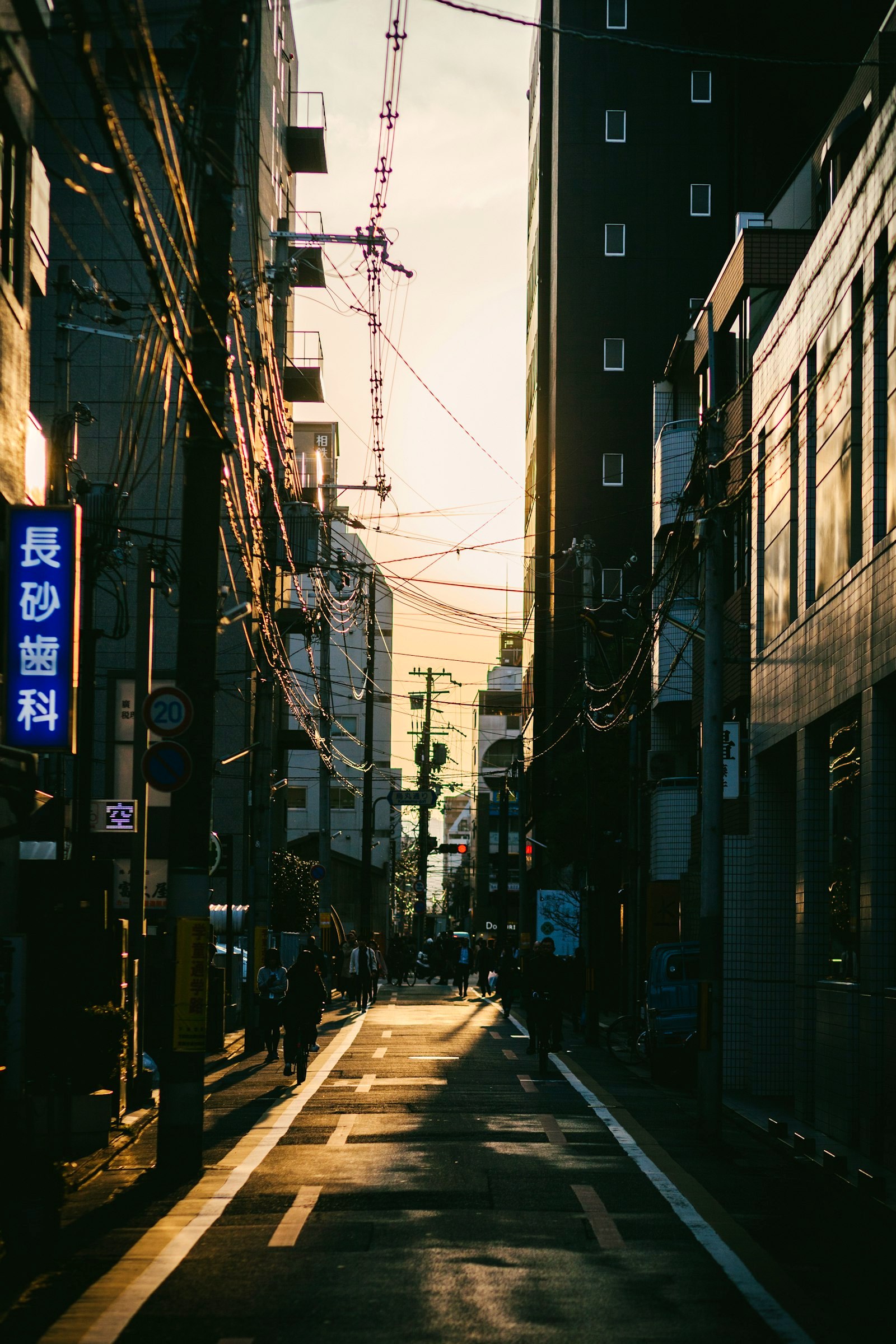
The sukajan comes from streets like this one, outside the base gates at Yokosuka, where tailors embroidered jackets for men about to ship home.
The short version: a sukajan is a reversible satin blouson with real embroidery, born in post-war Yokosuka, and the whole category divides on one test: thread or print. The heritage standard is Tailor Toyo, scoring 92 on the house basis. Honest Japanese mid-market jackets score 81. The printed tourist version, sold in every souvenir street on earth, scores 34 and is the skip: it keeps the picture and deletes the craft, which our Japanese roundup warned is the one unforgivable trade in Japanese clothing. This guide reads the jacket as data first: cloth, embroidery, construction, fit. Then it tells you how to wear one.
Checked and updated October 2026
What a sukajan is, and what it is not
A sukajan is a souvenir jacket in the literal, honourable sense: a garment made to carry a place home. The cloth is satin, most often acetate. The construction is a blouson, ribbed at the cuff and hem, cut short. The back and chest carry embroidery, dragons, tigers, eagles, cherry blossom, Mount Fuji, maps of Japan, worked in contrasting rayon thread that catches light the cloth does not. And a proper one is reversible: turn it inside out and a second, finished jacket appears, often in a different cloth or colour, sometimes with its own smaller work.
What it is not: it is not a bomber, though the silhouette borrows from flight jackets; it is not a varsity jacket, which belongs to American school sport; it is not a happi coat or any other traditional garment, and it carries no ceremonial meaning. It is not, whatever a marketplace listing says, any shiny jacket with a dragon on it. The dragon is the decoration. The embroidery is the garment.
Yokosuka, told straight
The origin is documented well enough to tell without decoration. After the Second World War, American servicemen stationed at the naval base at Yokosuka, south of Tokyo, took their jackets to local tailors, first on and around Dobuita Street outside the base gates, and had them embroidered with Japanese motifs as souvenirs of the posting. The name records the geography: Suka, from Yokosuka, plus jan, the slang clipping of jacket. Shops supplying the military exchanges formalised the trade, among them Kosho and Company, the predecessor of Toyo Enterprise, whose Tailor Toyo line still makes the jackets today. What began as a souvenir became, over decades, a fixture of Japanese street clothing, worn by everyone from rockabillies to the runways that keep rediscovering it. That is the whole history this page needs, and it is the version the evidence supports.
The anatomy, as data
Four systems decide whether a sukajan is the real article. Read them in this order when you shop, because each one is harder to fake than the last.
| System | The classes | What the desk rules |
|---|---|---|
| Cloth | Acetate satin is the standard: fluid drape, a deep rather than bright sheen, the cloth Tailor Toyo builds on. Rayon satin is the vintage-accurate class, softer and more fragile, dry-clean territory. Velveteen is the matte winter class, often the second face of a reversible jacket. Polyester satin is the cheap class, with a hard shine that reads plastic in daylight. | Acetate for the jacket you keep. Polyester is the first tell of the tourist version. |
| Embroidery | The traditional work is yokoburi, horizontal needle machine embroidery guided by hand, which gives the motifs their relief and slight life. Density is the measure: a serious back panel is covered, layered thread on thread, with the map or animal built from thousands of stitches. Print is the zero class: flat ink, perfect regularity, no relief at all. | Run a hand over the back. If you cannot feel it, it is not embroidery, and the jacket's main claim is false. |
| Construction | Fully reversible is the standard: two complete faces, a zip that works from both sides, ribbing finished to be seen from either. One-face jackets with a lining exist at every lower tier and delete the garment's best trick. | Reversible is not a feature. On a sukajan it is the definition. |
| Ribbing and trim | Knitted cuffs, collar and hem in acrylic or wool blends on the heritage jackets, holding their snap for years. Striped athletic ribbing belongs to the varsity family, not this one. | Sagging ribbing on a new jacket predicts the whole garment's standards. |
The fit ruling
A sukajan fits like a blouson and should be judged as one: room through the chest for a layer under it, the shoulder easy, the body ending at the belt line, the ribbed hem doing the shaping. Worn open, the embroidery frames the plain clothes under it. Worn zipped, it is a short, full jacket, and that fullness is the point.
The ruling exists because of the other version. The US souvenir-shop sukajan is cut long and boxy, sized like a rack of airport stock, with the hem dropping past the belt and the body hanging straight. It reads as merchandise because it is cut as merchandise. Against it: cropped, full, ribbed home. One more sizing fact, printed plainly: Japanese makers cut one to two sizes smaller than American labels, a fact their own retailers state openly. Size up, and trust the maker's centimetre chart over the letter on the tag.
How to wear it
The one-statement-piece rule. The jacket is the loudest thing you own that is still clothing. Everything under and below it goes quiet: a plain white tee or a plain Oxford, straight trousers or plain denim, quiet shoes. The embroidery is the outfit's entire argument; a second loud piece is a second argument, and the two cancel.
What it replaces. In an ordinary wardrobe the sukajan takes the slot of the statement layer, the printed camp shirt, the loud knit, the graphic anything. You do not add it to those pieces. You retire one of them.
The volume knob. The reversible construction is a styling tool. Embroidered face out for the evening, the plain or velveteen face when the room is quieter. Two registers, one garment, which is why the construction section above refuses to call reversibility optional.
The office line. It never crosses. Not the embroidered face, not the plain face, not on a Friday. The sukajan is weekend and evening clothing with a craft pedigree, and dressing it for work does not elevate the jacket, it misreads both rooms. Our Body Map files its torso layer among the coats for the same reason: it is outerwear with a point of view, worn where points of view are welcome. The desk that covers Seoul's softer tailoring in the Korean roundup applies the identical rule to every statement piece: one at a time, and never apologised for.
The buying ladder
Five ways to buy this jacket, scored briefly on the house basis, cloth and craft first. The data element is constant across the ladder: what the cloth is, what the embroidery is, how the jacket is built.
| Option | Cloth | Embroidery | Construction | US price | Score |
|---|---|---|---|---|---|
| Tailor Toyo acetate sukajan | Acetate satin, sometimes velveteen second face | Rayon thread, hand-guided machine work, full back panels | Fully reversible, acrylic ribbing | $450 to $670 | 92 |
| Mister Freedom × Tailor Toyo | Acetate, limited cloth runs | Exclusive motifs, Toyo workmanship | Fully reversible | $950 to $990 | 88 |
| Houston (Japan) | Acetate and satin blends | Real machine embroidery, simpler panels | Reversible on the core lines | $200 to $300 imported | 81 |
| The DTC embroidered sukajan | Acetate or acetate blends, thinner hand | Real embroidery, lighter density | Usually reversible | $140 to $198 | 68 |
| The printed tourist sukajan | Polyester satin-look | Print. None. | One face, lined | $30 to $90 | 34 |
Tailor Toyo (92) is the standard the category is measured against: Toyo Enterprise has supplied this trade since the souvenir years, and the current acetate jackets, sold through Japanese retailers like Hinoya and their US stockists, carry rayon-thread embroidery with the relief the hand test looks for. Buy this one if the jacket is a keeper. Mister Freedom's collaborations with Toyo (88) are the collector ceiling, limited runs at $950 to $990, superb and priced for people who already own the standard. Houston (81) is the honest Japanese mid-market: a domestic maker since the 1970s selling real embroidery at domestic prices, which land in a $200 to $300 band once imported. The direct-to-consumer embroidered class (68), labels like Koisea selling acetate jackets at $140 to $198, threads real embroidery onto thinner cloth with sizing that runs small even by Japanese standards; a fair first jacket, bought with the size chart open. The fifth row is below, where it belongs.
The Skip: the printed tourist sukajan
It hangs in every souvenir street and airport on earth: dragon across the back, satin shine, a price between $30 and $90, and not one stitch of embroidery anywhere on it. The motif is printed, the cloth is polyester wearing satin's name, and the second face is a lining. Our Japanese roundup put the general rule in print: a purchase that keeps only the graphic has deleted the point. This jacket is that rule's purest case. If the budget is $90, the desk's advice is to keep the $90 and save toward the real ladder. A man in a plain jacket looks dressed. A man in a printed sukajan looks souvenirred.
Questions, answered
What is a sukajan jacket?
A sukajan is a Japanese souvenir jacket: a blouson, usually satin, embroidered across the back and chest with motifs like dragons, tigers, eagles and maps, and usually reversible. The name joins Suka, from Yokosuka, the port city where the style was born, with jan, slang for a jacket. It began as embroidery work done for American servicemen after the Second World War and became a permanent piece of Japanese clothing.
How can you tell a real sukajan from a fake?
Turn it over and run a hand across the back panel. Real embroidery has relief: raised thread you can feel, slight irregularity, and thread continuing on the inside of the garment. A print is flat, perfectly regular, and often slightly glossy. Then read the cloth line, acetate or rayon on a real one, polyester on the tourist version, and check whether the jacket is genuinely reversible, with a finished second face rather than a lining.
How should a sukajan fit?
Like a blouson: room through the chest, a raglan or set shoulder, ribbed cuffs and hem, and a body that ends at the belt line, worn over one layer. It should read cropped and full, never long and boxy. Japanese sizing runs one to two sizes smaller than American sizing, so size up and check the maker's chart. The long, loose fit of the airport souvenir version is the tell that it was cut for a rack, not a body.
How much does a good sukajan cost?
The heritage standard, Tailor Toyo's acetate jackets, runs about $450 to $670 at US-reachable retail. Honest Japanese mid-market jackets land in a $200 to $300 band imported. Real embroidery from direct-to-consumer labels starts around $140. Under about $90, what is on offer is a print on polyester, whatever the listing calls it.
How do you wear a sukajan without looking costumed?
Treat it as the only loud thing you are wearing. Plain tee or plain Oxford under it, plain trousers, quiet shoes, and the jacket does all the talking. Wear it open in the evening and on weekends. It replaces the statement layer of an outfit, the printed shirt or the loud knit, and it never crosses into an office, on either face.
Why is one side of a sukajan plain?
Because it is two jackets. A proper sukajan is fully reversible, with a finished second cloth, often a contrasting colour or a velveteen, and sometimes its own smaller embroidery. The plain face is the volume knob: full embroidery out, or the quiet side when the room calls for less. A jacket with a mere lining is a cheaper construction wearing the name.
How this guide stays honest
The history above is the documented version: the Yokosuka souvenir trade, the tailors outside the base, Toyo Enterprise's line of supply. Where the record is folklore, this page does not print it. Prices were checked this session at US-reachable retail: Tailor Toyo's acetate range at $450 to $670, the Mister Freedom collaborations at $950 to $990, direct-to-consumer embroidered examples at $140 to $198. Houston's figure is a labelled band, converted from its Japanese domestic pricing, and is printed as a band for that reason. Merchant routes may earn us a commission at no cost to you; the disclosure carries the details, and the methodology carries the scoring basis. No commission has ever raised a stitch count on this desk.