

One half of the pairing, captioned as exactly that: the blazer itself, navy and soft, in the frame our credits log carries for the jacket's own Card. The bank holds no frame of the pairing entire, no textured blazer over dark denim in any register, and the care section prints that absence rather than dressing a suited leg as this outfit.
Checked and updated October 2026
The ruling, up front: a blazer with jeans is not tailoring relaxed or denim dressed up; it is two garments walking toward each other and meeting in the middle of the formality scale, and it works only where they meet. The blazer comes down: unstructured, soft in the shoulder, patch-pocketed, in a cloth with visible texture, hopsack, flannel, tweed. The jean comes up: dark, one-wash or lightly washed, undistressed, straight or gently tapered, a leg that could take a crease line. And the law’s teeth are reciprocal: each half is charged for the other’s failures. A worsted suit jacket over jeans is not elevated denim, it is a suit orphaned. Ripped or faded jeans under a blazer do not rise to the jacket; they pull the jacket down, and the better the blazer, the further it falls. Inside that law this brief prints the pairing’s own rulings: the cloth pairings, the colour table with its one refusal, the shirt layer and its tie ruling, the shoe ladder, the fit arithmetic of jacket length against denim rise, and the rooms. On scores: no garment is scored here. The numbers quoted are the parent briefs’ Cards, cited as what they are.
This brief: the decisive rule · cloth and texture · the colour table · the shirt layer · the shoe ladder · the fit law · the rooms · the looks · the mistakes · care and our photography
The decisive rule: the two halves meet in the middle, and each is charged for the other
Every brief in this family rules a garment, and two of them have already ruled this pairing in passing, from opposite sides, in identical words. How to Wear No. 03 calls it the blazer’s best weekend row and prints its three conditions; How to Wear No. 05 states the same contract from the denim’s side and calls the obedient version a decision. What neither parent brief prints, because neither is the pairing’s page, is the law underneath the conditions, and the law is a meeting. The blazer and the jean stand at opposite ends of the wardrobe’s formality scale, and the pairing works at exactly one point on it: the middle, where each garment has travelled halfway toward the other. The blazer’s journey down is construction: out goes the padded shoulder, the fused front, the flap pocket and the smooth cloth, and in their place the soft shoulder, the patch pocket and the visible weave that say this jacket was born alone and knows it. The jean’s journey up is finish: out goes the fade, the whisker, the rip and the stack at the ankle, and in their place the deep even colour, the clean hem and the tapered leg that say this trouser is read, for one outfit, as tailoring’s casual citizen. Where the journeys are both made, the outfit is a single decision, coherent at a glance and at a photograph’s enlargement. Where either journey is skipped, the pairing does not degrade gracefully. It splits, visibly, into two outfits arguing across the waistband, the phrase both parents use because it is the fact.
The law’s second clause is what gives it teeth, and it is printed here as the pairing’s signature ruling: each half is charged for the other’s failures. In most outfits a weak piece is a local fault, a bad shoe under a good suit. In this pairing the faults are contagious by design, because the outfit’s whole claim is the meeting, and a failure at either end is read as a failure of the meeting itself. Run the charges. The smooth worsted jacket, structured, sheened, flap-pocketed, is not rescued by standing over denim; the denim exposes it, because beside a cloth as honest as denim the jacket’s suit-evidence, printed entire at No. 03, reads louder, and the outfit is judged as an orphan suit with jeans standing where its trousers should be. The jacket is charged with the pairing’s failure though the jeans beneath it were blameless. Run it the other way. The faded, whiskered, ripped jean under a good hopsack blazer does not borrow the jacket’s polish; the jacket borrows the jean’s leisure, and reads, by the end of the evening, as a man who dressed his top half for one occasion and his bottom half for another and split the difference at the belt. The jeans are charged, and so is the blazer, which is why this brief refuses the common consolation that a great jacket can carry a tired jean. In this pairing nothing carries anything. That is the price of the meeting, and it is also the pairing’s defence: obeyed at both ends, it is the most useful outfit in the modern wardrobe, the one assembly that is correctly dressed in more rooms than any other a man owns.
The scored record under the law is the parents’, and it is printed here as the pairing’s exhibits. Verdict Card No. 63 ranked the blazer shelf, and its winner is the Spier & MacKay Navy Hopsack Sport Coat at 85: a named, textured cloth, born alone, the species this brief sends over denim, its victory on that Card a victory for exactly the construction the decisive rule demands. Verdict Card No. 11 ranked the jeans inside the Denim Index’s classes, and the Levi’s 501 Original won it at 81, the straight, honest leg the index’s dark classes are drawn around; the classes themselves, the one-wash dark and the black, stand at formality three on that Index, the highest rung denim reaches, one step below the blazer’s four on the jackets index, which is the scale’s own picture of this brief’s law: two garments one step apart, each asked to close half the distance. Nothing in this brief is scored, and those numbers are cited as garment scores, on garment Cards, for the propositions they prove: the jacket the pairing wants exists and has been ranked, the jean the pairing wants exists and has been ranked, and what remains is the wearing, which is this page’s jurisdiction entire.
Cloth and texture: the jacket brings the weave, the denim brings the depth
The pairing’s cloth law is a division of labour, and it follows from the decisive rule’s geometry. The two garments meet in the middle, but they do not meet as equals in every property: the jacket supplies the outfit’s texture and the jean supplies its depth of colour, and a pairing in which either garment tries to do the other’s job fails in a characteristic way. Texture is the blazer’s passport into denim’s company because denim is itself a textured cloth, a diagonal twill with a slub and a fade pattern written into its nature, and a jacket standing beside it must speak the same material language or be read as a visitor from the suiting floor. The hopsack’s open basket weave, the flannel’s brushed nap, the tweed’s fleck and nub: each is a surface with an argument in it, and beside denim each reads as a colleague. The smooth worsted’s surface has no argument; it is finished, sealed, faintly sheened, and beside denim’s honest twill it reads as what No. 03 proves it is, half of a suit. So the first cloth ruling is the parents’, restated as a pairing law with its reason attached: smooth worsted is refused over denim, not because it is formal but because it is smooth, and its smoothness, blameless over its own trousers, becomes its indictment over a textured leg.
Hopsack is the pairing’s default cloth, for the reasons No. 03 seats it first among the blazer cloths and one more that belongs to this page. It breathes, it resists creasing, its weave is visible at the distance a conversation happens, and it is the cloth of the Card’s winner at 85. The pairing’s own reason is its weight of presence: a hopsack jacket has enough surface to stand against denim’s visual weight, where a finer cloth, however correct its construction, can look out-argued by a heavy jean. Flannel is the winter form: matte, brushed, quiet, its nap the closest thing tailoring owns to denim’s softness, and the pairing it makes with a dark jean is the cold season’s most reliable dressed assembly, the two cloths reading as one family at two registers. Tweed is the pairing’s most forgiving cloth and its ceiling of casualness in the other direction: the flecked, nubbed surface is so far from suiting that the orphan question never arises, and a tweed over dark denim is the countryside’s version of the outfit, licensed entire; its limit is the room’s, since tweed’s argument is loud enough to cap the pairing’s formality below flannel’s. Cotton twill is the weekend cloth, No. 03’s ruling and this brief’s: a twill jacket over a twill jean is the pairing at its most casual, two workwear descendants in conversation, and it obeys the colour law below with extra care because the cloths’ kinship makes the break carry the whole outfit.
Linen is the summer form, with its condition printed. An unlined linen blazer over a dark lightweight jean is the hot season’s version of the pairing and it is licensed, the linen’s wrinkle being, as No. 03 rules, its texture rather than its defect. The condition is the jean’s weight: a heavy raw jean under a linen jacket is two seasons in one outfit, the leg arguing October while the jacket argues July, so the summer pairing takes the index’s lightweight classes in their darkest washes and stops there. One refusal closes the section, the cloth that fails both halves of the law at once: the shiny synthetic, No. 03’s named skip, woven smooth and finished to photograph like worsted. Over trousers it merely fails as a blazer. Over denim it fails twice, its smoothness triggering the orphan read and its sheen, against denim’s matte honesty, reading as the cheapest surface in the outfit by a distance no other piece can close. The pairing has no seat for it.
The colour table: navy over indigo, and the one refusal
The pairing’s colour law is inherited and extended. From No. 05 it takes the break: jacket and leg must differ clearly in colour and texture, or the eye merges them and reads a suit that missed. From No. 03 it takes the same law from the jacket’s side, whose one failing trouser is the navy that almost matches. What this brief adds is the pairing’s working table, because blazer-and-jeans has a default combination whose difficulty neither parent had reason to isolate: navy over indigo is the pairing’s first form and its hardest, the two blues near enough in family to want to merge and different enough in substance to refuse to. The combination is licensed, it is the classic, and it survives on the break’s second term: where the colours approach, the textures must separate. A hopsack’s open weave over denim’s smooth dark face is a real break, matte against matte but weave against twill, and it widens as the jean darkens: the deep one-wash indigo, nearly black-blue at the seam, gives the navy jacket a ground dark enough to stand on. The failure is the mid-wash jean under the navy blazer, the two blues meeting in the middle of their range and merging into one blue column with a belt in it, the pairing’s commonest colour accident and the reason the table below grades combinations rather than garments.
| The jacket | The jean | The ruling |
|---|---|---|
| Navy hopsack or flannel | Deep indigo, one-wash | The default. Licensed on the texture break, the weave against the twill, and on the jean’s depth: the darker the indigo, the clearer the navy’s ground |
| Charcoal flannel or tweed | Indigo, dark to mid-dark | The quiet form. Grey over blue is the pairing’s easiest break, colour doing the work texture does in the default, and the cold season’s most forgiving assembly |
| Brown, tobacco or olive textured cloth | Indigo, one-wash or mid-dark | The earth form. Licensed and underused: the warm jacket over the cool leg is a break by temperature as well as shade, and it takes the suede shoe of the ladder below as its natural finish |
| Navy or charcoal, any licensed cloth | Black | The evening form. The break survives in tone, the black leg darker than either jacket, and No. 05’s warning stands entire: the black jean grounds the outfit, it does not impersonate a trouser in a formal room |
| Black | Black | Refused. The colour half of the break is gone, texture alone cannot hold two dark surfaces apart at distance, and the read is the orphan read in monochrome: a suit that missed, in black |
Two corollaries close the section. The first is the near-match in its denim form: a navy jean, the dyed-dark jean that is not quite indigo and not quite black, under a navy blazer is the table’s hidden refusal, worse than the black-on-black it resembles, because the two blues differ just enough to prove they were meant to differ and not enough to succeed. The second is the light jean’s licence, stated so the table is not misread as a ban: a faded or ecru jean has its blazer rows, in summer, under the cotton twill and linen jackets of the cloth section, where the pairing’s whole register has dropped a step and the meeting happens lower on the scale. What the light jean may not do is stand under the flannel or the hopsack in the pairing’s dressed form and claim the default’s authority. The meeting place moves with the season; the law that the halves must meet does not.
The shirt layer: the middle held, the tie ruled
Between the jacket that came down and the jean that came up stands the layer, and its job is the pairing’s job in miniature: hold the middle. The layer is graded by a single test, whether it belongs to both halves’ worlds at once, and the garments that pass are the soft register’s: the Oxford button-down first, the pairing’s oldest citizen, its buttoned collar and matte oxford cloth equally at home under tailoring and over denim, ranked as a shelf at the Oxford Verdict ranking and worn here tucked in the dressed rows and untucked only where the room and the jean both allow it. The fine crew knit stands beside it for the cold rows, the knit No. 03’s matrix seats in its evening row, fine gauge under tailoring always. The knit polo carries the warm rows, the plain tee carries the weekend end of the pairing and no further, and the roll neck carries the winter’s dressed rows entire, on the terms How to Wear No. 60 prints for the knit under tailoring: fine gauge, dark colours, worn as a base layer rather than a sweater, a garment whose company with a blazer over dark denim is that brief’s logic at one step less formality, the suit exchanged for the pairing and the laws surviving the exchange.
The dress shirt is refused, and the refusal is a pairing ruling rather than a shirt ruling, because the dress shirt is a fine garment in its own rows. Its offence here is directional: a formal shirt, smooth poplin, cutaway or spread collar, French cuffs at the extreme, pulls the outfit’s top half upward, toward the suit’s register, at exactly the moment the jean is holding the bottom half at denim’s. The two halves’ journeys, which the decisive rule requires to meet, are set walking apart again by the layer between them, and the outfit reads as a business top half looking for its trousers over a weekend bottom half looking for its jacket. No. 03’s and No. 05’s shared sentence is the refusal’s shortest form: never a dress shirt and tie. The dress shirt part of that sentence is graded here rather than merely quoted: the smoother and more formal the shirt, the wider the argument across the waistband, and the Oxford, whose cloth is visibly woven and whose collar buttons down like the work shirt it descends from, is the formal limit of the layer, the dressiest shirt the pairing licenses and the one it reaches for first.
The tie is refused as the default and licensed in exactly one form. Refused, because the tie is the suit’s grammar in the way No. 60 prints it, the signal of the formal proceeding, and a tie over denim spends that signal on a leg that cannot honour it: the outfit reads as the office’s top half on its day off, the single most dated version of this pairing in the wild. The licence is narrow and printed so it cannot be widened by taste: a knit tie, square-ended, matte, worn with the Oxford and the textured blazer in the pairing’s dressed rows, is a casual instrument wearing the tie’s silhouette, its knitted texture placing it in the layer’s soft register rather than the suit’s, and it is licensed as texture, not as formality. The silk tie, the woven tie, the tie of the suit wardrobe in any colour, is refused without a licence, and the man whose room requires one is not in this pairing’s rooms at all: he is in No. 03’s office row, over tailored trousers, where the tie belongs.
The shoe ladder: the loafer’s home, the sneaker’s floor
The pairing’s last variable is its most honest one, because the shoe cannot pretend: it stands at the outfit’s ground, touching the jean’s hem, and its formality is read before the jacket’s cloth is. The ladder is therefore printed as a ladder, each rung setting the whole outfit’s register, and the wearer chooses his rung as a decision about the room, not as an afterthought at the door. The loafer is the pairing’s home shoe, the rung the outfit was drawn around: leather, polished or suede, it is formal enough to honour the blazer and unstructured enough to stand over denim without irony, the one shoe in the wardrobe that belongs natively to both halves’ worlds, which is why No. 05’s office ruling puts the dark jean on leather and names the loafer among its shoes. The suede boot and the suede derby are the ladder’s upper rungs in the cold rows: a Chelsea or chukka in suede raises the pairing to its evening register, the suede’s matte nap rhyming with flannel and tweed, and No. 05’s shoe ruling governs the fit of it, the leg opening cut to receive the boot it stands over. The leather derby stands beside them as the dressed rows’ workhorse, a step below the loafer in ease and a step above it in ceremony, and the pairing takes either without argument.
The minimal sneaker is the ladder’s floor, licensed with its condition printed. A clean, plain leather sneaker, low, unbranded in effect whatever its maker, worn with the dark jean and the unstructured blazer, lowers the whole outfit exactly one clear step, into the weekend register No. 03’s matrix prints, and in that register it is a decision, coherent and deliberate. The condition is that the step down must be the only step down: sneaker under blazer over the dressed jean and the Oxford is one casual fact too many unless the room is the weekend’s, because the pairing’s arithmetic allows each half one concession and the sneaker spends the jacket’s. The ladder’s refused rungs are its two ends. At the top, the polished Oxford of the suit wardrobe, the shoe that orphans downward: its shine and its closed lacing argue the full suit against a leg that is denim, and the outfit reads as the suit’s survivor at both extremities, jacket argued away by the cloth law and shoe arguing it back. At the bottom, the running trainer and the statement sneaker, which do not lower the pairing’s register but abandon it, turning the blazer into fancy dress, a costume piece worn over gym clothes. The ladder’s whole doctrine is No. 05’s, extended one rung in each direction: the shoe follows the room, and the pairing’s room is the wide middle, so its shoe is the middle’s.
The fit law: jacket length against denim rise, break and taper
The pairing’s fit law is an arithmetic of two garments that were not cut for each other, and its first term is the meeting of the jacket’s hem and the jean’s rise. No. 03’s length rule stands entire: the hem covers the seat and lands near the knuckle of a curled hand. The pairing adds the term the blazer brief had no jean to measure against: the jacket’s length is read against the denim’s rise, because the eye takes the outfit’s proportions from the distance between the jacket’s hem and the jean’s waistband, the visible band of shirt and belt between them. A mid rise, the band the trouser index prints at 10 to 11.5 inches for most legs, is the pairing’s home: it gives the fastening button, at the natural waist per No. 03’s stance rule, a waist to fasten over, and it keeps the jacket’s hem and the jean’s seat in the proportion tailoring assumes. The low rise is the fit law’s refusal: a jean worn low drops the waistband away from the jacket’s stance, the button closes over hip instead of waist, the shirt band between jacket and jean stretches into a stripe, and the outfit reads as two garments in different sizes sharing a torso. The high rise, worn honestly at the waist, is licensed entire and is the vintage form of the pairing, the 501’s own rise being the Card winner’s at 81, with the one caution that the jacket over it is buttoned in the shop, sitting down, per No. 03’s stance test, because a high waist under a closed jacket is where strain announces itself first.
The leg’s arithmetic is the second term. The jean in this pairing is tapered or straight, and its hem is a trouser’s hem in behaviour: it meets the shoe once, with the slightest break or none, and it does not stack, pool or flare. The stack, denim’s honest excess of cloth over a boot in the jean’s own rows, is refused here because the blazer reads the leg as a trouser, and a trouser that pools at the ankle is a trouser the wrong length, the fit failure No. 05 names in its bootcut form: the opening read against the shoe, a broad opening over a slim shoe the two halves arguing. The taper is the pairing’s friend precisely because it performs the meeting in the leg’s silhouette, the jean’s thigh keeping denim’s ease and its ankle arriving at tailoring’s neatness. The skinny leg is refused from the other side: a jean sprayed to the calf under a blazer argues the fashion rows, dates at fashion’s speed per No. 03’s length doctrine, and unbalances the jacket’s softness with a leg that has no drape in it. And the belt, the fit law’s smallest term, is ruled in one sentence: leather, quiet, matched to the shoe’s family, because the waistband is the pairing’s border crossing and everything at the border is inspected.
Above the waist the law is No. 03’s, restated only where the jean changes its application. The shoulder is bought, soft and in the wearer’s size, with no padding to lend what is not there. The fastening button closes without the X of pulled cloth, tested over the layer the day actually holds, the fine knit of the cold rows included, because a pairing bought over a tee and worn over a roll neck is a size discovered in January. The cuff shows its sliver where a shirt is worn, No. 03’s centimetre, the tailoring edge the blazer frames; where the layer is a knit or a tee, the jacket’s sleeve ends at the wrist bone and the question does not arise. Nothing goes over the blazer in the pairing’s dressed rows: it is the outfit’s roof as well as its top half, formality four and warmth two on the jackets index, and the man who needs a coat over it is in the overcoat’s rows, where the pairing waits underneath as the coat’s own assembly.
The rooms: where the pairing is licensed, and where it is not
The pairing’s rooms are printed as plainly as its cloth table, because the outfit’s usefulness is exactly its range and its failures are mostly range errors, a licensed outfit carried one room too far. The licensed rooms are the wide middle entire: the creative and commercial office rows, the dinner, the evening event that is not a ceremony, the gallery, the weekend’s dressed hours, the travel day that ends at a table. In those rooms the pairing is not a compromise formation, the thing worn when neither a suit nor a sweater would do. It is frequently the best-dressed outfit present, because it is the one assembly whose formality the wearer has set deliberately, rung by rung, cloth, colour, layer and shoe, and deliberateness is what rooms actually grade. The office is its home room and is ruled here in the pairing’s own terms: No. 05’s ruling admits the dark jean to the office on its colour depth, and the blazer is what the jean is admitted under, the tailored element that does the room’s formality work, so the pairing at its best, dark jean, textured jacket, Oxford, loafer, is the office ruling’s full dress, not its loophole.
The ceilings are two, and they are refused for the pairing’s own reasons. The first is the uniform’s room, the strict boardroom, the court, the formal client floor, the rooms No. 60 prints for the roll neck: where the tie is still the proceeding’s uniform, denim is the proceeding’s opposite, and no depth of indigo dyes that fact away. The pairing’s honesty here is inherited from No. 05, which refuses to pretend its cloth outranks the rooms it cannot enter: in those rooms the same blazer, the same Oxford, the same loafer go over the tailored trouser, and the jean waits for the rooms that are its own. The second ceiling is the ceremony’s: the wedding’s formal rows, the occasions whose dress code is set by a host’s day rather than a room’s custom, where the guest’s agreement is the shirt, tie and trouser of the code as written. The pairing renegotiates that agreement at the leg, however beautifully, and the renegotiation is the discourtesy, as No. 60 prints for its own pairing. The rows around the ceremony, the dinner before, the party after, are this pairing’s ground entire, and an outfit licensed for the whole weekend except one afternoon has lost nothing it was for.
The floor is printed with the ceilings, because a pairing can also be carried one room too low. In the genuinely casual room, the pairing overdresses: the blazer over jeans at the barbecue, the pub garden, the sideline, reads as a man who brought tailoring to a cloth fight, and the outfit’s own parts are better spent apart there, the jean with the overshirt and the chore coat, the blazer saved for the rooms where its meeting with denim is the point. The pairing’s range is the middle, held at both ends, and the brief’s whole doctrine compresses into the sentence its looks table is drawn from: dress the pairing at its best for the middle rooms, and do not ask it to impersonate the garments at either end of the scale it meets in the middle of.
The looks: four assemblies the brief licenses
| Setting | The assembly | The layer and shoe | The judgment |
|---|---|---|---|
| The office rows | Navy hopsack blazer over the deep one-wash indigo jean, straight or gently tapered, hemmed to the shoe | Oxford button-down, tucked; leather loafer | The pairing’s full dress: No. 05’s office ruling with its tailored element in place, the default combination obeying the colour table’s texture break |
| The cold evening | Charcoal flannel blazer over the dark indigo jean | Fine black or charcoal roll neck, per No. 60; suede Chelsea boot | The winter form: two matte cloths in one register, the knit holding the middle the shirt holds in summer, the pairing at its most complete |
| The earth register | Brown or tobacco tweed over the one-wash indigo jean | Crew knit or Oxford; suede derby or chukka | The forgiving form: tweed’s surface makes the orphan question unaskable, and the break runs by temperature, the warm jacket over the cool leg |
| The weekend end | Unstructured cotton twill or hopsack blazer over the dark jean | Plain tee or knit polo; clean minimal sneaker | The licensed floor: the sneaker’s one clear step down taken as a decision, every other term of the law obeyed entire |
The ruling
Wear the blazer and the jean as a meeting, and grade the meeting at both ends. The jacket unstructured and textured, hopsack first, its shoulder soft and its pockets patched; the jean dark and tailored in behaviour, one-wash or black, undistressed, tapered or straight, hemmed like a trouser. Hold the break in colour and texture, navy over deep indigo on its weave, and refuse the black over black that erases it. Fill the middle with the soft register, Oxford, fine knit, roll neck in the cold rows, and keep the dress shirt and the silk tie in the suit’s wardrobe where they belong. Set the shoe as the room’s decision, the loafer home, the suede boot up, the clean sneaker down one honest step. Keep the pairing in its rooms, the wide middle entire, and out of the two printed above it, the uniform’s room and the ceremony’s rows. Obeyed so, the pairing is not two compromises. It is the one outfit in the wardrobe that both halves travelled to make, and it shows.
Where the pairing goes wrong
The orphan over denim. The decisive rule’s capital crime, charged to the jacket: the smooth worsted suit jacket, flap-pocketed and sheened, worn over jeans on the theory that tailoring is tailoring. No. 03’s orphan rule was written for odd trousers; over denim the read is worse, because denim’s honesty throws the jacket’s suit-evidence into relief, and the outfit is a suit’s top half standing where its trousers should be, over a leg that announces the substitution. The fix is not a darker jean. It is a blazer, born alone.
The faded jean under the good blazer. The reciprocal crime, charged to the leg: the mid-wash, whiskered or ripped jean carried under a hopsack blazer in the belief that the jacket’s quality will lend the leg its register. The charge law runs the other way. The leg lends the jacket its leisure, and the better the blazer, the more visible the theft. A pair faded past mid-wash has retired from this pairing, whatever it cost, and the retirement is No. 05’s fade limit applied to the blazer row.
The two blues merging. The navy blazer over the mid-wash jean, the colours meeting in the middle of their range and collapsing into one blue column divided by a belt. The default combination survives on depth and texture, the deep indigo and the open weave; surrender both, a smooth navy jacket over a mid-blue leg, and the outfit has no break left to stand on. Grade the combination, not the garments: the same jacket over the one-wash jean is the classic, and over the mid-wash is the accident.
The business top half. The dress shirt and silk tie under the blazer over jeans, the outfit with its top half at the office and its bottom half at the weekend, arguing across the waistband exactly as both parent briefs print. It is the pairing’s most dated form because it misunderstands the meeting: the layer’s job is to hold the middle, and a formal shirt and tie are not the middle of anything. The Oxford is the dressed limit; beyond it, change the leg, not the shirt.
The ceremony smuggle. The pairing worn into the rooms section’s ceilings on the argument that the dark jean is nearly a trouser and the blazer nearly a suit, nearly being the word both rooms grade. It is the one mistake of judgment rather than of cloth, and the most expensive, since it is paid in the room’s currency: the host’s or the proceeding’s. The pairing’s range is its virtue; the smuggle spends the virtue to save a change of trousers.
The low rise and the pooled hem. The fit law’s failure worn as a style: the jean riding low under the jacket’s stance, the shirt stretched into a stripe between them, and the leg stacking over the shoe until the trouser the blazer is reading no longer exists. Both halves were bought correctly and the meeting still fails, at the border between them, which is why the fit section measures the pairing as one arithmetic rather than two garments’ sizes.
Care, honestly, and our photography
The pairing’s care is the care of its two halves under one extra strain: each is worn more often because the other exists, the blazer becoming the dark jean’s standing partner and the jean the blazer’s. Rest both. The blazer rests a day between wearings on its hanger, shoulders filled, per No. 03’s cloth doctrine, and is brushed rather than cleaned, its textured cloths forgiving of everything except frequency. The jean is washed as denim asks, seldom, cold, inside out, the one-wash colour that licenses this whole pairing being a wasting asset that every wash spends; the fade limit in the mistakes above is a calendar as much as a colour, and the reader who washes weekly will retire his pairing jeans to weekend duty inside a year while the reader who washes rarely keeps them at the office for three. The border between them wants its own small discipline: a leather belt kept conditioned, since the waistband is where the outfit is inspected, and the loafer’s leather kept at the same standard as the belt’s, the shoe and the border being the two leather terms the pairing’s fit law prints.
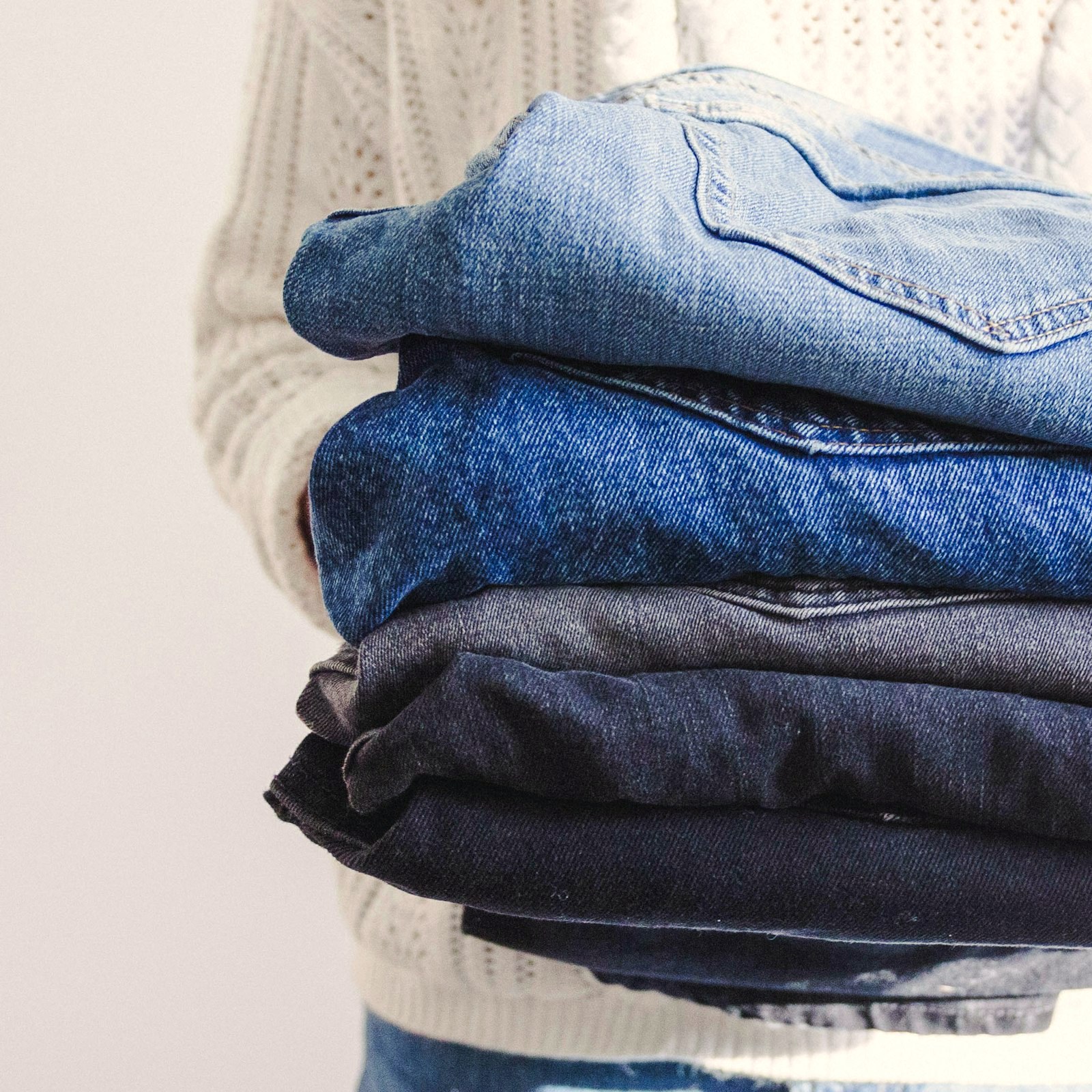
The photography, stated plainly, because this page’s exact subject is absent from our bank. The bank holds no frame of the pairing itself: no textured blazer over dark denim, in any cloth, colour or register, and our credits record the wider gap honestly, that no honest navy blazer on body stands in the bank at all beyond the jacket frame this page carries. The hero is therefore the jacket half of the pairing, the navy blazer frame our credits log carries for the Fall Edit grid and the Sport Coat’s Card, captioned as the half it is; the figure in the cloth section is the denim half, the graduated-wash stack from the Japanese brands page, showing the ladder of washes of which only the darkest rung is licensed here. No frame of a suited leg has been captioned as this pairing’s jeans, and no folded stack has been dressed as a worn outfit: the two halves stand at either side of the subject, and the page says so. The harvest list this page is waiting for, in order: first, the pairing entire at street level, a navy hopsack blazer over a deep one-wash jean, the break visible at conversational distance, the outfit’s whole argument in one frame; second, the border at close range, the fastening button over the waistband, the shirt band and the belt, the fit law photographed; third, the cold form, flannel over indigo with the roll neck between them, the winter assembly given its portrait.
Questions, answered
Can you wear a blazer with jeans?
Yes, and it is the pairing this brief exists to rule, under the law both parent briefs print: the two halves meet in the middle of the formality scale. The blazer must be the unstructured species, soft shoulder, patch pockets, a textured cloth, hopsack, flannel or cotton twill; the jeans must be the tailored species, dark, one-wash or lightly washed, no distressing, straight or gently tapered with a leg clean enough to take a crease line. Each half is charged for the other: a worsted suit jacket over jeans is a suit orphaned, and faded or ripped jeans under any blazer pull the jacket down rather than rising to it. How to Wear No. 03 rules the blazer entire and No. 05 the denim; this brief rules the pairing.
What kind of blazer goes with jeans?
The unstructured one: a soft or natural shoulder with little or no padding, patch pockets, and a cloth with visible texture, because texture is the jacket's passport into denim's company. Wool hopsack is the default, flannel is the winter form, tweed the coldest and most forgiving, and cotton twill the weekend cloth. The refused cloth is the smooth worsted, however it is labelled: a smooth, sheened jacket over denim reads as half of a suit, and no styling rescues the orphan read. Verdict Card No. 63 ranked the blazers on their published records and its winner is the species named here, the Spier & MacKay Navy Hopsack Sport Coat at 85.
What jeans go with a blazer?
The darkest class the denim index sells: deep indigo, one-wash or raw, or black, even in colour from waist to hem, straight or gently tapered, hemmed to sit on the shoe without pooling. No fading, no whiskers, no distressing, no exceptions negotiated at the mirror. The leg matters as much as the wash: the jean under a blazer is read as a trouser, so it is cut like one, a rise that meets the jacket's stance and a hem that could hold a crease line. As wear fades a dark pair past mid-wash it retires from this pairing to weekend duty, How to Wear No. 05's office ruling applied to the blazer row.
What shirt do you wear with a blazer and jeans?
The layer's job is to hold the middle the two halves meet in, so it is chosen from the soft register: an Oxford button-down, tucked or untucked by the room; a fine crew knit; a knit polo; a plain tee at the weekend end; and the roll neck in the cold rows, ruled entire at How to Wear No. 60. The dress shirt is refused, not for its cloth but for its company: a formal shirt under a blazer over jeans pulls the top half up to a formality the jean cannot answer, and the outfit argues across the waistband. The tie is refused with it as the default; its one licence, printed in the shirt section, is the knit tie worn as a deliberate casual instrument, never the silk tie of the suit wardrobe.
What shoes go with a blazer and jeans?
The shoe sets the pairing's final formality, and the ladder is printed in the shoe section: a leather loafer is the pairing's home shoe, formal enough for the blazer and easy enough for the jean; a suede boot or suede derby is the cold-weather and evening step; a clean minimal sneaker is the licensed floor, plain leather, no branding theatre, and it lowers the whole outfit one clear step, which must be a decision and not a drift. The refused shoes are the two ends: the polished Oxford of the suit wardrobe, which orphans downward against denim exactly as its jacket does, and the running trainer, which pulls the blazer into fancy dress.
Can you wear a blazer and jeans to the office?
In the wide middle of offices, yes, at the pairing's best: the dark one-wash jean, the textured blazer, the Oxford or fine knit, the loafer. That assembly is How to Wear No. 05's office ruling dressed in full, the jean legal because of its colour depth and the blazer doing the room's formality work. The ceilings are printed in the rooms section: the formal floor, the client whose uniform is the suit, the rooms where a tie is the proceeding's dress, are above the pairing, because denim is still denim in them however dark it is dyed. In those rooms the same blazer goes over the tailored trouser, which is the outfit No. 03's matrix prints.
Can you wear a black blazer with black jeans?
Not as this pairing's form, and the colour section prints the refusal: black over black collapses the break the pairing is built on. The blazer outfit lives on a clear difference of colour and texture between jacket and leg; black on black removes the colour half of the break and leaves texture alone to separate two dark surfaces, which at any distance reads as a suit that missed, the orphan read in monochrome. Black denim has its own logic, printed at How to Wear No. 05: monochrome first, under a dark knit or a clear-toned top half, and never as a black dress trouser's understudy. The pairing's black form is the dark blazer, navy or charcoal, over the black jean, where the break survives in tone.
Has Young Cotton scored the garments in this pairing?
The garments, yes; the pairing, no, and the distinction is this brief's honesty. Verdict Card No. 63 ranked seven blazers on their published records, the Spier & MacKay Navy Hopsack Sport Coat winning at 85, and Verdict Card No. 11 ranked the jeans inside the Denim Index's classes, the Levi's 501 Original winning at 81; the dark class both briefs send to this pairing stands at formality three on that Index. What no Card scores is the combination, because a pairing is worn, not bought: this page rules it as a set of conditions, and a combination that obeys them is licensed whatever its labels, while one that breaks them fails at any price.
Next
The family this brief completes stands around it: How to Wear No. 03, the blazer, the parent brief, whose orphan rule, cloth classes and cuff and stance laws this page takes as premises; How to Wear No. 05, denim, the other parent, whose wash-break law, office ruling and black-denim logic stand here as the leg’s terms; and How to Wear No. 60, the turtleneck with a suit, the pairing brief before this one, whose roll neck carries this pairing’s cold rows on the laws printed there. The buying is scored at Verdict Card No. 63, where the hopsack winner’s 85 was earned, and at Verdict Card No. 11, where the 501’s 81 stands inside the classes the Denim Index defines. The full series lives in the How to Wear index, and how every score behind those pages is built stands on our methodology page.