
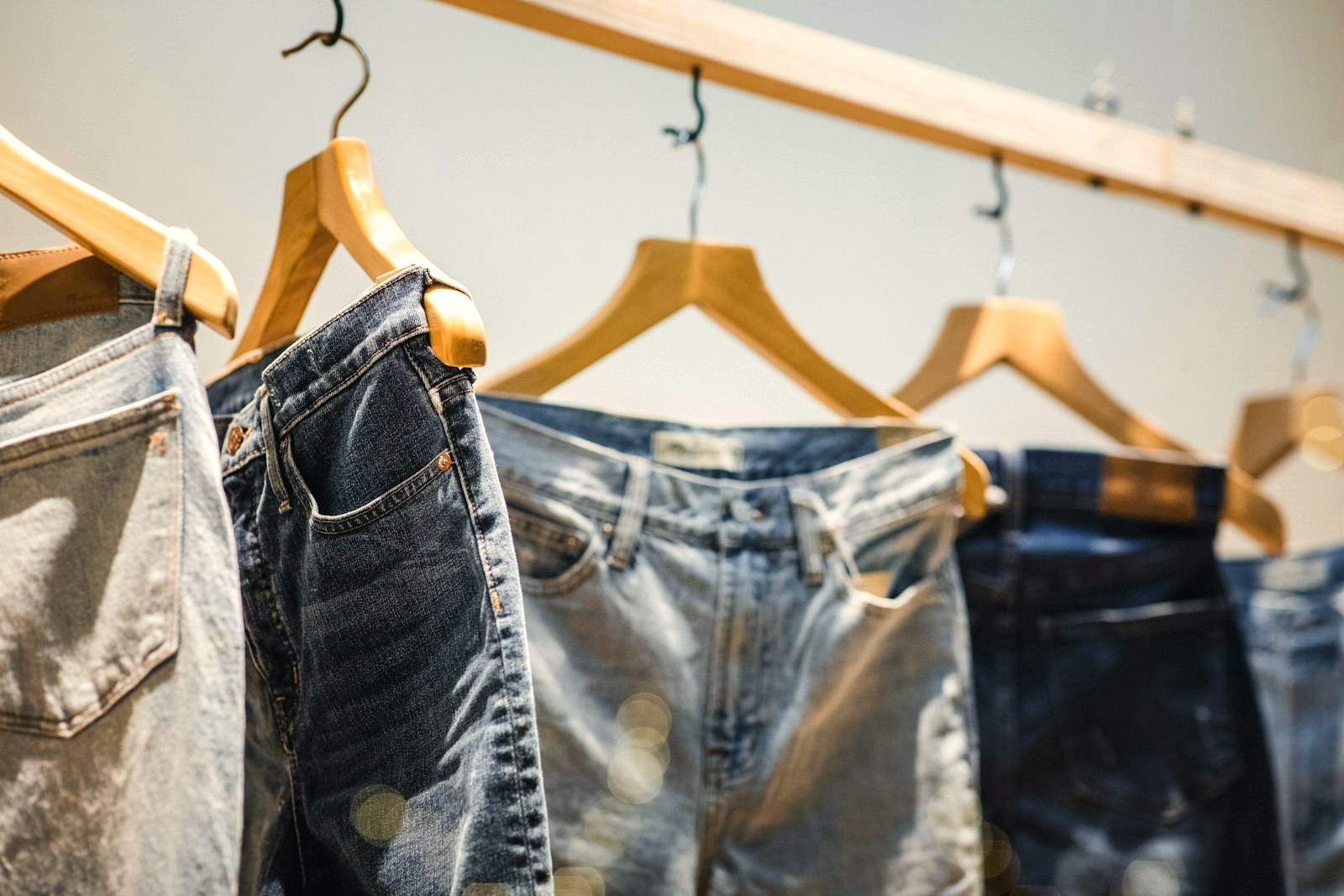
A jean is a cloth with a cut attached. This ranking weighs the cloth first, in ounces, in the open.
Checked and updated October 2026
The verdict, up front: seven jeans scored out of 100 on the denim basis this site publishes: cloth and weight 30, construction and hardware 20, fit range 20, value 15, longevity and fade 15. The Levi's 501 Original wins at 81, rigid cotton, a button fly and the deepest size run in the field at a list price under $85. The Iron Heart IH-634S is second at 80 and is the finest cloth here by a distance, 21 ounces of Japanese selvedge at $385, beaten on fit range and value alone. The Uniqlo selvedge at $59.90 finishes fifth at 72, above both mall entries. And the fast-fashion jean is sent home at 36: light stretch cloth, a printed fade, and a cost per wear three times the winner's. Every weight below is printed in ounces, the maker's figure where the maker publishes one, the class figure where it does not, and marked as which.
The cloth is the garment
Denim is the most honest category in menswear, because it is the one category that prints its own evidence. A jean carries its specification in its body: the weight of the cloth in ounces, the weave, the mill, the dye. A heavyweight rope-dyed selvedge and a lightweight stretch twill are both sold under the word jeans, and the distance between them is the distance between a five-year garment and an annual one. Our denim index files the cloth classes themselves, lightweight under twelve ounces, the standard around fourteen, heavyweight at sixteen and up. This page scores the finished jeans those cloths become, across the whole market: the Japanese selvedge tier, the heritage American icon, the permanent-collection tier, the honest budget selvedge, the mall, and the fast-fashion rail where the category's promises go to be printed rather than kept.
Every score below is built from the makers' published specifications and checked US prices under our published methodology. Where a maker publishes its cloth weight, the weight table prints that figure and marks it. Where it does not, the table prints the desk's figure for the cloth class and marks that instead. Four of the seven makers below do not publish a weight, and one of them, to its discredit, is the winner.
How the scores work
Five rows, the denim basis, printed here so the scores can be argued with. Cloth and weight judges the fabric itself: ounces per square yard, weave, fibre honesty, whether the dye is in the yarn or on the surface. Construction and hardware judges the make: stitching, chainstitched hems, rivets and buttons, pocketing. Fit range judges the rises and leg shapes offered and the size run, scored against the rise bands our trouser index publishes: low under 10 inches, mid from 10 to 11.5, high at 11.5 and above. Value divides what you get by the US price, against the whole field. Longevity and fade estimates years of service and whether the fading is earned by wear or printed at the factory. The rows sum to the score.
Seven jeans, ranked
Levi's 501 Original
US list price at last check: $79.50 to $84.95 by wash at the maker's store, and promoted most weeks.
The call: the centre of gravity of the entire category, and the rare icon that still earns it on specification. The core washes are rigid 100 percent cotton with a button fly, copper rivets and a front rise of 11.25 inches, mid band, and the fit row is at full marks because nobody else in the field offers this many bodies a jean: waists deep into the forties, three lengths, and a family of shapes around the original. The cloth row is honest about the modern pair: the maker does not publish a weight, the class figure is about 12.5 ounces, and today's cloth is lighter and less consistent than the vintage pairs the reputation was built on. It wins anyway, because at $82 at list it is the cheapest jean on this page per wear, and the one a first buyer should own and a tenth buyer still wears. Wearing it well is a separate skill, and it is briefed in how to wear denim.
Iron Heart IH-634S
US price at last check: $385 at Self Edge.
The call: the best cloth on this page and the second-best buy, which is the heavyweight argument in one line. The 634S is cut from Iron Heart's flagship 21-ounce indigo selvedge, the maker's own figure, woven in Japan, rope-dyed so the core of the yarn stays white and the fades arrive with contrast no wash can fake. The construction is the field's standard: hidden copper rivets, chainstitched hems, heavy cotton pocketing, seams built to be darned and worn again. The longevity row is at full marks because this is the jean that outlasts the rotation around it. What it gives back is everything else: $385, one straight cut, one rise, and a break-in measured in months. If your leg fits the pattern, it is the last jean argument you will have. If it does not, there is no second shape to try.
3sixteen SL-100x
US prices at last check: about $250 to $270 across the maker's store and US stockists.
The call: the connoisseur's middle path, and the fade hobby's favourite instrument. The 100x cloth is a 14.5-ounce selvedge woven by Kuroki Mills in Okayama to the brand's own specification, the maker's figure, rope-dyed, sanforised, with a slub texture that records wear faster and more personally than any cloth here except the 21-ounce above it. The jeans are sewn in San Francisco with chainstitched hems, a button fly, hidden rivets and a roughout leather patch, and the same cloth comes in four fits, straight, tapered and their classic variants, which is what lifts the fit row above the ceiling pair's. At about $260 in the middle of its band it is not cheap, and the value row says so. What the money buys is the hobby itself: a jean designed to become a document of its wearer.
Asket The Jean
US price at last check: $230 at the maker's store.
The call: the permanent-collection answer, scored on the same ruler as the selvedge tier and finishing within four points of it without a selvedge edge to its name. The cloth is a published 13 ounces of organic cotton denim from Candiani in Italy, milled, cut and washed in Italy, and the maker publishes the cost breakdown of the garment down to its assembly, which is a kind of honesty the denim specialists could learn from. The fit row is the quiet triumph: three fits, slim, regular and loose, across a graded waist and length grid wider than any specialist here offers, all mid rise. The raw version fades honestly; the washed versions arrive as they will stay. At $230, never discounted, the value row is unmoved, and the brand behind it scores 92 in our Scandinavian ranking. This is the jean for the reader who wants the category's virtues without the hobby.
Uniqlo Selvedge Slim Straight Jeans
US price at last check: $59.90 at the maker's store.
The call: real selvedge at a fast-fashion price, and the standing embarrassment of every jean priced between it and the winner. The cloth is co-developed with Kaihara, woven on shuttle looms with the red selvedge edge, rope-dyed so the white core shows through with wear, and cut in a clean slim straight. The maker does not publish a weight; the class figure is about 13 ounces, and the stretch woven into it is the honest asterisk: it buys day-one comfort with fade purity and with the elastane's lifespan, which is why the longevity row stops at 8. The value row is at full marks and the fit range runs waists 27 to 40 with free hemming. The brand scores 84 in our Japanese ranking, and its full decoding, ceiling included, is on our brands like Uniqlo page. As a first raw jean, nothing else is close.
Abercrombie & Fitch 90s Straight Jean
US list price at last check: $80 to $90 by wash at the maker's store.
The call: the best jean in the mall, which is a real title and a bounded one. The 90s Straight gets the silhouette of the moment right, a mid-to-high rise and a true straight leg, and the fit matrix around it is the widest in the mall: athletic cuts, five lengths, waists for everybody. The cloth is where the ceiling sits. The maker's vintage stretch fabric is a cotton and elastane twill, weight unpublished, class figure about 12 ounces, and the washes arrive pre-faded, which means the jean has already spent its one good look at the factory and can only decline from it. At $80 to $90 it charges the winner's money without the winner's cloth, construction or second decade. Buy it for the fit if your body is the argument. Do not call it a denim purchase.
H&M Slim Jeans
US list price at last check: $49.99 at the maker's store, and discounted far below that most weeks.
The call: the silhouette without the substance, the recurring pattern of this site's rankings in its fifth costume of the year, after 41 in our Oxford ranking, 48 in chinos, 33 in overshirts and 38 in flannel. The cloth is a light stretch denim, weight unpublished, class figure about 10.5 ounces, and the fade is a print of other jeans' lives. The fit range is genuinely wide and is the only row with anything to say. The maths below is the whole review: replaced every year, it costs about 33 cents a wear, three times the winner's rate, for a garment that was never really denim in the first place. The honest budget jean exists on this page. It is the selvedge at $59.90, ten dollars above this list price and thirty-six points above this score.
The weight table
Denim is bought by weight before it is bought by anything else, so the weights stand together here. A maker's figure is the weight the maker publishes for the cloth. A class figure is the desk's figure for that cloth class, printed where the maker does not publish one, and marked as what it is. The weave and the mill stand beside the number, because an ounce count without an origin is only half the specification.
| Jean | Cloth | Weight | Figure |
|---|---|---|---|
| Iron Heart IH-634S | Indigo selvedge twill, woven in Kojima, Japan | 21 oz (about 710 gsm) | Maker's figure |
| 3sixteen SL-100x | Indigo selvedge twill, Kuroki Mills, Okayama | 14.5 oz (about 490 gsm) | Maker's figure |
| Asket The Jean | Organic cotton twill, Candiani, Italy; not selvedge | 13 oz (about 440 gsm) | Maker's figure |
| Uniqlo Selvedge Slim Straight | Shuttle-loom selvedge twill with stretch, Kaihara, Japan | About 13 oz (about 440 gsm) | Class figure |
| Levi's 501 Original | Right-hand twill, rigid washes; mill varies by run | About 12.5 oz (about 425 gsm) | Class figure |
| Abercrombie & Fitch 90s Straight | Stretch twill; mill not published | About 12 oz (about 405 gsm) | Class figure |
| H&M Slim Jeans | Light stretch twill; mill not published | About 10.5 oz (about 355 gsm) | Class figure |
Read the table against the ladder and the category's second rule falls out, with one honest complication. The three makers who publish a weight finish second, third and fourth, in weight order. But the winner publishes nothing, and neither do the two entries at the bottom: an unpublished weight is evidence of nothing by itself, which is why the cloth row judges the cloth and not the press release. Weight is not the whole row either: the winner's rigid, stretch-free twill outscores the heavier stretch cloths below it, because an ounce of elastane is not an ounce of denim.
What each jean costs per wear
The maths, assumptions printed. Jeans are the hardest-worn garment in the wardrobe, so the model runs at 150 wears a year: three days a week, every week. Expected life is estimated from construction and cloth class, not from the price tag: five years for the rigid pairs at the top, four for the midweight pair and the permanent pair, three for the stretch selvedge, two for the mall pair, one for the skip. Where a price is a band, the table uses its middle and says so here: $82 for the 501, $260 for the 3sixteen, $85 for the Abercrombie. These are the data team's estimates, published so you can argue with them.
| Jean | Price | Expected life | Cost per wear |
|---|---|---|---|
| Levi's 501 Original | $82 | 5 years | $0.11 |
| Uniqlo Selvedge Slim Straight | $59.90 | 3 years | $0.13 |
| Abercrombie & Fitch 90s Straight | $85 | 2 years | $0.28 |
| H&M Slim Jeans | $49.99 | 1 year | $0.33 |
| Asket The Jean | $230 | 4 years | $0.38 |
| 3sixteen SL-100x | $260 | 4 years | $0.43 |
| Iron Heart IH-634S | $385 | 5 years | $0.51 |
The table's shape is the category in miniature, and it inverts the naive reading of the ladder. The winner is also the cheapest way to wear a jean, at eleven cents a time, and the gateway selvedge is second at thirteen. The heavyweight ceiling, the best cloth here, is the most expensive per wear at fifty-one cents, because even five years cannot fully amortise $385 at three wears a week; what the money buys is the cloth and the fades, and this page has never pretended otherwise. And the cheapest jean on the rail costs three times the winner's rate, because its denominator is one year. In denim, as in every category this site scores, cheap is a price and cost per wear is the verdict.
The Skip · 36/100
The H&M Slim Jean, $49.99 at list in the US, is this ranking's named loser, and it loses on the category's defining test: there is barely any denim in it. A light stretch cloth near ten and a half ounces, its weight unpublished by its maker, its fade printed at the factory from photographs of better jeans' lives, cannot hold a crease, cannot fade honestly, and cannot see a third year at the stress points. It occupies the jean's place in an outfit while doing none of the jean's work, and the cost-per-wear table prices the trick at about 33 cents a wear, three times the winner's rate. The cruellest line in the table is the one above it: for ten dollars more than this list price, the Uniqlo selvedge is a real shuttle-loom cloth that fades as you live in it. Spend the $59.90 once, or spend the $49.99 every year. The first jean a man buys teaches him what denim is. This one teaches him it is a picture.
Which one to buy
If you buy one: the Levi's 501, in the rigid wash, sized for the mid rise it is, and wear it for the half-decade. If you want the best cloth: the Iron Heart 634S, and accept the break-in as the price of the ceiling. If the fades are the hobby: the 3sixteen SL-100x, the instrument built for exactly that. If you want the virtues without the hobby: the Asket, in raw, on the graded grid. If the budget is the whole story: the Uniqlo selvedge, honestly bought with its stretch asterisk understood, over the mall pair at more money and the skip at the same money. How the winner wears with the rest of the wardrobe is briefed in how to wear denim, and the cloth classes themselves are indexed in types of denim.
Questions, answered
What are the best jeans for men?
The Levi's 501 Original, scored 81 out of 100. Rigid 100 percent cotton in the core washes, a button fly, a mid rise of 11.25 inches, the widest size run in the field, and a list price of $79.50 to $84.95. The Iron Heart IH-634S at 80 is the better cloth by a distance, 21 ounces of Japanese selvedge, but at $385 in a single straight cut it is a project, not a default. The 501 is the jean the projects have to argue with.
What weight of denim should I buy?
Fourteen ounces is the standard the category is measured against, and it is the right first weight: structured, four-season, slow to wear out. Under twelve ounces is the lightweight class, cooler and faster-wearing, suited to heat and travel. Sixteen ounces and up is heavyweight, a cooler-months cloth with a real break-in, and the 21-ounce pair on this page is a project with a season of stiffness in it. Our denim index prints the full class table; this page scores the jeans that wear them.
Is selvedge denim worth it?
Selvedge is a finished edge, not a quality grade: it means the cloth was woven on a shuttle loom to a width that uses the fabric's own edge, and it correlates with the mills and makers who also rope-dye, chainstitch and publish their weights. The correlation is what you are paying for. The proof is on this page in both directions: the Uniqlo selvedge at $59.90 outscores two jeans at four times its price, and the Asket at $230 is not selvedge at all and finishes fourth on cloth honesty alone.
Are expensive jeans worth it?
At the cloth end, the maths is closer than the tags suggest: at 150 wears a year, the $385 Iron Heart works out to about 51 cents a wear across five years, against about 11 cents for the $82 Levi's 501 and 13 cents for the $59.90 Uniqlo selvedge. Expensive jeans buy cloth, construction and fade character, not economy. The one indefensible seat at the table is the middle of the fast-fashion rail: the $49.99 skip on this page costs about 33 cents a wear because it is replaced every year.
Rigid or stretch denim: which is better?
Rigid, for anything you intend to keep. A 100 percent cotton jean fades where your body bends it, holds its shape for years, and can be repaired indefinitely. Stretch denim is comfortable on day one and dishonest by year two: the elastane tires, the knees bag, and the wash you bought was printed at the factory, which means the jean arrives having already spent its one good look. Every jean in this ranking's top five is rigid or nearly so, and that is not a coincidence.
How long should a pair of jeans last?
The rigid pairs at the top of this page are costed at four to five years of regular wear in our cost-per-wear table, and the heavyweight pair will outlast that with darning. The stretch selvedge is costed at three years, the mall pair at two, and the named skip at one: light stretch cloth at the stress points is a countdown, not a wardrobe. A jean bought well is a half-decade garment. A jean bought at the bottom of this page is an annual subscription.
How this ranking stays honest
Scores follow our published methodology and are re-checked on the cadence in the byline; when a maker changes cloth, construction or price materially, the score moves and the move is noted here. Prices are US prices at last check: the Iron Heart, Asket and Uniqlo figures are single list prices from the maker's store or its US stockist; the Levi's, 3sixteen and Abercrombie lines price across washes and stockists in bands, and the cards print the bands rather than a false precision. Cloth weights are labelled throughout as the maker's figure or the desk's class figure, and the class figures will be replaced by maker's figures on the day the makers publish them.