
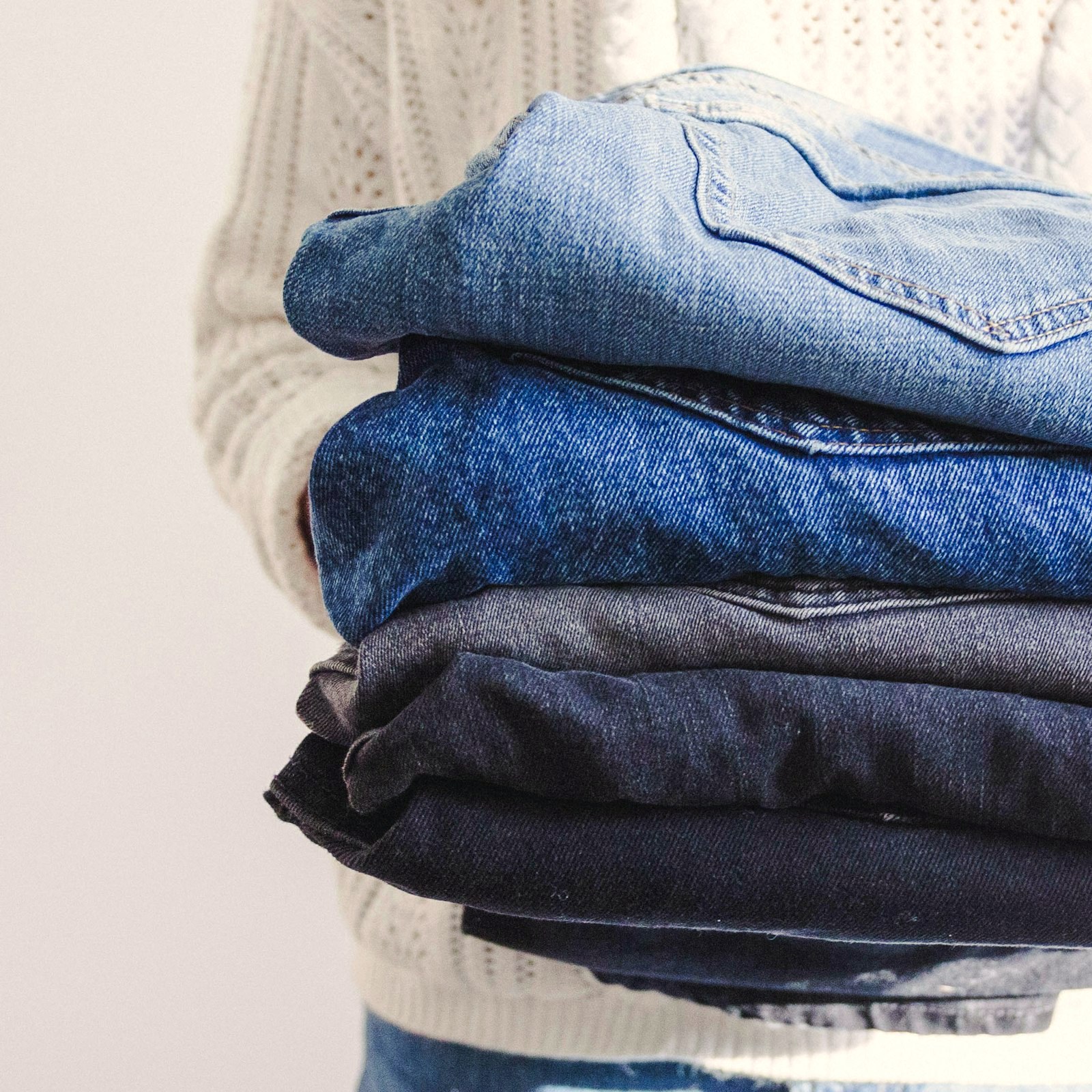
The whole index in one held stack: graduated indigo, from the deep unfaded end to the worn pale end. Denim is one cloth. The classes are the decisions taken about it.
Checked and updated October 2026
The ruling, up front: there are ten classes of denim that cover a man's whole rotation, and every pair on every rail is a position taken on four decisions: the weight of the cloth, the loom and mill it came off, the wash or finish it was sold with, and the fit it was cut to. This page indexes all ten and scores each for formality from one to five, with the numbers compiled underneath: ounces per square yard, the rise and opening bands this site already prints for trousers, and the one buying rule that decides each class. The one-wash dark pair and the black pair top the ladder at three; the heavyweight project jean and the distressed pair stand at the bottom at one; and the class most rails push hardest, distressed, is the one where the garment's life was spent before the sale.
On this page: the index, the numbers, weave and origin, wash and finish, the fakes, the buying rule, questions.
The index: ten denims, four decisions
The scores are the data team's compiled judgement, built from cloth, colour depth and how each class behaves in the rooms it is worn in. One note on where this ladder sits inside the site's wider one. On the trouser index, the five-pocket pattern stands at formality two, and most denim lives there with it: a jean is a jean. Two classes stand a rung higher, at three, and the reason is colour, not cut: a deep one-wash or a black pair, unfaded, clean-hemmed and worn with a proper shoe, does the chino's job in the rooms the chino works, and three is the chino's rung. No class of denim climbs past three. The ladder's ceiling is printed here so nobody buys a jean expecting it to be a dress trouser, a mistake the denim brief, No. 05, names in its mistakes.
| Class | Cloth and finish | Formality | Weight and fit | The one rule |
|---|---|---|---|---|
| One-wash dark denim | Indigo denim rinsed once, the colour held deep and even | 3 | Midweight, 12 to 14 oz; mid rise, straight or tapered | This is the office jean: dark, clean, unfaded, worn like a trouser and retired to weekends when it fades. |
| Black denim | Denim dyed black, through the warp and usually the weft | 3 | Midweight, 12 to 14 oz; slim or straight | Its formality is colour, not construction. It runs on monochrome logic and tops out below tailoring. |
| Raw selvedge, Japanese cloth | Shuttle-loom selvedge from the Okayama mills, sold unwashed | 2 | Midweight 12 to 14 oz is the standard; fits by the inches below | Buy the cloth and the fit. The fade is earned over a year of wear, not included in the price. |
| Raw denim, American cloth | Projectile-loom denim in the Cone tradition, sold unwashed | 2 | Midweight, 12.5 to 14.5 oz; the classic five-pocket rises | The edge is a finish, not a grade: the same indigo without the selvedge ID costs less and wears the same. |
| Heavyweight raw, 16 oz and up | Dense cloth from the heavy end of the Japanese trade | 1 | 16 to 21 oz and beyond; stiff, structured fits | A project, not a first jean: the break-in is measured in weeks, and the leg stands up on its own at first. |
| Lightweight denim, under 12 oz | Lighter yarns, often with a percent of stretch for ease | 2 | 9 to 11.5 oz; every fit | The summer and travel class. Buy it knowing the trade: cooler cloth, shorter life. |
| Stonewashed and mid-wash | Denim lightened by washing and abrasion before sale | 2 | Usually midweight; every fit | Buy the wash in daylight. Mid-wash is where cheap fading shows first, across the thigh and the seat. |
| White and ecru denim | Undyed ecru, or denim dyed white | 2 | Midweight; straight or relaxed | A summer class worn as a colour: dark above it, and every mark it collects is part of the deal. |
| Stretch denim | Cotton with elastane, from one percent to legging territory | 2 | Follows its wash; usually slim and tapered | Read the percentage: one to two percent is comfort; past that, the knee bags and the read turns to legging by evening. |
| Distressed denim | Factory-faded, whiskered and holed before sale | 1 | Follows its base cloth, thinned at every fade | You pay for wear you did not do, in cloth thinned exactly where a leg stresses. The picture of a life, at the price of the garment's. |
The numbers: weight classes, and fits in inches
Two compiled references run underneath the whole table. Weight is measured in ounces per square yard of cloth, and it falls into four working classes. Lightweight, under 12 ounces: the summer cloth, cooler and quicker to wear out. Midweight, 12 to 14 ounces: the classic band, the weight the five-pocket pattern was built in, warm enough for three seasons and structured enough to hold a leg's line. Heavyweight, 14 to 16 ounces: a cooler-months cloth with a break-in you can feel. Heavyweight-plus, 16 ounces and up: the project class, where the cloth is stiff enough to stand and the fades come high-contrast because the surface is working so hard. Weight is the first number to ask for in a shop, and the data team's rule from the flannel ranking holds here unchanged: a maker who publishes a weight expects the cloth to be checked, and a maker who hides one has told you something else.
Fit is where denim's marketing and its facts part company. The fit names on the rail, slim, straight, relaxed, wide, are adjectives, and adjectives cannot be measured. The inches can. This index uses the bands the trouser index already prints, unchanged, because a leg is a leg in any cloth. Front rise: low is under 10 inches, mid is 10 to 11.5, high is 11.5 and above. Denim's classic rises sit in the mid band, and the low-rise jean inherits the trouser index's verdict on the low band whole: a dated cut that shortens the leg and works a tucked shirt loose. Leg opening: a tapered leg lands around 6 to 7 inches across, a straight leg at 7 to 8, a wide leg at 9 to 10.5, and the opening is read against the shoe, as it is for trousers: a broad opening over a slim trainer is two halves of an outfit arguing, a point the denim brief makes with bootcut in its mistakes. The fit names translate roughly onto the numbers, slim onto the tapered band, straight onto the straight band, relaxed and wide onto the wide band, and where a maker's slim measures like another maker's straight, the inches are the ones telling the truth.
Weave and origin: the selvedge question, and where cloth comes from
Selvedge is the class the whole category argues about, so here is the fact of it. A vintage shuttle loom weaves slowly, in narrow cloth, around thirty inches wide, passing the weft back and forth in one continuous thread. Because the thread never gets cut at the edge, the cloth finishes its own edge as it goes: a self edge, shortened over a century of use to selvedge, and usually woven with a coloured ID thread so a mill's cloth could be told from another's. Cuff a selvedge jean and the finished edge shows inside the outseam, ID thread and all. A modern projectile loom weaves the same denim roughly twice as wide and far faster, and its edges are overlocked to stop them fraying, which is why a non-selvedge jean shows a stitched outseam inside the cuff instead. That is the entire physical difference. Selvedge is a weave and a finish, not a grade: it tends to arrive with texture, slub, an irregular character in the yarn, because the looms that weave it are old and unhurried, but the indigo does not know which loom it came off, and neither does the fade.
Origin is the second half of the weave story, and it is a texture and price fact, not a morality grade. Japanese cloth, centred on the mills of Okayama, is the character end: vintage shuttle looms kept running for decades, slubby yarns, deep and uneven indigo, the cloth the heavyweight classes are woven in. American cloth is the classic end: the Cone Mills tradition, whose White Oak plant in Greensboro wove American selvedge for a century before it closed in 2017, set the template for a cleaner, more uniform denim, the cloth of the original five-pocket jean. Turkish cloth is the volume end: the big modern mills weave much of the world's fashion denim, including most of its stretch, at a consistency the vintage looms cannot match and a character they were never asked for. A serious pair can come off any of the three. What the origin line on a label is really telling you is which texture to expect, and the index's rule is to buy the texture you want at the weight you need, and let the flag on the cloth look after itself.
Wash and finish: raw, one-wash, stonewash, distressed
The third decision is what was done to the cloth after weaving, and the classes run in order of how much of the jean's life the factory has already spent. Raw is denim sold as it came off the loom, dye intact, nothing washed away: stiff at first, then a record of the wearer's actual life, fading at his knees, his pockets, his cuff line. Two raw sub-facts decide a purchase. Sanforized cloth has been pre-shrunk and buys true to size; unsanforized, the shrink-to-fit tradition, can give up close to a tenth of its length in the first wash, and is bought long on purpose. One-wash is raw denim the maker has rinsed once before sale: the shrinkage is taken out, the fit is the fit, and almost all of the colour stays, which is why the darkest class on this index is a finish and not a separate cloth. Stonewash is lightening by abrasion, classically pumice, applied evenly across the garment: the mid-wash read, soft from the first wear, honest when the fading is uniform and cheap-looking when it pools in the wrong places, at the fly and the hem instead of the thigh and the seat where a leg actually fades a jean. Distressed is the factory doing the whole biography at once: whiskers at the hip, honeycombs behind the knee, holes at the stress points, applied by laser, sandpaper and hand. It is named here as a class because it is sold as one, and its cost is printed with it: every one of those effects is cloth removed or thinned at exactly the points a leg stresses, so the garment arrives with its longevity already spent, a first year of wear worn by nobody. A man who wants the faded read honestly can buy raw and live in it. The distressed pair is the photograph of that life, and it fades no further, because there is nothing left to fade.
The fakes: printed selvedge, and fading that was never worn
Two classes on the rail are not classes of denim at all, and the index names them apart so they are never bought by accident. Printed selvedge-look is ordinary projectile-loom cloth finished to imitate the selvedge edge: a coloured stripe printed along the outseam allowance, or a decorative tape sewn inside the cuff, so the turned-up leg flashes the ID stripe of a cloth it is not. The tell is the edge itself. A real selvedge edge is the cloth's own finished border, woven, slightly irregular, continuous with the fabric on both sides; the fake is a surface, a stripe sitting on top of plain cloth, and the cloth under it frays like any cut edge when you look at the seam allowance. A maker is allowed to decorate a cuff. A maker is not allowed to call the decoration selvedge, and a listing that does has graded its own honesty. Fake fading is the print version of distressing: whiskers and honeycombs applied as a surface pattern, flat, with no relief in the cloth and, the real tell, the identical fade map on every pair in every size, because a print does not know whose legs are inside it. Real fading has texture, raised and worn yarn at the crease lines; printed fading is a picture of texture, and it reads as one in daylight. Both fakes are skip classes on this index, no score attached, because they fail before scoring starts: the garment's central claim is a claim about a cloth it does not contain. The desk's one-line test covers both. Turn the jean inside out and look at the outseam and the creases. Denim keeps its evidence on the inside.
The Denim Ruling
The ladder: formality runs one-wash dark and black 3; raw selvedge, raw American, lightweight, stonewash, white and ecru, and stretch 2; heavyweight raw and distressed 1, and nothing in denim climbs past the chino's rung, because a jean is a jean. The rule: buy the rise first, the weight and weave second, the wash last, because the wash is the only one of the three that changes by being worn, and a dark pair can become a mid-wash pair while the reverse journey does not exist. The wardrobe error: five pairs of the same mid-wash slim jean at the same weight, which is one class bought five times, leaving the dressed end and the seasonal ends of the leg bare.
The one buying rule, and the rotation
Buy the rise first, the cloth second, the wash last. The order is inherited from the trouser index and it holds in denim for the same reason: the rise decides where the jean lives on the body and no tailor can change it; the weight and weave decide the season, the texture and the lifespan; and the wash decides the read of the garment for now, knowing that wear will revise it in one direction only. The rotation a man actually needs is three across this index: one dark pair, one-wash or black, for the dressed end, the pair How to Wear No. 05 builds its office and tailoring rows on; one everyday pair, raw if the fade project appeals, an honest mid-wash if it does not; and one seasonal pair, lightweight or white against the heat, heavyweight against the cold. The jackets that go over all ten classes are indexed in the jackets index, whose denim trucker obeys the wash-break rule the brief prints in full, and the figure that wears this site's winning leg, the chino, with denim as its rotation partner, is mapped in the Body Map, legs layer.
Questions, answered
What are the main types of denim?
Ten classes cover the whole rail: one-wash dark denim, black denim, raw selvedge on Japanese cloth, raw denim on American cloth, heavyweight raw at sixteen ounces and up, lightweight denim under twelve ounces, stonewashed and mid-wash denim, white and ecru denim, stretch denim, and distressed denim. Each is a position taken on four decisions: the weight of the cloth, the loom and mill it came off, the wash or finish it was sold with, and the fit it was cut to. This page's index scores each class for formality from one to five and prints the one buying rule that decides it.
What is selvedge denim?
Denim woven on a vintage shuttle loom, slowly, at about half the width of a modern loom's cloth. The shuttle carries the weft back and forth in one continuous thread, so the cloth finishes its own edges as it weaves: a self edge, shortened to selvedge, usually marked with a coloured ID thread. You see it when the jean is cuffed, as the finished stripe inside the outseam. It is a weave and a finish, not a quality grade by itself: the same indigo on a modern projectile loom wears the same and usually costs less. What selvedge reliably signals is a maker working at the cloth-first end of the trade, which is why this index files it with the cloth classes and not with the marketing.
What weight of denim should I buy?
Midweight, twelve to fourteen ounces, for the pair that does the most work: it is the classic band, warm enough for three seasons, structured enough to hold a leg's shape, and it fades at a readable pace. Under twelve ounces is the lightweight class, the summer and travel jean, bought knowing it wears faster. Fourteen to sixteen is heavyweight, a cooler-months cloth with a real break-in. Sixteen and up is heavyweight-plus, a project class for men who enjoy the break-in itself. The weight is printed in ounces per square yard of cloth, and a maker who will not publish it has told you something, the same thing a flannel maker who hides a weight has told you.
What is dark wash denim?
Denim sold with its indigo held as deep as the dye can make it: raw denim rinsed once, or washed so lightly that almost no colour leaves the cloth. On this index it is its own class, one-wash dark, and the top of the formality ladder at three, because depth of colour is what lets a jean do a chino's job in a smart room. Dark wash is not a treatment added to a faded jean; it is the absence of the treatments. The test is the thigh: a true dark wash is one even colour from waist to hem, with no pale panel where the wearer's life would have faded it.
What does low stretch mean in jeans?
That the cloth carries about one percent elastane, two at the outside: enough to give at the knee and the waistband when you sit, not enough to change how the jean behaves. A low-stretch jean still breaks in like denim, still fades like denim, and goes back to its shape overnight. High stretch, three percent and up, is a different garment wearing the same name: it fits like a legging by evening, bags at the knee, and fades unevenly because the cloth never rests at one tension. This index's rule for the stretch class is to read the percentage on the fibre line. One to two is comfort. Past that, you are buying the bagging in advance.
How many pairs of jeans should a man own?
Three across this index cover a life: one dark pair, one-wash or black, for the dressed end; one everyday pair, raw or an honest mid-wash, for the middle of everything; and one seasonal pair, lightweight or white against the heat, heavyweight against the cold. The failure mode is five pairs of the same mid-wash slim jean at the same weight, which is one jean bought five times. Buy the missing class, not another copy of the class you already stand in.
Next
From the index to the brief: the classes worn, ruled and assembled are in How to Wear Denim, No. 05; the fits in their wider family are indexed in types of pants, whose five-pocket row is this cloth's own pattern in a borrowed fabric; the denim jacket is scored among the twelve in types of jackets; and the leg the site's figure wears is mapped in the Body Map.