
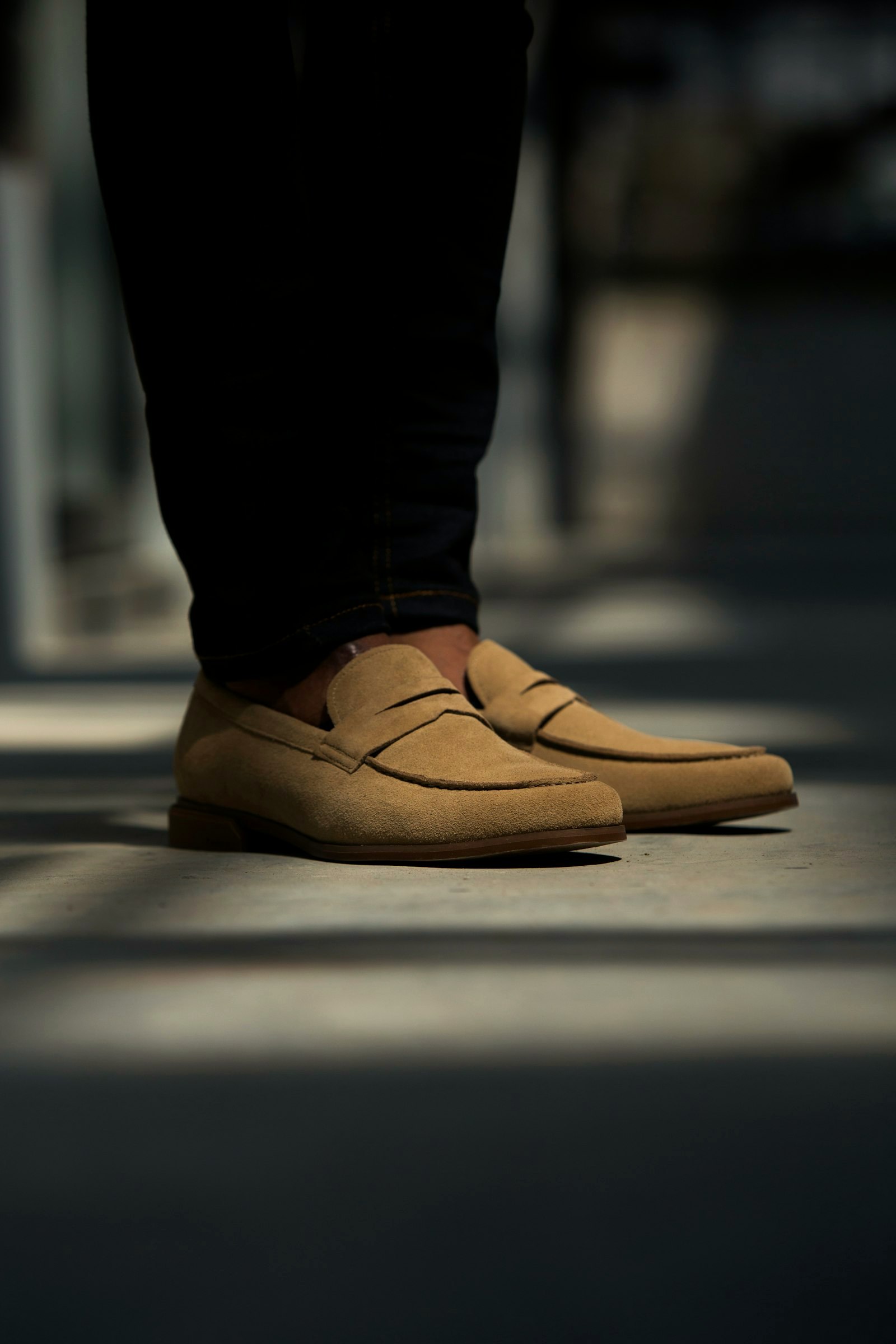
The licensed species in its summer form: a suede loafer under a hem cut short and clean, the ankle bare over a no-show sock. The bank holds exactly one loafer frame, this one, already the hero of No. 11 and the break figure of No. 04, and the care section prints that absence rather than dressing another shoe as this one's polished brothers.
Checked and updated October 2026
The ruling, up front: the loafer is the suit’s one licensed informality, and the licence is narrow, because the loafer is the only shoe in the tailored wardrobe that arrives without its fastening. Every other dress shoe closes: laces tie, a buckle shuts, a boot zips or gussets. The loafer slips on, and what it surrenders at the throat of the shoe, the laces’ tension and the closed shoe’s declaration that the outfit was finished on purpose, must be repaid by everything around it. This brief prints the repayment. The shoe itself carries the first share: a species from the top of the ladder, polished penny or tassel in calf, the horsebit read as jewellery and ruled with the metals, suede licensed as the summer form. The trouser carries the second: cut for the shoe, no break or a whisper of one, its opening tapered or straight over the narrowest vamp in the wardrobe. And the sock carries the third, ruled as law rather than taste: invisible, or a fine dark crew the hem covers, by season and by room, with the white sock refused entire. Inside those laws the pairing is not the suit dressed down. It is the suit at its ease, in the rooms this brief licenses, and outside them it is refused in the ceilings the family has already printed. On scores: no shoe is scored here, this site publishing no footwear ranking. The numbers quoted are the tree’s garment scores, cited as what they are.
This brief: the decisive rule · the species ladder · the trouser cut for the shoe · the sock, ruled as law · the suit species · the colour table · the belt and the metals · the rooms · the looks · the mistakes · care and our photography
The decisive rule: the licence is narrow, and the shoe repays what the laces surrender
Two briefs in this family have already touched this pairing without making it their subject, and this page takes their law as its premises entire. How to Wear No. 11, the loafer brief, prints the shoe’s whole doctrine: the one-notch rule, by which a loafer moves an outfit exactly one notch and never two; the species ladder on the site’s formality scale; the sock table; and the break amendment, no break to slight over a loafer, nothing longer, ever. How to Wear No. 04, the suit brief, prints the garment’s system: the fit fitted in a fixed order, and an outfit matrix that already seats this shoe, in the summer row entire, suede loafers under a linen or fresco suit with no socks or invisible ones, and already refuses it in the boardroom and evening rows, which belong to black oxfords. How to Wear No. 54 carries the shoe into the cold. What none of them prints, because none of them is the pairing’s page, is the law of the pairing itself, and the law begins with what the loafer is. It is the dress shoe with its closure removed. The Oxford’s laces are not fastening alone; they are the visible evidence that the shoe was put on as an act, tensioned, finished. The loafer offers no such evidence. It is stepped into, and everything about its reading follows from that ease: the ease is the pleasure of the shoe, the reason it exists, and under a suit the ease is also the risk, because the suit is the wardrobe’s most deliberate garment and the loafer is its least fastened one, and a pairing of the most deliberate with the least fastened stands or falls on whether the deliberateness is supplied somewhere the eye can find it.
So the decisive rule is a repayment, in the form this family’s pairing briefs print it. The loafer is the suit’s one licensed informality, and the licence is narrow: the shoe must carry the formality the missing laces surrender. Carry is the operative word, and it is literal. The formality does not vanish; it is redistributed. Part of it moves into the shoe itself, into species and finish, a polished calf where a matte one would have done under laces, a ladder’s top where its middle is the loafer’s ordinary home. Part of it moves up the leg, into a trouser hemmed for this shoe and no other, because a hem cut for an Oxford and worn over a loafer spends the difference in pooled cloth at exactly the point where the two garments meet. And part of it moves to the ankle, the strip of the outfit the loafer uniquely exposes, where the sock stops being an undergarment and becomes a ruled article, judged as law in its own section below. The reciprocal charge of the pairing briefs applies entire: the stations are read together. A polished tassel under a pooling hem is a claim the cloth contradicts; a perfect hem over a scuffed penny is money spent above a failure at the floor, where this outfit, more than any other in the family, is finally read, because the loafer draws the eye down the leg and leaves it there. The man who wears the pairing well has understood that he has not chosen an easier shoe. He has chosen a shoe whose ease must be earned at three other stations, and paid for all three.
The scored record under the law is the tree’s, and it is thinner for this shoe than for any garment this family has paired, which the page prints rather than pads. There is no loafer Verdict Card on this site and there will be none quoted here: footwear rankings are excluded from the site’s programme, and this brief scores no shoe. The one loafer the site has scored is a garment inside a wardrobe: the Spier & MacKay unlined suede loafer, 88 in the business-casual capsule, $218 at last check, printed there as the office shoe, and cited here as exactly that, a capsule’s judgment on one shoe in one wardrobe, standing on the ladder where No. 11’s arithmetic puts its species, the suede penny’s family at 3 less the unlined build’s half, a garment the capsule grades in its own company. The trouser the shoe keeps being sent under is likewise a garment score: the Spier & MacKay tropical wool trouser, 87 on Verdict Card No. 15, worn with loafers in No. 10’s formality-ceiling row and in No. 11’s break section, the slim tapered wool leg this brief’s trouser section is built around. And the suit itself stands at Verdict Card No. 64, the Spier & MacKay Core Suit winning at 85, printed on No. 04. Every party to the pairing has been graded somewhere except the shoe as a class, and the system below is printed so the class can be judged without a ranking: by its ladder, its hem and its sock, which is how the pairing is actually worn and actually read.
The species ladder, ruled under tailoring
The ladder is No. 11’s, printed there as the shoe family’s scale and adopted here entire, because under a suit the ladder stops being a taxonomy and becomes a licence schedule: each rung states what a species may carry. The scale is the site’s published one-to-five ladder, the Oxford shoe owning 5, and the loafer’s whole family standing below it, which is the pairing’s first honesty: the highest loafer is half a rung below the shoe it replaces, and the licence is written for that gap, not in denial of it. The penny loafer in polished calf stands at 3.5, the original, a plain slotted strap and nothing else, the ladder’s versatile middle and the pairing’s default species in its middle rows: under an unstructured suit, a textured cloth, a summer worsted, the polished penny is the shoe that asks the least attention and repays its share of the surrendered formality in finish alone. The tassel loafer in calf stands at 4, the ornament of its two tassels and laced strap making it the tailored species, the loafer that stands closest to a derby, and under tailoring it is the licence’s fullest form in leather: the dressed rows that admit a loafer at all, the office’s best rows, the evening’s licensed edge, are the tassel’s ground, its small decoration reading as intention where the penny reads as ease.
The horsebit stands at 4.5 in dark polished calf, the highest a slip-on reaches, and it is read as jewellery and ruled with the metals. The bit across the vamp is a metal ornament on a shoe, and it changes the species’ terms in two directions at once. Upward: at 4.5 the dark polished horsebit is the one loafer that can stand in the outfit’s most dressed licensed rows without apology, the shoe for the summer evening, the gallery, the dinner in a light suit, its gleam doing at the floor what the tie’s silk does at the throat. Downward: an ornament is a claim, and the horsebit’s claim is spent the moment anything else in the outfit makes the same claim louder, which is why this brief rules the species in the metals section rather than here alone: the bit must be the outfit’s one bright note at its stations, answered by a quiet buckle and a quiet watch or by nothing, and a horsebit worn with a loud belt and a gold watch is three ornaments arguing at three heights. The bright-metal and pale-leather versions of the species, the tan horsebit, the bit as fashion hardware, fall off the licence’s dressed end: they are the species as decoration, and decoration is not what the ladder’s top rung is for. Suede is the summer licence, and it costs every species half a rung. The suede penny stands at 3, the suede tassel at 3.5, the suede horsebit at 4, and those are the summer rows’ numbers exactly: No. 04’s matrix seats the suede loafer under linen and fresco because the nap’s matte ease is the season’s register, the shoe lowered by the same half-step the cloth is. Suede’s licence is therefore written in cloth as much as in species: fresco, linen, seersucker and the open weaves, the unstructured jacket, the lighter colours. Against the smooth dark worsteds suede is not refused by species law, it is refused by register, two finishes arguing across the outfit’s length, and the argument is settled in the suit species section.
Below the ladder’s tailored half, the licence ends, and the two refusals are printed as species so they cannot be negotiated as tastes. The chunky lug-soled loafer is refused under tailoring entire. The sole is priced elsewhere in this family: How to Wear No. 15 sets the lug-soled boot at 2.5 on the same scale, a work register that leaves the dress family, and the loafer built on that sole inherits the number and the register with it. A commando sole under a slip-on upper is the pairing’s contradiction in one object, the ease of the loafer married to the tread of a work boot, and under a suit trouser it reads as a commute compromise, a shoe changed for the journey and not changed back. Its rows are the work rows and the weather rows, in denim and work trousers, where No. 54 already rules the winter loafer’s retirement in slush. The driving shoe is refused on a plainer ground: it is not a shoe for walking in a suit, it is a slipper with a road contract. Its studded sole, its soft unstructured body, its moccasin construction are engineered for a pedal and a car’s footwell, and every one of those virtues is a vice at a trouser’s hem: no structure to carry formality, no sole to stand a pavement day, no finish that survives weather. It has its own rows, the car, the summer weekend, the denim brief’s far edge. Under tailoring it does not go, in any species, at any price, and the man whose summer suit feels incomplete without it is in No. 54’s and No. 11’s casual rows, where he will be better dressed than in a suit asked to follow him down.
The trouser, cut for the shoe
The second station of the repayment is the hem, and its law is No. 11’s amendment to No. 04’s ladder, printed here as the pairing’s own because the pairing is where the amendment is spent. No. 04’s ladder runs no break, the hem clearing the shoe; a slight break, one small fold, the site’s default over a dress shoe; a medium break; and a full break, cloth pooling. Over a loafer, the answer moves one rung shorter: no break, or a whisper of one, a slight break at the very most, and nothing longer, ever. The reason is the shoe’s architecture, and it is worth printing at the pairing’s length because it decides money at the tailor’s. A loafer is a low shoe: a low vamp that bares the ankle’s front, a low heel, a small footprint of leather under the hem. Cloth is read against what it lands on. Over an Oxford, a slight fold of cloth rests on a shoe with the height and the substance to carry it, and reads as drape. Over a loafer, the same fold covers a third of the shoe there is, and a medium break covers the vamp entire: the outfit’s foundation, the piece the whole pairing turns on, disappears into its own trouser, and the eye, denied the shoe, reads the hem’s pool as the outfit’s ending. The loafer asks for the shortest hem in the tailored wardrobe because it has the least shoe to spend, and the man who hems one trouser for both shoes has hemmed it for the Oxford and against the loafer, which the tailor should be told before the chalk comes out, not after.
The opening agrees with the length, on the arithmetic No. 05 prints for the whole dressed leg and No. 11 repeats for this shoe: a slim shoe wants a tapered or straight opening above it, and a wide or flared opening over a narrow shoe is the two halves of the outfit arguing. The loafer is the narrowest shoe in the tailored wardrobe, so the leg above it tapers or runs straight, and the hem’s width is judged against the shoe’s vamp as a proportion: the opening should clear the shoe’s widest point and no more, the cloth’s edge falling close enough to the vamp that the shoe reads as the leg’s ending rather than as a small object under a wide tube. Where the record prints its exemplar it is the same garment both parent briefs reach for: the Spier & MacKay tropical wool trouser, 87 on Verdict Card No. 15, a slim tapered wool leg, worn with loafers in No. 10’s ceiling row and No. 11’s break section because, as No. 11 prints, a slim tapered wool trouser over a loafer at a short break is the closest this shoe gets to a uniform. The cuff question closes the section, and it is ruled from No. 04’s own doctrine: turn-ups add a horizontal line and a little weight at the ankle and belong on pleated or fuller trousers; over a loafer, whose whole station is an exposed ankle and a short hem, the cuff’s extra line crowds the one junction the pairing is graded at, and the plain hem is this brief’s ruling for the loafer rows, the cuff reserved for the Oxford’s longer break, where the ankle can afford the furniture.
The sock, ruled as law
The third station is the ankle, and this brief promotes its ruling from taste to law because the loafer is the only shoe in the tailored wardrobe whose sock is part of the outfit: the low vamp puts the ankle on display, the short hem keeps it there, and a decision every other shoe hides is made in public at every step. The site’s position is already in print in the summer rows of No. 04 and No. 03, loafers without socks or with invisible ones, and No. 11 prints the honest version of it, which this brief adopts as law: the invisible sock is the ruling; the truly bare foot is a photograph, not a practice. A foot sweats through a working day, and in a bare foot inside a leather shoe every drop goes into a lining that cannot be washed, cannot be replaced, and does not forgive, which is how a good shoe dies young from the inside. The no-show sock is not a compromise with the look. It is the instrument that makes the look survivable, and under a suit it is worn in every row this brief licenses where the ankle shows, which is to say in every row where the hem is cut as the trouser section rules it.
| The row | The sock | The reason |
|---|---|---|
| Summer rows: linen, fresco, seersucker, the light cloths | No-show, always | The ankle is the season’s grammar and the silhouette’s ending; a visible sock interrupts the line the short hem was chosen to make |
| The dressed middle: office rows, dinners, the unstructured suit in the working year | No-show, or a fine dark crew the hem covers standing | Either the ankle is bare by instrument or the sock is a chosen note in the trouser’s family; what is refused is the sock that appears by accident when the leg crosses |
| Cold rows: flannel and the winter cloths, per No. 54 | A fine dark crew, chosen, in a colour answering the trouser or the knit | No. 54’s winter law: cold weather legalises the covered ankle, provided the cover is deliberate and the hem does its half of the work |
| Every row, every season | The white sock refused entire | The white athletic sock under a tailored trouser and a loafer is the one article that spends the shoe’s whole licence at the ankle: a gym signal at the outfit’s most-judged junction, refused as No. 11 refuses the visible athletic sock above all, here without its shorts exception, because a suit has none |
The sock’s own scored record stands in the family, and it is printed so the legal crew is bought as a graded article rather than grabbed as an afterthought: Verdict Card No. 36 ranked the sock shelf, its winner the Darn Tough Hiker Micro Crew at 88 and the Organic Basics Core Crew second at 82, the records No. 54’s winter argument is built on. Those are the winter rows’ citizens, the crew worn for warmth under a covered hem. The dressed rows’ fine dark crew is the same purchase at a finer gauge: a sock thin enough to sit inside a low shoe without crowding it, dark enough to read as the trouser’s shadow rather than as an article, and long enough to stay where the hem’s law puts it. The no-show has its own discipline, and it is a fit’s: a no-show that slips is worse than the crew it replaced, because the outfit is then wearing a malfunction at its most-read junction, so the instrument is bought with its grip intact, silicone at the heel or a cut that holds, and retired when it starts to travel. The law compresses to one test, printable on the sock drawer: under a suit, the ankle is either deliberately bare over its instrument, or deliberately covered by a sock that answers the trouser, and it is never, in any row, accidentally white.
The suit species: which suits license it
The licence is granted by the shoe’s side and by the suit’s, and the suit species divide by the same register logic as No. 04’s cloth doctrine, which stands as this section’s premise. The unstructured suit licenses it first. The soft shoulder, the unlined or half-lined jacket, the suit cut nearest the blazer’s construction, is the pairing’s home garment, for the reason the blazer brief’s family knows: its whole register is tailoring at one step’s ease, and the loafer is that ease at the floor, the two decisions rhyming rather than arguing. Under the unstructured suit the polished penny is the default and the tassel the dressed form, and the pairing at its best is frequently the best-judged outfit in its rooms, because every term of it is a decision the room can read. The summer cloths license it with the season, and print the licence themselves. No. 04’s matrix summer row is this brief’s charter: linen or fresco, stone, tan or light grey, the cloth as the decoration, suede loafers, no socks or invisible ones. Fresco, the high-twist open weave, carries the suede species and the polished penny alike; linen carries suede first and leather second, its creases being its texture; seersucker and the open weaves stand in the same row. In the summer species the licence is not an edit to the suit’s standard dress. It is the standard dress, and the Oxford shoe in August is the outfit arguing with its own cloth.
Flannel is the borderline, and it is ruled rather than left. The matte grey cloth is the middle register’s winter citizen, soft where worsted is hard, and the loafer’s question under flannel is which half of the pairing steps down. Ruled: the polished calf species, penny and tassel, are licensed under flannel in the creative and evening rows and in the office’s licensed middle, their finish answering the cloth’s softness with the repayment’s polish, the pairing reading as winter’s version of the summer row, ease chosen at both stations and repaid at both. Suede under flannel is refused as the default and licensed as the exception: refused where the flannel is standing in for the uniform, the grey suit worn to the conservative room, because two softenings at two stations is the succession spent twice; licensed where the flannel is worn as itself, the weekend-adjacent rows, the creative office in the cold, with No. 54’s winter care behind it, the nap brushed, the spray renewed, salt kept off it. And the smooth boardroom worsted is refused as the pairing’s default ground entire, on No. 60 and No. 62’s principle: the hard dark worsted is the uniform’s cloth, the garment whose construction argues the proceeding, and the loafer under it reads not as the outfit relaxed but as the uniform edited, at the ankle, which is the one reading every section of this brief exists to prevent. A worsted suit in the licensed rows, the dinner, the evening event, takes the loafer at the ladder’s top and under the full repayment, hem, sock and polish at their strictest. In the rooms where the suit is a uniform it keeps its Oxfords, and the man is ruled for plainly.
The colour table: leather against cloth
The pairing’s colour law is a continuity law before it is a taste law: No. 04’s suit is one continuous surface from shoulder to shoe, and the loafer is where the surface ends, so the leather’s colour is graded by whether it closes the column or breaks it at the floor. The table prints the pairings this brief licenses, in the cloths the suit species section admits.
| The suit | The loafer | The ruling |
|---|---|---|
| Charcoal, worsted or flannel | Black calf, penny or tassel, polished | The dressed pairing: black is charcoal’s own shadow, the column closing unbroken to the floor, the metals kept quiet to match |
| Navy, worsted, fresco or unstructured | Black calf first; burgundy second; brown suede in the summer rows | Black keeps the register; burgundy is licensed as the third leather on its traditional ground; suede is the season’s lowering, repaid in the cloth’s texture |
| Mid grey, flannel or fresco | Burgundy calf or suede; black for the dressed rows | Grey is burgundy’s home cloth, the pairing the third leather exists for; black dresses the same suit up its one licensed step |
| Stone, tan, light grey: linen and the summer cloths | Brown or snuff suede; brown calf at the dressed edge | No. 04’s summer row in its colours: the nap against the light cloth, the ankle bare over its instrument, black refused here as a winter note struck in summer’s rows |
| Brown and olive suits, textured cloths | Brown calf or suede, a shade apart from the cloth | Tonal, never matched: the shoe a step darker or lighter than the trouser, so the leg reads as a gradient and not as a boot |
| Black suit | Black calf only, at the ladder’s top, in the evening’s licensed rows | The narrowest licence on the table: the black suit’s rows are the Oxford’s by default, and the loafer enters them only polished, dark and deliberate |
The burgundy case is printed on its own because it is the table’s most misread row. Burgundy, oxblood, cordovan’s colour, is the tailored wardrobe’s third leather, neither black’s formality nor brown’s ease, and its licence is old: with navy and with grey it is the traditional pairing, the one warm note a dark suit admits at the floor without stepping down a register. Under tailoring it obeys two conditions. Its finish carries it: a burgundy loafer at the licence’s dressed end is polished calf, the colour deep enough to read as a decision, where a pale or red-brown suede in the same rows reads as brown’s casual cousin and spends the pairing’s register accordingly. And its metals are ruled in the next section with the rest, because burgundy’s warmth invites the gold note, and the invitation is declined there on the outfit’s behalf. Two refusals close the table. The light tan calf loafer under a dark suit is refused in every row: it is the floor’s loudest object, a pale shoe under a dark column, drawing the eye to the outfit’s cheapest point and spending the continuity the suit exists to make. And the matched shoe, the loafer dyed to the suit’s exact colour in the suede rows, is refused as a set: tonal is a gradient, matched is a uniform, and the pairing’s whole law is that the shoe is a decision, not a continuation.
The belt and the metals: the discipline carried down to the ankle
The repayment’s third station on No. 62’s page was the belt and the metals, kept quiet and matched, and this brief carries that discipline down the leg to where this outfit is read, because the loafer throws the outfit’s remaining leather and metal into a relief the laced shoe never asks for. The belt answers the shoe. The law is the wardrobe’s ordinary law enforced at the new stakes: leathers matched, belt to shoe, in family and in finish, black calf to black calf, brown to brown, burgundy to burgundy where the wardrobe owns it, and the belt’s finish at the shoe’s polish, a matte belt over a polished tassel being a small default on the repayment read at the waist. Suede is the discipline’s named case: the suede loafer takes a suede or a woven belt in its family, or no belt where the trouser’s cut allows the side adjusters No. 04 prints, because a smooth polished belt over a napped shoe is two finishes arguing across the outfit’s length at its two leather stations, and the argument is settled by matching the quieter one up or the louder one down, never by hoping the jacket hides the waist all day.
The metals are matched or quiet, and the horsebit is counted among them. No. 62’s law stands: the buckle and the watch case in one family where the eye can compare them, nothing added to compensate. The pairing adds a third station to the comparison, at the floor: the horsebit’s metal. A bit is jewellery worn on a shoe, and it enters the outfit’s metal budget as its largest single item, larger than the buckle, brighter than the watch case’s edge, and read first because it moves. Ruled: where the horsebit is worn, it is the outfit’s one bright note, and the buckle goes plain and the watch goes quiet, steel answering steel or the whole set kept in one family, and the gold bit over a gold buckle over a gold watch is refused as a stack, three stations spending the same claim until the outfit reads as furnished rather than dressed. The plain species invert the budget without enlarging it: the penny and the tassel carry no metal at the floor, which licenses the ordinary buckle and the ordinary watch at their ordinary finish, and nothing more, because the loafer’s licence is a redistribution of formality, not of ornament, and an outfit that repays the laces’ surrender with jewellery has repaid it in the wrong currency, the compensation error this family’s pairing briefs refuse in every material.
The rooms: licensed, oversight, barred
The rooms are printed in three classes, in the family’s standing form, because the pairing’s failures in the wild are mostly range errors, a licensed outfit carried one room too far. The licensed rooms are the wide middle entire, in the suits that license the shoe: the commercial and creative office rows, the summer office in its cloths, the dinner, the evening event that is not a ceremony, the gallery opening, the wedding’s licensed rows under the invitation’s terms, the travel day that ends at a table, where the loafer’s ease is the journey’s and the arrival’s at once. In those rooms the pairing at its best, the ladder’s top or its summer species, the hem cut for the shoe, the sock ruled, is not the Oxford outfit’s understudy. It is frequently the best-judged outfit present, for the reason No. 62 prints for its own outfit: every term of it is a decision the room can read, and rooms grade deliberateness above completeness.
The oversight rooms are the licensed rooms’ edge, where the outfit is permitted and still misread: the first day, the client floor whose custom is a half-step above the wearer’s own office, the formal lunch in a conservative trade, the interview’s far side of the table. There the loafer is not barred and is not wise, because the reading it risks is the shortcut’s, the man who stopped at the ankle, and the wearer spends his first impression explaining a shoe instead of being met in his suit. The ruling is prudence’s, as this family prints its ceilings: a range is exercised by judgment at its edges, not by defiance, and the same suit over black Oxfords carries those rooms entire, the loafer unchanged in the wardrobe for the rooms that are its own. The barred rooms are two, and they are the ceilings the removal briefs print, inherited entire. The uniform’s room, the strict boardroom, the court, the proceeding where the suit is still the uniform of the business, bars the loafer as it bars the roll neck and the open collar: the dressed shoe there is a signal of subordination to the room’s purpose, and declining the signal while keeping its suit is the one discourtesy the outfit can commit, No. 04’s matrix having reserved those rows to black oxfords before this brief was written. And the ceremony’s rows bar it on the courtesy’s terms: where a host’s code asks for the dressed shoe, the guest’s agreement is the dress as written. No. 08’s sentence, which No. 60 prints for the roll neck and No. 62 for the open collar, closes this brief’s bars in its third form: if the room requires the suit at its full formality, the loafer is not the loophole.
The looks: four assemblies the brief licenses
| Setting | The assembly | The shoe and the sock | The judgment |
|---|---|---|---|
| The summer office | Stone or light grey fresco suit, unstructured; white Oxford or linen shirt; the tropical wool trouser’s lighter brothers in the same cut | Snuff suede penny or tassel; no-show sock; hem at no break | No. 04’s summer row ruled as itself: the pairing’s home assembly, the cloth the decoration and the shoe the season’s |
| The dressed middle | Navy unstructured or soft worsted suit; white Oxford; square white linen or none | Black polished tassel; no-show or the fine dark crew the hem covers; belt black calf to match | The licence at its fullest in leather: the dressed rows that admit the shoe at all, every station of the repayment made |
| The evening version | Dark navy or charcoal suit, the darkest short of black tie; the whitest shirt owned; black belt, quiet watch | Dark polished horsebit, the outfit’s one bright note; no-show; hem at a whisper | The ladder’s top in its room: the bit doing at the floor what silk does at the throat, and nothing else in the outfit competing with it |
| The cold form | Grey flannel suit; fine knit or Oxford; the flannel’s own trouser at the short hem | Polished calf penny or tassel; the fine dark crew, chosen, per No. 54; suede only in its licensed exception | Flannel’s borderline ruled in the wearer’s favour: winter’s version of the summer row, repaid in polish instead of nap |
The ruling
Wear the loafer with a suit as a licence, and keep the licence’s terms at every station. The shoe carries the formality the laces surrender: the polished penny or tassel in calf at the ladder’s tailored half, the horsebit in dark polished calf as the outfit’s one bright note, suede as the summer licence at its half-rung discount, the lug sole and the driving shoe refused entire. The trouser is cut for the shoe, no break or a whisper of one, the opening tapered or straight over the narrow vamp, the plain hem over the cuff. The sock is law: invisible, or a fine dark crew the hem covers, by season and by room, and the white sock nowhere. The leathers and metals answer each other quietly, belt to shoe, buckle to watch to bit, one bright note at most. Keep the pairing in its rooms, the wide middle entire, at judgment’s care on the oversight edge, and out of the two rooms barred above it, the uniform’s and the ceremony’s, where the black Oxford’s rows have stood since No. 04 printed them. Ruled so, the loafer under a suit is not the suit unfinished. It is the suit at its ease, its formality carried by the shoe that surrendered it, and it shows.
Where the pairing goes wrong
The hem cut for another shoe. The pairing’s capital failure, and the one the trouser section exists to prevent: the suit hemmed at the slight or medium break its Oxfords want, worn over loafers because the shoes were changed and the trouser was not, the cloth pooling over the low vamp until the shoe reads as an object the trouser is swallowing. It is a failure of the pairing rather than of either garment, which is why it is charged first: the suit is right, the shoe is right, and the outfit is wrong, at the one junction the two were never fitted to. The fix is a tailor’s, one hem per shoe class, and it is cheaper than the shoes.
The shortcut read. The loafer chosen as the outfit’s one act of ease and worn at the ladder’s bottom to prove it: the matte penny unpolished, the suede out of its season, the unlined shoe under the hardest suit, each a surrender the repayment was supposed to answer and did not. No. 11’s law is the charge: the loafer moves an outfit one notch, and under a suit the notch is spent by the shoe’s existence, so everything else about the shoe must hold its value or the outfit lands two notches down, in the register of a man dressed by someone who stopped early. The loafer is the suit’s licensed informality. It is not the suit’s licensed carelessness, and the difference is a brush, a polish and a species chosen from the ladder’s upper half.
The ankle accidents. The sock failures, named as one mistake because they share one cause, the ankle treated as an undergarment’s business in the one outfit where it is a station: the white athletic sock under the trouser, refused entire in the sock section and still the wild’s commonest sight; the slipped no-show, its grip gone, riding down into the shoe until the outfit is wearing a malfunction at its most-read junction; the coloured crew chosen as a note and played at a volume the trouser never agreed to, stripes at a funeral’s register of errors. Each is small. The pairing is graded at the ankle the way the open collar is graded at the throat, and small is the size of the whole subject there.
The ornament stack. The horsebit worn as one jewel among several: the bright bit, the gold buckle, the gold watch, the bracelet at the cuff, each defensible alone and together a furnishing. It is the compensation error in metal, the laces’ surrendered formality repaid in notice rather than in polish, and the metals section’s rule is the fix stated as a budget: one bright note, at one station, and the horsebit, when it is worn, is that note, because it is the largest and it moves. The man whose outfit needs a second jewel is in another outfit’s rows, and the suit is not improved by being asked to carry his jewellery box at three heights.
The uniform edit. The pairing carried into the barred rooms on the argument that the shoe is polished and the hem is right, the system obeyed entire and the room misjudged entire. It is the one mistake of judgment rather than of dress, and the most expensive, since it is paid in the room’s currency: the boardroom that reads the loafer as a declined signal does not grade the wearer’s species ladder. The ceilings are not a challenge the pairing rises to. They are the boundary that makes its licensed range worth having, and the man who respects them loses two rooms and keeps the whole middle of the wardrobe’s map.
Care, honestly, and our photography
The pairing’s care is the care of its stations under one extra strain: each is read harder because the shoe has no laces to hide behind. The shoe’s polish is the repayment’s standing condition rather than an occasion’s preparation, the pair for the suit rows kept at the higher finish as a rota’s discipline: calf brushed and creamed on rotation, the suede’s nap brushed and its protection renewed per No. 54’s winter doctrine, spray before the season and after every wetting, salt kept off it as the nap’s one unrecoverable insult. The shoe rests as every dress shoe rests, trees in overnight, no pair working two days running, a law the sock section’s hygiene argument doubles for the unlined species, whose lining is the outfit’s most vulnerable article. The trouser’s half of the care is a tailor’s record rather than a rota: the hem lengths for the two shoe classes written down and kept with the suits, so the pairing’s capital failure is never committed by a laundry’s guess; and the sock drawer is maintained as an instrument’s drawer, no-shows retired when their grip goes, the fine crews kept dark and thin, the white athletic stock living in the gym bag’s jurisdiction, which is not this outfit’s.
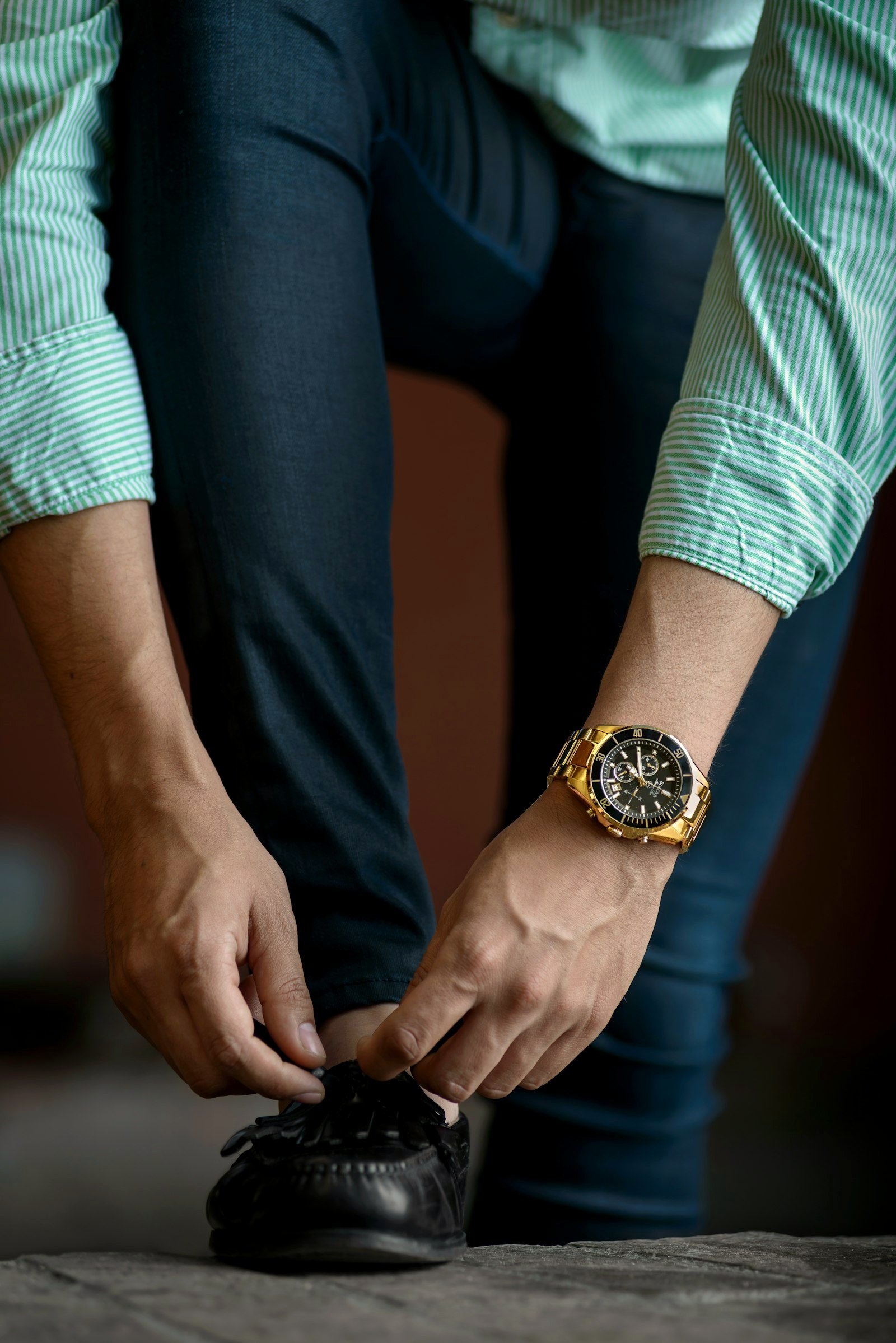
The photography, stated plainly, because this page’s exact subject is the bank’s thinnest subject. The bank holds exactly one loafer frame, the suede pair in street shadow that stands as this page’s hero: CREDITS-logged, already the hero of No. 11 and the break figure of No. 04, a frame the credits themselves note has carried the loafer for the Italian, Scandinavian and quiet-luxury roundups in turn, one frame for the whole welted-loafer class. The figure in the trouser section is the bank’s one frame of a hem meeting a shoe at working distance, the hands at the ankle and the watch at the wrist, captioned for what it shows. No frame in the bank shows the polished penny or tassel under a worsted trouser, no frame shows a horsebit at all, no frame shows the black loafer this brief’s colour table puts first, and no frame has been captioned as showing any of them. The harvest list this page is waiting for, in order: first, the pairing entire at street level, an unstructured navy suit over a polished black tassel, the hem at no break, the sock invisible, the licence photographed whole; second, the colour table’s first row, the black loafer under charcoal at the ankle’s range, hem, sock and vamp in one frame; third, the horsebit in dark calf under a dark suit in evening light, the bit as the outfit’s one bright note, the metals section in a single exposure.
Questions, answered
Can you wear loafers with a suit?
Yes, under a licence, and the licence is narrow. The loafer is the suit's one licensed informality, and it holds only where the shoe repays the formality its missing laces surrender: a species from the top of the ladder our loafer brief prints, the polished penny or tassel in calf, or the suede species in its summer rows; a trouser cut for the shoe, no break or a whisper of one; and the sock ruled as this brief prints it, invisible or a fine dark crew the hem covers. Outside those terms the loafer under a suit is not a style. It is the uniform edited at the ankle, and the rooms section names the rooms where no terms license it at all.
Which loafers are formal enough for a suit?
The top of the species ladder our loafer brief prints on the site's formality scale: the tassel loafer in polished calf at 4 and the horsebit in dark polished calf at 4.5, the highest a slip-on reaches, with the penny in polished calf at 3.5 the ladder's versatile middle. Suede costs every species half a rung, which is why suede's licence is the summer rows and the lighter cloths rather than the dressed middle. Below the ladder's tailored half the licence ends: the chunky lug sole stands at 2.5 on our Chelsea brief's sole scale, a work register that leaves the dress family, and the driving shoe, a slipper with a road contract, is refused under tailoring entire. The Oxford shoe owns 5, and no loafer takes its rows.
Do you wear socks with loafers and a suit?
A sock the room cannot see, or a sock the outfit chose on purpose, and never the white sock. With tailoring the ruling is the no-show sock, the invisible one being the honest version of the bare ankle the photographs suggest, because a bare foot gives a day's sweat nowhere to go but a lining that cannot be washed. In the cold rows a fine dark crew is legal and can be a deliberate note, in a colour that answers the trouser or the knit, provided the hem covers it standing. The white athletic sock under a suit trouser and a loafer is refused entire, in every season and every room this brief licenses: it is the one article that spends the shoe's whole licence at the ankle.
How long should suit trousers be with loafers?
Shorter than the same trouser over an Oxford shoe: no break, the hem clearing the shoe, or a whisper of one, a slight break at the very most, and nothing longer, ever. The reason is the shoe's shape, as our loafer brief prints it: a loafer is low, a low vamp, a low heel, a small footprint of leather, and cloth that pools over it swallows it, where the same cloth over an Oxford reads as drape. The hem's opening agrees with the length: a tapered or straight leg above the shoe, never a wide or flared opening over the narrowest shoe in the tailored wardrobe. The trouser is cut for the shoe, or the pairing is not being worn, whatever the label on either garment says.
What colour loafers go with a navy suit?
Black first, in the polished penny or tassel, the pairing that keeps the outfit's register highest and its metals quietest. Burgundy second, the third leather, licensed with navy and with grey as its traditional ground, its warmth doing the work a brown would argue with. Brown in calf is the middle rows' answer where the suit's cloth is textured or unstructured, and suede in brown or snuff is the summer licence, over fresco and linen, the nap lowering the outfit exactly the half-rung our loafer brief prices it at. What navy refuses is the light tan calf loafer, which draws the eye to the floor and spends the suit's continuity at its cheapest point.
Are suede loafers formal enough for a suit?
For the suits that license them, yes, and our suit brief prints the licence in its own matrix: the summer row runs a linen or fresco suit, stone, tan or light grey, over suede loafers with no socks or invisible ones. Suede costs every species half a rung on the ladder, so the suede penny stands at 3 and the suede tassel at 3.5, which is the summer rows' register exactly and the dressed rows' shortfall. Against the boardroom worsted suede is refused with every other loafer, and against flannel it is the borderline this brief rules in the suit species section: licensed in the creative and evening rows at the polished end of the suede bench, refused where the flannel is standing in for the uniform.
Can you wear loafers with a suit to a wedding or the office?
To the office's licensed rows, yes: the commercial and creative rows, the travel day, the summer office entire, at the outfit's best. To a wedding, under the invitation's terms, as our pairing briefs print for their own removals: where the code is the summer version, or states its own terms, the loafer at its ladder's top arrives as what was asked for; where the code asks for the dressed shoe, the loafer renegotiates the agreement at the ankle. The barred rooms are the uniform's, the strict boardroom, the court, the proceeding where the suit is still a uniform, which belong to black oxfords on our suit brief's own matrix. The loafer's licence is wide. It is not the whole map.
Has Young Cotton ranked loafers?
No, and this page will not pretend otherwise: there is no loafer Verdict Card on this site, footwear rankings are excluded from the site's programme, and this brief scores no shoe. The one loafer this site has scored is a garment inside a wardrobe, not a ranking entry: the Spier & MacKay unlined suede loafer, 88 in our business-casual capsule, $218 at last check, printed there as the office shoe. The trouser this brief keeps sending the shoe under is also a garment score on its own page: the Spier & MacKay tropical wool trouser, 87 on Verdict Card No. 15. Everything else here is a wearing system, printed so any loafer can be judged by it, including the ones this site has never handled.
Next
The family this brief completes stands around it: How to Wear No. 11, the loafers, the parent brief, whose one-notch rule, species ladder, sock table and break amendment this page takes as premises and spends under tailoring; How to Wear No. 54, loafers in winter, the shoe’s cold sibling, whose winter sock law and suede doctrine the cold form above is built on; How to Wear No. 04, the suit, whose fit order, break ladder and outfit matrix first licensed this shoe in the summer row and refused it in the boardroom’s; and the removal pairings, No. 60, the turtleneck with a suit and No. 62, a suit without a tie, whose ceilings this page inherits and whose repayment, in No. 62’s belt and metals, it carries down to the ankle. The pairing before this one stands at No. 61, a blazer with jeans, the formality scale met from the other direction. The buying around the pairing is scored at Verdict Card No. 64, where the Core Suit’s 85 was earned, at Verdict Card No. 15, where the tropical wool trouser’s 87 stands, at Verdict Card No. 36, where the sock shelf’s 88 was earned, and in the business-casual capsule, where the one scored loafer in print stands at 88 as a garment. The full series lives in the How to Wear index, and how every score behind those pages is built stands on our methodology page.