
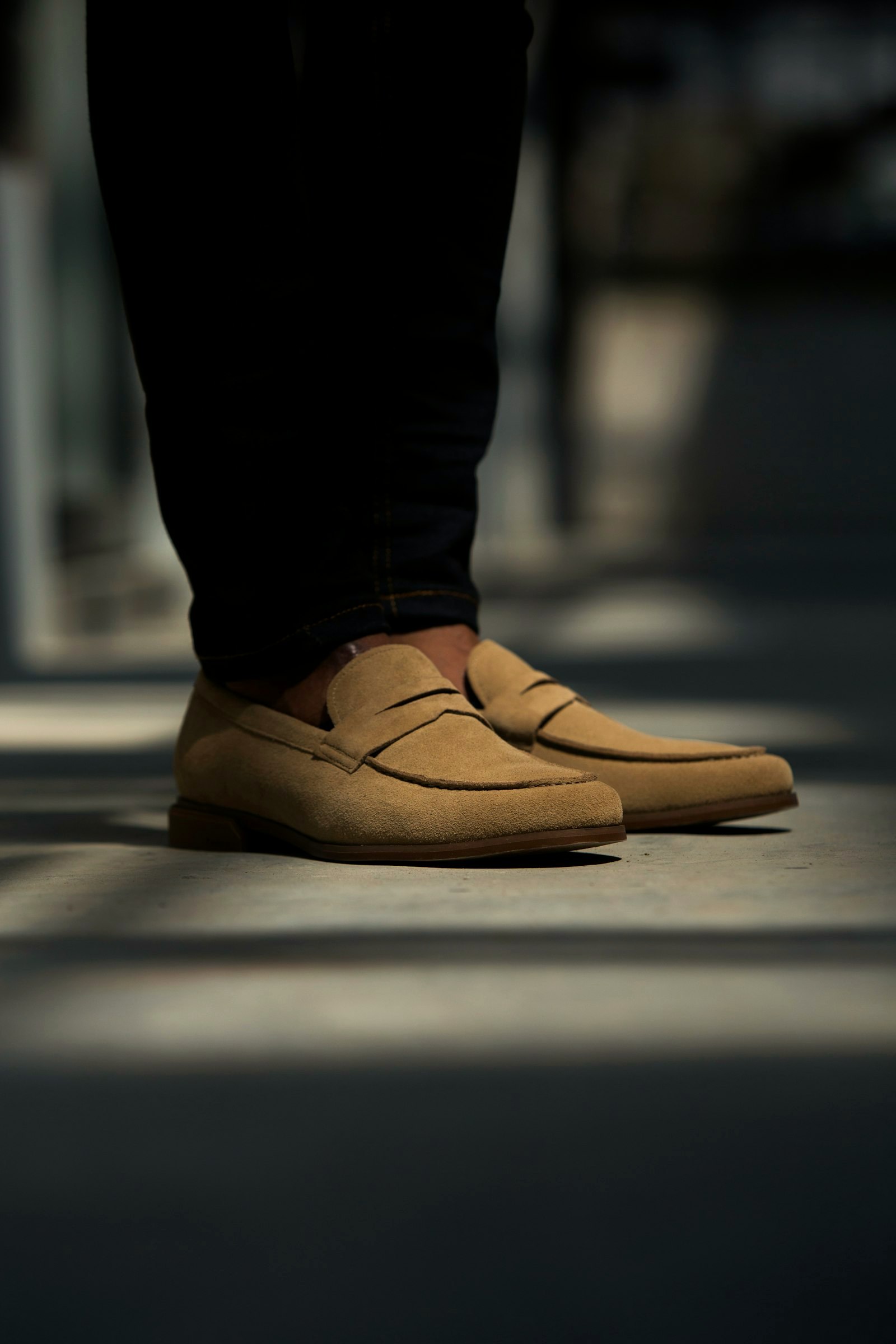
The parent brief's frame and this page's starting problem, captioned as exactly that: the suede penny under dark denim, the ankle bare over a no-show sock, in the summer assembly No. 11 prints. It is the only loafer frame our bank holds, and everything this brief changes for winter happens below that hem: the sole under the shoe and the sock inside it. The gap and the harvest list are named in the care section below.
Checked and updated October 2026
The ruling, up front: the loafer survives winter on its sole and its sock, not on its upper. A leather-soled loafer on wet pavement is the failure; the winter loafer is a rubber or lug-soled shoe worn with a sock chosen as part of the outfit, never as an apology. Everything above the ankle is inherited: How to Wear No. 11 prints the one-notch rule, the species ladder, the sock table and the short break, and this brief contradicts none of it. What winter changes is the ground the shoe stands on and the ankle it exposes, and this brief rules those two things: the sole law, the sock promoted to an instrument, suede’s salt line, the heavy trousers, and the cold-floor line where the shoe hands its shifts to the boot. This site publishes no footwear ranking, in this season or any other, and none is smuggled in here.
This brief: the decisive rule · the sole law · the species in winter · the sock as instrument · suede and salt · the winter trousers · the looks · the cold-floor line · the mistakes · care and our photography
The decisive rule: winter is decided below the hem
Every brief in this family has a rule that decides its garment, and this garment arrives with most of its law already printed, because No. 11 ruled the loafer entire: it moves an outfit exactly one notch in either direction and never two; its species stand on a formality ladder, the penny at 3.5 in polished calf, the tassel at 4, the horsebit at 4.5, with suede costing every species half a rung and an unlined construction the other half; its hem runs at no break to slight break and nothing longer; its office is the business-casual capsule, which scores its suede loafer at 88 as a garment; and its boardroom is refused, because the boardroom belongs to the black Oxford at the ladder’s top rung. This brief keeps every one of those rulings at full strength. A winter loafer outfit that breaks No. 11’s law is not a winter variation. It is the parent brief’s failure photographed in colder weather.
What winter adds is two facts the summer brief never has to price. The first is the ground: wet stone, salted melt, packed snow at the kerb, surfaces on which the shoe’s underside, the part of a loafer nobody styles, becomes the whole garment. The second is the ankle: the loafer’s low vamp, the very thing that makes it the summer shoe, leaves the ankle and the top of the foot in a single layer of leather exactly where the cold and the wet arrive. That is this brief’s decisive rule: the loafer survives winter on its sole and its sock, not on its upper. A leather-soled loafer on wet pavement is the failure, and the winter loafer is a lug or rubber-soled shoe worn with a sock chosen as part of the outfit, never an apology. The upper, calf or suede, penny or bit, is the last thing winter asks about. The season reads a loafer from the ground up.
Two corrections belong to the rule itself, because this commission arrived with premises the tree corrected, and the corrections are printed here rather than absorbed. The first is a species: the commission named four, penny, tassel, bit and Belgian, but the parent brief’s taxonomy files three, and the strap is the taxonomy entire. The Belgian, a soft unstructured slipper of a shoe, stands nowhere in No. 11’s table; it is filed in this brief’s species section only to be refused a winter seat, on its construction, and no ruling of the parent brief is extended to cover it. The second correction is a number: the commission cited the socks Card by its second card, the Organic Basics Core Crew at 82. Verdict Card No. 36 is won by the Darn Tough Hiker Micro Crew at 88, a merino boot sock, and the distinction matters to this brief’s whole argument, because the Card’s winner is built for the boot that takes the loafer’s hardest shifts, while the loafer’s own winter sock is argued from the Card’s fibre ruling and its dress-height cards. Both records are used below as the Card prints them, the winner as a boot sock and the runner-up as the daily crew.
The sole law: leather dresses, rubber walks, lug works
The winter loafer is chosen from underneath, and the sole classes are three. The prices this brief puts on them are not new: they are the arithmetic How to Wear No. 15 prints for the loafer’s winter form, the Chelsea, whose species table separates the boot by upper and sole in exactly these classes, applied here to the shoe the boot was winterised from.
| The sole | What it buys | What it costs | Its weather |
|---|---|---|---|
| Leather | The dress finish: a slim waist, a clean edge, the sole the species ladder was priced in | Grip, on any wet surface: No. 15’s sentence for its own sleek boot is that the leather-soled version skates on wet pavement | Dry days, door to door, interiors |
| Slim rubber | Wet pavement, at no formality price: No. 15 counts the trade as free on the boot, and the loafer’s ladder is the same ladder | Nothing on the ladder; a thicker edge at macro range, which no outfit has ever been judged at | The winter default: rain-slicked streets, wet leaves, the ordinary cold commute |
| Lug and commando | Tread: packed snow at the kerb, slush-adjacent crossings, frozen ruts, the surfaces the slim sole steps around | The dress register entire: No. 15 prices its lug boot at 2.5, a different animal, and a lug under a loafer’s low upper moves the shoe the same way, out of the tailored rows into a casual one | The hard casual rows: the country weekend, the dog, the worst pavements worn with denim and cords |
Read the table as a sequence of permissions. The leather sole is not banned; it is scheduled, the way No. 11 schedules the shoe itself out of the slush. A calf penny on leather is a correct winter shoe on a dry cold day, door to door, and the man who owns only that shoe owns a winter loafer for the majority of the season’s days in most cities. The slim rubber sole is the brief’s default because it removes the scheduling: it is the same shoe on every dry day and every merely wet one, at a cost the family’s own arithmetic sets at zero. The lug is the honest extreme, bought knowingly: it converts the loafer into winter equipment and charges it the tailored rows, exactly as No. 15 charges its lug boot, and a lug loafer worn under a blazer has made the boot brief’s named error in a shorter shoe. Buy the sole for the ground the week actually holds, and let the upper be chosen by No. 11’s ladder, which is where uppers are chosen.
One construction line rides with the soles, inherited from the parent brief’s mistakes: the winter loafer is stitched, not glued. No. 11 prices the category’s honest floor at about $200, below which a loafer stops being stitched and starts being glued, and a glued sole cannot be resoled. Winter is the season that finds the adhesive out: the wet works at the bond daily, the salt works at the welt, and the shoe whose whole winter case is its sole cannot be a shoe whose sole is a consumable. The resoleable rubber sole is not a luxury specification. It is the winter version of the parent brief’s whole buying law, a decade purchase or a season’s costume, decided at the price before the fit is tried.
The species in winter: which forms carry which soles
The species are the parent brief’s three, and winter sorts them by a question No. 11 never had to ask: which forms are built, across the market as a class, on which soles. The answer is printed in general terms, as a property of the forms, with no model invented to carry it.
| Species | Formality, from No. 11 | The soles the form carries | The winter read |
|---|---|---|---|
| Penny | 3.5 in calf, 3 in suede | All three: leather, slim rubber and lug versions of the penny stand on the rail in every season, the widest sole range in the family | The winter default, as it is the family’s default: the capsule’s species, the denim brief’s shoe, and the one form that takes the rubber sole without changing its read |
| Tassel | 4 in calf, 3 in suede | Leather and slim rubber: the tailored species is built as a dress shoe and its rubber versions keep the slim profile | The dressed winter loafer: the blazer rows in cold weather, on rubber, with the ornament reading as the formality claim No. 11 prices it as. A lug under a tassel contradicts the species, hardware jewellery on a work sole, and the pairing is refused |
| Horsebit | 4.5 in calf, 3.5 in suede | Leather, and slim rubber in its dress builds: the bit is evening hardware and the form is sold as one | The narrowest winter seat, as it is the narrowest seat in the parent brief: dark tailored rows on dry or merely damp ground. The bit at 4.5 under winter tailoring on a rubber sole is the family’s ceiling holding in the cold, and no higher, because the boardroom above it belongs to the Oxford in every season |
| Belgian | Not filed by No. 11 | A soft, unstructured slipper construction on a thin sole: no winter build of the form exists as a class | Refused a winter seat, and filed here only so the refusal is printed: a house shoe’s construction, with neither the sole nor the structure the season’s ground asks for. Its season is the summer evening of the parent brief’s world, and this brief leaves it there |
The two discounts of the parent brief apply in winter at full value, and they stack with the sole law rather than against it. Suede still costs half a rung, which is why the suede penny at 3 remains smart casual’s centre in January exactly as in June. The unlined construction still costs the other half, and winter adds its own sentence to that discount: the unlined shoe is the capsule’s office shoe and the most comfortable form in the family, and it is also the thinnest wall in the family, a single layer of suede between the foot and the weather with no lining to slow the cold or the wet. The unlined suede loafer on a rubber sole, with the winter sock inside it, is a correct office shoe on a dry cold day. It is the first form retired as the ground worsens, and the order of retirement is printed in the limits section: unlined first, then suede, then the shoe itself.
The sock as the winter instrument
The parent brief’s sock table has a cold-weather row, and this brief is that row written at full length. No. 11 rules that with trousers in cold weather a fine dark crew sock is legal and can be a deliberate note, provided the hem covers it standing, and that denim runs the loafer crew-socked in winter. Winter takes the ruling the rest of the way: the sock is not the winter loafer’s concession to the cold. It is the instrument that makes a low shoe a winter shoe, the layer that covers the ankle the vamp exposes, insulates the gap between hem and shoe, and is chosen, coloured and textured as part of the outfit, shown in the stride and seated, exactly as deliberately as the knit above the trouser. A sock worn as an apology, the athletic white pulled up, the thin dress sock shivering at a summer weight, fails the season the way the visible sock with shorts fails the parent brief’s summer: two signals contradicting each other at the same ankle.
| The winter row | The sock | The record |
|---|---|---|
| The long day: commute, travel, hours outdoors between interiors | A merino crew, midweight, in a colour that answers the trouser or the knit | The fibre is Verdict Card No. 36’s ruling: merino is the working fibre, moisture-moving, odour-resistant across repeated wears, regulating temperature in a shoe as in a boot. The Card’s merino winner, the Darn Tough Hiker at 88, is a micro crew at eight and a half inches, a boot height its own card calls tall for a loafer, so the winter loafer takes its fibre at crew height, not its winning garment |
| The tailored day: flannel, cords, the blazer rows | A fine dark crew, thin enough for the slim last, covered by the hem standing | The parent brief’s own row, and the Card’s dress answer stands behind it: the Pantherella Danvers at 79, cotton lisle, the thin crew the Card files as the sock for the shoe. Cotton is the desk fibre on the Card’s ruling, cool and smooth; the tailored winter day is a desk day, and the fine crew is its sock |
| The daily drawer | The certified cotton crew, in rotation | The Organic Basics Core Crew at 82 on Card No. 36, second on the page and the Cotton Standard’s sock: the daily pair the desk would stock seven of, worn here at the height No. 11’s table assumes |
| Every winter row | Never the no-show | Ruled in the section below |
The no-show sock’s winter status, ruled plainly: retired. The no-show is a summer instrument, built for the bare-ankle grammar of No. 11’s warm rows, and winter reverses every term of its case. It covers nothing the season attacks: the ankle it leaves bare is the exact surface the loafer’s low vamp exposes to the cold, so the winter outfit built on it has a gap at its foundation, skin between sock and hem in January. And the parent brief’s hygiene truth stands behind the styling: the invisible sock was always the honest minimum between the foot and a lining that cannot be washed, and a winter foot in a heated office sweats the same day’s sweat into the same unwasheable lining. The no-show’s winter replacement is not a longer version of itself. It is a different decision: the crew, chosen, shown, and warm. The bare ankle in winter is not a register. It is a summer photograph worn out of season, and the men in those photographs, as No. 11 prints, are barefoot for ninety seconds.
Suede in winter: rain is survivable, salt is not
Suede is the winter loafer’s most argued upper, because the family’s centre is a suede shoe: the capsule’s scored loafer is unlined suede, the hero frame at the top of this page is a suede penny, and No. 11’s ladder puts suede half a rung below calf in every species. The care record the tree prints is fuller than the folklore, and this section prints it whole, because the distinction it makes is the brief’s whole suede case: the enemy is not water falling. It is salt lying.
Rain, first, because it is the survivable one. The Chelsea brief’s ruling, printed as its own question and answer, is that protected suede survives drizzle and nothing suede survives a downpour, and unprotected suede should not be tried in either. Protection has a schedule, printed in No. 15’s care section: spray with protector before the first wear, not the first storm, and again after every clean; brush after wears to lift the nap; work an eraser or crepe brush at scuffs before they set. A pair that does get soaked is stuffed with paper, stood away from radiators and every other heat source, and given a full day, and suede that dries slowly and gets brushed usually comes back. In dry cold, none of this is even engaged: No. 28 seats the suede shoe as the tailored cut’s answer in dry cold, two matte surfaces in agreement, and the suede loafer in a dry January is a shoe in its element, the nap reading as winter texture against flannel and cord.
Salt is the other case, and the record is blunt about it. No. 11’s care section gives suede a brush, an eraser for marks, and protection from salt and standing water, and its mistakes section prices the failure: a nap that salt water stains in one crossing of one street. No. 15 prints the same chemistry for the boot: salt eats leather the way slush eats an unlined loafer, and the city schedule crosses salted pavements daily, so the pair is wiped down after slush wears, dried standing, and creamed more often in the salt months. The distinction the folklore misses is that rain is an event and salt is a residue. Rain wets the nap and, on a protected pair, dries out of it. Salt arrives dissolved in meltwater, wicks into the nap as the water dries, and crystallises there, which is why the tide line on a salted suede shoe does not brush out the way a rain mark does. The winter suede loafer’s law follows: protected, it works the dry days and survives the drizzly ones; the salted slush crossing is refused at any level of protection, and a pair that has crossed one is wiped and dried the same evening, on No. 15’s schedule, not at the weekend.
The winter trousers: heavy cloth at the parent brief’s break
The trousers above the winter loafer are the heavy plain cloths, and every rung of the rail is ranked. Flannel is the first seat, the brushed winter class itself: Verdict Card No. 15 files the Brooks Brothers wool flannel at 76, matte and warm at about 300 grams as a class figure, the trouser its ranking reaches for from October to March, its brushed surface answering the suede’s nap and the calf’s smoothness with equal ease. Corduroy is the second seat, on No. 24’s wale law, needlecord dressing up and standard cord the all-rounder: the Drake’s Field Games at 79 in Verdict Card No. 38, in tobacco or navy, texture over texture with the loafer’s smooth vamp as the quiet surface between two piles. Dark denim is the third seat, under No. 05’s law entire: the Levi’s 501 at 81 in Verdict Card No. 11, the loafer crew-socked beneath it in winter by the denim brief’s own rows, taking the dark pair into the evening exactly as the parent brief prints.
The hem does not soften for the season. No. 11’s break law is restated here at full strength because winter cloth tempts the violation: over a loafer, the answer is no break to slight break, and nothing longer, ever. Heavy cloth makes the law stricter, not looser. Flannel and cord stand stiffer off the leg than tropical wool, a fuller break in a winter cloth does not drape over the shoe, it collapses around it, and the low loafer disappears into a heavier pool of cloth than the summer version of the same error. The leg above the narrow shoe tapers or runs straight, on the parent brief’s opening arithmetic, and the wide winter leg over a loafer fails here as it fails over the boot in No. 15: the shaft or the shoe is swallowed whole, and what remains reads as something wrong at the ankle. The crop is the winter leg’s licensed exception, and it changes its meaning with the season: a cropped flannel or cord ends above the shoe by design and shows the sock, which in summer would be the error and in winter is the system working, the chosen crew standing in the gap as the outfit’s deliberate band. The crop and the no-show together remain refused, the summer assembly in January, and they are named together in the mistakes.
The looks: the winter loafer styled on the published records
Six assemblies from this brief’s rulings. The trousers and socks in them are the Cards’, at the Cards’ scores; the shoe is styled as a species under its parent brief’s law, because no Card ranks it, and nothing in the judgments is scored here.
| Setting | The assembly | With | The judgment |
|---|---|---|---|
| The dry cold office | The capsule’s unlined suede penny, on a slim rubber sole, the winter sock inside | Grey flannel, the Brooks Brothers cloth class at 76 on Card No. 15, a fine dark merino crew, an Oxford and a blazer carried or worn | The office default translated: the capsule’s assembly entire, with the two winter substitutions this brief exists to license, rubber under the shoe and a chosen crew inside it. The shoe remains the answer No. 11 and the capsule print; the season has changed its sole and its sock and nothing above the hem |
| The dressed winter evening | A calf tassel at 4, on slim rubber | Charcoal flannel at no break, a fine-gauge crew knit, the Danvers-class thin crew sock at 79 on Card No. 36 | The parent brief’s blazer row in cold weather: the species that stands on the blazer’s rung, answered by the dress sock the socks Card files for the shoe, the whole assembly one notch below the Oxford it never pretends to replace |
| The cord weekend | A suede penny at 3, protected, on rubber | The Drake’s Field Games corduroy at 79, tobacco, a heavy knit above | Texture over texture at the season’s centre: pile, nap and knit in agreement, the smooth vamp the quiet surface in the assembly, legal on every dry street and retired at the first salted crossing by the suede section’s law |
| Dark denim, winter evening | A brown calf penny at 3.5, on slim rubber | The Levi’s 501 at 81, dark and plain, crew-socked by No. 05’s own winter row, a knit or an Oxford above | The hero frame’s assembly with its winter terms filled in: the jean dressed up its one notch, the notch now carried by a shoe that can walk home on wet stone and a sock that was chosen for the gap it shows in the stride |
| The hard casual day | A penny on a lug sole, calf, worn as equipment | Straight denim or cords, a heavy overshirt or chore coat above | The lug’s licensed row, priced by No. 15’s arithmetic and printed with its cost attached: the shoe has left the tailored family for the day, and the outfit agrees with it, work register entire, grip bought honestly and formality spent knowingly |
| The slush day, printed as a ruling | No loafer: the Chelsea, sleek calf on rubber or the lug boot for the worst of it | The same trousers, hemmed to the shaft’s law, not the shoe’s | The matrix’s necessary counter-row, inherited from No. 15’s table: the loafer is retired by slush and the boot takes the shift, covering the ankle the loafer exposes. A rotation that owns both shoes owns the whole winter; a loafer forced into this row is the parent brief’s named destruction, restated in the limits below |
The ruling
Wear the loafer through winter from the ground up. Choose the sole before the species: rubber as the default at no formality cost, leather scheduled for dry days, the lug bought knowingly as casual equipment. Put the winter sock inside it as an instrument, merino crew for the long day, the fine dress crew for the tailored one, and retire the no-show until the season that invented it. Keep suede for dry cold and protected drizzle, and refuse it the salted crossing. Hem the heavy cloth at the parent brief’s short break, let the crop show the chosen sock, and hand the slush, the snow and the downpour to the boot without argument. Assembled this way the loafer is not a summer shoe surviving winter on nerve. It is the same one-notch instrument, winterised at exactly the two points the season touches it, and honest about the line where its winter ends.
The cold-floor line: where this brief sends you to boots
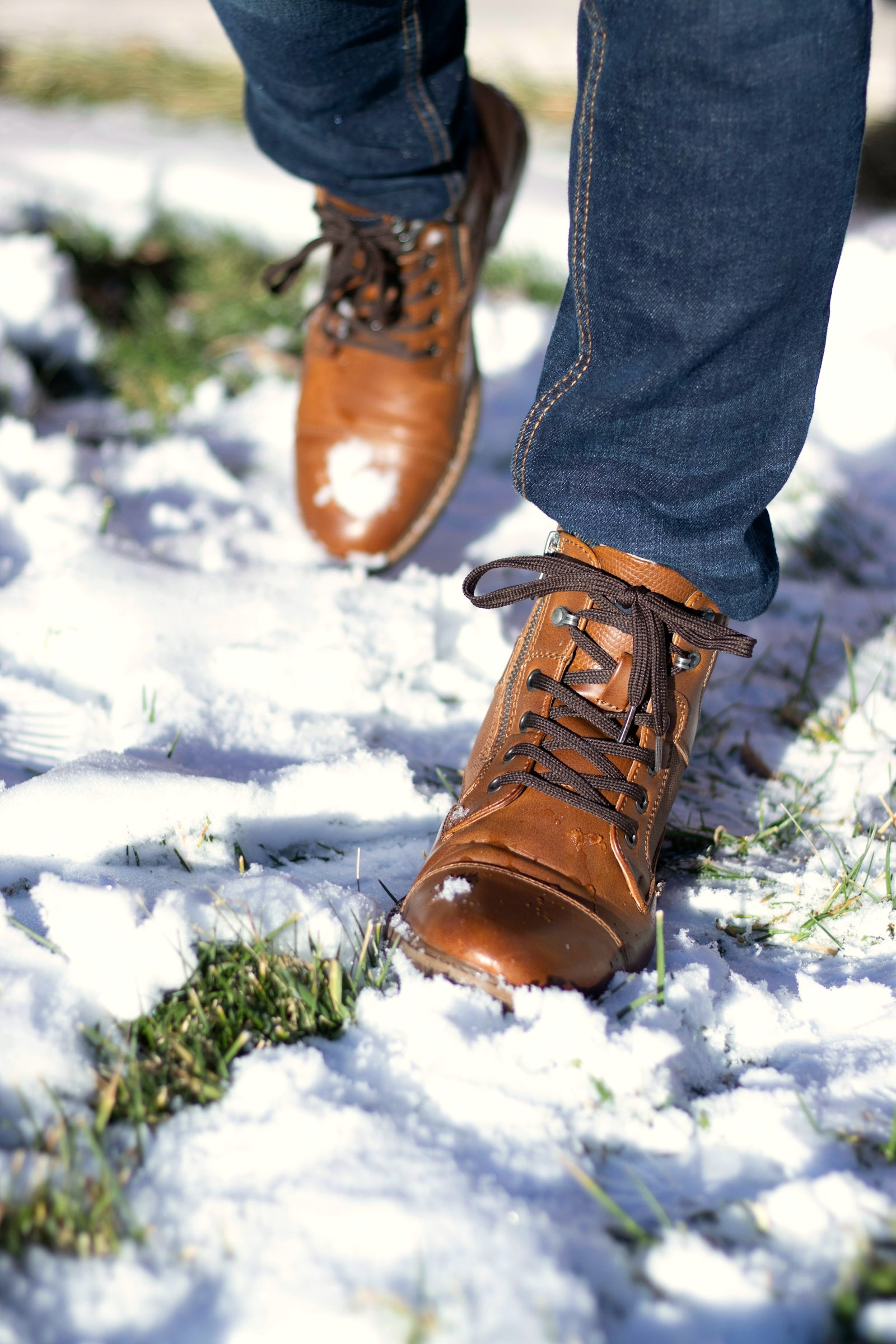
Every brief in this family prints its boundary, and this one prints its boundary as a list of surfaces before it is a temperature, because the tree’s record is a record of surfaces. Slush and standing meltwater: the loafer is retired, on construction grounds the parent brief prints in its own mistakes section: a low cut that admits meltwater at the ankle, a thin sole with no lugs and no storm welt, and in suede a nap that salt water stains in one crossing. Snow: No. 19 prints the lug as the only sole in the wardrobe built for snow and slush, and the dressed rows wait for dry weather rather than ruin good calf on salt; a loafer on any sole it is sold on is not that sole. The downpour: nothing suede survives it on No. 15’s ruling, and the trench brief’s rain row asks for boots with a real sole, meaning leather on rubber at boot height. Those three surfaces are the boot’s, and the boot is No. 15’s Chelsea, the loafer’s winter form, which exists in the trilogy precisely to take the rainy evening, the cold commute and the wet weekend the loafer and the sneaker leave uncovered.
Temperature is the boundary’s second half, and it is printed here as what it is: this site’s record states no degree figure for any shoe, so the line below is argued from the garment’s construction, labelled as first principles rather than record. A loafer is a low shoe: the top of the foot sits under one layer of leather, the ankle stands open above the vamp, and the foot rides a few millimetres of sole above the ground it walks on. On frozen ground, over distance, the cold arrives through the sole and at the open ankle together, and no sock inside the shoe closes the ankle above it, because the sock ends where the shoe’s opening begins. The Chelsea’s shaft is the instrument built for exactly that arrival: it covers the ankle the loafer exposes and carries a thicker sole under the foot. So the working line, argued and labelled: the loafer’s winter is the cold a man crosses, between door and door, in a city winter’s ordinary range; the cold a man stands in, works in or walks miles in, on frozen ground, belongs to the boot at any temperature the forecast prints. The shoe is not insulted by the line. It is the same honesty No. 11 prints for the boardroom: a ceiling is not a defect in the shoe. It is the shoe.
The mistakes
The leather sole on wet stone. The winter version of the parent brief’s arithmetic failures, and the only one that can put a man on the ground: the dress sole, polished and slim, meeting wet pavement, salted marble, the tiled lobby floor with melt tracked across it. No. 15 prints the verdict for its own sleek boot, that the leather-soled version skates on wet pavement, and the loafer’s lower heel and lighter build make the sentence shorter, not longer. It is a grip failure before it is a style failure, which is why this brief puts the sole before the species: the man who chose the right shoe on the wrong sole has made the season’s most elegant mistake at the exact moment it stops being elegant.
The apologetic sock. The winter loafer’s sock failures are one failure in two directions. Down: the no-show kept into January, the ankle bare in the gap the whole brief exists to close, a summer signal contradicting a winter outfit at its foundation. Up: the athletic crew, white or logo’d, pulled high under a tailored trouser, the shorts error of the parent brief committed in reverse, a gym signal at a dress ankle. Both are the sock worn as something other than a decision: hidden where it should be chosen, or loud where it should be quiet. The winter sock is a fine or midweight crew in a colour the outfit already owns, and every deviation from that sentence is visible from across the street, because the loafer puts the ankle on display in every season. That was No. 11’s first sock sentence, and winter does not repeal it.
Unprotected suede in the salt months. No. 15 names the boot version one of its mistakes outright: suede’s nap drinks water and keeps the receipt, and unprotected suede in rain is not a rugged look, it is a care failure photographed. The loafer version is worse, because the loafer’s salt exposure is total: no shaft, no welt, the nap meeting the salted melt at street level with nothing between. The spray costs a minute before the first wear. The tide line costs the shoe. A man who will not protect suede owns a calf loafer for winter, and this brief would rather print that trade than watch the other one happen again.
The summer assembly in January. The crop and the no-show and the leather sole, each legal in its season, assembled entire in the cold: the trouser cropped to show an ankle that is bare, over a shoe that cannot grip, in an outfit whose every term was set in August. It fails the way the parent brief’s two-notch outfits fail, as arithmetic: three summer decisions summing to a winter outfit none of them voted for. The winter assembly is not the summer one with a coat over it. It is the same law re-run at the new season’s terms, sole, sock and hem each re-decided, which is the whole of what this brief adds to No. 11.
Care, and a note on our photography
The winter loafer’s care is the parent brief’s care with the season’s schedule added. The rotation is still the system: no pair works two days running, cedar trees in the shoes overnight, because a lining that never dries ages in dog years, and winter doubles the moisture the day delivers. Calf takes cream and rest and comes back better, and No. 15’s salt schedule applies to it at shoe height: wiped down after slush-adjacent wears, dried standing away from heat, creamed more often in the salt months. Suede takes the record printed in this brief’s suede section entire: the spray before the first wear and after every clean, the brush after wears, the eraser at scuffs, the paper and the full day for a soaked pair, and never a radiator. The rubber sole asks for the one check the leather sole does not: its tread and its bond are the shoe’s winter case, and a rubber sole worn smooth by spring is next winter’s leather sole, scheduled for the resole the stitched construction was bought to allow.
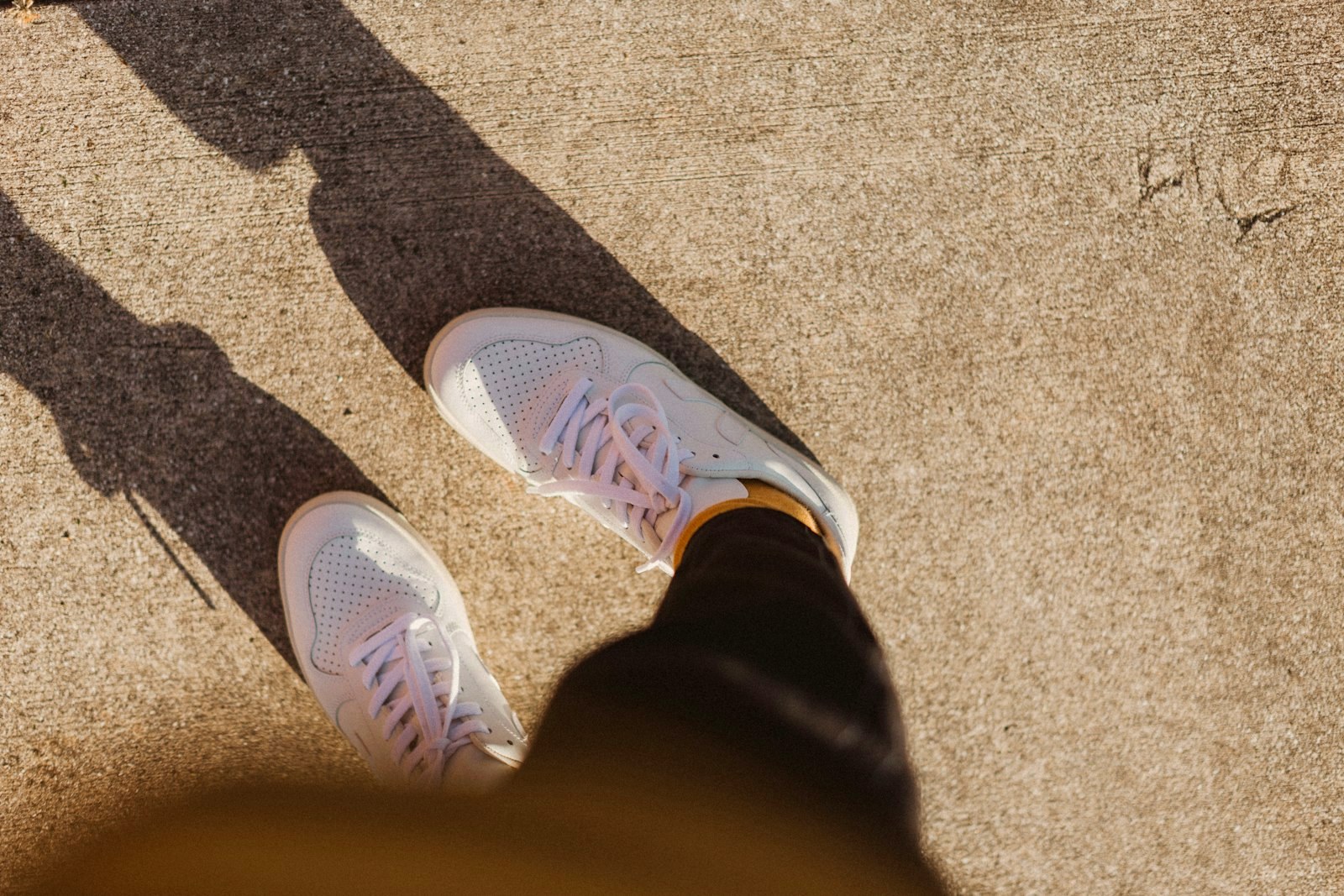
A note on our own photography, printed because this page believes in saying so: our photo bank holds exactly one loafer frame, the suede penny at the top of this page, and it is the parent brief’s hero, worn here again because it is the frame that exists. There is no lug-soled loafer on wet stone, no visible wool sock worn with a loafer over flannel, no suede loafer photographed after rain, and no winter loafer at any range that this page could open on without reusing its parent’s one true frame. The figures inside are captioned for what they show: a crew sock at an ankle above a sneaker, for the instrument section, and boots in snow, for the boundary the boot owns. The gaps are on the harvest list, named in this order: a lug-soled loafer on wet stone first, a visible wool sock with a loafer and flannel second, a suede loafer after rain third. Until those frames exist, this page describes the winter shoe in words and shows the two honest frames it has, which is the family’s standing practice rather than a borrowed photograph dressed as the subject. Prices and records on this page were checked against the site’s own published Cards and briefs in October 2026; the method that built them is written out on the methodology page.
Questions, answered
Can you wear loafers in winter?
Yes, in dry cold, on two conditions this brief exists to print: the sole is rubber or lug rather than leather, and the sock is a chosen crew rather than a no-show or an apology. Our loafer brief, No. 11, already runs the shoe through cold weather in its sock table and its denim rows; what winter changes is the ground and the ankle, not the shoe's law. The one-notch rule, the species ladder and the short break all stand. What winter retires is a set of surfaces, named in this brief's cold-floor section: slush, standing meltwater, snow and the downpour belong to the boot, as No. 11's own mistakes section already rules for the slush.
What sole should a winter loafer have?
A rubber one, and a lug one when the streets ask for it. The sole arithmetic is the boot brief's, printed for the Chelsea in How to Wear No. 15: a slim rubber sole costs a laceless shoe nothing in formality and buys it the wet pavement the leather-soled version skates on. Leather is the dress sole and a dry-day sole; on wet stone it is the winter loafer's first failure, a grip failure before it is a style one. The lug sole buys slush-adjacent grip and packed snow at the kerb, and pays for it the way No. 15 prices its lug boot at 2.5: it moves the shoe out of the dress family into a work register, so the lug loafer is a casual shoe and is worn as one.
Do you wear socks with loafers in winter?
Yes: a crew sock, chosen as part of the outfit. Our loafer brief's sock table already licenses the fine dark crew with trousers in cold weather, covered by the hem when standing, and this brief extends the ruling to its winter form: the sock is the instrument that makes a low shoe a winter shoe, shown in the stride and seated as a deliberate band of colour or texture between hem and shoe. The fibre is merino where the day is long, on Verdict Card No. 36's fibre ruling, and the height is the crew, not the boot's micro crew. The no-show sock is ruled out for the season: it is a summer instrument, it leaves bare the ankle the loafer's low vamp exposes, and No. 11's hygiene truth stands behind it, the bare or near-bare foot sends the day's sweat into a lining that cannot be washed.
Can you wear suede loafers in winter?
In dry cold, yes: our waxed jacket brief, No. 28, seats the suede shoe as the tailored answer in exactly that weather. In rain, only protected, and only drizzle: the Chelsea brief's ruling is that protected suede survives drizzle and nothing suede survives a downpour, with the protector sprayed before the first wear and after every clean. In salt and slush, no. The loafer brief's care section and its mistakes section agree: suede takes protection from salt and standing water, and salt water stains the nap in one crossing of one street. Suede's winter enemy is not water falling. It is the salted melt lying on the ground, and the distinction is argued in this brief's suede section.
What trousers do you wear with loafers in winter?
The heavy plain cloths, at the parent brief's break. Wool flannel first, the brushed winter class: the Brooks Brothers flannel stands at 76 in Verdict Card No. 15. Corduroy second, on the wale law of How to Wear No. 24: the Drake's Field Games at 79 in Verdict Card No. 38. Dark denim third, under No. 05's law, which runs the loafer crew-socked in winter and takes the dark pair into the evening rows. The hem law does not soften for the season: No. 11 rules no break to slight break over a loafer and nothing longer ever, and heavy cloth pools worse than light cloth, so the winter hem is if anything the stricter one. A cropped winter trouser is legal and shows the chosen sock by design.
When should you wear boots instead of loafers?
At this brief's cold-floor line, which is a list of surfaces before it is a temperature. Slush and standing meltwater, because the loafer's low cut admits water at the ankle and its thin sole has no storm welt, which is why No. 11 names the loafer in the slush as a destruction, not a risk. Snow, because the pea coat brief, No. 19, prints the lug as the only sole in the wardrobe built for it. The downpour, because nothing suede survives it and the trench brief's rain row asks for boots with a real sole. Those shifts belong to the Chelsea of How to Wear No. 15, the loafer's winter form, which covers the ankle the loafer exposes and takes the rainy evening, the cold commute and the wet weekend this brief hands it.
Has Young Cotton ranked loafers?
No, in winter or any other season, and this page will not pretend otherwise: footwear rankings are a standing exclusion on this desk, there is no loafer Verdict Card, and this brief scores no shoe. The one loafer this site has scored is a garment inside a wardrobe, the Spier & MacKay unlined suede loafer at 88 in our business-casual capsule, $218 at last check, cited here as exactly that. The socks this brief styles the shoe with are ranked, on Verdict Card No. 36, and the trousers on Cards No. 15 and No. 38; the shoe itself is styled under its parent brief's law and measured against the boot that takes its hardest shifts.
Next
The parent brief is How to Wear No. 11, whose law this page extends and whose sock table’s cold-weather row it writes at full length; the shoe that takes this brief’s retired shifts is briefed in How to Wear No. 15, the loafer’s winter form, and the trilogy’s third shoe in No. 12. The sock is ranked in Verdict Card No. 36; the trousers in Verdict Card No. 15 and Verdict Card No. 38, with the cord styled in How to Wear No. 24 and the denim in No. 05. The coat above the winter loafer is briefed in No. 19 and the overcoat brief, the neck in No. 25, and the wardrobe that made the loafer its office shoe is the business-casual capsule.