
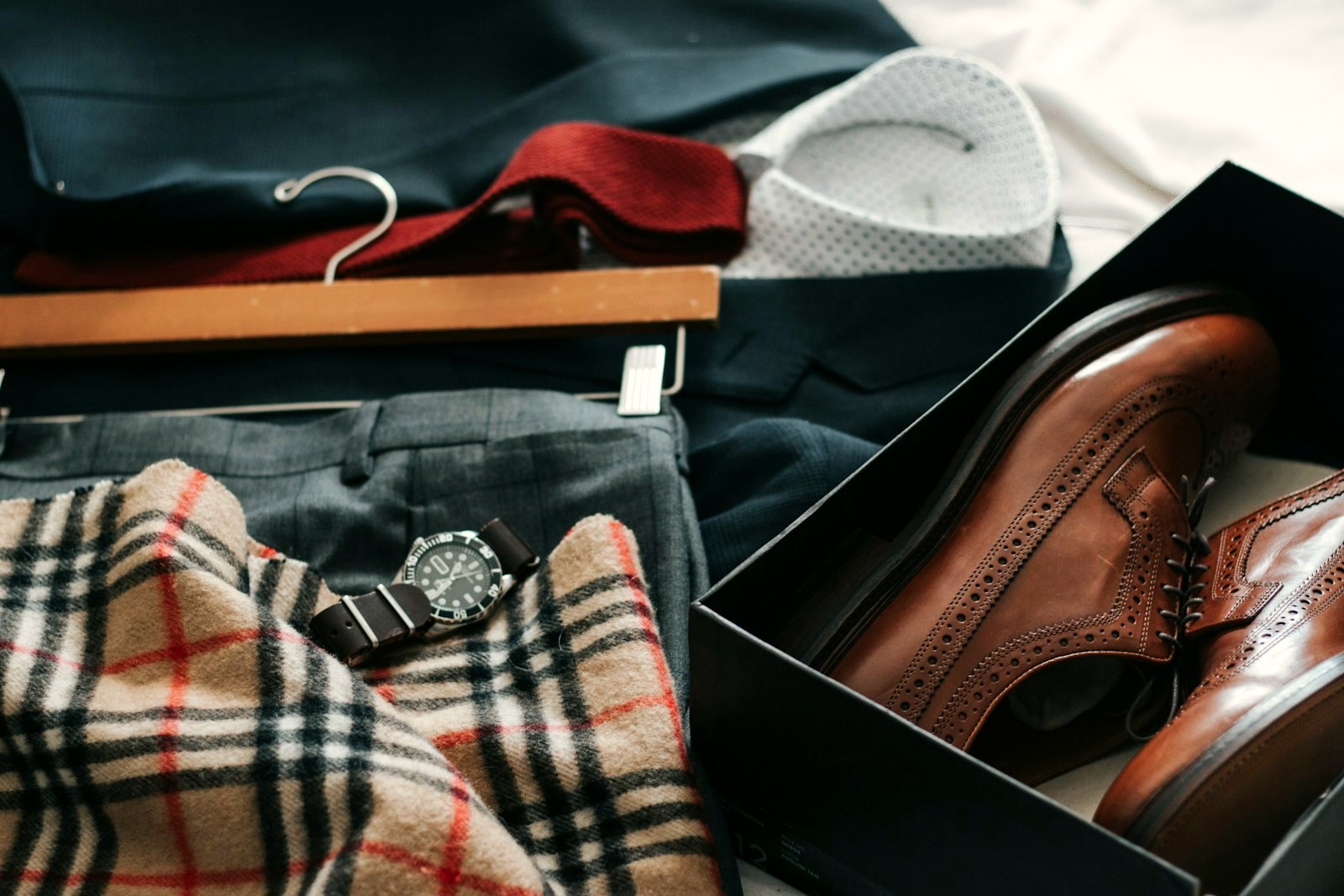
Corduroy is graded by its wale, the ribs per inch, and this ranking prints the number wherever a maker publishes one. A note on photography, printed because this page believes in saying so: the hero is a bank frame of tailored trousers in a flat-lay, captioned as exactly that. Our bank holds no photograph of a corduroy trouser, worn or folded, so no ranked pair is pictured anywhere on this page, and the frames this page needs head the harvest list in the honesty section.
Checked and updated October 2026
The basis: a corduroy is graded by its wale before its colour, because the wale is this cloth's gauge and the number most rails never print. Then the fibre truth, because this category's standing lie is a cotton story told over a synthetic line. The winner: the Drake's Field Games trousers at 79, 100 percent cotton at a published 15.4 ounces, made in Italy, at $595, docked in the cloth row for the one number its page withholds, the wale itself. The skip: the Brunello Cucinelli double-pleated corduroy, scored 50 and named in the verdict box below: $1,350 for a fibre line that reads cotton and polyester with the split unpublished. In between, the Fort Belvedere Stancliffe prints its 8 wale in its name at $350, L.L.Bean prints its 11 wale the same way at $79.95, Quince sells the field's only needlecord at $60, and two household names are charged in the open for the spec lines their pages did not expose to this check.
First, the decision
Every corduroy argument is really three arguments, and this page settles all three before it scores anything. The first is the only question most readers actually have: if you buy one pair of corduroy trousers, buy the Drake's Field Games. It is ranked first below on the published evidence, and it is named here, in the first screen, because a page that buries its answer under eight cards has not answered it. Its cloth is the heaviest verified in the field, its build carries the full tailored furniture, adjusters, bearer, fob pocket, and its one silence is charged on its card rather than forgiven.
The second argument is the wale, and it is a number, not a vibe. Needlecord, 14 to 16 ribs to the inch: the fine end, pile so short the cloth reads almost smooth, the corduroy that dresses up and sits under a blazer beside flannel. Standard cord, 8 to 11 wale: the all-rounder, visible ribs, country colour, the weekend and the pub and the cold office alike. Wide wale, under 8 ribs: the statement, bold corduroy, the cloth of a decade's silhouette, bought deliberately or regretted on the same schedule as the silhouette. Our types of pants index prints the same law in one line: the wale is the formality dial. A maker who publishes the number earns the cloth row. A maker who sells corduroy by adjectives alone is charged for the silence, and three cards below carry that charge.
The third argument is fibre, and it is where this category lies for a living. Cotton is the cloth's honest form: warm, matte, and mortal in a specific way this page scores, pile crush at the seat and knee. Cotton with a little elastane is the comfort form, graded mildly here: the stretch buys movement and charges a creep tax, knees and seat growing slowly across a season. Polyester in the line is the impostor form, a corduroy-look cloth wearing a cotton story, and it is convicted wherever it appears, at $32 or at $1,350. Price is no alibi. The most expensive trouser on this page carries the least honest fibre line in the field, and the cheapest honest one prints its wale in its name.
How the scores work
Every pair is scored out of 100 on the same five rows. Cloth and wale (30) reads the fibre line and the number: full cotton from a published spec scores at the top, a published wale count earns its points, elastane loses points in proportion, polyester in the line loses more, and a wale or a fibre split the maker will not publish is charged as silence. Construction (20) reads what holds the trouser up and finishes it: waistband build, adjusters, pocketing, bearer and closure, hems delivered with something for a tailor to work with. Fit (20) is scored against this site's published rise and leg bands from the pants index: the rises, leg shapes and sizes a maker actually sells. Value (15) is the score divided by the bill, not the bill alone. Longevity (15) is the pile-crush row: cloth weight and pile density against the seat shine and the knee wear that end every corduroy, with anti-crush and easy-care claims graded as claims until a spec stands behind them. Row scores add to the total, on every card.
The ranking
Drake's Cotton Corduroy Field Games Trousers
The Winner
US price at last check: $595.
The cloth: 100 percent cotton on the maker's own fibre line, and the weight is published, which almost nobody in this field does: 15.4 ounces, a heavy vintage corduroy, the densest pile verified on this page and the longevity story in one figure. The charge is printed with the credit: the maker's US page for this trouser nowhere publishes the wale. The house knows the number matters, its Games corduroy in its home store is sold as an 8-wale cloth woven in the Calder Valley in Yorkshire, but that is a sibling garment's spec and this desk does not transfer specs across a range. For the Field Games cloth, the wale is silence, and the cloth row is docked for it.
The build and the fit: the full tailored furniture, made in Italy: single pleats, side adjusters beside belt loops, a concealed button fob pocket, vertical pockets, an internal French bearer behind a button fastening and zip fly. The cut is a high rise and a fuller leg recalling a mid-century silhouette, in the pants index's high band, with a gentle taper. Waists run 28 to 40 in even sizes. Nothing in the field is built past it, and the construction row says so.
The call: buy it in navy as the pair the whole cold rotation leans on, and know the two facts the score holds at once: the cloth and build are the best verified here, and $595 for a corduroy is a price only the cost-per-wear table below can argue with, at $1.24 a wear across the longest life we score.
Fort Belvedere Stancliffe Corduroy Trousers, 8-Wale
The Honest Number
US price at last check: $350.
The cloth: cotton corduroy, and the wale is in the product's name: 8 wale, the floor of the standard band, printed where a buyer cannot miss it. That act of printing is worth cloth points on this page, because it is the number the winner withholds. The maker's own answers describe a visible rib with structure and warmth for fall and winter. What the page does not publish is a weight or a mill, and the row stops where the evidence stops: no elastane is published, and none is assumed away.
The build and the fit: a flat front on a high waist with a full cut through the seat and thigh, tailored full rather than slim in the maker's own description, waists 28 to 42. The construction detail this desk credits most is a tailor's one: fabric reserve left in the waist and in the leg, so the pair can be let out and lengthened instead of replaced, a longevity feature built into the seam allowances. The maker's care line recommends dry cleaning to keep the pile and the colour, printed here because it is a real cost of ownership.
The call: buy it as the country pair with a tailored waist, in sage or khaki drab, if the Drake's money is not in the season's budget. It is the runner-up on evidence, not on charm: every number on its card was published by its maker.
L.L.Bean Stretch Country Corduroy Pants, 11-Wale
The Value Answer
US price at last check: $79.95.
The cloth: 98 percent cotton and 2 percent spandex on the maker's fibre line, in a published 9-ounce weight, and the wale is printed twice by the maker, in the product's name and in its copy: 11 wale, the top of the standard band, sold in the maker's words as the cord to dress up with an Oxford or down with a flannel. Full marks for honesty, then the deductions the basis requires: the spandex costs its proportion, and 9 ounces is a midweight pile that will crush before the winner's 15.4.
The build and the fit: a plain front on a classic fit that sits at the waist, trim through hip and thigh, a straight leg, front on-seam pockets and back button-through pockets, and a fully finished inside waistband, the one tailored detail the maker prints and the construction row credits. The fit range is the quiet rout: waists and inseams in a full grid, the widest honest sizing in the field under $350. Machine wash and dry, in the maker's words, which is a care cost of nearly zero. This house's garments have won cards on this site before on exactly this pattern, its Chamois cloth overshirt at 83 and its Scotch Plaid flannel at 85: plain spec, printed plain, priced plain.
The call: buy two colours before you buy one pair of anything dearer on this page. At $0.27 a wear it is the cheapest serious corduroy year in the field, and it is the pair the desk expects to be worn most.
Bugatchi Palmer Corduroy Dress Pant
The Dress Cord
US price at last check: $398.
The cloth: 99 percent cotton and 1 percent elastane on the maker's own material line, the smallest stretch share in the field, in a fine-wale Italian fabric. Fine-wale is the maker's phrase and it is credited as a phrase: no number is published, so the cloth row takes the fibre at full value and the wale at partial. Made in Italy with Italian fabric, in the maker's words, a refined fine-wale texture for tailored dressing.
The build and the fit: a clean flat front, a looped waistband, zip and button fly, angled side pockets and welt back pockets, the standard dress-trouser furniture executed at Italian make. The fit is one slim tailored shape, which is the point of the garment and the limit of its range: the fit row scores the narrowness honestly. Dry clean, per the maker.
The call: buy it if the corduroy has to enter rooms where the Bean reads casual and the Drake's reads country. It is the dress end of the standard band at a dress price, $1.11 a wear on the life we score, and the card that proves fine wale plus a published fibre line is most of what luxury money is supposed to buy.
J.Crew Relaxed-Fit Double-Pleated Corduroy Pant
The Shape of the Season
US price at last check: $168.
The cloth: here the card charges a silence, and prints the charge. The maker's US product page for this pant, as exposed to this check, publishes its name, its price and its fit, and no fibre line and no wale count that this desk could capture. Corduroy is a category where the fibre line is the garment, so the cloth row scores what is verified, a corduroy of unpublished composition, and stops. The house's cloth story is not in doubt generally: its suiting programme describes Italian corduroy from named mills for its tailored cords, but a sibling's mill is not this pant's spec, and this desk does not transfer specs across a range, for J.Crew any more than for Drake's.
The build and the fit: what is verified is the pattern, and the pattern is the news: a relaxed fit with double pleats, the tailored form of the wide silhouette this house has been building its name on, a fuller leg with the pleats doing the work a taper used to do. J.Crew's brand score on this site stands at 73, built from garments like this one: the shape is right, the paperwork is late. At $168 the value row is fair, and the longevity row is scored on the class, midweight cord in a relaxed cut, because the maker gave this desk nothing garment-specific to score instead.
The call: buy it for the silhouette if the silhouette is your season, in the knowledge that you are buying a pattern, not a published cloth. If J.Crew prints the fibre line and the wale, this card gets rescored at the next check, and the page will say so.
Quince Organic Stretch Corduroy 5-Pocket Pants
The Needlecord
US price at last check: $60.
The cloth: the field's only needlecord, and the maker prints the number: 16 wale, the fine end of the dial, in 98 percent organic cotton and 2 percent spandex on the maker's own line. Two gradings follow, both printed. The organic claim is the maker's word: the product page names facility frameworks, Higg FEM and BSCI, and no certifier and no licence for the cloth itself, so under this site's Cotton Standard the certification is unscored and the claim is graded as a claim. And the wale cuts both ways: 16-wale pile is short, so it dresses up beautifully and crushes sooner, which is the longevity row's 8.
The build and the fit: a traditional five-pocket pattern on a straight leg, a metal shank button and rivets in the maker's words, jean furniture on a dressier cloth. One shape, a waist run, no pleat or rise options: an honest basic, scored as one. The house's garments have scored in this country on this site before, its waffle robe at 79 and its sweatpant at 74, value-led builds with the paperwork mostly in order.
The call: buy it as the needlecord experiment at $60, the cheapest way in the field to learn whether fine wale is your register. At $0.33 a wear across the three years we score, it teaches the lesson at Bean prices.
Uniqlo Corduroy Easy Ankle Pants
The Attainable
US price at last check: $49.90.
The cloth: the second silence this page charges. Uniqlo's US listing for its corduroy easy ankle pant publishes the price and the pattern; a fibre line and a wale count were not captured from the US listing in this check, and the cloth row scores the gap rather than a guess. What can be said on evidence is the class: an easy-waist ankle pant in the house's value line, the corduroy sibling of the Smart Ankle pattern whose wool-like version this site scored 62 on the wool trousers card, an honest garment graded on what it is.
The build and the fit: the easy pattern, an elasticated waist behind a clean front, a tapered ankle length, and the widest size run on the page, a unisex XS to 3XL grid on a body-first pattern. The fit row scores the range; the construction row scores the basics, because basics are what is published. Uniqlo's standing on this site is the value benchmark, a brand score of 84 built on exactly this trade: fit and price first, cloth paperwork last, stated openly.
The call: buy it if the budget is the budget. It is the cheapest corduroy here at $0.28 a wear, it fits more bodies than any other card, and its maker's silence costs it a ranking its fit nearly earns back. When the US listing's fibre line is captured, the card is rescored.
Brunello Cucinelli Double Pleated Corduroy Trousers
The Skip
US price at last check: $1,350.
The cloth: the conviction is one line long, and it is the fibre line as printed by the maker's own retailer: cotton and polyester. No percentages. No wale. At $1,350. Every other card on this page publishes its split, including the $49.90 pair's maker on its better days, and the one house that charges twenty-seven times the Uniqlo's price is the one house that will not say how much of its corduroy is plastic. Polyester in a pile cloth is not a rounding error: it is the impostor form this page's basis exists to catch, a corduroy-look surface with a synthetic share, sold inside a Solomeo story about natural fibre.
The build and the fit: credited in full, because the score is not a tantrum. Double front pleats, a belt-loop waist, side slant pockets, back welt pockets, straight legs, button and zip fly, made in Italy: the construction row's 16 is the second-highest on this page, and the tailoring is genuinely fine. It does not save the pair, and the arithmetic is why. On the most generous life in our table, eight years, the pair costs $2.81 a wear, ten times the L.L.Bean's wear and more than double the winner's, for a cloth whose maker hides the split. The house's flat-front corduroy at the same retailer, $1,150, carries the same unpublished fibre class one rung down: the pattern is the house's, not the garment's.
The call: leave them. If the money is real and the dress cord is the want, the Bugatchi at $398 publishes 99 percent cotton and keeps the change. A fibre line with something to hide is the whole review.
Wale and fibre, printed
Maker's figures are the maker's own published wale counts, fibre lines and weights. Where a maker publishes nothing this desk could capture, the table says so rather than inventing a spec, and the card above carries the charge.
| Trouser | Score | Wale | Fibre line | Price |
|---|---|---|---|---|
| Drake's Field Games | 79 | Not published for this cloth (charged) | 100% cotton, 15.4 oz (maker's figures) | $595 |
| Fort Belvedere Stancliffe | 76 | 8 wale, printed in the product name | Cotton (maker's figure) | $350 |
| L.L.Bean Stretch Country | 75 | 11 wale, printed in the product name | 98% cotton, 2% spandex, 9 oz (maker's figures) | $79.95 |
| Bugatchi Palmer | 69 | Fine-wale, maker's phrase; no number published | 99% cotton, 1% elastane (maker's figure) | $398 |
| J.Crew Relaxed Double-Pleated | 68 | Not captured from the maker's US page (charged) | Not captured from the maker's US page (charged) | $168 |
| Quince 5-Pocket | 67 | 16 wale (maker's figure) | 98% organic cotton, 2% spandex (maker's line; certification unscored) | $60 |
| Uniqlo Corduroy Easy Ankle | 63 | Not captured from the US listing (charged) | Not captured from the US listing (charged) | $49.90 |
| Brunello Cucinelli Double Pleated (the skip) | 50 | Not published | Cotton and polyester, split unpublished (retailer's line) | $1,350 |
Read the table the way the desk reads it. The two pairs that print their wale in their names sit second and third, and the pair that hides its fibre split entirely sits last at twenty-seven times the attainable price. In this category the paperwork is not bureaucracy. The paperwork is the product.
Cost per wear, printed in the open
The assumption, printed before the numbers: a corduroy trouser is a cold-season garment in a rotation, worn about 60 times a year, rested a day between wears. The life column is the service life our longevity row scores for, not a promise. Tailoring and care are excluded; dry-clean-only pairs carry a real care cost the table does not hide, and their cards say so.
| Trouser | Price | Scored life | Cost per wear |
|---|---|---|---|
| L.L.Bean Stretch Country 11-Wale | $79.95 | 5 years | $0.27 |
| Uniqlo Corduroy Easy Ankle | $49.90 | 3 years | $0.28 |
| Quince Organic Stretch 5-Pocket | $60 | 3 years | $0.33 |
| J.Crew Relaxed Double-Pleated | $168 | 4 years | $0.70 |
| Fort Belvedere Stancliffe 8-Wale | $350 | 7 years | $0.83 |
| Bugatchi Palmer | $398 | 6 years | $1.11 |
| Drake's Field Games | $595 | 8 years | $1.24 |
| Brunello Cucinelli Double Pleated (the skip) | $1,350 | 8 years | $2.81 |
The table's lesson is the ranking's lesson in arithmetic. The three cheapest wears in the field belong to the three makers who publish the most, and the dearest wear in the field, granted the joint-longest life we score, belongs to the one maker who publishes the least. Honesty and value are not the same row on the card. In corduroy they keep arriving together anyway.
Which pair to buy
If you buy one: the Drake's Field Games, in navy. The heaviest verified cloth, the fullest tailored build, and a $1.24 wear that the table defends. If the wale in the name matters to you, and it should: the Fort Belvedere Stancliffe at $350, the runner-up on published evidence alone. If you want the rotation workhorse: two pairs of the L.L.Bean, in two colours, for less than the J.Crew, and let the cost-per-wear table close the argument. If the cord has to dress up: the Bugatchi for the office at a published 99 percent cotton, or the Quince needlecord at $60 to learn the fine end of the dial. If the budget is hard: the Uniqlo, eyes open about its paperwork. The trouser's whole family is indexed in our types of pants index, its tailored sibling is ranked on the wool trousers card, its warm-weather sibling on the chinos card, and where a trouser sits on the body is mapped in the Body Map.
Questions, answered
What are the best corduroy trousers for men?
The Drake's Cotton Corduroy Field Games Trousers, scored 79 out of 100: 100 percent cotton at a published 15.4 ounces, single pleats, side adjusters and an internal French bearer, made in Italy, at $595. The Fort Belvedere Stancliffe follows at 76, the one card here that prints its wale in its name, an 8-wale cotton at $350. The value answer is third: L.L.Bean's Stretch Country cords at 75, an 11-wale the maker prints in the product's own name, at $79.95.
What is wale, and which wale should I buy?
The wale is the number of ribs, or cords, per inch of cloth, and it is this fabric's gauge, the way a knit is graded by its gauge. Needlecord at 14 to 16 wale is fine enough to sit under a blazer and beside flannel. Standard cord at 8 to 11 wale is the all-rounder, the country and weekend register. Wide wale under 8 ribs to the inch is a statement, and statements date: it is the wale that reads as a decade. Buy the wale for the room the trouser has to enter, and treat any corduroy sold with no wale published as a question the maker declined to answer.
Is stretch in corduroy a problem?
A little elastane is a comfort fact, not a crime, and this page scores it mildly: the 2 percent in the L.L.Bean and Quince cloths costs cloth points in proportion and buys movement. The failure mode is different. Elastane creeps: the knee and the seat grow across a season of wears and do not fully come back, and a fine wale shows the growth first. What this page convicts is not stretch but substitution, corduroy whose fibre line carries polyester under a cotton story, which is the skip's offence at $1,350.
Why do corduroys go shiny at the seat and bald at the knee?
Corduroy's pile is cut loops standing on end, and sitting crushes the pile flat at the seat while the knee bends it back and forth until fibres break. Crushed pile reflects light differently, which is the shine, and broken pile is the bald patch. Weight is the defence: a heavier cloth with a denser pile crushes later, which is why the longevity row tracks published weight where a maker gives one. The care is mechanical: rest the pair a day between wears, brush the pile one way, wash inside out, and never press the seat.
Are corduroy trousers smart enough for an office?
At the right wale and the right cut, yes, and the boundary is printed on this page. Needlecord and the fine end of standard cord, in a tailored cut, sit under a blazer the way flannel does; our types of pants index places corduroy at formality 3 of 5, the middle of the ladder. Wide wale, five-pocket cuts and washed finishes stay casual whatever the price tag says. The trouser that fails an office is not a corduroy, it is a corduroy in the wrong wale.
Is the Brunello Cucinelli corduroy trouser worth $1,350?
No, and the conviction is the fibre line as printed by its retailer: cotton and polyester, with the split unpublished, at $1,350. Every other card on this page publishes its percentages. A four-figure corduroy owes the buyer a fibre line with nothing to hide, and this one hides the one number that decides what the cloth is. The construction is genuinely Italian and genuinely fine, scored 16 of 20 here, and it does not save the pair: at $2.81 a wear on the most generous life in our table, it costs ten times the L.L.Bean's wear for a cloth whose synthetic share its seller will not state.
How this ranking stays honest
Three names a reader expects on this page are not on cards, and the reasons are printed rather than smoothed over. Spier & MacKay is this desk's tailoring answer: its high-rise chino won the chinos card at 84 and its tropical wool trouser won the wool card at 87, and those scores stand as records, cited here as evidence and never transferred to a different garment. Its corduroy is a seasonal line, and this check could not capture a current corduroy spec, fibre, wale or price, from the maker's own pages, so no card was scored on a review's paraphrase. When the maker publishes the cord's spec, it will be scored like everything else here. Buck Mason, whose brand score stands at 90 on this site, is rested on the same rule: a chunky cord chino stands in its current collection, and no product spec page for it could be verified in this check. Todd Snyder, brand score 79 standing, appears as evidence only, the same treatment its records received in the Buck Mason family ranking. H&M is rested entirely: no H&M corduroy was scored for this card, and the desk's standing derivation of that brand, printed on its family page, is untouched by anything here. The silences charged to J.Crew and Uniqlo are capture facts about this check, printed as such, and both cards are rescored when the lines are captured. The Quince organic claim is graded as a claim under the Cotton Standard, because its maker names no certifier for the cloth. Prices were checked against US listings in October 2026. That is the whole method, and it is written out in full on the methodology page.
Photography, one last time: this page pictures no corduroy, because our bank holds none, and a ranking about cloth honesty is not going to borrow a stranger's pile and caption it as the garment. The frames this page needs are a corduroy trouser worn, a wale macro that shows the ribs at two gauges, and a crushed seat beside a fresh one. They head the harvest list, and when they land, this page gets its pictures.
Young Cotton's verdict cards rank garments on published evidence: wale counts and fibre lines from makers' own spec pages, prices checked at the doors named on the cards, and standing scores cited as records, never transferred across garments. This card closes with the finding the whole category keeps making: corduroy is the one cloth that prints its own gauge on its face, so a maker who will not print the number is telling you the number.
Checked and updated October 2026