
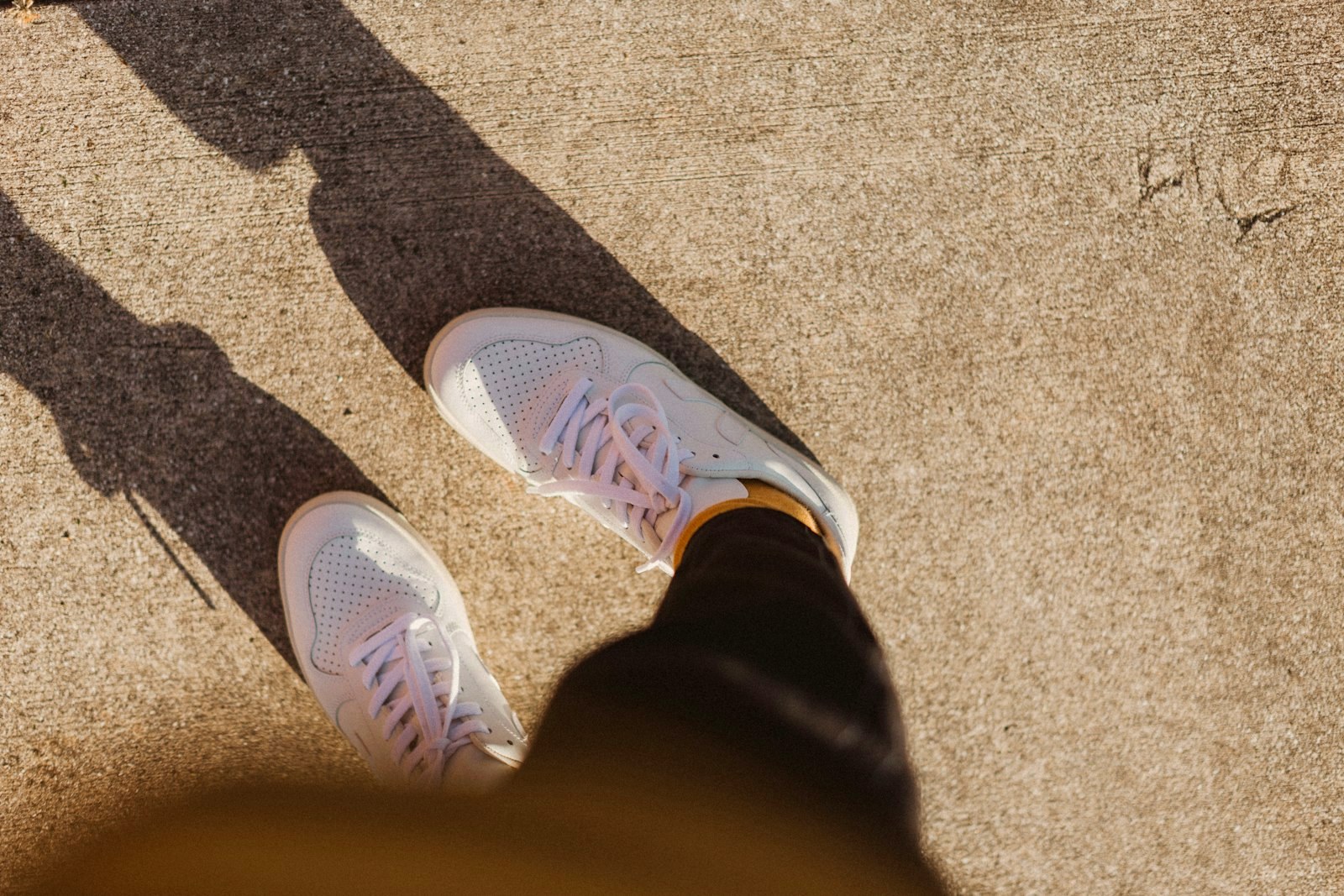
The sock is the smallest garment in the wardrobe and the one graded least honestly. This ranking grades it at the heel pocket and the cuff, after fifty washes, on the fibre line as the maker publishes it. A note on photography, printed because this page believes in saying so: our photo bank holds no sock photography, so no ranked pair is pictured anywhere on this page. The hero is the one frame in the bank where a sock actually shows, a mustard crew at the ankle in hard sunlight, captioned as what it is, and the frames this page actually needs head the harvest list in the honesty section.
Checked and updated October 2026
The basis: a sock is graded on its fibre line before its features, because the fibre line is where this category tells its standing lie: the sock sold under the word cotton that is mostly synthetic underneath. Then the heel pocket and the cuff, the two places a sock actually fails, and the price per pair at the pack price people actually pay. The winner: the Darn Tough Hiker Micro Crew Midweight Cushion at 88, 61 percent merino wool with its nylon declared as structure, a seamless toe, and an unconditional lifetime guarantee, at $26 a pair. It is the one pair to buy if you buy one. The skip: the Gucci Web-Striped Cotton-Blend Sock at 45, named in the verdict box below: 75 percent cotton and 25 percent polyamide at a $230 list, a fibre split structurally identical to the £18 dress sock ranked third on this page, with a stripe where the value should be. In between, a certified organic cotton crew takes second at $9 a pair, a Japanese right-angled heel out-engineers socks at three times its price, the comfort-marketing test case is graded feature by feature, and the $1.75 multipack staple is priced by the half-year it actually lasts.
First, the decision
Every sock argument is really three arguments, and this page settles all three before it scores anything. The first is the only question most readers actually have: if you buy one pair, buy the Darn Tough Hiker Micro Crew. It is ranked first below on the published evidence, and it is named here, in the first screen, because a page that buries its answer under seven cards has not answered it. Its cloth is an honest merino blend with every percentage printed, its toe is seamless, its cushion sits where feet actually load, and its maker guarantees it for life in writing, which no other house in this field does. At $26 it is the dearest daily pair here, and the per-year table below shows why it is not the dearest year.
The second argument is fibre, and it is where this category lies for a living. Merino: the working fibre, moisture-moving, odour-resistant across days, warm in a boot and cool out of one; it wins the top of this ranking and it is never 100 percent of any honest sock, because pure wool wears through, so the nylon share is structure and should be printed, as the winner prints it. Cotton: the desk and dress fibre, cool and smooth, right when its staple is named, Egyptian lisle at the dress end, Supima in the middle of the market. The unnamed blend: the bottom rung, and the rung is not a fibre, it is a behaviour. The floor of this market sells socks under the word cotton whose splits it does not publish on the listing, and buyers on the maker's own retail pages document labels that read differently from the listings they bought from. Those reports are printed on the Hanes card below, as reports, because that is what they are, and the cloth row is graded on the evidence that exists.
The third argument is height, settled in four lines. Boot and micro crew: the default. A cuff that clears the shoe's collar with margin, eight and a half inches from heel to cuff on the winner, correct under everything from work boots to sneakers. Crew: the dress and daily standard, the height every tailored trouser assumes. Short and quarter: the warm-weather and trainer heights, honest in their place, and their place is not inside a boot, where a short cuff rubs and slides. Half calf: the retro height the comfort brands revived, between quarter and crew, graded on its cloth like everything else rather than on its nostalgia.
The Cotton Standard commitment, kept in the open, third time due. This desk scores a GOTS-certified garment when the certification verifies the way cloth claims are verified here: a product-level claim on the garment's own page, and a certifier and licence the reader can check. The Organic Basics crew sock ranked second meets both halves. Its product page states the product is GOTS-certified and carries the mark, and the house publishes its certifier, Control Union, and its licence, CU 1067589, the same chain verified for the underwear ranking that this sock's sibling won. It becomes the third ranked GOTS-certified garment on this site, after that boxer brief and the Pact crew on the undershirt ranking, and the count is printed precisely because this desk has printed it at one and at two before, and will correct it in the open if a future check finds the licence lapsed.
How the scores work
Every pair is scored out of 100 on the same five rows, and the rows are printed on every card, so the reader can disagree with the weighting and still use the evidence.
Cloth, 30 points. The fibre line as the maker publishes it: which fibre, in what percentage, with the staple named where a maker names one, and, for any organic claim, whether the certification verifies against the certifier's own published licence rather than the label copy. A sock whose split the seller will not print earns the cloth row its silence deserves. Trademarked finish and technology names, and every maker here has several, are graded as finishes: they may help a pair, they never substitute for a fibre.
Construction, 20 points. The build as published: heel pocket geometry, toe closure, cushion placement, cuff build. Cushion is graded on where it sits, underfoot and over the Achilles is engineering, everywhere is padding; a seamless or hand-linked toe is a fact, and a trademarked name for an arch band is a claim until the pattern work behind it is described.
Fit & height, 20 points. The size system and the cuff: sizes stated in shoe sizes or centimetres a reader can measure against, the height stated or measurable, and whether the range covers the feet the page is written for. A house that publishes its size chart earns points a house that publishes adjectives does not.
Value, 15 points. The per-pair price at the pack price people actually pay, printed as such on every card. A donation bundled into a price is graded as a donation: it buys a second pair for someone else, which is a good thing to buy, and it is not a better sock for the buyer, so it earns no points on this row.
Longevity & wash, 15 points. How the pair ages in the machine and in the drawer: the care line's ceremony or lack of it, the fibre's known arc, the cuff elastic, which is where every sock in this category actually dies, and guarantee terms where a maker publishes them, quoted from the maker's own page. A product warranty counts here. A satisfaction guarantee is a returns policy and does not.
The rows sum to the score. Maker's figures are labelled the maker's figures throughout.
Seven socks, ranked, and one sent home
Darn Tough Hiker Micro Crew Midweight Cushion
The Winner · The One Pair to Buy
$26 a pair, $130 for the maker's 5-pack, at Darn Tough
The call: the winner is the guaranteed pair, and the guarantee is the least interesting thing about why it wins. The cloth is 61 percent merino wool, 36 percent nylon and 3 percent Lycra spandex, every percentage published, the nylon declared as what it is, the structure that lets a wool sock survive a boot. The knit is fine gauge, the toe is closed with the house's seamless technology, the cushion is terry underfoot with targeted protection over the ankle and Achilles, and the whole thing is knitted in Vermont by a house that makes one product. It is the one pair to buy if you buy one, and it is built like the maker expects to be held to that.
The guarantee, quoted from the maker's own page, because the longevity row of 15 is built on it: the socks are, in the house's words, unconditionally guaranteed for life, and if they are not the longest lasting socks you have ever owned, you return them for another pair. The shorter formulation on the same store reads: no strings, no conditions, for life. That is a product warranty, and it changes the arithmetic of the $26 ticket: costed in the table below at a conservative five years it is $5.20 a year, and the true figure is whatever year the guarantee stops being honoured, which has not happened since the house started printing it. The deductions are printed with the praise. Micro crew is a boot height, eight and a half inches from heel to cuff by the maker's own measure, tall for a loafer and wrong for a tailored trouser's clean line, which is what the third card is for. The care line asks for cold water and a gentle cycle with the socks inside out. And the fit is a performance fit, close by design; the maker's size chart runs XS to XXL against shoe sizes, the widest published range in this field. Five years at $5.20 a year, $0.10 a wear, with the warranty standing behind year six.
Organic Basics Core Crew Socks 2-Pack
The Certified Cotton · The Cotton Standard, Third Time Due
$18 for the 2-pack, $9.00 a pair, at Organic Basics
The call: the certified pair, and the second GOTS garment this house has put at the top of one of our rankings. The cloth is 71 percent organic cotton, 19 percent recycled polyamide, 7 percent polyamide and 3 percent elastane, the full split printed on the product page, including the unglamorous 7 percent of virgin polyamide a less honest house would have folded into the recycled figure and hidden. The product page states the product is GOTS-certified and carries the mark; the house publishes its certifier, Control Union, and its licence, CU 1067589, and names its sock maker, a GOTS-certified factory in Zhejiang, tier by tier, the way this desk wishes every maker published. At $9 a pair it is the certified drawer at high-street money.
The deductions are printed with the praise. The construction is competent rather than special: reinforced heels and toes and an arch support the maker describes, no seamless toe claim made or graded. The fit system is three sizes stated in European shoe ranges, 35 to 38, 39 to 42 and 43 to 46, which covers the field but grades coarsely beside the winner's six. The cloth row of 26 is built on the certification chain printed in the decision section above, and it carries the same standing caveat as the underwear winner's: the GOTS public database is a search application this desk's checker could not submit a query to in this session, so the licence number is printed here in full and the check takes a reader a minute. The maker's two trademarked finishes, a lasting finish and a cool finish, are graded as finishes, which is to say as claims, and the score stands without them. Two years at $4.50 a year, $0.09 a wear.
Pantherella Danvers Cotton Lisle Socks
The Dress Answer · Priced in Its Own Sterling
£18 a pair at Pantherella
The call: the dress sock, from the Leicester house that has made socks in England since 1937 and makes the pair the rest of this page's tailored hours need. The cloth is 75 percent Fil d'Ecosse, cotton lisle, the long-staple Egyptian cotton yarn gassed and mercerised into the smooth, thin, strong cloth the category's dress end is defined by, with 25 percent nylon declared. The gauge is fine enough to slide into a slim dress shoe without a wrinkle, the toe is seamless, and the rib knit holds the cuff where a dress sock's cuff is graded, at the calf at four in the afternoon. If the winner is the sock for the boot, this is the sock for the shoe, and the two of them are the whole drawer most wardrobes need.
Two deductions put the dress answer third, and both are printed. The price is the maker's own sterling, £18 a pair on Pantherella's own store, and this page does not convert currencies it did not transact in, so the per-year table carries this row in sterling and says so. And the fit system, while published in full, UK, EU, US and Japanese sizes across S to XL, is a standard-stretch system: four sizes doing the work the winner's six do, graded as such. Hold this card against the skip at the bottom of the page, because the comparison is the page's whole argument in miniature: the same fibre architecture, 75 percent cotton to 25 percent nylon, the same job, and the difference between £18 and $230 is a stripe. Three years at £6.00 a year, £0.12 a wear.
Muji Right Angle Pile Short Socks
The Heel, Re-Engineered · Four Dollars Ninety
$4.90 a pair at Muji
The call: the engineering answer, and the cheapest serious sock on this page. Muji's insight is anatomical and it is printed on the maker's own pages: a heel is a right angle, and ordinary socks are knitted at 120 degrees, so the house knits its heel at 90, wrapping the heel pocket completely with no excess cloth to bunch, slip, or wear through first. It is the only genuine pattern innovation in this field that is not a trademark for an arch band, and it comes from a house that charges $4.90 for it. The cloth is 86 percent cotton, 11 percent polyester, 2 percent nylon and 1 percent spandex, the split published in full on the product page, in a pile knit that cushions the sole.
The deductions are printed with the praise. The cotton's staple is unnamed, and the cloth row of 20 grades an honest split in an ordinary cotton, a clear step below the named staples above it. The maker's own care notes warn that the pile sheds fluff under friction and after washing, printed here because the maker printed it, and the longevity row of 10 prices a thin short sock's known arc honestly. The height is short, a trainer and warm-weather height, wrong inside a boot. The size chart is the best published at this end of the market, centimetre ranges with US conversions across five sizes, which is what the fit row of 17 is paying for. A stock note, because this desk prints those too: the pair showed sold out on the maker's US store at check time, with restock the house's pattern for the line. One year at $4.90 a year, $0.10 a wear.
Uniqlo SUPIMA Cotton Blend Pique Socks
The Attainable Answer · Three for $14.90
$5.90 a pair, 3 for $14.90 on the maker's multibuy, at Uniqlo
The call: the attainable answer, from the house whose standing brand score on this site is 84, recorded here for the record; this garment was scored fresh, as garments are, and neither number borrowed from the other. The ranked pair is the Supima cotton blend pique sock: a calf-length dress-casual crew in a structured pique knit, with the toe and heel reinforced for durability by the maker's own description, a three-dimensional heel design for a snug fit, and gentle elastic at the ankle. At the maker's standing multibuy, three pairs for $14.90, it is $4.97 a pair for a named-staple blend with reinforced wear points, which is the correct price for the middle of this market and the pair to stock a drawer with while the top of this page is being saved for.
The deductions are printed, and the first is a silence this page charges openly. The maker's US product page names the blend and the staple and publishes no percentage split that this desk's checker could capture, so the cloth row of 18 grades a named Supima blend whose proportions the reader cannot verify from the listing, a clear step below the full splits printed by every card above it, and the November re-check owns the capture. The fit system is one size, US 8 to 11, with the product length published at ten and three-quarter to eleven and a half inches: honest paperwork, and a single size asked to cover what Muji covers in five, which is what the fit row of 14 prices. The house's self-deodorizing yarn is a finish and is graded as one; its published abrasion-testing programme for sock durability is a fact about the house and is credited in the longevity row. One year at $4.97 a year at the multibuy price, $0.10 a wear.
Bombas Solid Vintage Stripes Half Calf Socks
The Comfort-Marketing Test Case · Graded Feature by Feature
$15.00 a pair at Public Lands
The call: the test case, graded the way this desk grades every loud claim, feature by feature against the published evidence. The construction is real: a cushioned footbed, a seamless toe, a Y-stitched heel, a honeycomb arch band and a stay-up cuff are pattern work, and the construction row of 17 credits all of it, trademarks and all. The cloth is where the marketing and the sock part company. The pair is sold on extra-long staple cotton, and the full split, printed on the retailer's listing, is 65 percent cotton, 23 percent polyester, 6 percent nylon and 6 percent elastane. There is nothing disgraceful in that blend. There is something worth naming in a $15 sock whose story is cotton and whose second fibre, at nearly a quarter of the garment, is polyester.
The rest of the card is the business model, graded as a business model. The price is $15 a pair, verified at a national retailer's exact product page and named on this card, because the maker's own store sells the line in packs whose per-pair arithmetic changes with the promotion of the week. One pair bought is one pair donated, and the donation is genuinely good: it buys a sock for a shelter, and it buys the buyer nothing, which is why the value row of 7 grades the sock and not the glow. The house's happiness guarantee is a satisfaction guarantee, a returns policy of unusual generosity, graded in the questions below against the winner's product warranty, and it earns the longevity row nothing; the row of 11 is the cotton-polyester arc, respectable and unremarkable. Buy it if the arch band is your specific comfort. Know that the certified pair in second does the daily job at $9, with its split printed to the last percent. Two years at $7.50 a year, $0.15 a wear.
Hanes Crew Socks 8-Pack with FreshIQ
The Multipack Floor · A Dollar Seventy-Five, Half a Year
$14.00 for the 8-pack, $1.75 a pair, at Target
The call: the floor, graded as a floor. A dollar seventy-five a pair buys a cushioned crew sock with a reinforced heel and toe by the maker's description, in the widest distribution in this field, and the value row of 15 is the maximum this page awards, because $1.75 for a wearable pair is a fact no scoring system should argue with. For the first drawer, the spare drawer, the gym bag's permanent resident, this is a rational purchase, and this page says so without a smirk.
The rest of the card is why the floor is the floor, and it is the fibre-honesty finding this page exists to print. The listing sells this sock under the words cotton blend and publishes no percentage split on the product page. What the percentages are, buyers have had to learn from the label, and on this retailer's own pages for the house's sock lines, buyers document the lesson repeatedly: a line specified at 69 percent cotton arriving labelled at 39, a line advertised at 98 percent cotton whose packaging reads 98 percent polyester, each printed here as the buyer report it is. The ranked pair's own split could not be verified from its listing, and the cloth row of 11 grades exactly that: a major fibre claim with no published evidence behind it. The longevity row of 6 is the same story told by the same pages, thinning and lost elasticity reported by verified buyers through this autumn, and the honest life is half a year. Costed at that life the cheapest pair in the field is $3.50 a year, the cheapest year here, bought at the price of replacing the drawer twice annually and never knowing what it is made of. Half a year at $3.50 a year, $0.07 a wear.
Gucci Web-Striped Cotton-Blend Socks
The Skip · The Logo Tax, at Ankle Height
$230 list for a single pair at Italist
The call: skip it, and the conviction is a fibre line, not a taste. Farfetch's own listing for this sock prints its composition in full: cotton 75 percent, polyamide 25 percent, made in Italy. Now read the third card on this page. The Pantherella Danvers is 75 percent cotton lisle and 25 percent nylon, the same architecture to the percentage point, knitted in Leicester by a house that has made socks since 1937, with a seamless toe and a published size chart, at £18. The Gucci pair lists at $230. The difference between the two garments is not cloth, not construction, not country. It is a green-red-green stripe knitted into the cuff, and this site has an anti-award for exactly that difference: the Logo Tax, collected here at ankle height in its purest form yet, twelve times the honest pair for the same split.
Run the year and the case closes. At list over a generous two-year life, this is $115 a year, ten times the dearest honest year in this ranking, for a sock with no published cushion, no reinforced wear point the listing names, no size system this desk could verify, and a cloth row of 15 that grades a perfectly ordinary cotton-nylon blend honestly: it is not a bad sock, it is a £18-class sock wearing a $230 price. The channel agrees with the arithmetic in its own way: the pair sat sold out at Farfetch at check time while the channel's discounters move the same line at a third off and more, the standing pattern of a price maintained for the reader who does not scroll. If the stripe is the point, buy it knowing the stripe is the whole of what the extra $212 buys. Two years at $115 a year, $2.30 a wear, at list.
The numbers, side by side
Every figure from the cards above, in one table. Fibre splits are the maker's published percentages; where a seller publishes none, the table says so rather than guessing.
| Sock | Score | Cloth | Height | Price per pair |
|---|---|---|---|---|
| Darn Tough Hiker Micro Crew | 88 | Merino wool 61% · nylon 36% · Lycra 3% | Micro crew, 8.5" | $26 |
| Organic Basics Core Crew | 82 | Organic cotton 71% · recycled polyamide 19% · polyamide 7% · elastane 3% | Crew | $9.00 |
| Pantherella Danvers | 79 | Cotton lisle 75% · nylon 25% | Standard crew | £18 |
| Muji Right Angle Pile Short | 78 | Cotton 86% · polyester 11% · nylon 2% · spandex 1% | Short | $4.90 |
| Uniqlo SUPIMA Pique | 73 | Supima cotton blend, split not published on the US listing | Crew | $4.97 at multibuy |
| Bombas Vintage Stripes Half Calf | 67 | Cotton 65% · polyester 23% · nylon 6% · elastane 6% | Half calf | $15.00 |
| Hanes Crew 8-Pack | 56 | Sold as cotton blend, no split published on the listing | Crew | $1.75 |
| Gucci Web-Striped (the skip) | 45 | Cotton 75% · polyamide 25% | Crew | $230 list |
Cost per pair, and per year, in the open
No sock is expensive or cheap until it is divided by its life. Every figure below is computed from the printed per-pair price and the stated life, with wears at the desk's rotation: a pair in a seven-pair drawer, worn weekly.
| Sock | Per pair | Life used | Per year | Per wear |
|---|---|---|---|---|
| Darn Tough Hiker Micro Crew | $26 | 5 years, guarantee-backed | $5.20 | $0.10 |
| Organic Basics Core Crew | $9.00 | 2 years | $4.50 | $0.09 |
| Pantherella Danvers | £18 | 3 years | £6.00 | £0.12 |
| Muji Right Angle Pile Short | $4.90 | 1 year | $4.90 | $0.10 |
| Uniqlo SUPIMA Pique (multibuy) | $4.97 | 1 year | $4.97 | $0.10 |
| Bombas Vintage Stripes Half Calf | $15.00 | 2 years | $7.50 | $0.15 |
| Hanes Crew 8-Pack | $1.75 | Half a year | $3.50 | $0.07 |
| Gucci Web-Striped (the skip) | $230 list | 2 years | $115 | $2.30 |
Read the table the way the desk reads it. The guarantee flattens the winner's ticket into an ordinary year. The certified pair is the cheapest serious year in the field. The floor is the cheapest year outright, and the table prices it honestly, at the half-year life its own buyers report, because a cheap year that has to be bought twice, in a fibre nobody will name, is a different purchase from a cheap year that lasts. And the skip costs ten times the winner's year for a fibre split available at £18, which is the whole of its conviction in one line.
Which one to buy
If you buy one pair: the Darn Tough Hiker Micro Crew.
Eighty-eight points, an honest merino split, a seamless toe, cushion where feet load, and a lifetime guarantee quoted in the maker's own words on its card. It covers the boot, the sneaker and the long day, and the per-year table shows the ticket dividing into an ordinary year. Every other recommendation below exists because a drawer has more than one job.
If your drawer is cotton: the Organic Basics Core Crew.
The certified pair at $9, second on the page, the third ranked GOTS garment on this site, its full split printed down to the unglamorous percentages. It is the Cotton Standard's sock, and the daily pair the desk would stock seven of.
If the shoe is a dress shoe: the Pantherella Danvers.
Lisle at £18, thin enough for a slim last, made in Leicester since before the category had marketing departments. Pair it with the styling notes on wearing loafers, where the dress sock's cuff is half the outfit.
On a budget, or for the trainer: the Muji Right Angle.
The best heel geometry in the field at $4.90, with the Uniqlo pique at $4.97 on multibuy as the crew-height alternative one rung down. Between them they cover the attainable drawer at under five dollars a pair, with published splits and named staples where the floor offers neither.
With boots, always a cuff that clears the boot.
The winner's eight and a half inches is the measure; the styling system on the Body Map prints sock height against boot height in the Feet and Ankle sections, and the Chelsea boots page works the same pairing through an outfit. A short sock inside a boot is the one fit error this page exists to prevent.
The cross-sell, printed as plainly as everything else here: socks are the last drawer this desk ranked, after underwear, boxers and the rest of the basics shelf, and the whole shelf grades on the same five rows under the same methodology. Rebuild the drawer in that order and it will not need rebuilding again for years.
How we know: the honesty section
This is the permanent furniture of these rankings. Everything the reader needs to discount the page is printed on the page.
Fibre percentages come from maker and retailer spec pages, never from reviews. Darn Tough's 61/36/3 split is the maker's published materials line for the style. Pantherella's 75/25 is the maker's own product page. Organic Basics' split is its product page's own fibre line. Muji's 86/11/2/1 is the maker's US product page. Bombas' 65/23/6/6 is the fibre line on the named retailer's exact product page. Gucci's 75/25 is the composition on Farfetch's own listing for the pair. Two silences are charged on the cards where they occur: Uniqlo's US page names its Supima blend without a percentage split this desk could capture, and Hanes' listing publishes no split at all. Where the evidence is a buyer report rather than a spec page, the copy says buyer report, and it stays a report.
Prices were checked at the doors named on the cards on the day this page was checked. The Darn Tough per-pair figure divides the maker's own 5-pack, $130 for five, sold on the maker's store. The Bombas price is a named national retailer's single-pair price, because the maker's own pack pricing moves with promotions; the retailer is named on the card for that reason. The Pantherella price is the maker's own sterling and is not converted, on this page's standing rule. The Gucci figure is the list price for the line at a major discounter, with the pair sold out at the listing carrying its composition at check time; the card carries no struck-through discount, because this desk does not price theatre. The Muji pair showed sold out on the maker's US store at check time and is flagged on its card. Prices move; the freshness line at the foot of this page says when ours were taken.
The GOTS count, stated precisely. This page raises the site's ranked GOTS-certified garment count from two to three: the Organic Basics Core Boxer Brief that won the underwear ranking, the Pact crew ranked on the undershirt ranking, and now this sock, whose product page claims GOTS certification for the product and whose house publishes certifier Control Union and licence CU 1067589. The GOTS public database is a JavaScript search application this desk's checker could not submit a query to in this session; the licence number is printed so the reader's own check takes a minute, and this page will correct the count in the open if that check ever fails.
Scores are this desk's. The construction and fit rows grade published pattern and size-system facts. The longevity rows grade care lines, fibre arcs, buyer reports labelled as reports, and guarantee terms quoted from makers' own pages. No maker paid for a score, and no score in this ranking was supplied by a brand, a network, or a reader. Houses named in copy were not consulted. Where a maker's claim could not be graded, it is printed as a claim and the row shows it.
Photography, disclosed. This page carries no photograph of any ranked pair. The photo bank this site draws from holds no sock photography, and the desk's rule is that a wrong photograph is worse than none: the hero is the one bank frame where a sock actually shows, an ankle above a white sneaker in sunlight, captioned as exactly that. The frames this page needs are on the harvest list and named here so the gap is auditable: folded pairs in a drawer under window light, a ribbed cuff in macro, a crew sock above a boot top outdoors. When the bank holds them, this page gets its pictures and this paragraph comes out.
Questions, answered straight
What are the best socks for men?
The Darn Tough Hiker Micro Crew Midweight Cushion, 88 out of 100: 61 percent merino wool, 36 percent nylon and 3 percent Lycra spandex in a fine-gauge knit with a seamless toe, terry cushion underfoot, and the maker's unconditional lifetime guarantee, at $26 a pair. Second is the Organic Basics Core Crew Sock at 82, the certified organic cotton pair at $9. Third is the dress answer, Pantherella's Danvers cotton lisle at 79, priced in its maker's own sterling at £18.
Merino wool or cotton: which sock fibre is better?
They win different hours, and this page scores both at the top. Merino is the working fibre: it moves moisture, resists odour across repeated wears, and regulates temperature in a boot, which is why the winner is 61 percent merino with its nylon declared as structure. Cotton is the desk and dress fibre: cooler against skin, smoother in a slim shoe, and honest when its staple is named, as Pantherella names its cotton lisle. What loses on this page is neither fibre. It is the unnamed blend, the sock sold under the word cotton with a majority of polyester underneath it, a habit documented by buyers on the floor brand's own retail listings.
Is there a GOTS-certified sock worth buying?
Yes, and it is ranked second on this page. The Organic Basics Core Crew Sock carries a product-level GOTS claim on its own product page, 71 percent organic cotton with 19 percent recycled polyamide, 7 percent polyamide and 3 percent elastane, and the house publishes its certifier and licence, Control Union, licence CU 1067589, the same chain this desk verified for the underwear ranking. It becomes the third ranked GOTS-certified garment on this site, after the Organic Basics boxer brief and the Pact undershirt crew. Organic as a word, with no certifier and no licence behind it, scores nothing here.
What does a lifetime sock guarantee actually cover?
Darn Tough's, in the maker's own words, is unconditional: if these are not the longest lasting socks you have ever owned, return them for another pair. No strings, no conditions, for life, in the house's shorter formulation. That is a product warranty, and it is why the winner's longevity row is the maximum this page awards. It is not the same instrument as a satisfaction guarantee, which is a returns policy: Bombas' happiness guarantee, ranked sixth here, promises a refund or replacement if you are unhappy, which is good service and earns no longevity points, because it insures your feelings about the sock rather than the sock.
How many pairs of socks do I need, and how long should a pair last?
Seven pairs of the daily sock is the working drawer, one a day with a wash in the middle of the week, and every score on this page assumes that rotation. A well-built pair in that rotation should give two to five years; the merino winner is guaranteed for life and costed in this page's table at a conservative five. The replacement signal is not the hole. It is the cuff: when the cuff stops recovering and the pair slides into the shoe by noon, the sock has ended, whatever the foot still looks like. By that test the cheapest ticket in this ranking, the $1.75 Hanes pair, is costed at half a year, and the dearest year in the field is the $230 skip at $115 a year.
What sock height should I wear with boots, loafers, and sneakers?
Match the cuff to the shoe's collar and the trouser's break. Boots want a crew or micro crew that clears the boot's top line with margin, eight and a half inches from heel to cuff on the winner here, because a cuff that ends inside the boot is a cuff that rubs. Loafers and dress shoes want the thin crew that disappears under a tailored trouser, the Pantherella class, or a no-show in summer heat. Sneakers take the widest range, from the Muji short sock to a full crew, and the deciding factor is the trouser: cropped or rolled hems show the sock, so the sock becomes part of the outfit and should be chosen like it.
Young Cotton's verdict cards rank garments on published evidence: fibre lines from makers' own spec pages, construction as described and diagrammed by the houses that build it, size systems a reader can measure against, prices checked at the doors named on the cards, and guarantee terms quoted in the makers' own words. This card adds the basics shelf's last drawer, and it closes with the finding the whole shelf keeps making: the honest fibre line is the luxury, at every price, and the logo is the tax, at every height.
Checked and updated October 2026