
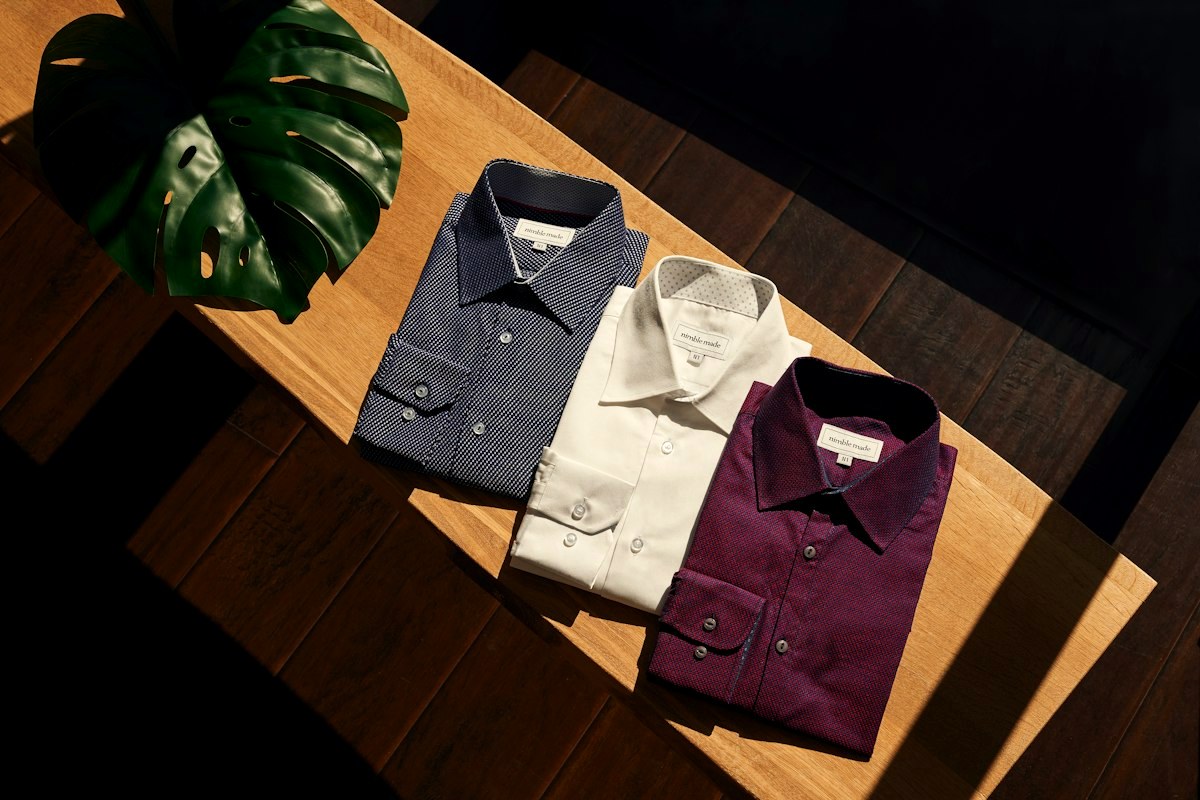
The boxer short is a shirting garment worn as underwear: every serious pair in this ranking is cut from a named shirt cloth, oxford, poplin, broadcloth or batiste, and this page grades the weave before the waistband because the weave is the category. A note on photography, printed because this page believes in saying so: our photo bank holds no boxer photography, so no ranked pair is pictured anywhere on this page. The hero is a folded-shirting still life from the bank, the cloth family every pair below is cut from, captioned as what it is, and the frames this page actually needs head the harvest list in the honesty section.
Checked and updated October 2026
The basis: a boxer short is graded on its cloth and its weave before anything else, because in this category the weave is not a detail, it is the garment: oxford cloth, poplin, broadcloth and batiste are four different answers to the same question, and a maker who will not name one has answered it too. Prices are graded per pair at the multipack price people actually pay. The winner: the Brooks Brothers Cotton Oxford Boxers at 83, 100 percent cotton in the sturdiest weave in the field, $29.63 a pair at the three-pair rate. It is the one pair to buy if you buy one. The skip: the Mack Weldon 24/7 Woven Boxer at 45, named in the verdict box below: a $34 performance boxer whose own product page, asked directly what fabric it is made of, declines to publish a fibre line. In between, a long-staple poplin takes the cloth honours, a $7.45 broadcloth trunk rebuilds the whole drawer for the price of two skips, the best-made splurge in London prints its construction like a tailor, an undyed organic pair from India is graded on its provenance with its certification honestly unscored, and a printed mall classic does the charm job properly.
First, the decision
Every boxer argument is really three arguments, and this page settles all three before it scores anything. The first is the only question most readers actually have: if you buy one pair, buy the Brooks Brothers Cotton Oxford Boxers. They are ranked first below on the published evidence, and they are named here, in the first screen, because a page that buries its answer under seven cards has not answered it.
The second argument is the one this site's underwear ranking started, and this page owes it an honest answer. That ranking placed the woven boxer as a style, not a solution, because it supports nothing and bunches under anything tailored. That ruling stands, in full, for the under-trouser question, and this page does not relitigate it. What this ranking grades is the boxer at its own job, which is a different job: air. The boxer is the sleep-and-airflow garment that briefs marketing pretends to be, worn under the trousers that can afford it, meaning loose ones, and in the hours where support is not the point. The two rankings are built to be read together: the brief owns the tailored day, the boxer owns the night, the heat and the house, and a drawer with only one of them is half dressed.
The third argument is the body-heat brief, and it is settled the way the underwear ranking settled it: as garment physics, not as medicine. A loose woven short holds a layer of air, touches less skin, and asks nothing of the body's cooling but room to do it; that is a property of cut and cloth, and this page grades it in the fit and room row. Sellers in this category go further and promise outcomes for the body itself, in studies cited and hormones invoked. Those promises are graded on these cards as what they are, marketing, wherever they appear, and they earn no points anywhere on this page. Nothing here is a health claim.
The weave ladder, graded as cloth, because the weave is the category. Oxford cloth: the basket weave, two yarns over two, the sturdiest and most textured of the shirting weaves, softening for years; the winner's cloth. Poplin: the fine, tight plain weave, smooth as a dress shirt's best day; the highest cloth row on this page belongs to a long-staple poplin. Broadcloth: the honest middle, a plain weave lighter and crisper than poplin, the value pair of this ranking, the $7.45 one. Batiste: the luxury lightweight, soft and sheer-adjacent, Derek Rose's signature. Seersucker: the puckered summer weave, named here because the ladder should be complete; no seersucker pair made this field on verifiable evidence, and the desk says so rather than padding the card count. And the bottom rung, as on the sister ranking, is the unnamed cloth: a fibre line a maker will not publish is not a mystery to be respected, it is a score to be given, and it is given at the bottom of this page.
The Cotton Standard commitment, kept in the open, second time due. On the pajama ranking this desk committed to scoring a GOTS-certified garment when one could be verified, and on the underwear ranking that commitment came due with a winner whose certifier and licence are printed on the page. This page ran the same search for the woven boxer, and prints the result plainly: no GOTS-certified woven boxer short could be verified to that standard. The certified boxers on the market are knits. Organic Basics' GOTS-certified Easy Boxer Short is a jersey with a fitted pouch and no fly, a boxer brief in a boxer silhouette, and it sat at final sale on the maker's US store at check time. Pact's boxer is a knit boxer. NADS publishes a GOTS claim for a knit boxer with no licence number on its product page and no weave to grade. The one woven organic pair in this field, Industry of All Nations at 69, publishes the fullest provenance on this page, fibre, loom and village, and no certifier or licence anywhere, so its cloth is graded on the published evidence and its certification is not scored. The pillar's ranked GOTS count stays at one. When a woven pair verifies, certifier, licence and price together, this page will score it and say which number it displaced.
How the scores work
Every pair is scored out of 100 on the same five rows, and the rows are printed on every card, so the reader can disagree with the weighting and still use the evidence.
Cloth, 30 points. The fibre and the weave as the maker publishes them: which fibre, in which named weave, at what staple or weight where either is published, and, for any organic claim, whether the certification verifies against a certifier and licence rather than the label copy. A weave a maker declines to name, and a fibre line a maker declines to publish, are graded as the absence they are. Trademarked technology names are graded as finishes and claims, never as fibre.
Construction, 20 points. The build as published: waistband construction, fly closure, and the seat, where a centre back seam is a cost a better pattern designs out and a back panel is the published proof of having done it. Seam finishing that a maker prints, double-turned, flatlocked, enclosed, earns what it says.
Fit & room, 20 points. The honest case for looseness, graded as a system: the room the cut actually provides, the size range, and whether the maker's sizing is stated in inches a reader can measure against. Airflow is graded here as a property of the cut. The same row charges the boxer's known loss, printed on every relevant card: under a slim tailored trouser, loose woven cloth bunches, and no score here pretends otherwise.
Value, 15 points. The per-pair price at the multipack price people actually pay, printed as such on every card. A pair sold only singly is costed singly, and a single-pair list price beside a permanent multi-buy is graded as the pair of numbers it is.
Longevity & wash, 15 points. How the pair ages in the machine and in the drawer: the care line's ceremony or lack of it, the weave's known arc, and the elastic, which is where most pairs in this category actually die. One pair in this field has no elastic to die, and its row says what that is worth. Stated lives in the per-year table are this desk's, printed beside the figures so the reader can argue with the life rather than the arithmetic.
The rows sum to the score. Maker's figures are labelled the maker's figures throughout.
Seven pairs, ranked
Brooks Brothers Cotton Oxford Boxers
The Winner · The One Pair to Buy
$39.50 a pair, $29.63 a pair at 3 or more, at Brooks Brothers
The call: the winner is the shirting house's own cloth, cut into the garment the house has sold longer than anyone else in this field. Brooks Brothers lists its boxers by weave, broadcloth, end-on-end and oxford, all at the same $39.50, and the ranked pair is the oxford: a basket weave, two yarns passing over two, the most textured and the most durable cloth in this category, the same weave this site's Oxford shirt ranking is built on. A boxer is a shirt you sleep in, and this is the shirt cloth that outlasts the others, softening across years of washing instead of thinning through them. At the standing offer, 25 percent off three or more, the pair costs $29.63, and that is the price this page costs, because three pairs is how boxers are actually bought.
The deductions are printed with the praise, and there are two. The house publishes less construction paperwork than the English makers below it: no back panel is claimed in its listing, no seam finish is described, and the construction row of 15 is what a famous pattern with thin paperwork earns beside Sunspel's published engineering. And no staple length or cloth weight is published for the oxford, so the cloth row of 26 grades the weave itself, which is verifiable, and not a fineness claim, which would not be. What the listing does publish is a full traditional cut with the field's widest size ceiling on the maker's own store, and a century-deep pattern that has never needed a technology name. Four years at $7.41 a year, $0.15 a wear, and the arithmetic is in the table further down.
Sunspel Classic Boxer Short
The Cloth Honours · The Finest Published Build
£49 a pair at Sunspel
The call: the finest cloth and the best paperwork in the field, from the English house that introduced the boxer short to Britain in 1947 and has barely changed it since. The cloth is a super-fine, long-staple cotton poplin, the maker's own words, smooth where the winner's oxford is textured, and the cloth row of 27 is the highest awarded on this page. The construction row of 18 is also the field's highest, and it is earned entirely in print: a distinctive back panel built to avoid a central seam, seams smoothed and double-turned for comfort and against fraying, an open fly, and manufacture in Portugal. This is what a construction row is for. If the drawer were graded on fineness alone, this card would be first.
It is graded on the whole garment, and two honest charges put it second. The price is £49 a pair in the maker's own sterling, printed as found because this desk does not convert currencies it did not transact in, and the value row of 8 is what the field's second-highest ticket earns even with a multi-buy on same size and colour. And the care line asks for a gentle wash at 40 degrees with no tumble drying, a small ceremony the winner does not demand, which the longevity row prices beside poplin's lighter hand. The house's boxer brief stood fourth on the underwear ranking at 76, scored fresh there; this garment, the woven original, is scored fresh here, and the pattern is worth noticing: at Sunspel, the 1947 garment outbuilds its modern descendant. Four years at £12.25 a year, £0.25 a wear.
Uniqlo Woven Trunks, Broadcloth
The Attainable Answer · The Whole Drawer for Fifty Dollars
$7.90 a pair, $7.45 a pair at 2 for $14.90, at Uniqlo
The call: the attainable answer, sitting in the first three because this desk's rule is that it must, and earning the seat on evidence rather than on the rule. The cloth is 100 percent cotton woven broadcloth, a named weave in a crisp, light plain weave, published by the maker in those words, and the build carries a button fly front and side slits for movement. The fit system is the best paperwork at this end of the field: sizes from S to 3XL with the waist chart printed in inches on the product page, a medium at 30 to 33 inches, the same publishing habit that won this house the fit row on the underwear ranking. The 4.2 out of 5 from its 69 buyers is printed as a report, because it is one.
The naming is honest on the card because it is honest on the maker's page: this is a trunk, a shorter and closer woven cut than the classic boxer, and the fit and room row of 14 charges it for the room it does not provide. The reader who wants the full traditional volume buys the winner. The reader who wants the woven drawer rebuilt now buys seven of these: at the two-for-$14.90 rate a full seven-pair rotation costs $52.15, which is less than two pairs of the skip at the bottom of this page, in a named weave, with a fly, from a maker who publishes his inches. Uniqlo's standing brand score on this site is 84, recorded here for the record; this garment was scored fresh, as garments are, and neither number borrowed from the other. Two years at $3.73 a year, $0.07 a wear, the cheapest honest year in this ranking.
Derek Rose James Classic Fit Boxer Shorts
The Best-Made Splurge · Construction Like a Tailor
$100 a pair at Neiman Marcus; the maker's own US store lists the line from $120
The call: the splurge, and the only one in this field whose construction reads like tailoring. The cloth is the house's signature cotton batiste, the fine, light luxury weave, and the build carries the two details this page's construction row exists to reward: a back panel that designs out the rear centre seam, and a fully elasticated waistband adjusted by a traditional two-button fly, a waistband the house modelled on its pajama waistbands when it first cut boxers from leftover pajama cloth. The classic fit is generous by design. The construction row of 18 ties Sunspel's at the top of the field, and the cloth row of 25 sits one point behind the poplin, batiste being the lighter and more delicate of the two fine weaves.
What holds the best-made pair in the field to fourth is printed on its price line. At $100 a pair at Neiman Marcus, and from $120 on the maker's own US store, this is three to four times the winner's per-pair rate, and the value row of 4 is the arithmetic of that, not a judgement on the make. The house's pajama set stood fifth on the pajama ranking at 72, held back by the same arithmetic against the same quality, and this garment is scored fresh here with that record cited as evidence of the house's standard and nothing more. Buy it when the drawer is otherwise finished and the finest light cloth in the category is the point. Costed at the Neiman Marcus figure: five years at $20.00 a year, $0.40 a wear, the dearest honest year on this page, buying the real thing.
Industry of All Nations Woven Boxers
The Organic Entrant · Provenance in Full, Certification Unscored
$35 a pair undyed, $40 in indigo, at Industry of All Nations
The call: the most interesting garment in this field, and the one this page grades with the most care. The pair is 100 percent organic cotton, woven in Tamil Nadu, India, undyed and unbleached, enzyme-washed and pre-shrunk, with every stage of its making, raw material, processing, cutting, labels and packaging, published by the maker as Indian. The waist has no elastic at all: an organic cotton drawcord adjusts it, and the fly closes with a button carved from river shell, so the whole garment is biodegradable at the end of its life. The cloth row of 24 grades that published fibre and provenance evidence, the fullest in the field. What it does not grade is certification, because there is none to grade: no certifier, no licence number and no standard is named anywhere on the maker's product page, and on this desk an organic claim without a checkable licence is a maker's account, printed as one.
The rest of the card is the price of the philosophy. The fit and room row of 11 is the field's lowest above the skip, because the size system is one size, unisex, with no inch chart a reader can measure against: the room is real and generous, and it is the same room for every waist. Underwear sales are final, printed by the maker and repeated here. And the longevity row holds a genuine first: every other pair in this ranking dies at the elastic, and this pair has none, so the category's usual cause of death is designed out, worth 11 in a cloth with no published weave name to grade further. This is the pillar's organic boxer, ranked on its evidence with its one missing document named. Four years at $8.75 a year, $0.18 a wear.
J.Crew Patterned Boxers in Cotton
The Charm, Done Properly · Pattern Without the Joke
$29.50 a pair at J.Crew
The call: the printed boxer, done the way it should be done. J.Crew sells its boxer in cotton with a classic elastic waistband and a rotating cast of patterns, priced at $29.50 singly on the maker's store, and the pattern is the point of the pair: pattern as charm, a stripe, a check, a small motif, rather than the novelty joke the category's bottom end sells. The buyers' report is strong, 4.8 out of 5 across 146 reviews on the maker's page, printed as a report. The fit row of 15 credits a classic relaxed cut that its reviewers consistently describe as true to size, again as reported, and this is the pair for the reader whose drawer is all solids and whose sleepwear can carry one cheerful note.
The deductions are a paperwork story. The maker does not publish the weave, so the cloth row of 19 grades a cotton whose structure this desk cannot name, against a field where the top four cards all name theirs; on a page whose thesis is that the weave is the category, that absence costs what it costs. Construction detail beyond the waistband class is likewise unpublished. The house's pajama set took third on the pajama ranking at 76, evidence that its sleepwear make is sound, and this garment is scored fresh here, as garments are. At $29.50 the value row reads it as a dollar under the winner's three-pair rate for a thinner published record, which is a fair price for charm and an honest one. Three years at $9.83 a year, $0.20 a wear.
Mack Weldon 24/7 Woven Boxer
The Skip · The Cloth the Maker Will Not Name
$34 a pair at Mack Weldon
The call: skip it, and the conviction is a document, not a taste. This page grades cloth first, so the desk went to the maker's own product page and read its answer to the plainest question in the category: what fabric are these boxers made of? The answer, verbatim in substance, is that they are woven boxers constructed to deliver a smooth, soft feel. No fibre. No weave name. No percentages. Asked whether the boxers keep you cool, the same page answers yes, that the fabric is specifically engineered to stay cool, and retail coverage of the line attributes the claim to a trademarked cooling technology with an anti-odor function. On this desk a trademarked technology is a finish, graded as a claim, and an unpublished fibre line is graded as an unpublished fibre line, which is the bottom of the cloth row: 8 of 30, for the absence itself.
What is not being graded is printed too. The cut is a real idea: tailored to be less bulky under trousers while staying looser than a brief, with outseams published by size, the one fit answer in this field aimed squarely at the slim-trouser problem, and the fit row of 13 credits it. The house's service reputation is not in dispute here either. What is in dispute is the exchange: $34, more per pair than the winner costs at the three-pair rate, for a cloth the buyer is not permitted to know, sold on a cooling claim the cloth cannot be checked against because the cloth is a secret. Every other card on this page names its weave in its product title or its first paragraph. When this house publishes a fibre line, this desk will rescore the card and print the new number with the same prominence as this one. Two years at $17.00 a year, $0.34 a wear, the dearest year per honest garment in this ranking.
The numbers, side by side
Maker's figures, checked against the makers' own pages this month, with the claims labelled as claims: where a maker publishes a fibre line, a weave or a size chart, it is printed as theirs, and where a maker publishes none, the table prints that instead.
| Pair | The cloth | The build | Fit system | The fine print |
|---|---|---|---|---|
| Brooks Brothers Cotton Oxford Boxers | 100% cotton oxford cloth, the weave in the product name | Traditional elastic-waist pattern; construction detail thin in the maker's listing | Full traditional cut; the field's widest size ceiling on the maker's store | $39.50 single; 25% off at 3 or more, costed at $29.63 |
| Sunspel Classic Boxer Short | 100% cotton poplin, super-fine long-staple per the maker | Back panel with no centre seat seam; double-turned smoothed seams; open fly; made in Portugal | Classic cut, barely changed since 1947 | £49 in the maker's sterling; multi-buy on same size and colour; gentle wash, no tumble dry |
| Uniqlo Woven Trunks, Broadcloth | 100% cotton woven broadcloth | Button fly front; side slits | Trunk cut, shorter than the classic boxer; waist chart in inches, S to 3XL | $7.90 single, 2 for $14.90, costed at $7.45; 4.2 of 5 from 69 buyers, as reported |
| Derek Rose James Classic Fit | Cotton batiste, the maker's signature cloth | Back panel; two-button adjustable fly; fully elasticated waistband | Classic generous fit; a modern fit exists elsewhere in the line | $100 at Neiman Marcus; maker's own US store from $120; costed at $100 |
| Industry of All Nations Woven Boxers | 100% organic cotton, woven, undyed; no certifier published | Organic cotton drawcord, no elastic; river shell button | One size, unisex; no inch chart published | $35 undyed, $40 indigo; underwear sales final |
| J.Crew Patterned Boxers in Cotton | Cotton; weave unpublished by the maker | Classic elastic waistband | Classic relaxed fit; 4.8 of 5 from 146 buyers, as reported | $29.50 single on the maker's store |
| Mack Weldon 24/7 Woven Boxer (the skip) | Fibre line unpublished on the maker's own product page | Tailored cut, published outseams; no-roll waistband claim | Tailored, less bulky fit | $34 single; the cooling claim rests on a trademarked technology, graded as a claim |
Read the cloth column and the ranking explains itself. The top of the table is three named weaves in price order reversed: the sturdiest weave wins, the finest weave takes the cloth honours, and the honest middle weave at $7.45 takes the value crown outright. The bottom of the table is a cloth that is a marketing claim and a cloth that is a secret, and on a page that grades cloth, those are the two ways to finish last.
Cost per pair, and per year, in the open
The table divides each per-pair price by a stated working life for its cloth and build, printed beside the figure so the reader can argue with the life rather than the arithmetic. Per-pair prices are the multipack prices people actually pay, as the basis requires. Wear counts assume a pair in a seven-pair rotation, fifty wears a year. Woven cotton is costed at three to five years by weave weight and build, the light broadcloth trunk at two, and the Sunspel row is carried in the sterling it was verified in, because this desk does not convert currencies it did not transact in.
| Pair | Price per pair | Stated life | Cost per year | Cost per wear |
|---|---|---|---|---|
| Brooks Brothers Cotton Oxford Boxers | $29.63 at 3 or more | 4 years | $7.41 | $0.15 |
| Sunspel Classic Boxer Short | £49.00 | 4 years | £12.25 | £0.25 |
| Uniqlo Woven Trunks, Broadcloth | $7.45 at 2 for $14.90 | 2 years | $3.73 | $0.07 |
| Derek Rose James Classic Fit | $100.00 | 5 years | $20.00 | $0.40 |
| Industry of All Nations Woven Boxers | $35.00 | 4 years | $8.75 | $0.18 |
| J.Crew Patterned Boxers in Cotton | $29.50 | 3 years | $9.83 | $0.20 |
| Mack Weldon 24/7 Woven Boxer (the skip) | $34.00 | 2 years | $17.00 | $0.34 |
Two headlines live in that table. The cheapest year in the field is not close: the Uniqlo trunk at $3.73 a year undercuts even the winner, which is what a named weave at a mass price does to arithmetic. And the dearest year that buys an honest garment is the Derek Rose at $20.00, which at least brings the field's joint-best construction to its five years. The skip's $17.00 buys an unpublished cloth for two.
Boxers as sleepwear: the dual use, answered with arithmetic
The question this pillar hears most, answered with the two rankings' own numbers. The pajama ranking is won by the Petite Plume Lightweight Pima set at 83, $158, $31.60 a year, $0.21 a wear, and that wear buys a full set: a piped woven top and a woven trouser. The winning boxer on this page costs $0.15 a wear, and a wear of it, with a tee already in the drawer, is the cheapest respectable sleep bottom across both rankings. In a warm room it is also the coolest sleep in either field, cooler than any trouser the pajama ranking graded, because air is the boxer's whole design: a loose woven short holds a layer of it and asks nothing more. Hot sleepers with a medical-grade grudge against the night have their own deeper ranking, the cooling Card, whose fibre table this page does not contradict.
What the boxer does not do is pass the pajama pillar's door test, and the difference is the whole ruling. A woven set reads as clothing at the front door, in the family breakfast photograph and on the school run nobody planned; boxers and a tee read as underwear in all three, because they are. Comfortable must not look sloppy is the pillar's standing rule, and it prices the set's premium honestly rather than pretending the premium is waste. So: sleep in boxers without apology from May to September, and in any month in a warm house. Own one woven set for the door, the photograph and the cold. The boxer is the sleep garment; the set is the sleep outfit; the drawer needs the first nightly and the second within reach.
Which one to buy
Buy one pair only: the Brooks Brothers Cotton Oxford Boxers at 83. The sturdiest weave in the category from the house that named it, $29.63 a pair the way boxers are actually bought, $0.15 a wear. This is the classic, bought correctly.
The finest cloth: the Sunspel Classic Boxer Short at 81, in its maker's sterling. The long-staple poplin and the published back panel are the field's best paperwork, and the 1947 pattern has outlasted every technology name since.
The drawer rebuilt this week: the Uniqlo Woven Trunks at 74. Seven pairs at the multibuy rate cost $52.15, less than two pairs of the skip, in a named broadcloth with a button fly and an inch chart. Start here if the current drawer is a disgrace.
The splurge that is actually made: the Derek Rose James at 73. Batiste, a back panel and a two-button waistband at $100, costed in the open. Buy it when the rest of the drawer is finished and fineness is the point.
The organic drawer, eyes open: the Industry of All Nations pair at 69. Full provenance, a drawcord instead of elastic, a shell button, and a certification that does not exist on paper and is therefore not scored. Buy the garment for what is published; the desk has printed exactly what that is.
The rest of the base layer: the brief half of the drawer is ranked on the underwear page, where the pillar's GOTS commitment was kept and its licence printed; the sleep half is ranked on the pajama page. Where every layer sits is mapped on the Body Map, and the full method behind these scores is on the methodology page.
How we know: the honesty section
The scores are this desk's own, computed on the basis printed above from maker-published fibre lines, weave names, construction details, size systems and care instructions, checked against the makers' own pages this month. Prices were verified on the seller's page at check time, and the exceptions are printed rather than smoothed over.
Six disclosures specific to this page. First, the GOTS search, because it carries the pillar's running commitment. The desk checked the certified houses first. Organic Basics' Easy Boxer Short is GOTS-certified at product level on the maker's own page, and it is a woven-jersey knit with a fitted pouch and no fly opening, a boxer brief in a boxer silhouette, and it sat at final sale with sizes gone on the maker's US store at check time. Pact's boxer is its Organic Everyday Knit Boxer, a knit by its own name. NADS publishes a GOTS claim for its boxer on its product page, alongside the fullest health marketing in the category, and publishes no licence number and no weave for the garment, so the claim could not be verified the way Verdict Card No. 24 verified its winner. Industry of All Nations publishes provenance in full and no certifier at all. Conclusion, printed on this page and in its questions: no woven boxer short with a verifiable certification was found this session, none is scored as certified, and the pillar's ranked GOTS count stays at one, with the search itself as the record.
Second, Brooks Brothers. The maker's product pages sit behind a script wall that this desk's fetcher renders only as store listing data; the product name, cloth, $39.50 price and standing 25 percent offer at three or more were verified in the maker's own store listings, crawled within days of this page's check, and the construction row is graded only on what that record supports, which is precisely why it trails the English makers' published engineering. The buy link goes to the maker's store, to the listing this desk verified. Third, Derek Rose is priced at Neiman Marcus, $100 for the James stripe, with the maker's own US store range, from $120, printed on the card, because no stable single-product price on the maker's US store could be pinned at check time; the card is costed at the lower figure. Fourth, the Mack Weldon conviction is the maker's own FAQ, fetched from the maker's own product page this session: the fabric question and the cooling answer are characterised there in substance, and the COOLMAX attribution is retail coverage of the line, labelled as such on the card. If the house publishes a fibre line, the card will be rescored and the change printed. Fifth, rested names, with reasons. Calvin Klein's woven Cotton Classic boxers and Fruit of the Loom's woven six-pack are the category's familiar floor, and neither could be verified to this desk's standard on a maker's own listing at check time, retail roundups notwithstanding, so both are named here rather than ranked. J. Press, the other classic name this page went looking for, shows no boxer short this desk could verify on its store at check time. Sixth, photography: the bank holds no boxer photography, no folded boxer stack, no waistband frame, and this page does not pretend otherwise. The cards run without images rather than borrow a wrong frame, the hero is a folded-shirting still life captioned as what it is, and the harvest list for this pillar names what is missing: a folded stack of woven boxers in window light, a waistband macro covering both the elastic and the drawcord builds, and weave macros of broadcloth, poplin and oxford cloth side by side, which the fabric Decoder wants as much as this page does.
Nothing on this page is a health claim. The scores grade cloth, construction, fit and wash behaviour, and the comfort language is garment language. Makers in this category sell pairs with promises about the body that no garment can keep; where those promises appear, they are graded as marketing on the card that carries them, and they earn no points anywhere on this page.
Questions the desk hears
What are the best boxers for men?
The Brooks Brothers Cotton Oxford Boxers, 83 out of 100: 100 percent cotton in a true oxford cloth weave, the sturdiest cloth in the category, at $39.50 a pair or $29.63 a pair when you buy three or more, which is the price this page costs. Second is the Sunspel Classic Boxer Short at 81 and £49, the finest published cloth and construction paperwork in the field, a long-staple cotton poplin with a back panel and double-turned seams. Third is the attainable answer, the Uniqlo Woven Trunks in broadcloth at 74 and $7.45 a pair at the two-pair rate.
Boxers or boxer briefs: which should I buy?
Both, for different hours, and this site's two rankings are built to be read together. The boxer brief, ranked on the underwear page where the Organic Basics Core Boxer Brief won at 87, is the under-trouser default: support, no bunching, correct under tailoring and slim denim. The woven boxer on this page is the airflow garment: sleep, hot months, loose trousers, and every hour where support is not the job. Where the boxer loses, it loses plainly: under a slim tailored trouser it bunches, and no weave fixes geometry. Where the brief loses, it loses on air: a knit against skin all night is a warmer sleep than a loose woven short, which is why the boxer is the sleep garment briefs marketing pretends to be.
What is the best fabric for boxer shorts?
A named cotton weave, and the weave is the category. Oxford cloth, the basket weave, is the sturdiest and the winner's cloth. Poplin is the finest and smoothest, and takes the highest cloth row on this page in Sunspel's long-staple version. Broadcloth is the honest middle, crisp and light, and at Uniqlo's price it is the best value cloth in the field. Batiste is the luxury light weave, Derek Rose's signature. What loses is the unnamed cloth: a boxer whose maker will not publish a fibre line, and there is one at the bottom of this ranking, asks to be graded on adjectives, and adjectives score nothing here.
Can I sleep in boxers instead of pajamas?
Yes, and the arithmetic is on this page: the winning boxer costs $0.15 a wear against the pajama ranking's winning set at $0.21 a wear, and in a warm room the loose woven short sleeps cooler than any trouser in that field because air is its whole design. What boxers do not do is pass the pajama pillar's door test: a set reads as clothing at the front door and in the breakfast photograph, and boxers with a tee read as underwear. Sleep in boxers without apology through the warm months; own one woven set for the door and the cold ones.
Is there a GOTS-certified boxer short?
Not one this desk could verify, and the search is printed on this page. The certified boxers on the market are knits: Organic Basics' GOTS-certified Easy Boxer Short is a jersey with a fitted pouch and no fly, and Pact's and NADS' boxers are knits too. The one woven organic boxer in this ranking, Industry of All Nations at 69, publishes its full provenance and no certifier or licence, so its organic claim is graded as a maker's account and the certification is not scored. The Underwear pillar's ranked GOTS count therefore stays at one, the Organic Basics boxer brief that won Verdict Card No. 24 with its licence printed on the page.
How long should a pair of boxers last, and when do I replace it?
A woven cotton pair in a seven-pair rotation should give three to five years, and the replacement signal is the same as it is for briefs: the elastic. When the waistband stops recovering, the garment has ended, whatever the cloth still looks like. The per-year table on this page costs the field on that basis, from the Uniqlo trunk at $3.73 a year to the Derek Rose at $20.00. The one design that escapes the rule is the Industry of All Nations pair at 69: it has no elastic at all, only a cotton drawcord, so the part that dies first everywhere else does not exist in it.
Seven pairs, four named weaves, one licence still waiting to exist, and a winner cut from the same cloth as the shirt that built its house. The first layer is the foundation. Buy the weave, not the adjective.
Checked and updated October 2026