
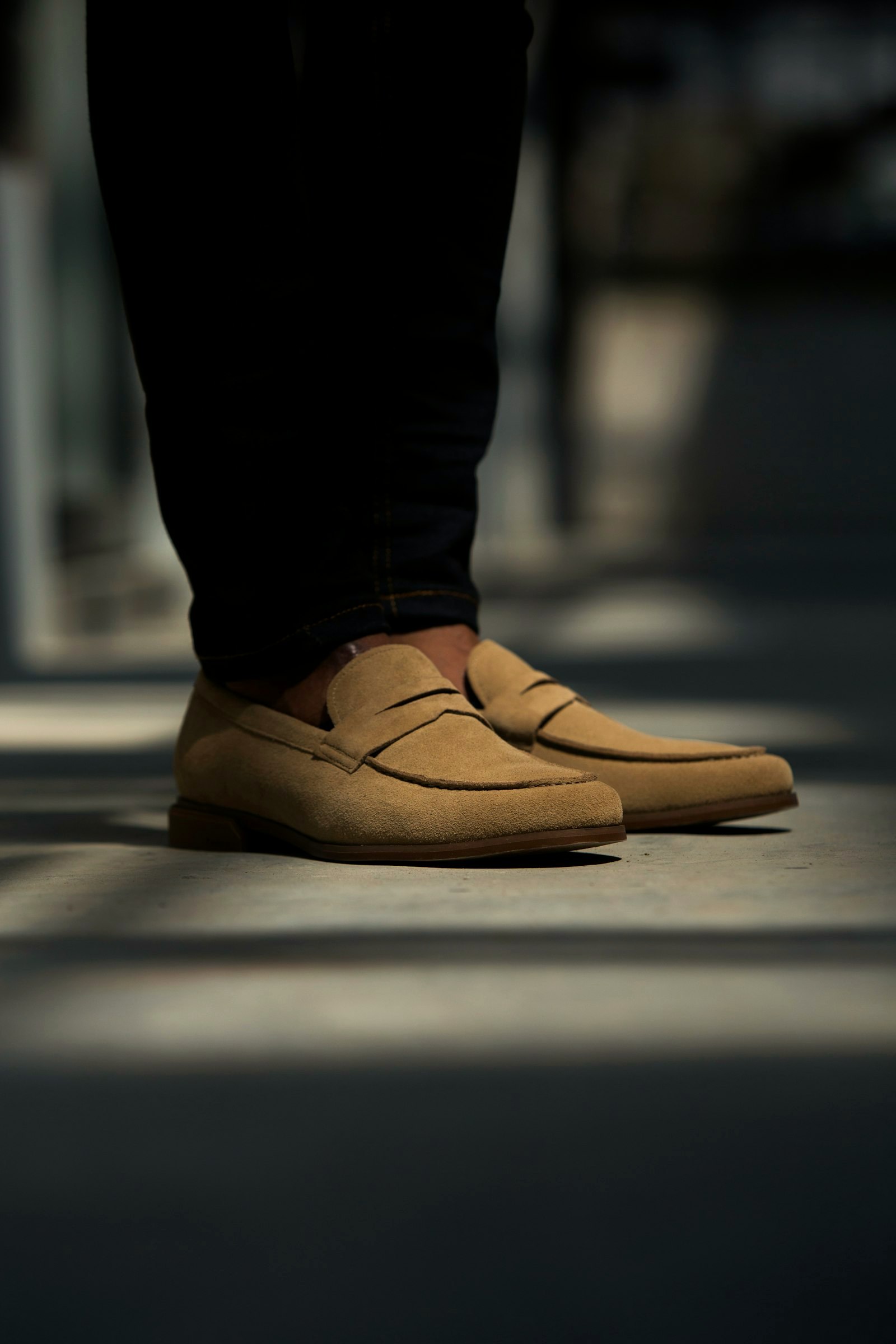
The whole brief in one frame: a suede penny loafer under a dark jean hem cut short and clean, the ankle bare over a no-show sock. The jean has been dressed up exactly one notch. Nothing in the frame is trying for two.
Checked and updated October 2026
The ruling, up front: a loafer is the dress shoe with its tie untied, and it obeys one law: it moves an outfit exactly one notch. Under a tailored trouser, it dresses the outfit down one notch, from the Oxford shoe toward ease. Over a jean, it dresses the outfit up one notch, from the trainer toward tailoring. It never moves anything two notches, in either direction, and most loafer failures are arithmetic failures: the man asked for two. Which loafer, in which leather, with which sock, is decided by the notch you chose, and this page prints the species ladder, the sock ruling, the break the shoe asks for, and the office answer. This site publishes no footwear ranking, and none is smuggled in here: the one scored loafer in print is a garment inside the business-casual capsule, cited below as exactly that.
This brief: the one-notch rule · the three species · the sock ruling · the break · the office ruling · the outfit matrix · the mistakes · leather care
The decisive rule: one notch, never two
Every shoe in the wardrobe has a direction of travel, and the loafer is the only one that travels both ways. Put it under a tailored trouser and the outfit relaxes: the suit's formality is spent, deliberately, on ease, which is why How to Wear No. 04 licenses it in the summer row and nowhere near the boardroom. Put it over a dark jean and the outfit sharpens: How to Wear No. 05 prints the shoe answer for the whole denim family, and it is that leather derbies and loafers take the dark pair into office and evening rows. Same shoe, opposite work. What it cannot do is travel two notches at once. A loafer under a boardroom suit does not split the difference; it reads as a shortcut, a man who dressed for the meeting and stopped at the ankle. A loafer under shorts does not make the shorts formal; it makes the shoe look lost. One notch is the shoe's whole genius, and its whole limit.
The corollary governs buying as much as wearing: because the loafer works by small movements, its details are not decoration, they are the mechanism. The species of strap, the leather's finish, the presence or absence of a sock, the length of the trouser above it: each of these is worth a fraction of a notch, and fractions are the only currency this shoe trades in. A trainer forgives sloppiness because it moves nothing. A loafer forgives nothing, because everything about it moves something. The sections below price each fraction.
One boundary before the ladder: this brief ranks nothing. Footwear rankings are not this site's business, and the desk will not borrow authority it has not earned. Where a score appears on this page, it is a garment score earned on another page and cited as one: the capsule's loafer at 88, the Fall Edit's white sneaker at 84. The system is the content here, as it is in No. 03 and No. 04, and it is printed so it can be applied to any loafer in any shop, including the ones this site has never handled.
The three species, separated
Three straps circle the same slip-on last, and the strap is the taxonomy. The numbers below are this brief's new desk scale, printed as new, set on the ladder the site already publishes: the tee at formality 1, the overshirt at 2, the blazer at 4, the dress trouser at 5. The Oxford shoe owns the ladder's top rung, 5, and no loafer reaches it. The family's ceiling is 4.5, and that missing half rung is not a defect in the shoe. It is the shoe.
| Species | The tell | Formality, polished calf | Formality, suede | The read |
|---|---|---|---|---|
| Penny | A plain slotted strap across the vamp, nothing on it | 3.5 | 3 | The original and the default: the loafer of the capsule, the denim brief and the summer suit row. If a man owns one loafer, it is this one, in brown. |
| Tassel | Two tassels hung from a laced strap | 4 | 3 | The tailored species: the ornament is a deliberate formality claim, so it earns the blazer's rung in calf and stands closest to a derby. Under a blazer it is the finished version of the outfit. |
| Horsebit | A metal bit across the vamp, jewellery on a shoe | 4.5 | 3.5 | The dressiest slip-on made: in dark polished calf it stands half a rung below the Oxford and no higher. The bit is hardware, and hardware is a claim, so this species fails hardest when the rest of the outfit makes none. |
Two discounts apply to every row, and they stack. Suede costs half a rung: the matte nap reads as ease wherever it goes, which is why the suede penny at 3 is smart casual's centre and the calf penny at 3.5 reaches further into tailored rooms. An unlined construction costs the other half: the soft, unstructured loafer that moulds to the foot is the most comfortable shoe in this family and the least formal, because structure is what formality is made of. The capsule's scored loafer sits exactly where the arithmetic puts it: an unlined suede penny, formality 3, the business-casual shoe. The Northampton bench tradition this site grades in its quiet-luxury ranking keeps its reference loafer, the Lopez, as the one other loafers are measured against, and the measurement is a construction measurement: a stitched, structured shoe in calf, holding the top of the family because it gives away the fewest fractions.
Colour is the last fraction. Brown is the family's working colour, in calf or suede, because it sits inside more of the wardrobe's palette than any rival. Black is a narrower instrument: right under charcoal and navy tailoring in the evening, wrong almost everywhere below formality 4, for reasons the mistakes section prices in full. Burgundy and oxblood split the difference and are the connoisseur's answer rather than the beginner's, because they ask the rest of the outfit to have an opinion about colour too.
The sock ruling, stated plainly
The loafer is the only shoe whose sock is part of the outfit, because the shoe's low vamp puts the ankle on display. The site's position is already in print twice, in the summer rows of No. 04 and No. 03: loafers, without socks or with invisible ones. This brief keeps the ruling and prints the honest version of it: the invisible sock is the ruling; the truly bare foot is a photograph, not a practice.
| Outfit class | The sock | The reason |
|---|---|---|
| Tailoring: suit rows, blazer rows | No-show, always | The ankle is part of the silhouette at a short break. A visible sock interrupts the line the break was chosen to make. |
| Trousers and chinos, warm weather | No-show | Heat is the loafer's season and the bare ankle is the season's grammar. |
| Trousers and chinos, cold weather | A fine dark crew is legal | Chosen on purpose, in a colour that answers the trouser or the knit, and covered by the hem when standing. It is a note, not an accident. |
| Denim | Either, by weather | No. 05's rows run the loafer sockless in summer and crew-socked in winter; the jean forgives both because the shoe is doing the dressing-up. |
| Shorts | No-show, no exceptions | A visible sock with shorts and loafers is the sandals error committed in leather: two summer signals contradicting each other at the same ankle. |
The hygiene truth, without squeamishness: a foot sweats through a working day, and in a bare foot inside a leather shoe, every drop of it goes into the lining. A lining cannot be washed, cannot be replaced, and does not forgive: it absorbs the day, keeps the smell as a souvenir, and breaks down early, which is how a good shoe dies young from the inside. The no-show sock is not a compromise with the look. It is the instrument that makes the look survivable, a washable layer between the foot and the one part of the shoe that can never be cleaned. Add the rest of the system: a rotation, so no pair works two days running; cedar trees in the shoes overnight, which is where the moisture goes to leave; and powder on the longest days. The men in the photographs are barefoot for ninety seconds. You are in the shoes until dinner.
The break: shorter than the Oxford asks for
The trouser above a loafer is hemmed by No. 04's ladder, and this brief adds the loafer's amendment to it. The ladder runs no break, the hem clearing the shoe; a slight break, one small fold, the site's default; a medium break; and a full break, cloth pooling over the shoe. Over an Oxford shoe, the slight break is the answer, and the medium break has its traditional defenders. Over a loafer, the answer moves one rung shorter: no break to slight break, and nothing longer, ever. The reason is the shoe's shape. A loafer is low: a low vamp, a low heel, a small footprint of leather under the hem. Cloth that pools over an Oxford reads as drape; cloth that pools over a loafer swallows it, and the outfit's foundation disappears into its own trouser. No. 04's ladder already knows this: its no-break row names the shoe outright, loafers and clean minimal shoes, with the note that there is no cloth to spare over a heavy shoe. The loafer is the lightest shoe in the tailored wardrobe, so it gets the shortest hem in it.
The opening agrees with the hem, on the arithmetic No. 05 prints for the whole dressed leg: a slim shoe wants a tapered or straight opening above it, and a wide or flared opening over a narrow shoe is the two halves of the outfit arguing. The loafer is a narrow shoe by design, so the leg above it tapers or runs straight, and the bootcut pairing fails here for the same reason it fails in the denim brief. In the matrix below, the trousers that carry the loafer rows are the ones the site has already scored in that shape: the Spier & MacKay tropical wool trouser, 87 in Verdict Card No. 15, worn with loafers in No. 10's formality-ceiling row and again here, because a slim tapered wool trouser over a loafer at a short break is the closest this shoe gets to a uniform.
The office ruling
Plainly: the loafer is the business-casual shoe, and it is not the boardroom shoe. Both halves are already in print. The business-casual half belongs to the capsule, which files the loafer as the office shoe outright: formal enough for the conservative tier in dark brown suede, relaxed enough for the tech tier without a costume change, and it scores its pick, the Spier & MacKay unlined suede loafer, at 88 with the price printed at $218 at last check. That is a garment score inside a wardrobe, cited here as one, and it is the strongest evidence this page has: in the one wardrobe the site built for office life, the loafer is not the casual option. It is the answer. The boardroom half belongs to No. 04, whose matrix gives the boardroom and evening rows to black oxfords and does not apologise for it. A room that measures formality is measuring at the ladder's top rung, and the loafer's ceiling is half a rung below it. Wear the loafer to the office on the four days it is the right shoe. Wear the Oxford on the day it is not, and let each shoe's authority cover the other's absence.
The outfit matrix: six ways, no improvisation needed
| Setting | The loafer | With | The judgment |
|---|---|---|---|
| The summer suit | Suede penny, no-show sock | A linen or fresco suit, stone, tan or light grey, an open-collar shirt | No. 04's summer row, verbatim: the loafer is the licensed lowering of the suit's register for heat. The row's terms are the row's terms. |
| The blazer evening | Calf tassel or penny, formality 4 or 3.5 | A navy or charcoal blazer over a fine crew neck, dark trousers | No. 03's evening row: the blazer at formality 4 answered by the one loafer species that stands on the same rung. The knit is fine gauge, per the row below. |
| The knit row | Calf penny with fine gauge; suede penny when the gauge thickens | A fine-gauge crew, roughly 24 to 30 gauge per No. 09, over an Oxford, with the Spier tropical wool trousers at 87 | No. 09's bands govern the top half: fine gauge under tailoring, always. A mid-gauge crew, 12 to 20, is a softer outfit, and the shoe softens with it, calf to suede, one fraction following the other. |
| Dark denim, dressed up | Brown suede penny, the hero's shoe | Dark one-wash or raw denim at a short break, an Oxford or a knit polo above | No. 05's shoe answer at work: the loafer takes the dark pair into the evening row. The wash-break law governs the two denims if a trucker joins; the shoe is not denim and stays out of the argument. |
| The office default | The capsule's unlined suede loafer, 88 as a garment | Chinos or wool trousers, an Oxford shirt, a blazer carried or worn | The capsule's assembly: the shoe that answers the business-casual matrix in every column, bought snug because unlined suede moulds to the foot within the week. |
| Shorts, summer evening | Suede penny, no-show, no exceptions | A tailored linen short built like a trouser, a tucked shirt or a knit polo | The shorts ranking's summer-evening uniform, Milan to the Lower East Side. No blazer above it: No. 03 keeps the blazer out of shorts, and the loafer's welcome below them changes nothing above them. |
The ruling
Choose the notch before the shoe. One notch down under tailoring, one notch up over denim, never two in either direction, and never the boardroom, which belongs to the Oxford at the ladder's top. Then let the fractions agree: the species on its rung, suede half a rung below calf, the sock invisible under tailoring and shorts, the hem one rung shorter than an Oxford asks for, the leg tapered or straight above a narrow shoe. A loafer outfit fails the way a chord fails, one note off, audibly. Assembled in tune, it is the most efficient shoe a man owns: the entire distance between the trainer and the dress shoe, covered by one slip-on, in both directions.
The mistakes
Black patent energy with chinos. The polished black loafer, horsebit gleaming, worn under tan chinos and a polo: a formality-4.5 shoe bolted to a formality-2 outfit, two notches of daylight between the top of the shoe and the bottom of the trouser. Black polished leather carries evening and ceremony in its finish, and patent energy carries more; under daylight casual cloth it reads as a waiter between shifts or a groom who lost the rest of the outfit. The chino's loafer is brown, in suede before calf, and the black horsebit's home is the dark tailored row it was priced for in the species table. This is the one-notch rule broken from above: the shoe tried to move the outfit up two, and the outfit refused.
The visible sock with shorts. Socks and sandals is the famous version; this is the same logic in a better shoe and it fails for the same reason. Two summer signals at one ankle contradict each other: the short says heat, the pulled-up sock says October, and the loafer, which was supposed to be the deliberate element, ends up refereeing. The shorts row of the sock table has no exceptions because the error has no subtle version: white athletic sock, dark dress sock, cheerful striped sock, all of them print the same sentence. No-show, or choose a different shoe.
The loafer in the slush. A suede loafer in January slush is not a style risk; it is the destruction of the shoe on a schedule. The loafer has no weather defences in any of its constructions: a low cut that admits meltwater at the ankle, a thin sole with no lugs and no storm welt, and in suede a nap that salt water stains in one crossing of one street. The season system this site publishes puts the loafer in the summer suit row and the capsule's office rotation, and winter belongs to the boot. A man picking his way across a slushy kerb in loafers has not dressed down. He has dressed in the wrong season, and the shoe pays for the ticket.
The glued loafer. The buying failure the capsule prints in one line: below about $200, a loafer stops being stitched and starts being glued, and the category's honest floor is where the recommendation begins. A glued sole cannot be resoled, a coated split-leather upper cannot be conditioned back to life, and the shoe's whole lifespan is the lifespan of an adhesive. The leather ladder from Verdict Card No. 17 grades the same materials the same way in a belt: full-grain at the top, split at the bottom, with the cheapest article the most expensive per wear. A loafer is a decade purchase or it is a season's costume. The price is where that is decided, before the fit is even tried.
Leather care, briefly
The house register for leather is the belts Card's, because the hide does not care which garment it became. The ladder: full-grain keeps the hide's entire surface, tight fibres and all, and ages by gaining character; top-grain is sanded and finished, a little strength traded for a cleaner face; split is the loose fibrous underside, usually coated to imitate grain, and it is the bottom of the ladder in a belt at 31 and in a shoe at any price. A loafer's care follows from which rung its upper stands on. Full-grain and good top-grain calf take cream and rest and come back better; suede takes a brush, an eraser for marks, and protection from salt and standing water; split and coated uppers take nothing, because there is nothing under the coating to feed, and their care plan is the replacement date.
The rotation is the care. Leather that works two days running never dries between wears, and a shoe's lining and insole age in dog years under that regime: the belts Card costs its winner over 1,500 to 1,800 wears precisely because a rotation is assumed. Give a loafer a day off between wears, cedar trees in it overnight, and a brush after dusty days, and the construction the capsule prices, stitched rather than glued, will outlast the fashion for it several times over. Fit is care's first chapter, and the capsule prints it: a loafer is a fit instrument, unlined suede moulds to the foot within a week, so buy snug, not tight, because suede gives. A loafer bought loose is a shoe already retiring: the heel slip that feels like comfort in the shop is the upper stretching toward a shape it will never hold.
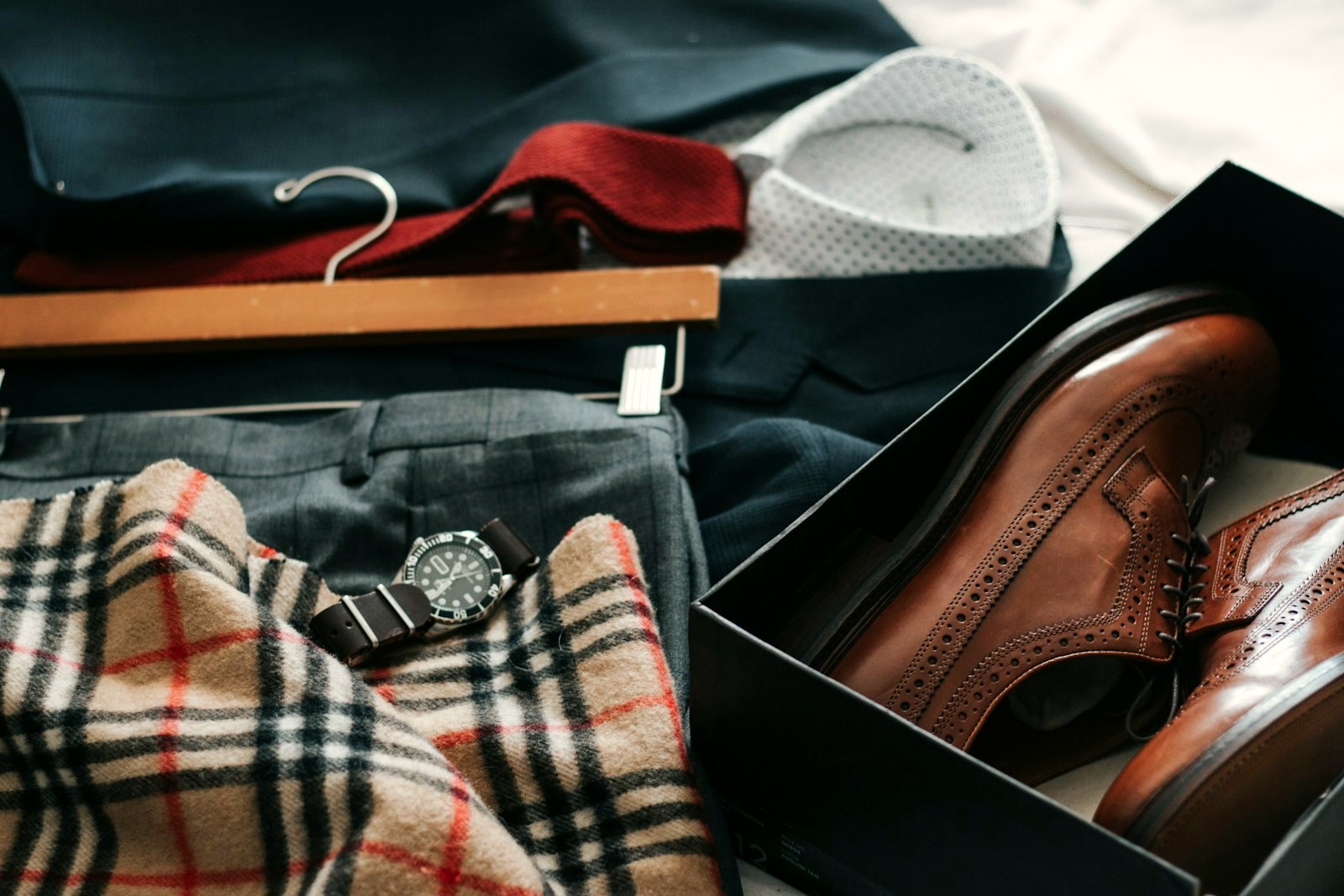
A note on our own photography, printed because this page believes in saying so: our photo bank holds exactly one honest loafer frame, the suede penny at the top of this page, worn sockless under dark denim in street shadow, and it also serves the suit brief, because it is the frame that exists. There is no tassel frame and no horsebit frame, no calf loafer on a body and no loafer under a tailored trouser at size, so the species table runs on the one true frame, the rival's frame and No. 03's flat-lay rather than borrowed shots. The gaps are on the harvest list, named: loafer on body, calf and suede, under trousers.
Questions, answered
How do you wear loafers?
By the one-notch rule: a loafer moves an outfit exactly one notch and never two. Under a trouser it dresses the outfit down one notch, from the Oxford shoe's formality toward ease. Over a jean it dresses the outfit up one notch, from the trainer toward tailoring. It cannot do both jobs in one outfit, and it cannot move anything two notches: loafers under a boardroom suit still read as a shortcut, and loafers cannot make shorts formal. Choose the notch first, then the species, then the sock.
What is the difference between penny, tassel and horsebit loafers?
The strap across the vamp is the whole taxonomy. A penny loafer carries a plain slotted strap and nothing else: it is the original and the most versatile, at formality 3.5 in polished calf on this brief's scale. A tassel loafer hangs two tassels from a laced strap: the ornament makes it the tailored one, formality 4 in calf, the loafer that stands closest to a derby. A horsebit carries a metal bit across the vamp, jewellery on a shoe: formality 4.5 in dark polished calf, the highest a slip-on reaches, and still half a rung below the Oxford shoe, which owns 5. Suede costs every species half a rung, and an unlined construction costs the other half.
Do you wear socks with loafers?
You wear a sock the room cannot see, or a sock the outfit chose on purpose, and you almost never wear the bare foot the photographs suggest. With tailoring and with shorts, the ruling is the no-show sock: our suit and blazer briefs both print it as no socks or invisible ones, and the invisible one is the honest version, because a bare foot gives a day's sweat nowhere to go but the shoe's lining, which cannot be washed. With trousers in cold weather a fine dark crew sock is legal and can be a deliberate note, provided the hem covers it standing. The banned article is the visible athletic sock, above all pulled up with shorts: that is the sandals error in a leather shoe.
Can you wear loafers with a suit?
In the rows our suit brief licenses, yes, and outside them, no. No. 04's matrix puts suede loafers in the summer row, with a linen or fresco suit, and loafers beside clean minimal shoes in its no-break row. Its boardroom and evening rows belong to black oxfords, and no loafer takes them: the loafer's ceiling on this brief's scale is 4.5, and the boardroom is a 5. The loafer with a suit is a deliberate lowering of the outfit's register for heat, travel and ease. Worn to look formal, it is simply the wrong shoe.
Can you wear loafers with shorts?
Yes, and our shorts ranking already rules it: a tailored short, built like a trouser with a proper rise and a hem one to three inches above the knee, reads deliberate with loafers and a tucked shirt, the summer-evening uniform from Milan to the Lower East Side. Two conditions ride with it. The sock is a no-show, always, because a visible sock with shorts and loafers is the sandals error. And no blazer goes over the top: our blazer brief rules the blazer over shorts a runway proposition, not a wardrobe one. Shorts take the camp collar shirt, the knit polo and the overshirt. The loafer is welcome below them. The jacket is not.
Has Young Cotton ranked loafers?
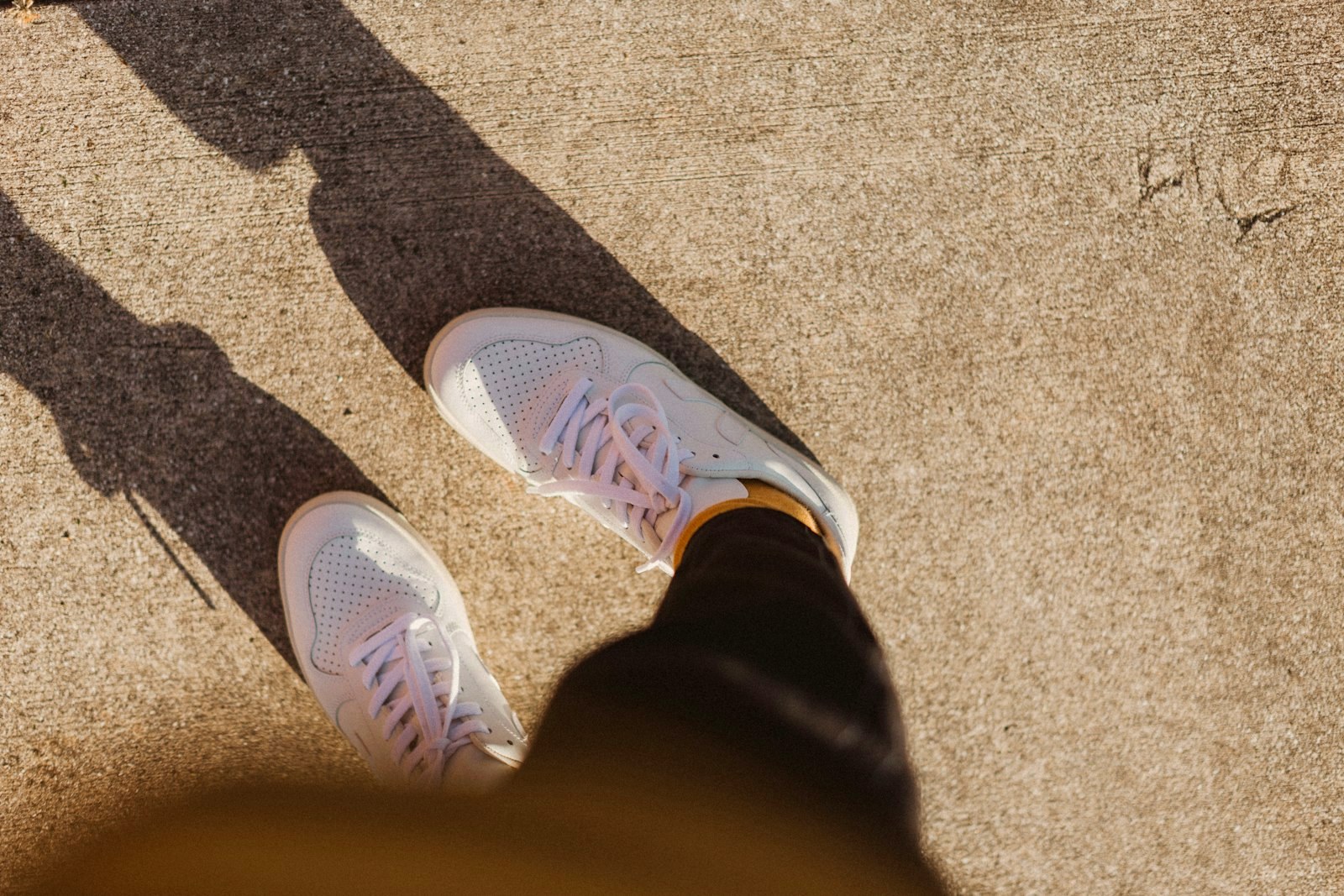
No, and this page will not pretend otherwise: there is no loafer Verdict Card on this site, and this brief scores no shoe. The one loafer this site has scored is a garment inside a wardrobe, not a ranking entry: the Spier & MacKay unlined suede loafer, 88 in our business-casual capsule, $218 at last check, printed there as the office shoe. The shoe this page measures the loafer against is also a garment score on its own page: the Koio Capri Triple White, 84 in the Fall Edit. Everything else here is a wearing system, printed so any loafer can be judged by it.
Next
The briefs this one answers to: the suit and its break ladder in How to Wear No. 04, the blazer whose evening row the tassel was built for in How to Wear No. 03, and the denim whose dark pair the loafer promotes in How to Wear No. 05. The knit above the shoe is briefed in How to Wear No. 09, the layer the overshirt adds in cold weather in How to Wear No. 10. The shoe measured against this one all autumn is in the Fall Edit, the wardrobe that made the loafer its office shoe is the business-casual capsule, and the leather ladder the care section grades by is Verdict Card No. 17, the belts Card.