
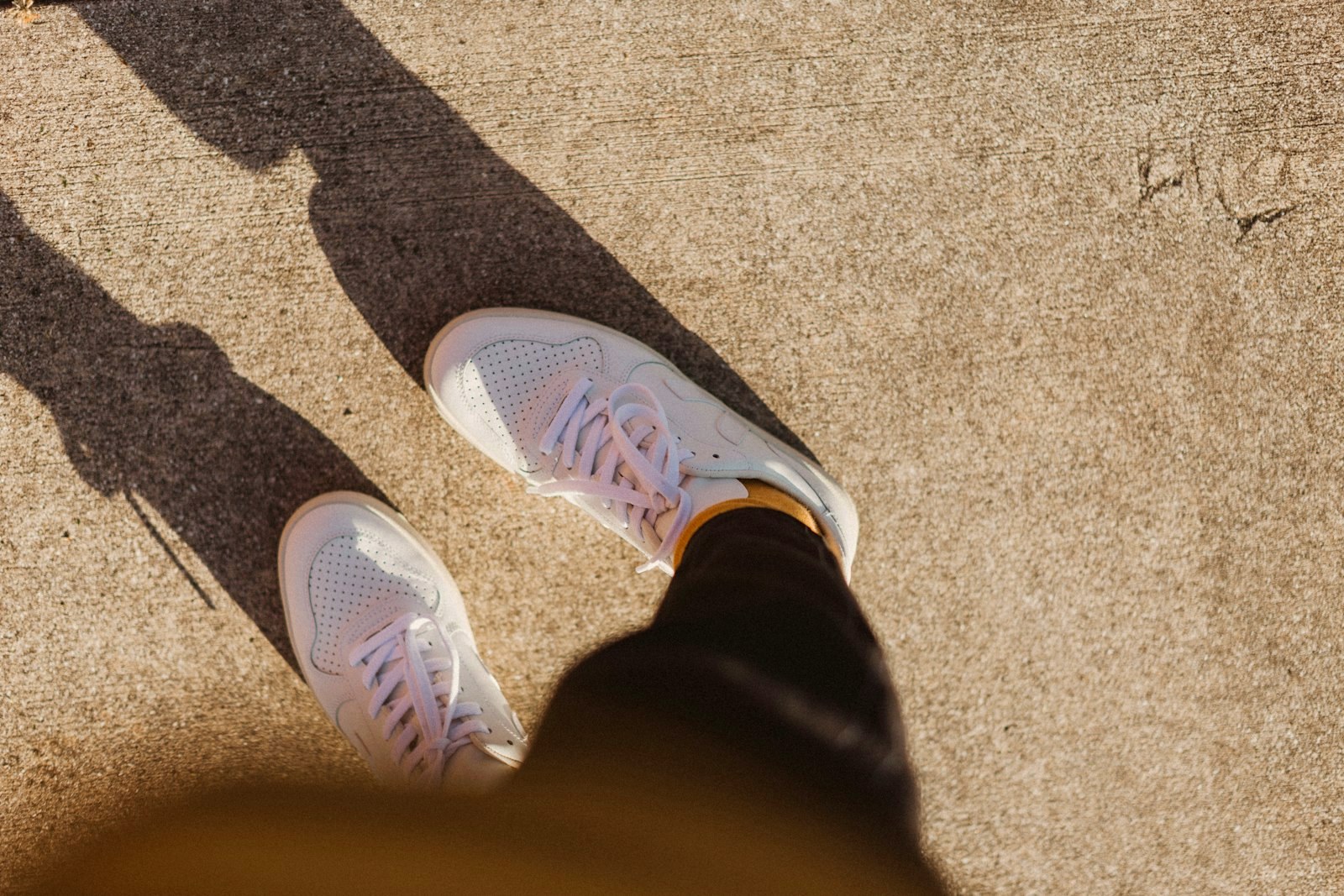
The whole brief in one frame: a plain white sneaker, low and clean, on real concrete in real light. Nothing on the shoe but the shoe, and nothing spent yet: this is the condition every ruling on this page assumes, and the condition the care routine exists to keep.
Checked and updated October 2026
The ruling, up front: a white sneaker is a formality solvent. It dissolves exactly one level of formality from the outfit it touches, it never adds any, and it dissolves nothing else. That single fact explains both of its famous effects: it saves a summer suit, because a suit has levels to spare and lands at deliberate ease; and it ruins a black-tie-adjacent outfit, because black tie has no level to spare and lands out of uniform. It is the one-way version of the loafer's one-notch rule: the loafer moves an outfit one notch in either direction, the sneaker moves it down one level or not at all. Which sneaker, in which condition, under which trouser, is decided by the level you intend to land on, and this page prints the species ladder, the cleanliness doctrine, the trouser rules and the office answer. This site publishes no footwear ranking, and none is smuggled in here: the one scored white sneaker in print is a garment inside the Fall Edit, cited below as exactly that.
This brief: the solvent rule · the three species · the cleanliness doctrine · the trouser rules · the office ruling · the outfit matrix · when not to · the mistakes
The decisive rule: one level down, never one up
Every shoe in the wardrobe has a direction of travel. How to Wear No. 11 prints the loafer's: one notch in either direction, down under a trouser, up over a jean, never two. The white sneaker travels the same road with half the licence. It can spend formality and it cannot create any. Under a dark jean it moves zero notches, because the jean and the shoe already live on the same level, and this is the sense in which No. 11 calls the sneaker the zero-notch shoe: from the denim side, nothing changes. Against tailoring the same shoe is a solvent. A suit stands at the top of the site's ladder; put a clean minimal sneaker under it and the outfit does not collapse, it settles exactly one level down, from ceremony to deliberate casual tailoring, which is the settlement How to Wear No. 04 licenses in its summer and travel rows. One shoe, two readings, one arithmetic: down one level where there is a level to spend, zero where there is not, up never.
The corollary is the failure mode. A solvent does not ask what the outfit is for; it dissolves the first level it touches. Where the level it touches is the outfit's whole claim, the outfit is not softened, it is spent. Black tie is the extreme case: its formality is not a quantity but a code, a uniform agreed in advance, and one level below the code is not a relaxed version of the code. It is a different event, attended in the wrong clothes. The same arithmetic, at lower stakes, is why the sneaker fails at the formal evening and the ceremony rows throughout this page. The shoe is not too casual in some vague sense. It is a solvent applied to a surface that had exactly one coat.
One boundary before the ladder: this brief ranks nothing. Footwear rankings are not this site's business, by ruling, and the desk will not borrow authority it has not earned. Where a score appears on this page, it is a garment score earned on another page and cited as one: the Fall Edit's white sneaker at 84, the capsule audit's pre-distressed loser at 39. The system is the content here, as it is in No. 03, No. 04 and No. 11, and it is printed so it can be applied to any white sneaker in any shop, including the ones this site has never handled.
The three species, separated
Three silhouettes share one colour, and the silhouette is the taxonomy. The numbers below are this brief's new desk scale, printed as new, set on the ladder the site already publishes: the tee at formality 1, the overshirt at 2, the blazer at 4, the dress trouser at 5, the Oxford shoe owning the top rung at 5, and the loafer family spread between 3 and 4.5 by species and leather. No sneaker reaches the loafer family's middle, let alone its ceiling. The family's whole territory is the ladder's lower half, and the differences inside it are the differences that decide the tailored rows.
| Species | The tell | Formality, clean | The read |
|---|---|---|---|
| Minimal leather court | A plain low upper in smooth full-grain leather, a flat cupsole, no panels, no branding, nothing on the shoe but the shoe | 3 | The only sneaker tailoring admits, at the same rung as the suede penny loafer: the two shoes share No. 04's summer row and its no-break row. The capsule's slot rules are the species definition: full-grain leather, a clean low profile, a stitched sole. |
| Retro runner | Suede and mesh panels over a shaped, cushioned sole: a 1970s running shoe kept as a style object | 2 | The overshirt's rung: a layer-level shoe for denim, chinos and off-duty rows. Its sport ancestry is its ceiling, because No. 04's distinction is ancestral as well as actual: the sneaker that works is a shoe with a flat sole, not athletic equipment, and the runner's sole is shaped for a stride. |
| Canvas low-top | Cotton canvas on a vulcanised rubber sole, the plimsoll's descendant | 1.5 | Summer's shoe: shorts, light denim, washed chinos, the beach end of the wardrobe. The cheapest of the three, the shortest-lived, and the one whose rung is spent fastest, because canvas cannot be restored the way leather can. |
The exhibit for the first species is already in print. The Fall Edit files its white sneaker as a garment and scores it: the Koio Capri Triple White, 84, full-grain leather on a Margom sole, made in Italy, with nothing on the shoe but the shoe. The quiet-luxury capsule slots the same shoe under the rules quoted in the table above, as the most-worn shoe in the wardrobe it builds. That is the standard the species is judged by on this page: not a brand, a recipe. Any maker's court shoe that meets the recipe stands at 3; any that adds panels, logos or a sculpted sole has changed species and takes the runner's rung and the runner's rooms.
Colour is simpler here than anywhere else in the wardrobe, because the brief is about the one colour that is also a condition. White is the subject; the near-whites are footnotes. An off-white or cream sneaker is the court shoe with its contrast lowered, legal in every row the white one is, and kinder about the condition doctrine below. A white shoe with a gum sole is the runner's tell worn by a court shoe and reads as the runner in tailored rows. Keep the sole white in the rows that measure, and let the experiments live in the casual rows where the species are forgiven.
The cleanliness doctrine: condition is the formality
Stated plainly: a white sneaker's formality is its condition. Every other shoe on this site holds its rung by construction: the Oxford is formal because of how it is built, the loafer by its species and leather. The white sneaker holds its rung by maintenance. The silhouette rents the rung; the condition pays for it, daily, and the payment is visible from across the room. This is why the species table above carries the word clean in its column head. The numbers are not the shoes' permanent addresses. They are the shoes' addresses on the day they are kept.
The discount for neglect is charged in whole levels, not fractions, and the difference from No. 11's arithmetic is deliberate. Suede costs a loafer half a rung because suede reads gradually, as a softening. Dirt does not read gradually. A court shoe at 3 with a grey cast across the toe and a yellowed edge on the sole is not a court shoe at 2.5; in every eye in the room it has changed species, from court shoe to old trainer, and old trainers stand at 1, beside the gym kit. One visible state of neglect costs one level: scuffed and grey, the court shoe falls to the runner's rung of 2 and keeps only the casual rooms. Two states, the yellowed sole worn anyway, the laces gone grey with them, and it stands at 1, where no styling brief can help it, because the outfit above it is now being read as the clothes a man wears with his oldest shoes.
The doctrine has a negative proof already in print. The quiet-luxury capsule audited a famous pre-distressed designer sneaker, a well-made leather shoe sold with its wear manufactured in a factory, and scored it 39: fit and versatility 5, longevity 3, a shoe whose entire point expires the moment real scuffs join the fake ones. The desk's sentence on it stands as this brief's doctrine from the other direction: buy the plain white sneaker and distress it yourself, by walking. Condition is not a cosmetic preference on this page. It is the mechanism the whole shoe runs on, and paying a premium to fake its absence is the one purchase the system cannot make sense of.
| Step | Leather (court and runner uppers) | Canvas |
|---|---|---|
| 1. After every wear | Wipe the uppers down with a dry or barely damp cloth; brush dust out of the seams | Knock the soles together and brush dry dirt off before it is walked into the weave |
| 2. The weekly clean | Damp cloth and mild soap on marks; a melamine sponge takes the scuff ring off the rubber midsole | Hand wash cold, or machine wash cold in a laundry bag, with mild detergent |
| 3. The laces | Out, washed or replaced. Grey laces on a clean upper announce the clean as an accident; fresh laces are the cheapest formality restoration in the wardrobe | |
| 4. The rest | A day off between wears, on trees or stuffed with paper, out of heat and direct sun. Rotation is care here as it is for leather everywhere on this site, and sunlight is the yellowing agent the next step cannot undo | |
| 5. The sole | Yellowing is oxidation in the rubber, and it cannot be cleaned back; it can only be slowed by step 4. Once the sole's edge yellows, the shoe leaves the tailored rows permanently and finishes its life in the casual ones. That is a demotion, not a death: the doctrine retires shoes downward, rung by rung, and a kept pair earns every rung it descends | |
A note on our own photography, printed because this page believes in saying so: our photo bank holds exactly one honest white-sneaker frame, the pair at the top of this page, and it also serves the Fall Edit, the suit brief and the shorts ranking, because it is the frame that exists. There is no retro runner on a body in the bank, no canvas shoe on a street, and no white sneaker under a tailored trouser at size, so the species table runs on the one true frame and the chino frame below rather than borrowed shots. The gaps are on the harvest list, named: white sneaker on body under tailoring, runner on body, canvas on body.
The trouser rules: break, taper, and the three cloths
The trouser above a white sneaker is hemmed by No. 04's ladder, and this brief adds the sneaker's amendment to it, on the same reasoning No. 11 used for the loafer. The ladder runs no break, the hem clearing the shoe; a slight break, one small fold, the site's default; a medium break; and a full break, cloth pooling over the shoe. The sneaker is the lowest, flattest shoe in the wardrobe, lower than the loafer, with a thin sole and no heel to speak of. Cloth that pools over it does not read as drape; it swallows the shoe whole and leaves the outfit standing on a fold of fabric. Over a white sneaker the answer is no break to slight break, and nothing longer, ever. No. 04's ladder already knows the pairing: its no-break row names the shoes outright, loafers and clean minimal shoes, with the note that there is no cloth to spare over a heavy shoe. The sneaker is the lightest shoe in the wardrobe, so it shares the shortest hem in it.
The opening agrees with the hem, on the arithmetic No. 05 prints for the whole dressed leg: the opening and the shoe agree, or the outfit argues. The court shoe is a small shoe, a low narrow wedge of white under the hem, so the leg above it tapers or runs straight and finishes close. A wide opening over a minimal sneaker makes the shoe disappear and the trouser look unaccompanied; wide legs ask for a shoe with presence, a boot or a loafer with a sole to answer the cloth. The runner, bulkier by design, tolerates the straighter and wider openings the court shoe cannot, which is one of the two honest reasons to own one. The other is in the matrix.
| The cloth | The hem | The sock | The judgment |
|---|---|---|---|
| Tailoring: suit rows, wool trousers | No break, the hem clearing the shoe; No. 04's row notes the sock shows when you walk, so the sock is chosen, not defaulted | No-show, or a fine plain sock answering the trouser's colour | The court shoe only, at condition 3, in the rows No. 04 licenses. The Spier & MacKay tropical wool trouser, 87 in Verdict Card No. 15, is the matrix's tailored leg. |
| Chinos | No break to slight; the one legal turn-up in the tailored half of the wardrobe, a single roll that shows the ankle on purpose | No-show in warm weather; a fine sock when the roll comes down | The shoe's home cloth. Cotton twill at the court shoe's own level, which is why the pairing needs the least thought and survives the most wear. |
| Denim | Hemmed to sit on the shoe, or turned once; no stacking over the court shoe, because the shoe's clean line is the point of the pairing | By weather, as in No. 05's rows | The wash-break law governs the two denims if a trucker joins; the shoe is not denim and stays out of the argument. The runner tolerates the stack the court shoe refuses. |

The sock ruling, stated plainly: in the tailored rows, a no-show sock or a fine plain sock in a colour that answers the trouser, and never the white athletic crew sock pulled up under a tailored hem. That sock is the gym kit announcing itself at the ankle, the one article that can dissolve a level the wearer did not budget for. Below tailoring the answer widens by species: the court shoe keeps the no-show or the fine sock in every row, because its line is the point; the runner and the canvas shoe may take a white crew sock as a deliberate period note under denim, chinos and shorts. Chosen is the operative word in both directions. A sock the outfit picked is a note. A sock the gym bag supplied is an accident, and accidents are what the solvent rule cannot absorb.
The office ruling
Plainly: the white sneaker is an office shoe in the rooms whose code is a shirt's code, and it is not an office shoe in the rooms whose code is tailoring's. The first half is arithmetic. Smart casual's floor on this site is formality 2, the overshirt's rung, and a clean court shoe at 3 stands above that floor with a level to spare: under chinos or wool trousers, beneath a collared shirt or a fine knit, it is not the casual option in the outfit. It is the finished version of it, the shoe the quiet-luxury capsule builds its rotation on and files among the first five pieces a wardrobe buys. The second half is No. 04's: a room with a tailoring expectation is answered by the shoes the tailoring rows name, the loafer for the business-casual week and the Oxford for the day the room measures. The sneaker's office life is real and it is bounded, and the bound is the same bound the overshirt lives under: formality does not present in rooms that measure it by borrowing a lower rung and hoping.
One condition rides with the ruling, and it is the doctrine's: the office pair is a kept pair. In a casual room a scuffed sneaker reads as a shoe having a life. In an office it reads as the outfit's one unconsidered element, because the office is where the shoe is compared, at desk height and meeting distance, against leather shoes that hold their rung by construction. The rotation the care section prints is what makes the ruling survivable: two pairs alternating will hold condition 3 through a working season; one pair worn daily will not, and its demotion to the weekend rows should be a decision the wearer makes before the room makes it for him.
The outfit matrix: six ways, no improvisation needed
| Setting | The sneaker | With | The judgment |
|---|---|---|---|
| The summer suit | Minimal leather court, spotless, no-show or fine sock | A linen or fresco suit, stone, tan or light grey, an open-collar shirt; on a travel day, the dark high-twist suit instead | No. 04's licensed rows, verbatim in effect: the solvent spent on purpose, one level down from ceremony to ease. The travel row's own words are derbies that can walk all day, or the minimal sneaker. |
| The blazer, dissolved on purpose | Minimal leather court, clean | A navy blazer over an Oxford, chinos at no break | The solvent's showcase: the blazer stands at formality 4, the shoe spends one level, and the outfit lands at the smart-casual register the evening actually asked for. When the evening asks for the blazer's full 4, the shoe is the loafer, and No. 03's evening row says which. |
| Dark denim, the default | Court shoe for the clean read; runner when the day is long | Dark one-wash or raw denim hemmed to the shoe, a white tee and a trucker, or an Oxford above | No. 05's base assembly with the shoe at zero: nothing dissolved, nothing raised. If the evening needs the jean promoted, that is the loafer's one-notch-up job in No. 11, and no sneaker is promoted into it. |
| The knit row | Court shoe, no-show or fine sock | A fine-gauge crew, 24 to 30 gauge per No. 09, over an Oxford, with the Spier tropical wool trousers at 87; or a mid-gauge crew, 12 to 20, standing alone over chinos | No. 09's bands govern the top half: fine gauge is the knit that can sit beside tailoring, and the shoe matches its register exactly. A mid-gauge knit is a softer outfit, and the shoe stays the court shoe while the runner waits for the denim rows. |
| The overshirt row | Clean court shoe, or canvas in high summer | An overshirt at formality 2, open over a tee, with chinos or denim | Two formality-2-and-above casuals in agreement: No. 10's own shorts-weather row names clean sneakers under this garment. The solvent reads zero here; there is nothing above the shoe's level to dissolve. |
| Shorts, summer evening | Canvas low-top, or the court shoe; no-show sock | A tailored short built like a trouser, a camp collar shirt, a knit polo or an overshirt above | No. 03 keeps the blazer out of shorts entirely: a runway proposition, not a wardrobe one. Below the short, the low white shoe is the sanctioned finish, and the canvas species earns its keep in exactly this row. |
The ruling
Decide the level before the shoe. If the outfit should land exactly where it stands, the white sneaker is the honest finish, at zero. If it should land one level below its cloth, a summer suit loosened, a blazer brought down to the evening's real register, the clean court shoe is the instrument, and the spending is the style. If it should land one level up, or lose nothing at all in a room that measures, close this page and open the loafer's: the solvent cannot do that work, and asking it to is how the mistakes below happen. Then keep the shoe at its condition, because the rung is rented daily: the wipe, the laces, the rest day, the demotion accepted when the sole yellows. A white sneaker wardrobe run on those terms is the most efficient footwear system a man owns: one shoe, three species, every casual row in the matrix, and a single tailored row it borrows honestly and returns clean.
When not to: the rooms another shoe owns
The boardroom and the formal evening. These belong to the Oxford shoe at the ladder's top rung, and No. 04 gives them to black oxfords without apology. A room that measures formality is measuring at 5, the sneaker's ceiling is 3, and the two missing levels are not a gap a clean upper can charm its way across. The solvent framing makes the reason precise: these are the rooms where the outfit has no level to spend, because the level is the message.
The loafer's promotion jobs. Dark denim dressed for the evening, the blazer's evening row, the summer suit worn to look finished rather than loosened: every job that asks a shoe to move an outfit up one notch, or to hold a tailored outfit at its full register in a softer shoe, is No. 11's work. The sneaker's candidacy in those rows is the category error this brief exists to prevent. It is not that the sneaker is worse. It is that it travels in one direction, and the job faces the other way.
Wet winter streets. No. 11 retired the suede loafer from the slush on construction grounds; the white sneaker's exclusion is on condition grounds, and it is stricter. One crossing of a slushy kerb spends, in a minute, the condition this page's whole system prices: the grey cast, the salt tide line, the sole edge darkened past what a sponge restores. The boot owns that weather. A white shoe worn into it has not taken a style risk; it has accepted a demotion on a schedule, and the demotion is charged whether the wearer notices or not.
The mistakes
The gym shoe in tailoring's clothing. No. 04 names it first among the suit's failures and this brief adopts the naming: a running shoe under a suit, cushioned, coloured, built with a sole shaped for a stride, worn under a hem cut for a dress shoe. It spends the suit's entire formality in a single step and buys nothing back, and the chunk of the sole fights the trouser's line as hard as the register fights the room. The distinction the whole family insists on is between that shoe and the minimal leather sneaker, low, plain and clean, which is a shoe that happens to have a flat sole. One is athletic equipment at a meeting. The other is a decision. The retro runner lives nearer the line than its wearers admit: its sole is shaped, its panels are sport's, and in a tailored row it is read by the same rule.
The yellowed sole worn anyway. The condition doctrine's home failure: the court shoe whose sole edge has oxidised to a nicotine yellow, still being worn in the summer suit row because the upper looks fine from above. The wearer sees the upper; the room sees the sole, at every step, at trouser-hem height, which is the exact sightline tailored rows are judged at. The shoe has not kept its rung and lost a decoration. It has changed species, to old trainer, and old trainers dissolve two levels, not one: the second level is the wearer's credibility about the first. Demote the pair to the casual rows, where its remaining life is honest, and let the tailored rows be served by a shoe whose condition is current.
White sneakers with a black suit at a funeral. The solvent applied where there was nothing to dissolve into. A funeral's black suit is not an outfit with formality to spare; its formality is the respect being paid, expressed in the only currency the occasion accepts, which is conformity to its code. No. 04 files the black suit's solemn rows with black oxfords, and the code has no casual row, no travel row, no summer exception. A white sneaker there does not read as ease or as personality. It reads as the one man who treated the day as being about his outfit, and it is remembered longer than the suit. Some rooms are not styling problems. This is the page's clearest one.
The bought-dirty shoe. The purchasing failure the capsule's audit already graded: a pre-distressed designer sneaker, well-made leather under manufactured wear, scored 39 on that page, with fit and versatility at 5 and longevity at 3, because a joke about ageing ages fastest of all. The buyer has paid the highest price in the category to begin at the condition this brief demotes shoes for reaching. Every ruling on this page assumes condition is earned by maintenance and spent by wear; the pre-distressed shoe inverts the economy, spending money to arrive pre-spent. Buy the plain shoe, keep it on the routine, and let its scuffs, when they come, be a record rather than a costume.
Questions, answered
How do you wear white sneakers?
By the solvent rule: a white sneaker dissolves exactly one level of formality from the outfit it touches, it never adds any, and it dissolves nothing else. It is the one-way version of the loafer's one-notch rule in How to Wear No. 11. The loafer moves an outfit one notch in either direction; the sneaker moves it down one level or not at all. Under denim it moves nothing, which is why No. 11 calls it the zero-notch shoe. Against tailoring it spends one level, which is why it saves a summer suit and is useless at black tie, where there is no level to spare. Choose the level you intend to land on, then the species, then check the shoe's condition, because condition is what holds the level.
Can you wear white sneakers with a suit?
A minimal leather sneaker, low, plain and clean, yes, in the casual rows: a summer suit, a travel day, an evening that is not formal. That is How to Wear No. 04's ruling, kept verbatim here. A gym shoe, no, in any row: a running shoe under tailoring spends the suit's whole formality in one step and buys nothing back. The sneaker that works is a shoe that happens to have a flat sole, not athletic equipment. The boardroom and evening rows belong to black oxfords, and no sneaker takes them, clean or otherwise.
What is the difference between a minimal leather sneaker, a retro runner and a canvas sneaker?
The silhouette is the taxonomy, and this brief's desk scale places each species on the site's formality ladder. The minimal leather court shoe, a plain low upper in smooth full-grain leather on a flat sole with nothing on the shoe but the shoe, stands at formality 3 when clean: it is the only sneaker tailoring admits. The retro runner, suede and mesh panels over a shaped cushioned sole, stands at 2: a running shoe's descendant, and its sport ancestry is its ceiling. The canvas low-top stands at 1.5: summer's shoe, for shorts and light cloth, the cheapest of the three and the fastest to age out of its rung.
How do you keep white sneakers white?
By routine, not by rescue. For leather: wipe the uppers down after wear, clean marks with a damp cloth and mild soap, take the scuff ring off the midsole with a melamine sponge, wash or replace the laces (the cheapest restoration there is), and rest the pair a day between wears on trees or stuffed with paper. For canvas: brush dry dirt off, wash cold with the laces out, and air dry stuffed with paper, never in a dryer, whose heat warps the last and yellows the glue lines. Sole yellowing is oxidation and cannot be cleaned back; it can only be slowed, by storing the shoes out of heat and direct sun. Once the sole yellows, the shoe leaves the tailored rows for good.
Do you wear socks with white sneakers?
In the tailored rows, a no-show sock or a fine plain sock in a colour that answers the trouser, and never the white athletic crew sock pulled up under a tailored hem: that is the banned article, the gym kit announcing itself at the ankle. In the casual rows the answer widens by species. The court shoe keeps the no-show or the fine sock everywhere, because its line is the point. The retro runner and the canvas shoe may take a white crew sock as a deliberate period note under denim, chinos and shorts. The difference is intention: a sock the outfit chose is a note; a sock the gym bag supplied is an accident.
When should you not wear white sneakers?
In the rooms another shoe owns. The boardroom and the formal evening belong to the Oxford shoe at the ladder's top. A funeral belongs to the black suit and black oxfords: ceremony has no level to dissolve. Any job that asks a shoe to dress an outfit up belongs to the loafer, which moves an outfit one notch in either direction; the sneaker can only move one down. And white sneakers stay home in slush and standing rain, not as a style ruling but as a schedule: one crossing of a wet street spends the condition the shoe's whole formality depends on.
Has Young Cotton ranked sneakers?
No, and this page will not pretend otherwise: footwear rankings are excluded on this site, and this brief scores no shoe. The white sneaker this site has scored is a garment inside other pages, cited here as exactly that: the Koio Capri Triple White, 84 in the Fall Edit, full-grain leather on a Margom sole, made in Italy, filed there as the white sneaker and slotted by the quiet-luxury capsule under the rules full-grain leather, a clean low profile, a stitched sole, and nothing on the shoe but the shoe. The capsule's audit also scored a pre-distressed designer sneaker at 39, and this brief's cleanliness doctrine is that score, generalised.
Next
The briefs this one answers to: the loafer whose two-way rule this page's solvent is the one-way version of, in How to Wear No. 11; the suit and its sneaker ruling in How to Wear No. 04; the denim whose wash-break law the shoe stays out of, in How to Wear No. 05. The blazer the solvent spends on purpose is briefed in How to Wear No. 03, the layer the matrix pairs the shoe with in How to Wear No. 10, and the knit above the trousers in How to Wear No. 09. The shoe itself, scored as a garment, is in the Fall Edit, and the wardrobe that builds its rotation on it is the quiet-luxury capsule.