
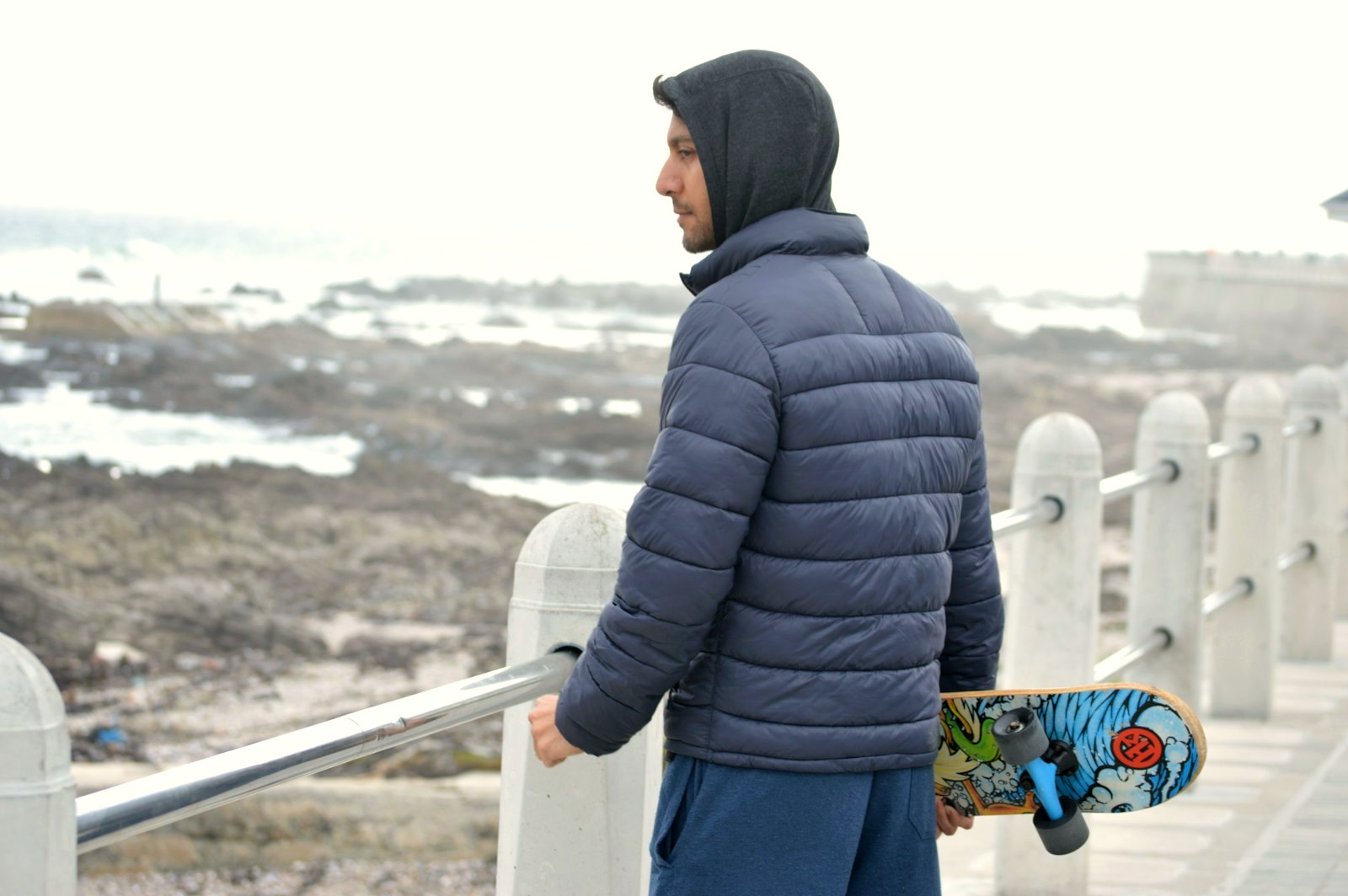
The register this brief rules, photographed at the water the garment was drawn for: a navy winter coat at a harbour railing in cold, flat light. The coat in this frame is a puffer, warmth 5 on our jackets index, the ladder's other winter answer, and it is printed here for the harbour and the cold, not dressed as the subject. Our bank holds no true pea coat frame, and this page prints that gap in its care section rather than borrow a wrong coat.
Checked and updated October 2026
The ruling, up front: the pea coat is the warmest short coat in the wardrobe, and the only naval garment that never reads as costume when the fit is honest. Our jackets index files it at formality 3, warmth 4, in heavy melton wool, season autumn through winter, and describes it in one sentence: double-breasted, hip length, heavy enough to block a harbour wind. Everything in this brief is that record unfolded: the hem ends at the hip because the index says so and the pattern agrees; the double front is worn closed, as designed, because an overlapped front worn open is half a coat; and the collar is the instrument, the broad lapel that converts and buttons to the throat, the one raised collar in the wardrobe that is equipment rather than gesture. This brief prints the full system: the three species separated, the collar's three states graded, the trousers and knits it takes whole, the office ceiling and the suit refusal, and a six-outfit matrix. Which pea coat to buy is a record this site keeps in its index. This brief is the wearing system.
This brief: the decisive rule · the three species · the collar states · the winter stack · the office ruling · the outfit matrix · the mistakes · care and the buttons
The decisive rule: density, worn closed, at hip length
Start where the index starts, with the cloth. The pea coat's warmth is density: melton is a wool woven so tight and fulled so hard that the weave nearly disappears, and wind that moves through every other coat in the short family stops at this one. That is the whole mechanism behind the number, warmth 4, and behind the index's buying rule, which this brief adopts as the garment's first test: the cloth should nearly stand up on its own. Soft melton is a sweater with buttons. Hold a candidate coat by the shoulder and let the body hang. Real melton holds a shape that is recognisably a coat before anyone is inside it. A coat that collapses into drape is a fashion garment wearing the pattern, and it will fail the warmth number it was sold under by the first harbour wind it meets.
The length is hip length, and the index is the authority. Fashion periodically stretches the pea coat toward the thigh and calls the result modern, and the stretch is not an update, it is a different garment arriving, the bridge coat, separated in the species table below and judged on the overcoat's terms. The pea coat's own geometry is a working compression: the warmth of the long wool coats packed into a body that ends at the hip, so the legs stay free for ladders, decks and ordinary city movement. Length past the seat spends that compression and buys nothing the overcoat does not do better. Buy the hem at the hip, covering the seat, and let longer coats be longer coats.
The front is worn closed. A double-breasted front is an overlap engineered against wind: the second layer of melton across the chest is the insulation, and the buttons are its fastening system, not its decoration. Worn open, the coat keeps its colour and loses its design, the overlap hanging as two flaps and the chest, the part the pattern most protects, open to the weather. Open is a legal state indoors and in mild air for the length of a doorway. As a wearing position in real cold it is the garment declining its own job, and it is named in the mistakes below in those terms. The working button is part of the fit test: closed over the winter stack, the front holds a clean line with no pull at the button that works, no strain across the chest, the lapels lying where the pattern puts them.
The fit test is the stack test, and it is this brief's own ruling, printed as new. A pea coat is sized over what it will actually close over: the full winter stack of the Fall Edit, base, warmth layer, and the coat as the weather layer over both. In the shop that means the heaviest knit you own, the heavy gauge of No. 09's bands, not the shirt you wore in. A coat that closes beautifully over a tee and strains over the roll neck fails the only fitting that matters, because winter is when it will be worn. Size for the stack, and let the coat's closer body over a single layer in October be the price of a coat that still works in January.
The numbers, against the coats it is confused with:
| The coat | Formality | Warmth | What the numbers mean |
|---|---|---|---|
| The pea coat | 3 | 4 | The subject. The warmest short coat on the index, at the short family's shared ceiling rung, in a hip-length body |
| The overcoat | 5 | 4 | The same warmth at the wardrobe's formal ceiling, bought with length and with room for a suit beneath. The pea coat matches its number and refuses its job |
| The trench coat | 4 | 2 | One rung more formal, half the warmth: a rain instrument per How to Wear No. 02, scored as one. The pea coat is not a short trench and the trench is not a dry pea coat |
| The puffer | 1 | 5 | The only warmer coat on the index, warming by loft where the pea coat warms by density, and spending every rung of formality to do it. The coldest week's coat, not the dressed week's |
| The Harrington | 3 | 2 | The same rung, the opposite season: No. 18's jacket takes the polite months, the pea coat takes the cold ones, and the rung is the year's handshake between them |
The three species, separated
The rail sells three garments under this name, and they share buttons the way the short family shares ribbed hems: as furniture, not as identity. The species error is the common one, the right silhouette bought at the wrong length or the wrong weight.
| Species | What it is | Its numbers | The ruling |
|---|---|---|---|
| The melton original | The issue pattern as the index files it: heavy melton wool, double-breasted, hip length, broad convertible lapels, the body cut with room for the stack beneath | Formality 3, warmth 4, the index's own numbers for the type | The default and the first buy, and the only species this brief's matrix is written for. Navy is its honest colour, the service colour, with black and charcoal as the city's translations of the same coat. Every other species is measured against this one, including on price |
| The bridge coat | The same front and collar stretched to mid-thigh or the knee, the naval officer's longer coat that the fashion rail periodically renames a long pea coat | Judged on the overcoat's terms, this brief's ruling, printed as new: it has left the pea coat's compression and entered the long coats' contest, where the overcoat stands at formality 5 and warmth 4 | Placed honestly: it is not a better pea coat, it is a different garment, and it inherits the long coat's questions instead: does it cover the jacket beneath it, does its length suit the wearer's height, does it earn its place against a true overcoat. A man who wants length should buy the overcoat's silhouette deliberately rather than a stretched version of this one |
| The fashion-slim version | The pattern redrawn close: lighter cloth, a body cut to a shirt's ease, sometimes a single row of buttons wearing the double-breasted name, sold on the silhouette alone | Below the type's numbers in practice, this brief's grade, printed as new: the cloth fails the index's standing test and the cut fails this brief's stack test, so the warmth 4 on its label is a claim the garment cannot cash | The trap species, because it photographs like the original and performs like a blazer with big buttons. Its tell is the fitting room: it closes over a shirt and strains over a knit, and its cloth drapes instead of standing. Bought knowingly as an autumn blazer-weight coat it is a legal garment. Bought as a winter coat it is the season's most expensive disappointment |
On provenance, because this garment's is unusually functional. The pea coat was drawn as working equipment for sailors in northern navies, and the pattern's every famous feature is a job: the melton for wind, the double front for the overlap, the broad lapels for the collar conversion, the short body for a working deck where a long coat is a hazard. None of this is scored, and none of it asks to be re-enacted, the mistakes section rules on the surplus-store version of that error. It is printed because it explains the garment's rare property, the one the index names: it pairs with everything from tailoring to denim without changing its expression. Equipment that honest tends to. The coat has no costume built into it; costume is only ever added by the wearer, and subtraction is always available.
The collar states: down, up, up with a scarf
The pea coat's collar is the broadest piece of furniture in the short wardrobe: lapels cut wide enough that, unbuttoned from their resting position and turned up, they meet and fasten at the throat, closing the coat's last open edge. It is the only collar in this series that was designed from the first sketch to be worn up, and this brief rules its three states as grades, not moods.
Down: the dressed default. Lapels lying open in the double-breasted front, the V of the coat showing the layer beneath: the roll neck's fold, the crew's band, the Oxford's collar. This is the state for rooms, for mild cold, and for every row in the matrix where the outfit underneath has something to say. Down is also the state that proves the fit: with the front closed and the lapels lying flat and even, a pea coat's shoulder and chest read at a glance, and a collar that will not lie flat down is telling you the chest is straining before the buttons do.
Up: the working state, and the separation from the trench's law. Buttoned to the throat, the converted collar turns the coat into a closed system: chest overlapped, neck sealed, the wind left with the hem and the cuffs and nothing else. How to Wear No. 02 rules the trench's collar up only if the weather earns it, and names the raised collar among that coat's costume details when it is deployed as theatre. That law is the trench's and it does not transfer, for a printed reason: on a rain coat, the collar is a gesture added to a belted silhouette; on the pea coat, the raised collar is a fastening the pattern was issued with, the final button of the coat's closure system. Worn up in real cold, it reads as what it is, equipment in use. The costume risk on this coat is not the collar's position. It is the surplus cosplay named in the mistakes, and it is about the whole outfit, never about one fastening doing its job.
Up with a scarf: the coldest rows. When the wind gets past even the converted collar, the scarf is the gasket, and it has one legal position: wound at the neck and tucked inside the closed front, its ends disappearing into the overlap, so the coat stays a closed system with the scarf as its seal. Draped over the closed coat, ends flying, it reads as decoration on a garment that does not take decoration, and it flaps in exactly the wind it was meant to answer. Colour obeys the coat's discipline: the scarf is a quiet surface in the coat's own family, navy, grey, camel, burgundy at the deepest, because between a dark coat and a covered face it is the only colour the outfit shows, and the pea coat's whole register is that it never shouts. One pattern is the ceiling, worn the way No. 18 rules the Harrington's lining: everything else in the row goes quiet around it.
The winter stack: trousers, knits and boots
The pea coat is the weather layer of the Fall Edit's four-layer order, base, warmth, structure, weather, and it is the short coat best built for the job, because its formality 3 lets the stack beneath it run dressed while its warmth 4 lets the stack run thick. The Edit's test governs the whole section: if taking the coat off ruins the outfit, the stack was a costume, not a system. Under a pea coat the dressed layers are complete outfits in their own right, and the coat is their roof, not their excuse.
The knits: the full gauge range, with the turtleneck first. The roll neck is this coat's oldest partner, two naval garments in one row, and How to Wear No. 08 rules it folded once, flat and even, its collar the outfit's argument with nothing competing. Under the pea coat's open lapels the fold sits exactly in the frame the coat draws, and No. 08's class is scored: the Smedley Cherwell at 85 in Verdict Card No. 05, garment evidence. The crew neck runs the full width of No. 09's bands beneath this coat, which is the pea coat's privilege among short coats: fine gauge, 24 to 30, for the dressed rows; mid gauge, 12 to 20, as the daily layer; and heavy gauge, 7 and below, licensed here where the slimmer coats refuse it, because the stack test sized the coat over exactly that knit. The class of the Smedley Lundy, 87 in the crew ranking, is the reference. A shirt alone under a pea coat in deep winter is a legal base and a thin one; the coat was sized for more, and the row reads underdressed at the neck where the collar's frame shows the gap.
The trousers: wool first, denim on its law, chinos between. The tailored wool trouser is the dressed leg: the class Verdict Card No. 15 scores with the Spier & MacKay tropical wool at 87, garment evidence, in winter weights beneath this coat. Chinos hold the middle rows, the ranking's Spier & MacKay high-rise at 84, garment evidence, in their heavier twills. Denim runs under How to Wear No. 05's law as the index itself promises, the coat pairing with denim without changing its expression: dark indigo under navy is the classic monochrome, separated by texture; black denim runs on its own evening logic. The leg's shape obeys the family's arithmetic: slim or straight, hem breaking clean, because a hip-length coat over a wide or pooling leg cuts the body at two wrong places at once. Shorts and cropped summer trousers are refused as season arithmetic, the same refusal No. 18 prints for its spring jacket, with the seasons reversed.
The boots: the lug comes home. How to Wear No. 15's Chelsea scale is the footwear law here: sleek calf at 4.5 for the dressed rows, suede at 4 in dry cold with No. 15's rain honesty unchanged, and the lug-soled boot at 2.5, the species that brief files as a different animal and refuses under tailoring. Under the pea coat the lug gets its one licensed dressed-adjacent posting: this is a naval working coat, its formality 3 was earned on decks, and a clean lug boot under wool trousers and the closed melton front reads as winter equipment honestly worn, the exception the boot's own brief leaves room for by grading rather than banning. Snow and slush settle the question the other way: the lug is the only sole in the matrix built for them, and the dressed rows wait for dry weather rather than ruin good calf on salt.
The office ruling
Plainly, as the number requires: the pea coat is formality 3, and it works exactly where formality 3 is the room's code, which in winter is further than any other short coat reaches, because the Harrington that shares its rung is a warmth 2 spring garment and the pea coat is still working in January. In the smart-casual office it stays on over the dressed stack: roll neck or fine crew, wool trousers, Chelsea boots, the ceiling assembly printed in the matrix. Worn that way it is not a loophole in the code. It is the correct coat at the correct rung for the cold months, the dressed winter coat for every room that stops below tailoring.
Where it stops is the suit, and the stop is structural. The jackets index reserves one coat for the suit: the overcoat, formality 5, built long and roomed to be worn over tailoring as a matter of course. The pea coat over a suit fails twice at once. Its hip length leaves the suit jacket's hem and skirt showing below the coat's hem, two hems arguing in public. And its closer body, cut for knits, strains across the structured shoulder beneath it, pulling at the working button the fit test watches. Neither failure is a styling choice that better taste fixes; both are the pattern declining a job it was not issued. In tailoring rooms the pea coat's office life is the commute, over the suit for the journey and off at the door, and the coat that goes indoors over the suit is the overcoat. The pea coat also stops, with every coat in the family, at the tie worn as a claim its rung cannot cash: over an Oxford and a knit it is complete; the tie belongs to the blazer's formality 4 and above, and dressing the pea coat as if it stood there is the rung error this series prints at every level.
The outfit matrix: six ways, no improvisation needed
| Setting | The coat | With | The judgment |
|---|---|---|---|
| The default | Navy melton pea coat, worn closed, collar down | A charcoal roll neck, dark indigo jeans, suede Chelsea boots | The base assembly, two naval garments in one row. The roll neck is No. 08's class, the Cherwell's 85 garment evidence; the denim obeys No. 05's colour logic, dark under navy separated by texture; the boot is No. 15's suede at 4 in dry cold |
| The knit row | Navy or charcoal pea coat, worn closed | A heavy-gauge crew in No. 09's 7-and-below band, wool trousers, lug-soled boots | The row the stack test exists for: the thickest knit in the wardrobe under the coat sized to close over it. The trousers are the 87 class of Verdict Card No. 15; the lug boot takes its licensed posting under the working coat |
| The office ceiling | Charcoal or black pea coat, worn closed, collar down | A fine-gauge crew or roll neck, tailored wool trousers, sleek calf Chelsea boots | The highest assembly a short coat owns in winter: every layer at formality 3, the boot No. 15's sleek calf at 4.5. It stops one deliberate step below the blazer's rooms, honestly, and says so in the office ruling |
| The harbour row | Navy pea coat, collar up and buttoned, scarf inside the front | A mid-gauge crew, chinos in a heavy twill, lug-soled boots | The working state, worn for weather rather than rooms: the collar converted, the scarf as gasket, the chino the ranking's 84 class. The row the coat was issued for, and the one where every fastening it owns is doing its job |
| The monochrome row | Black pea coat, worn closed | A black roll neck, black jeans, sleek black calf Chelsea boots | Black running on No. 05's own logic: one colour, separated by texture at every layer, melton against knit against denim against calf. The evening form of the default, and the coat's quietest row |
| The chino row | Navy pea coat, worn open indoors only | An Oxford shirt, stone chinos, suede loafers | The mild end of the coat's season, autumn rather than January: the front open for the length of a room, the loafer moving the outfit one notch up per No. 11. The row that proves the index's line about the coat pairing across the wardrobe without changing its expression |
The ruling
Buy the melton original, in navy, at hip length, sized over the heaviest knit you own and judged by the index's cloth test before the mirror gets a vote: if the cloth will not nearly stand up on its own, it is not this coat. Wear the front closed in any weather worth the name, the collar down in rooms and up as a fastening in wind, the scarf inside the closure when the cold goes past the collar. Run the whole winter stack beneath it, wool trousers and the full gauge range and the Chelsea in all three of its species, and let it take every formality 3 room the cold months offer. Refuse it the one job it was not issued: over a suit, where the overcoat at formality 5 is the coat the index built for the purpose, and refuse the fashion-slim version that cannot pass the stack test it will be worn under. Every failure of this garment is a refusal of its construction: cloth that drapes, a front worn open against its design, a hem stretched into another garment's job, a collar treated as theatre in either direction. Worn on its numbers, the pea coat is what the jackets index calls it, the warmest short coat in the wardrobe, density doing loft's work at a dressed rung, the rare coat whose honesty is visible from across the street. The cloth is not the decoration on the ruling. The cloth is the ruling.
The mistakes
The surplus-store coat two sizes up, worn as authenticity. The genuine issue coat in an army-surplus bin is a real garment at a kind price, and the mistake is not buying it. The mistake is wearing its size as a credential: a coat cut to go over a uniform and a lifejacket, worn two sizes large over civilian clothes, hangs past the hip the pattern specifies, drowns the shoulder, and turns the stack test inside out, room where the design wanted density. It reads as what it is, a borrowed uniform, and it fails the garment's own first virtue, the honest fit. An issue coat in your size, closed over a knit, is a fine coat. Provenance is the cloth and the pattern. It is not the volume.
Anchor-button costume detail. The fouled anchor embossed on the button is the coat's service furniture, small, dark and unremarkable on honest versions. The costume version enlarges it: bright metal anchors, epaulettes added to a pattern that never carried them, braided cuffs, a captain's hat anywhere in the same postcode. Each addition moves the coat from equipment toward fancy dress, and the accumulation is the read No. 02 names for its own coat: every heritage detail deployed at once stops being clothing and becomes a character. The fix is the same subtraction. The pea coat's details were decided by a navy for weather. Wear the ones that work and let the silhouette, which needs no help, carry the history.
The pea coat over a suit, worn as a system. Not the commute, which this brief licenses plainly, but the system: the hip-length coat buttoned over a suit jacket as the planned outer layer, the suit's hem and skirt showing below the coat's hem in every photograph, the coat's chest straining over the structure it was never roomed for. It fails the index's plainest reservation, the overcoat as the only type built to be worn over a suit as a matter of course, and it fails visually in a way no confidence repairs, because the eye reads two hems before it reads anything else. The man who owns one winter coat and a suit owns a reason to make that coat an overcoat. The pea coat is the second coat of a dressed wardrobe, and pretending otherwise demotes both garments.
Worn open in real cold, defeating the design. The double front is an overlap with a job, and the open coat in hard weather is the design declined in public: the protected chest exposed, the two halves of the overlap hanging as flaps, the silhouette the coat is famous for replaced by its own negation. It usually travels with the collar down and a shirt beneath, the full mild-weather costume worn into weather that asked for the closed system. The coat has a legal open state, indoors and in autumn, and the chino row in the matrix wears it there. Past that line, close the coat. A pea coat worn open in a January wind is not a styling position. It is a man declining the use of the warmest short coat he owns, at the exact moment it was for.
Care, and the buttons
Melton's care is a brush, not a bath. Brush the coat after wearing, downward strokes with a clothes brush, which lifts the day's dust and harbour grit out of a cloth too dense to let it settle deep, and keeps the surface's tight face smooth. Wet melton dries on its hanger at room temperature, never at a radiator, whose heat can set a shine into the cloth that no brushing reverses. The coat washes rarely and professionally: this is dry-clean cloth, cleaned on evidence, a spill, a season that earned it, rather than on schedule, and stored out of the summer in a breathable bag with cedar, because a dense wool is exactly what moths are looking for. Rest it between wears the way every heavy wool in this series is rested, a day off the body for the cloth to give up the weather it absorbed.
The buttons are the scheduled repair, and this garment's alone in the short family. A pea coat's working buttons carry a load no blazer button knows: a double front under tension, closed and opened daily across a winter, the thread flexing against heavy cloth at every fastening. Inspect them the way this series inspects the Harrington's ribbing, as a consumable with a date on it. A button with play in it gets re-sewn before it goes, shanked properly so the thread wraps stand the button off the cloth and the melton closes without strain. The spare buttons on the coat's inside facing are there for the day one is lost in the street, and a lost anchor button replaced with a plain horn one is a repair, not a scandal: the coat's honesty was never in the embossing. Budget the re-sewing the way No. 17 budgets the bomber's re-knit, as the one appointment the construction always kept, at a tailor's smallest price against the coat's longest life.
The collar and the cloth keep their own small lines. The converted collar spends its winters folded two ways, and it is pressed, never creased hard, so the lapel's roll stays a roll rather than becoming a fold with a memory. Salt is the winter cloth's quiet enemy: slush spray dries white on navy melton and brushes out when dry, and left for weeks it works into the fulled face, so the harbour row gets its brushing the same evening. None of this is precious. It is the position this site takes on every garment it rates: the care is printed because the lifespan is part of the verdict, and a melton coat brushed and buttoned on schedule is a twenty-year garment wearing a ten-minute routine.
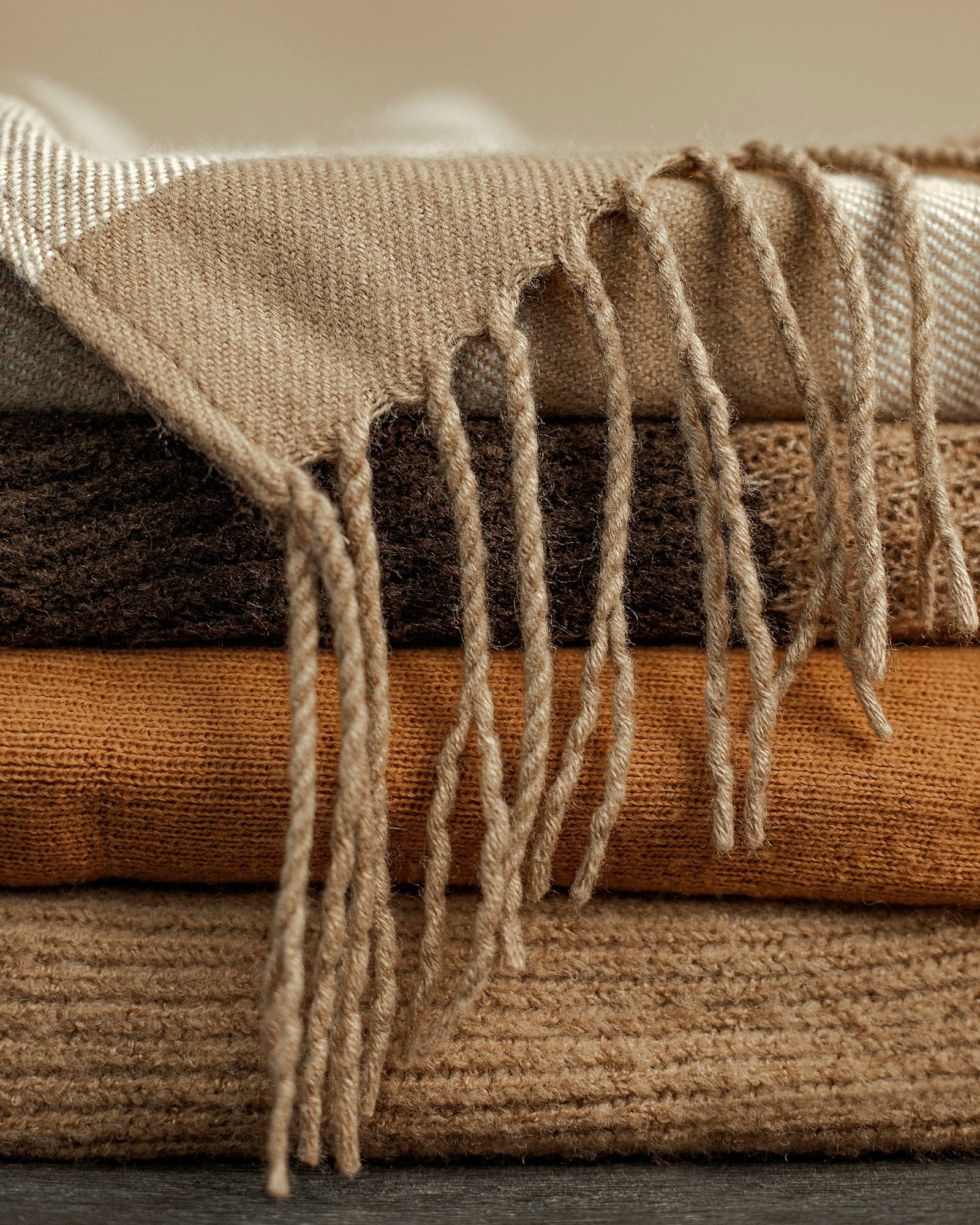
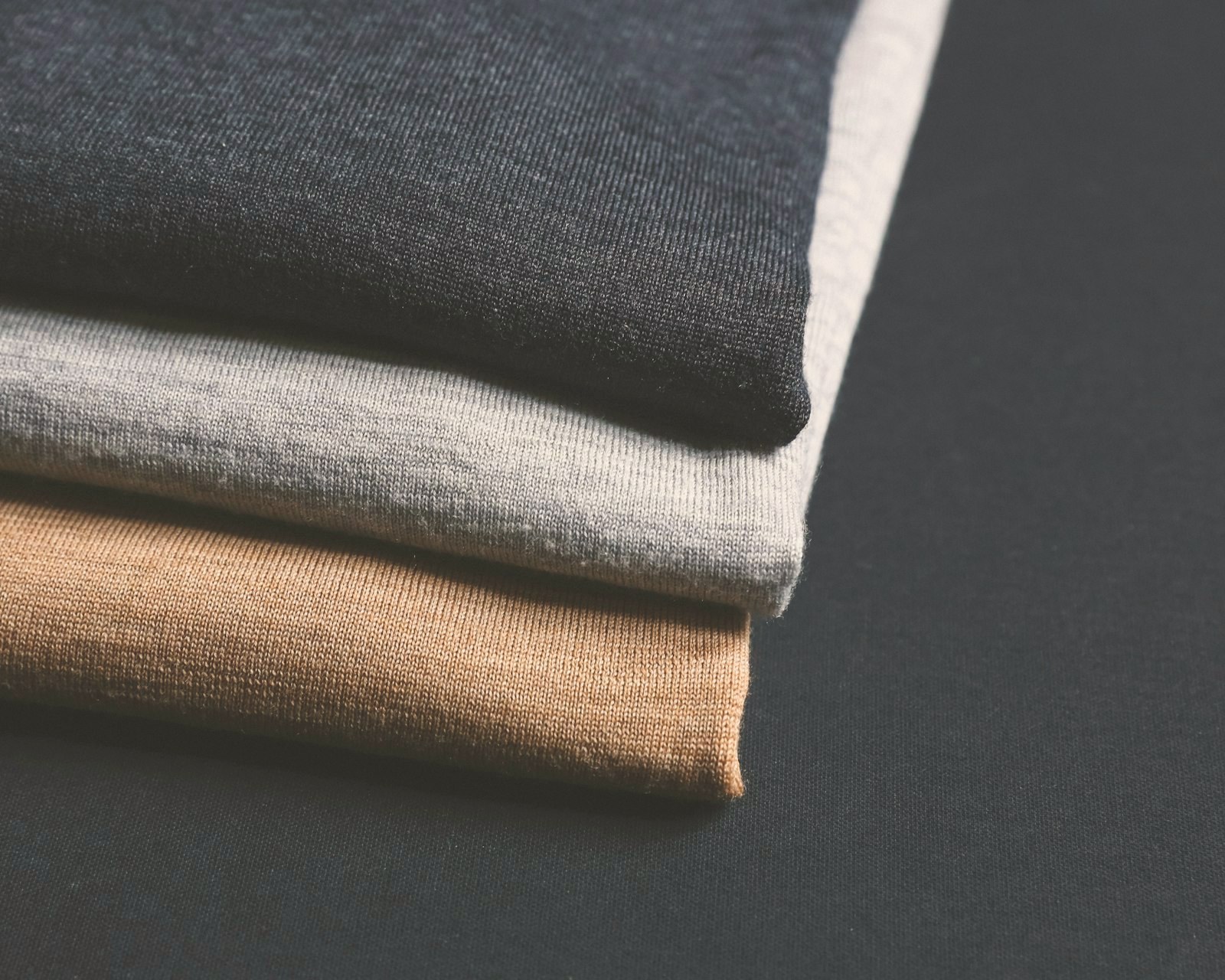
A note on our own photography: our photo bank holds no true pea coat frame. The hero figure is captioned for exactly what it shows, a navy puffer at a harbour railing, printed for the water and the cold rather than dressed as the subject, and the figures inside are the scarf and the knit stack, captioned as the layers they are. The bank holds no pea coat on body in any species, no converted collar closed at the throat, no melton macro and no double front buttoned in frame, so those sections run without frames rather than borrow wrong ones. All four are on the harvest list, named, and this page will take the frames the week they exist.
Questions, answered
What is a pea coat?
A short double-breasted coat in heavy melton wool, cut to hip length, with broad lapels that convert into a collar that buttons up to the throat. It was drawn as an issue coat for sailors in northern navies, and every part of the pattern is weather furniture: the dense cloth blocks wind, the double front overlaps against it, and the collar closes the last gap at the neck. Our jackets index files the type at formality 3 and warmth 4, season autumn through winter, in heavy melton wool, and prints its cloth test in one line: the cloth should nearly stand up on its own; soft melton is a sweater with buttons.
How warm is a pea coat?
Warmth 4 on our jackets index, the warmest short coat on it and level with the overcoat, below only the puffer at 5. The difference is the mechanism: the puffer warms by loft, trapped air in baffles, and the pea coat warms by density, a heavy woven wool that wind cannot move through. Density is why the pea coat keeps its shape and its formality 3 rung while it warms, where loft spends both. What warmth 4 does not cover is the legs: a hip-length coat leaves the thigh to the trouser, and in the coldest week of the year the index sends you to the puffer or the overcoat with the pea coat's blessing printed in advance.
How should a pea coat fit?
Hip length, as the jackets index files it: the hem covers the seat and ends at the hip, no longer. The double-breasted front is worn closed, on the buttoning the pattern was drawn for, with the cloth holding a clean line from shoulder to hem and no pull at the button that works. The fit is tested over the winter stack, not over a shirt: sized so the coat closes without strain over a heavy-gauge knit, because a pea coat that only fits over thin layers is a coat for the shop's weather, not the harbour's. The cloth test rides on the fit test: real melton nearly stands up on its own, and a coat that drapes like a cardigan has failed before the mirror gets a vote.
Pea coat, trench coat or overcoat?
Three different instruments on the jackets index, separated by both ladders. The trench is formality 4 and warmth 2: a rain coat, longer, belted, built to shed water rather than hold heat. The overcoat is formality 5 and warmth 4: the ceiling of outerwear, cut long and roomed to be worn over a suit as a matter of course. The pea coat is formality 3 and warmth 4: the trench's warmth doubled and the overcoat's warmth matched at two rungs lower, in a hip-length body. Buy the trench for wet months and formal rooms, the overcoat for tailoring and the longest cold, and the pea coat for the dressed winter week that stops below a suit: it is the warmest coat on the index that still reads as a short coat, and the only one of the three that pairs with denim without changing its expression.
Can you wear a pea coat over a suit?
No, and the reason is arithmetic, not taste. Our jackets index calls the overcoat the only type built to be worn over a suit as a matter of course: it has the length to cover the jacket beneath it and the room in the cut for tailoring. The pea coat is hip length at formality 3. Over a suit, the suit's jacket hem and skirt show below the coat's hem, two hems arguing in public, and the coat's closer body strains over the structure beneath it. In a formality 3 room, over a knit or an Oxford and wool trousers, the pea coat stays on and is the correct coat. Over tailoring, its office life is the commute, and the coat that takes the suit indoors is the overcoat at formality 5.
Should a pea coat collar be worn up or down?
All three states are legal, and this brief grades them. Down, the broad lapels lie open in the double-breasted front: the dressed default, the state for rooms and mild cold. Up, the lapels convert and button to the throat: the collar's designed working state, worn whenever the wind is the kind the coat was issued for, and the one raised collar on this site that is equipment rather than costume. Up with a scarf, the scarf fills the collar's frame for the coldest rows, worn inside the closed front rather than draped over it. The law that separates this collar from the trench's is printed in How to Wear No. 02: the trench's collar goes up only if the weather earns it, because on a rain coat the raised collar is a gesture. On the pea coat it is the garment's final fastening, and it is worn as one.
Has Young Cotton ranked pea coats?
Not as a Verdict Card, and this page will not pretend otherwise. What exists in print is the garment's record across the site: the jackets index files the pea coat among the twelve jacket types at formality 3 and warmth 4 with its cloth rule; How to Wear No. 18 takes its rung as the shared ceiling of the short family; the Fall Edit's stack order governs what goes under it; and this brief is the wearing system those records imply, the fit law, the species, the collar states and the outfit matrix, printed so any pea coat can be judged before a ranking exists.
Next
The coat's place among all twelve jackets, with its formality and warmth in the table, is the jackets index. Its rung-mate in the polite months is briefed in How to Wear No. 18, and the long rain coat it is most often confused with is No. 02. The stack beneath it is ordered in the Fall Edit, and the coat layer drawn on the figure is the Body Map's. The layers at its neck are ruled in No. 08 and No. 09; the boots beneath it are ruled in No. 15.