

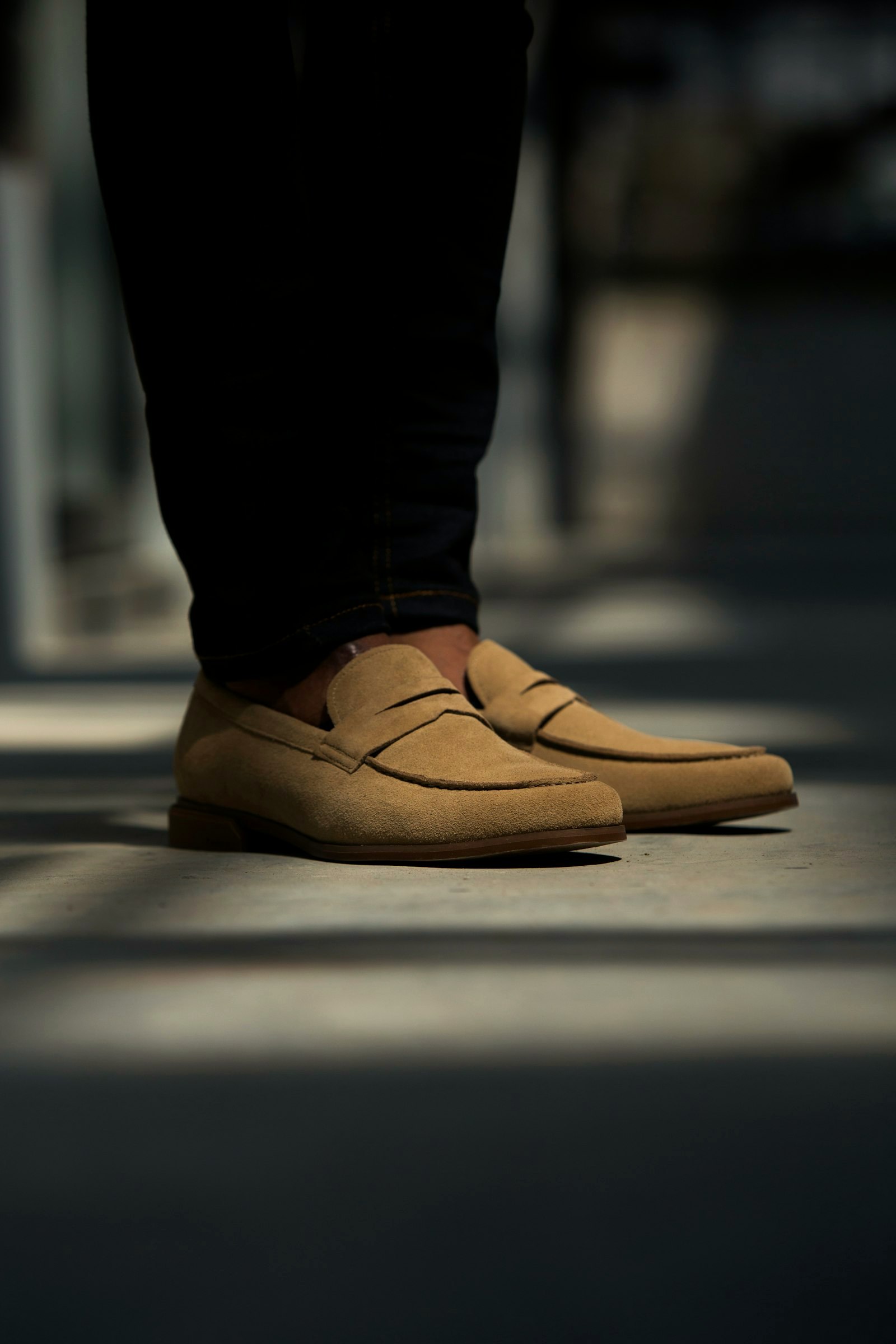
The outfit system this brief rules, photographed from the belt down: a waist-length jacket over chinos and court sneakers on a real street. The jacket in this frame is a denim trucker, the work family's waist-length cousin. Our bank holds no true Harrington frame, and this page prints that gap in its care section rather than dress another garment as its subject.
Checked and updated October 2026
The ruling, up front: the Harrington is the bomber's polite brother. Same waist length, same ribbed hem, same shoulder seasons, and one rung higher, because of one piece of furniture: the two-button stand collar. Our jackets index files the Harrington at formality 3, warmth 2, the highest of the short family, and files the bomber of How to Wear No. 17 at formality 2. That single rung is the whole subject of this brief, and it is not asserted, it is proved: outfit by outfit below, the collar is what lets this jacket take the polo, the Oxford, the wool trouser and the smart room that the bomber is refused, and the same page prints where the rung runs out. This brief prints the full system the index implies: the three species separated, the tartan lining graded open and closed, the trouser rail, the office ceiling and a six-outfit matrix. Which Harrington to buy is a record this site keeps in its index. This brief is the wearing system.
This brief: the decisive rule · the three species · the lining question · the trouser rail · the office ruling · the outfit matrix · the mistakes · care and the ribbing
The decisive rule: the collar buys the rung
Stand the two brothers side by side and the patterns nearly match. Both end at the belt. Both close with a zip. Both finish cuff and hem in ribbed knit. Both live in the shoulder seasons. A reader who stopped at the pattern would call them the same jacket in two cloths, and the market encourages the error by selling them off the same rail. The difference is at the throat. The bomber's collar is a low rib of knit, the flight pattern's seal against altitude wind, and it reads as what it is: sport. The Harrington's collar is a stand collar in the jacket's own cloth, closed by two buttons, a piece of tailoring furniture, and it reads the way a shirt collar reads, as an intention. Our jackets index prints the whole garment's test in its buying rule: the stand collar and the ribbed cuff decide it; everything else is a windbreaker. This brief prints the consequence: the collar is worth exactly one rung, formality 3 against the bomber's 2, and the rung is spent in specific rooms, on specific outfits, which this page names one by one.
The fit law is inherited, then added to. The waist-length family's tests from No. 17 apply unchanged: the ribbed hem lands on the belt line with the belt visible below it; the zip closes over the day's thickest honest layer without pull lines; a size up buys length, the one dimension a cropped jacket cannot spend. The Harrington adds its own condition, because its silhouette is the neat one of the family. The bomber's flight ease is built into its cut; the Harrington's body is cut tidy, close without gripping, and volume that reads as ease on the bomber reads as sloppiness here, a blouson wearing a good collar. And it adds the test no sibling needs: the collar test. Closed, the stand collar fastens at both buttons without pulling at the throat and stands clean around the neck. Open, it settles into two points that lie flat and do not curl. A collar that fails closed is a size wrong; a collar that fails open is a cloth wrong, too soft to hold the one shape the garment is filed for. Judge the collar in the shop, in both positions, before the mirror gets a vote on anything else.
The proof, outfit by outfit. A rung is not a vibe; it is a list of doors that open and doors that stay shut. The doors, against No. 17's published scale:
| The outfit | The bomber (formality 2) | The Harrington (formality 3) | What decides it |
|---|---|---|---|
| White tee, dark jeans, court sneakers | Legal. Its default row | Legal. Its floor, not its ceiling | A tie at street level. The rung buys nothing where no room is measuring, which is why the street alone never justifies the Harrington's premium |
| Polo, chinos, loafers | Refused as a dressed row: the knit collar over the polo's collar band reads as two sports garments stacked | Legal. The home row of this brief's matrix | The collar. The stand collar frames the polo's collar the way a blazer's lapel frames a shirt's, and No. 06's polo, formality 2, gains a jacket at its own register's ceiling |
| Oxford shirt, wool trousers, loafers | Refused above the commute. No. 17 prints its ceiling lower | Legal. The office ceiling assembly of this brief | The collar again, and the hem's behaviour: a neat body over a tucked Oxford keeps the shirt's line, where the bomber's bloused ease spends it |
| Fine-gauge crew, wool trousers, suede Chelsea | Legal at its 2.5 suede refinement, in formality 2 rooms | Legal, and the knit disappears under the collar's frame | No. 09's fine band, 24 to 30, behaves under both jackets; the Harrington's collar is what lets the assembly hold in a room one rung up |
| Blazer, suit, or a tie | Refused, in every species, at any price | Refused, in every species, at any price | The rung is not a ladder. The blazer stands at formality 4, and a ribbed hem across a lapel line demotes both garments, the law No. 17 prints and this brief inherits word for word |
What the rung costs, printed honestly. The Harrington gives something back for its formality: warmth. The index files it at warmth 2, a full point below the bomber's 3, a spring and mild-autumn garment where the bomber reaches deeper into the cold. The open stand collar seals nothing at the throat; the cotton twill stops wind and sheds a shower, and that is the end of its weather. The brothers divide the short family's year between them: the Harrington takes the polite months and the smart rooms, the bomber takes the colder weeks and the street. A wardrobe that buys one should know which half of the calendar it just covered.

The three species, separated
The jackets index gives the Harrington two cloths, cotton twill and suede, and the modern rail adds a third the index's table predates, the technical shell. The three species share the pattern, the collar and the rung's furniture. They do not share prices, seasons or ceilings, and the species error is this garment's common one: the right pattern bought in the cloth whose rooms the wearer does not live in.
| Species | What it is | Its rung | The ruling |
|---|---|---|---|
| The cotton original | The G9 pattern as it has been made since 1937: cotton twill, two-button stand collar, slanted flap pockets, ribbed cuff and hem, the Fraser tartan lining, a vented back yoke cut to shed rain off the shoulders | Formality 3, warmth 2, the index's own numbers for the type | The default and the first buy, and the index's spring default in its own words. Stone, navy, black and olive are its honest colours. Every other species is measured against this one, including on price |
| The suede altitude | The same pattern cut in suede, the collar, pockets and ribbing kept, the surface doing the dressing | Formality 3.5, this brief's refinement inside the index's rung: the index itself prints that in suede the garment climbs toward the blazer, and a clean hide earns half a rung and no more | The ceiling species and the office assembly's jacket. It stops below the blazer's 4 for two printed reasons: the waist length, and the ribbed hem, which reads knit at any price. It is priced like a suede jacket because it is one, and No. 15's rain honesty applies to it unchanged |
| The technical shell | The pattern rebuilt as weather equipment: a membrane cloth, taped or bonded seams on the honest ones, the collar kept, the tartan almost always gone | Formality 2.5, this brief's placement, printed as new: the collar keeps it above the bomber's street register and the membrane cloth pulls it below the cotton's 3 | Placed honestly: it is a rain instrument wearing the Harrington's silhouette, and it is judged the way our index judges the rain shell, by specification. If the membrane is not named and the seams are not sealed, it is a windbreaker with a good collar. Bought as weather, it earns its place; bought as the dressed species, it disappoints in both directions |
On the windbreaker line, one printed warning. The index's buying rule ends in a fence: everything else is a windbreaker. The rail is full of the fence's other side: collarless or shirt-collared zip jackets in shiny polyester, sold under the Harrington's name on the strength of a ribbed hem alone. The hem is the family's common furniture, shared with the bomber and half the sportswear ever made. The garment is the collar. A jacket without the two-button stand collar is not a cheaper Harrington; it is a different, lesser garment wearing the name, and it will fail every dressed row in this brief's matrix while passing the street rows its buyer could have covered for less.
On provenance, because this garment has more of it than most. The pattern was drawn in Manchester in 1937 by Baracuta, a rainwear house, as the G9: golf jacket first, its vented back and slanted pockets cut for a swing and a shower. The tartan inside it is the Fraser clan's, carried by the makers' account under clan permission, and it has lined the jacket ever since. The name arrived a generation later and from a screen: Rodney Harrington, Ryan O'Neal's character in the television serial Peyton Place, wore the jacket, and the garment took the character's surname and kept it. None of this is scored, and none of it is a reason to buy. It is printed because the garment's two later adoptions, by the mods and then by the skinheads, are sometimes read as the jacket's meaning. They are its history, one chapter each, and the mistakes section rules on what that history does and does not license.
The lining question: a signature with two states
Every other jacket in the short family is one surface. The Harrington is two: the shell the room sees and, in the original and every honest copy, the Fraser tartan inside it, a red-based check that has been the garment's private flag since 1937. The lining is the reason the jacket photographs like a costume in the wrong hands and like a signature in the right ones, and the difference is not the lining. It is which of its two states the wearer is running, and whether the clothes beneath have been told.
Worn closed: the lining is a private fact. Zipped to the collar, the tartan shows nowhere but a flash at the cuff when an arm bends and a sliver at the hem in a wind. In this state it asks nothing of the outfit: the shell carries the register, the trousers obey the rail below, and the lining is the wearer's own knowledge, the dressed garment's equivalent of a good watch movement. This is the state for the office rows and for any room where the jacket is working rather than talking. Most men who wear the garment well wear it closed most of the time, and the tartan's rarity in their outfits is exactly what keeps it a signature.
Worn open: the lining joins the outfit, and is dressed like a surface. Open, the tartan becomes the largest pattern the outfit owns, and this brief grades it the way it grades any strong surface: it is the outfit's only pattern, and everything beneath it goes quiet. A plain tee, the Asket's class from Verdict Card No. 02, garment evidence at 88. A plain fine-gauge crew in No. 09's 24 to 30 band. A plain polo. What it never sits over is another pattern at the same volume: an open tartan-lined Harrington over a checked shirt or a bold stripe is two patterns arguing in public, and the argument is the precise moment the jacket tips from signature into costume, a flag worn instead of a lining kept. The half-open middle state obeys the same law with a discount: the sliver of tartan at an open zip is a pattern at low volume, and it tolerates a quiet stripe or a small check beneath it, graded by the distance between the two patterns' scales.
The rule, in one line, so it survives the page: closed, the tartan is yours; open, it is the outfit's, and the outfit dresses around it. And the colour law that rides on it: the shell stays in the family's honest colours, stone, navy, black, olive, because those are the colours a red tartan can live inside. A loud shell over a loud lining is two statements with no listener, and it is refused here the way this series refuses every doubled statement.
The trouser rail: the legs the bomber refuses
Here is the rung, cashed. No. 17 licenses the wool trouser under one dressed species and refuses it as the bomber's default; the Harrington takes the tailored rail as its home ground, because a formality 3 jacket over a formality 3 trouser is a matched rung rather than a stretch. The geometry is inherited unchanged: the leg stays slim or straight, hem breaking clean over the shoe, because the cropped volume above the belt still needs its answer below it. What changes is which trousers stand at the front of the rail.
Chinos first, the spring default. The cotton jacket over the cotton trouser is the garment's oldest civilian assembly, and the class is scored on this site: the Spier & MacKay high-rise chino at 84 in the chinos ranking, cited as garment evidence. Stone jacket over navy chino, navy jacket over stone or olive chino, the colour distance doing the work the wash break does between denims. The chino is also the trouser that proves the collar's point cheapest: the same chino under a bomber reads as a day off; under the Harrington's stand collar it reads as an intention, and nothing else in the outfit changed.
Wool trousers above them, the ceiling rail. The tailored wool trouser is the leg the Harrington was promoted to reach: the class Verdict Card No. 15 scores with the Spier & MacKay tropical wool at 87, garment evidence. In spring weight wool, with the suede species or a dead-clean cotton one, this is the assembly that holds the office ceiling and the evening rows. The law that rides on it is the hem's: a wool trouser under a ribbed jacket hem must break clean, because a pooled tailored hem under a cropped jacket reads as two garments both slightly too long, the failure No. 17 names and this brief inherits.
Denim, under No. 05's law as it applies. The jeans below a jacket are governed by How to Wear No. 05, and its wash-break law is a law between two denims: the jacket and the jean are never the same wash. A Harrington is not denim, so no wash arithmetic is owed between jacket and jean. What is owed is colour distance, the same law wearing its other coat: dark indigo under a stone or pale jacket, stone refused over pale denim where the two tones sit close enough to read as a failed match, a clear tone above doing the separating. Black denim runs on its own logic, as No. 05 prints it: monochrome first, the black jean under the black or navy Harrington with texture doing the separation, or the dark ground under a clear colour above it. And the jean never impersonates the wool trouser in the ceiling rows: No. 05's ceiling prints with the class, and this brief does not raise it.
Wide trousers and shorts, answered once each. Wide trousers are refused as the default for No. 17's arithmetic unchanged, volume answered with volume reads as padding, and the Harrington's neater body makes the refusal stricter, not looser: this jacket's whole register is tidiness, and a wide leg under it is two silhouettes arguing. The one licence No. 17 prints, a cropped wide trouser with drape, a visible ankle and a clean court shoe, survives here only under the cotton species in the street rows, never in the ceiling rows. Shorts are refused as season arithmetic: the Harrington is a spring and mild-autumn garment at warmth 2, shorts are a summer leg, and a cropped jacket over shorts also spends the belt-line break the family exists to draw. The summer short layer is a different rail. This brief leaves it there.
The office ruling
Plainly, as the number requires: the Harrington is formality 3, the highest rung any waist-length jacket reaches on this site, and it works exactly where formality 3 is the room's code. That is a real promotion over its brother. The bomber's office life outside its ceiling assembly is the commute; the Harrington, in the smart-casual rooms that are most offices now, stays on. Its ceiling assembly, printed in the matrix, is the suede species or a dead-clean cotton one, over an Oxford or a fine-gauge crew, with tailored wool trousers and loafers, and worn that way it is not a loophole in the dress code. It is the correct jacket at its correct rung for the mild months, the garment the index describes as behaving in rooms the other short jackets cannot enter.
Where it stops is printed with the same plainness. It is never worn over a blazer or a suit, in any species, at any price: the blazer stands at formality 4 in How to Wear No. 03, and a ribbed hem biting across a lapel line is two garments arguing, the argument demoting both, the law this series prints at every rung below the blazer. It is never worn over a tie, the prohibition that follows from the same number: a tie is a formality claim a formality 3 jacket cannot cash in a tailored room, however well it behaves in its own. And in the rooms with a tailoring expectation, its office life is the bomber's: the commute, over the office clothes and off at the desk, because the weather layer is not the structure layer. The Harrington reaches further into the building than any jacket its length. It does not reach the boardroom, and this page will not pretend a collar can do what only cloth and cut at rung 4 can do.
The outfit matrix: six ways, no improvisation needed
| Setting | The jacket | With | The judgment |
|---|---|---|---|
| The default | Stone or navy cotton Harrington, worn closed | A plain white tee, tapered chinos, clean white court sneakers | The base assembly. The tee is the Asket's class, 88 in Verdict Card No. 02, garment evidence; the chino is the ranking's 84 class; the shoe is No. 12's court sneaker at 3, clean. Closed, the tartan is a private fact and the outfit is all shell and discipline |
| The polo row | Cotton Harrington, worn open over the polo | A piqué polo with its collar inside the stand collar, chinos, suede loafers | The home row, the one the bomber is refused. No. 06's polo stands at formality 2, smart casual's floor; the stand collar frames it rather than fighting it, the polo's collar never worn over the jacket's. The loafer moves the outfit one notch up per No. 11, and one notch is all this row needs |
| The knit row | Navy cotton Harrington, zipped | A fine-gauge crew in No. 09's 24 to 30 band, Spier & MacKay tropical wool trousers, suede Chelsea boots | The trousers are the 87 of Verdict Card No. 15; the boot is No. 15's suede Chelsea at 4. The knit is the class of the Smedley Lundy, 87 in the crew ranking, garment evidence. The assembly holds a formality 3 room on every layer, jacket included |
| The office ceiling | Suede Harrington, worn closed | An Oxford shirt, tailored wool trousers, suede loafers | The species at its 3.5 refinement, the highest assembly a waist-length jacket owns on this site. The Oxford's collar sits inside the stand collar as the polo's does, the loafer answers the suede, and the whole outfit stops exactly one rung below the blazer, honestly |
| The open lining row | Black cotton Harrington, worn open | A plain black tee, black jeans, sleek black calf Chelsea boots | The lining's licensed state, run under its law: the tartan is the outfit's only pattern and its only colour, everything beneath it quiet and monochrome on No. 05's black logic, texture separating what colour cannot. No. 15's sleek calf boot at 4.5 closes the leg. The signature, worn as a signature |
| The denim row | Olive or stone cotton Harrington, worn closed | Dark indigo jeans, a plain crew or tee, white court sneakers or suede Chelsea boots | Colour distance doing the wash break's work: dark denim under a pale jacket, the break readable at a glance. Pale denim under stone is refused on the same law, two tones close enough to read as a failed match. The spring street row, and the jacket's most forgiving |
The ruling
Buy the cotton original first, in stone or navy, sized by the zip over a mid-gauge knit and judged by the collar test in both positions before anything else gets a vote. Wear it closed when it is working and open only over quiet clothes, with the tartan treated as the outfit's one pattern. Let it take the chinos and the wool trousers its brother is refused, keep the leg slim or straight beneath it, and spend its rung in the formality 3 rooms it was filed for, never against a blazer, a suit or a tie. Add the suede species when the wardrobe earns a second, at the hide's price and under the rain honesty every suede on this site carries. Every failure of this garment is a refusal of its furniture: a collar missing or failed, a lining worn as a flag, volume where the pattern asked for neatness, a rung it was never filed at, a tribe's uniform borrowed as a costume. Worn on its numbers, the Harrington is what the jackets index calls it, the neat one, the short jacket that behaves in rooms the others cannot enter, and the rare garment whose politeness is a construction detail rather than a personality. The collar is not the decoration on the ruling. The collar is the ruling.
The mistakes
The popped collar, worn as a statement. The stand collar has a working position and a resting one. Buttoned up in wind and rain it is a seal, the golf course furniture doing its job. Worn up in a room, collars turned to the jaw as a permanent pose, it stops being a collar and becomes a costume detail, the single most reliable tell that the jacket is being worn as a reference rather than as clothing. It also fails mechanically: a popped collar hides the neck, shortens the body's line and spends the neat silhouette the garment exists to draw. The collar stands when the weather asks. Indoors, it lies in its two points and does its quieter work, framing what is beneath it.
The Harrington two sizes up. The family's shared sin in this garment's stricter form. A size up buys length, the hem dropping below the belt line the whole family exists at, and it buys volume through a body that was cut to be tidy, so the jacket blouses over its own ribbing and the stand collar floats loose on a neck it no longer frames. The bomber forgives some of this because its flight pattern was drawn with ease in it. The Harrington's pattern was drawn neat, and oversized it does not read as ease. It reads as a borrowed jacket, the one silhouette this garment cannot survive, because neatness is not its styling. It is its construction.
Subculture fancy dress, in either direction. The history is real and this page prints it rather than flinching from it: a Manchester golf jacket from 1937, a television name from the 1960s, adopted by the mods, who wore it sharp over polos and Sta-Prest, and then by the skinheads, who wore it over braces and boots, until the jacket carried two tribes' signatures at once. The mistake is dressing as either tribe: the full period kit assembled as a tribute, the badges, the braces worn as heraldry, the scooter-era cosplay, or at the other pole, the jacket avoided entirely because of who else wore it. Both directions make the same error, letting a chapter of the garment's history outrank its fit. The ruling this brief prints is the series' usual one: the garment is ruled by its construction, not by its tribes. A Harrington that passes the collar test, over quiet clothes, at the correct rung, is a jacket. It becomes a costume only when the wearer dresses the rest of the outfit as a re-enactment, in either direction, reverent or ironic.
The windbreaker bought under the Harrington's name. The collarless zip jacket in shiny polyester, ribbed hem, nothing else of the pattern, bought because the rail called it a Harrington and worn into the dressed rows on that passport. It fails the index's own test in its own words: the stand collar and the ribbed cuff decide it, and everything else is a windbreaker. The failure is not snobbery about a cheaper garment. A windbreaker is honest equipment at its own rung. The mistake is the passport: a formality 1 shell claiming a formality 3 jacket's rooms, failing in public at the polo row and the office ceiling alike. Read the collar before the label. The label is marketing; the collar is the garment.
Care, and the ribbing
The Harrington shares its brother's consumable and adds one of its own. The ribbing is the first consumable: cuff and hem knit that holds the silhouette's two lower points, on the same schedule No. 17 prints for the bomber. Rest the jacket between wears so the knit recovers, never pull the sleeves up by the cuff, hang it wide or fold it rather than let a thin hanger stretch the collar under the garment's weight, and know that a bagged cuff or hem is a re-knit, a scheduled repair at a fraction of the jacket's price, not a death. A Harrington whose hem has gone has not worn out. It has reached the one appointment its construction always kept.
The collar is the second consumable, and it is this garment's alone. The stand collar is a shaped piece of cloth asked to hold one curve for years, and it fails the way shaped cloth fails: slowly, at the fold, going soft at exactly the points the collar test inspects. Care for it the way tailoring is cared for. Button it closed in storage so the shape rests as it was cut. Keep it out of the tumble dryer, whose heat is the fastest route to a collar that curls. Press the collar points flat with a cool iron when they begin to lift, never crease the stand itself. And read the failure honestly when it comes: a collar that will no longer stand is the jacket asking for a tailor's pressing and, past that, for retirement to the street rows, where its remaining virtues still earn their keep.
The species have their own lines, inherited from their briefs. The cotton twill washes cold and rarely, spot-cleaned first, on evidence rather than schedule, the way every cloth in this series is washed; the tartan lining brushes clean and is never ironed against the shell in one pass. Suede takes the protection and rain honesty of How to Wear No. 15 unchanged: sprayed before its first wet week, never worn into a storm on the theory that it survived one once, brushed rather than washed. The technical shell takes the rain shell's law from the jackets index: its waterproofing is a specification with a lifespan, renewed by the maker's reproofing when the cloth starts wetting out, and a shell whose membrane has gone is a windbreaker again, judged as one. None of this is precious. It is the position this site takes on every garment it rates: the care is printed because the lifespan is part of the verdict.
A note on our own photography: our photo bank holds no true Harrington frame. The hero figure is captioned for exactly what it shows, a waist-length jacket over chinos and court sneakers with the jacket itself a denim trucker, and the golden-hour frame in the rule section is the bomber, captioned as the sibling and used to draw the boundary rather than to illustrate a garment it is not. The bank holds no Harrington on body in any species, no stand collar close in frame, no tartan lining visible and no suede Harrington on the street, so those sections run without frames rather than borrow wrong ones. All four are on the harvest list, named, and this page will take the frames the week they exist.
Questions, answered
What is a Harrington jacket?
A waist-length jacket defined by three pieces of furniture: a two-button stand collar, ribbed cuffs and a ribbed hem, and a body that ends at the belt. The original is the Baracuta G9, made in Manchester since 1937, lined in the Fraser clan tartan its makers were granted the use of. The name is younger than the jacket: it stuck in the 1960s, borrowed from Rodney Harrington, the television character who wore one. Our jackets index files the type at formality 3 and warmth 2, in cotton twill and suede, for spring and mild autumn, and prints its test in one line: the stand collar and the ribbed cuff decide it; everything else is a windbreaker.
Harrington or bomber, which should I buy?
They share a waist length, a ribbed hem and a season, and our index separates them by exactly one rung: the bomber is formality 2, the Harrington formality 3, the highest of the short family. Buy the bomber if your rooms are the street's rooms: it is warmer at warmth 3, plainer, and built around a knit collar that reads sport by design. Buy the Harrington if your waist-length jacket has to walk into smart rooms, over a polo, a knit or an Oxford and tailored trousers, because its two-button stand collar is what buys the rung. One jacket at this length is coverage; the second is range. If a wardrobe holds only one, the Harrington covers more of the week.
How should a Harrington jacket fit?
By the waist-length family's law, with this garment's own addition. The ribbed hem lands on the belt line, the belt visible below it, exactly as How to Wear No. 17 rules the bomber. The shoulder is clean and the body neat rather than bloused: the Harrington's silhouette is a tidy one, and ease bought as volume turns it into a blouson. Over that, the collar test, which is this jacket's alone: closed, the two-button stand collar stands around the neck without strangling it, the top button fastening without pull; open, it lies in two clean points and does not curl. A Harrington whose collar fails either position has failed at the exact feature that files it at formality 3.
Can you wear a Harrington jacket to the office?
Further than any waist-length jacket on this site, and the boundary is printed. Our jackets index files the Harrington at formality 3, the rung of the pea coat and the leather jacket, a full rung above the bomber's 2. In rooms whose code is formality 3, the smart-casual office, it stays on: the ceiling assembly is the suede species over an Oxford or a fine-gauge crew, with tailored wool trousers and loafers. Where it stops is where every short jacket stops: it is never worn over a blazer or a suit, because the blazer stands at formality 4 and a ribbed hem across a lapel line demotes both garments, and never over a tie. In tailoring rooms its office life is the commute, over the office clothes and off at the desk.
What trousers go with a Harrington jacket?
The trousers the bomber refuses are this jacket's home rail: chinos first, the class our chinos ranking scores with the Spier & MacKay high-rise at 84, and tailored wool trousers above them, the class Verdict Card No. 15 scores at 87, because a formality 3 jacket over a tailored trouser is a matched rung, not a stretch. The leg stays slim or straight, never wide by default, for the volume arithmetic How to Wear No. 17 prints. Jeans are licensed under How to Wear No. 05's law as it applies: the Harrington is not denim, so no wash arithmetic is owed, but colour distance is, dark denim under a pale jacket, pale denim refused under stone, and black denim running on its own monochrome logic.
Should a Harrington be worn open or closed, with the tartan lining?
Both, graded. The Fraser tartan lining of the original is the garment's signature and its one costume risk, and this brief rules it as a surface with two states. Worn closed, the lining is a private fact: it flashes at the cuff and in movement, and it asks nothing of the clothes beneath. Worn open, the lining joins the outfit and is dressed like a surface: what sits under it goes quiet, a plain tee, a plain knit, a plain polo, and the tartan is the outfit's only pattern. An open Harrington over a checked or striped shirt is two patterns arguing at the same volume, and it is the read that turns a signature into a costume. The lining is never the reason to buy a loud colour above it either. The shell stays stone, navy, black or olive, and the tartan does the talking from inside.
Has Young Cotton ranked Harrington jackets?
Not as a Verdict Card, and this page will not pretend otherwise. What exists in print is the garment's record across the site: the jackets index files the Harrington among the twelve jacket types at formality 3 and warmth 2 with its buying rule; How to Wear No. 17 takes its rung as the ceiling the bomber cannot reach; and this brief is the wearing system those records imply, the collar proofs, the species, the lining grades and the outfit matrix, printed so any Harrington can be judged before a ranking exists.
Next
The brother this brief is measured against, rung by rung, is briefed in How to Wear No. 17, whose ceiling this page's collar passes. The Harrington's place among all twelve jackets, with its formality and warmth in the table, is the jackets index. The legs beneath it obey How to Wear No. 05 for denim and the chinos ranking and Verdict Card No. 15 for the tailored rail; the collar's partners are briefed in No. 06 and No. 09; the shoes beneath those are ruled in No. 11 and No. 15.