

The flight pattern in its civilian form: matte cloth, a ribbed collar, a clean shoulder and the utility pocket on the sleeve that the original carried. Everything on this page is a variation on one question, where the jacket ends and what its ribbing is doing.
Checked and updated October 2026
The ruling, up front: a bomber jacket is a waist-length instrument, and it lives or dies on three measurements, all arithmetic. The ribbed hem lands on the belt line, the belt visible below it. The ribbing holds without gripping, hem at the belt all day, cuff at the wrist bone. And the zip closes over the day's thickest layer without pull lines, because a cropped jacket that cannot close has resigned from weather. The record underneath is already published on this site: the jackets index files the bomber at formality 2, warmth 3, autumn and spring, with its buying rule printed in one line, cropped and clean; the further it drifts from the flight original, the faster it dates. This brief prints the full system the index implies: the three species separated, the trouser law, the layering stack, the office answer and a six-outfit matrix. Which bomber to buy is a record this site keeps in pieces. This brief is the wearing system.
This brief: the three tests · the three species · the trouser law · the layering arithmetic · the office ruling · the outfit matrix · the mistakes · care and the ribbing
The decisive rule: the belt line, the ribbing, the zip
Most jackets fail gradually. A blazer a size off still reads as a blazer; a trucker bought long is a style position, argued about in How to Wear No. 16. The bomber fails at a line. Its whole silhouette is a cropped body closed by knit at the collar, the cuff and the hem, and every one of those closures sits at a fixed point on the body. Move the points and the garment does not become a looser bomber. It becomes a different, worse jacket, a blouson with a parkas' proportions and a flight jacket's warmth. So this brief rules the garment the way the garment is built, as three tests, each pass or fail, none of them a matter of taste.
Test one, the hem. Zip the jacket closed and look at the waist. The ribbed hem must land on the belt line: the belt itself visible below the hem, the trouser's rise readable, the break between top half and bottom half drawn exactly where the body's own hinge is. A hem that swallows the belt and falls toward the pocket line has failed, and the failure has a name in this series: it is the cropped garment's version of No. 16's stacking, cloth pooling where the pattern promised a stop. The flight original was cut there for a cockpit reason, a seated man and a harness, and the civilian version keeps the line for a silhouette reason. The short body is what makes the legs long and the outfit quick. Spend the line and both are gone.
Test two, the ribbing. The ribbing is the jacket's engine, the knit that pulls a roomy flight body into a clean shape at three openings, and it must hold without gripping. At the hem: it keeps the jacket at the belt through a day of sitting, standing and reaching, without the wearer tugging it down, and without biting into the layer beneath. At the cuff: it sits at the wrist bone, the hand free, no sleeve stacked in folds above it. Ribbing that grips is a size too small wearing a disguise. Ribbing that hangs is a garment already spending its one consumable, the failure the care section prices. The test takes ten seconds in a shop and predicts the jacket's whole life, which is what a test is for.
Test three, the zip. The jacket must close over the thickest layer it will honestly cover, a mid-gauge knit in its autumn and spring season, without pull lines running out from the zip and without the hem riding up as the price of closing. This is the same sizing law every working brief in this series prints, bought over the layer, not over a t-shirt in a warm shop, and the bomber states it more strictly than the trucker does: a button front can be worn open as a position, but a cropped zip jacket worn permanently open because it cannot close is a garment confessing. Buy the size that zips. The ease the silhouette wants is already in the pattern; the flight cut was drawn roomy through the chest for a man who needed to move in it. A size up does not buy ease. It buys length, at the hem and the sleeve, and length is the one currency this garment cannot spend.
The reconciliation, because this site keeps one law. The jackets index calls the bomber the most fashion-exposed type on this page, which is why its rule is restraint, and prints the dating law beside it: the closer it stays to the original flight pattern, the longer it stays wearable. The three tests are that restraint made measurable. Every seasonal drift the index warns about, the longer body, the dropped shoulder, the added volume, the hardware, the gloss, is a test failed in advance: length against test one, volume against test two, decoration against the pattern the tests protect. A bomber that passes all three is not a conservative purchase. It is the garment at the setting its own index says does not date.
The three species, separated
The jackets index gives the bomber three cloths, nylon twill, suede and leather, and the three cloths are three species with three registers. They share the pattern and the three tests. They do not share rooms, partners or prices, and most bomber failures are a species error before they are a fit error: the right pattern bought in the cloth whose register the wearer does not live in.
| Species | What it is | Its rung | The ruling |
|---|---|---|---|
| The MA-1, nylon twill | The flight original in civilian hands: matte nylon twill, a low ribbed collar, the utility pocket on the left sleeve, knit at cuff and hem | Formality 2, the index's own number for the type; warmth 3 | The default and the first buy. Black and deep olive are its honest colours. This is the species the three tests were written on, and the one every other species is measured against |
| The A-1 altitude, suede or leather | The flight pattern cut in a hide: suede first, smooth leather second, the ribbing kept, the surface quiet | Formality 2.5, this brief's refinement inside the index's rung: the index itself lets suede climb in the short family, and a clean hide with no hardware earns half a rung and no more | The dressed end and the ceiling species. It takes the wool trouser, the Oxford and the office ceiling assembly. It never reaches the Harrington's 3, because ribbing reads sport at any price, and it is priced like a leather jacket, because it is one |
| The minimalist matte | The pattern stripped to its diagram: unmarked matte cloth, no sleeve pocket or a hidden one, no sheen, no logos, the soft register's version | Formality 2, rising to 2.5 in black, dead clean, in the ceiling rows only | The quietest species and the one this magazine's centre owns. Its whole argument is surface discipline, so it is the species most ruined by one loud decision under it. It asks for plain clothes and rewards them |
On the nylon's sheen, one printed warning. The MA-1's cloth is a matte twill in the original and in every honest civilian copy. The glossy version, nylon with a wet shine, is a drift the index's dating law covers exactly: it reads as a season's costume, photographs loud, and takes the garment out of the trouser rows below into fancy dress. Judge the cloth in daylight, not shop light. If the jacket shines back, it is not the species on this page, whatever the rail calls it.
On the leather species' pricing, the record this site already keeps. A leather bomber is bought the way every leather jacket is bought, on the hide and on the chain. The one bomber with a price record on this site is a leather garment inside a brand card: the AllSaints Deceit, in Brands Like No. 14's family, where the house stands at 66 and its bomber is printed at $569 at list, chained down to $272.80 in the brand's own sale. That is garment evidence for one thing only, printed here for exactly that: in this species, list price is an opening bid, and the man who pays it has skipped the garment's first lesson. The record is cited, not transferred. No score attaches to any bomber in this brief.
On the embroidered species, a separation, not a ruling. The bomber with a worked back panel, tigers, maps, dragons, is not a fourth species of this garment. It is the sukajan, the souvenir jacket, and it lives in its own record on this site, the sukajan guide, which gives it a history, an anatomy and a fit ruling of its own: a blouson cut, cropped and full, the ribbed hem doing the shaping, worn under a one-statement-piece rule with everything beneath it quiet. This brief does not relitigate a word of that. It draws the fence the guide implies. The bomber's surface is empty because its cloth and cut are the statement; the sukajan's surface is the statement and its clothes go quiet. A jacket trying to be both, souvenir embroidery on a flight pattern worn over loud clothes, fails the two records at once. The mistakes section names it as the cosplay it becomes.
The trouser law: the leg narrows below the volume
A bomber's body is cropped and, by the flight pattern, carries some ease through the chest. That volume has to be answered below the belt, and the answer is the page's second piece of arithmetic: the leg narrows, or at least straightens, as it leaves the jacket. Tapered and slim trousers are the default and need no argument. Straight legs are licensed on one condition, that the hem breaks clean over the shoe with no stacking, because a pooled hem under a cropped jacket doubles the outfit's stops and reads as two garments both slightly too long. The chino, the wool trouser and the jean all obey the same geometry; only their registers change.
Wide trousers: refused as the default, licensed in one case. The refusal first, with its reason. Volume over volume stacks two inflated halves, the bloused top and the wide leg, and the eye reads padding rather than ease; it is the duvet silhouette the mistakes section convicts, assembled from the trouser side. The one licence, printed with its conditions because the city's softer register wears it well when it is done deliberately: a cropped wide trouser, cut to end above the shoe so the ankle or the sock shows and the line stops where it should; a cloth with drape, not stiffness, so the leg falls rather than flares; the jacket dead clean and matte, the minimalist species or a black MA-1; the shoe doing the narrowing, a clean court sneaker at No. 12's 3. And the wide leg is the outfit's only wide decision: a long tee or a loose knit under the jacket spends the licence. Outside those conditions the answer is the family's usual one. The trouser changes, not the law.
Denim under a bomber obeys the denim law, unchanged. The jeans below a jacket are governed by How to Wear No. 05's wash break and by No. 16's arithmetic where it applies: distance between the surfaces, a third surface at an open front widening a passing break, black denim running on colour's rules and anchoring the monochrome evening row the matrix prints. A bomber is not denim, so no wash arithmetic is owed between jacket and jean; what is owed is the leg's own law, the taper above and No. 05's colour logic, dark jean under the pale species, faded jean licensed under black, the mid jean doing its work under a jacket that is not trying to match it. The black bomber over black jeans is the one full match this brief licenses outright, for the same reason No. 16 licenses it: black was never on the wash ladder, and texture, nylon's flat plane against denim's twill, does the separating.
Shorts, answered once. The bomber is an autumn and spring garment at warmth 3, and shorts are a summer leg; the pairing is refused not as taste but as season arithmetic, two records disagreeing about the weather in one outfit. The cropped jacket over shorts also spends the hem test: with no trouser rise to read against, the belt-line break the garment exists to draw has nothing to draw against. The summer short jacket is a different rail. This brief leaves it there.
The layering arithmetic
The bomber sits at the top of the stack in its season and in the middle of it in deep cold, and its layering is governed by one piece of furniture the trucker does not have: a front zip over a knit collar. What fits under it is a longer list than No. 16 allows, and what goes over it is shorter, and both follow from the pattern.
Beneath it: the tee, the base frame. The plain tee under an open bomber is the assembly the hero photograph wears and the garment's oldest civilian form. The tee is judged as the tee ranking judges it: Verdict Card No. 02's winner, the Asket at 88, is the reference, garment evidence for the class, and its virtues are the ones this layer needs, a collar that holds its line inside the jacket's ribbed one and cloth that does not read as underwear against a jacket's weight. One cropped-jacket condition rides on it, printed as this brief's own ruling: the shirt-tail rule. A tee or shirt beneath a bomber may show below the hem by a thumb's width and no more. A tail hanging a hand's length below a cropped jacket is not a layer; it is a second hem, and it spends the belt-line break the whole garment exists to draw. Tuck it, or wear the length the jacket licenses.
Beneath it: the knit rungs. How to Wear No. 09's gauge bands govern, unchanged: fine gauge, roughly 24 to 30, disappears under any species and is the ceiling row's knit, the band of the Smedley Lundy that won the crew ranking at 87; mid gauge, roughly 12 to 20, is the jacket's everyday partner, worn zipped in the cold or open in the shoulder weeks; heavy gauge, 7 and below, stands with the jacket open over it or not at all, because the zip test is run over the thickest honest layer and a heavy knit is the layer that decides sizes. The roll neck has its evening row: a black or navy turtleneck under a matte black bomber is the jacket's dressed form after dark, the knit doing the formality work and the jacket standing down, the pairing No. 08's collar rules govern at the neck, the roll worn as it falls, never unfolded tall.
The hoodie: licensed, and the licence is mechanical. No. 16 refuses the hoodie under the Type III trucker, and its reasons are printed there: the hood bunches against a structured collar, the chest pulls over the hoodie's body at the buttons. Neither reason survives contact with this pattern. The bomber's collar is a low rib of knit with no structure to displace, and its front is a zip over a chest cut with flight ease. The hood rests behind the collar, the zip closes, and the assembly is the jacket's honest street register, the one its season is for. The conditions are the family's: a plain hoodie, no logos doing the talking, its own fit honest, the class Verdict Card No. 26 scored with the American Giant at 87, cited as garment evidence for what a good one is. One jacket in this series refuses the hoodie and one licenses it, and the difference is not taste. It is collars and closures, which is to say, it is arithmetic again.
Above it: the coat, in deep cold only. In its own season the bomber is the weather layer and nothing goes over it. In deep cold it changes jobs the way No. 16's trucker does under the trench: it becomes the insulation layer under an overcoat, and it is better built for the demotion than most jackets, a smooth shell that slides under a coat without catching, a low knit collar that leaves the coat's collar the only one at the neck. The stack is the Fall Edit's order, honoured exactly: the layer that touches skin, the warmth layer, the structure, and the weather last, the coat closing the system. Two jackets at once, bomber over trucker or trucker over bomber, is refused by No. 16's logic unchanged: two waist-length fronts with competing closures read as one garment doubled, and neither jacket's hem test can be passed through the other. Pick the jacket the day asks for. The other stays on its hook.
The office ruling
Plainly, as the number requires: the bomber is formality 2, the trucker's rung, and it works exactly where formality 2 is the room's code. In those rooms it has one ceiling assembly and the matrix prints it: the suede or matte species, closed or open over a fine-gauge crew or an Oxford whose tail obeys the shirt-tail rule, with tailored wool trousers and loafers or a suede Chelsea. Worn that way it is not a loophole. It is the correct jacket at its correct rung for the shoulder seasons, warmer than the trucker at the same rung, which in an autumn commute is an argument and not an apology. Everywhere the room expects tailoring, the bomber's office life is the commute, over the office clothes and off at the desk, for the reason the Fall Edit's stack prints: the weather layer is not the structure layer, and the garment that answers those rooms is the blazer of How to Wear No. 03 at formality 4. The bomber is never worn over a blazer or a suit, in any species, at any price: ribbing against lapels is two garments arguing in public, and the argument demotes both. And never over a tie, the prohibition this series prints at every rung below the blazer. A tie is a formality claim a formality-2 jacket cannot cash.
The outfit matrix: six ways, no improvisation needed
| Setting | The jacket | With | The judgment |
|---|---|---|---|
| The default | Matte black or olive MA-1, worn open | A plain white tee, tapered dark jeans, clean white court sneakers | The base assembly. The tee is the Asket's class, 88 in Verdict Card No. 02, garment evidence; the shoe is No. 12's court sneaker at 3, clean; the leg narrows under the cropped volume per the trouser law. Every other row is a variation on this one's discipline |
| The knit row | MA-1 or minimalist matte, zipped | A fine-gauge crew in No. 09's 24 to 30 band, Spier & MacKay tropical wool trousers, suede Chelsea boots | The trousers are the 87 of Verdict Card No. 15; the boot is No. 15's suede Chelsea at 4, the business-casual office shoe. The jacket stays 2 and the outfit dresses around it honestly: this is the shoulder-season ceiling in casual rooms |
| The evening row | Matte black bomber, zipped | A black roll neck, black jeans, sleek black calf Chelsea boots | No. 05's monochrome system under a jacket: black runs on colour's rules, texture separates what colour cannot, the roll neck is No. 08's knit worn as it falls, and No. 15's sleek calf boot at 4.5 closes the leg. The bomber's most dressed legal form |
| The suede altitude | Suede A-1 species, worn open | An Oxford shirt with its tail tucked to the rule, Spier & MacKay chinos, suede loafers | The species at its 2.5 refinement, the chinos the 84 of the chinos ranking, the loafer moving the outfit one notch up per No. 11. The office ceiling in formality-2 rooms, and the row that justifies the hide's price |
| The wide licence | Minimalist matte bomber, zipped | A plain tee, cropped wide trousers with the ankle showing, clean court sneakers | The trouser law's one licensed exception, run under all its conditions: drape in the cloth, a visible ankle, the shoe narrowing at 3, the wide leg the outfit's only wide decision. Outside the conditions this row does not exist |
| The cold stack | Any species, demoted to the middle | A mid-gauge crew beneath it, an overcoat above the whole stack, dark jeans, boots | Warmth 3 layered as the Fall Edit's stack orders it: skin, warmth, structure, weather. The bomber insulates, the coat closes, the knit collar leaves the coat's collar alone at the neck. The two-jacket stack with the trucker stays refused, per No. 16 |
The ruling
Buy the MA-1 first, in matte black or deep olive, sized by the zip test over a mid-gauge knit, and check it against the belt line before the mirror gets a vote. Let the leg narrow below it, let the layers obey the gauge bands and the shirt-tail rule, and keep it at formality 2 with the ceiling assembly for the rooms at that rung. Add the suede species when the wardrobe earns a second, at the hide's price and on the sale chain's terms. Every failure of this garment is a refusal of its arithmetic: a hem past the belt, ribbing gripping or gone, volume answered with volume, a rung it was never filed at, embroidery borrowed from another garment's record. Worn on its numbers, the bomber is what the jackets index calls it, the flight family's civilian, cropped and clean, the short jacket that asks the least thought of any in the twelve and repays it the longest. The arithmetic is not the obstacle to wearing it. The arithmetic is how it gets worn well.
The mistakes
The duvet: the puffy bomber worn two sizes up. The flight pattern bought as bedding, volume on volume, the hem dropped past the belt, the sleeves stacked at the wrist, the ribbing floating free of every point it exists to hold. It fails all three tests at once and adds a fourth failure of its own: it confuses the garment with the puffer, the index's formality 1, warmth 5 weather equipment, and gets neither garment, a blouson's silhouette with a flight jacket's insulation. The MA-1's ease is in its pattern, drawn for a seated man in a cockpit. The wearer who wants more room than the pattern holds does not want a bigger bomber. He wants a different jacket, and the index has eleven others.
Souvenir embroidery worn as a bomber upgrade. The tiger across the back, bought as decoration for a plain jacket and worn over loud clothes on the theory that a statement piece excuses the rest. It does not, because the embroidered jacket is not this garment. It is the sukajan, with its own guide on this site, its own Yokosuka history and its own law: one statement piece, everything under and below it quiet, the fit a blouson's, cropped and full with the ribbed hem home. Worn as a bomber, over graphics and logos and colour, the embroidery fails the sukajan's law and the bomber's restraint in the same outfit, and the read is costume, a souvenir of a place the wearer is performing rather than a jacket he is wearing. Buy the embroidery as a sukajan and wear it under its guide's rules, or buy the bomber plain. The middle purchase is the mistake.
The bomber over tailoring. The matte black species carried over a suit or a blazer on the theory that black and plain is nearly formal, worst of all into the rooms How to Wear No. 04 reserves. The jackets index files the garment at formality 2 and the blazer at 4, and no discipline of surface moves a rung; what the pairing actually produces is visible at a glance, a knit hem biting across a lapel line, a zip against a button stance, the coat logic of the Fall Edit's stack inverted, weather worn as structure. In the formal room the substitution demotes every honest piece under it, the suit included. The bomber's tailored life is the commute, over the suit and off at the desk, and worn that way it is a good servant. Asked to be the tailoring, it is a costume of a man who owns no coat.
Zipped to the chin, from door to door. The jacket worn as armour, the zip run to the throat in every room and every temperature, the collar standing into the jaw, the outfit's whole top half sealed into one dark column. It fails no test in the rule section and fails the garment anyway, because the bomber's zip is a dial, not a lock: closed against weather, half open on the street so the layer beneath joins the outfit, open indoors where a third surface does the separating work every brief in this series asks of it. Sealed permanently, the jacket stops being clothing and becomes equipment, and the man inside it reads as braced. The flight original zipped for altitude. At sea level, the dial is yours. Use it.
Care, and the ribbing
Every garment family on this site has a declared consumable, the part that wears on a schedule while the rest endures: the Chelsea boot's elastic gusset, the belt's hole, the tee's collar. The bomber's is printed on its face. The ribbing is the consumable. The shell of a nylon bomber will outlast its knit by years; a hide will outlast its ribbing by decades. The hem that bags, the cuff that stops recovering, the collar that stands away from the neck: these are not the jacket wearing out. They are the jacket reaching the one repair its construction always scheduled, and the care of the garment is mostly the art of arriving at that repair late.
The habits are cheap and specific. Rest the jacket between wears, a day on the hook for a day on the back, because knit recovers its snap in rest and loses it in rotation without rest. Never pull the sleeves up by the cuff; push them from the shell, because every cuff-pull spends the stretch the ribbing test measured. Hang the jacket on a wide hanger or fold it: a thin hanger puts the garment's whole weight on two points of a knit collar, and collars bag from the top down as surely as cuffs bag from the wrist up. Wash the nylon species cold and rarely, spot-cleaning first, the way every cloth in this series is washed, on evidence rather than schedule. And when a rib does go, know the ending in advance: a knit repairer re-knits a cuff or a hem for a fraction of a replacement's price, and the repaired jacket is not a patched compromise. It is the garment kept, the way the series keeps its boots resoled and its denim darned.
The species have their own lines, inherited from their briefs. Suede takes the protection and the rain honesty of How to Wear No. 15 unchanged: sprayed before its first wet week, never worn into a storm on the theory that it survived one once, brushed rather than washed. Smooth leather takes a conditioner on the belts record's cadence, fed when the surface asks and not on a calendar. And the matte minimalist species takes the discipline its price implies: it is a surface garment, and a stained or shined minimalist bomber has lost the only argument it makes, so it is cleaned early and stored away from the rail's friction. None of this is precious. It is the same position this site takes on every garment it rates: the care is printed because the lifespan is part of the verdict.
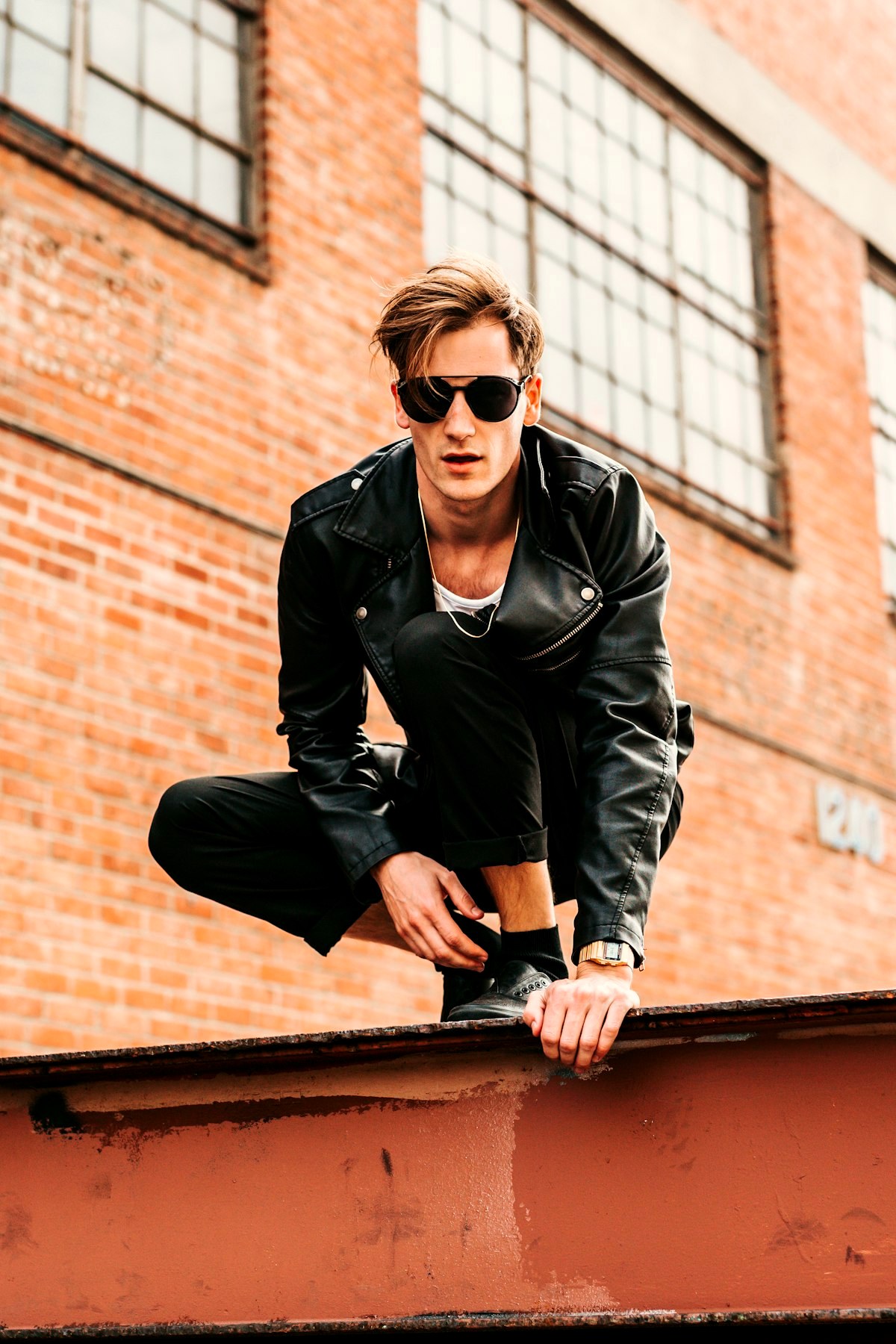
A note on our own photography: our photo bank holds one true bomber frame, the golden-hour portrait this brief leads with, and it is captioned for exactly what it shows. The leather frame in the rule section is a Perfecto and is captioned as one, used to draw the species boundary rather than to illustrate a garment it is not. The bank holds no suede bomber on body, no olive MA-1 on body, no bomber over a knit and no wide-trouser pairing, so those rows run without frames rather than borrow wrong ones. All four are on the harvest list, named, and this page will take the frames the week they exist.
Questions, answered
How should a bomber jacket fit?
By three tests, all mechanical. The hem test: zipped closed, the ribbed hem lands on the belt line, the belt visible below it and the trouser's rise readable; a hem that swallows the belt and drops toward the pocket line has changed species into a long blouson. The ribbing test: hem and cuffs hold their place without gripping, the hem staying at the belt through a day without being tugged down, the cuff sitting at the wrist bone with no sleeve stacked above it. The zip test: closed over the thickest layer it has to cover, the front zips without pull lines running from it, because a cropped jacket that cannot close has resigned from weather. The ease of the flight pattern is built into its cut. Buying a size up does not add ease; it adds length, and length is the one dimension this garment cannot spend.
Can you wear a bomber jacket to the office?
In the rooms whose code is formality 2, yes, at one ceiling assembly: the suede or matte species, over a fine-gauge crew or an Oxford whose tail obeys the shirt-tail rule, with tailored wool trousers and loafers or a suede Chelsea. Our jackets index files the bomber at formality 2, the trucker's rung, and formality 2 is the ruling, not a styling problem to be solved. In a room with a tailoring expectation the bomber's office life is the commute: the Fall Edit's stack puts the weather layer last and the structure layer under it, so the jacket travels over the office clothes and comes off at the desk. It is never worn over a blazer or a suit, and never over a tie, because the blazer stands at formality 4 and ribbing against lapels is two garments arguing.
What trousers go with a bomber jacket?
The leg that narrows, or at least straightens, below the jacket's cropped volume: tapered and slim trousers are the default, straight legs are licensed when the hem breaks clean over the shoe. Wide trousers are refused as the default, because volume over volume stacks two inflated halves and the outfit reads as padding. They are licensed in one case only, printed in this brief: a cropped wide trouser in a cloth with drape, the ankle visible, the shoe doing the narrowing, the jacket dead clean and matte, the wide leg the outfit's only wide decision. Jeans obey the law that governs them under every jacket on this site, the wash break of How to Wear No. 05: distance from the top half, a third surface at the open front, black running on colour's rules.
Can you wear a bomber jacket over a hoodie?
Yes, and the licence is mechanical. How to Wear No. 16 refuses the hoodie under the Type III trucker because the hood bunches against a structured collar and the front pulls at its buttons. The bomber has neither problem: its collar is a low rib of knit with nothing to displace, and its front is a zip cut with room through the chest. The hood rests outside the collar, the zip closes over the hoodie's body, and the assembly is the jacket's honest street register. The conditions are the family's usual ones: a plain hoodie, no logos doing the talking, and the hoodie itself a garment that earns its place, the class Verdict Card No. 26 scored with the American Giant at 87, cited as garment evidence.
Is a sukajan a bomber jacket?
No, and this site keeps the two in separate records on purpose. The sukajan is the embroidered souvenir jacket, a satin blouson with a worked back panel, and it has its own guide on this site, with its own fit ruling: it fits like a blouson, cropped, full, the ribbed hem doing the shaping, worn under a one-statement-piece rule with everything under and below it quiet. The bomber is the flight family's civilian, plain by pattern, its surface empty because its cloth and cut are the whole statement. A bomber bought with a souvenir back panel has failed both garments at once: too loud for the flight pattern's restraint, too plain in its cloth and cut for the sukajan's register. Buy the embroidery as a sukajan, under its guide's law, or not at all.
How do you look after a bomber jacket's ribbed cuffs and hem?
By treating the ribbing as what this brief declares it: the garment's consumable. The shell of a bomber outlasts its knit by years, and the ribbing sets the jacket's lifespan the way the Chelsea boot's elastic gusset sets the boot's. So: rest the jacket between wears so the ribbing recovers its snap; never pull the sleeves up by the cuff, which spends the cuff's stretch on a habit; hang it on a wide hanger or fold it, because a thin hanger stretches the knit collar under the garment's own weight; and know that a bagged cuff or hem is a repair, not a death, since a knit repairer can re-knit a rib for a fraction of the jacket's price. On suede, the protection and rain honesty of How to Wear No. 15 apply unchanged. The jacket whose ribbing has gone is not worn out. It is a jacket asking for its one scheduled repair.
Has Young Cotton ranked bomber jackets?
Not as a Verdict Card, and this page will not pretend otherwise. What exists in print is the garment's record across the site: the jackets index files the bomber among the twelve jacket types at formality 2 and warmth 3 with its buying rule; the one bomber carrying a price record is a leather garment inside a brand card, the AllSaints Deceit in the Rag & Bone family, listed at $569 and chained down to $272.80 in the brand's own sale, cited here as evidence for the leather species' pricing behaviour and nothing more; and the embroidered species is ranked in the sukajan guide, its own record. This brief is the wearing system those records imply, printed so any bomber can be judged before a ranking exists.
Next
The jacket this brief is confused with, and the arithmetic it shares, is briefed in How to Wear No. 16, whose hoodie refusal this page's licence is distinguished from, collar by collar. The bomber's place among all twelve jackets, with its formality and warmth in the table, is the jackets index. The embroidered species lives in the sukajan guide. The legs beneath it obey How to Wear No. 05, the shoes beneath those are scaled in No. 12 and No. 15, the gauges beneath it are No. 09's, and the stack it joins in the cold is the Fall Edit's.