

The base assembly and the second fit in one frame: an oversized trucker over a plain white tee on a city street. Everything on this page is a variation on one question, the distance between the jacket and everything touching it.
Checked and updated October 2026
The ruling, up front: a denim jacket worn with jeans is legal under two conditions, both arithmetic. The washes must sit at opposite ends of the wash ladder, dark against light, or break by colour family, black or ecru against indigo. And the surfaces must differ: one piece worn and textured, the other smooth and even. Pass both and double denim is an outfit. Fail either and the jacket does not negotiate, argue or accessorise its way out: it changes trousers. The law underneath is already published on this site, in How to Wear No. 05's wash break and No. 13's matched-set ban; this brief prints the full arithmetic the two imply, then rules the garment itself: three fits, five washes, the layering stack, the office answer and a six-outfit matrix. Which trucker to buy is a record this site keeps in pieces, in the jackets index and the Denim Index. This brief is the wearing system.
This brief: the two conditions · the three fits · the five washes · the layering arithmetic · the office ruling · the outfit matrix · the mistakes · care and fade
The decisive rule: two stops, two surfaces, or different trousers
Double denim is the most attempted assembly in this cloth and the most argued about, because the argument is usually conducted in vibes: it looks right, it looks wrong, a photograph is produced, a photograph is countered. This page ends the argument the way this site ends arguments, with numbers. The wash ladder has three indigo stops, the classes the Denim Index defines: the dark end (raw and one-wash, colour deep and even), the mid class (stonewashed, lightened evenly before sale), and the light end (faded, worn pale, the wash a leg earns or a factory imitates). Beside the ladder stand two colour families that are not stops on it at all: black, which No. 05 rules a colour system rather than a wash, and white and ecru, the undyed summer class.
Condition one, the wash distance. Jacket and jean must come from opposite ends of the ladder: a dark jacket over light jeans, a light jacket over dark jeans. Or they must break by family: black under indigo or indigo under black, white or ecru against any indigo. Everything else fails. The same wash fails, obviously. Neighbouring stops fail, dark against mid, mid against light, because at one stop of distance the eye groups the two pieces by class before it reads the shade, and the read is an attempted match. And the mid class fails against indigo altogether, at any shade, from either direction. That sentence will cost this page its most common pairing, so it is printed plainly: the mid-wash trucker over dark jeans, the assembly half the high street wears, is the near miss at full size. No. 05 names the failure in miniature, two mid-washes a shade apart reading as an accident, a man who tried to match and failed. The mid class is that accident as a category: close to both ends, identical to neither, and never far enough from anything to be a decision. The mid jacket is not a bad jacket. It is a jacket whose legal partners are black jeans, ecru jeans and trousers that are not jeans at all, and the matrix below dresses it accordingly.
Condition two, the texture. The surfaces must differ as surely as the washes do. One piece shows a worn texture: a fade map at the thigh and elbow, slub in the yarn, whiskers earned at the crease lines. The other is smooth and even: colour uniform, surface flat, the cloth reading as a single calm plane. This condition is the one that convicts the second commonest failure, the two brand-new pieces bought in deliberately different washes and worn together the same afternoon. The washes pass, the surfaces do not: two flat, uniform, unmarked pieces of new denim read as a set however far apart their shades sit, because nothing in either piece has lived yet. A dark raw jacket over honestly faded jeans passes both conditions before breakfast. The same jacket over new mid jeans fails the first. A new light jacket over new dark jeans fails the second. Both conditions are cheap to satisfy and impossible to fake, which is what a rule is for.
The reconciliation, because this site keeps one law. None of this replaces what is already in print; it completes it. The jackets index prints the floor in one line, the trucker's buying rule: never the same wash as the jeans; the colour break is the outfit. No. 05 prints the law in full for the leg's side of the pairing, the wash break, the near miss, the third surface that widens a break for free. No. 13, the chore coat brief, bans the matched mid-wash denim set outright, a coat and a jean in one wash reading as a one-piece work suit. Read together, the three are this brief's two conditions seen from three garments: the matched set fails condition one and condition two at once, same wash, same flat new surface, which is exactly why it collapses into a single garment in the eye. And No. 05's limiting case holds here unchanged: a third surface, the tee or knit at the open front, widens a passing break and strengthens it, but it cannot rescue a failing one. The denim tuxedo, three denim surfaces at once, is the proof. A break is made by distance, not by decoration.
The escape is a feature, not a defeat. When a pairing fails, the ruling is not to try harder at the mirror. It is that the trucker is, in the jackets index's own words, the one jacket that pairs with every trouser a man owns, and the wash law governs only its meetings with its own cloth. Over chinos, over wool trousers, over corduroy, over black or ecru denim, the jacket owes the ladder nothing. The man with a mid-wash trucker and a rail of indigo jeans is not badly dressed. He is one trouser decision away from being well dressed, and the decision costs him nothing he does not already own.
The three fits, separated
The trucker pattern is old enough to have settled, and the jackets index describes the settled form in four words: waist length, close cut. Everything sold as a denim jacket is a position taken against that sentence, and the three fits below are the three positions that matter. They are not a quality ladder. They are three garments with three jobs, and the failures begin when one is asked to do another's.
The Type III trucker: the default. The standard pattern, waist length, close through the body without being tight, a button front, two chest flap pockets, panel seams down the front, a hem that ends at the waistband so the trouser's rise and the belt line stay visible. This is the jacket the index files, the one that pairs with every trouser, and the one to buy first, in a midweight cloth, 12 to 14 ounces, the Denim Index's classic band. Size it the way every working brief in this series sizes its garment: over the thickest knit it has to cover. A trucker that fits perfectly over a t-shirt in the shop is one size too small for October, and the test is mechanical, not aesthetic: it must button closed over a mid-gauge crew without pulling at the chest, because a jacket that cannot close is a jacket that has resigned from weather. Sleeves to the wrist bone, shoulder seam on the shoulder. The close cut is the silhouette, not a squeeze.
The oversized fit: the street register, bought second. Longer in the body, dropped at the shoulder, room through the chest, the fit this page's hero photograph wears over its white tee. Placed honestly: it is a real garment with a real job, the soft, slouching top layer of a street outfit, and it works under one condition, that it is the outfit's only oversized piece. The legs beneath it stay straight or slim, the tee beneath it stays plain, and the silhouette keeps a floor. Oversized over wide legs over a long tee is three soft decisions stacked into a pile, and the pile reads as laundry, not ease. The oversized trucker also dates the fastest of the three fits, because its proportions are a season's argument rather than a pattern's settlement. Buy it knowingly, after the Type III earns its keep, and let it be the jacket of one era of your life rather than the jacket of your wardrobe.
The cropped fit: the fashion end, placed last. Cut above the waistband, the body short enough to show the whole rise of the trouser, descended from the early short jackets of the pattern's first decades. It has one legal assembly and it is a good one: over high-rise trousers, where the short body and the high waist meet at a clean, deliberate break and the proportions read as tailoring's logic in denim. Over a mid or low rise it strands a band of tee or skin at the waist and reads as a jacket that shrank. It is the least forgiving fit, the least layered (nothing thick closes under it), and the one whose moment passes soonest. A man who loves it should wear it at full commitment, high rise, plain top, nothing competing. A man choosing his first denim jacket should leave it on the rail.

The five washes, placed
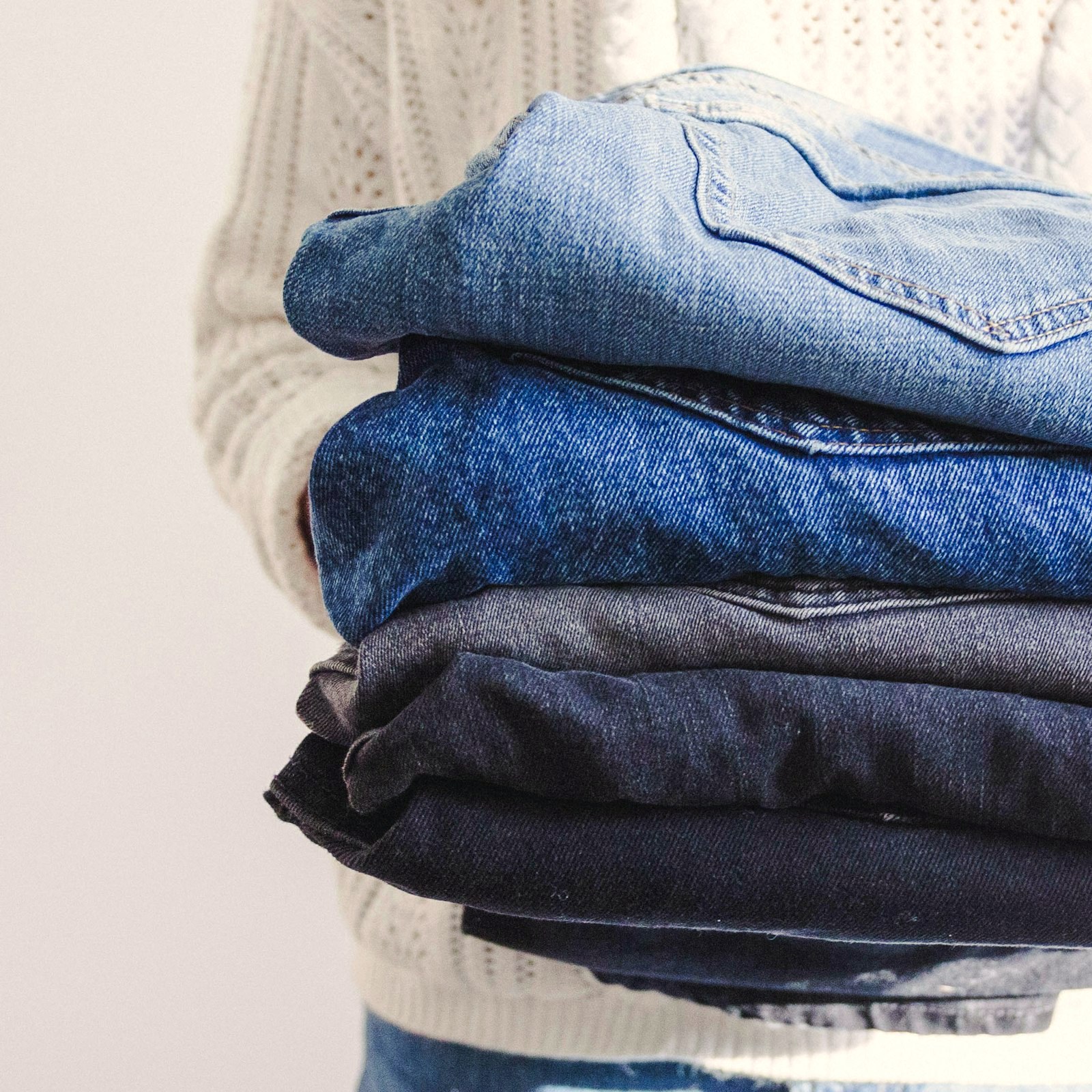
A denim jacket is bought in a wash before it is bought in anything else, because the wash decides its partners, its rooms and its decade. The five below are the Denim Index's classes read from the jacket's side of the rail. One fact governs all five, the index's own rule: wear revises a wash in one direction only. A dark jacket becomes a mid jacket across the years. The reverse journey does not exist, and the care section plans for the handover.
| Wash | What it is | Its legal partners | The ruling |
|---|---|---|---|
| Dark indigo, raw or one-wash | Colour deep and even, waist to hem, the index's top denim class at formality 3 as a jean | Light and faded jeans under the two conditions; every non-denim trouser; the only wash licensed over wool trousers | The dressed end and the first buy. The jacket the office ceiling and the wool-trouser row are built on. Its fade, when it comes, is earned at the elbows and collar |
| Mid, stonewashed | Lightened evenly before sale, the high street's default and the ladder's middle stop | Black jeans and ecru jeans, by family break; chinos, wool and corduroy, by leaving the ladder entirely | The trap class, ruled head-on in the rule section: against indigo it is the near miss as a category. Dressed with trousers instead, it is the easiest jacket in the wardrobe |
| Light, faded | The pale end: stonewashed hard, sun-faded, or a raw jacket a decade into its journey | Dark jeans, the classic direction, passing both conditions when the fade is real texture; white tees and summer cloth beneath | The summer top half and double denim's oldest legal form. Bought faded, its texture must be honest abrasion, not the index's printed fakes |
| Black | Denim dyed black, a colour and not a wash, running on colour's rules per No. 05 | Indigo jeans by family break; black jeans only inside the full monochrome system, texture doing the separation | The evening jacket. Black over black is the one licensed match in this brief, legal because black was never on the wash ladder, and only when the whole outfit commits to the monochrome |
| White and ecru | Undyed or white-dyed denim, the index's summer class at formality 2 | Any indigo jean by family break; dark trousers; navy and colour above nothing, it is the colour | The warm-weather statement, worn as a colour and marked as one: every scuff it collects is part of the deal the index prints for the class |
Two buying corollaries ride on the table. First, the dark jacket is the rotation's anchor for the same reason No. 05 buys the dark jean first: it holds the most jobs, the ceiling rows and the everyday rows alike, and its slow journey down the ladder is a second jacket arriving free inside the first. Second, the mid jacket is not a mistake to be returned. It is a jacket whose partner rail is the trouser rail, and worn there, over the chino and the wool trouser and the cord, it never has to pass an arithmetic test at all.

The layering arithmetic
The trucker sits in the middle of the stack more often than at its top, and its layering is arithmetic too: what fits under a waist-length, close-cut jacket is a short list, and what goes over it is shorter. The governing fact is the index's line for the type, warmth 2, spring through autumn, which makes the trucker a shoulder-season outside and a cold-season middle.
Beneath it: the tee, the base frame. The plain white tee under an open trucker is the assembly this brief's hero wears and the one the whole garment family was standardised around. The tee is judged as the tee ranking judges it: cloth with a published weight and a collar that recovers. Verdict Card No. 02's winner, the Asket at 88, is the reference, and its virtues are the ones this layer needs, a bound collar that holds its line at the jacket's open front and cloth heavy enough not to read as underwear against 12 ounces of denim. Colour beneath a trucker follows the third-surface rule: white and grey widen any break, a strong colour carries the separation by itself, as No. 05's mustard-knit frame proves on the jean's page.
Beneath it: the shirt and the knit rungs. An Oxford under a dark trucker is the ceiling assembly's shirt position, the collar inside the jacket's collar, the formality carried by the shirt in the rooms where the jacket comes off. The knit rung is How to Wear No. 09's gauge bands, unchanged: fine gauge, roughly 24 to 30, is the only knit that closes under a Type III; mid gauge, roughly 12 to 20, wears the jacket open over it or takes the oversized fit; heavy gauge, 7 and below, is a top layer that stands alone and no trucker is sized up to swallow it. The roll neck has its own row: a black or navy turtleneck under a dark or black trucker is the jacket's evening form, the knit doing the dressing and the denim standing down, the pairing the matrix prints in full.
The hoodie: refused in the default, licensed in one place. Under a Type III, this brief refuses the pairing, and the refusal is mechanical before it is aesthetic. The hood bunches against the trucker's collar and pushes it out of line; the hoodie's body fills the close cut so the front pulls at its buttons; and two garments with strong casual signatures compete at the one place the eye lands first. In the oversized fit, and only there, the pairing is licensed as a street outfit: a plain hoodie, no logos doing the talking, its hood worn outside the jacket's collar, the whole assembly understood as one deliberate soft layer rather than two garments negotiating. The hoodie needs no smuggling. It is a scored garment with its own brief on this site, Verdict Card No. 26, where the American Giant took the category at 87, and a top layer by design.
Above it: the trench, and the cold stack. In the wet shoulder seasons the trucker changes jobs the way No. 13's chore coat does in real cold: it becomes the middle. The coat that closes the system is How to Wear No. 02's trench, formality 4 and warmth 2, whose brief prints the licence in its own FAQ: under the trench goes whatever the day already required, denim named among the weekend rows. The division of labour is exact. The trench is the weather skin, because denim is not rain cloth and a soaked trucker is a heavy, cold, slow-drying garment; the trucker underneath does the texture and insulation work, buttoned closed so the stack reads as one outfit from the street; and the collar order stays clean, trucker collar inside trench collar, one collar visible to the weather. In dry cold the same stack runs under an overcoat: knit, trucker, coat, the January assembly this series prints for every warmth-2 jacket that earns a middle layer's place.

The office ruling
Plainly, as the number requires: the trucker is formality 2, and it works exactly where formality 2 is the room's code. In those rooms, studios, workshops, genuinely casual offices, it has one ceiling assembly and the matrix prints it: a dark raw trucker, closed, over an Oxford or a fine-gauge crew, with tailored wool trousers and leather shoes. Worn that way it is not a loophole in a dress code. It is the correct garment at its correct rung, the jacket the wardrobe reaches for when a blazer is too much. Everywhere the room expects tailoring, the trucker's office life is the commute: it travels over the office clothes and comes off at the desk, because the garment that answers those rooms is the blazer of How to Wear No. 03, standing at formality 4, and two rungs is not a styling gap to be bridged with confidence. It is a different outfit. The denim brief's honesty rule applies to the jacket unchanged: this page does not pretend its cloth outranks the rooms it cannot enter.
The outfit matrix: six ways, no improvisation needed
| Setting | The jacket | With | The judgment |
|---|---|---|---|
| The default | Light-wash Type III, worn open | A plain white tee, dark raw jeans, clean white sneakers | The classic direction, passing both conditions: light against dark, a faded surface against a smooth one, the tee the third surface at the front. The leg's record is Verdict Card No. 11's, the Levi's 501 at 81, garment evidence for the class |
| Double denim, ruled head-on | Dark raw Type III, worn open | A white tee, faded light jeans, suede boots | Two stops and two surfaces, the full arithmetic satisfied in the summer direction. This is the pairing the rule exists to protect, named so the near misses cannot borrow its name |
| The trap, avoided | Mid-wash Type III, worn open | Spier & MacKay high-rise chinos, a plain tee or an untucked Oxford | The mid class leaves the ladder and takes the trouser rail, where it owes no arithmetic. The chinos are the 84 of the chinos ranking, and the outfit is better than the dark-jean version it replaces |
| The formality ceiling | Dark raw Type III, worn closed | A fine-gauge crew in No. 09's 24 to 30 band, Spier & MacKay tropical wool trousers, loafers | The trousers are the 87 of Verdict Card No. 15. The loafer moves the outfit one notch up, per No. 11, the knit disappears under the closed jacket, and the trucker stays formality 2: the office ceiling, in formality-2 rooms only |
| The black evening row | Black Type III, worn closed | A black roll neck, black jeans, black Chelsea boots | No. 05's monochrome system in full: black runs on colour's rules, texture does the separation colour does elsewhere, and No. 15's boots close the leg. The one licensed match in this brief |
| The wet-weather stack | Any wash Type III, buttoned, demoted to the middle | A mid-gauge crew beneath it, a trench above the whole stack, dark jeans, boots | Warmth 2 layered as the index's season line prints it. The trench is No. 02's territory and takes the rain; the trucker takes the texture. Collar order: denim inside, gabardine out |

The ruling
Buy the Type III first, in dark raw, midweight, sized over the thickest knit it must close over. Wear it with jeans only at two stops and two surfaces, or by a family break, and let every failing pairing end the same way, with the jacket over a trouser that is not a jean. Keep it formality 2 and proud of the rung: the ceiling assembly for the casual rooms, the middle layer under the trench, the evening's black system. Every failure of this garment is a refusal of its arithmetic: washes too close, surfaces too similar, a rung it was never filed at, a biography it has not lived. Worn on its numbers, the trucker is what the jackets index calls it, the one jacket that pairs with every trouser a man owns. The arithmetic is not the obstacle to wearing it. The arithmetic is how it gets worn well.
The mistakes
The matched-wash set, worn as a uniform. Jacket and jean in the same wash, bought together in one transaction, worn together ever after. It fails both conditions at maximum strength, one wash, one flat new surface, and the read is the one No. 05 names first among denim's failures and No. 13 bans from the chore coat's rail: a single surface from shoulder to shoe, a one-piece work suit, the uniform the cloth descends from arriving at the exact moment the wearer aimed for its opposite. It is also the cheapest mistake in this brief to fix. The two pieces are each fine. They are simply never again to be introduced.
The trucker as a blazer substitute. The dark trucker carried into a formal register on the theory that dark denim is nearly tailoring: over a dress shirt, with tailored trousers, at a wedding, in a measured room, worst of all over a tie. The jackets index files the garment at formality 2 and the blazer at 4, and no depth of dye moves a rung. In the formal room the substitution reads instantly, as No. 05 says of the black jean in the same rooms, and it demotes every honest piece around it. The dark trucker has a ceiling and this brief prints it proudly, the closed jacket over a fine knit and wool trousers in a casual room. A ceiling is not a failure. Pretending it is a staircase is.
Patches, pins and borrowed biography. The jacket decorated into a résumé: band patches, enamel pins, chains, tour badges, a back panel announcing affiliations the wearer does not hold. It is the distressed class's fraud continued by hand, the Denim Index's fakes translated to the jacket: a surface claiming a life the cloth has not lived. One earned thing, a repair, a patch where the wearer actually tore it, a badge from a place he actually stood, is memorabilia and this page has no quarrel with it. A constellation of them is costume, and it fails the same test the pre-faded jean fails. The garment is supposed to collect its record. It is not supposed to be issued one.
The raw jacket worn stiff as armour. The heavyweight raw trucker bought as a project and then protected from the project: worn board-stiff and boxy, never sat in, never leaned on, never washed when the collar asks, its creases set like a display piece and its owner moving inside it like a man carrying glass. Verdict Card No. 11 prices the heavyweight cloth honestly, the Iron Heart at 80, a break-in measured in months, as the terms of the ceiling. The armour wearer accepts the price and refuses the terms. Raw denim's whole argument is that the garment becomes a document of its wearer, and a document nobody writes in is just expensive paper. Sit in it. Lean on door frames. Let the elbows honeycomb. The stiffness is the first chapter, not the book.
Care, and the fade
The jacket's care is the jean's care at a slower clock, and the law is Verdict Card No. 11's, unchanged: rigid denim fades where the body bends it, and every wash spends colour across the whole garment at once. Washing is the fade's accelerator; restraint is its author. The jacket's stress map is gentler than a jean's, no seat, no knee, no thigh rub, so its cadence is longer: spot-clean the day off it, air it on a hook, and wash cold, inside out, when the collar and cuffs say the time has come rather than when the calendar does. A jacket washed on a schedule fades evenly and early into the mid class. A jacket washed on evidence keeps its dark end for years and earns its fade map in the right places.
The fade map is the garment's diary, and the entries are specific. Honeycombs behind the elbows, where the arm bends ten thousand times. A paler collar, where sun and skin do their slow work. The outline of a phone in the chest pocket, the one modern entry every honest trucker eventually prints. Vertical falls down the front panels where the cloth hangs and rubs. Read together they are a record no factory can apply, which is the Denim Index's verdict on the distressed class stated from the other side: the printed version is a photograph of this diary, taken from someone else's life. The man who wants the faded read honestly already owns the instrument. It is the dark jacket in his wardrobe, plus time.
Two closing notes of housekeeping, printed because this page believes in saying so. First, the handover: when the dark jacket's fade crosses into the mid class, and one year it will, its legal partners change with it. The light jeans it wore are retired from its rail, the black and ecru jeans and the trousers inherit it, and a new dark jacket, if the wardrobe wants one, starts the ladder again. Plan the handover and the jacket's second life is as designed as its first. Second, repairs: denim takes a mend the way the chore coat's canvas does, honestly, at the cuff, the collar point and the pocket corner, in a near thread or a contrasting one that admits itself. The ceiling cloth of Verdict Card No. 11 is built to be darned and worn again. So is this jacket. Patch what you tore, and let the patch join the diary.
A note on our own photography: our photo bank holds the four denim-jacket frames this brief uses, the oversized city frame, the outdoor trucker, the lined light-wash portrait and the knit and chino pairings, and all four are captioned for exactly what they show. The bank holds no black trucker on body, no cropped fit on body and no trucker under a trench, so those rows run without frames rather than borrow wrong ones. All three are on the harvest list, named, and this page will take the frames the week they exist.
Questions, answered
Can you wear a denim jacket with jeans?
Yes, when the pairing passes two conditions, and this brief prints both as arithmetic. First, the wash distance: jacket and jean must come from opposite ends of the wash ladder, dark against light, or break by colour family, black against indigo or white and ecru against indigo. Same wash fails, neighbouring washes fail, and anything against a mid-wash jean or under a mid-wash jacket fails against indigo, because the mid class is the near miss No. 05 names, a class that sits close to both ends. Second, the texture: one piece must show a worn, textured surface and the other must be smooth and even, or the pairing reads as a set bought in two washes. Pass both and the outfit is legal, with a third surface at the open front widening the break. Fail either and the jacket does not negotiate: it changes trousers, to chinos, wool trousers or a family-break jean.
What is a Type III trucker, and which denim jacket fit should you buy first?
The Type III is the default pattern of the denim jacket: waist length, close through the body, a button front, two chest flap pockets and seams that panel the front. Our jackets index describes the trucker in its shortest form, waist length, close cut, the one jacket that pairs with every trouser a man owns provided the colour-break rule is kept. Buy it first, sized to close over the thickest knit it has to cover, hem at the waistband so the trouser's rise stays visible. The oversized fit is a second jacket, a street register that works when it is the outfit's only oversized piece. The cropped fit is a third, the least forgiving of the three, licensed over high-rise trousers and bought knowing it dates fastest.
Can you wear a denim jacket to the office?
In the rooms whose code is formality 2, yes, at one ceiling assembly: a dark raw trucker, closed, over an Oxford or a fine-gauge crew, with tailored wool trousers and loafers. Our jackets index files the trucker at formality 2, and formality 2 is the ruling, not a styling problem to be solved. In a room with a tailoring expectation the jacket's office life is the commute, over the office clothes and off at the desk, because the blazer stands at formality 4 and the trucker is never its substitute. And never over a tie: a tie is a formality claim a formality-2 jacket cannot cash, the same prohibition the chore coat brief prints one rung down the same ladder.
Can you layer a denim jacket under a trench coat?
Yes, and it is the jacket's best wet-weather assembly. The trench of How to Wear No. 02 is formality 4 and warmth 2, weather equipment whose own brief prints that under it goes whatever the day already required. The trucker, buttoned closed, becomes the middle layer in the wet shoulder seasons: the trench takes the rain, because denim is not rain cloth and a soaked trucker is a heavy, cold garment, and the denim does the texture and insulation work underneath. Keep the collar order clean, trucker collar inside the trench collar, and the same stack works under an overcoat in dry cold.
Can you wear a denim jacket over a hoodie?
Not under the classic Type III, and this brief refuses the pairing there for mechanical reasons: the hood bunches against the trucker's collar, the chest pulls over the hoodie's body, and two casual signatures compete at the neck. It is licensed in one place only, the oversized fit, worn as a street outfit, with a plain hoodie, no logos, its hood outside the jacket's collar. The hoodie is a top layer by design on this site, the garment Verdict Card No. 26 scored with the American Giant at 87, and a garment with its own brief does not need to be smuggled under another one to earn its place in an outfit.
How often should you wash a denim jacket?
When it needs it, not on a schedule, and less often than the jeans it matches in cloth. Verdict Card No. 11's rule for rigid denim governs here: the cloth fades where the body bends it, and every wash spends colour across the whole garment at once, so washing is the fade's accelerator and restraint is the fade's author. The jacket lives an easier life than a jean, away from the seat and the knee, so spot-clean first, air it, and wash cold and inside out when the collar and cuffs say the time has come. A dark jacket will still become a mid jacket across the years, because wear revises a wash in one direction only, and this brief's care section plans the rotation for the day it does.
Has Young Cotton ranked denim jackets?
Not as a Verdict Card, and this page will not pretend otherwise. What exists in print is the garment's record across the site: the jackets index files the trucker among the twelve jacket types at formality 2 and warmth 2 with its buying rule, the Denim Index defines the wash and weight classes the jacket is cut from, and Verdict Card No. 11 scores the jeans below it, the Levi's 501 at 81 and the Iron Heart IH-634S at 80, cited here as garment evidence for the legs in the matrix. This brief is the wearing system those records imply, printed so any trucker can be judged before a ranking exists.
Next
The law this brief completes is stated for the leg in How to Wear No. 05, whose wash break, office ruling and black system govern every row above. The working jacket it is confused with is briefed in How to Wear No. 13, whose matched-set ban is the same law seen from another garment. The cloth classes are defined in the Denim Index, the jeans themselves are ranked in Verdict Card No. 11, and the trucker's place among all twelve jackets, with its formality and warmth in the table, is the jackets index. The coat that goes over it in the rain is How to Wear No. 02, and the knit gauges beneath it are How to Wear No. 09.