
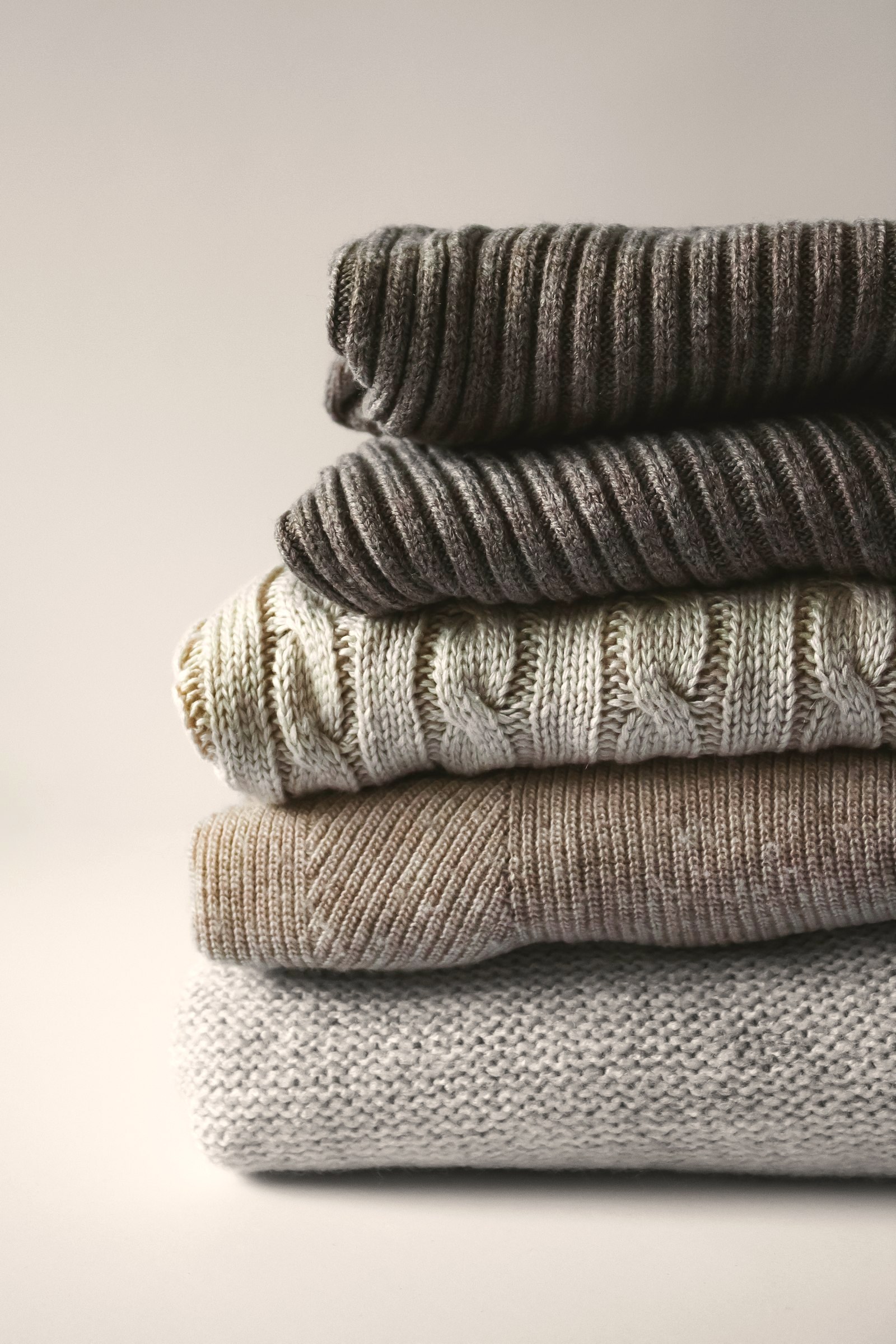
A hoodie is graded on its cloth first, because fleece is the whole garment: there is no tailoring to hide behind, no lining to rescue it, only the weight of the knit, the build of the hood and the honesty of the price. A note on photography, printed because this page believes in saying so: our photo bank holds no hoodie photography, on a body or off one, so no ranked hoodie is pictured anywhere on this page. The hero is a folded stack of grey knits from the bank, captioned as what it is, and the frames this page actually needs head the harvest list in the honesty section.
Checked and updated October 2026
The basis: a hoodie is graded on its cloth before its cut, because the cloth is the garment entire, and on its fleece weight only where the maker publishes one: a weight in grams or ounces printed by the house is evidence, and a weight guessed from a photograph is a fiction this page does not print. The winner: the American Giant Classic Pullover at 87, a 100 percent cotton heavyweight fleece at 12.2 ounces per square yard, the heaviest published weight in the field, built with a double-lined hood and metal hardware at $155. It is the one hoodie to buy if you buy one. The skip: the Palm Angels Curved Logo Track Hoodie at 49, named in the verdict box below: a $595 track hoodie whose product is the logo across its chest, carrying the thinnest published cloth evidence in the field at the field's highest price. In between, the prep altitude holds second, a $49.90 oversized cut takes third and the attainable slot with it, the loopback terry states the midweight case, the drape altitude is priced as a line, and a $550 silhouette is graded as what its own sales channel says it is worth.
First, the decision
Every hoodie argument is really three arguments, and this page settles all three before it scores anything. The first is the only question most readers actually have: if you buy one hoodie, buy the American Giant Classic Pullover. It is ranked first below on the published evidence, and it is named here, in the first screen, because a page that buries its answer under seven cards has not answered it. Its maker publishes the number the rest of the field hides, 12.2 ounces per square yard of 100 percent cotton fleece, and then builds to it: a double-lined hood, reinforced elbows, metal at every point where cord meets cloth. At $155 it costs less than the prep answer in second and a quarter of the silhouette in sixth.
The second argument is the weight, and it fits in one line: midweight is the default, heavyweight is outerwear, lightweight is a layer. Midweight, the terry class ranked fourth here, is the hoodie for nine months of the year, the one that goes under a coat in January and over a tee in April. Heavyweight, the published class that starts around 390 grams per square metre, is not a thicker version of the same purchase; it is a different garment, worn as the outer layer itself, the jacket on the days a jacket would be fleece. The winner is graded as outerwear and wins as outerwear. Lightweight fleece is a layer to be worn under other things, bought for that job or not at all. A reader who buys one hoodie for every job should buy the midweight and accept the compromise. A reader who buys the best hoodie buys the winner and wears it as the coat it is.
The third argument is the face of the cloth, loopback against brushed, and it is graded in full in the basis below. The short version: a loopback leaves its loops uncut, breathes, layers cleanly and has no pile to pill; a brushed fleece raises its inside into pile, feels warmer on the first touch, and pills first. The field holds one of each at its published weights, the terry in fourth and the heavy fleece at the top, and the ranking between them is decided by build and price, not by the face. What is not graded anywhere on this page is a weight nobody published. Two makers here print theirs. The other five are scored with the absence on the card, because an unpublished weight is data too: it tells you what the house thinks the number would do to the sale.
And the office ruling, stated plainly, because this category is where office dressing goes to negotiate. This site files the overshirt at formality 2, the floor of smart casual, and the hoodie sits below the overshirt: it is a layer, and a layer is always one rung below the garment it covers. The arithmetic is the loafer brief one-notch rule run in reverse: a piece that moves an outfit one notch cannot move it two, and a hoodie under a blazer is a two-notch ask, which is why it reads as a costume instead of a compromise. So the hoodie has exactly two legal office forms. It is the commute layer: worn over the office clothes to the door, doing a light coat's work in the shoulder seasons, and it comes off at the desk. Or it is the top layer in a genuinely casual room, clean, logo-free and midweight, in a workplace where a plain tee would already pass. In any room that measures formality, the answer is the same as the overshirt answer, one rung further down: the room is answered by a jacket, and the hoodie waits outside it.
How the scores work
Every hoodie is scored out of 100 on the same five rows, and the rows are printed on every card, so the reader can disagree with the weighting and still use the evidence.
Cloth, 30 points. The fleece as the maker publishes it: its weight in grams per square metre where a weight is published, in ounces per square yard where the house prints ounces, with any conversion labelled as this desk conversion and never as the maker figure. Loopback against brushed is graded as the bargain each is: the loopback cooler, cleaner-layering and slower to pill; the brushed warmer, softer at first touch and first to tire. The fibre line is graded as printed: an all-cotton fleece earns what all-cotton earns, a blend earns its ratio, and a house that publishes neither weight nor fibre story is graded on the silence.
Construction, 20 points. The build as published: the hood first, because the hood is the garment signature, double-lined against single, standing against collapsing; then the rib at cuff and hem, the drawcord hardware, metal against plastic against none, and the seams where the maker prints them.
Fit and drape, 20 points. The silhouette graded against this site's published soft standard: room carried with structure, the shoulder dropped by pattern rather than by sag. The line is printed here so the cards can be audited against it. Boxy is a cut: the shoulder drops on purpose, the body has room in every direction, and the garment still ends where the pattern says, the hem at the hip, held by a rib that grips, the hood standing in its layers. Sloppy is a failure: the same room with the structure gone, the hood flat and dead, the cuffs surrendered, the hem belled. A boxy garment passes the lights-out test, hood standing, rib recovered, after a season of washing. A sloppy one fails it in the shop, on the hanger, before money has changed hands.
Value, 15 points. The price as a reader first meets it, printed on every card with its seller. A list price that the maker's own channel permanently marks down is graded at the list and convicted by the markdown, in the open, on the same card.
Longevity and wash, 15 points. How the garment ages in the machine and on the back: the care line ceremony or lack of it, the fibre known arc, and the two failure modes this category dies of, pilling, where the brushed face breaks into fuzz, and hood collapse, where a hood stops standing and the garment silhouette goes with it. Stated lives in the per-year table are this desk's, printed beside the figures so the reader can argue with the life rather than the arithmetic.
The rows sum to the score. Maker figures are labelled maker figures throughout, and three kinds of number appear on this page, kept separate on every card: garment scores, set fresh here on this basis; brand scores, set on the brand pages and cited for the record only; and one line score, graded as a line on its own page. No number borrows from another kind.
Seven hoodies, ranked
American Giant Classic Pullover
The Winner · The One Hoodie to Buy
$155 at American Giant
The call: the winner is the hoodie whose maker publishes the number, and then builds like the number is a promise. The cloth is a 100 percent cotton heavyweight fleece, combed ringspun cotton from the Carolinas, printed on the product page at 12.2 ounces per square yard, about 414 grams per square metre in this desk conversion, the heaviest published weight in this field. The build reads like a spec sheet because it is one: a double-lined hood, reinforced elbow patches, custom metal grommets and drawcord tips, double-needle straddle stitching in high-strength thread, rib side panels for mobility, and a size chart in inches running to 3X. Made in Los Angeles, sold direct at $155, with a care line of machine wash cool and a warm dryer, no ceremony anywhere. If you buy one hoodie, buy this one.
The deductions are printed with the praise, and they are fit and only fit. The cut is the maker's classic fit, regular with slight ease, and the maker tells you on the same page to size up for a relaxed fit, which this page prints because it is the honest instruction: graded against the soft, boxy standard this site publishes, the winner is cut closer than the standard, structured where the standard drapes, and the fit row of 14 is that distance priced. Know what you are buying: this is outerwear by the weight ruling, the garment you wear as the jacket on cold days, over a tee or a flannel, and its structure is the point. The 4.7 from its 1,253 buyers on the maker page is printed as a report, because it is one. Five years at $31.00 a year, $0.52 a wear, and the arithmetic is in the table further down.
Noah Core Classic Hoodie
The Prep Altitude · Heavyweight, at Retail, All Year
$168 at Noah
The call: the prep altitude, and the steadiest transaction in the field. Heavyweight fleece is the house cloth, the core of a New York line this site has graded before: the Classic Pocket Tee is $58 and this Core Classic Hoodie is $168 at the maker store, checked on the shop page today with the hoodie first in the rail and on sale at retail, which is the house's whole promise, the core priced in the open and kept in stock instead of vanishing into a drop. The cut is the classic regular, neither the winner closer structure nor the drape field long stack, and for the reader whose wardrobe runs prep, this is the hoodie that behaves like the rest of it: under a coat, over an Oxford, unremarkable in the best sense for a decade.
The deductions are two, and both are about what the house does not print. The maker publishes no fleece weight for this garment on the surfaces this desk could check, so the cloth row of 25 grades the heavyweight house cloth on the record this site has already published, and grades the missing number as missing: in a field where two makers print theirs, the silence costs what it costs. And the reach is one door: a narrow line through the maker's own store, sizes XS to XXL, with core sizes moving in and out, which is the fit row's known limit from the brand page, carried here as a garment fact. Noah standing brand score on this site is 77, set on brands like Noah; this garment was scored fresh on this page's basis, as garments are, and neither number borrowed from the other. Four years at $42.00 a year, $0.70 a wear.
Uniqlo Sweat Oversized Pullover Hoodie
The Attainable Answer · The Silhouette at $49.90
$49.90 at Uniqlo
The call: the attainable answer, and the surprise of the field: the silhouette this page grades as the standard, dropped shoulders and room in every direction, sold at $49.90 by the mass-market house, designed by Clare Waight Keller for the UNIQLO : C line. The maker describes the cloth as thick, structured cotton, the silhouette as a relaxed oversized fit with a clean neckline and ribbed details, and the fit row of 19 is the highest awarded on this page, because this is the cut the standard is drawn from, on sale in a size run from XXS to 3XL with the waist and chest measurements published in inches. The 4.7 from its 604 buyers is printed as a report. For the reader who wants the shape of the moment without the moment prices, this is the correct fifty dollars, and it is not close.
The rest of the card is the fifty dollars' other side. The maker publishes no weight for the cloth, so none is graded, and the structured hand the description promises is graded as a description. The construction is competent and unremarkable next to the winner's spec sheet, and the longevity row of 9 prices the class arc honestly: the structure is the selling point, and structure in a mass-market fleece is what the second year tests, at the rib, at the surface, at the hood stand. Costed at a stated two years, this is $24.95 a year, the cheapest year in the field as well as the cheapest ticket, which makes it the rare attainable pick that wins its own arithmetic outright. When it tires, the winner above it is the upgrade, in the same silhouette direction and three times the cloth evidence. Uniqlo standing brand score on this site is 84, recorded here for the record from brands like Uniqlo; the garment was scored fresh.
Reigning Champ Midweight Terry Standard Hoodie
The Midweight Default · The Loopback Exhibit
$128 at Backcountry
The call: the midweight default, and the field's loopback exhibit. The Vancouver house builds its name garment in a 100 percent cotton French terry, the maker's published weight for the cloth is 390 grams per square metre, and the inside is loopback, loops uncut, which is why this is the layering hoodie of the field: it slides under a coat without grabbing, breathes where a brushed face would smother, and carries no raised pile to pill. The construction is the athletic tailor work the house is known for: flatlock seams, semi-raglan sleeves, rib side gussets, cut and sewn in the maker's own factory in Vancouver. By the weight ruling printed above, this is the class most readers should default to, and if your hoodie life is layers rather than cold streets, this card, not the winner, is your first purchase.
The deduction is the fit, and the house prints it itself: the Standard is the trim pattern, an athletic cut that the maker's own guidance steers broader bodies away from, toward the Relaxed fit or a size up. Graded against the soft standard, a trim hoodie is a narrower welcome, and the fit row of 13 is that narrowness priced; the drape is clean, tailored and deliberate, and it is not the drape this site's standard describes. The price is $128, read across the stocking retailer listings this desk could verify to the dollar, the maker's own storefront colourways having moved since the figure was set; the card names the seller it was verified at, as this page's cards do. Four years at $32.00 a year, $0.53 a wear.
Fear of God Essentials Classic Hoodie
The Drape Altitude · The Outline, Priced as a Line
$140 at PacSun, the line official stockist
The call: the drape altitude, graded as a garment for the first time on this site. The evidence is the stockist's own page, checked today: an 80 percent cotton, 20 percent polyester fleece with a soft fleece lining, dropped shoulders, an oversized fit, ribbed cuffs and hem, a kangaroo pocket, rubber brand labels at hood and cuff, and a back graphic, in seven sizes from XXS to XXL at $140. The fit row of 19 ties the highest on this page, because this silhouette, the dropped shoulder and the long, stacked body, is the outline the soft standard was drawn around, and this line is where most readers first met it. The house sells the same outline at mainline prices one card below; this line sells it at $140, priced as a line, and the value row of 11 records the honesty of that.
The deductions are cloth and care. The fleece is a blend, workwear grade rather than luxury grade, the finding printed when this line was scored on brands like Amiri, and its 20 percent polyester face is the surface in this field most likely to pill on schedule. No weight is published for the cloth, so none is graded. And the care line is the field's only ceremony: hand wash, printed on the stockist page in bold, for a garment whose entire pitch is everyday ease, a contradiction the longevity row of 9 prices without further comment. The stockist also marks these purchases final sale, which is printed here because a reader should know it before the click, not after. Three years at $46.67 a year, $0.78 a wear. The Essentials line score on this site is 65, set on the Amiri page and kept on brands like Fear of God; it is a line number on the brand basis, cited for the record, and this garment's 71 was scored fresh on this page's basis. The two numbers measure different things and neither borrows from the other.
Fear of God Eternal Hoodie
The Silhouette, Priced as a Fabric · Graded by Its Own Channel
$550 list, marked to $220 at Neiman Marcus
The call: the mainline garment, scored fresh, and the strangest card in the field: a hoodie whose silhouette is a genuine contribution and whose price is a genuine problem. The Eternal range is the house permanent collection, finished to a permanent standard, and the drape, elongated, dropped, stacked, is the outline half this field is chasing; the fit row of 15 grades the silhouette as the silhouette. The cloth row of 21 grades the house's published record, Italian and Japanese cloth across the programme, docked to where a fleece with no published weight belongs: the hoodie is a fleece garment priced by its cut, the sentence this site printed when the house was scored, and nothing found since has moved it.
The value row is the conviction, and the house's own channel delivers it. The Eternal hoodie lists at $550. Neiman Marcus, the department store that carries the range, marks it to $220 in season, a 60 percent cut printed in the retailer's own sale pages, which means the market grades the list price the way this page does: the silhouette is worth the line price of $140 and a premium for the finish, and it is not worth $550. At list, this garment costs $137.50 a year over a generous four years, the second-dearest year in the field. At the markdown it costs $55.00 a year, still dearer than the winner at full price, which is the whole argument in one comparison. Buy it at $220 if the drape is your religion. The desk grades the price a reader is first shown. The house brand score on this site is 68, derived in the open on brands like Fear of God from the published record; this 63 is a garment score on this page's basis, a different instrument, and the two are printed side by side here precisely so neither is mistaken for the other.
Palm Angels Curved Logo Track Hoodie
The Skip · The Logo Tax at $595
$595 at Neiman Marcus
The call: skip it, and the conviction is the product name. This is a track hoodie sold at $595 whose name is its logo programme: the curved logo is not a detail on the garment, it is the garment, the thing the price buys and the thing the chest carries. Against the basis printed above, there is almost nothing to grade. No fleece weight is published for the cloth, no fibre story beyond the category ordinary, no construction claim that separates the build from a standard track top. The cloth row of 15 and the construction row of 12 are what an unremarkable fleece earns when it declines to publish its evidence, and the value row of 1 is what $595 earns next to a winner that publishes everything at $155.
Run the year and the case closes. At a generous three years, the fashion life of a chest graphic, this is $198.33 a year, $3.31 a wear: the dearest year in this ranking by a factor of six over the winner, for the field's thinnest evidence. This site keeps an anti-award for exactly this transaction, the Logo Tax, and this hoodie is the tax in its purest fleece form, a logo with a garment attached, priced above the mainline silhouette in sixth whose own channel marks it down by 60 percent. The honest version of the want underneath it, a relaxed logo-free hoodie with a real drape, is ranked fifth on this page at $140 by the line that industrialised the outline, and ranked third at $49.90 by the house that sells it in every mall. Buy either. Let the $595 go unpaid.
The numbers, side by side
Maker figures, checked against the makers' and sellers' own pages this month, with the claims labelled as claims: where a maker publishes a weight, a fibre line or a size chart, it is printed as theirs, and where a maker publishes nothing, the nothing is printed too.
| Hoodie | The cloth | The build | Fit system | The fine print |
|---|---|---|---|---|
| American Giant Classic Pullover | 100% cotton heavyweight fleece, 12.2 osy published by the maker, about 414 GSM in this desk conversion | Double-lined hood, reinforced elbow patches, metal grommets and drawcord tips, double-needle straddle stitching, rib side panels | Classic fit, slight ease; size up for relaxed, per the maker; chart in inches, S to 3X | Made in Los Angeles, sold direct; 4.7 from 1,253 buyers, as reported |
| Noah Core Classic Hoodie | Heavyweight fleece, the house cloth; no weight published | The house core build, finished to be kept | Classic regular cut; XS to XXL; one door in, the maker's own store | Brand score 77 stands on the brand basis; the garment is scored fresh here; price checked on the maker's shop page today |
| Uniqlo Sweat Oversized Pullover Hoodie | Thick, structured cotton, per the maker; no weight published | Clean neckline, ribbed details | Oversized fit, dropped shoulders; XXS to 3XL; chart in inches | UNIQLO : C, designed by Clare Waight Keller; 4.7 from 604 buyers, as reported |
| Reigning Champ Midweight Terry Standard Hoodie | 100% cotton loopback terry, 390 GSM published for the cloth | Flatlock seams, semi-raglan sleeves, rib side gussets, made in the maker's Vancouver factory | Standard fit, the trim pattern; the house steers broader bodies to Relaxed or a size up | Priced at the stocking retailer named on the card; the maker's own colourway page had moved at check |
| Fear of God Essentials Classic Hoodie | 80% cotton, 20% polyester fleece, soft fleece lining; no weight published | Ribbed cuffs and hem, rubber labels at hood and cuff, kangaroo pocket, back graphic | Oversized fit, dropped shoulders; XXS to XXL, seven sizes | Hand wash only; purchases marked final sale at the stockist; the line score of 65 stands on its own page |
| Fear of God Eternal Hoodie | Mainline fleece; the house cloth programme is Italian and Japanese; no weight published for the garment | The Eternal range, finished to a permanent-collection standard | Elongated, dropped, stacked: one doctrine silhouette | $550 list at the department-store channel; the channel's own markdown is $220 in season |
| Palm Angels Curved Logo Track Hoodie (the skip) | No weight published; no fibre story beyond the category ordinary | A standard track build | Relaxed track fit | The product is the curved chest logo; the dearest year in the field at $198.33 |
Read the cloth column and the ranking explains itself. The top of the table is the field's only published heavyweight and the house whose heavyweight record this site had already graded; the middle is the loopback with its weight printed and the drape with its ratio printed; the bottom is a fleece priced as tailoring and a track top that publishes nothing at $595. Evidence, all the way down, is the ranking.
Cost per year, in the open
The table divides each price by a stated working life for its cloth and build, printed beside the figure so the reader can argue with the life rather than the arithmetic. Wear counts assume a hoodie in regular rotation, worn about sixty times a year. Heavyweight all-cotton builds are costed at four to five years, the loopback terry at four, the blend and the core fleece at three to four, the mass-market structure at two, and the logo piece at the three years of a graphic fashion life.
| Hoodie | Price | Stated life | Cost per year | Cost per wear |
|---|---|---|---|---|
| American Giant Classic Pullover | $155 | 5 years | $31.00 | $0.52 |
| Noah Core Classic Hoodie | $168 | 4 years | $42.00 | $0.70 |
| Uniqlo Sweat Oversized Pullover Hoodie | $49.90 | 2 years | $24.95 | $0.42 |
| Reigning Champ Midweight Terry Standard Hoodie | $128 | 4 years | $32.00 | $0.53 |
| Fear of God Essentials Classic Hoodie | $140 | 3 years | $46.67 | $0.78 |
| Fear of God Eternal Hoodie | $550 at list | 4 years | $137.50 | $2.29 |
| Palm Angels Curved Logo Track Hoodie (the skip) | $595 | 3 years | $198.33 | $3.31 |
Two headlines live in that table. The cheapest ticket in the field is also the cheapest year: the $49.90 Uniqlo costs $24.95 a year even at a short stated life, because fifty dollars divided by anything reasonable stays small, and this page says so without flinching. And the dearest year is not the $550 silhouette, though at list it is second and grim. It is the $595 logo piece, whose three-year fashion life makes its year cost six times the winner, for a garment that publishes less about its cloth than every other card here. The Eternal at its own channel markdown, $220 over four years, is $55.00 a year, printed here because the markdown is the channel verdict, and it still loses the year to the winner at full price.
Which one to buy
Buy one hoodie only: the American Giant Classic Pullover at 87. The heaviest published cloth in the field, a hood built in two layers, metal where the cord meets the cloth, $31.00 a year. Wear it as the outerwear the weight ruling says it is.
The default weight: the Reigning Champ Midweight Terry at 74. Loopback, 390 GSM, made in the maker's own factory, and the layer that works nine months a year under everything else you own.
The silhouette on a budget: the Uniqlo Sweat Oversized Pullover at 76. Dropped shoulders and the boxy cut at $49.90, the cheapest year in the field, bought knowing its structure is a two-year proposition.
The prep wardrobe: the Noah Core Classic at 80. Heavyweight house fleece at a printed price, in stock at retail, the hoodie that behaves like the rest of a tailored wardrobe.
The drape is the point: the Essentials Classic at 71. The outline at $140, hand wash and all, bought from the line that sells the silhouette without the mainline rent.
The rest of the layer system: the same desk grades what goes under and over this garment, from the crew neck ranking that shares the fleece family tree, to the overshirt brief whose formality arithmetic the office ruling above borrows. Where every layer sits is mapped on the Body Map, and the full method behind these scores is on the methodology page.
How we know: the honesty section
The scores are this desk's own, computed on the basis printed above from maker-published fibre lines, weights, construction details, size systems and care instructions, checked against the makers' and sellers' own pages this month. Prices were verified on the seller page at check time, and the exceptions are printed rather than smoothed over.
Six disclosures specific to this page. First, prices. The American Giant at $155, the Uniqlo at $49.90 and the Essentials at $140 were read off live product pages today, the maker's own page, the maker's own page and the line's official stockist page this site already links, respectively. The Noah at $168 was read off the maker's shop page today, where the Core Classic Hoodie stands first in the rail at that price with sizes selling through; the card links the shop page itself, the same door the brand page in this series uses, because that page is where the garment is sold. The Fear of God Eternal at $550 and its $220 markdown, and the Palm Angels at $595, are Neiman Marcus list and sale figures, the department-store channel this site used when the Fear of God house was scored, re-read in that channel's listings today. The Reigning Champ is priced at $128 at the stocking retailer named on its card, the figure consistent across that retailer's listings; the maker's own colourway page for the garment had moved at check time, so the retailer page is the verification, and it is labelled as one.
Second, weights. Exactly two makers in this field publish one. American Giant prints 12.2 ounces per square yard; the conversion to about 414 grams per square metre is this desk arithmetic and is labelled as such wherever it appears. Reigning Champ cloth is published at 390 grams per square metre, the maker figure for its Midweight Terry, carried in trade coverage of the current line. Every other cloth on this page is graded with its weight unpublished, and no weight has been estimated from a photograph, a review or a reputation anywhere in the scoring.
Third, the three kinds of number, because this page is where several of them meet. The garment scores are fresh, set here on this page's basis. The brand scores cited on the cards, Noah 77, Uniqlo 84 and the Fear of God house 68, were set on the brand pages of this site on the brand basis, and the Essentials 65 is a line score set on the Amiri page on its own evidence. None of them was inherited by, or lent to, any garment score here, and where a garment out-scores or under-scores its house brand number, the two instruments are measuring different things: a house across its whole line, and one fleece garment against six others.
Fourth, a rested name. H&M sells hoodies, and no H&M garment is scored on this page, deliberately: the field convicts its skip on price evidence that needs no fast-fashion exhibit, and the hooded jacket this site exhibited on the Fear of God page remains what it was there, an exhibit in a pattern section, not a ranked garment. It is not re-scored here, and no derived brand arithmetic moves because of this page.
Fifth, the American Giant fleece is the maker current version of its signature cloth, described by the house as reworked for a softer hand and a better drape at the same published weight; the ranked garment is the production on sale today, at the price and specification read today, and earlier production is neither ranked nor implied. Sixth, photography: the bank holds no hoodie photography, no fleece on a body in street light, no hood-standing detail frame and no loopback-against-brushed macro, and this page does not pretend otherwise. The cards run without images rather than borrow a wrong frame, the hero is a folded-knit still life captioned as what it is, and the harvest list for this category names what is missing: a heavyweight hoodie worn on a city street, a double-lined hood standing in profile, and a cloth macro that shows the loopback face against the brushed one.
Questions the desk hears
What is the best hoodie for men?
The American Giant Classic Pullover, 87 out of 100: a 100 percent cotton heavyweight fleece whose weight the maker publishes at 12.2 ounces per square yard, about 414 grams per square metre, with a double-lined hood, reinforced elbow patches and metal drawcord hardware, made in Los Angeles at $155. Second is the Noah Core Classic Hoodie at 80, the prep altitude, heavyweight house fleece at $168 and on sale at retail all year. Third is the attainable answer, the Uniqlo Sweat Oversized Pullover Hoodie at 76 and $49.90, the dropped-shoulder silhouette this page grades as the standard, at a third of the money the field usually charges for it.
How heavy should a hoodie be?
Midweight is the default, heavyweight is outerwear, lightweight is a layer. Midweight, the class of the Reigning Champ terry in fourth, is the hoodie that layers under a coat and works nine months a year. Heavyweight, the published class that starts around 390 grams per square metre, is worn as the outer layer itself on cold days, and the winner of this ranking is graded as exactly that. Lightweight fleece is a layer to be worn under things, not the purchase. And a maker who publishes no weight at all is graded as unpublished, never estimated from a photograph: two makers in this field publish, and the rest of the field is scored knowing it.
Loopback or brushed fleece: which lasts longer?
Loopback, on the evidence of how each face ages. A loopback or terry cloth leaves its loops uncut on the inside: it breathes better, layers without grabbing, and has no raised pile to pill, which is why the Vancouver terry in fourth holds its surface. A brushed fleece has its inside raised into pile: warmer and softer on the first touch, and the first surface in the garment to pill and mat, which is the failure this page costs in the longevity row. Brushed is the warmer buy and the shorter-lived face; loopback is the cooler buy and the longer one. Neither is a defect. They are two different bargains, and the cards price them as such.
Can you wear a hoodie to the office?
As the commute layer, yes. As the outfit, only where the room is truly casual, and never where a jacket was invited. This site files the overshirt at formality 2, smart casual floor, and a hoodie sits below it: it is a layer, and a layer is always one rung below the garment it covers. The loafer rule applies with the signs reversed: a hoodie can move an outfit one notch, and it cannot move it two, so a blazer over a hoodie does not split the difference, it reads as a costume. Worn over office clothes to the door and off at the desk, the hoodie is legal everywhere. Worn as the top layer, it is legal only in rooms where a plain tee would already pass.
How should a hoodie fit: boxy or slim?
Boxy is a cut, sloppy is a failure, and the difference is structure. A boxy hoodie drops the shoulder on purpose, carries room in every direction, and still ends where its pattern says: the hem at the hip, held there by a rib that grips, a hood that stands in two layers instead of lying flat and dead. A sloppy hoodie has the same room with none of the structure, and you can read it at lights out: the hood collapsed, the cuffs surrendered, the hem belled. Buy the cut in your size and the failure in no size. In a trim cut, follow the maker: the winner of this ranking tells you on its own page to size up for a relaxed fit, and that instruction is printed on its card.
How long should a hoodie last, and what kills it?
A heavyweight cotton hoodie in regular rotation should give four to five years, and two things kill it, both printed in this page's basis: pilling, where the brushed face breaks into fuzz and the garment starts to look tired before it is worn out, and hood collapse, where a single-layer hood loses its stand and lies flat against the back. The replacement signal is the hood and the cuffs, not a hole: when the hood will not stand and the rib will not recover, the garment has ended. Costed at those lives, the per-year table on this page runs from $24.95 a year for the $49.90 attainable pick to $198.33 a year for the $595 skip, the dearest year in the field by a distance of six winners.
Seven hoodies, two published weights, one hand-wash warning, and a winner that prints its number where anyone can check it. Buy the cloth, not the chest.
Checked and updated October 2026