
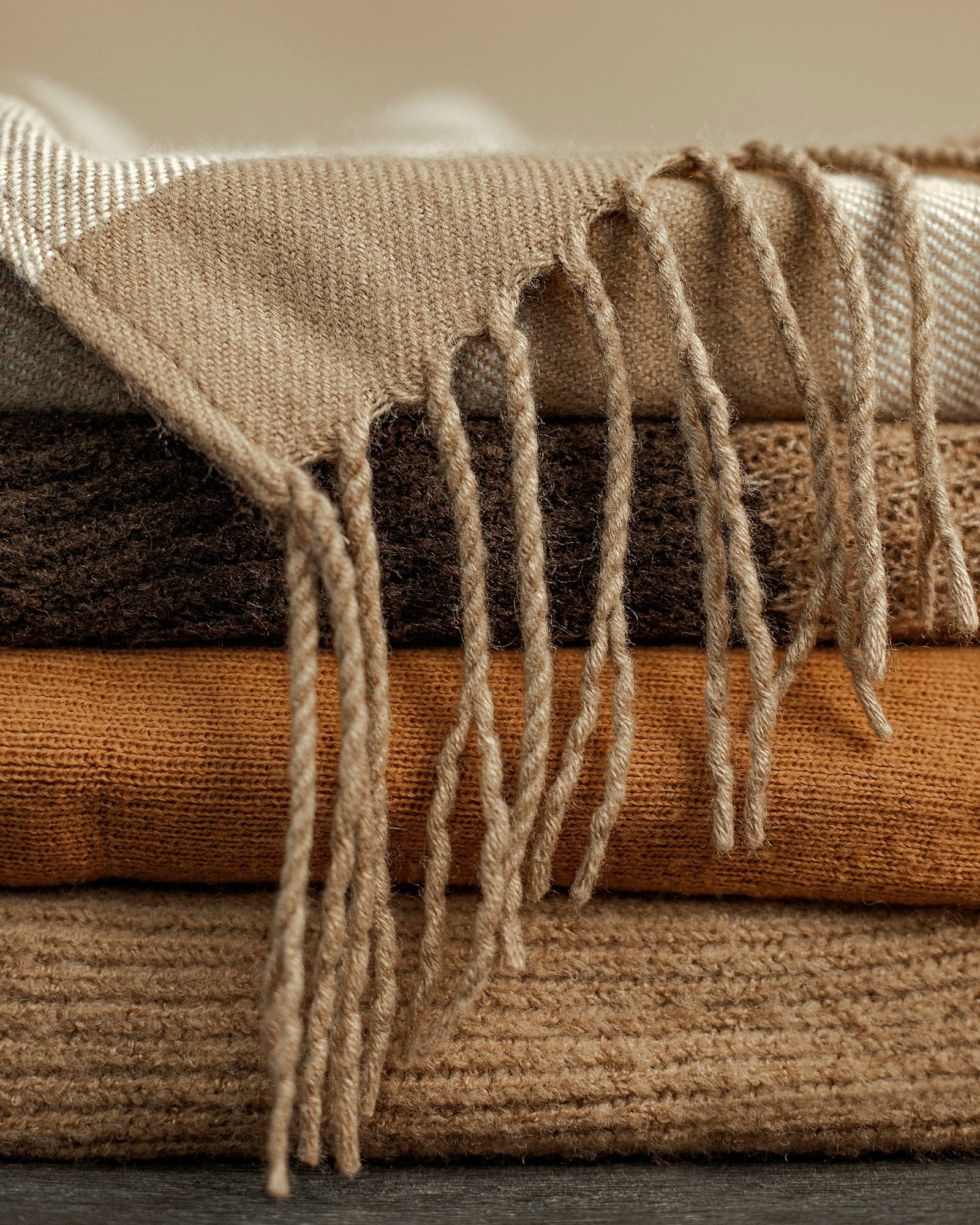
The subject, folded: a bank frame of folded knits with a fringed scarf among them, captioned as exactly that. Our bank holds no photograph of a scarf being worn, at any knot, on any neck, so no ranked scarf is pictured being worn anywhere on this page and no frame here is captioned as one. The knot rulings below are argued from the ranked field's published dimensions instead, which is the evidence this brief actually runs on. The care section prints the gap and the harvest list, as the Card that ranks the cloth prints it too.
Checked and updated October 2026
The ruling, up front: the scarf is the only garment whose styling is its construction. Every other piece in the wardrobe arrives manufactured, and styling is arrangement. A scarf arrives as a rectangle. The knot is its second manufacture, performed by the wearer every morning, and a bad one cannot be rescued by cut, cloth or price, because the knot is where all three are either spent or saved. This brief rules the manufacture. Verdict Card No. 37 ranks the cloth, and its rankings stand untouched here: the Begg x Co Vier at 84, the Johnstons of Elgin merino at 77, the COS pure cashmere at 76, the Drake's wool-silk at 75, the L.L.Bean Irish lambswool at 73, the Uniqlo cashmere at 72, the Acne mohair checked at 62, and the Burberry check cashmere at 72 sent home, named in this brief as a warning and styled nowhere. Over that field, four laws. The knot taxonomy is a ruling table, not a catalogue: the Parisian is the default, the once-around is the short scarf's knot, the drape is ruled by temperature and cloth, the ascot tuck is the wide cloth's knot, and two knots are banned outright. Length and width are law: every knot is sized against the Card's published dimensions, and a knot that only works at 180 by 70 is not a ruling for a scarf woven at 180 by 28. Cloth behaviour governs friction: cashmere drapes and is crushed by tight knots, lambswool holds a knot's architecture, wool-silk slides, and mohair's halo forbids friction altogether. And the coats decide the rest: what goes inside a formal overcoat, what a pea coat's closure allows, what a denim jacket refuses, and the colour order that runs it all. It is October, the first cold weeks of the year. The scarf comes out of the drawer now, and how it is tied is the whole of how it looks.
This brief: the knot rulings · the length law · cloth behaviour · the coat pairings · fringe and the tuck law · the looks · the mistakes · care and knot memory
The decisive rule: the knot is the second manufacture
A tailor manufactures a coat once, and well or badly it stays manufactured. A scarf is manufactured twice: once at the mill, where the cloth is woven, and once at the mirror, where the rectangle is given its shape, its hold and its register by the knot the wearer ties in it. The second manufacture is the one the street sees. It decides whether the neck is warm, whether the coat's line survives, and whether the finest cloth in the ranked field reads as a finished garment or as a blanket in transit. So this brief treats the knots the way the Card treats the cloth: as a short list of rulings with reasons, not a catalogue of possibilities. There are four knots in the taxonomy and two on the banned list, and every ruling in it is sized in the next section against real dimensions.
The Parisian: the default. Fold the scarf in half, wrap the fold around the neck, pull the two ends through the loop, and settle the loop at the throat. It is the default for three reasons that are properties, not preferences. It is self-adjusting: the loop tightens or slackens as the coat opens and closes, so the knot set at the door is still the knot at the desk. It fills the coat's V exactly, the folded bulk sitting in the open triangle of a tailored coat where the cold gets in. And its hold does not depend on friction: the ends are captive in the loop, so the knot works in a smooth wool-silk as honestly as in a grippy lambswool, a property no wrap knot has. Against a tailored coat there is no second candidate for the default, and a reader who learns one knot learns this one. Its conditions are real and they are the next section's subject: it is tied with a folded scarf, it spends length on the loop, and it asks for the working length the Card prints.
The once-around: the short scarf's knot, and the pea coat's. Lay the scarf around the neck, cross one end over the other once at the throat, and let both ends fall, or tuck them. No fold, no loop: the knot is a single crossing, and it spends the least cloth of any knot that holds, which is why it is the ruling for every scarf too short to fold. It is also the knot of the short coat, argued in the coat section: inside a pea coat's closure it is the only bulk the double-breasted front has room for. Its weakness is printed with its strength: the crossing holds by friction and by the coat over it, so in a sliding cloth worn with an open coat it loosens through the day, and the wearer re-crosses it at noon. That maintenance is the price of the short knot, and it is cheaper than the strangle of a forced Parisian.
The drape: no knot, ruled by temperature and cloth. The scarf laid around the neck, ends hanging, nothing tied. The drape is the register of wide cloth and mild cold, and it is ruled by both. By temperature: a drape finishes a neck; it does not seal one. In the first cold weeks, over a closed coat or a heavy knit, the hanging cloth covers the throat's front and the outfit is complete. In hard cold the drape is a pretence, two warm ends framing an open and freezing throat, and the honest move is a knot. By cloth: the drape belongs to width. A 50 or 70 centimetre cloth hangs in folded layers that read as the garment's design; a 28 centimetre cloth hangs as two straps, which reads as an untied knot rather than a chosen drape. Width drapes. Narrow cloth knots. The taxonomy is mostly that sentence.
The ascot tuck: the wide cloth's knot. Fold the wide scarf lengthwise until it behaves like a band, lay it around the neck, cross the ends once at the chest, and tuck them into the coat's closure or the neckline of the layer beneath, so what shows is folded cloth lying flat at the throat. The ascot is the dress register's knot, the heir of the cravat, and it exists because of the drape class's physics: cloth 50 to 70 centimetres wide cannot be knotted without bunching, argued in the length section, and a sliding wool-silk cannot be trusted to hold a wrap, argued in the cloth section. The tuck solves both at once: the coat holds what the knot cannot. It is also the taxonomy's one indoor survivor, the only form of the scarf that reads as part of the dress layer rather than as outerwear not yet removed, which is why the blazer pairing in the coat section is built on it.
The statement wrap: quarantined, not banned. The ranked field contains one scarf built for a knot of its own: the Acne mohair checked at 62, 250 centimetres of cloth whose knot is the double wrap, around the neck twice with an end left trailing, the scarf worn as the outfit's silhouette rather than its finish. This brief does not ban it, because it is a deliberate instrument bought for exactly that effect, and the Card prints its terms: convicted on price at list, acquitted on fibre, bought at the sale price by the reader who wants the silhouette. But it is quarantined from the defaults. The double wrap is a styling statement with a scarf attached, it obeys none of the laws below, and the reader who reaches for it as an everyday knot has bought the loudest scarf in the field to do the quietest job in the wardrobe.
The banned list. Two knots are refused outright, at any cloth, at any length. The full wrap, the neck brace: the scarf wound around the neck two or three times, drum-tight, ends tucked out of sight, until the head sits on a turret of cloth. It fails as warmth, because the trapped bulk insulates the scarf from the neck it was meant to cover; it fails as line, because it erases the neck and shortens the wearer by a head's proportion; and it fails as manufacture, because a rectangle wound into a brace is the one shape that uses none of the cloth's properties, neither its drape nor its length nor its fringe. The muffler wad: a wide cloth, the drape class's 50 to 70 centimetres, forced into a Parisian or a once-around and bunched into a ball at the throat. The wad spends the width the scarf was bought for and reads as a knot that lost an argument. Wide cloth is folded and tucked or it is draped. It is never wadded.
| The knot | The build | Sized for | Its register |
|---|---|---|---|
| The Parisian | Fold in half, ends through the loop, loop settled at the throat | The knot class: 180 long, 25 to 30 wide | The default: tailored coats, the filled V, the self-adjusting hold |
| The once-around | One crossing at the throat, ends falling or tucked | Short scarves, and any scarf inside a short coat's closure | The pea coat's knot, the neck warmer's honesty |
| The drape | No knot: laid around the neck, ends hanging | The drape class: 50 to 70 wide, in cold the outfit can handle | Mild cold, wide cloth, knitwear and open coats |
| The ascot tuck | Folded to a band, crossed at the chest, ends tucked into coat or neckline | The drape class, and sliding cloths at any width | The dress register: the blazer, the indoor survivor |
| The full wrap | Wound two or three times, drum-tight, ends hidden | Banned at every size | The neck brace: warmth, line and manufacture all refused |
| The muffler wad | Wide cloth forced into a knot and bunched | Banned at every size | The wad: the drape class's width spent on a ball |
Length and width as law: every knot is sized
The Card prints the dimensions, and the dimensions are not trivia. They are the sizing chart of this entire brief, because a knot is a machine built out of length and width, and a machine specified for one size of cloth jams in another. The ranked field falls into three published classes and one unpublished one, and the rulings of the taxonomy are issued class by class. A styling page that teaches one knot for every scarf is teaching a knot that only works at 180 by 70 and calling the failures taste. This page works the other way: the knot follows the number.
The knot class: 180 long, 25 to 30 wide. The field's standard, set by its winner: the Begg x Co Vier at 180 by 28, the Card's working dimension exactly. The Parisian's arithmetic explains the class. The fold halves the scarf before the knot begins, so the knot is tied with roughly 90 centimetres a side: the loop takes its share at the throat, and both ends still land on the chest with coverage to spare. At 28 wide the folded loop is a neat double band, bulk enough to fill a coat's V, not enough to fight its closure. Every default in the taxonomy is calibrated here, and a scarf bought to be knotted under coats should be bought to this class's numbers: 180 in length, the high twenties in width.
The drape class: 175 to 180 long, 50 to 70 wide. Two scarves in the field carry the width: the COS pure cashmere at 175 by 50, on its maker's Swedish store's figures, and the Drake's wool-silk at 180 by 70. Width changes the machine. Fold a 70 centimetre cloth in half for a Parisian and the loop alone is a pillow; wrap it once around and the crossing is a wad, the banned list's second entry, manufactured by arithmetic rather than by carelessness. What the width is for is surface: folded lengthwise into a band it gives the ascot tuck its layered front, and left open it gives the drape its folds. Even the class's length obeys the width: the COS at 175 runs five centimetres short of the working length, a deficit no knot at that width would notice, because the cloth was never meant to be knotted. Buy width for folding and draping. Buy length for knotting. The field's two wide scarves are the proof that the two purchases are different garments sharing a name.
The short-scarf problem, answered honestly. Below 160 centimetres the Card's law is unsparing: a scarf that length knots, strangles, and leaves the chest to the weather. The dishonest answer is the forced Parisian, the loop tied anyway, the ends arriving at the sternum like a bib and the wearer adjusting it all day in the hope it will grow. The honest answers are three, and they are employments, not consolations. First, the tucked once-around: one crossing, ends tucked down inside the coat, the scarf working as a throat seal under a closed front, which is a real job in real cold. Second, the ascot inside tailoring: a short scarf with any width to it, folded and tucked into a closed coat or a sweater's neck, reads as a dress layer and needs no length at all beyond the chest it crosses. Third, the chest layer: laid flat against the chest under a buttoned coat, fold at the throat, a gasket rather than a garment. What a short scarf cannot do is the full wrap with coverage, and a brief that pretended otherwise would be lying with the reader's money. The short scarf is a neck warmer with good cloth. Worn as one, it is honest. Worn as a failed 180, it is a costume.
The unpublished class, and how this brief handles it. Three of the field's seven ranked scarves publish no dimensions this desk could capture: the Johnstons of Elgin merino, whose US page states its fibre in words without a figure for length or width; the L.L.Bean Irish lambswool, praised by its maker for a generous length the maker never numbers; and the Uniqlo cashmere, whose US listing publishes neither. The Card charges each silence on its card, and this brief inherits the charge rather than laundering it into a guess. Their knots in the looks below are therefore argued from cloth and class, never from an invented centimetre: forgiving knots, the once-around and the inside-coat forms, that work across the plausible range of a mill's standard weave or a workwear scarf's generous cut. That is the styling consequence of unpublished dimensions, and it is a real one: a maker who will not print the size of a scarf is asking the wearer to tie blind, and the blind knots are the cautious ones.
Cloth behaviour: friction is a property, not a detail
Two scarves of identical dimensions in different cloth are different machines, because knots run on friction: on whether the cloth grips itself, slides against itself, or crushes under the pressure that holds it. The Card grades the fibres as cloth. This brief grades them as behaviour, and the behaviours rule which knots each scarf in the field is actually allowed.
Cashmere drapes, and must not be crushed. The field's two pure cashmere scarves, the COS at 76 and the Uniqlo at 72, share the fibre's defining behaviour: it falls. Cashmere's drape is its luxury, the cloth pouring into folds no knot arranged, and the same softness is its weakness under manufacture: a tight knot crushes the pile at the crossing, prints a crease the cloth remembers, and starts the wear exactly where the Card locates pilling, at the fold. So the cashmere rulings are looseness rulings. The Parisian tied easy, the loop settled rather than cinched. The drape worn inside a coat, where the coat does the holding. And the friction knots refused: a once-around pulled tight on cashmere is a crease being ironed in by hand, all day, at the throat. The Uniqlo's printed arc sharpens the point: short-staple cloth, roughly a three-year scarf, has fewer creases to spend than the COS's six-year class, and the reader who knots it hard is spending them at the fastest available rate. Verdict Card No. 42 grades the cashmere claim in sweater form, staple by staple; at the neck the same fibre asks for the same respect in a looser hand.
Lambswool holds the architecture. The winner's cloth, 90 percent lambswool in the Begg at 84, and the rugged fifth, the Bean's Irish lambswool at 73, behave as the opposite pole: a teasel-raised or yarn-dyed wool surface grips itself, so a knot tied at the door is the knot at the destination, its loop keeping the shape the morning gave it. Lambswool is the knot class's native cloth, the fibre the Parisian was effectively designed in, and its one tax is printed on both cards: the hand against a bare neck is heartier than cashmere's, a matter of skin the Card refuses to call for the reader. Behaviourally the ruling is simple. In lambswool, tie the knot you mean. It will still be the knot you meant at midnight.
Merino springs. The Johnstons at 77 is the field's tailored middle: fine, smooth, and springy, a cloth that takes a knot cleanly and releases it without keeping the crease, because the fibre's natural crimp is a memory for its own shape rather than for yours. Merino is the ascot's easiest cloth and the Parisian's most forgiving one, and its tartan weave adds the pattern law's one complication, argued in the coat section: a patterned scarf is a plain coat's partner. The mill's own care word for the garment, folded to store, is picked up in the care section, where it belongs: the spring that makes merino easy to tie makes it just as easy to store badly, one hard fold at a time.
Wool-silk slides, and its knots migrate. The Drake's at 75, 70 percent wool and 30 percent silk, is the field's smooth cloth, and silk's contribution to behaviour is slip: a wrap knot tied in wool-silk at breakfast has walked down the chest by noon, loosening a centimetre at a time, because nothing in the cloth's surface argues with gravity. This is not a defect to be managed with tighter tying, which only buys a wad that slides as a unit. It is the reason the ascot tuck exists. Tucked into a coat's closure or a neckline, the sliding cloth is held by the garment over it, and its slip becomes the drape's liquid fall in the folds that stay. Rule the cloth by its behaviour: wool-silk is tucked or draped, never trusted to a knot.
Mohair's halo forbids friction. The Acne's blend, alpaca first and mohair fourth on its own maker's split, is a brushed cloth, and a brushed cloth's surface is a halo of raised fibre that friction destroys on contact: every wrap rubs the halo flat at the crossing, and the maker's own page warns, in its own words, that it is natural for small fibres to shed over time. A friction knot on a brushed scarf is a machine for manufacturing bald patches and lint. So the statement wrap of the knots section is worn loose and open, the wraps resting rather than gripping, and the cloth is kept off dark tailoring for its first outings while the loose fibre leaves, on the Card's shedding routine. The halo is the garment. Knots that spend it are banned by physics, whatever the taxonomy allows the other cloths.
The coat pairings: the scarf is finished by what covers it
No scarf is worn alone. It is worn at the top of a coat or a knit, and the pairing is a negotiation between two collars, two lengths and two registers. The pairings below are ruled coat by coat, against the briefs that own each coat, and they end with the colour order, because the finest knot in the taxonomy fails over the wrong colour at the wrong coat.
The overcoat, No. 20: the Parisian's home. The long tailored coat of How to Wear No. 20 is the scarf's natural senior partner: its open V is the exact space the Parisian's loop was sized to fill, its length answers the scarf's length, and its formality sets the tuck law that the fringe section prints. In the overcoat the default runs at full specification: the Begg-class knot, loop at the throat, ends inside the coat per the formal law, the whole manufacture invisible except its result, a sealed and finished neckline. In milder cold the same coat worn open takes the drape, ends hanging outside, and the pairing drops a register on purpose. The overcoat is also the one partner that never argues with a long scarf: 180 centimetres against a knee-length coat is proportion, and the statement wrap's 250 is the only cloth in the field that can out-argue it, which is another way of stating the quarantine.
The pea coat, No. 19: the knot goes inside the closure. The pea coat of How to Wear No. 19 is a short, double-breasted coat with a collar built to stand, and its geometry writes the scarf ruling without appeal. The double-breasted front has no open V to fill; it has a closure, and the scarf lives inside it: the once-around, crossed once at the throat, ends tucked down inside the buttoned front, the collar standing over the whole arrangement when the weather earns it. Two pairings are refused here by name. Ends hanging outside a buttoned pea coat fight the double-breasted front, cloth over buttons over cloth, the outfit's neatest coat made scruffy at its neatest point. And the Parisian's loop, bulk the closure has no room for, rides above the collar like a life ring. Collar up and scarf inside, the pea coat assembly is the warmest short form in this brief; it is also the Johnstons tartan's home, argued in the looks.
The blazer, No. 03: the ascot, and the indoor ruling. With tailoring worn as a jacket rather than a coat, the scarf changes species. The knotted scarf over a blazer, the assembly of a man who has come in from the cold and not finished arriving, reads as outerwear indoors, and this brief's ruling is that the scarf comes off with the coat class, in the same motion, for the same reason. One form survives indoors, and it survives because it is not outerwear: the ascot tuck of How to Wear No. 03's register, wide cloth folded and tucked into the blazer's open front or a sweater's neckline, the Drake's class worn as a dress layer in the cravat's line of descent. The distinction is the whole ruling: a knot announces weather, a tuck announces dress. The blazer takes the tuck and refuses the knot, and the reader who wants a neck layer with tailoring all evening is shopping for the ascot's cloth, 50 to 70 wide, silk in the blend, printed if the outfit is plain enough to carry it.
The denim jacket, No. 16: refused, with one exception. The refusal first, argued on geometry. The trucker of How to Wear No. 16 is waist-length with a shirt collar, the shortest coat in the wardrobe. Buttoned, its collar has no room for a knot: the Parisian's loop rides against the jaw or spills over the placket, and any scarf long enough to knot properly hangs past the jacket's hem, the outfit's two lengths publicly disagreeing. A long garment over a short one is a proportion error before it is anything else, and no cloth in the ranked field is short enough to fix it by being expensive. The exception is the season's first cold weeks, and it is a drape, not a knot: the jacket worn open, the scarf laid around the neck outside the collar, ends hanging in front and cut off by the rule that they end at or above the jacket's hem, which in practice means the once-around worn loose with its ends tucked, or a shorter scarf draped and left. The scarf does the warming the denim cannot, the jacket keeps its line, and the pairing reads as layers rather than as a mismatch. Full knots under a buttoned trucker, and long wraps over one, stay refused.

Knitwear and the sweatshirt, No. 23: the drape's casual register. Over knitwear there is no closure to negotiate, and the scarf drops to its loosest forms: the drape over a heavy crew, the loose Parisian over the sweatshirt of How to Wear No. 23, ends hanging outside because there is no inside to tuck them into. This is the Uniqlo cashmere's home ground in the looks below, attainable cloth in the casual register, tied easy per the cashmere looseness rulings. It is also where the colour order does its loudest work, because over a plain knit the scarf is the outfit's entire upper register, pattern and colour both, which brings the brief to the order itself.
The colour order, printed coat by coat. Against a navy coat: mid grey first, the cold wardrobe's most reliable contrast and the winner's own colour family, the Begg in its light grey weave; camel and tan second, the warm answer; cream third, the brightest register; deep green and burgundy after, as colour with intent. Against charcoal: cream comes forward, then burgundy, then camel; charcoal is the coat that most needs the scarf to supply the temperature. Against black: mid grey or a pattern on a light ground, and never a black scarf, which disappears into the coat and shows only its lint, the dark pairing the Card's shedding routine warns about in reverse. Against a camel or tan coat: navy first, the deepest contrast the drawer owns, then deep green, then charcoal. And over every coat in the list, one pattern per neck: a checked or tartan scarf on a plain coat, a plain scarf on a checked coat, never both at once, because two patterns at the throat is two arguments in the outfit's smallest space. The Johnstons tartan obeys the law it benefits from. The Burberry check is the law's standing exhibit of the stakes: a pattern so identified with its maker that the Card prices the pattern itself at roughly $250 over the same mill's plain cloth, and a pattern that expensive should at least be the only one in the outfit.
Fringe, and the tuck law
The fringe is the scarf's hem made visible, and it is the garment's casual signature: the Begg's fringed ends, the Drake's eyelash fringe, the Acne's 12 centimetres of it inside its 250. A fringed scarf announces the register its maker built it for, and the styling law follows the announcement. Outside casual coats, the fringe hangs and shows. Over the pea coat worn open, over knitwear, over the chore coat class, the fringe is part of the cloth's movement and the outfit is poorer tucked. Inside formal tailoring, the fringe is tucked with the ends. Fringe escaping a formal overcoat's closure is the one detail that undoes an otherwise correct tuck: it reads as the scarf not finished being put on, a hem escaping a suit. And at any register, never knot through the fringe: the knot is tied in the cloth above the fringe line, because a knot that swallows the fringe crushes the one part of the scarf built to move, and works itself loose on the fringe's slip while it does it.
The tuck law, stated whole. Over a formal coat, both ends go inside. The loop of the Parisian sits at the throat, the ends run down inside the coat against the chest, the fringe goes with them, and the scarf presents to the room as a finished neckline and nothing else: worn as a throat, not as a banner. Over casual coats the law reverses: the ends hang outside, roughly even, where the cloth can be read. The one licensed asymmetry is the drape's thrown end, one end carried over the shoulder, and it is licensed narrowly: the drape only, in still air, in casual rooms. In wind it unwraps the neck it was decorating and trails into other people's space; in a formal room it reads as disarray arriving. Symmetry is the default because the scarf is a balanced garment on a centred body, and every departure from it is a claim the wearer should be making on purpose.
The looks: the field, tied
Four assemblies, each built from Verdict Card No. 37's ranked field and this brief's rulings, each tied in the knot its scarf's dimensions and cloth allow. The Burberry check cashmere appears in no look on this page, by the Card's verdict and this brief's agreement: a cloth whose own maker documents the mill that weaves it, sold at $545 against that mill's $250, gets cited as the pattern law's exhibit, as it is in the coat section. It does not get styled.
Look one: the tailored default. The Begg x Co Vier at 84, the field's winner and its knot class entire, tied in the Parisian and worn inside a navy overcoat on No. 20's pairing: loop at the throat, ends and fringe tucked down inside the coat, mid grey against navy at the top of the colour order. This is the assembly the taxonomy was built around, the default doing the default's job at the field's highest score: lambswool holding the loop's architecture from door to destination, the self-adjusting knot filling the coat's V, nothing hanging, nothing announcing itself. When one scarf and one coat have to carry a winter's worth of formal mornings, this is the form it takes, and the Card's arithmetic stands behind it at €133.95 for the scarf that does it.
Look two: the pea coat knot. The Johnstons of Elgin merino at 77, tied once around and tucked inside the pea coat's closure on No. 19's ruling, the tartan against a plain navy or charcoal coat under the one-pattern law, the coat's collar standing over the arrangement in real cold. The knot is chosen for a second reason this brief prints rather than hides: the maker's US page publishes no dimensions for this scarf, so the knot argued for it is the forgiving one, the single crossing that works at any plausible length a vertical mill weaves to, tied blind the way the maker, by its silence, asks. Merino's spring does the rest, holding the crossing and releasing the crease at night. At $280 the scarf is the connoisseur's paperwork problem; worn this way, inside the closure of the coat built for it, the paperwork is the only problem it has.
Look three: the dress drape. The Drake's wool-silk at 75, all 180 by 70 centimetres of it, folded lengthwise to a band and ascot-tucked into the open front of a blazer on No. 03's ruling, or, over knitwear in milder cold, left as the full drape it was cut for, the printed unicorn cloth in folded layers at the throat. The sliding cloth is held by the tuck, the width reads as pattern and surface rather than as bulk, and the print is the outfit's one pattern, everything around it plain. The attainable version of the same fold is printed beside it: the COS pure cashmere at 76, 175 by 50, folded across its width and tucked the same way, cashmere's drape doing in a plain cloth what the Drake's does in a printed one, at $135 against $395. Two prices, one manufacture: the fold is the knot, and it is the wide cloth's only honest one.
Look four: the attainable cold. The Uniqlo cashmere at 72 over the sweatshirt of No. 23, tied in a loose Parisian or left draped in the casual register, the knot kept easy per the cashmere looseness rulings, because this cloth's three-year arc is spent at its fold and the wearer who cinches it is spending faster. Beside it, the outdoor version of the same budget: the L.L.Bean Irish lambswool at 73, once around with the ends out over an open coat or a heavy knit, the rugged cloth in the knot that asks least of it, at $59.95 the cheapest serious year in the Card's table at $0.15 a wear. Between the two, the attainable drawer is covered indoors and out for less than the price of one designer fringe, and both scarves are tied the way their cloth, not their price, dictates, which is the whole doctrine of this page in one look.
The ruling
Buy the scarf by its dimensions and tie it by the same numbers. The knot class, 180 by the high twenties, takes the Parisian as its default and the once-around as its reserve; the drape class, 50 to 70 wide, is never knotted at all, only folded, tucked and draped; the statement length is a silhouette, quarantined from the defaults; and a short scarf is a neck warmer, employed honestly at the throat of a closed coat rather than failed at a wrap it cannot reach. Tie by cloth as well as by size: lambswool holds the knot you tie, merino forgives it, cashmere is crushed by it and asks for a loose hand, wool-silk slides out of it and must be tucked, and a brushed halo is spent by friction and is never knotted hard. Finish by the coat: inside the formal overcoat, inside the pea coat's closure, tucked as an ascot at the blazer, refused at the denim jacket except as a drape in the first cold weeks, and coloured by the order, grey on navy first and one pattern per neck always. Store the result rolled, never hung, never knotted, and rotate the fold before the fold becomes the crease the pills colonise. The field is ranked and this brief has not touched a number: the Begg at 84 is the reference and the default's scarf, the Johnstons at 77 is the pea coat's, the Drake's at 75 is the drape's, the Uniqlo at 72 is the attainable lesson in tying gently, and the Burberry at 72 is the warning that keeps the category honest. A scarf is a rectangle that becomes a garment at the mirror. Manufacture it well.
The mistakes
The neck brace, worn daily. The banned full wrap is the commonest scarf failure in cold cities: wound tight, ends hidden, the head on its turret. It reads as an injury, it photographs as a shortening, and it wastes the cloth entirely, because a brace uses none of the scarf's length, drape or fringe, the three things the money bought. Its wearer is usually defending against cold the knot cannot answer, and the honest repair is a real knot, the Parisian's loop sealing the throat, under a coat closed over it. Warmth lives in the seal at the neck and the layer over it, not in the number of turns.
The drum-tight knot on cashmere. Cashmere's whole value is drape, and a cinched knot is drape's opposite: the crossing crushes the pile, prints the crease the cloth will remember, and opens the pill line at exactly the fold the Card grades. The mistake is usually anxiety, a smooth cloth loosening once and being punished for the season. The repair is the taxonomy: tie the Parisian easy and let the loop's captivity, not its tightness, do the holding, or move the scarf to the drape inside the coat, where the coat holds and the cashmere only has to fall. A cashmere scarf should look poured, never strangled, and the hands that tied it are the whole difference.
Two patterns at the neck. A checked scarf over a checked coat, a tartan over a patterned knit, a printed scarf competing with a striped shirt at the same throat: the eye gets two arguments in the outfit's smallest and most looked-at space, and both lose. The law is one pattern per neck, and its discipline is simple because the drawer is small: plain coats take the field's patterned cloth, the Johnstons tartan and the Drake's print, and patterned coats take its plain one, the Begg's light grey weave and the COS's unprinted cashmere. The reader with a checked coat and a checked scarf owns two good garments and no outfit at the neck, which is a shopping problem with a one-scarf answer, and the answer is plain.
The Parisian forced on a short scarf. The length-blind knot: the loop tied in a scarf under 160 centimetres, the ends landing at the sternum, the chest open to the weather the scarf was bought against, the wearer re-settling it at every corner in the hope the cloth has grown. It fails the Card's size law in public, and it fails kindly, which is why it persists. The repair costs nothing: demote the scarf to its honest employments, the tucked once-around, the ascot, the chest layer under a closed coat, and buy the next scarf at the working length. A short scarf worn as a neck warmer looks deliberate. The same scarf worn as a failed wrap looks like a mistake the wearer has not noticed, which is the one impression no garment in this field, at any score, was bought to make.
Care, and knot memory
The Card prints the fibre physics and care follows it: a scarf wears where it is folded and rubbed, at the fold line and under the coat's lapel, which is where loose surface fibre balls into pills. The knot is the fold's daily form. Tie the same knot at the same place every day and the cloth takes the knot as a crease, a printed line across its middle where the bending concentrates, and that line pills first, thins first, and dates the scarf before its cloth is spent. Knot memory is not a metaphor. It is the scarf learning the shape it is stored and worn in, and care is the discipline of teaching it no single shape.
The management, in the order of the wears. Rotate the knot through the week, Parisian one day, once-around the next, the drape where the cold allows, so the fold travels and no single line does all the bending. Vary the fold itself when the Parisian is tied, a few centimetres either way, the cheapest care in this brief. Rest the scarf a day between wears, the Card's standing rule, so the fibres recover what the day took. Comb the fold line when the first pills show, with a cashmere comb whatever the fibre, because the fold is where they will show first and a comb at the first showing is maintenance while a comb at the hundredth is archaeology. And brush a new brushed scarf down before it goes on rather than after it comes off, the Card's shedding routine, keeping the loosest fibres off dark tailoring for the first few outings.
Storage: rolled, never hung, never knotted. A knitted scarf hung on a hook or over a hanger stretches under its own weight through a winter, and takes the hanger's point at its middle, a ready-made crease at exactly the fold line the knot then colonises. A woven scarf over a bar takes the bar's single hard crease, pressed in by its own hanging weight. Rolling has neither failure mode. Roll the scarf loosely around the hand, comb the fringe straight before it goes in, because a fringe stored tangled keeps the tangle, and lay the roll in a drawer or a box with nothing stacked on it. The field's own maker prints the same law in its own words: the Johnstons of Elgin merino is sold with the instruction dry clean, folded to store. Folded loosely or rolled, the principle is one: the scarf rests flat or curled, never suspended, and never, on any night of its life, stored in the knot it was worn in, which is the one storage position guaranteed to set the crease the next sections of its life will pill along.
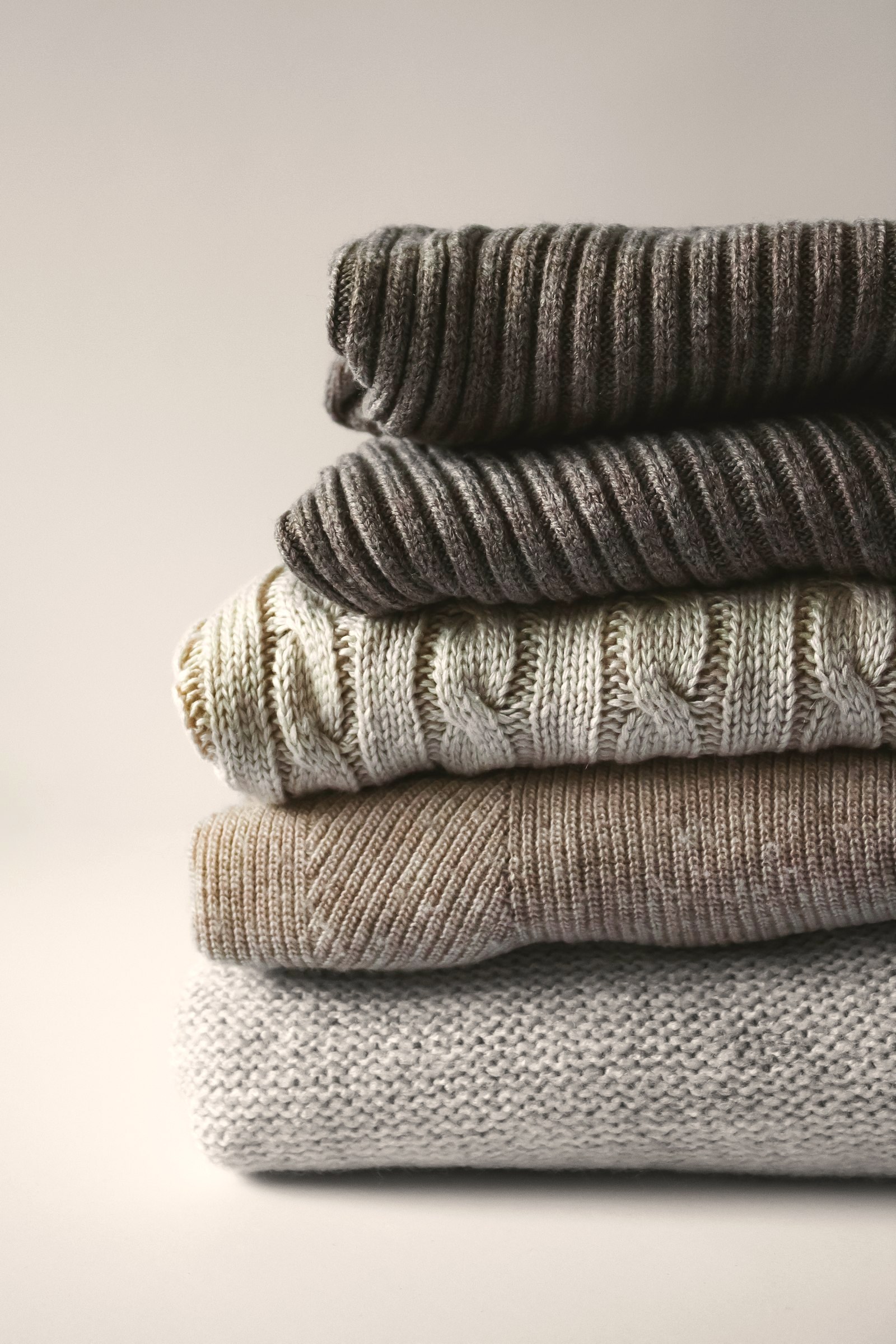
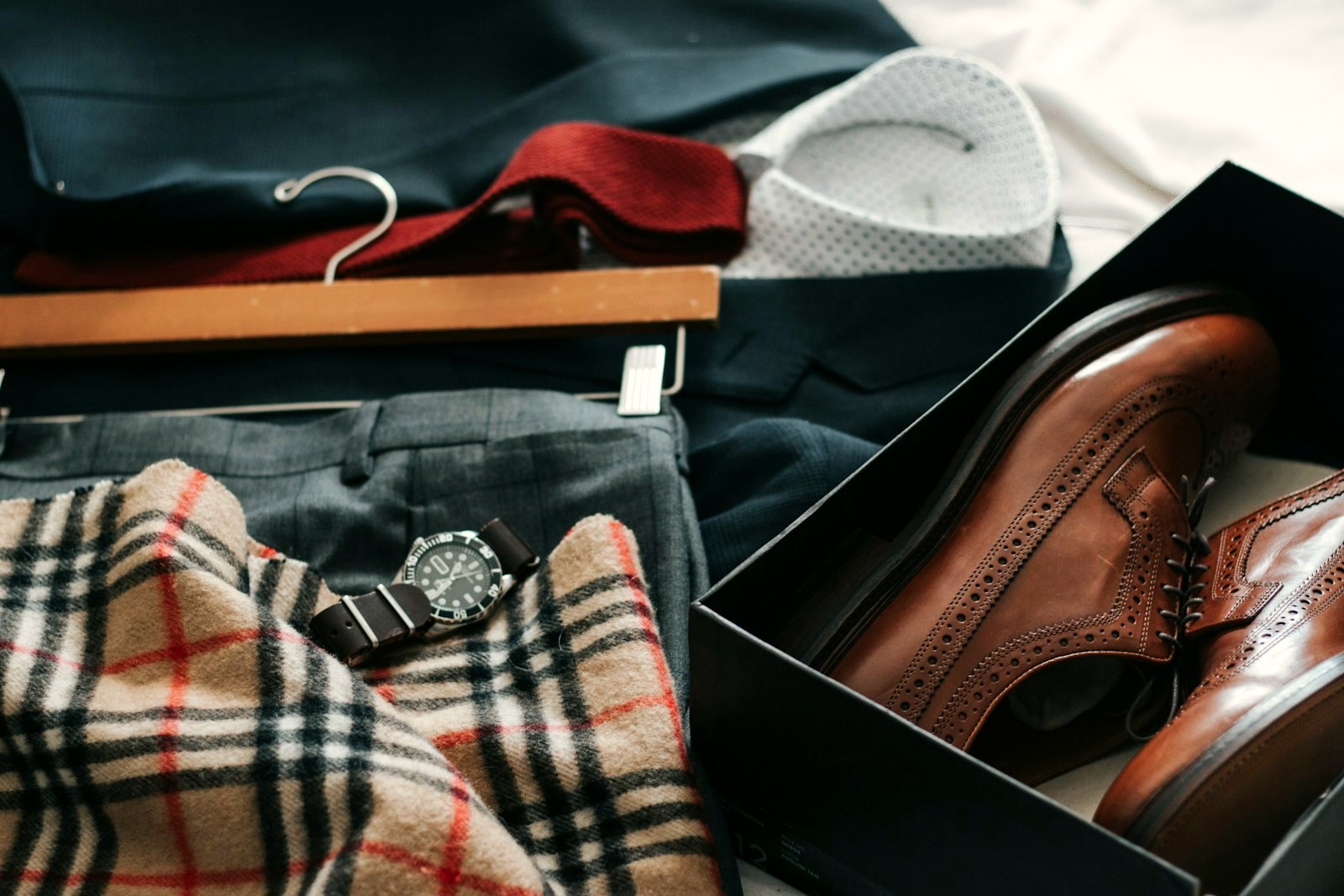
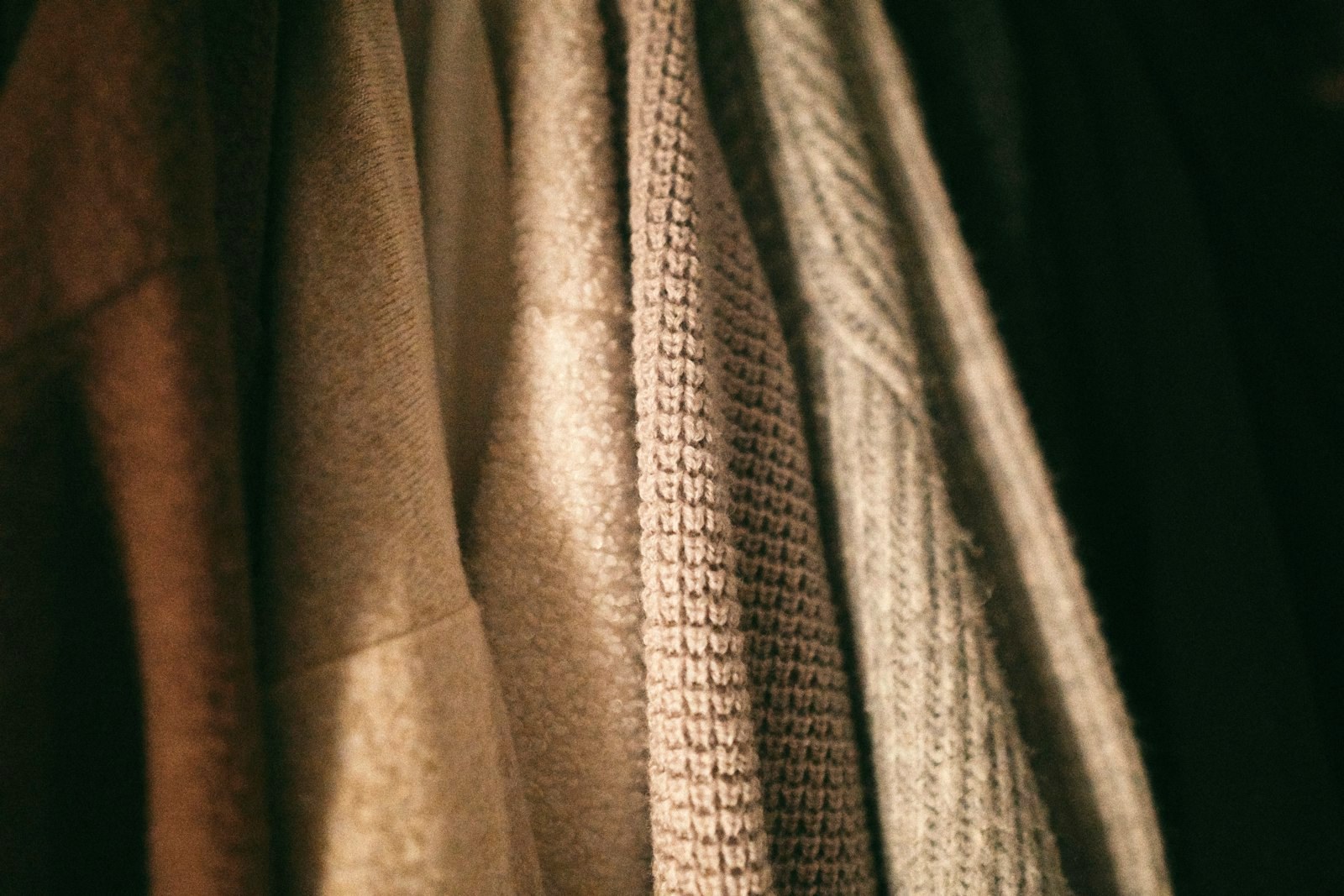
A note on our own photography, printed in the same place the Card prints its own: our photo bank holds no scarf being worn. No Parisian on a neck, no ascot at a blazer, no fringe in a hand, no knot-memory crease in macro exists in the bank, and the one frame that contains a scarf at all is the hero, folded among knits, captioned as folded. The frames inside are the flat-lay the check belongs to, the knit surfaces the friction rulings are argued from, the denim jacket of the refusal, and the folded stack of the storage law, each captioned for exactly what it shows and none dressed as the subject. The harvest list names what is missing: a scarf wrapped on a neck in window light, the Parisian tied in stages, a teasel-raised cloth in macro, a fringe combed straight in hand, and this page will take those frames the week they exist, and retire this paragraph.
Questions, answered
What is the best knot for a scarf?
The Parisian, as the default: fold the scarf in half, wrap the fold around the neck, and pull the two ends through the loop. It is the default because it is self-adjusting, it fills the open V of a coat exactly, and its hold does not depend on friction, so it works in smooth cloth and brushed cloth alike. Its one condition is length: it is a full knot tied with a folded scarf, and it asks for the working length, the 180 centimetres Verdict Card No. 37's winner is woven to. Below that length the loop spends the cloth and the chest goes short, and the honest knot changes to the once-around. Every other knot in this brief's taxonomy is a specialist: the once-around for short scarves and short coats, the drape for mild cold and wide cloth, the ascot tuck for the drape widths. The Parisian is the generalist, and a wardrobe with one scarf and one coat needs the generalist first.
How long does a scarf need to be for the Parisian knot?
About 180 centimetres for the knot with coverage, on the size law Verdict Card No. 37 prints. The Parisian folds the scarf in half before it starts, so the knot is tied with roughly 90 centimetres a side: enough for the loop at the throat and both ends still covering the chest. The ranked field's knot class is built to it, the Begg x Co Vier at 180 by 28. At 175 the knot still works and the ends run shorter, and the COS at 175 by 50 is wide enough that its width is folded across as well, or it is moved to the ascot tuck its width prefers. Under 160 centimetres the answer changes honestly: the Card's law is that a scarf that length knots, strangles, and leaves the chest to the weather. Wear a short scarf once around with the ends tucked, or tucked as an ascot inside a closed coat, and let it be a neck warmer rather than a failed wrap. Three scarves in the ranked field publish no dimensions at all, the Johnstons, the Bean and the Uniqlo, and their knots in this brief are argued from their cloth and their class, never from an invented number.
Which knot suits a wide scarf?
None, and that is the ruling: width is not knotted, it is folded and tucked. The drape class in the ranked field runs 50 to 70 centimetres wide, the COS pure cashmere at 175 by 50 and the Drake's wool-silk at 180 by 70, and a cloth that wide forced into a Parisian or a once-around bunches into a wad at the throat that spends the very width it was bought for. The wide scarf's knot is the ascot tuck: fold the cloth lengthwise until it behaves, lay it around the neck, cross the ends at the chest and tuck them into the coat or into the neckline of what is worn beneath, so the width reads as folded layers at the throat. Or wear it as the drape it was cut for, open over knitwear, in cold the rest of the outfit can handle. Wide and flat is the dress register; wide and knotted tight is the muffler wad, and the wad is on this brief's banned list.
Should scarf ends go inside or outside a formal coat?
Inside, both of them, and the knot goes with them. The tailored law this brief prints: over a formal overcoat the scarf is worn as a throat, not as a banner. The Parisian loop sits at the collar, the ends run down inside the coat against the chest, and nothing hangs outside but the fold at the throat. Ends hanging outside a formal coat belong to the drape register, an open coat in milder cold, and carried into a formal room they read as an arrival that never finished. The fringe obeys the same law: fringe is the scarf's casual signature, and fringe escaping a formal coat's closure is the one detail that undoes the tuck. The casual coats reverse the law: over an open pea coat, a chore coat or knitwear, the ends hang outside where the eye can read the cloth, and the fringe is shown on purpose.
Can you wear a scarf with a denim jacket?
Not knotted, with one exception, and the refusal is geometry before it is taste. The trucker of How to Wear No. 16 is a waist-length jacket with a shirt collar. Buttoned, its collar has no room for a knot, which rides up against the jaw or spills over the placket, and any scarf long enough to knot properly hangs past the jacket's hem, two lengths in an argument. The exception is the drape in the first cold weeks: the jacket worn open, the scarf laid around the neck outside the collar, the ends hanging in front and no lower than the hem, the cloth doing the warming the denim cannot. The short once-around, ends tucked and above the hem, passes the same test. What never passes is the full knot under a buttoned trucker, or the long wrap worn over one. The scarf is a long garment and the trucker is a short one, and the pairing works only when the scarf agrees to be short too.
What colour scarf goes with a navy coat?
Mid grey first, on this brief's printed order. Grey against navy is the cold wardrobe's most reliable contrast: light enough to read across a street, quiet enough to stay tailored, and it is the colour family of the ranked field's winner, the Begg x Co Vier in its light grey weave. Camel and tan are second, the warm answer. Cream is third, the brightest register, for the darkest days and the plainest coats. Deep green and burgundy follow, as colour worn with intent. Two refusals are printed with the order. Never a black scarf on a navy or black coat, where the scarf disappears into the coat and only its lint shows. And never a second pattern against a patterned coat, because one pattern per neck is the law of this brief: a checked or tartan scarf belongs on a plain coat, and a checked coat takes a plain scarf.
How should a scarf be stored?
Rolled or loosely folded, in a drawer, never hung, and never in the knot it was worn in. A knitted scarf hung on a hook or a hanger stretches under its own weight and takes the hanger's point at its middle. A woven scarf folded over a bar takes a single hard crease at the fold, pressed in by its own hanging weight. Rolling has neither failure: roll the scarf loosely around the hand, comb the fringe straight before it goes in, and lay it where nothing stacks on it. The maker of the ranked field's second scarf prints its own version of the same law: the Johnstons of Elgin merino is sold with the instruction dry clean, folded to store. The knot belongs to the same physics. Cloth remembers where it is repeatedly folded and knotted, and the fold line is where Verdict Card No. 37 locates pilling, at the fold and under the lapel. Rotate the knot and the fold position through the week, rest the scarf a day between wears, and store it flat or curled rather than suspended, so no single line does all the bending.
Has Young Cotton ranked scarves?
Yes. Verdict Card No. 37 ranks seven and sends one home, scored on cloth, construction, fit and dimensions, value and longevity. The Begg x Co Vier wins at 84, 90 percent lambswool and 10 percent cashmere at 180 by 28 centimetres, at €133.95. The Johnstons of Elgin merino follows at 77, the COS pure cashmere at 76, the Drake's wool-silk at 75, the L.L.Bean Irish lambswool at 73, the Uniqlo cashmere at 72, and the Acne mohair checked at 62, acquitted on its fibre and convicted on its price. The Burberry check cashmere is the skip at 72: Burberry's own heritage page states that Johnstons of Elgin weaves it, and the mill's own-label cashmere scarf sells at $250 against the check's $545. This brief styles that ranked field; it does not re-score it, and every knot ruling here is sized against the dimensions the Card published.
Next
The ranked field this brief ties is Verdict Card No. 37, every fibre split, dimension and price printed. The cashmere cloth the looseness rulings protect is graded in sweater form in Verdict Card No. 42. The coats are briefed in How to Wear No. 20, No. 19 and No. 03, the refused partner in No. 16, and the knit the attainable look hangs over in No. 23. The winter shelf the scarf completes, coats, knits and the rest of the cold drawer, is ranked throughout the Verdict Cards and styled throughout this series.