

The suit and the shirt, captioned as what the frame shows: the bank holds no frame of the open collar under tailoring in which the collar itself reads at size, and the care section prints that absence rather than dressing another outfit as this one. The collar this brief is about stands at close range in the figure inside.
Checked and updated October 2026
The ruling, up front: a suit without a tie is not the suit with a piece missing; it is the suit with its formality re-anchored, and it works only where the re-anchoring is done deliberately. The tie did three jobs: it drew the outfit’s one vertical line down the chest, it held the collar’s architecture under tension, and it banked a measurable quantity of formality at the throat. Remove it and all three jobs fall vacant at once. This brief fills them in order. The collar is the garment: it must stand open and frame the neck, spread and cutaway the licensed species, the collapsed collar the capital failure. Exactly one button opens as the default; the second is a licence with printed conditions. And the formality the tie carried is repaid elsewhere: the shoe polished a step up, the pocket square licensed as the replacement colour instrument and disciplined, the belt and metals kept quiet and matched. Inside those laws this brief prints the shirt species table, the failure modes, the suit species that license the outfit, the rooms, and the knit alternatives that are its winter form. On scores: no garment is scored here. The numbers quoted are the tree’s Cards, cited as what they are.
This brief: the decisive rule · the collar species · the shirt table · the button count · the repayment · the failure modes · the suit species · the rooms · the knit alternatives · the looks · the mistakes · care and our photography
The decisive rule: the tie’s three jobs fall vacant, and the shirt inherits them
Every brief in this family rules a garment or a pairing, and two of them have already touched this outfit without making it their subject. How to Wear No. 04, the suit brief, prints the system this page takes as its premises entire, the fit fitted in order, shoulder, stance, break, cuff, and its outfit matrix licenses the open collar in named rows: the wedding guest’s summer version, a tie or an open collar with a square; the evening row, a dark tie, or none with a white square; the travel row, a knit tie, or none. How to Wear No. 60 rules the neighbouring removal, the roll neck installed in the shirt and tie’s place together, and prints the ceilings this page inherits. What neither prints, because neither is the open collar’s page, is the law of the removal itself, and the law begins with an inventory. The tie is the smallest garment in the suit’s assembly and the busiest. It draws the outfit’s only vertical line, a continuous stroke from the throat to the belt that lengthens the torso and gives the eye its route down the chest. It tensions the collar, the knot sitting in the collar’s V and holding the two points in their architecture against the neck, so that a tied collar is a collar under management. And it banks formality: a quantity of ceremony, legible in every room, stored in four inches of silk at the throat. A man who removes the tie has not simplified the outfit. He has struck its line, its tension and its bank in one gesture, and the outfit stands or falls on whether the vacancies are filled or merely left.
So the decisive rule is a succession. Removing the tie removes the suit’s one vertical line and its formality anchor, and the shirt must do the tie’s work. The line’s job passes to the collar and the opening beneath it: the standing collar and the shallow V of one open button draw, between them, the shortened vertical the chest still offers, and they draw it only if the collar stands, because a collapsed collar draws nothing and the chest reads as a field with a shirt on it. The tension’s job passes to the collar’s own construction, its band’s height and stiffness and its points’ cut, which is why the collar, an accessory’s frame in the tied outfit, is promoted here to the garment itself, the piece the whole assembly is graded by. And the bank’s job, the formality, passes out of the throat entirely and is repaid at the outfit’s other stations, the shoe, the square, the metals, under the repayment law printed below. The succession is the brief’s whole doctrine, and its teeth are the same reciprocal charge the pairing brief prints: the vacancies are read together. A standing collar over a scuffed shoe is a claim the ground floor contradicts; a polished shoe under a collapsed collar is money spent below a failure at the throat, where the eye settles first. The open collar is graded as a system or it is not graded at all, which is the difference between this outfit and the accident it is most often mistaken for, the tied outfit at the end of a long day, tie in pocket, collar surrendered, one station of the system still dressed and the rest stood down.
The scored record under the law is the tree’s, printed here as the outfit’s exhibits, because the removal this brief rules is the removal of a graded thing. Verdict Card No. 40 ranked the tie shelf on its published records, weave over print down the whole table, and its severest sentence is the one this brief borrows for the tie’s value: a tie is graded on whether its pattern is in its cloth or on it, an instrument of woven structure, and the Card’s named impostor, the BOSS tie sold under the name Silk H-Tie at sixty percent silk and forty percent polyester on its retailer’s own details line, stands in prose on that page, unranked and unscored, a reminder that even the tie’s own shelf polices what the word tie may claim. The suits stand at Verdict Card No. 64, seven off-the-rack suits ranked, the Spier & MacKay Core Suit winning at 85, printed on No. 04 and cited here as the suit’s record. The shirt stands at the Oxford Verdict ranking, Ranking No. 01 of the Oxford Files, its winner the Kamakura at 93, the shelf this brief’s shirt table is drawn from. Nothing in this brief is scored; those numbers are garment scores on garment Cards, and what they establish for this page is that every party to the removal, the suit, the shirt and the tie itself, has been bought and graded on its own evidence. What remains is the wearing of the absence, which is this page’s jurisdiction entire.
The collar species: the collar is the garment
The collar law follows from the succession, and it is printed as species because collars fail and succeed by kind before they fail by example. A tied collar is held: the knot fills the V, tensions the points, and forgives a soft band and a tired construction because the assembly is under management. An open collar is unheld, and everything the knot forgave is exposed: the band’s height, the points’ length and cut, the cloth’s willingness to stand. The licensed collar is therefore the one that stands open and frames: the band tall enough to hold its height against the neck without the knot, the points long enough to reach toward the jacket’s lapels and stay there, the whole frame reading as architecture rather than as cloth at rest. Grade any collar by the end of the day rather than the beginning of it, because the open collar’s working life is measured in hours of standing unheld, and a collar that frames at nine and folds by noon has failed at the length of a working morning.
The spread collar is the brief’s default species. Its points open wide, which under a tie spreads them around the knot, and without one spreads them around the opening, the frame’s two sides drawn apart at the angle the V beneath them wants. A spread of moderate width, in a band with real height, stands open all day on its own construction, and its width does the framing the rule demands: the eye takes the collar’s horizontal, then the opening’s short vertical, and the chest keeps its order. The cutaway is the licensed extreme, its points cut back further toward the horizontal, and it is ruled with its condition: the cutaway is the most architectural of the open collars and the least forgiving, demanding the tallest band and the crispest cloth on the table, because a point cut that far back has the least cloth left to stand with. Worn in poplin with its stays in, it is the dressed rows’ sharpest frame. Worn tired, it is the first collar on this page to fold, and it folds outward, wings over the lapels, the failure mode the next sections name.
The button-down is licensed on a condition, and the condition is the brief’s most useful ruling. The button-down’s points are buttoned to the shirt’s body, which is a built-in management the other species lack, and a button-down whose points stand buttoned and crisp holds its frame open respectably, the Oxford of the shirt table being its home cloth. The failure is not the species; the failure is the collapsed button-down, the shirt worn past its crispness, points gone soft at the button, the wings folding flat against the chest or curling at their tips, the collar reading as a thing that has given up. A collapsed collar of any species fails the rule, and the button-down is named because its collapse is the commonest in the wild, the office shirt at its third wearing, asked to do the tie’s work on a laundry cycle’s evidence. The ruling is a discipline rather than a ban: the button-down goes under the open-collar suit on the day it is pressed, and retires to the tied rows and the weekend as it softens. The band collar is refused entire. The band, the grandad, the mandarin collar removes the collar along with the tie, striking the frame as well as the line, and under tailoring the throat is left with nothing to read: no points, no frame, a band of cloth where the outfit’s most-judged junction stands. The band collar has its own garments and its own briefs in the wardrobe’s casual rows. Under a suit, in the outfit whose whole law is that the collar must do the tie’s work, a collar that has resigned the work before it began is the one species with nothing to grade.
The shirt table: three cloths under tailoring, ruled
The shirt is graded after its collar, by its cloth, because the cloth decides how long the collar’s architecture survives and how much of the tie’s smoothness the shirt must supply on its own. The table prints the three species the open-collar suit is actually worn with, each ruled under tailoring, and the Oxford’s record is the table’s anchor: the Oxford shelf is ranked entire at the Oxford Verdict ranking, and this brief’s first row is that ranking’s cloth worn in this outfit’s service.
| The shirt | The cloth | The ruling under the open collar |
|---|---|---|
| White Oxford | Oxford cloth, visibly woven, matte, with a basket texture the hand can feel | The default, and the brief’s first recommendation. The matte weave holds the middle register the tie vacated, dressy enough for the suit and textured enough not to argue with it; the button-down points, kept crisp per the collar section, hold the frame; the cloth’s body keeps the collar standing hours longer than a finer cloth’s. This is the shirt No. 04’s travel row already sends under tailoring, the crease resister, and it is the open collar’s home shirt |
| Poplin dress shirt | Smooth, fine, plain-woven cotton, the dress shirt’s standard cloth | Licensed, with conditions, in the dressed rows. Poplin is the smoother and more formal surface, and its collar species, spread and cutaway, are this brief’s sharpest frames; but the cloth is thinner in the band, the collar’s standing depends on its stays and its pressing, and the failure arrives sooner in the day. Ruled: stays in, pressed that morning, and the shirt retired from the open rows when its collar will no longer stand a full day, which the mirror reports honestly by evening |
| Linen shirt | Flax, open weave, soft in the band, creasing as it is worn | The summer species, licensed by the season and the suit’s cloth together. Linen’s collar will not hold the poplin’s architecture and is not asked to: under a fresco or linen suit, in No. 04’s summer row, the softness is the register, and the collar’s gentle stance reads as the season’s rather than as collapse. Against the boardroom worsted it is refused, the soft collar under the hardest suit being two registers arguing at the throat. Its creases are the cloth’s texture, as the suit brief rules for the suit itself |
Two rulings close the table. The colour ruling is the tie’s absence applied to the rail: white first, because with the vertical line gone the shirt’s field is the chest’s whole ground, and white is the ground that argues with nothing; pale blue second, the tied wardrobe’s other citizen, licensed entire; and pattern kept at the shirt’s own scale, the fine stripe and the small check, because a loud shirt under an open collar spends the chest’s quiet twice, once on the pattern and once on the opening, and the outfit’s remaining colour instrument is the square, under the discipline of its own section. And the finish ruling: the shirt under this outfit is worn tucked, always, in every row this brief licenses, because the open collar has already spent the outfit’s one informality at the throat, and an untucked shirt under a suit is a second informality at the waist, and the succession law that governs the collar governs the shirt’s hem as well: each vacancy must be repaid, and the waist has nothing to repay with.
The repayment: where the tie’s formality is spent back
The succession’s third term is a budget. The tie banked a quantity of formality at the throat, and the open collar withdraws it; an outfit that withdraws without repaying reads poorer than it is, which is the open collar’s commonest verdict in the wild, a good suit reading as an unfinished one. The repayment is made at three stations, and it is made in polish and discipline rather than in added ornament, because the outfit’s register after the removal is set by how finished its remaining parts are. The shoe is polished a step up. The tied suit’s shoe keeps the formality, as No. 04 prints; the open-collar suit’s shoe must add to it, because the ground floor is now carrying part of the throat’s withdrawn share. In practice the step up is a rung on the shoe ladder the wearer already owns: the derby’s leather kept at a polish the tied outfit would call evening, the Oxford shoe admitted in the dressed rows where the tied outfit might have rested at the derby, the loafer, where it is worn, in its leather form and kept, the suede loafer’s nap brushed, its edges dressed. The principle is printed plainly: whatever shoe the room and the cloth choose, it is worn one degree more finished than the same outfit with a tie would ask, and a scuffed shoe under an open collar is not a local fault but a default on the repayment, read as such.
The pocket square is licensed as the replacement colour instrument, and disciplined. With the tie gone, the square inherits the outfit’s one deliberate colour decision, the small field where pattern and hue are allowed to speak, and the inheritance comes with the tie’s own probity rules. The default is white linen in a straight fold, the TV fold, a ruled edge of white at the pocket that rhymes with the cuff’s sliver at the wrist and costs the outfit nothing in register: it is the square No. 04’s evening row already prints for the tieless version, none with a white square being that row’s whole licence. Beyond the default, a coloured or patterned square is licensed in the evening and summer rows, in silk or linen, kept in the suit’s family of colours or in one deliberate contrast, and folded flat rather than built. The refusal is the theatrical square, puffed and pointed and patterned at once, which spends in a single pocket the formality the whole repayment is trying to bank, and announces itself louder than the tie it replaces ever did. The square’s discipline compresses to one test: it should be the second thing read in the outfit, after the collar, and the man whose square is read first has mispriced his repayment.
The belt and the metals are kept quiet and matched. The open collar removes the chest’s ornament, which throws the outfit’s remaining metal into relief: the belt buckle at the border the eye now travels to, the watch at the cuff No. 04 rules, the cufflinks where the shirt carries them. The law is the wardrobe’s ordinary law enforced at the new stakes: leathers matched, belt to shoe, in family and in finish; metals matched or deliberately quiet, the buckle and the watch case in one family where the eye can compare them; and nothing added to compensate for the missing tie, no pin at the lapel worn as a substitute jewel, no bracelet stack at the cuff. The chain and pendant question belongs to this station as much as to the failure section, and it is ruled here in its positive form: jewellery worn under the shirt is the wearer’s own affair and no brief’s; jewellery worn over the open collar, the chain across the V, becomes the outfit’s loudest statement by default, a pendant doing the tie’s job in a louder material, and in the dressed rows it is refused, not from prudery but from arithmetic: the outfit has one vertical left, the opening itself, and it is not to be decorated. The summer and evening licence for the second button carries this condition inside it, printed there and repeated here so neither section can be quoted without the other.
The failure modes: how the open collar goes wrong
The wandering collar. The open collar’s characteristic failure is migration: one point riding up over the jacket’s lapel, the other folded beneath it, the frame asymmetric by noon. It is a construction failure before it is a carelessness, the band too low or the points too short to hold their stations against the lapel’s edge, and it is why the collar section grades species by the end of the day. The interim disciplines are printed because they are honest ones: the collar’s points belong outside the lapels or inside them by the maker’s cut, never one of each; a collar that will not stay where it is put is a collar whose shirt has retired from this outfit, however it performs tied, the knot being a manager whose absence the wandering collar cannot survive.
The chest exposure line. The opening has a geography, and its border is anatomical: the V may show the throat and the sternum’s head, the shallow triangle of the one-button default, and it may not show the chest’s field, the hair, the pendant’s drop, the undershirt’s edge. The undershirt’s appearance in the V is its own named failure, a second collar drawn inside the first, in a cloth that belongs to no part of the outfit; the ruling is that an undershirt worn under this outfit is cut to stay out of the opening, the deep V undershirt existing for exactly this service, or it is not worn. The exposure line is also where the second button’s licence is policed in practice: a deeper opening that crosses the line in the course of the day, by sitting, by the jacket’s movement, has spent its licence whether the mirror granted it in the morning or not.
The chain over the opening. Ruled in the repayment as a refusal and named here as a failure because it is usually a compensation: the neck feels bare to a man newly tieless, and the chain is hung where the tie hung, to fill the frame. The failure is one of category. The tie’s vertical was cloth, matte, and part of the garment’s system; the chain’s is metal, bright, and part of no system the outfit recognises, and it converts the opening from a cut in the tailoring to a display case. In the outfit’s casual far rows a chain is the wearer’s taste and this brief prints no law against taste. In the rows this page licenses, the dressed and the wide middle, the chain over the open collar is the single fastest way to make the succession read as its opposite, decoration added where formality was withdrawn, and it is refused with the pendant, the medallion and the open collar worn as their frame.
The shirt that was never a candidate. The last failure is a selection’s: the open collar attempted in a shirt whose species the table refused, the soft camp collar under a blazer’s harder cousin, the polo under tailoring, the tee under a suit jacket worn as a provocation. Each has its own brief elsewhere in this family. Under the suit they share one fault, which is that none of them carries a collar that can do the tie’s work, and an outfit whose first law is a succession cannot be built from a shirt with nothing to succeed with. The open collar is a narrower outfit than the tied suit, not a wider one, and its narrowness is its dignity: fewer shirts, fewer counts, fewer rooms, each of them kept entire.
The suit species: which suits license it
The removal is licensed by the shirt’s side and by the suit’s, and the suit species divide by the same register logic as the cloth table in No. 04, which stands as this section’s premise. The unstructured suit licenses it first. The soft shoulder, the unlined or half-lined jacket, the suit cut nearest the blazer’s construction, is the removal’s home garment: its whole register is tailoring at one step’s ease, and the open collar is that ease at the throat, the two decisions rhyming rather than arguing. The summer cloths license it with the season: fresco, the high-twist open weave No. 04 names the summer business cloth, and linen, whose creases are its texture, carry the open collar as their rows’ standard shirt position, No. 04’s summer row printing the tie as optional and the cloth as the decoration, a sentence this brief adopts as a species ruling. Flannel licenses it in the evening and creative rows, its matte softness holding the middle register the removal wants, and refuses it nothing except the strictest rooms, which the rooms section judges on their own terms. The boardroom worsted is refused as the removal’s default ground, on the same principle No. 60 prints for the roll neck: the smooth, hard, dark worsted suit is the uniform’s cloth, the garment whose whole construction argues the proceeding, and the open collar under it reads not as the outfit relaxed but as the uniform edited, the one reading this brief exists to prevent. A worsted suit in the licensed rows, the dinner, the evening event, takes the open collar under the full repayment, collar, count and polish at their strictest; in the rows where the suit is a uniform it keeps its tie, and the man is ruled for plainly rather than left to negotiate with a cloth.
The rooms: licensed, oversight, barred
The rooms are printed in three classes, because the open collar’s failures in the wild are mostly range errors, a licensed outfit carried one room too far, or a barred room’s outfit mistaken for a licensed one. The licensed rooms are the wide middle entire: the commercial and creative office rows, the dinner, the evening event that is not a ceremony, the gallery opening, the wedding’s licensed rows under the invitation’s terms, the travel day that ends at a table, which is No. 04’s travel row with its knit tie left in the bag. In those rooms the open collar at its best, standing collar, one button, the repayment made, is not the tied outfit’s understudy. It is frequently the best-judged outfit present, because every term of it is a decision the room can read, and rooms grade deliberateness above completeness.
The oversight rooms are the licensed rooms’ edge, where the outfit is permitted and still misread: the first day, the interview’s far side of the table, the client floor whose custom is a half-step above the wearer’s own office, the formal lunch in a conservative trade. In those rooms the open collar is not barred and is not wise, because the reading it risks is the accident’s, the tie forgotten, and the wearer spends his first impression explaining an outfit instead of being met in it. The ruling is prudence’s, printed as this family prints its ceilings: the outfit’s range is wide, and a range is exercised by judgment at its edges, not by defiance. The same suit, the same shirt and the tie from the rail the tie shelf graded will carry those rooms entire, and the open collar will be there, unchanged, for the rooms that are its own. The barred rooms are two, and they are No. 60’s ceilings inherited entire. The uniform’s room, the strict boardroom, the court, the proceeding where the tie is still the uniform of the business, bars it as a uniform bars any edit: the tie there is a signal of subordination to the room’s purpose, and declining the signal while keeping its suit is the one discourtesy the outfit can commit. And the ceremony’s rows bar it on the courtesy’s terms: where a host’s code asks for the tie, the guest’s agreement is the dress as written. No. 08’s sentence closes both bars and is printed here as this brief’s ceiling entire: if the room requires a tie, the open collar is not the loophole.
The knit alternatives: the winter form of the same ruling
The open collar has a cold-weather sibling, and the kinship is a ruling’s rather than a resemblance’s. How to Wear No. 60 rules the roll neck under the suit, the garment that replaces the shirt and the tie together, graded on both their jobs, its gauge its formality, its colour held darker than the cloth, its ceilings the boardroom and the wedding. How to Wear No. 38 rules the mock neck, the roll’s shorter collar, in its own rows. Both are this brief’s law in another material: a vacancy at the throat filled by a garment that can hold the frame, the knit’s collar standing where the shirt’s collar stands here, its discipline, fine gauge, base-layer fit, dark colours, being the collar law translated into wool. The man whose winter rows are the open collar’s rooms, the office’s wide middle, the dinners and the evenings, owns both forms and chooses between them by the day’s register: the open collar keeps the shirt in the outfit and strikes the tie alone, the lighter edit, the form for the room a half-step from the tie’s; the roll neck strikes shirt and tie together, the fuller edit, the form for the room a full step away and for the cold that makes a knit a comfort rather than a statement. What neither form may do is borrow the other’s licence at the ceilings: the bars are the same bars, printed on both pages, because the uniform and the invitation do not grade which garment a guest or a counsel chose for the vacancy. They grade that a vacancy was chosen.
The looks: four assemblies the brief licenses
| Setting | The assembly | The collar and count | The judgment |
|---|---|---|---|
| The office rows | Navy or charcoal unstructured or fresco suit; white Oxford; leather derby or Oxford shoe polished a step up | Button-down points buttoned and crisp, or a moderate spread; one button open; square white linen or none | The outfit’s full dress: No. 04’s system with the tie’s jobs inherited entire, the default assembly every other look is a variation of |
| The summer version | Linen or fresco suit in stone, tan or light grey; linen or Oxford shirt; suede loafers | Soft collar at the season’s stance; one button, the second licensed where the day is the evening’s; no square or a linen one | No. 04’s summer row ruled as itself: the cloth is the decoration, and the open collar is the row’s standard position rather than its edit |
| The evening rows | Dark navy or midnight suit, the darkest short of black tie; the whitest poplin shirt owned, stays in; black Oxfords kept polished | Cutaway or spread at full height; one button; white square in the straight fold | The removal at its most deliberate: No. 04’s evening row with none and a white square, the repayment made at every station the section prints |
| The cold form | Flannel suit in grey; fine roll neck in black or charcoal per No. 60, or the Oxford and open collar where the room sits nearer the tie’s | The knit’s collar standing, or the shirt’s; the count governed by the form chosen | The winter ruling: the two forms of the same succession, chosen by the room’s distance from the tie, both under the same ceilings |
The ruling
Wear the suit without the tie as a succession, and grade the succession at every station. The collar does the tie’s work: standing open and framing, spread or cutaway in a tall band, the button-down licensed while its points stand buttoned and crisp, the collapsed collar and the band collar refused. One button opens, and the second only under its printed licence, summer and evening, chest plain, collar at full height. The formality is repaid where the tie banked it from: the shoe polished a step up, the square white and straight or quiet in the licensed rows, the belt and metals matched and unadorned, no chain over the opening. Keep the outfit in its rooms, the wide middle entire, at judgment’s care on the oversight edge, and out of the two rooms barred above it, the uniform’s and the ceremony’s. Ruled so, the open collar is not the suit unfinished. It is the suit re-anchored, its line redrawn at the collar, and it shows.
Where the open collar goes wrong
The forgotten-tie read. The outfit’s capital failure, and the one every other ruling exists to prevent: the tied outfit stood down, tie removed at the day’s end or never put on, collar unbuttoned and unconsidered, shoe at its ordinary finish, no square, the whole assembly reading as a man whose outfit was completed by someone else and abandoned by him. It is a failure of the system rather than of any piece, which is why it is charged first: every term of the succession left unfilled at once. The fix is not a tie. It is the brief entire, the collar chosen, the count set, the repayment made, the decision visible in each.
The collapsed collar worn proudly. The soft button-down at its third day, points folded, band slumped, worn under a good suit on the theory that the open collar is a relaxed register and relaxation excuses the frame. The collar law grades the opposite: the open collar is a stricter register than the tied one at the throat, because the knot’s management has been withdrawn and the collar’s construction is the whole of what remains. A collar that cannot stand is not a relaxed collar. It is a retired one, and it takes the outfit’s first reading down with it.
The count drift. The outfit set at one button in the morning and read at two by the afternoon, the V deepened by sitting, by the jacket’s swing, by a hand’s habit, until the exposure line is crossed by a count nobody chose. It is the button section’s warning worn as a mistake: the deeper counts deepen themselves, which is part of why the default is one, the count with the margin. The discipline is a mirror’s at midday, unglamorous and entire.
The compensation ornament. The vacancy filled with jewellery or theatre: the chain over the opening, the lapel pin worn as a medal, the square built into a sculpture, each a decoration hung where the tie’s discipline hung, each louder than the garment it compensates for. The repayment law spends the tie’s formality on polish, which is quiet, and the compensation spends it on notice, which is the opposite currency. An outfit can survive being quiet. It cannot survive apologising at volume.
The uniform edit. The open collar carried into the barred rooms on the argument that the collar stands well and the shoe is polished, the system obeyed entire and the room misjudged entire. It is the one mistake of judgment rather than of dress, and the most expensive, since it is paid in the room’s currency. The ceilings are not a challenge the outfit rises to. They are the boundary that makes its licensed range worth having, and the man who respects them loses two rooms and keeps the whole middle of the wardrobe’s map.
Care, honestly, and our photography
The outfit’s care is the care of its stations under one extra strain: each is read harder because the tie is gone. The shirt’s collar is the outfit’s architecture, and it is maintained as architecture: collars pressed with their points flat and their bands shaped, stays kept in the poplin shirts and replaced when they tire, the button-downs’ buttons kept fastened in the wash so the points keep their set, and a shirt whose collar will no longer stand a day retired from the open rows to the tied ones, where the knot manages what the band no longer can, a demotion that costs the shirt nothing in dignity and the outfit everything if it is postponed. The suit rests and is brushed per No. 04’s cloth doctrine; the shoe’s step up in polish is a rota’s discipline, the pair for the open rows kept at the higher finish as a standing condition rather than prepared as an occasion’s surprise; and the square’s linen is pressed flat and folded straight, the one ornament in the outfit being the one whose preparation is entirely folding, which is the repayment’s whole philosophy in a pocket’s compass.
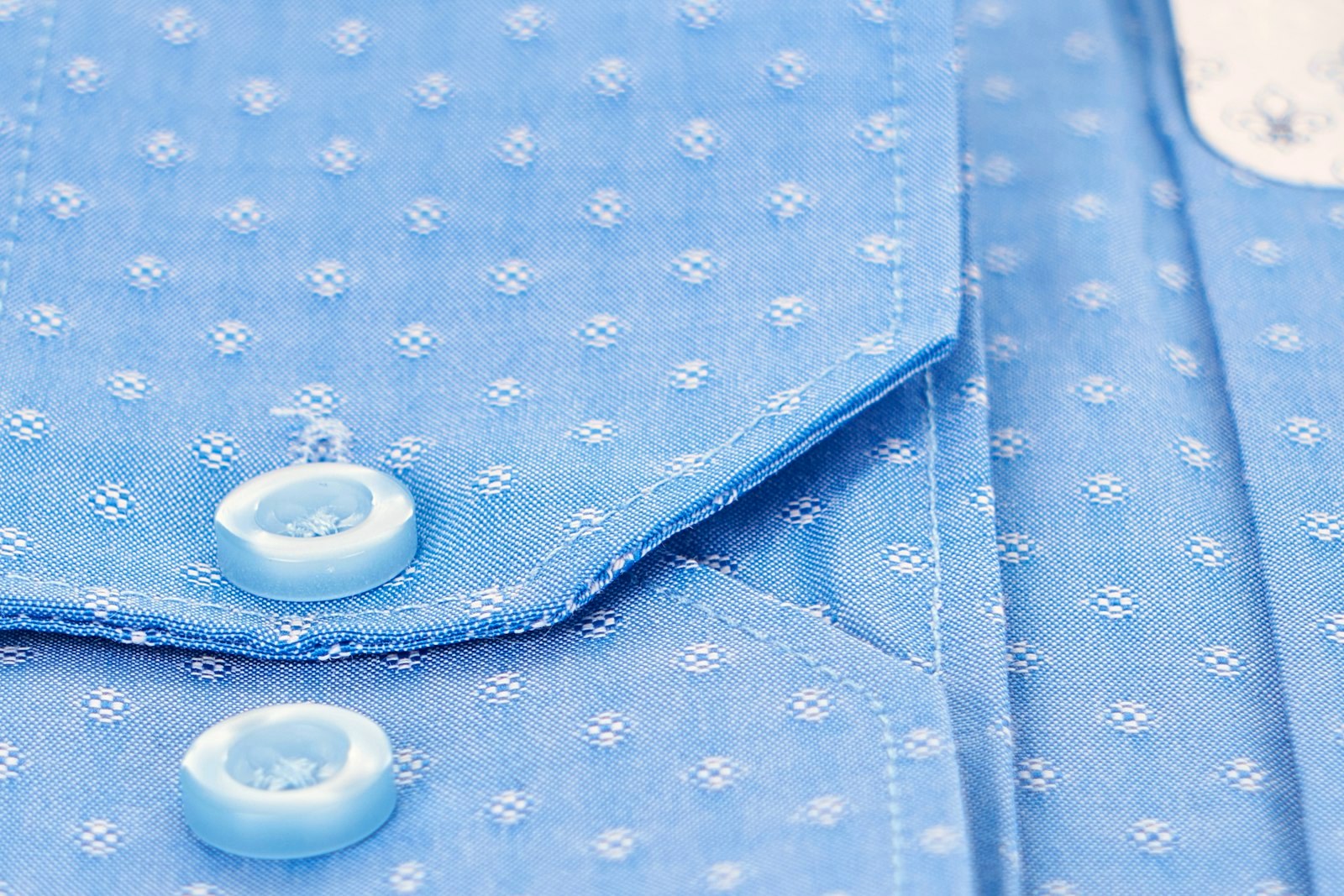
The photography, stated plainly, because this page’s exact subject is absent from our bank. The bank holds no frame of the open collar under tailoring in which the collar reads at size: no standing spread collar over a suit’s lapels, no one-button V under a jacket, in any cloth or register, and the wider gap stands in our credits, that the bank’s tailoring frames are a handful of street and studio shots in which the suit reads and the collar does not. The hero is therefore the suit and its shirt, the navy frame our credits log carries for the Oxford hub and the pairing brief before this one, captioned as what it shows; the figure in the collar section is the collar itself at close range, the detail frame from the Charles Tyrwhitt ranking, the one place in the bank where a collar’s band, points and buttoning can actually be read. No frame has been captioned as showing the open collar’s stance, because none shows it at the size the stance is judged at. The harvest list this page is waiting for, in order: first, the outfit entire at street level, an unstructured navy suit, a white Oxford, one button open, the collar standing against the lapels, the succession photographed whole; second, the throat at close range, collar band, points and the shallow V, the brief’s first law in one frame; third, the evening form, the dark suit and the whitest shirt with the white square, the repayment visible at collar, pocket and shoe together.
Questions, answered
Can you wear a suit without a tie?
Yes, under this brief's law, which is stricter than the habit it replaces. Removing the tie removes the suit's one vertical line and its formality anchor, so the shirt must do the tie's work: the collar becomes the garment, standing open and framing the neck rather than collapsing onto the chest; exactly one button opens as the default; and the formality the tie carried is repaid where this brief prints, the shoe polished a step up, the square disciplined, the metals quiet. An open collar obeying those terms is a decision. An open collar obeying none of them is a tie forgotten, and rooms can tell the difference at a glance.
What shirt do you wear with a suit and no tie?
The white Oxford first: its oxford cloth is visibly woven and matte where poplin is smooth, its button-down points, kept buttoned and crisp, hold the collar's architecture open without a tie's knot to tension it, and the shelf stands ranked at the Oxford Verdict ranking, the Kamakura winning at 93. The poplin dress shirt is the second species and the harder one: smoother, dressier, and dependent on its collar stays and its band's stiffness to stand open, ruled here with its conditions. The linen shirt carries the summer rows, its softness licensed by the season and the suit's cloth, fresco or linen, never against the boardroom worsted. The shirt species table prints each ruling in full.
How many buttons do you leave open with a suit and no tie?
One, as the default, counted from the collar button: the collar button open, the next button closed, the opening a shallow V that ends where the sternum begins. The second button is a licence with conditions printed in the button section, not a default: the summer rows and the evening rows, a chest kept plain, no chain worn over the opening, and a collar standing high enough that the wider opening reads as cut rather than as undress. The third button is refused in every row this brief licenses. The count is the outfit's most-read measurement, and it is read in buttons, by everyone, instantly.
Which collar works open under a suit?
A collar that stands: tall enough in the band to hold its height without the knot's tension, with points that frame the neck and stay where the maker cut them. The spread and the cutaway are the brief's licensed species, their width holding the opening's architecture; the button-down is licensed while its points stand buttoned and crisp, the failure being the collapsed button-down, points gone soft, wings folded flat against the chest, the collar reading as surrendered. The band collar is refused entire under tailoring: it removes the collar along with the tie, and an outfit that has struck both has no frame left at the throat, which is where this outfit is read.
Can you wear a suit without a tie to a wedding?
Under the invitation's terms, as How to Wear No. 60 prints for its own pairing: a wedding's dress code is set by the couple, and the guest's tie is a form of agreement with it. Where the code asks for the tie, the open collar renegotiates the agreement, however well the collar stands. Where the code is the summer version No. 04's matrix prints, a tie or an open collar with a square, or where the invitation states its own no-tie terms, the open collar arrives as what was asked for, and this brief's collar, button and repayment laws govern how it is worn. The rows around the ceremony, the dinner before and the party after, are the open collar's ground entire.
Can you wear a suit without a tie to the office?
In most office rows, yes, at the outfit's best: the standing collar, one button, the shoe polished up a step, the square white or absent. The ceiling is the uniform's room, printed at No. 60 for the roll neck and standing here entire: the strict boardroom, the court, the proceeding where the tie is still the uniform, are above the open collar, because the tie there is not decoration to be edited but a signal of the room's business, and the open collar declines the signal while keeping the suit that carries it. No. 08's sentence governs the ceiling: if the room requires a tie, the open collar is not the loophole.
Do you wear a pocket square with a suit and no tie?
Licensed, as the replacement colour instrument, and disciplined harder than the tied version. With the tie gone, the square is the outfit's one remaining place for a deliberate colour or pattern decision, which is an argument for wearing one and a stricter argument for restraining it: white linen in a straight fold is the default and the dressed rows' whole licence; a coloured or patterned square is the evening and summer rows' instrument, kept quiet, in the cloth's family rather than in competition with it. What is refused is the theatrical square, puffed, pointed and patterned at once, spending in one pocket the formality the collar is trying to bank.
Has Young Cotton scored the garments in this outfit?
The garments, yes; the omission, no, and the distinction is this brief's honesty. Verdict Card No. 64 ranked seven suits on their published records, the Spier & MacKay Core Suit winning at 85; the Oxford shelf stands ranked at the Oxford Verdict ranking, its winner at 93; and the tie itself is a graded garment, Verdict Card No. 40 having ranked the tie shelf on weave over print, which is why this brief treats its absence as a decision with a cost rather than a gap: the thing being removed has a record, and the record is what the collar must repay. What no Card scores is the open collar as an assembly, because an omission is worn, not bought; this page rules it as a set of conditions.
Next
The family this brief completes stands around it: How to Wear No. 04, the suit, the parent brief, whose fit order, stance, break and cuff system this page takes as premises and whose matrix rows first licensed the open collar in named rows; How to Wear No. 60, the turtleneck with a suit, the pairing brief before this one in the removal line, whose roll neck is this outfit’s winter sibling and whose ceilings this page inherits; and How to Wear No. 61, a blazer with jeans, whose tie ruling, refused as a default and licensed as a knit, is the same instrument judged in denim’s company. The buying is scored at Verdict Card No. 64, where the Core Suit’s 85 was earned, at the Oxford Verdict ranking, where the Kamakura’s 93 stands, and at Verdict Card No. 40, where the tie this brief removes was graded on its weave. The full series lives in the How to Wear index, and how every score behind those pages is built stands on our methodology page.