
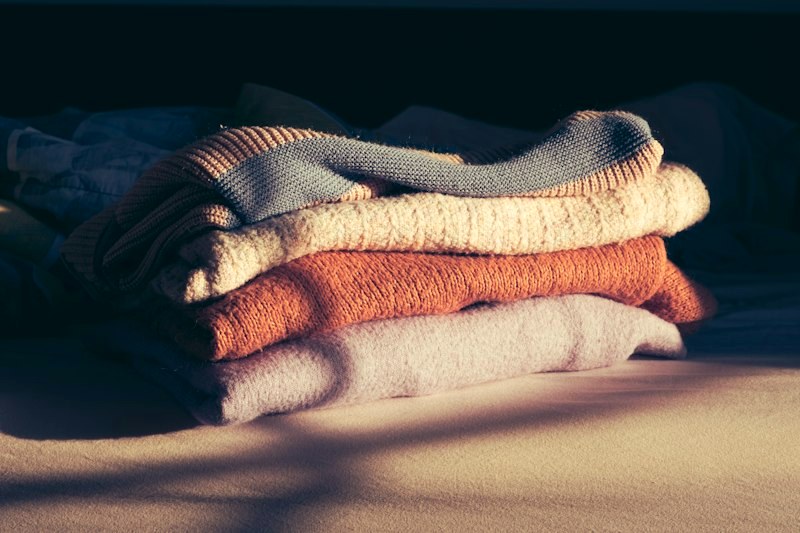
The garment's cloth and palette, folded, captioned as exactly that: a stack of knits in hard window light. Our bank holds no photograph of a mock neck sweater in any species, so this page opens on the knits it is cut from rather than dress a turtleneck, a crew neck or a quarter-zip as its subject. The care section prints that gap and the harvest list.
Checked and updated October 2026
The ruling, up front: the mock neck is the finished stand: the one neckline in the drawer that is complete at the throat and asks for nothing in either direction. Our sweaters index files it at formality 3 and warmth 3, in merino and cotton blends, in the room it names smart casual, under jackets, and calls it the roll neck's easier sibling. The V-neck of No. 37 is a frame, judged by what it holds: a collar, a knot. The mock holds nothing and frames nothing, and that is the whole brief: a band of knit an inch or so tall that must justify itself as a finished edge, standing clean on the throat with no picture inside it and no layer beneath it showing. Worn at its number, close, fine, its stand below the jaw and clear of the jacket over it, it is the high-neck read with the commitment halved, the index's own description. Worn against its number, it collapses into one of its two misreadings: a turtleneck that gave up, its stand grown too tall or slumped too tired to excuse, or a crew that reached, its half collar shrunk and bagged into a band with ambitions. Two boundaries stand at its sides: the roll neck of No. 08 above it, the folded summit at formality 4 that this garment deliberately is not, and the quarter-zip beside it, the same stand with a zip through it, ruled another brief's garment below.
This brief: the decisive rule · the species, the height law and the yarn law · what goes under it · what goes over it · trousers, colour and pattern · the ceiling and the costume lines · the looks · the mistakes · care and our photography
The decisive rule: the mock is a finished stand, and a finished edge is judged standing alone
Every neckline in the knit drawer is a decision about the throat, and the mock is the only one that makes the decision and then stops. The crew finishes low, a band and a circle, complete by saying almost nothing. The roll neck finishes high, completing the throat by covering it, a collar with a gesture, the fold, that has to be performed correctly every time it is worn. The V finishes nothing, outsourcing its completion to the collar and knot it frames. The mock finishes at half height and outsources nothing. Its stand is a complete edge: nothing goes under it that shows, nothing goes in it, nothing is worn over it at the throat, and no fold is made or unmade. That is this brief's decisive rule, printed as new: buy and wear the mock neck as a finished stand, and judge every outfit by whether the stand is standing, at its inch, clean, unaccompanied. Dressed, it stands under a blazer with the jacket's collar as the only other architecture at the throat. Casual, it stands alone over a plain trouser as the outfit's single neckline decision. Failed, it is accompanied, by a tee band above it, a pendant on it, a scarf stuffed against it, or it has slumped, and a finished edge that needs help or has lost its posture is the unfinished garment the index's buying rule warns about.
The boundary with the V is worth printing at the top, because the two garments are the drawer's opposite answers to the same question and are constantly bought for each other's jobs. No. 37 owns the V-neck: formality 4, warmth 3, a frame built for a shirt collar and a tie knot, the only neckline that looks better with more clothing under it than less. The mock is formality 3, warmth 3, and it looks better with nothing under it at all: the index files its room as smart casual, under jackets, with no collar anywhere in its description, because its stand occupies the ground a collar would stand on. The man who wants the collar and the knot visible buys the V. The man who wants the throat closed and the question closed with it buys the mock. Buying the mock and then mourning the tie it cannot take is the category error this brief exists to prevent, and the tie section below prints the refusal as the garment's honesty: it declines an exam the V was built to pass.
The boundary upward matters as much. No. 08 files the mock the least formal of the family's three collars and the kindest to a short neck, and both halves of that sentence are load-bearing. Least formal is not a defect in a garment whose index room is smart casual; it is the posting. The mock is the high neck with the ceremony removed, and its career, its spread through every office and airport in the temperate world, is explained by exactly that: it delivers most of the roll neck's read, the covered throat, the clean vertical, the jacket-ready line, at half the commitment and none of the fold's daily discipline. Its failures begin where its buyers forget the other half of the bargain and send it to do the roll neck's formal work, or let its one moving part, the stand, go slack. Everything below is those two disciplines: the rung, kept, and the stand, kept standing.
The garment, against the records of its neighbours:
| The garment | Its record | What it contributes | Its posting |
|---|---|---|---|
| The mock neck sweater | Sweaters index: formality 3, warmth 3, merino and cotton blends, smart casual, under jackets; the roll neck's easier sibling, buy it close, cheap yarn bags at the half collar first | The finished stand: the high-neck read without the fold, a complete edge at the throat that holds nothing and needs nothing | Under the blazer as its home posting, alone over a plain trouser in its index room, and as the travelling neck of No. 08's own matrix: the three postings of the decisive rule |
| The roll neck and turtleneck | Sweaters index: formality 4, warmth 4, the collar is the garment, it must stand, fold and stay folded; styled in No. 08; ranked on Verdict Card No. 05, the Smedley Cherwell at 85 | The summit: the throat completed by covering it, the fold as a daily gesture, the family's only formality-4 high neck | The evening, the cold room and the formal end of the blazer seat: the boundary above this brief, whose rooms the mock enters only at one rung less and whose discipline this garment deliberately halves |
| The V-neck sweater | Sweaters index: formality 4, warmth 3, the office, over a collar; styled in No. 37; ranked on Verdict Card No. 57, the John Smedley Blenheim at 87 | The frame: the neckline cut to host a collar and a knot, judged by what it holds | The tailored office with the tie in the room: the opposite instrument to this one, and the garment to buy when the throat is meant to be furnished rather than finished |
| The crew neck | Sweaters index: formality 3, warmth 3, everywhere below a tie; styled in No. 09; ranked on Verdict Card No. 10, the Smedley Lundy at 87 | The baseline: the closed band that is finished alone and asks nothing of any outfit | The drawer's default and first buy: the sibling the mock is misread as when its stand fails, and the honest alternative for the man who wants the mock's plainness without its posture to maintain |
| The quarter-zip | Sweaters index: formality 2, warmth 3, knitted not fleece, layered casual and travel; styled in No. 21; ranked on its own Card, the Smedley Tapton at 86 | The stand made adjustable: the same collar idea with a zip through it, converting the finished edge into an opening | The layered casual posting: the kin this brief separates in the species section, owned by its own brief, and named here so the zipped mock is never bought as this garment with a bonus |
The species, separated, the height law, and the yarn law
The rail sells three garments under this brief's name and tries to sell a fourth as a bonus version of it. They share a stand and nothing else: different gauges, different rooms, different ceilings.
| Species | What it is | Its register | The ruling |
|---|---|---|---|
| The fine mock | A plain-stitch pullover in fine-gauge merino, roughly 24 to 30 on the crew ranking's bands, its stand a clean ribbed band of an inch or so, unadorned everywhere else: the index row's own garment | The tailoring species and the reference form: the stand in its working state, the neck that sits under a blazer where the roll neck's fold argues for the room | The first buy, and the species every ruling in this brief is priced against. Its mechanism is subtraction: where the roll neck posts a folded collar under a jacket and asks the jacket to frame a statement, the fine mock posts a band and asks the jacket to do the dressing. Fine gauge is the entry requirement for the same reason it is in No. 08: the knit beneath tailoring is fine, always, sitting flat at the chest and inside the jacket's line, and the stand's smoothness is what lets a lapel pass it without a negotiation. In merino it takes the blazer posting of the over section and the bounded suit posting, and its ceiling is the index's formality 3 reached cleanly: smart casual at its most deliberate, the neckline a room reads as finished rather than dressed down |
| The ribbed-stand casual mock | The same silhouette in mid gauge, 12 to 20 on the bands, the stand usually a wider rib, in merino or the index's cotton blends, in the day colours | The weekend and travel species: the roll neck's understudy off duty, the high-neck read at walking pace | The honest second species, and the one No. 08's own outfit matrix already wears: its travel row posts a black or navy mock with clean trousers and minimal sneakers, half height, no fold to crush in a cabin, which is this species' whole argument in one line. It surrenders the blazer seat to its fine sibling, because mid gauge cannot sit inside a tailored jacket's line, and keeps everything below that rung: over chinos and denim, under an open chore coat, overshirt or field jacket, as the outfit's only neckline decision. Its cotton versions are the shoulder-season form, the stand as a spring garment entire. Buy it knowing its ceiling is its index room, smart casual, and that inside that room it is not a compromise but the correct weight of the idea |
| The half-zip mock | The stand with a zip run through it, sold as the mock with options: zip up for the stand, zip down for air | Ruled kin by collar, and another garment by register: the index already files it, under its own name, at formality 2 | The ruling is taxonomic before it is aesthetic. The mock's whole law is the finished edge, a stand that is complete because it cannot be opened; the moment a zip bisects it, the edge becomes an opening, adjustable, and the garment joins the family the index files as the quarter-zip: formality 2, warmth 3, knitted not fleece, the layered-casual and travel type, styled in No. 21 and ranked on its own Card, where the Smedley Tapton stands at 86. That is good company and a good garment, on its own brief's laws, which judge a collar that stands when the zip is open and closes clean when it is up. It is simply not this brief's garment, and buying it as a mock with a bonus misprices both: worn zipped to the top it is a stand with a seam of metal through its one clean line, and worn open it has left the mock's register entirely for the quarter-zip's. Choose the collar you mean: closed and finished, or zipped and adjustable, under two different briefs |
| The tall mock | The fashion species: a stand knitted at two inches and beyond, halfway to a turtleneck, sold on the drama of nearly | Refused: the gave-up reading in its purest form, manufactured rather than worn in | Refused outright, on the family's collar facts before this brief's taste. The turtleneck Card publishes the definitions that govern this drawer: the turtleneck is a tall collar that folds, the mock stands at half height and never folds. A stand at turtleneck height that cannot fold satisfies neither definition: it climbs to the jaw, crowds the face the way No. 08 warns a short neck is crowded, and holds none of the fold's intention, so every reader files it as the garment that meant to be the other one. Height in this family is chosen by the neck and by the collar's construction, never by splitting the difference. The man who wants the tall collar owns the roll neck and folds it once. The man who wants the mock owns an inch of stand and the cleanliness of stopping there |
The height law, printed as new, and measured against the jaw and the jacket. The index gives the stand's measure in its own words, an inch or so, and this law adds the two surfaces the inch is measured against. Against the jaw: the stand ends on the throat below the jawline, with clear water between its top edge and the jaw, so the face sits above the band and not in it. A stand touching the jaw has left the mock's territory for the tall species refused above, whatever the label called it. Against the jacket: worn under a blazer, the stand must clear the jacket's collar band and the lapel's notch without stacking cloth against either, because the interface at the throat is where this garment wins or loses its seat. The roll neck's fold doubles its cloth at exactly that interface, two layers of collar inside the lapel's V; the mock's single band passes through it untouched, which is the structural fact the blazer arbitration in the over section is built on. Buy the height the way the blazer brief buys a size: in the shop, under the jacket it will actually sit inside, with the jaw it will actually stand under.
The arbitration, printed because this site does not smooth its own record. One answer in the turtleneck Card's collar record calls the mock neck the least forgiving of a short neck. Against that phrase stand three records: the sweaters index prints that the mock suits the men the full roll neck overwhelms; No. 08, the senior neck brief, files the mock the kindest of the three collars to a short neck and its height ruling sends the short neck to the roll or the mock; and the turtleneck Card's own face answer recommends the mock or the roll, which sit lower, to exactly that reader. This brief follows the three: the mock is the short neck's remedy in this family, the high-neck read at the height a short neck can carry, and the stray phrase is not carried into any ruling here. What the mock genuinely does not forgive is recorded by the index in its buying rule, and it is not a face shape. It is the yarn, which brings the law that closes this section.
The yarn and fit law, the index's own, enforced. Buy it close: that is the index's buying rule for this garment, printed whole, and it is a structural requirement rather than a style preference. The stand has no fold to hide behind and no collar above it to share its work; it is a short band of ribbing holding its shape against gravity and the throat's movement, alone. In a tired yarn or a loose fit it bags, first at the front where the throat works hardest, and a bagged half collar is the gave-up reading made physical: the garment has not become relaxed, it has become a crew whose band stretched in the wash of its seasons. Close means the stand grips the throat lightly all the way around without pressure, the body follows the torso over one layer at most, and the hem finishes at the belt as the knit family's hems do. Judge a mock in the shop by the stand before the cloth: pull it gently and watch the recovery. The ribbing that does not spring back on the rail will not stand on the neck by winter.
What goes under it: nothing at the neck, by construction
The V-neck's under section is a contract with the collar it frames. This garment's is shorter, and it is a refusal: nothing shows under a mock neck at the neck. The stand is a finished edge, knitted complete, the last thing designed to touch the throat. Whatever rides above it, a tee's crew band, an undershirt's edge, the collar of a shirt worn in hope, frames that finished edge with an unfinished one, and the assembly reads at conversational distance as a garment worn over its own underwear. It is the one under-layer error this family has, and it is made by men who layer by habit from the crew's and the V's briefs, where something beneath is either invisible or the whole point. Here there is no third state: beneath is either invisible, or it is wrong.
What is legal is what the eye never audits. A base layer is a warmth instrument, and the mock, at the index's warmth 3, has honest cold-weather work for one: a fine base whose neckline is cut to end below the stand does its work under the knit and never appears at the throat, and the outfit keeps its single finished edge. The test is the mirror at the neck, not the layer count at the torso. The moment the under-layer's band enters the frame above the stand, the outfit has two necklines, and two necklines is the arguing-collars failure this series prints wherever it occurs, transposed to a smaller stage. Size the base layer by its neckline first and its warmth second, the reverse of the order the base layer's own brief teaches, because in this assembly its neckline is its only visible property.
The shirt beneath is refused as a picture, not as a layer. A collared shirt under a mock, worn with its collar out over the stand, is sometimes offered as the best of both garments. It is the worst of both, on geometry: the shirt's collar was cut to stand around a neck or sit inside a frame, and the mock's stand already occupies the ground, so the collar collapses over the ribbing in soft folds with neither the button-down's fastened discipline inside a V nor a jacket collar's authority over a knit. No. 37 refuses the polo beneath a V for the same reason, and the index already owns the answers for the man who wants a collar at the throat: the V, which frames one, and the knit polo, which knits one in. The mock's contribution to the drawer is precisely the rooms where no collar is wanted. Furnishing it with one deletes the contribution and keeps the compromise.
The tie is refused here, and the refusal is printed as the garment's honesty. A tie needs a collar to knot against and an opening to sit inside; the mock offers a band of knit and a closed throat, and a tie draped over that band is not an outfit but an apology, an accessory looking for the garment it belongs to. No. 08 prints the family's office sentence, that the turtleneck is not the loophole where a tie is required, and it binds this collar with the same force. But the refusal should be read the way the garment means it: the mock does not fail the tie test, it declines the exam, in the same way the roll neck declines it, and the drawer is not poorer for owning two collars that close the throat and one, the V, that furnishes it. The man whose room wants a knot wears the V and frames it. The man whose room wants the throat finished wears the mock and finishes it. Confusing the two rooms is the error; neither garment is.
What goes over it: the blazer arbitration, the suit bound, and the coat stack
The blazer is the mock neck's home posting, and the seat is shared with its senior sibling under an arbitration this brief prints rather than assumes. No. 08 establishes the folded collar under a blazer as the family's classic register: fine gauge, the collar standing where a shirt and tie would crowd, the line clean. The mock claims the same seat on different papers, and the honest division runs on the index's rungs. The roll neck stands at formality 4, the mock at 3; the roll neck's fold is a statement the jacket frames, the mock's stand is a band the jacket passes. So: the roll neck keeps the blazer's evening seat and its cold rooms, where the collar is the outfit's whole argument and the fold's doubled cloth at the lapel is the price of the statement. The mock takes the blazer's working seat: the daytime office, the softer and unstructured jacket, the warmer room where a folded collar is insulation nobody ordered, and every neck the fold would crowd. Its height law pays out here in full, a single band clearing the lapel notch where the fold negotiates it, the jacket's collar remaining the only architecture at the throat. One jacket, two necks, divided by rung, by room and by the neck inside them, not by taste: that is the arbitration, and a wardrobe that owns both collars is not duplicated but completed.
The conditions are the family's, from No. 03, repeated because they are the ones that fail in practice. The knit beneath tailoring is fine gauge, always, which confines the blazer posting to the fine species and sends the ribbed-stand mock to its own rooms. The sweater is plain, because at the jacket's opening the knit is the whole visible field and a pattern there fights the jacket's cloth. And the blazer is bought for the plan, tried in the shop with the sweater under it, the winter size chosen honestly for the layer it will actually cover. The chunky mock under a slim blazer is No. 08's chunky roll under a slim blazer in a shorter collar: two silhouettes fighting, the jacket straining, the stand erupting out of the lapel line, both garments losing.
Under a suit, the mock inherits the turtleneck's posting with its rung spent, and the bound is printed plainly. No. 08 posts the fine turtleneck or roll neck under a soft-shouldered suit in a textured cloth as a complete shirt replacement, black, charcoal or deep navy, the suit doing the formal work while the knit does the ease. That posting is earned at formality 4, the ladder's top, and the mock stands at 3. It therefore takes the suit only in the suit's softest rooms: the soft shoulder, the flannel or brushed cloth, the creative office and the evening that expects no tie of anyone in it, in the same three dark colours, fine and plain. Where the suit is being judged as a suit, its cloth hard, its room formal, its wearer expected to look tailored rather than eased, the mock is refused and the roll neck, or the shirt the roll neck replaces, keeps the seat. This is not the mock failing the suit. It is the index's arithmetic enforced: a formality-3 neckline spends one rung of the assembly it joins, and the soft suit has a rung to spend where the judged suit has none.
The coat stack runs the mock at the middle bands, on the Fall Edit's order. Base, warmth, structure, weather, per the Fall Edit: the mock is a warmth posting with a finished edge, the knit that can sit between a base layer and an overcoat and still present a complete throat when the coat opens, which neither the crew's band nor the V's empty frame quite does. Over the casual species, the country and field coats take over on their own briefs' laws, the jacket open, the stand as the outfit's whole neckline decision. The scarf question answers itself from the decisive rule: a scarf is worn over a coat, against weather, and comes off with it; a scarf kept on indoors, stuffed against the stand, is an accompaniment the finished edge refuses, two throat garments apologising for each other. Choose by the throat's job, as the V brief closes its own stack: the frame when the collar and knot are the picture, the roll when the picture is closed for winter, and the stand when the picture is finished and the day is not cold enough to argue.
Trousers, colour and pattern: the register, completed below the waist
The trousers follow the stand's plainness down. The mock's home leg is the tailored trouser, flannel first, in the dressed postings: the assembly of a finished band at the throat and a finished trouser below is the smart-casual uniform the index files this garment in, and under the blazer posting the ranked tailored end of the family carries it, the class of the Spier and MacKay tropical wool trouser at 87 on Verdict Card No. 15. The chino is the casual lender, the ranked class of No. 29's record, the Spier high-rise at 84 as garment evidence, carrying the ribbed-stand species through its rooms. Dark straight denim is granted on the family's usual conditions, the casual species only, no jacket over the assembly claiming tailoring, because the mock on denim is No. 08's smart-casual roll neck transposed to a shorter collar and inherits its welcome there. The mock's one trouser refusal of its own is the short: a finished stand is a dressed throat, and a dressed throat over a bare leg is the sweater vest brief's incoherence in this family's seat, tailoring above and holiday below.
The colour discipline, printed as new, and the rule is the face. Every knit shows its colour at the torso, where cloth is expected to be. The mock shows a band of its colour at the throat, an inch of uninterrupted knit closer to the face than any other garment in the drawer except its folded siblings, and unlike them it has no fold to break the band into light and shadow. Its colour is therefore read the way a collar's colour is read, as part of the face's frame, and the order is ruled by that fact. Charcoal first, the working band, dark enough to finish the throat and quiet enough to sit under every jacket in the wardrobe. Navy second, the day instrument, softer at the face and better in daylight, No. 08's verdict on the family's day colour transposed. Mid-grey third, the band at its most neutral, the colour that lets the jacket be the outfit's claim. Black is fourth and knowingly, for reasons the ceiling section prints in full: at the throat, uninterrupted, it is the strongest statement this garment can make, and its most quoted one. Cream and the pale colours are last and occasion-only, on the turtleneck brief's collar risk with the fold's alibi removed: the stand sits against skin, sunscreen and collar grime, every mark shows, and where the fold hides a little of it the stand hides none. Buy cream in a washable gauge and let the collar set the garment's lifespan, as No. 08 rules for its sibling.
The pattern law is the family's, tightened by the band. One pattern per outfit, inherited from the briefs around this one, and in this family the mock is plain by near-law: its one patterned species, a marled or flecked yarn, belongs to the casual rooms where the texture reads as cloth rather than statement. A printed or striped mock puts a pattern at the exact band the eye reads with the face, and competes with the wearer, which no garment in this series is licensed to do. The footwear follows the trousers, briefly: the flannel assembly takes the loafer and the suede shoe, the chino assembly the clean court shoe of the class the white tee ranking keeps company with and the suede boot, the denim assembly the plain work boot and the minimal trainer of No. 08's own travel row. The polished dress shoe under a mock with no jacket spends formality the formality-3 neckline cannot repay; under the blazer the refusal lifts with the assembly, as it does in the briefs around this one.
The ceiling, and the costume lines printed plainly
The ceiling first, plainly: the mock neck's ceiling is deliberate smart casual, reached in the blazer posting, and it stops one rung below its folded sibling everywhere. It is formality 3 on its own index, and the rung is not an insult but a set of coordinates: it does not take the roll neck's evening seat, it takes the suit only in the suit's softest rooms, and it is refused wherever a tie is required, by construction and by No. 08's sentence together. Its warmth ceiling is the index's 3, the middle family's rating, honest over the torso and no platform for deep winter unassisted. Inside those two ceilings the garment is close to irreplaceable in the other direction: no other neckline gives the covered throat, the jacket-ready line and the closed question at this little daily cost, no fold to make, no collar to furnish, no knot to frame. Its failures are never really about the yarn, except the one the index names. They are about the lines this section now prints.
Costume line one: the black mock as a famous founder's uniform. Named, as it must be to be ruled: Steve Jobs wore a black mock neck, blue jeans and trainers as a deliberate uniform, the tops made for him by Issey Miyake, a system designed to delete the daily decision of dressing and to make the man a logo. It worked, for a man whose work was the point and whose face was already the most recognised in his industry. Copied as an outfit by anyone else, the assembly is read as the quotation before it is read as clothes: the black band at the throat, unbroken, over denim, is a reference with a wearer inside it, which is this series' definition of a costume. The garment itself is acquitted; black is fourth in this brief's own colour order and the travel row of No. 08 wears it. The line is the uniform as a whole, worn as a shortcut to a persona: if the rest of the outfit is not plain working clothes in rooms where the man is known for something else, the mock is not a neckline, it is fancy dress with a keynote playing behind it.
Costume line two: the chain or pendant at the stand. The turtleneck brief prints the family's law: no jewellery over the knit, because anything at the neck competes with the collar. On the mock the geometry is worse, and more specific. The stand is short, so the throat above it is bare, and a pendant on a chain comes to rest at exactly the stand's top edge, half on skin and half on knit, drawing a line of metal across the one clean line the garment owns. It does not accessorise the neckline; it interrupts a finished edge at the place where the edge is the entire garment, and reads as decoration applied to a decision that was already complete. Under the knit, out of sight, a chain is the wearer's own business. Over the stand it is the outfit arguing with itself at conversational distance, and in the office postings it spends the deliberate read the whole assembly was bought for.
Costume line three: the mock sent to the roll neck's rooms, and its mirror. The roll neck owns rooms the mock does not: the evening where the folded collar is the argument, the cold room where formality 4 and warmth 4 are the entry price, the formal end of the blazer seat. A mock posted there, chosen because it was nearer the door or easier to keep, reads by the index's own phrase as the commitment halved, the silhouette of a man who wanted the high neck's read and declined its discipline: not a failure of the garment, which never applied for the posting, but of the assignment. The mirror line is the wearer who stretches the mock toward the fold, buying the tall species refused in the species section or pulling a stand up the throat in the mirror each morning. Both lines are the same costume in opposite directions: this garment dressed as its sibling. The mock worn as itself, at its inch, in its rooms, is a garment. Worn as an apology for the turtleneck, in either direction, it is a costume of one.
The looks: the stand, standing
Four assemblies from this brief's rulings, each built on the records around the garment. No mock neck sweater is scored in this brief; the numbers in the judgments are the neighbours' records, reproduced from their own pages.
| Setting | The sweater | With | The judgment |
|---|---|---|---|
| The blazer seat | Plain charcoal fine-merino mock, stand below the jaw, hem at the belt | A navy hopsack blazer over it, grey flannel trousers, suede loafers, nothing at the throat | The garment at its ceiling and its design point: the working seat of the arbitration, the band clearing the lapel line where the fold would negotiate it, the jacket doing the dressing and the stand finishing the throat. The trousers are the class of the wool trouser ranking's winner at 87, and the assembly is the index's room, smart casual under a jacket, at its most deliberate |
| The soft suit's soft room | Plain deep-navy fine mock under a soft-shouldered suit | A textured flannel suit, suede shoes, no tie anywhere in the room's expectations | The bounded suit posting demonstrated inside its bound: the shirt replacement at one rung less, legal because the suit is soft, the cloth is textured and the room is the suit's own soft end. The same sweater under a hard glossy suit in a judged room is the over section's refusal, and the difference is the room and the cloth, not the mirror |
| The index's room | Ribbed-stand mock in a day colour, mid gauge, close | Chinos of the ranked class, an open chore coat over the lot, clean court shoes | The casual species at its honest work: the high-neck read at walking pace, the stand as the outfit's only neckline decision, the coat open because the stand, unlike a fold, does not need framing. The chino is the class of No. 29's record at 84 as garment evidence, and the assembly is the sweater's second honest life, the one it was filed for |
| The travel posting | Plain black or navy mock, fine to mid gauge | Clean tailored trousers, minimal sneakers, a coat over the lot in weather | No. 08's own matrix row, worn as printed: half height, no fold to crush in a cabin, a finished throat at the end of a journey with no collar to have wilted on the way. Black is legal here on the ceiling section's terms, a garment in a working outfit, because the room is an airport and the man is travelling, not keynoting |
The ruling
Buy the fine merino mock first, plain, in charcoal or navy, its stand at an inch, if your wardrobe is jacket-forward and your neck or your rooms argue with the fold: under the blazer in its working seat, alone in its index room, as the travelling neck that arrives finished. Buy the ribbed-stand mock second, for the casual species' life, over chinos and under open coats, in the day colours. Buy no other species: the half-zip is a quarter-zip wearing this brief's name, and the tall mock is a turtleneck that cannot fold, refused at any price in any yarn. Refuse the visible under-band, refuse the shirt's collar over the stand, refuse the pendant at its edge, refuse to send it where the fold was required. The test in the shop is the height law with the yarn law added: under the jacket it will actually sit inside, the stand below the jaw and clear of the lapel, close at the throat, springing back when pulled, ending at its inch without apology in either direction. The man who can name the jacket it will sit inside and the rooms it will not be sent to has bought a mock neck sweater. The man who bought it as a turtleneck with the commitment halved, and wears it as one, has bought the index's warning in the shape of a slumping band, where it was always visible.
The mistakes
The slumped stand. The first error, and the index prints its mechanism in the buying rule: cheap yarn bags at the half collar first. A stand that has lost its posture slumps into folds at the front of the throat, and the garment crosses from finished edge to the gave-up reading in a single season, while its body is still sound. It is prevented at the rail, by the recovery test in the species section, and after purchase by the care section's storage law. Judge an ageing mock by its stand before its cloth: the stand is the garment, and its retirement is announced there first.
The band above the stand. The under-layer error: a tee's band or an undershirt's edge riding visible above the stand, framing the finished edge with an unfinished one. It reads as underwear at the throat, and it is made by layering from habit, out of briefs where an under-layer is either invisible or the point. In this assembly there is no third state. Cut the base layer's neckline below the stand, or leave it in the drawer.
The mock pulled tall. The wearer who buys the mock and then stretches it up the throat each morning, chasing the roll neck's coverage at the mock's price. The stand was knitted at its inch; pulled tall it bags at the base, sits in wrinkles at the jaw, and performs the tall species' failure with none of its cloth. Height in this family is chosen at the rail, by the neck, between the mock's inch and the fold, and it is not renegotiated in the mirror.
Sent to the fold's rooms. The posting error: the mock chosen for an evening, a cold room or a judged suit where the roll neck's formality 4 was the entry price. The garment arrives a rung short and reads as the commitment halved, the phrase its own index prints, in the room that wanted the commitment whole. Name the room first; the collar follows from the room, in this family as in every other on this site.
Care, by fibre, and the stand rule
The mock neck's maintenance is the knit family's, printed in No. 09 and in No. 08's collar care, with its whole weight on one point. Fold every knit and store it flat; the hanger is where necklines go to stretch, and this garment's neckline is not a detail of the garment, it is the garment. The turtleneck brief's care ruling for its own collar, fold it before the sweater goes on and never drag a made fold over the head, has its version here: the stand goes over the head at every wearing, stretched by the exact motion that tires it, so the mock's stand is on a shorter clock than any other edge in the drawer and its storage is the only lever the owner holds. Stored folded and rested between wears, a good stand in a good yarn holds its inch for years. Hung by its shoulders for one summer, it comes back bagged at the front, and a bagged stand does not recover: it retires the sweater from the blazer seat to the travel row, which is retirement by instalments. Merino is the working fibre, fine enough for the tailoring postings and washing without ceremony. The cotton blends of the casual species wash easiest and bag soonest, the index's warning priced into their lower cost honestly. Care is not a ritual. It is how the index's numbers become yours rather than the rail's.
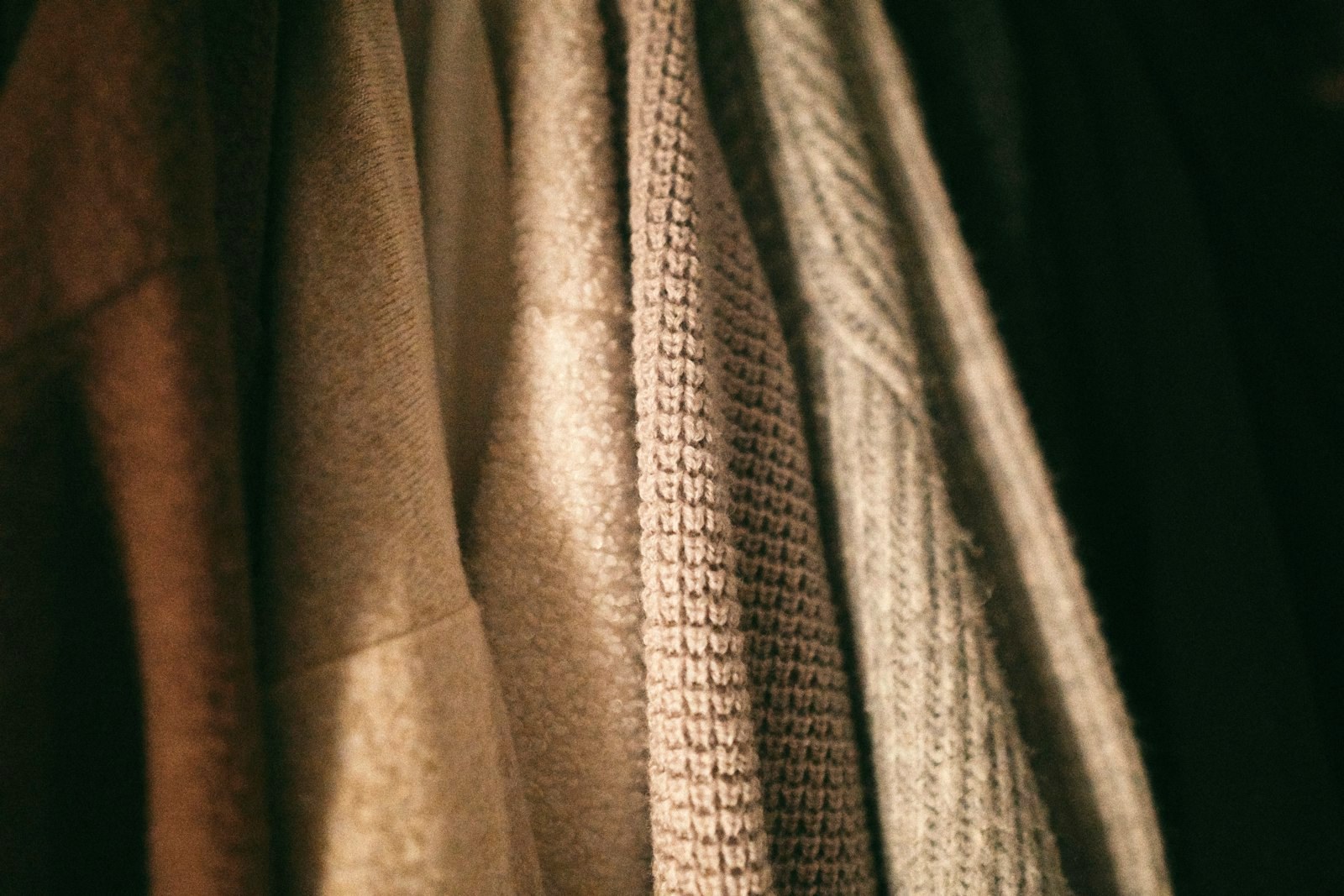
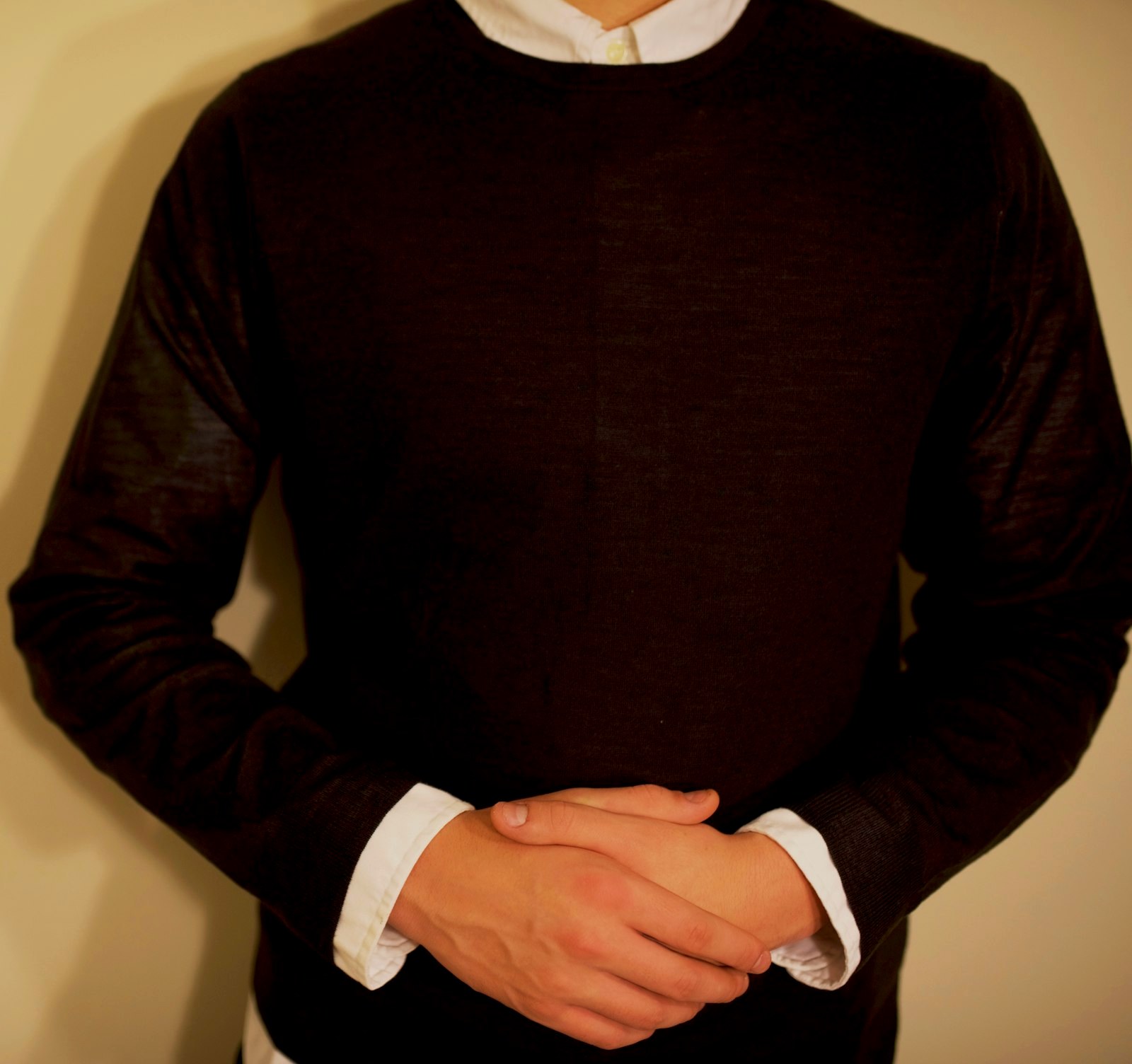
A note on our own photography: our photo bank holds no mock neck frame in any species. There is no fine mock under a blazer with the stand clear of the lapel line, no stand at macro range against a jaw, no bagged half collar to print as the failure exhibit this brief's mistakes describe, and this page will not caption a turtleneck, a crew neck or a quarter-zip as the mock neck to fill the slot. The hero is a folded knit stack in the garment's own palette, captioned as folded knits; the figures inside are knit textures hanging at close range and a fine crew neck over the collared shirt this garment is the alternative to, each captioned for exactly what it shows. This page will take the harvest frames the week they exist: the charcoal fine mock under a navy blazer at the range where the arbitration can actually be seen, the stand's inch measured against a jaw in profile, and the casual species under an open chore coat in daylight.
Questions, answered
What is a mock neck sweater, and how is it different from a turtleneck and a crew neck?
It is the knit family's short stand collar: a pullover whose neckline rises an inch or so up the throat and stops, finished, never folding. Our sweaters index files it at formality 3 and warmth 3, in merino and cotton blends, in the room it names smart casual, under jackets, under one buying rule: it is the roll neck's easier sibling, buy it close, because cheap yarn bags at the half collar first. The turtleneck is the family's tall collar, knitted to fold down over itself once, at formality 4 and warmth 4: it completes the throat by covering it and replaces the shirt entirely. The crew neck is the closed band at formality 3 and warmth 3, finished alone and asking nothing. The mock is the third answer to the same throat: more than the crew's band, less than the roll neck's fold, a complete neckline that holds nothing and needs nothing, which is both its virtue and the whole difficulty of wearing it well.
How tall should a mock neck stand be?
An inch or so, which is the index's own measure, and the tests are the jaw and the jacket, never the mirror's fashion. Against the jaw: the stand ends below the jawline with clear water between the stand's top edge and the jaw, sitting on the throat as a band. A stand that climbs to the jaw is a turtleneck that cannot fold, and reads as one. Against the jacket worn over it: the stand clears the blazer's collar band and lapel notch without stacking against them, which is the mock's structural advantage over the roll neck, whose fold doubles the cloth at exactly that interface. And it must stand, not slump: the index prints that cheap yarn bags at the half collar first, so the stand's height is bought with the yarn and kept with the fit, close, never tight and never loose. A mock that has slumped to a rumpled band has not become casual. It has become a crew that reached.
Who should wear a mock neck instead of a turtleneck?
The man the full collar crowds, on the senior neck brief's own ruling. No. 08, the turtleneck brief, chooses height by neck, not by fashion: a long neck takes the full fold, a short neck takes the roll or the mock, and the index prints that the mock suits the men the full roll neck overwhelms. At half height with no fold to stack around the throat, the mock gives the high-neck read, the covered throat and the clean line under a jacket, without shortening the neck the way a folded collar does. It is also the answer where the roll neck's statement is more than the room wants: the mock is the least formal of the three collars, and its rooms are the roll neck's rooms at one rung less, smart casual and under jackets. One stray line elsewhere in our archive calls the mock the least forgiving of a short neck; the index, the turtleneck brief and the turtleneck ranking's own face answer all rule the other way, and this site follows its senior record. What the mock does not forgive is not the neck. It is the yarn.
Can you wear a mock neck under a blazer?
Yes, and it is the garment's home posting, with the seat divided honestly between the two high necks. The roll neck keeps the blazer's evening seat: at formality 4 to the mock's 3, its folded collar is a statement the jacket frames, the classic register No. 08 prints. The mock takes the blazer's working seat: the daytime office, the softer jacket, the warmer room, and any neck the fold would crowd. Its stand sits lower than a folded collar and adds no doubled cloth at the lapel line, so the jacket's own collar stays the only architecture at the throat. The conditions are the family's, from the blazer brief: fine gauge under tailoring, always, the sweater plain, and the blazer bought for the plan, tried in the shop with the knit beneath it. A mid-gauge or chunky mock under a slim blazer fails the same way its folded sibling does in No. 08's mistakes: two silhouettes fighting in one outfit.
Can you wear a mock neck with a suit?
In the suit's softest rooms only, and the bound is the index's arithmetic, not a taste. No. 08 posts the fine turtleneck under a soft-shouldered, textured suit as a complete shirt replacement, and the roll neck stands at formality 4, joint top of the ladder, when it does it. The mock stands a rung below at 3, so it inherits the posting with the rung spent: a soft suit, a textured cloth, a fine plain mock in black, charcoal or deep navy, in rooms where no tie is expected of anyone present. Where the suit is being judged as a suit, the mock is refused, and where the room requires a tie it is refused absolutely, on No. 08's sentence transposed: the mock neck is not the loophole. The man who wants the high neck at full formality owns the roll neck for it. The mock's honesty is that it does not pretend to the fold's rung.
What do you wear under a mock neck sweater?
Nothing that shows at the neck, and the reason is construction, not modesty. The mock is a finished neckline: its stand is a complete edge, knitted to be the last thing at the throat. A tee's band or an undershirt's edge riding above the stand frames the finished edge with a cheaper one, and the assembly reads as a garment worn over its own underwear, the one under-layer error this family has. What is legal is what is invisible: a base layer whose neckline is cut to end below the stand, doing warmth work the eye never audits. The contrast is the V-neck of No. 37, a frame built to hold a collar and judged by what it holds. The mock is the opposite instrument, judged by its needing nothing held. If you want a collar showing at the throat, the drawer already owns the garments for it, and this is not one of them.
Can you wear a mock neck with a tie, or with a chain or pendant?
No tie, by construction, and the refusal is the garment's honesty rather than its lack. There is no collar to knot against, no opening to hold a knot, and nowhere for a tie to sit that would not drape it over a band of knit it was never cut for. The mock does not fail the tie test; it declines the exam, and the garment that exists to take it is the V-neck of No. 37, whose frame was built for the knot. The chain and the pendant are refused on the turtleneck brief's law, which binds this family: nothing competes with the collar. The mock's stand leaves a bare band of throat above it exactly where a pendant comes to rest, so jewellery there does not accessorise the neckline, it argues with a finished edge at the one place the edge is the whole garment. Anything worn at the neck goes under the knit, out of sight, or goes without.
Has Young Cotton ranked mock neck sweaters?
Yes, since Verdict Card No. 58 ranked seven mock neck sweaters on their published records, the Artknit Studios Ultrasoft Wool Mock-Neck winning at 83. This brief predates the Card; what existed in print when it was written is the garment's record across the site: the sweaters index files it fourth of its ten types at formality 3 and warmth 3, the roll neck's easier sibling, bought close, in smart casual and under jackets; the turtleneck Card publishes the family's collar facts, that the mock stands at half height and never folds, and scores the folded summit of the family at 85; the turtleneck brief styles all three collars and sends the short neck to this one; the crew ranking prints the gauge bands its fine species is bought by, fine roughly 24 to 30; the quarter-zip ranking scores the mock's zipped cousin at 86, the garment this brief rules kin by collar and another brief's by register; and this brief is the wearing system those records imply, the finished-stand rule, the height law, the species, the under and over laws and the outfit matrix, printed so any mock neck can be judged on the wearing before a ranking exists.
Next
The garment's place in the drawer, fourth of the ten types at formality 3 and warmth 3, is printed whole in the sweaters index. The summit above it is styled in How to Wear No. 08 and ranked in Verdict Card No. 05; the frame beside it in No. 37 and its ranking, and the baseline beneath it in No. 09 and Verdict Card No. 10. Its zipped kin is styled in How to Wear No. 21 and ranked on its own Card. The jackets of its home posting are briefed in No. 03 and No. 04; the gauge law in the crew ranking, and the stack its coat posting belongs to is ordered in the Fall Edit. Where a collar lands on the body is drawn in the Body Map.