
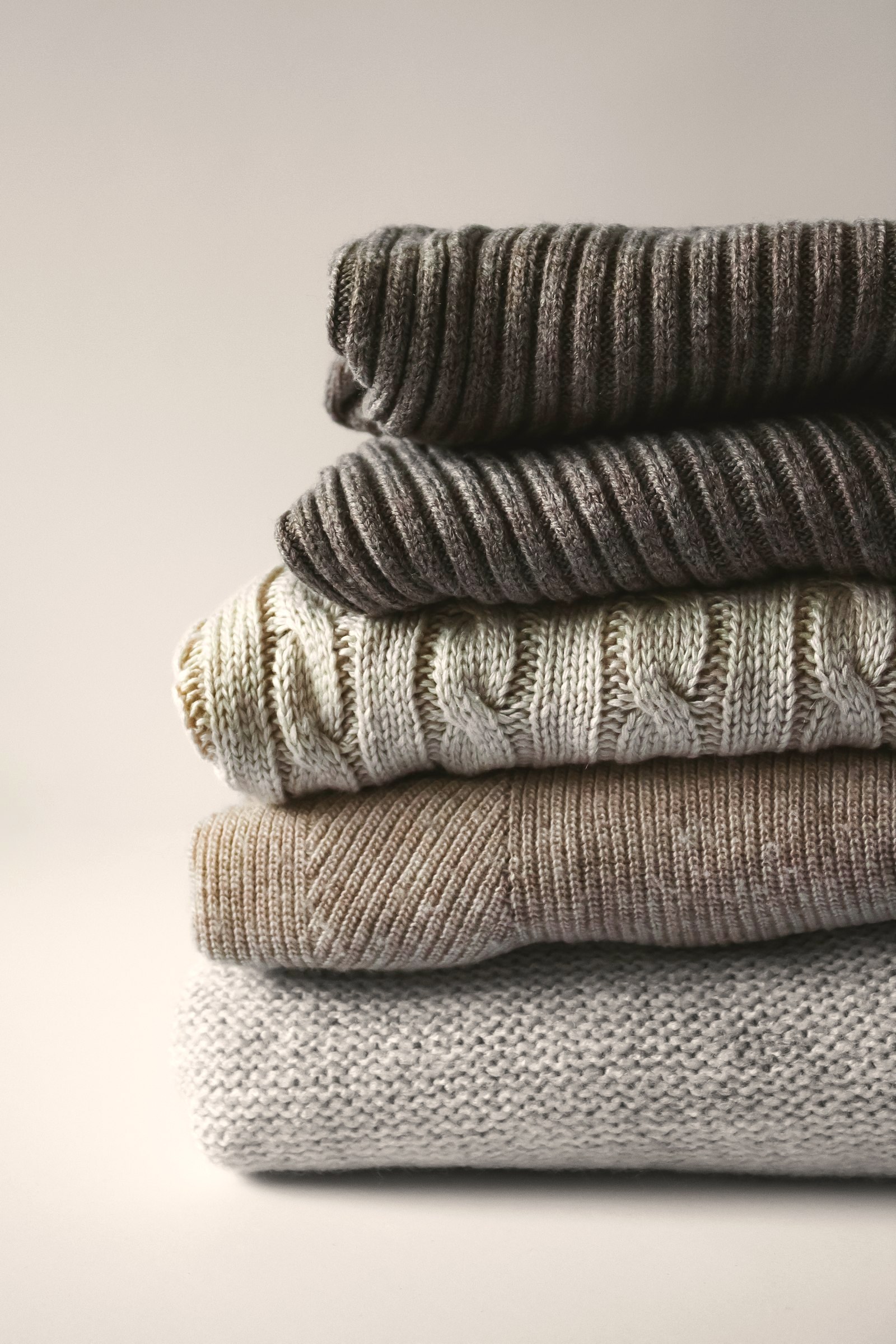
The garment's cloth and palette, folded, captioned as exactly that: a stack of grey knits. Our bank holds no photograph of a V-neck sweater in any species, so this page opens on the knits it is cut from rather than dress a crew neck, a cardigan or a V-neck tee as its subject. The care section prints that gap and the harvest list.
Checked and updated October 2026
The ruling, up front: the V-neck sweater is the tailoring knit, a frame built to hold a collar and a knot. Our sweaters index files it at formality 4 and warmth 3, joint top of the formality ladder, in the room it names the office, over a collar, and those numbers are the whole brief: it is the one sweater that looks better with more clothing under it than less, the only neckline in the drawer cut to host tailoring's furniture. Worn at its number, shallow to medium, fine gauge, over a shirt, with a tie when the room wants one and a blazer over the lot, it is what the index calls it, the most correct sweater in a formal building. Worn against its number, alone, deep and tight, or stretched over a polo's arguing collar, it is the index's own cautionary tale, the garment that fell from fashion as a styling accident. One boundary stands at each side of it: the sweater vest of No. 36 behind it, the same geometry sleeveless, a storey over a shirt with the arms left to the shirt, and the crew neck of No. 09 beside it, the complete sibling that asks nothing of an outfit. This brief owns the sleeved frame itself, in its species: the fine merino of tailoring, the lambswool of the country, the chunky V ruled on the index's own arithmetic, and the deep fashion V refused.
This brief: the decisive rule · the species, the gauge law and the depth law · what goes under it · what goes over it · trousers, colour and pattern · the ceiling, the disagreement, and the costume lines · the looks · the mistakes · care and our photography
The decisive rule: the V is a frame, and a frame is judged by what it holds
Every neckline in the knit drawer is a decision about the throat, and the V is the only one that outsources its own completion. The crew finishes itself: a band of ribbing, a closed circle, a garment that is whole on skin, over a shirt, under a jacket, asking nothing. The roll neck finishes itself upward, replacing the shirt entirely. The V finishes nothing. Its opening is a deliberate incompleteness, a frame cut into the knit to hold a picture it does not contain: the collar of the shirt beneath, and inside that collar, when the room dresses, the knot of a tie. The sweaters index prints the mechanism without ornament: the opening is a frame built for a shirt collar and a tie knot, and the V is the only type on the page that looks better with more clothing under it than less. That is this brief's decisive rule, printed as new: buy and wear the V-neck as tailoring's knit instrument, a frame for the collar, and judge every outfit by whether the frame is holding its picture. Dressed, it holds a shirt and frames a knot. Casual, it holds a deliberate substitute, a tee's clean band or a summer collar of skin under the cotton species, chosen knowingly. Failed, it holds nothing at all, and a frame holding nothing is the unfinished garment the index's buying rule names.
The boundary with the sleeveless sibling is worth printing at the top, because the two garments share a geometry and nothing else. No. 36 owns the sweater vest: the V's shape with the sleeves removed, a storey of dress added over a shirt, its arms left to the shirt beneath, filed by the index at formality 3 and warmth 2. This brief's garment is the storey made whole: formality 4, warmth 3, its arms covered by its own sleeves, its warmth a real if modest posting. The difference governs everything below. The vest can only ever be a layer over a shirt, because sleeveless on skin it is a tank with pretensions. The V-neck sweater is the shirt's replacement as often as its cover: it hosts the collar and tie from inside its own frame when the outfit is built that way, and it stands as the outfit's whole knit when the outfit is built the other way, over a tee in its country species, under a coat in its fine one. No. 36 is the brief of a layer. This is the brief of a garment.
The frame rule also explains the garment's strange career, which the index records in one sentence: its fall from fashion was a styling accident, not a design flaw. For a generation the V was sold and worn emptied of its picture, alone, deep and tight, the frame holding a bare chest, and the reading collapsed from office correctness to unfinished exposure. Nothing about the knit changed. The picture was removed, and the frame, judged on emptiness, was convicted of it. Every ruling in this brief is the restoration of the picture: the collar restored beneath, the knot restored inside, the depth restored to the band the index prints, shallow to medium. The man who wears the V as designed is not reviving anything. He is declining to repeat the accident.
The garment, against the records of its neighbours:
| The garment | Its record | What it contributes | Its posting |
|---|---|---|---|
| The V-neck sweater | Sweaters index: formality 4, warmth 3, fine merino, cashmere or cotton blends, the office, over a collar; buy it to layer over a shirt | The frame: the only neckline cut to host a collar and a knot, at the top of the formality ladder, with its arms and its modest warmth its own | Over the collared shirt as tailoring's knit, under the blazer as its home posting, and as the shirt's replacement in its casual species: the three postings of the decisive rule |
| The sweater vest | Sweaters index: formality 3, warmth 2, over a shirt, spring to autumn; styled in No. 36; ranked on Verdict Card No. 56, the Lockie Leven Slipover at 82 | The same frame with the sleeves removed: a storey of dress at almost no warmth, the arms left to the shirt | The layer over a shirt and under a blazer: the boundary garment behind this one, whose tie ruling this brief inherits and whose seat under tailoring this sweater also fills, with sleeves |
| The crew neck | Sweaters index: formality 3, warmth 3; styled in No. 09; ranked on Verdict Card No. 10, the Smedley Lundy at 87 | Completeness: the neckline that is finished alone, over a shirt and under a jacket, and asks nothing of the outfit | The drawer's default and first buy: the sibling this brief concedes priority to, and argues with, in the ceiling section, on the record the index prints for both |
| The roll neck | Sweaters index: formality 4, warmth 4; ranked on the turtleneck Card, the Smedley Cherwell at 85; styled in No. 08 | The other formality-4 neck, and the opposite mechanism: it completes the throat by covering it, replacing the shirt the V requires | The evening and the cold room, worn with no shirt at all: the summit this garment shares, reached by closing the frame the V holds open |
| The cardigan | Sweaters index: formality 3, warmth 3; No. 01 prints the fine cardigan over a shirt and tie as a softer waistcoat, the waistcoat's warmer understudy; ranked on Verdict Card No. 16, the Smedley Bryn at 84 | The opening knit: a middle layer with a hinge, the precedent on which the tie-over-knit ruling stands in both this brief and No. 36 | The middle of an outfit, opening and closing over the same shirt and tie this sweater frames closed: the cousin whose ruling this brief carries, not repeats |
The species, separated, the gauge law, and the depth law
The rail sells four garments under this brief's name, and they differ the way the index's yarns and gauges differ: same neckline, different jobs, different ceilings. The species error, buying one for another's posting, is where most of this garment's bad reputation is manufactured.
| Species | What it is | Its register | The ruling |
|---|---|---|---|
| The fine merino V | A plain-stitch pullover in fine-gauge merino, roughly 24 to 30 on the crew ranking's bands, the V at shallow to medium depth, ribbed at the neck, cuff and hem: the index row's own garment, unadorned | The tailoring species and the reference form: the frame in its working state, the office neck the index files at formality 4 | The first buy and the species every ruling in this brief is priced against. Fine gauge is not a refinement of the garment; it is the garment's mechanism, the gauge that sits flat against a shirt's placket, frames a knot without bulk at the throat, and disappears inside a jacket's line without printing through, the same law the index prints for every knit under tailoring. In merino it takes the tie, the blazer and the suit postings of the over section, and its ceiling is the index's formality 4, reached precisely because the knit says nothing of its own: the frame is the statement, and the plainer and finer the knit, the cleaner the frame reads |
| The lambswool V | The same silhouette in mid-gauge lambswool, 12 to 20 on the bands, a matte yarn with a soft halo, the V at the same governed depth, in the country colours | The country species: the frame at walking pace, over the button-down, in the rooms where no tie is present and none is missed | The honest second species, and the one the tee triangle belongs to. Mid gauge cannot sit inside a tailored jacket's line, so this species surrenders the suit posting and keeps the blazer only at the unstructured end; in exchange it is the V as a sweater rather than an instrument, worn over the Oxford with the collar open, over a tee in summer's shoulder weeks, under a field or waxed jacket through the cold ones. Its warmth is the index's 3 spent whole, the torso's and the arms' together. Buy it in navy, charcoal or the country browns, and buy it knowing its ceiling: it is the frame at formality 3 in practice, whatever the neckline's ladder says, because gauge is a property of the garment and not of the shape |
| The chunky V | The neckline knitted heavy, 7 and below on the bands, in a thick yarn at a depth the rail usually deepens to match the drama of the cloth | A contradiction wearing the frame's name: the index's arithmetic convicts it before taste is consulted | Ruled a contradiction in terms for the frame's purpose, on the index's own printed law: chunky versions of the same necklines fall two rungs, because formality in knitwear is a property of gauge as much as shape. A chunky V is therefore a formality-2 body carrying a formality-4 instrument it cannot play: it cannot sit under tailoring, its ribbing is too coarse to frame a knot, and its depth, over the bare chest the rail photographs it on, is the index's fall-from-fashion exhibit in a heavier yarn. One honest posting survives the ruling, printed so the species is not slandered: as a weekend country knit, shallow, over a heavy shirt, bought knowingly as a casual sweater that happens to open at the neck, it is a garment. Bought as the tailoring knit in a thicker cloth, it is a category error with a care label |
| The deep fashion V | The fashion species: a fine or slub knit cut with the V running toward the sternum and below, sold on skin, tight, the opening as the garment's whole proposition | Refused: the register the index's history sentence exists to bury | Refused outright, in the index's words before this brief's: worn alone, deep and tight, it read unfinished, and the reading has not changed with the decades that have passed since. The depth law below gives the arithmetic; this row gives the verdict. A V whose point falls below mid-chest is not a deeper version of the office neck. It is a different garment, a display frame holding the chest, and the chest is not a picture this site hangs. No fit discipline, no yarn and no confidence rescues it, because the failure is the geometry: the frame has been cut larger than anything it was built to hold |
The depth law, printed as new, and measured against the collar. Every error in this family is finally a depth error, so the law gets its own statement. The V is not measured in inches from the collarbone, and it is not measured against the chest it exposes. It is measured against the two things it was built to hold: the collar band of the shirt beneath, and the knot of the tie inside it. The working band is the index's, shallow to medium, and its tests are visible in a mirror. The collar must sit inside the V's ribbing with its points clear of the knit's edge, neither riding over the ribbing nor drowned below it. A knot, when one is worn, must sit inside the opening whole, its full width visible, its tip falling short of the V's point. And the point itself lands in the band those two tests draw: below the knot, above mid-chest. A V too shallow fails the first two tests, swallowing the knot and crowding the collar until the garment is a crew with a notch, the frame holding nothing a crew does not hold. A V too deep fails the third, and belongs to the refused species above. Buy the depth the way the blazer brief buys a size: in the shop, over the shirt it will actually cover, with the collar it will actually frame.
The fit law, inherited from the family and applied. The body is close over one shirt, never tight and never baggy: tight is the fashion species' other half, the index pairing deep with tight in its history sentence, and baggy spends the frame's precision at every edge. The hem finishes at the belt, over the tucked shirt's waistband, as the knit family's hems do in every brief in this series; a V that runs long turns the frame into a tunic and lengthens the torso it was meant to organise. The V's ribbed band is this garment's structured edge, the equivalent of the sweater vest's armhole ribbing in No. 36: the first place cheap knitting bags, and a V whose point has stretched and slackened has lost the frame's geometry, which is the garment. Judge it in the shop by the ribbing's recovery, and retire the sweater whose point no longer springs back, from the dressed postings first and then from the drawer.
What goes under it: the collar is the contract, and its two licensed exceptions
The index prints the under-layer in its buying rule, and this section does no more than enforce it with reasons: buy it to layer over a shirt. The collar is not a styling preference. The V is a frame, and a frame requires a picture: the shirt's collar is the vertical the opening is cut around, its placket is the centre line the V's point aims at, and the contrast, woven cotton under matte knit, the shirt's structure holding the frame's geometry open, is the garment's entire visual mechanism. Remove the shirt and the mechanism is gone, which is why the index's costume sentence names the alone state first among this garment's failures.
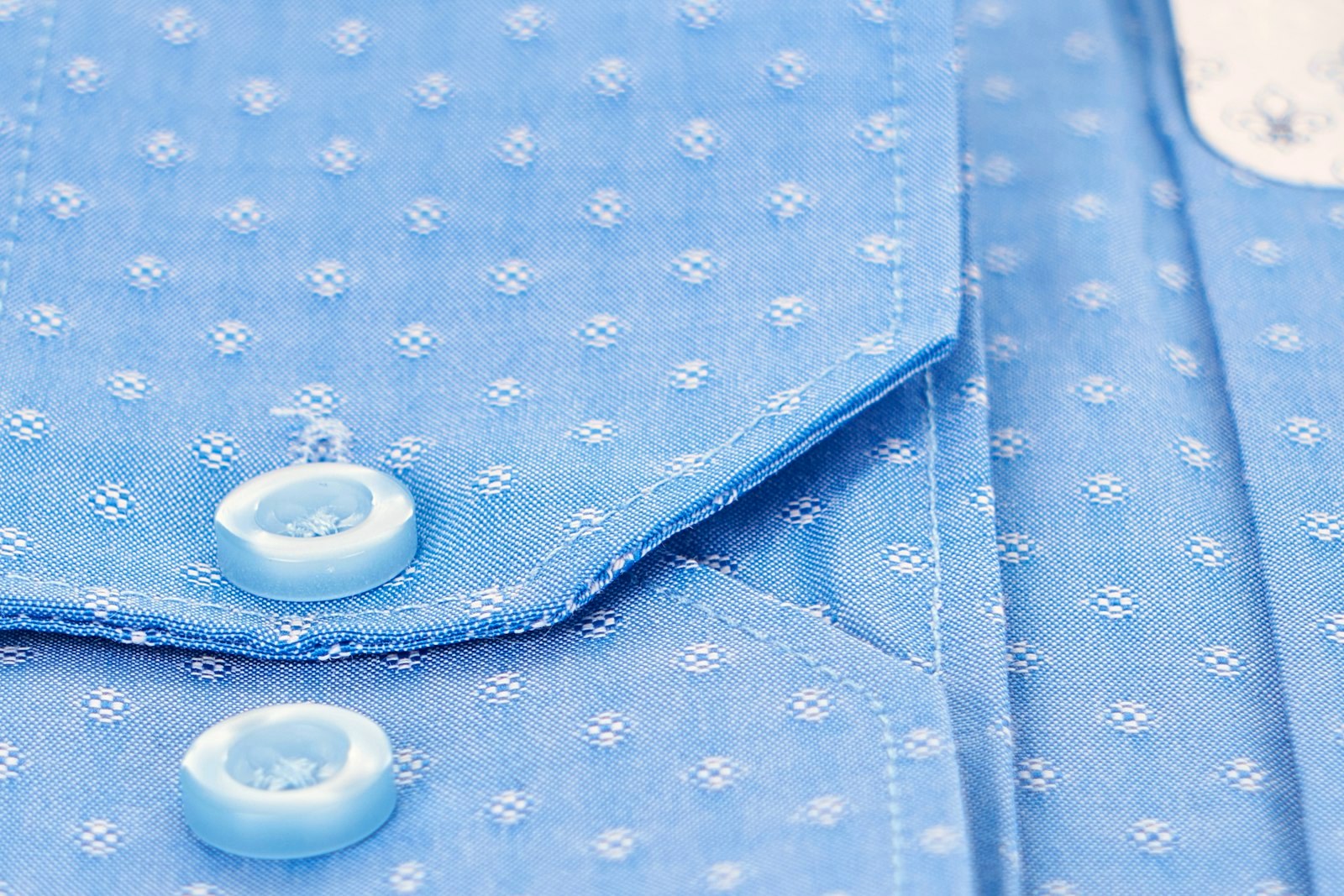
The default is the Oxford button-down, the class of the Kamakura that leads the Oxford ranking at 93, and the choice is mechanical as much as aesthetic. The button-down collar fastens its points to the shirt's chest, so the collar sits inside the V in a fixed, shallow roll and cannot wander over the knit's ribbing by the second hour, as an unbuttoned spread collar does under every knit it is paired with. At the dressed end the smooth dress shirt takes over, its collar the frame's inner frame, the tie's knot inside the V on the FAQ's conditions. In both cases the shirt is tucked and its tail covered by the sweater's hem at the belt: the assembly's horizontal line is drawn there, and a shirt tail escaping below a sweater's hem is two lengths arguing at the waist. The polo beneath a V is refused here once and named again in the ceiling section, on geometry: a polo's soft collar can neither sit inside the frame with a button-down's discipline nor stand over the ribbing with a jacket collar's authority, so the two collars argue over one throat until both lose, and the index already files the knit polo as its own type for the man who wants the knitted collar.
The first licensed exception: the tee, as a triangle, in the casual species. Here the sleeved garment parts company with its vest sibling, and the difference is structural. No. 36 answers the tee under a sweater vest as a change of garment, because the vest sleeveless over a tee leaves two soft layers and no structure anywhere. The V-neck sweater over a tee keeps its own sleeves and its own structure; what changes is only the picture in the frame, from a collar to a clean triangle of jersey. Ruled as a styling decision with a right and a wrong cloth, printed as new. Right: a plain fine tee of the class the white tee ranking leads at 88, white or cream, its neckband firm enough to sit inside the V's ribbing as a clean line, under the lambswool country species or a cotton V, in warm weather, as the outfit's known casual register. Wrong, in ascending order: the sports tee and the stretched band, which read as an undershirt caught outdoors; the tee under the fine merino at any posting where a collar was available, which spends the frame on a substitute the room did not ask for; and the deep V over any tee at all, the fashion species borrowing a witness. The triangle is the V's weekend picture. Hung in the frame knowingly, it is legitimate. Hung by default, it is the collar declined.
The second licensed exception: nothing, in the summer cotton species only. The index's buying rule ends with its warning, worn alone against skin it reads unfinished, and this brief prints the warning standing over every wool V in the drawer: a merino or lambswool V on bare skin is the accident of the history sentence at any depth. The exception is narrow, named and bounded. The index files cotton blends among the type's yarns, and the shallow cotton V in summer is a different instrument: a knitted shirt substitute, worn at the depth law's shallow end, its frame holding the throat the way a shirt's open collar does, in the heat months when the shirt beneath it would be a second layer too many. It is legal the way the tank is legal in its own brief: as a warm-weather garment entire, not as the office neck with its picture removed. The man who wears the fine merino on skin in October has not found the exception. He has repeated the accident, and the index has already printed his review.

What goes over it: the blazer posting, the suit's borrowed storey, and the coat stack
The blazer is the V-neck's home posting, and the laws that govern it are already printed in No. 03, needing only to be pointed at this garment. The blazer stands at formality 4 and warmth 2 among the twelve jacket types; it is the middle storey of an outfit, with nothing worn over it; and the knit beneath tailoring is fine gauge, always. The sweaters index's own answer to the blazer question names this garment by name: a V-neck when a tie is in the room. The fine merino V satisfies the whole arrangement at once. It puts the frame at the jacket's opening, where the opening shows it; it warms the chest the blazer leaves open at its button, the posting the waistcoat was invented for; and its sleeves run inside the jacket's sleeves without the bunching a mid-gauge knit guarantees. The conditions are No. 03's own, repeated because they are the ones that fail in practice: the blazer is bought for the plan, tried in the shop with the sweater under it; the sweater is plain, its pattern would fight the jacket's cloth at the one window where it shows; and the tie, when worn, is inside the V on the depth law, the knot whole, which is the assembly's entire point and the crew's structural disqualification from it.
Under a suit, the fine V takes the storey the waistcoat vacated. This ruling is this brief's own, printed as new, and its argument is assembled from parts the site has already published. No. 01 prints the fine cardigan over a shirt and tie reading as a softer waistcoat and names it the waistcoat's warmer understudy, a knit standing in tailoring's sleeveless seat. No. 36 builds its whole brief on the storey that seat represents. The sleeved V is the same understudy with its arms covered and its frame closed: posted under a suit jacket over a shirt and tie, it supplies the middle storey the three-piece suit builds in suiting cloth, in a material that warms where the waistcoat only dresses, and it reads, at the jacket's opening, as the deliberate layer it is. The bounds are the suit's own laws from No. 04: the suit is one garment in two pieces, fitted in its fixed order, its formality kept rather than spent, and a knit storey spends a measured amount of it. The V under a suit is therefore legal in the suit's softer rooms, the working office, the evening, the winter wedding's edges, and refused as a third piece where the suit is being judged as a suit, in the rooms where the waistcoat itself would be suiting or nothing. Fine gauge, plain, shallow to medium: under a suit the frame is at its most exposed and its least forgiven.
The coat stack runs the V at the mild and middle bands, on the Fall Edit's order. Base, warmth, structure, weather, per the Fall Edit: the fine V is a warmth posting with a structure of its own, the one knit that can sit between a shirt and an overcoat and still be doing dress work at both interfaces. Over the lambswool species, the country coats take over on their own briefs' laws, the waxed jacket and the field jacket over the open collar. What the V never does over a coat is substitute for depth of winter: when the gap the coat leaves is a cold gap at the throat, the instrument is the roll neck at warmth 4, which closes the throat the V exists to open, and the V worn there with a scarf stuffed into its frame is two garments apologising for each other. Choose by the throat's job: the frame when the collar and knot are the picture, the roll when the picture is closed for winter.
Trousers, colour and pattern: the register, completed below the waist
The trousers follow the frame up. The V's home leg is the flannel trouser, wool against wool, matte against matte, the dressed assembly the office neck was born into, and under the blazer posting the ranked tailored end of the family, the class of the Spier and MacKay tropical wool trouser at 87 on Verdict Card No. 15. The chino is the casual lender, the ranked class of No. 29's record, the Spier high-rise at 84 as garment evidence, carrying the lambswool species and the open button-down through the shoulder seasons. The jean is argued rather than granted, on the conditions the family briefs print for their denim rows, transposed: dark and straight denim, the country species only, no tie anywhere in the assembly, and a deliberate contrast of colour between knit and jean. Under those conditions the assembly lands as the weekend reading of the garment, a knitted frame over a work leg, and it is a real reading. Outside them, the fine merino over washed denim puts the office neck on a holiday leg, and the outfit reads as two calendars arguing. Shorts are refused without a hearing, for the sweater vest brief's reason transposed: the garment's register is a dressed torso, and a dressed torso over a bare leg is tailoring above and holiday below.
The colour discipline, printed as new, and the rule is the jacket. In a tailored outfit the shirt is white or blue by near-law and the jacket is navy or grey by near-law, which leaves exactly one garment free to carry colour: this one. The V is the colour layer of the tailored assembly, and its colours are therefore chosen against the jacket it will sit inside, not against the wardrobe it hangs in. Under a navy blazer or suit: mid-grey first, the quiet storey, the family's most office-legal colour pairing; burgundy and oxblood second, the statement colours, worn as the outfit's one claim with the tie solid and everything else silent. Under a grey jacket: navy, the default frame, dark enough to draw the V's edge against the shirt and quiet enough to let the knot be the picture. Black is last and knowingly, for the sweater vest brief's reason in a new seat: a black V over a white shirt at any distance reads as severity or service, and the man who wears it borrows that reading on purpose or not at all. Cream and the pale colours belong to the summer cotton species and the country species in daylight; worn in the fine merino under a dark jacket they glare at the opening, a frame brighter than its picture. The pattern law closes the section, inherited from No. 36 and applied without exception: one pattern per outfit, and in this family the V is usually plain so that the tie may be patterned, or patterned so that nothing else may be. A patterned V with a patterned tie is two statements in one frame, and the frame is too small for both.
Footwear follows the trousers, briefly. The flannel assembly takes the loafer and the suede shoe of the dressed casual register, and under the suit posting the shoe answers the suit, not the sweater. The chino assembly takes the clean court shoe and the suede boot. The denim assembly takes the plain work boot and the minimal trainer of the weekend rows. The polished dress shoe worn with the V and no jacket over it spends formality the knit has no way to repay, the gilet brief's reason transposed one family over; under tailoring the refusal lifts with the assembly, as it does there.
The ceiling, the disagreement with No. 09, and the costume lines printed plainly
The ceiling first, plainly: the V-neck's ceiling is the tailored office itself, reached in the blazer and suit postings, and it stops at the rooms where dress is judged as ceremony. It is formality 4 on its own index, the ladder's top, shared with the roll neck; it does not climb past the suit into the territory of the dinner jacket and the formal shirt, where no knit is legal tender, and its warmth ceiling is the index's 3, a middle family's rating that covers the torso and arms honestly and crosses no winter platform unassisted. Inside those two ceilings the garment is close to irreplaceable: no other knit hosts a tie, warms a suit's open chest in the waistcoat's seat, or lets a shirt and jacket read as a finished three-layer assembly with nothing at the throat left unresolved. Its failures are never really about the yarn. They are about the lines this section now prints, after the disagreement is settled.
The disagreement, printed because this site does not smooth its own record. No. 09, the crew brief, argues its garment's completeness against this one in terms that deserve quoting fairly: the V, it prints, is a period piece that survives under a jacket with an open collar, unfinished alone, framing a bare chest or demanding a shirt, and the crew is the neckline that never makes the rest of the outfit negotiate. This brief concedes the load-bearing half of that case, because the index concedes it: the V is unfinished alone, by its own buying rule, and the crew is the drawer's first buy, a ruling repeated in this page's own FAQ. The other half is answered from the senior record. The index files the V joint top of the formality ladder at 4, in the room it names the office, its opening a frame built for a collar and a tie knot; it prints that shallow to medium, fine gauge, over a collar, the V is the most correct sweater in a formal building; and No. 36 ruled the tie yes over this garment's exact geometry with the sleeves removed. An open collar is one picture the frame holds. It is not the only one, and on the index's evidence it is not the first one. The period the V belongs to is the tailored office, and that period is still in session every working day. Where the briefs disagree, the index arbitrates; the crew keeps the drawer, and the V keeps the tie.
Costume line one: the sweater over the shoulders, sleeves tied at the chest. Ruled as a register, not a crime, and the distinction is the point. Draped over a shirt at a summer posting, outdoors, in the country-club register the gesture comes from, the untied or loosely tied knit is a carried layer in a real tradition, a garment in transit on a body that will wear it by evening. The line is crossed by venue and intent: performed indoors, in winter, over tailoring, or as the outfit's whole idea of ease, the drape stops being a layer in transit and becomes a costume of leisure, a man dressed as the idea of a man at a regatta. The test is the Fall Edit's stack order worn honestly: a layer belongs in the stack or in the hand. Worn as a scarf with sleeves, it is in neither, and the tied knot at the chest, pre-tied and arranged, is the tell that the transit was staged.
Costume line two: the deep V over bare skin. The species section refuses the garment; this line names the wearing. The deep V on a bare chest is the one assembly in this family that is a reference before it is an outfit: it quotes a decade's red carpets and a generation of club photographs, and every reader of the silhouette reads the quotation first and the man second, which is the definition of a costume line in every brief in this series. The index has already printed the obituary, worn alone, deep and tight, it read unfinished, and this brief adds only the enforcement: no yarn, no fit and no occasion resurrects it, because the geometry is the failure. The frame was cut for a collar. Worn holding nothing, at a depth that displays the holding, it is the emptiest garment in the drawer.
Costume line three: the V over a polo, two collars arguing. The under section refuses the pairing on geometry; the ceiling names its public reading. A polo's collar will not sit inside the V with a button-down's fastened discipline, and it will not stand over the ribbing with a jacket collar's authority, so it collapses into the opening in soft folds, and the assembly reads as two garments each waiting for the other to dress the throat. Worn in the wild it reads as indecision at the neckline, the silhouette of a man who wanted the knit and the collar and negotiated neither. The index files the knit polo as its own type, a sweater with the collar knitted in, for exactly the man this line addresses: the answer to wanting a collar over a knit is a different sweater, not a second collar forced into this one's frame.
The looks: the frame, filled
Four assemblies from this brief's rulings, each built on the records around the garment. No V-neck sweater is scored in this brief; the numbers in the judgments are the neighbours' records, reproduced from their own pages.
| Setting | The sweater | With | The judgment |
|---|---|---|---|
| The office posting | Plain navy fine-merino V, shallow to medium, hem at the belt | A white Oxford of the ranked class beneath it, a solid or quietly patterned tie with its knot whole inside the V, grey flannel trousers, a hopsack blazer over the lot | The garment at its ceiling and its design point: the frame holding its full picture, collar and knot, at the jacket's opening. The Oxford is the class of the ranking's winner at 93, the tie is the outfit's one permitted pattern, and the assembly is what the index means by the most correct sweater in a formal building |
| The suit's borrowed storey | Plain charcoal fine-merino V under a navy suit | A white dress shirt and a solid tie beneath it, the suit's own shoes below | The waistcoat's seat taken in knit, on this brief's new ruling: the middle storey supplied in the material that warms, legal in the suit's softer rooms, the frame at the jacket's opening doing the third piece's work without borrowing its cloth. The same assembly in a judged room is the over section's refusal, and the difference is the room, not the clothes |
| The country species | Mid-gauge lambswool V in a country brown, over an open button-down | Chinos of the ranked class, suede boots, a waxed or field jacket over the lot in weather | The frame at walking pace: no tie anywhere in the assembly, the collar open inside the V, the knit as the outfit's whole warmth posting at the index's 3. The chino is the class of No. 29's record at 84 as garment evidence, and the assembly is the V's second honest life, the one the fashion cycle never managed to bury |
| The summer exception | Shallow cotton V in cream, worn on skin as the shirt's replacement | Pale chinos or linen trousers, sleeves pushed once, nothing beneath it | The licensed exception demonstrated inside its bounds: a warm-weather garment entire, shallow, its frame holding the throat the way an open shirt collar does. The same sweater in merino, in October, is the under section's repeated accident, and the difference is the yarn and the month, not the mirror |
The ruling
Buy the fine merino V first, plain, in navy or charcoal, at shallow to medium depth, if your wardrobe is collar-forward: over the button-down as the office's standard knit, with a tie on the days the room wants one, under the blazer as its home posting and under the suit in its softer rooms as the waistcoat's warmer understudy. Buy the lambswool V second, for the country species' life, over the open collar and the licensed tee, in the colours that sit quietly under a field jacket. Buy the summer cotton V knowingly, shallow, as a shirt substitute for the heat, and buy no other species: the chunky V is a contradiction priced as a sweater, and the deep fashion V is refused at any price, in any yarn, forever. Refuse the polo beneath it, refuse the patterned V with a patterned tie, refuse the drape performed indoors. The test in the shop is the depth law with the fit law added: over the shirt it will actually cover, the collar sitting inside the ribbing, a knot whole inside the opening if a knot is its future, the point below the knot and above mid-chest, close at the body, ending at the belt. The man who can name the collar it will frame and the jacket it will sit inside has bought a V-neck sweater. The man who bought it for how it looked on skin in the rail's photograph has bought the accident the index already reviewed, and will spend the season discovering the condition printed on it, in the shape of an empty frame, where it was always visible.
The mistakes
Worn alone. The first error, and the index prints it in the buying rule itself: worn alone against skin, it reads unfinished. A wool V on a bare chest has a frame and no picture, an opening holding the one thing it was not cut to hold. The summer cotton species is the bounded exception, shallow and in its season; every other alone wearing is the styling accident that cost the garment its reputation, repeated one man at a time.
The notch. The V bought too shallow, usually by a man who wanted a crew and took the V as its near relation. The collar crowds the ribbing, a knot disappears into the notch whole, and the garment does neither the crew's job nor its own: it is a frame too small for its picture, reading at ten paces as a crew with a defect at the throat. The depth law's mirror tests exist because this mistake is made at the rail, where no collar is present to convict it. Bring the shirt. Try the frame filled.
The bagged point. The fit error with a mechanism: the V's ribbed band is stretched every time the sweater is pulled over a head, hung by its shoulders, or stored folded under weight, and cheap ribbing does not come back. A slack point sags below the knot it was cut to sit under, the frame's geometry goes, and the sweater retires itself from the dressed postings to the tee register while its yarn is still sound. It is the sweater vest's bagged armhole in this family's seat, and the care section prints the storage law that prevents it. Judge a secondhand or ageing V by its point before its cloth.
Bought in the wrong species. The chunky V bought for the office, the fine merino bought for the fell, the deep V bought at all: the species section separates four garments sharing a neckline, and each is correct in exactly its own rooms. The failure is never really the knit, which is usually honestly made. It is the posting the buyer assigned it, a formality-2 body sent to do a formality-4 instrument's work, or the tailoring species sent to be a weekend sweater and resented for its care. Name the room first. The species follows from the room, in this family as in every other on this site.
Care, by fibre, and the ribbing rule
The V-neck's maintenance is the knit family's, printed in No. 09 from the crew ranking's longevity evidence, with one addition of its own. Fold every knit and store it flat; the hanger is where necklines go to stretch, and this garment's neckline is its whole mechanism. The V's ribbed band is the frame's structure, the edge that holds the opening's geometry against the collar it frames, and it takes the strain of every wearing at the point where the two ribbed arms meet. A V hung by its shoulders all summer comes back with its point slack, and a bagged point does not recover: it retires the sweater from the tie and blazer postings to the tee register, which is retirement by another name. Merino is the working fibre, fine enough for the tailoring postings and washing without ceremony. Cashmere, where the plain species reaches for it, wants rest days between wears and rewards them with years. Lambswool pills lightly in its first wears and then settles into its matte warmth, and the country species should be bought expecting that first season's pills as the price of the cloth's hand. Care is not a ritual. It is how the index's numbers become yours rather than the rail's.
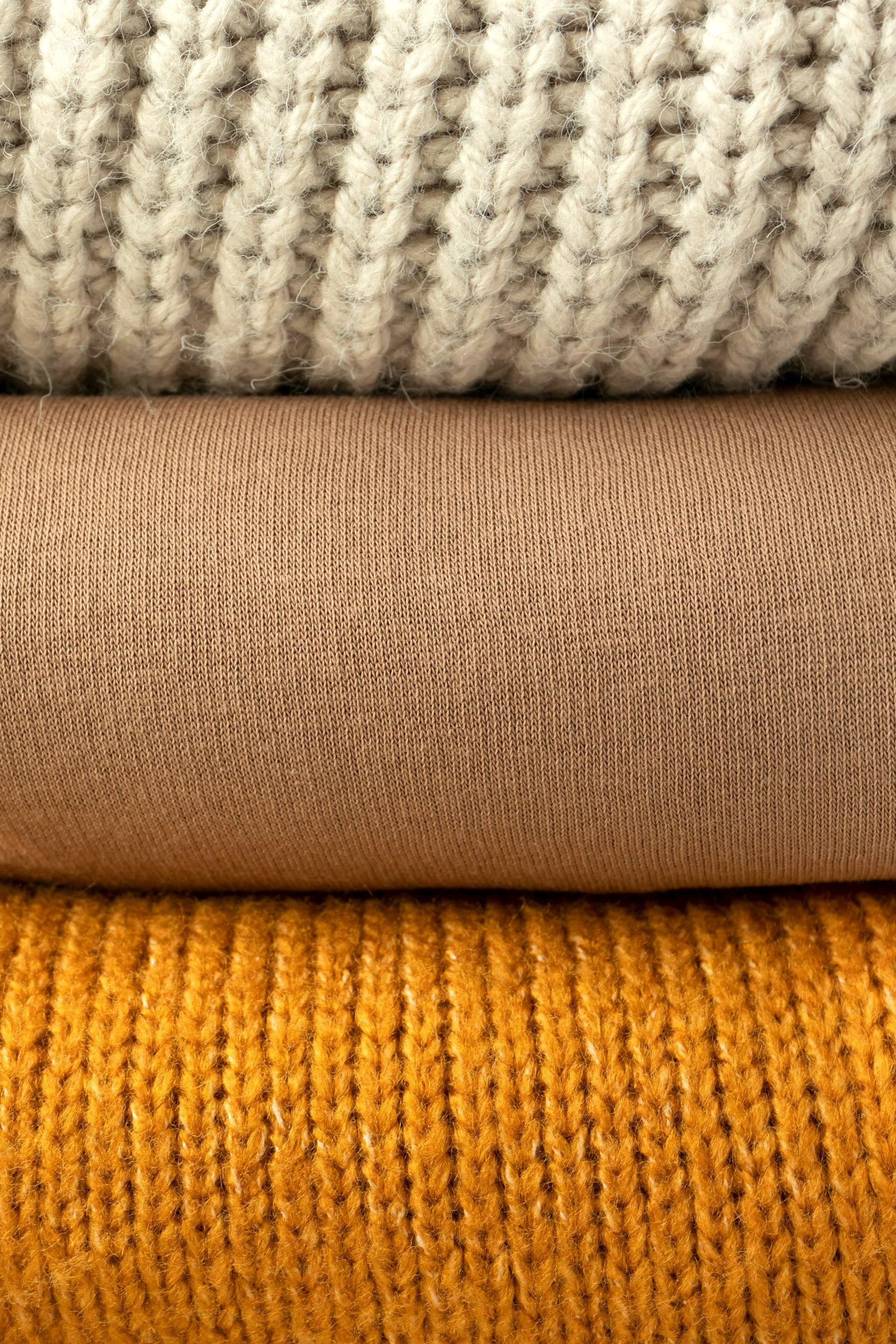
A note on our own photography: our photo bank holds no V-neck sweater frame in any species. The one v-neck file in the bank is a V-neck tee from the tee harvests, a jersey garment photographed as a face, and this page will not caption a tee, a crew neck or a cardigan as the V-neck sweater to fill the slot. There is no fine merino V over an Oxford with the knot inside the V, no V's point and collar at macro range, no lambswool V in country light. The hero is a folded grey knit stack in the garment's own palette, captioned as folded knits; the figures inside are the gauge made visible at macro range, a fine knit over the collared shirt this garment is worn over, and the collar the depth law measures against, each captioned for exactly what it shows. This page will take the harvest frames the week they exist: the navy fine V over a white button-down with the tie inside the frame, the point and the knot at the range where this brief's depth law can actually be seen, and the country species over an open collar under a field jacket.
Questions, answered
What is a V-neck sweater, and how is it different from a crew neck and a sweater vest?
It is the knit family's tailored neckline: a sleeved pullover whose opening is cut in a V to host what stands beneath it. Our sweaters index files it at formality 4 and warmth 3, joint top of the formality ladder with the roll neck, in fine merino, cashmere and cotton blends, in the room the index names the office, over a collar, under one buying rule: buy it to layer over a shirt, because worn alone against skin it reads unfinished. The crew neck, at formality 3 and warmth 3, is its complete sibling: finished alone, a frame over a shirt, asking nothing of the outfit around it. The sweater vest is this garment's geometry with the sleeves removed, filed at formality 3 and warmth 2 and styled in No. 36: a storey of dress over a shirt, with the arms left to the shirt. The V-neck sweater is the whole garment, not the storey: it covers the arms itself, carries the frame the vest borrows, and is the shirt's replacement as often as its cover.
How deep should a V-neck sweater's V be?
Shallow to medium, measured against the collar and the knot, never against the chest: that band is the index's own, printed beside its verdict that a V so worn, fine gauge over a collar, is the most correct sweater in a formal building. The working test is the picture the frame holds. The V's point should land below a tie knot, so the knot sits inside the opening whole, and above mid-chest, so the opening stays a neckline and does not become a display. Too shallow and the V is a crew with a notch: the collar crowds it, a knot is swallowed by it, and the garment does none of the work its neckline exists for. Too deep and the frame is holding the chest, which is the fashion register this garment fell from fashion in, worn alone, deep and tight, on the index's own account of the fall. Depth is not a taste. It is the difference between the office neck and the costume.
What do you wear under a V-neck sweater?
A collared shirt is the default and the design: the opening is a frame built for a shirt collar and a tie knot, and the index calls this the only type on its page that looks better with more clothing under it than less. The Oxford button-down is the working default, the class of the Kamakura that leads the Oxford ranking at 93, its collar points fastened down so they sit inside the V without wandering; the smooth dress shirt takes the dressed end, with a tie. The collar sits inside the V's ribbing, the shirt's tail stays tucked where the sweater's hem finishes at the belt, and the sweater's own sleeves cover the arms, which is the whole difference between this garment and its sleeveless sibling. A tee beneath it, and bare skin beneath its summer species, are separate postings with their own conditions, answered in the questions below; neither is the dressed one.
Can you wear a V-neck sweater with a tie?
Yes: it is the posting the neckline was cut for, and the ruling is not new on this site. The sweaters index files the V at formality 4 as the office neck and calls its opening a frame built for a collar and a tie knot; the sweater vest brief, No. 36, ruled the tie yes over the identical geometry with the sleeves removed, on the cardigan brief's precedent that a fine knit over a shirt and tie reads as a softer waistcoat. The conditions are that brief's three, carried over whole: the sweater is plain, because a patterned V and a tie are two statements in one outfit; the gauge is fine, roughly 24 to 30 on the crew ranking's bands, so the knit sits flat under the knot and inside a jacket's line; and the knot sits inside the V, whole, neither swallowed by a shallow neckline nor dropped below the point of a deep one. A V that cannot meet the third condition is the wrong depth, whatever its other virtues.
Can you wear a V-neck sweater over a t-shirt?
You can, and unlike its sleeveless sibling the sweater survives it, because the sweater is a complete garment and the tee is a deliberate under-layer, not a missing collar. But the triangle of tee visible inside the V is a styling decision, not a default, and it has a right and a wrong cloth. Right: a plain, fine tee of the class the white tee ranking leads at 88, white or cream, its band sitting clean inside the V's ribbing, under the lambswool country species or a cotton V, in warm weather, worn knowingly as the casual register. Wrong: a sports tee, or a tee whose band has stretched and bags below the ribbing, which reads as an undershirt caught outdoors; any tee at all under the fine merino at a dressed posting, where the frame was built for a collar; and the deep V over a tee at any gauge, the fashion register with a witness. The tee triangle is the V's weekend. It is not its office.
Can you wear a V-neck sweater under a blazer or a suit?
Under a blazer, it is the garment's home posting: the sweaters index's own answer for the blazer names a V-neck when a tie is in the room, the blazer stands at formality 4 among the jacket types as the middle storey of an outfit with nothing worn over it, and the knit beneath tailoring is fine gauge, always, with the jacket sized for the plan in the shop on No. 03's warning. Under a suit, the fine V takes the storey the waistcoat vacated: the cardigan brief prints a fine knit over a shirt and tie as a softer waistcoat, and the sleeved V is that understudy with its arms covered, warming the chest the suit jacket leaves open at its button. The suit's own laws bound the posting: the suit is one garment in two pieces on No. 04's ruling, its formality is kept, not spent, and the V is legal in the softer rooms a suit works, the office and the evening, not as a suit's third piece where the suit itself is being judged. In both postings the gauge is fine and the sweater is plain, because what shows at the jacket's opening is the whole of its job.
V-neck or crew neck: which should you buy first?
The crew, for the drawer, and this brief does not pretend otherwise. No. 09 tried that case for its own garment and the index's numbers support the verdict: the crew at formality 3 and warmth 3 is complete alone and over a shirt, while the V at 4 and 3 is unfinished alone by its own buying rule, so a man buying one knit buys the crew. Buy the V first only if your week is already collars and jackets, if the rooms you dress for are the office rooms the index files it in, because there the order reverses: a crew under a tie crowds the knot it cannot frame, and the V does the one job in the drawer no other neckline does. No. 09 calls the V a period piece that survives under a jacket with an open collar. This brief answers from the index, which files the V joint top of the formality ladder as the tie's frame: the period it belongs to is the tailored office, and that period is still in session. The two briefs disagree about the garment's century. They agree about everything else, including the crew's priority in a new drawer.
Has Young Cotton ranked V-neck sweaters?
Yes, since Verdict Card No. 57 ranked seven V-neck sweaters on their published records, the John Smedley Blenheim winning at 87. This brief predates the Card; what existed in print when it was written is the garment's record across the site: the sweaters index files it joint top of its formality ladder at 4, warmth 3, the office neck, bought to layer over a shirt; the crew ranking prints the gauge bands its fine species is bought by, fine roughly 24 to 30, and scores its round-necked sibling at 87; the turtleneck Card scores the ladder's other formality-4 neck at 85; the cardigan ranking scores the opening knit at 84; the sweater vest ranking scores this garment's sleeveless sibling at 82, and No. 36 styles it as the storey this sweater wears whole; the Oxford ranking scores the shirt beneath it at 93; and this brief is the wearing system those records imply, the frame rule, the depth law, the species, the under and over laws and the outfit matrix, printed so any V-neck sweater can be judged on the wearing before a ranking exists.
Next
The garment's place in the drawer, joint top of the formality ladder at 4 and warmth 3, is printed whole in the sweaters index. Its sleeveless sibling is styled in How to Wear No. 36 and ranked in Verdict Card No. 56; its complete sibling in No. 09, the brief this one disagrees with in print and answers from the index; the ladder's other formality-4 neck in No. 08 and the opening knit in No. 01. The jackets of its home postings are briefed in No. 03 and No. 04; the shirt beneath it is ranked in the Oxford ranking, the gauge law in Verdict Card No. 10, and its opening cousin in the cardigan ranking. The stack its coat posting belongs to is ordered in the Fall Edit; the trousers beneath it are ranked in Verdict Card No. 15 and styled in No. 29.