
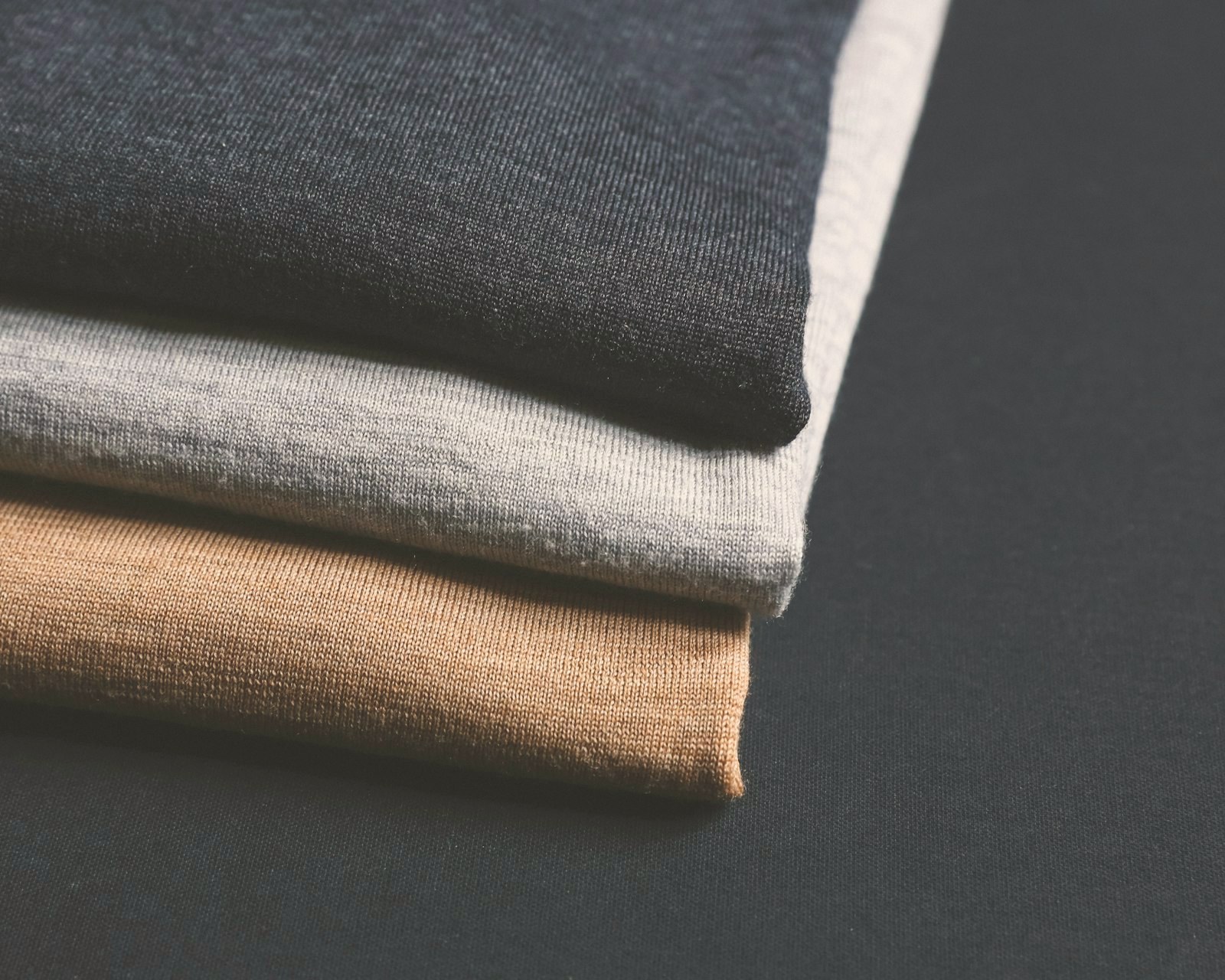
The garment's cloth and palette, folded, captioned as exactly that: a stack of knits in navy, grey and camel. Our bank holds no photograph of a sweater vest in any species, so this page opens on the knits it is cut from rather than dress a sleeved sweater as its subject. The care section prints that gap and the harvest list.
Checked and updated October 2026
The ruling, up front: the sweater vest is a storey of dress, not a layer of weather. Our sweaters index files it at formality 3 and warmth 2, and those two numbers are the whole brief: it exists to dress a shirt, to add the middle storey between the shirt and the jacket, and it warms the torso only as an accident of being knitted. Worn for its number, over a collared shirt, close, ending at the belt, it is the layer that lets a shirt be outerwear through the shoulder seasons and the blazer be warm at the chest through the cold ones. Worn against its number, alone, baggy, over a tee by default, or under a cardigan in the professor stack, it is the most costume-prone garment in the knit drawer, and the index prints the sentence this page exists to enforce: worn alone, or baggy, it reads as a costume in search of an argument. One boundary stands at each side of it, both drawn by No. 35: the gilet behind it, a stack garment that adds warmth and no formality, and the waistcoat ahead of it, tailoring's sleeveless garment travelling under a jacket. This brief owns the garment between them, in its four species: the plain V-neck, the cricket vest, the patterned vest, and the buttoned and zipped variants.
This brief: the decisive rule · the four species, and the two garments that are not this one · what goes under it · what goes over it · trousers, colour and pattern · the ceiling, and the costume lines · the looks · the mistakes · care and our photography
The decisive rule: it adds a storey, not a season
Every sleeveless garment on this site is a trade, and the first task is to name the right one. The gilet of No. 35 trades sleeves for core warmth: its fill is real, its formality is nothing, and its failures are failures of posting. The sweater vest trades in the opposite currency. Its warmth is the index's 2, the lowest warmth on the sweaters page that is not a deliberate warm-weather rating, a torso of fine or mid-gauge knit that takes the edge off a room and nothing more; no man has ever crossed a cold platform on the strength of it, and this brief will not pretend otherwise. What it adds is formality, a full storey of it: the shirt alone is one layer of intention, the shirt under a knit vest is a dressed torso, a middle term between the shirt and the jacket that changes how both neighbours read. That is this brief's decisive rule, printed as new: buy and wear the sweater vest as tailoring's soft instrument, a storey added over a shirt, and judge every outfit by whether the storey is doing dress work. The moment it is asked to do weather work, or worn where no storey is needed, it stops being a garment and becomes a reference, and references are costumes.
The costume gravity the index warns about is not an accident of fashion cycles; it is built into the trade. A garment whose whole job is to signal a storey of dress is one bad pairing away from signalling a character instead: the professor, the golfer, the grandfather, the sitcom neighbour. Each of those readings is a real historical posting of this garment, fossilised, and the vest carries all of them the way the fleece vest of No. 34 carries the employer's badge. The defence is the same in kind: posting discipline. The fleece vest is honest at work and a badge in the street; the sweater vest is honest over a collar, at its length, in its species' register, and a costume the moment it is worn as a joke about itself, a layer with nothing under it, or a second middle layer stacked over the first. This brief's species, fit and ceiling sections are that discipline, section by section.
The garment also has one ability neither boundary neighbour can match, and it is the reason the brief exists. It is the only layer that lets a shirt stand as outerwear. A shirt alone in April is a man underdressed for the hour after sunset; the same shirt under a plain knit vest is an outfit with a middle, finished at the torso, its sleeves doing the arms' dress in the open air. The index files the type's season as spring to autumn, and the season is the ability's boundary: the vest extends the shirt's range at the mild ends of the year, in the rooms and evenings where a jacket is too much and a shirt is not quite enough. It extends nothing at the cold end. That extension, the blazer posting of the over section, and the tie it frames are the garment's whole honest territory, and it is wide enough.
The garment, against the records of its neighbours:
| The garment | Its record | What it contributes | Its posting |
|---|---|---|---|
| The sweater vest | Sweaters index, tenth of ten: formality 3, warmth 2, merino, lambswool or cotton, over a shirt, spring to autumn | A storey of dress over a shirt at almost no warmth and no bulk: the trade every ruling in this brief prices | Over the collared shirt as the visible middle layer, or under the blazer as its warmth at the chest: the two postings of the decisive rule |
| The V-neck sweater | Sweaters index: formality 4, warmth 3, the office neck, bought to layer over a shirt | The same frame with sleeves: the neckline this garment inherits, one formality rung higher because the arms are dressed by the knit itself | The office and the dressed layer: the sibling whose geometry the vest borrows and whose rung it stands one below |
| The cardigan | Sweaters index: formality 3, warmth 3; No. 01 prints the fine cardigan as the waistcoat's warmer understudy; ranked on Verdict Card No. 16, the Smedley Bryn at 84 | A middle layer that opens: warmth a rung above the vest, a hinge at the waist, a thermostat the vest does not own | The middle of an outfit, over a shirt and tie, under a coat: the first buy of the family, and the garment never worn over this one |
| The tailored waistcoat | No brief of its own: tailoring's sleeveless garment, its button law printed beside the blazer's in No. 03 and shared with the cardigan in No. 01 | Formality inside a suit: a storey of dress in suiting cloth, warmth an accident, exactly this garment's trade in a harder material | Under a jacket only: a boundary garment, ruled out of this brief by No. 35, whose seat under the blazer the fine vest borrows in knit |
| The gilet | No index row in the jackets index: a posting, not a type, styled in No. 35; the insulation it carries graded on Verdict Cards No. 46, No. 53 and No. 55 | Core warmth with the arms freed: the opposite trade, weather work with no formality borrowed or lent | The stack's warmth posting, over a knit or under a coat: the other boundary garment, ruled out of this brief by No. 35 from the far side |
The four species, separated, and the two garments that are not this one
The rail sells four garments under this brief's name, and they differ the way the index's yarns differ: same silhouette, different jobs, different ceilings. The species error, buying one for another's posting, is where most of the costume readings begin.
| Species | What it is | Its register | The ruling |
|---|---|---|---|
| The plain V-neck vest | A sleeveless pullover knit in a plain stitch, fine to mid gauge, in merino for the dressed end and lambswool or cotton as the gauge coarsens: the index row's own garment, unadorned | The default: the layer of the family, as neutral as a knit can be, taking its register from the shirt beneath and the company it keeps | The first buy and the reference species, against which the other three are variations. Plain is not a lack of ambition; it is the condition of the garment's range. In fine merino it takes the tie and the blazer, the two dressed postings of this brief; in mid gauge over a button-down it is the shoulder-season shirt made outerwear. Its ceiling is the index's formality 3, and it reaches that ceiling precisely because it says nothing of its own: the storey is the statement, and the plainer the knit, the cleaner the storey reads |
| The cricket vest | The heritage species: a cable-knit sleeveless pullover in white or cream wool, or wool and cotton, traditionally trimmed with club colours banded at the V and the waist, cut for a summer game played in whites | Heritage, with a season attached: the most beautiful species and the most dangerous, because it arrives carrying its whole sport with it | Two laws, a cloth law and a season law, both printed as new. The cloth law: cable knit, white or cream, the trim in at most two colours; a cricket vest in a plain stitch or a dark colour is a plain vest in costume trim, neither species, and a smooth dark copy keeps the silhouette and deletes the garment. The season law: it is a summer garment, filed inside the index's spring-to-autumn span at its warm end, worn in daylight, over a white or pale shirt, with pale trousers. In season it is the finest posting the family owns. Out of season, under grey light in dark trousers, the same vest is a kit in search of a pitch, and the ceiling section prints where that line falls |
| The patterned vest: argyle and fair isle | The statement species: the plain vest's body carrying a knitted pattern, argyle's diamonds from the golf course's end of the family, fair isle's banded yoke patterns from the northern knit tradition | Statements, with the loudest costume gravity in the drawer: argyle borrows the golfer, fair isle borrows the fireside cardigan photograph, and both borrowings are one loud pairing from fancy dress | The one-pattern law, printed as new and applied without exception: the patterned vest is the outfit's single pattern, worn over a plain shirt, with plain trousers, and no tie or a solid one only, because a patterned tie over a patterned vest over a checked shirt is three statements shouting in a stairwell. Under the law the species is legal and even distinguished: a fair isle vest over a plain Oxford with flannel trousers is a real winter register, and an argyle in quiet colours over a plain shirt is golf's gift repatriated to the street. Outside the law the species is where the golf joke lives, and no fit discipline in this brief rescues a pattern pile-up, because the failure is not the vest. It is the noise around it |
| The buttoned and zipped sleeveless knits | The opening variants: a sleeveless cardigan, buttoning down the front, and a sleeveless zip-front knit, the cardigan's and the gilet's respective silhouettes translated into this family | Two different registers sharing a rail: the buttoned form sits nearest tailoring, the zipped form sits nearest sport, and they are not interchangeable | Ruled as different garments, printed as new. The button-front sleeveless knit is the cardigan cut sleeveless, and it inherits the cardigan's law: the middle buttoned, the bottom left open, on No. 01's shared rule; worn open it frames the shirt like a soft waistcoat, and it is the one variant that can stand in the waistcoat's seat under a blazer with its front visible and correct. Its ceiling is the plain vest's ceiling, reached by a different road. The zip-front sleeveless knit is the knit imitating the gilet, a casual register entire: a weekend garment over a tee or a henley, never with a tie, never under a blazer, because the zip is sport hardware and reads as such against every dressed neighbour. Buy the buttoned form for dress range. Buy the zipped form knowingly, as the family's floor |
The two garments that are not this one, ruled at the boundary, briefly, because No. 35 owns both rulings. Ahead of it stands the tailored waistcoat: suiting cloth, a storey inside a suit, travelling under a jacket on tailoring's laws, its warmth an accident. The fine sweater vest borrows the waistcoat's seat and its framing job; it does not borrow its cloth, its buttons' law beyond the shared hinge rule, or its right to be worn as a suit's third piece in a room where suits are being judged as suits. Behind it stands the gilet: insulation with the sleeves removed, the stack's warmth posting, formality nothing. The two garments share the sleeveless silhouette and nothing else, and the confusion costs both ways: a gilet worn to dress a shirt is equipment at a dress posting, and a sweater vest worn to warm a stack is a storey asked to be a season. No. 35 prints the full boundary, including the naming debt the word vest carries in British English, where it is the cotton undershirt ranked on Verdict Card No. 30. This brief's garment is the knit one, over a collar, and its name in this page is the sweater vest throughout.
The gauge law, inherited and applied by species. The knit briefs run on the bands Verdict Card No. 10 published and No. 09 restates: fine roughly 24 to 30, mid 12 to 20, heavy 7 and below, with the Smedley Lundy at 87 the reference knit of the family. The vest's dressed postings are fine-gauge postings, because fine is the gauge that sits flat against a shirt, frames a knot without bulk, and disappears under a blazer without printing through, the same law No. 09 prints for the crew under tailoring. Mid gauge is the shoulder-season gauge, the vest worn visibly over a button-down as the outfit's outside. Heavy gauge in a sleeveless knit is refused as a species error entire: a chunky sleeveless knit is warmth cloth with its warmth posting removed, the gilet's trade attempted in yarn, and it inherits neither garment's virtues. The patterned and cricket species live at mid gauge by construction, cables and colourwork needing the yarn to carry them, which is one more reason their ceilings sit below the plain fine vest's: the gauge chooses the room, in this family as in every other on this site.
What goes under it: the collar is the contract
The index prints the under-layer in its buying rule, and this section does no more than enforce it with reasons: over a collar, never worn alone. The collar is not a styling preference. The vest is a frame, and a frame requires a picture: the shirt's collar and placket are the vertical the V is cut around, the woven cloth is the structure that keeps the knit from reading as a soft tube, and the contrast, knit over woven, matte yarn over cotton twill, is the garment's entire visual mechanism. Remove the shirt and the mechanism is gone, which is why the index's costume sentence names the alone state first.
The default is the Oxford button-down, the class of the Kamakura that leads the Oxford ranking at 93, and the choice is mechanical as much as aesthetic. The button-down collar fastens its points to the shirt's chest, so the collar sits inside the V in a fixed roll and cannot wander over the knit's edge as an unbuttoned spread collar does by the second hour; the Oxford's textured weave stands beside a mid-gauge knit without the sheen argument a smooth poplin starts at that gauge. At the dressed end, under the plain fine vest with a tie, the smooth dress shirt takes over, its collar the frame's inner frame, the knot inside the V on the FAQ's conditions. In both cases the shirt is long-sleeved and tucked: the sleeves are the arms' whole dress in this assembly, the index's phrase is a layer with the arms left to the shirt, and a short sleeve leaves the arm half in summer and half in knit season, the silhouette of the golf joke in its original habitat. Tucked, because the vest ends at the belt and the outfit's horizontal line is drawn there; an untucked tail hanging below the hem is a skirt under a storey, two lengths arguing at the waist.
The tee, answered honestly, as the FAQ answers it: a different garment's register. Over a tee, nothing in the assembly supplies the frame: two soft garments, no collar, no contrast, and the vest reads as borrowed knitwear unless the whole thing is done at the plain, close, warm-weather end of the zip variant or the cotton plain vest, over a heavyweight tee of the class the white tee ranking leads at 88. This brief does not ban the assembly; it refuses to call it the garment's posting. The man who reaches for the vest over a tee daily has not found the vest's casual mode; he has made a uniform of the exception, and uniforms are this site's named failure in every family they appear in. The roll neck beneath a V is refused on geometry, printed in the FAQ: the turtleneck's collar occupies the frame the V exists to hold open, and the two necklines argue over one throat until both lose. And a sleeveless knit over a sleeved knit, vest over crew sweater, is refused as a layering inversion: the under-layer of this garment is woven by design, and knit over knit in the same family reads as one sweater wearing another, a confusion of storeys the over section meets again from the other side.

What goes over it: the blazer posting, the coat stack, and the one refusal
The blazer is the vest's best dressed posting, and the laws that govern it are already printed in No. 03, needing only to be pointed at this garment. The blazer stands at formality 4 and warmth 2 among the twelve jacket types; it is the middle storey of an outfit, with nothing worn over it; and the knit beneath tailoring is fine gauge, always. The fine plain sweater vest satisfies that law and adds what no sleeved knit can: warmth and a visible storey at the chest, inside the jacket's opening, with nothing at the arms to bunch inside the blazer's sleeves. It is the waistcoat's seat taken in knit, the understudy arrangement No. 01 prints for the cardigan translated one step further from suiting cloth. The conditions are No. 03's own, repeated because they are the ones that fail in practice: the blazer is bought for the plan, tried in the shop with the vest under it, since a winter layer discovered in January is a size error discovered with it; the vest is plain, its pattern would fight the jacket's cloth at the one window where it shows; and its hem ends at the belt, hidden below the jacket's button, so the storey reads only where the opening frames it.
The coat stack runs the vest at the mild end, and the direction is worth printing because it is the gilet's move inverted. No. 35's gilet extends a fixed-warmth coat's range into colder weather, insulation posted inward. The sweater vest extends the same coat's range the other way, into milder weather: in the shoulder months the overcoat over a shirt alone is a storey missing, the coat's structure with nothing between weather and woven cotton, and the vest supplies the middle term at warmth 2, exactly the size of the gap. On the Fall Edit's order, base, warmth, structure, weather, the vest takes the warmth word in an assembly whose weather word is a coat worn against wind and evening rather than against winter. Under a trench or a rain shell the same posting holds at smaller scale. What the vest never does under a coat is substitute for the sleeved knit of deep winter: when the coat's gap is a cold gap, the instruments are the crew and the roll neck at warmth 3 and 4, and the vest worn there is the decisive rule broken, a storey asked to be a season.
The refusal, printed once: no cardigan over a sweater vest, ever. The argument is structural, and the ceiling section gives it its costume name. The cardigan and the sweater vest claim the same storey: both are the middle layer over a shirt, both are formality 3 on the index, and the cardigan is printed in its own brief as the waistcoat's warmer understudy while the vest is the waistcoat's knit cousin in the same seat. Wearing both is wearing the understudy over the principal: the cardigan's buttons close across the vest's V, hiding the frame that is the vest's whole mechanism, and the outfit doubles its knit at the torso while the arms stay in shirt sleeves, warmth where it is not needed and none where it is. Each garment is correct alone over the same shirt. Together they are the professor stack, and it is a mistake of assembly, not of taste: two garments, one posting, no resolution. Choose by the day: the cardigan when the layer must open, close and warm; the vest when the shirt is the outfit and the storey is the point.
Trousers, colour and pattern: the register, completed below the waist
The trousers follow the storey up. The vest's home leg is the flannel trouser: wool against wool, matte against matte, the dressed casual assembly the garment was born into, and under the blazer posting the ranked tailored end of the family, the class of the Spier and MacKay tropical wool trouser at 87 on Verdict Card No. 15. The chino is the casual lender, the ranked class of No. 29's record, the Spier high-rise at 84 as garment evidence, carrying the mid-gauge vest and the button-down through the shoulder seasons without a murmur. The jean is argued rather than granted, on the conditions the blazer brief prints for its own denim row, transposed: dark and straight denim, a wide and deliberate break of colour between vest and jean, and the plain species only. Under those conditions the assembly lands as the weekend reading of the garment, a knit storey over a work leg, and it is a real reading. Outside them, light washed denim or a patterned vest over jeans puts a casual statement above and below at once, and the outfit reads as two weekends arguing. Shorts are refused without a hearing: the vest's season is spring to autumn at the index, but its register is a dressed torso, and a dressed torso over a bare leg is the blazer brief's runway proposition in knit, tailoring above and holiday below.
The colour order, printed as new. Navy first: the default storey, the colour that frames a white or blue shirt without arguing with either, and the vest's equivalent of the blazer's own first colour. Charcoal and mid-grey second, the quieter storeys, grey over a white shirt being the family's most office-legal assembly short of the tie posting. Burgundy and oxblood third, the statement colours, worn as the outfit's one claim with everything around them plain. Cream belongs to the cricket species and its season, and outside that species and season it reads as the cricket vest's costume borrowed without the cable. Black is last, and knowingly: a black sweater vest over a white shirt is read as service dress or severity at fifty paces, the waiter's and the undertaker's silhouette, and the man who wears it should know he is borrowing that reading on purpose. The pattern law closes the section and repeats the species ruling because it is the one most often broken at the trouser line as well: one pattern per outfit, and in this family the vest is usually it, plain shirt, plain trousers, plain tie or none.
Footwear follows the trousers, briefly. The flannel assembly takes the loafer and the suede shoe of the dressed casual register; the chino assembly takes the clean court shoe and the suede boot; the denim assembly takes the plain work boot and the minimal trainer of the weekend rows elsewhere in this series. The dress shoe proper, polished calf at the top of its scale, is refused under the vest worn without a blazer, for the gilet brief's reason transposed: it spends formality the garment above it has no way to repay. Under the blazer posting the shoe answers the blazer, not the vest, and the refusal lifts with the assembly.
The ceiling, and the costume lines printed plainly
The ceiling first, plainly, as an unnumbered-in-one-family garment requires: the sweater vest's ceiling is the top of the dressed casual register, reached in the blazer posting, and it stops below the rooms a suit owns. It is formality 3 on its own index and it does not climb: over a shirt and tie it reads as a softer waistcoat, formal enough for most offices on the cardigan brief's printed phrase, and it is not a waistcoat, not a third piece of a suit, and not legal dress where the suit itself is being judged. Its warmth ceiling is the harder one, printed in the decisive rule: warmth 2, a storey, not a season. Inside those two ceilings the garment is close to irreplaceable: no other layer dresses a shirt at so little bulk, warms a blazer's chest at no cost to its sleeves, or carries a shirt into the evening hours of spring as an outfit entire. Its failures are never really about the knit. They are about the line this section now prints, three times, in its three forms.
Costume line one: the full cricket kit off a pitch. The cricket vest in season, over a white shirt with pale trousers, is the family's finest heritage posting. The same vest worn as a kit, cream flannels below, the club trim carrying two colours, a cap or a blazer with piping anywhere in the assembly, in October, in a city, at a desk, is not the heritage posting; it is the uniform of a game photographed outside its ground, and it fails the oldest test on this site, the issued-garments law in reverse: a garment whose every feature announces a sport, worn where no sport is being played, is a costume of that sport. The line is the assembly and the calendar, not the vest: one heritage signal at a time, the cable and the cream carrying it alone, in the months the game itself is played.
Costume line two: the professor stack. The over section refuses the cardigan over the vest on structure; this line names what the refusal looks like from across the room. Two knit storeys over a shirt, the cardigan's buttons closed over the vest's V, is read instantly and universally as the academic fancy dress of a hundred productions, because the stack is what a wardrobe department reaches for when it wants to say lecturer without dialogue. The reading is unfair to both garments and completely reliable, which is the definition of a costume line: it is crossed not when the outfit becomes bad but when it becomes a reference. The fix is the over section's choice, made daily and without nostalgia: one middle layer, chosen for the day's job, cardigan for the layer that opens and warms, vest for the shirt-forward day. The man who owns both and wears them on alternate days owns a system. The man who wears them together owns a character.
Costume line three: the irony wearing. The sweater vest is the one garment in the drawer that is routinely bought as a joke, worn with a wink, defended as ironic. Print the rule plainly: if the vest needs the wink, it is a costume, and the wink does not save it; it announces it. Irony is a posting with no garment in it, a way of wearing a reference while declining to wear the clothes, and every other brief in this series refuses it in its own family's terms, the gilet as a badge, the fleece as a uniform. The vest worn earnestly, over a collar, at its length, in its species' register, is a garment with three centuries of postings behind it. The vest worn as a bit is a prop with armholes. The mirror can tell them apart at fifty paces, and so can every reader of this page, which is why the line is worth printing in the brief that finally gives the honest garment its due: the sweater vest did not earn its reputation. The joke borrowed it.
The looks: the storey, worn
Four assemblies from this brief's rulings, each built on the records around the garment. No sweater vest is scored in this brief; the numbers in the judgments are the neighbours' records, reproduced from their own pages.
| Setting | The vest | With | The judgment |
|---|---|---|---|
| The dressed posting | Plain navy fine-merino V vest, hem at the belt | A white Oxford of the ranked class beneath it, a solid tie inside the V, grey flannel trousers, a hopsack blazer over the lot or carried | The garment at its ceiling and its best: the storey visible at the blazer's opening, the tie framed by the V, the whole assembly reading as the waistcoat's softer understudy, on the cardigan brief's phrase. The Oxford is the class of the ranking's winner at 93, and every other element is plain, because the storey is the statement |
| The shirt as outerwear | Charcoal mid-gauge plain vest, closed at the belt line | A blue button-down under it, sleeves as the arms' dress, chinos of the ranked class, suede shoes | The spring and autumn posting the index files the garment for: the shirt finished at the torso, the middle term supplied, no jacket required until the light goes. The chino is the class of No. 29's record at 84 as garment evidence, and the assembly is the reason the type has survived every fashion cycle that buried it |
| The cricket vest in season | Cream cable-knit cricket vest, trim in two colours, over a white Oxford | Stone chinos or pale flannels, no tie, summer daylight | The heritage species inside both its laws: the cloth law kept, cable and cream, and the season law kept, worn in the months the game is played, with one heritage signal in the whole outfit and that signal the vest. The same assembly in November is the ceiling section's first costume line, and the difference is the calendar, not the clothes |
| The patterned statement | A fair isle vest in quiet colours over a plain pale Oxford | Plain flannel trousers, no tie, everything else in the outfit silent | The one-pattern law demonstrated: the yoke carries the outfit's single pattern, the shirt and trousers refuse to compete, and the species reads as a winter register rather than a fireside photograph. Add a checked shirt or a striped tie and the same vest becomes the noise the species section warns about, which is the law's whole point |
The ruling
Buy the plain V-neck first, in fine merino and navy, if your wardrobe is shirt-forward: over the button-down through the shoulder seasons as the shirt's finishing storey, with a tie on the days the office wants one, and under the blazer through the winter as its warmth at the chest, the blazer bought for the plan in the shop. Buy the cricket vest second, and only if you will wear it inside its season, in cream and cable, as the one heritage signal in a pale summer outfit. Buy the patterned vest knowingly, under the one-pattern law, as the statement it is, and buy the button-front sleeveless knit if the waistcoat's seat is the one you want in yarn. Refuse the heavy gauge, refuse the baggy and the long, refuse the tee as a default and the bare skin entirely, refuse the cardigan over it and the irony around it. The test in the shop is the index's own buying rule with the fit law added: over a collar, close, ending at the belt, armholes high. The man who can name the shirt it will cover and the room it will sit in has bought a sweater vest. The man who bought it because it was funny has bought a costume with a care label, and will spend the season discovering the condition printed on it, in the shape of the two armholes and the missing collar beneath, where it was always visible.
The mistakes
Worn alone. The first error, and the index prints it in the buying rule itself: never worn alone. A sleeveless knit on bare skin has no frame, no contrast and no posting; it is a tank with pretensions and a neckline cut for a collar it is not wearing. The sleeveless garment for skin exists, it is ranked, and it is made of cotton jersey. The vest's arms are left to the shirt, and a vest with no shirt has left them to nothing.
Baggy, and long. The twin fit errors, and the index's costume sentence names the pair: worn alone, or baggy, it reads as a costume in search of an argument. The baggy vest hangs off the torso it was meant to frame; the long vest runs past the belt and lengthens the body into the tunic silhouette that reads as borrowed robes. Fitted close over one shirt and ending at the belt, the same vest is the efficient storey of the verdict section. The difference is an inch of cloth at the hem and a size at the rail, which is why this brief prints fit as a law and not as a preference.
The pattern pile-up. Argyle over a checked shirt under a striped tie, fair isle over a patterned flannel, the cricket trim competing with a club-striped tie: the patterned species carries the outfit's one permitted pattern, and every additional pattern is a second statement in a room built for one. The failure is never the vest's cloth, which is usually the best thing in the outfit. It is the noise the wearer arranged around it, and the one-pattern law exists because this mistake, alone among the family's, can be committed with every individual garment fitting perfectly.
Bought as a joke. The ceiling section prints the line; the mistake is crossing it at the till. The vest bought for the wink, the themed party, the knowing photograph, enters the wardrobe as a prop and behaves as one: worn twice, quoted often, and quietly poisoning the honest version's reputation in the same drawer. The garment's postings are real, three centuries of them, and they are all earnest. A wardrobe has room for exactly one of the two purchases, and this brief is written for the man making the other one.
Care, by fibre, and the armhole rule
The vest's maintenance is the knit family's, printed in No. 09 from the crew ranking's longevity evidence, with one addition of its own. Fold every knit and store it flat; the hanger is where necklines go to stretch, and the sweater vest has two more openings than a crew to lose: the armholes. The armhole's ribbing is this garment's neckband, the structured edge that holds the frame's shape against the body, and it is the first place cheap knitting bags; a vest hung by its shoulders all summer comes back with its armholes slack, and a bagged armhole does not recover. It retires the vest from the dressed postings to the tee register, which is retirement by another name. Merino is the working fibre, fine enough for the tie and blazer postings and washing without ceremony. Cashmere, where the plain species reaches for it, wants rest days between wears and rewards them with years. Lambswool pills lightly in its first wears and then settles into its matte warmth, and the patterned species in lambswool should be bought expecting that first season's pills as the price of the cloth's hand. Care is not a ritual. It is how the index's numbers become yours rather than the rail's.
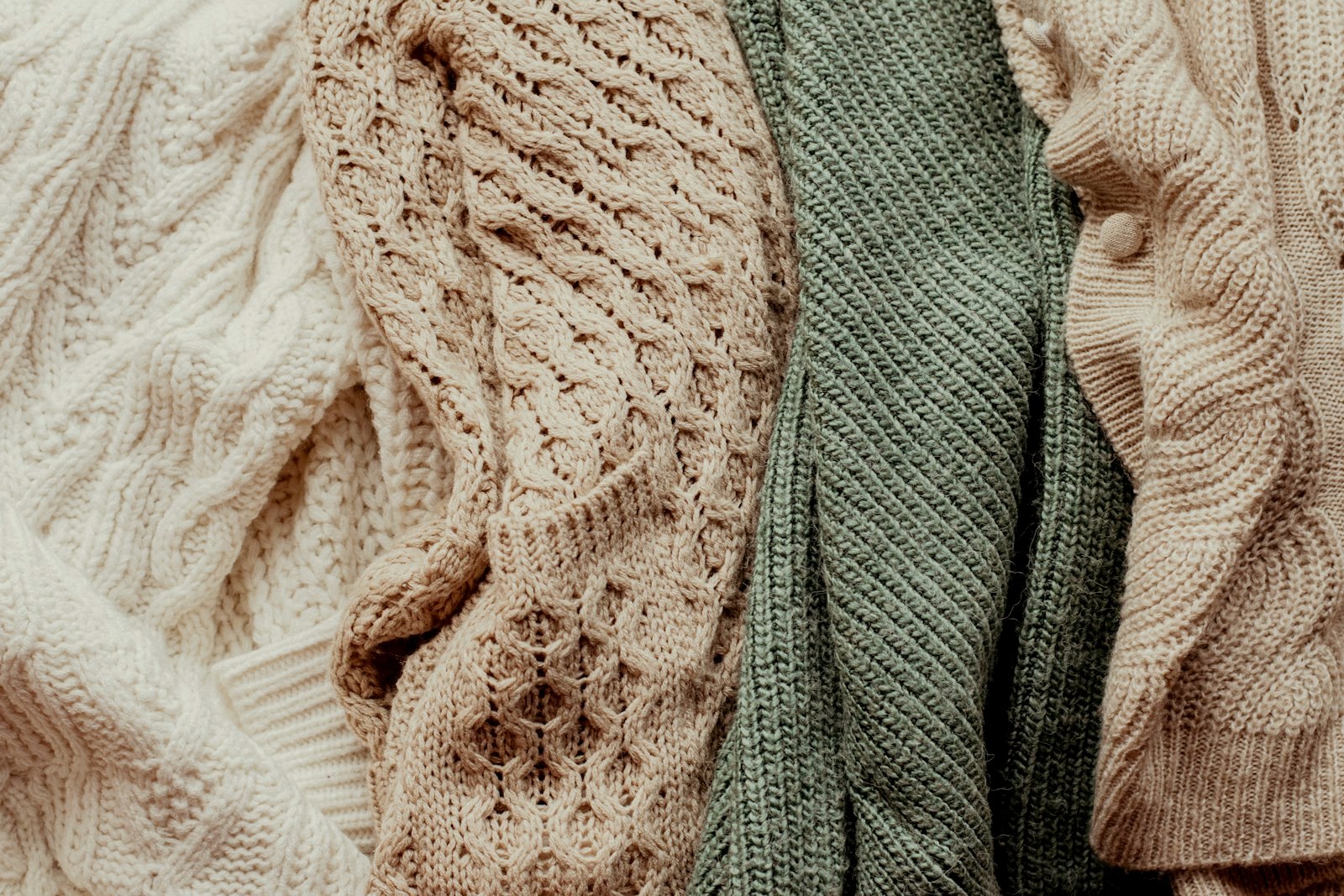
A note on our own photography: our photo bank holds no sweater vest frame in any species. There is no plain V vest over an Oxford on body, no cricket vest in season daylight, no armhole and V at macro range, no fair isle worn with everything else plain. The hero is a folded knit stack in the garment's own palette, captioned as folded knits; the figures inside are the cable cloth of the cricket species at macro range and a fine sleeved knit over the collared shirt this garment is worn over, captioned as a shirt and a sleeved knit. This page will not caption a crew neck, a cardigan or a gilet as the sweater vest to fill the slot, and it will take the harvest frames the week they exist: the navy fine vest over a white button-down with the tie inside the V, the cream cable vest in summer light over pale trousers, and the armhole at the range where this brief's fit law can actually be seen.
Questions, answered
What is a sweater vest, and how is it different from a waistcoat and a gilet?
It is the knit family's sleeveless garment, and the three sleeveless forms divide the wardrobe between them. Our sweaters index files the sweater vest tenth of its ten types, in merino, lambswool or cotton, at formality 3 and warmth 2, over a shirt, spring to autumn, under one buying rule: a layer with the arms left to the shirt, close fit, over a collar, never worn alone. The waistcoat is tailoring's sleeveless garment and travels the other way, under a jacket, on the laws the blazer and cardigan briefs print; the gilet is the outdoor stack's warmth posting, a jacket's fill with the sleeves removed, and No. 35 rules the sweater vest out of that brief and into this one. The distinction that governs everything in this brief: the gilet adds warmth and borrows no formality, the waistcoat adds formality inside a suit, and the sweater vest adds a storey of dress over a shirt while adding almost no warmth at all. It is a formality tool that happens to be knitted.
What do you wear under a sweater vest?
A collared shirt, long-sleeved and tucked in: that is the garment's whole posting, printed in its index row. The default is the Oxford button-down, the class of the Kamakura that leads the Oxford ranking at 93, because the button-down collar holds its points inside the V without wandering, and its cloth has the texture to stand beside a knit. A dress shirt in a smooth poplin works at the dressed end. The collar sits inside the V, the shirt's sleeves are the arms' whole dress, and the shirt tail stays below the belt where it belongs, because the vest ends at the belt and an untucked shirt tails out beneath it like a skirt under a storey. Refused beneath it: a short-sleeved shirt, which leaves the arms half dressed and is the golf-joke silhouette entire; a roll neck, whose collar fills the V the vest exists to frame, two necklines arguing over one throat; and nothing at all, which the index refuses in its buying rule. The sleeveless garment worn on skin is a different garment, the tank, and it has its own ranking.
Can you wear a sweater vest with a tie?
Yes, and in the plain species it is the garment's most dressed posting, not an eccentricity. The V is a frame built for a collar and a knot: it is the sleeved V-neck's geometry with the sleeves removed, and the V-neck sweater is filed at formality 4 as the office neck, bought to layer over a shirt. The knit precedent is printed in the cardigan brief: a fine-gauge knit over a shirt and tie reads as a softer waistcoat, formal enough for most offices. The conditions are three: the vest is plain, because a patterned vest and a tie are two statements in one outfit; the gauge is fine, roughly 24 to 30 on the crew ranking's bands, so the knit sits flat under the knot and inside a blazer's line if one follows; and the knot sits inside the V, neither swallowed by a shallow neckline nor dropped below the point. What is refused is the tie over the patterned species and over the cricket vest, whose trim already carries the outfit's one permitted decoration.
Can you wear a sweater vest over a t-shirt?
You can, but know that you have changed garments: over a tee the vest stops being the formality tool its index row describes and becomes a casual sleeveless layer in a different register, judged by different laws. The index's buying rule is over a collar, and the collar is not a decoration, it is the contrast the whole garment runs on, woven under knit, the shirt's structure holding the knit up. Over a tee, both garments are soft, nothing holds anything, and the assembly reads borrowed unless it is done plainly and knowingly: a plain cotton knit vest, close, over a plain heavyweight tee of the class the white tee ranking leads at 88, in warm weather, with the rest of the outfit equally quiet. Done as a daily default, or with a patterned vest, or at a size that bags, it is the costume this brief opens with, the golf joke and the professor fancy dress sharing one rail. The collar exists. Wear the collar.
Can you wear a sweater vest under a blazer?
Yes: it is the vest's best dressed posting, and the blazer brief's laws already make room for it. The blazer stands at formality 4 among the jacket types, it is the middle storey of an outfit with nothing worn over it, and the knit that goes under tailoring is fine gauge, always, on the sweater index's rule and No. 03's. A fine, plain sweater vest under a blazer adds the storey at the chest where the jacket's opening shows it, warms the torso the jacket leaves open, and borrows the waistcoat's architecture without borrowing its suiting cloth: the waistcoat travels under a jacket on tailoring's laws, and the vest is its knit understudy in the same seat. Two conditions: the blazer is bought for the plan, sized in the shop with the layer under it, not discovered in January, which is No. 03's own warning; and the vest ends at the belt, so nothing of it shows below the jacket's button. Mid or heavy gauge under a blazer is refused, as it is for every knit in that brief: the gauge chooses the room.
How should a sweater vest fit?
Close, at the belt, with the armholes high: three tests, all visible in a mirror. The hem ends at the belt, the index's season is worn over a shirt and the shirt is tucked; a vest that hangs past the waistband reads as a tunic and lengthens the torso into the professor silhouette, and a vest cut short reads as a costume crop. The armholes sit high and close to the body, because a low, gaping armhole shows the shirt's sleeve bunched inside it and reads as borrowed clothing at ten paces; the armhole's ribbing is this garment's neckband, the first place cheap knitting bags, and a bagged armhole retires it. The body is close without strain over one shirt, never baggy, which the index prints as a costume in search of an argument, and never sized to swallow a second layer, because nothing goes over it except a jacket and nothing under it except the shirt. The V's point lands mid-chest: deep enough to frame a collar and a knot, shallow enough that the frame is the garment and not the shirt.
Sweater vest or cardigan: which should you buy first?
The cardigan, for almost every wardrobe, on the index's own numbers: the two garments share formality 3, but the cardigan carries warmth 3 to the vest's 2, it opens and closes, which makes it a thermostat as well as a layer, and the cardigan brief prints it as the middle layer of the whole wardrobe, the only knit that sits over a shirt and tie and under a coat in the same outfit. The vest is the second buy, bought for a named wardrobe: the man whose default is a shirt, whose rooms run warm, whose blazer wants a storey at the chest in the months a sleeved knit is too much. The two are not substitutes and they are never worn together: both claim the same storey over a shirt, and the cardigan closed over a vest is the professor stack this brief's ceiling section argues in full. Buy the cardigan for range. Buy the vest for the shirt-forward wardrobe. Buy both only when each has its own postings to fill.
Has Young Cotton ranked sweater vests?
Yes, since Verdict Card No. 56 ranked seven sweater vests on their published fibre records, the William Lockie Leven Slipover winning at 82. This brief predates the Card; what existed in print when it was written is the garment's record across the site: the sweaters index files it tenth of ten at formality 3 and warmth 2, over a collar, never worn alone, and calls it the oldest layer on its page and the most misread; the crew ranking prints the gauge bands its fine species is bought by, and its winner at 87 is the reference knit of the whole family; the cardigan ranking scores its sleeved, opening sibling at 84; the Oxford ranking scores the shirt beneath it at 93; the gilet brief rules it out of the stack family and into the knit briefs, and the waistcoat waits on tailoring's laws in the blazer brief; and this brief is the wearing system those records imply, the four species, the under and over laws, the fit law and the outfit matrix, printed so any sweater vest can be judged on the wearing before a ranking exists.
Next
The garment's place in the drawer, tenth of ten at formality 3 and warmth 2, is printed whole in the sweaters index. Its boundary neighbours are styled in How to Wear No. 35, the gilet brief that ruled it into this family, and its sleeved siblings in No. 01, No. 09 and No. 08. The jacket of its best dressed posting is briefed in No. 03; the shirt beneath it is ranked in the Oxford ranking, the gauge law in Verdict Card No. 10, and its opening sibling in the cardigan ranking. The stack its coat posting belongs to is ordered in the Fall Edit; the trousers beneath it are ranked in Verdict Card No. 15 and styled in No. 29.