
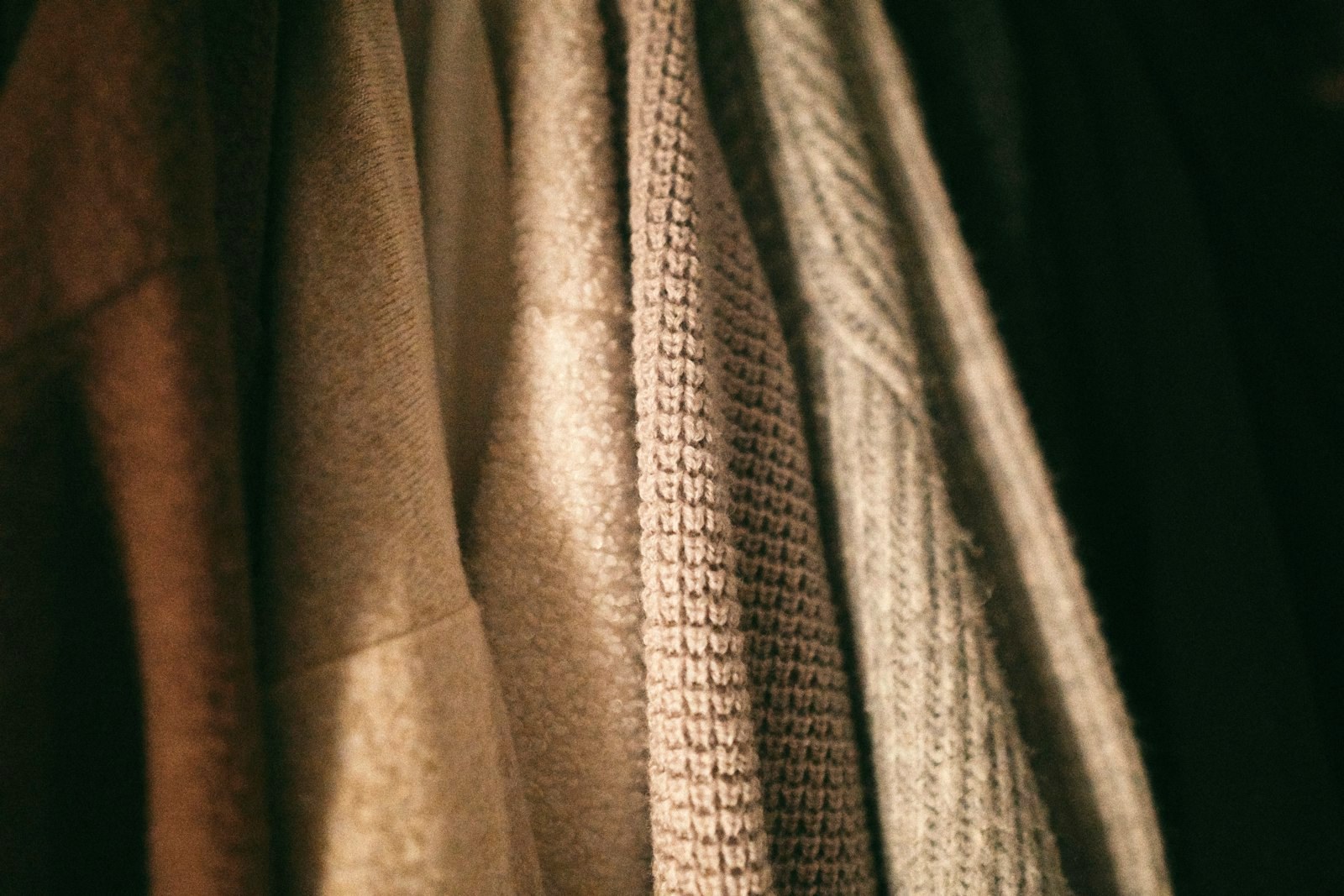
Cloth texture at close range, captioned as exactly that: knitwear surfaces hanging together. The fleece's whole argument is a cloth argument, pile against grid against loft, and our bank holds no photograph of a fleece jacket in any species, so this page opens on texture rather than dress a knit as its subject. The care section prints that gap and the harvest list.
Checked and updated October 2026
The ruling, up front: the fleece jacket is the middle term of the stack, warmth without weather and without structure, and its problem is register, not warmth. It was issued as one posting in a three-layer system, over the base layer and under the shell, and it escaped the mountain into a wardrobe that keeps asking it to be a jacket in the full sense: an outer garment with a register of its own. It survives the street on two honest postings, under the shell as the system's warmth, and in place of the knit as the day's warmth layer, and it fails in two costumes this brief names plainly: the full trail kit worn where nothing is being climbed, and the office uniform worn as if it were a style. One honesty entry before anything else: our jackets index files twelve types and this garment is not one of them. It owns no formality number and no warmth number there, and this brief assigns it none. Fleece is a cloth, and this brief styles it as one, in its four species: the grid, the classic pile, the high-loft, and the quarter-zip that offices adopted.
This brief: the decisive rule · the four species · the stack's middle term · trousers, colour and footwear · the ceiling · the looks · the mistakes · care and our photography
The decisive rule: warmth without a posting of its own
Begin with the cloth, because with this garment the cloth is the biography. Fleece is a knitted polyester pile, brushed up from the knit so the surface stands as thousands of small fibres, and the standing fibres are the insulation: they hold still air against the body the way a hedge holds snow. Everything the garment does well and badly follows from that one mechanism. It is light because it is mostly air. It is warm for its weight because the air is trapped well. It dries fast and insulates damp because the fibre itself drinks nothing. And it is open: the same knitted ground that lets the pile breathe lets moving air straight through it, so the warmth it makes is warmth it can only keep in still conditions. That is this brief's decisive rule, printed as new: the fleece's warmth is the stack's, not its own. Alone, in wind, it is a sweater with a zip, and wind is its examiner. The system it was issued in knew this and never posted it outermost in weather: the mountaineer's stack runs base, warmth, weather in the Fall Edit's printed order, structure where tailoring enters, and the fleece holds only the second posting. The shell above it stands at warmth 1 on our jackets index by design, a weather instrument carrying almost no warmth; the warmth in that famous assembly is the fleece's contribution, and the weatherproofing is none of it.
The escape happened anyway, and the record of it is printed on this site. Our American ranking names the fleece pullover of the Ventura house, the Synchilla Snap-T at about $139, as that house's key piece, and calls it a forty-year-old design that still works; its verdict on the house is to buy the fleece and the shell there before anywhere else. A garment does not hold a key-piece seat for forty years on warmth alone. It holds it because the pullover turned out to be the most comfortable warmth layer ever sold, soft where the knit is structured, forgiving where the shell is technical, and priced where a student could own one. The street took it, then the campus took it, then the office took its quarter-zip, and each taking moved the garment further from the stack that explains it. The result is the register problem this brief exists to rule on: one cloth now has to read as equipment on a trail, as heritage on a street, and as a uniform in a conference room, and it cannot read as all three in the same outfit. The species are the answer to that. They are genuinely different garments sharing a fibre, and they are separated below.
The garment, against the records of its neighbours:
| The garment | Its record | What it contributes | Its posting |
|---|---|---|---|
| The fleece jacket | No index row: a cloth, not one of the twelve types, and this brief assigns it no number | Warmth at almost no weight: trapped air in a brushed pile, drying fast, insulating damp, and open to any wind that finds it | The warmth posting of the stack: under the shell as the system's insulation, or in place of the knit as the day's layer; outermost only in still air |
| The base layer | Verdict Card No. 45's field: the Icebreaker 200 Oasis Crew at 82, the grid-backed Capilene Midweight at 76 | The skin's management: moisture moved, odour governed by fibre physics, the layer every stack starts from | Base: the posting beneath this garment, whose grid construction the equipment fleece shares at jacket scale |
| The quilted jacket | No index row either, styled in No. 33: the only insulated garment that layers in both directions | Insulation at cloth thickness, travelling inward under a coat as the liner species | Warmth layer inside the stack or light outerwear: the fleece's rival for the middle posting, beaten on weight, beaten by it on packability and price |
| The puffer | Index formality 1, warmth 5; Verdict Card No. 46's field, the Eos at 88 | Warmth at full loft with its own shell over it: the coldest-week instrument, a warmth layer that brings its own weather face | Weather layer: the garment that ends the argument the fleece cannot finish, at several times the fleece's bulk and price |
| The rain shell | Index formality 1, warmth 1; Verdict Card No. 44's field, the Torrentshell 3L at 86 | Weather: taped seams and a named membrane, the index's rain instrument, carrying almost no warmth of its own | Weather layer: the shell whose warmth this garment supplies, the two halves of the classic assembly |
| The field jacket | Index formality 2, warmth 3, the layering engine of the work family | Carriage and wind: a woven shell whose warmth climbs with what is under it | Weather layer of the work family: the woven answer to the same posting, and the garment a fleece is most often worn under in town |
The four species, separated
The rail sells four garments under this cloth, and confusing them is the species error this brief exists to prevent. They share a fibre the way the field jacket's species share pockets: as mechanism, not as identity.
| Species | What it is | Its register | The ruling |
|---|---|---|---|
| The grid fleece | The equipment species: a thin fleece whose inside face is a raised grid of squares or channels over a smooth ground, the construction our base layer ranking grades next to skin in the Capilene's diamond-grid back at 76, scaled up to a full-zip jacket | Equipment, honestly: the trail's working layer, drawn to breathe under a shell and to dump heat on the move | The technician and the only inward traveller. The grid traps less air than pile and moves more moisture, so it is the coolest species worn alone and the best species worn in a stack; it is also the only fleece that passes No. 33's under-coat test, its low face sliding against a lining instead of gripping it. Bought for systems, in dark neutrals, and worn outermost only as the visible half of one |
| The classic pile | The heritage species: a uniform brushed pile inside and out, cut as a pullover with a snap placket or a full zip, the pattern the American ranking's key piece has held for forty years at about $139 | The wardrobe's fleece: the species that left the mountain first and reads as clothing rather than kit, heritage in the way the chore coat is heritage | The default and the first buy. It is the day's warmth layer worn in place of a knit, over a tee or a base crew, and it is judged as a sweater with better physics: softer, lighter, warmer for its weight, and one register lower than the knit it replaces, which is the honest price of the comfort and is printed rather than hidden. Its face is the pilling face of our sweatshirt record, and the care section prices that |
| The high-loft | The statement species: a deep, long pile, the fibres standing at several times the classic depth, cut full and worn as the outfit's event | A statement: warmth approaching a light puffer's, volume approaching one too, with no shell of its own over any of it | The narrowest buy. Its loft is real and its posting is the shortest in the family: outermost, in cold still air, where its texture is the point. It cannot travel inward under anything, it sheds its presence over every trouser it meets, and in wind it is the family's most expensive sieve. Bought knowingly, as the one loud layer in a quiet wardrobe, it is a legal garment. Bought as a system piece it is the species error at full price |
| The quarter-zip fleece | The office species: a smooth-faced or fine fleece in the quarter-zip silhouette, the garment our quarter-zip record has already met and graded as what it is, a jersey wearing a sweater's shape | A uniform's register: our quarter-zip brief prints the room assignment whole, the knit belongs in the wardrobe, the fleece belongs at the conference, the jersey belongs at the course and the airport | The one-room species. Inside its room, over a collared shirt with the zip in its legal states, it is a working garment and this brief defends it there. Outside its room it imports the room with it, which is why it reads as a tech-bro uniform on a street: the garment is not badly made, it is badly posted, a conference layer photographed at large. Buy it for the office if the office is your posting; do not buy it as a wardrobe fleece |
The zip law, printed once and applied by species. The closure is not a detail on this garment; it is the register control. The full-zip is a jacket's closure: it opens down the front to vent on a climb, it goes on and off over a base layer without disturbing anything beneath it, and it is the closure of the species that work in systems, grid and high-loft alike. The pullover and its snap-placket variant are a sweater's closure: the garment is worn closed all day, which dresses it one rung above the full-zip in the same cloth, the way a pullover knit dresses above a cardigan, and charges for the rung in convenience, because a layer you must pull over your head is a layer you will leave on too long and take off too late. The quarter-zip is a neckline instrument, and the law is the one No. 21 prints for the silhouette: it borrows formality when the zip is up and returns it when the zip is down, it has two legal states, closed for structure and open about two inches over a collar, and it has one banned state, zipped to the throat over a bare tee, the failure that page names after this very cloth. A fleece bought without a decision about its closure is a species bought by accident, and the rail is full of men wearing the accident.
The stack's middle term: three postings, ruled
The Fall Edit prints the order the whole wardrobe runs on: base, warmth, structure, weather. The fleece owns exactly one word of that sentence, and this section rules its three legal postings inside it.
First posting: under the shell. This is the assembly the garment was born into and the one where its physics are all advantage. The shell of Verdict Card No. 44, the Torrentshell 3L at 86 at the field's head, is bought on the index's rain rule, taped seams and a named membrane, and it brings warmth 1 to the stack by design. The fleece beneath it brings the rest: the pile the wind cannot reach because the shell is standing in it. Posted here, the fleece is judged on system virtues alone, moisture moved outward, heat dumped through the shell's vents on the climb, nothing asked of its face or its register, which is why the grid species, the family's plainest garment, is its aristocrat. The houses are ranked on their family pages and the numbers are not restyled here: Patagonia at 83 with the fleece dock printed in its fabric row, the lifestyle end running to ordinary fleece at faithful prices, and the alpine houses behind it, Arc'teryx at 73, Rab at 77, Montbell at 73. The dock is worth pausing on because it is this brief's subject in one line: the fleece is the garment even its best house is graded down for making ordinarily at the lifestyle end. The technical end of the rail is where the cloth earns.
Second posting: in place of the knit. This is the escape posting, the one the street actually uses, and it is ruled by substitution. The fleece replaces the mid-gauge knit of No. 09's bands as the day's warmth layer, over a tee or over the base crew of No. 45's field, and the exchange is printed honestly: what is gained is weight, softness and drying speed; what is spent is register, because a knit is warmth with a garment's face and a fleece is warmth with a cloth's face, and every room reads the difference. Under a field jacket or a chore coat, inside the work family's own stack, the substitution is invisible and total, the engine of No. 32 climbing on exactly the warmth it was designed to climb on. Worn outermost, the classic pile holds the posting on its heritage terms and the grid holds it on equipment terms, and neither holds it in wind, which is the decisive rule collecting its tax.
Third posting: under the coat, one species only. No. 33 prints the two-way law for insulation that travels inward, and this brief refines it for a pile cloth. The grid fleece passes the under-coat test: thin, low-faced, sliding against the coat's lining, spending part of the allowance the overcoat of No. 20 is bought with, its rule to fit over a blazer. It owns there the same dressed trick the liner owns, zipped away under a blazer as invisible warmth, and it is the only fleece posting tailoring admits. The classic pile fails the test on two counts that are cloth physics, not taste: its bulk prints through the coat's chest, and its raised face grips the lining at every step, so the two garments bind and drag instead of travelling. High-loft under a coat is not a failed test but a refused one, two warmth systems in one stack with the outer one's loft crushed by the coat above it. Pile is the outermost warmth layer or it is nothing; that sentence, with the zip law, is most of this garment's styling.
The fit law: buy it over the layer it will cover, which is thinner than you think. A fleece is sized over a base layer or a tee, not over the knit it is sometimes asked to swallow; two warmth layers of full depth in one stack is bulk without a posting, the middle term doubled. The equipment species is bought close, the shell's size already assumes it. The classic pile is bought at sweater ease, the size the knit would have been. And the quarter-zip is bought at the office's ease, over the collared shirt it will actually cover, because a quarter-zip strain-zipped over a shirt is the uniform reading at its worst, the garment announcing its posting and missing it at once.
Trousers, colour and footwear: the register, completed below the waist
The trousers follow the posting, and the exception is argued, not assumed. In the system postings the leg is the work family's own: the fatigue trouser of our pants index at formality 2 in the same cotton sateen family as the field jacket above it, and the five-pocket leg, denim on No. 05's wash-break law, corduroy on No. 24's terms in the cold. In town, worn as the day's layer, the fleece takes the chino as its cleanest lender, the ranked class of No. 29's record, the Spier and MacKay high-rise at 84 as garment evidence, because a quiet garment reads at the register of its company and the chino lends without arguing. Pleated wool trousers are refused under the grid, the pile and the high-loft worn as outerwear, on the field brief's arithmetic: they spend formality the fleece has no way to return. The one case stands, and it is the office species' own: the quarter-zip fleece closed over a collared shirt, pleated wool trousers below, in the conference room our quarter-zip record assigns the garment. The case is legal because that assembly is a uniform, and a uniform is not read as an outfit; it is read as a posting, the way a shop coat is read. The same clothes worn to dinner are a costume, because the room that excused them is not in the room. The exception therefore proves the refusal: the pleated trouser is admitted exactly where the fleece stops being styled and starts being issued.
The colour order, this brief's ruling, printed as new. Earth tones and heathers first: moss, oat, rust, charcoal heather, the colours the pile was born in, which read as heritage because the heritage species was photographed in them for forty years, and which carry a practical dividend no other garment family offers, because heathering hides the pilling the face will eventually grow. Navy second, the town translation, the colour the pile wears when it is keeping weekday company. Black third, and only in the grid or in a matte fine face: black in a raised pile reads as a uniform before it reads as a colour, security and support staff and the vest of the next section all wear it, and a black pile jacket in town borrows their posting whether it wants it or not. Brights last, which in town means refused: signal orange, royal, volt, the trail's visibility colours, are equipment declarations, honest on a ridge and costume on a pavement, where nothing is being signalled except that the rest of the kit stayed home.
The footwear: boots at home, and the dressed shoe refused. The fleece stands over boots the way its whole family does: the plain work boot, and the lug-soled Chelsea of No. 15's scale at 2.5 in its native posting under an equipment layer, the suede Chelsea at 4 on dry town ground under the classic pile. The clean leather court shoe of No. 12's scale at 3 closes the town rows under the pile and the grid worn alone on mild days. The sleek calf Chelsea at 4.5 is refused under every species worn as outerwear, for the quilted brief's reason: a dressed shoe travelling down to visit, licensed only under the grid's inward posting, where the shoe answers the coat and not the fleece. The dress shoe proper is refused outright, and the loafer with it under the equipment species: both spend a formality the stack cannot repay below the waist any more than the pleated trouser can above it.
The ceiling: one room of its own, and the two costumes
Plainly, as the garment's unnumbered state requires: the fleece owns no rung of its own, so its ceiling is set by its species and its posting. The grid's ceiling is the top of the equipment register: it can stand anywhere the shell over it can stand, which is everywhere outdoors and almost nowhere with a door policy. The classic pile's ceiling is the casual room entire: the pub, the weekend, the creative office, the school run of adult life, and in heathered earth tones over a chino it reaches the top of that room without apology, the heritage read doing the work. The high-loft's ceiling is set by its volume: it is the outfit wherever it goes, and rooms that cannot take an outfit at the door cannot take it. The quarter-zip's ceiling is the strangest in the family: inside its one room it is practically uncapped, the conference layer that partners and interns wear identically, which is the definition of a uniform's social magic, and outside that room its ceiling drops below the pile's, because it carries the room's smell with it.
Where it stops, in both directions. Upward, it stops at the tie and at the blazer worn over any species but the inward grid, on the FAQ's arithmetic. It stops at the dress shoe and the pleated trouser outside the one excepted case. Downward, it stops at weather and at true cold: its shell credit is zero, the index owns instruments for rain and for the coldest week, the ranked shell of No. 44 and the lofted field of No. 46, and a fleece worn as the answer to either is the specification error this brief opened with, a middle term read as a whole sentence. The fleece's empire is the long middle of the year and the middle of every stack. Inside that empire it is close to irreplaceable, which is exactly why its failures are never about the garment and always about the posting.
The costume lines, printed plainly, both of them. The first is the full trail kit in the city: shell over fleece over base layer, technical trousers, trail shoes, a pack with its straps done up, assembled entire on a pavement where the weather is a light drizzle and the altitude is a kerb. Each piece is honest in its posting, and the assembly is the issued-garments law of the pants index in reverse: every feature present, none of them working, a uniform of recreation worn as an identity. The fleece is the signal piece of that costume because it is the layer that shows. The rule that keeps it honest is the field brief's rule: wear the system the day requires, and let the rest of the kit stay home unmissed. The second costume is the office uniform worn as a style, and its purest form is the fleece vest over a dress shirt: a warmth layer with its sleeves, and therefore most of its warmth, removed, worn open over tailoring it cannot support, functioning purely as a badge of the firm that issued it. As work dress inside its building it is unremarkable, and this brief does not grade work dress. Carried into the street as a look, it is the quarter-zip's error distilled: a uniform photographed outside its room, asking to be read as taste. The vest is named here as the failure it is so the jacket's own rule can be stated against it: a fleece worn as clothing must be doing the whole of its job, warmth included, in the room it is actually in.
The looks: the middle term, worn
Four assemblies from this brief's rulings, each built on the records around the garment. No fleece garment is scored in this brief; the numbers in the judgments are the neighbours' records, reproduced from their own pages.
| Setting | The fleece | With | The judgment |
|---|---|---|---|
| The system at work | Charcoal heather grid fleece, full-zip, closed | A merino base crew of the ranked class beneath it, fatigue trousers, plain work boots, the ranked shell carried or worn open above the lot | The first posting entire: base, warmth, weather in the printed order, the grid doing the job it is the family's aristocrat at. The base crew is the class of No. 45's winner at 82; the shell is No. 44's at 86; the fleece between them is the only unscored garment in the outfit and the one doing the warming |
| The heritage row | Classic pile pullover in moss heather, snap front closed | A plain tee beneath, five-pocket corduroy in a deep brown, suede Chelsea boots on a dry day | The escape posting on its best terms: the pile in its birth colours over the cord leg, the boot at No. 15's suede 4 licensed by the ground. The assembly the American ranking's key piece has been wearing for forty years, and the register is heritage because every companion garment agrees to it |
| The office species in its room | Navy quarter-zip fleece, zip closed over the collar | A button-down Oxford with its collar in the legal state, pleated wool trousers, plain leather shoes of the room | The one excepted case, worn where it is legal: a uniform read as a posting, not an outfit. The zip is up, the collar is under it, the trousers are the room's own. The same assembly at a restaurant in the evening is the ceiling section's second costume, and the difference is nothing but the room |
| The inward posting | Black grid fleece, zipped away, under a navy overcoat | A fine-gauge knit or base crew beneath it, wool trousers, the coat closed over all of it to No. 20's length floor | The third posting's proof: the overcoat bought over a blazer spends its allowance on the grid instead, its fixed warmth extended into the cold months with no pile in sight. The fleece is doing the most work in the outfit and, as with No. 33's liner, it is the part nobody sees |
The ruling
Buy the classic pile first, as a pullover or a full-zip, in a heathered earth tone, sized at sweater ease over the tee or base crew you will actually wear under it, and judge it as the knit it replaces, one register lower and half the weight, the comfort honestly priced. Buy the grid second if your winters run through a shell or a coat: dark, close, bought over a base layer only, judged by whether it disappears inside the stack it serves. Wear the pile as the day's warmth layer through the long middle of the year, under the field jacket and the chore coat, over the fatigue and the five-pocket, translated into town by navy and by the chino. Wear the grid as the system's warmth, under the ranked shell in weather and under the overcoat in the cold, the one species that travels in both directions across the stack. Refuse the brights in town, refuse the pile under a coat, refuse the tie and the dress shoe over every species, refuse the vest over a dress shirt anywhere it is being worn as a look, and refuse most of all the idea that the fleece is a coat: its warmth is borrowed from the stillness of the air around it, and it keeps the loan only inside the stack or on the calm days. Every failure of this garment is a posting error, and every success is a system working. The test in the shop is two questions long: what goes under it, and what goes over it. The man who can answer both has bought a fleece. The man who cannot has bought a costume with a zip, and the register, as always on this site, was the whole of the garment.
The mistakes
Bought as a coat. The first and commonest error, and the decisive rule exists to prevent it. The pile that traps the body's air so kindly indoors hands it to the first real wind, and the man standing at a February bus stop in a fleece alone is wearing the middle of a sentence as if it were the whole of one. The fix is not a thicker fleece, which is only a warmer middle, but the honest assembly: the shell over it in weather, the baffled field of No. 46 in the coldest week, and the fleece restored to the posting where its physics are all advantage.
The vest over the dress shirt, worn as a look. The ceiling section names the costume; the mistake is buying into it deliberately, the sleeveless fleece chosen over a shirt and tie as a personal style rather than accepted as a firm's issue. It fails as warmth, because the arms it removed were carrying half of it; it fails as register, because it reads as an employer at fifty paces; and it fails this site's oldest test, because a feature that has stopped working, a warmth layer that does not warm, is a costume. Inside the building that issued it, it is work dress and unjudged. Everywhere else it is a badge looking for a firm.
Pile posted inward. The classic pile stuffed under an overcoat or a blazer, worn by the man who read that insulation travels inward and reached for the wrong species. The bulk prints through the coat's chest, the raised face locks against the lining, and the whole stack drags at the shoulders by noon. The inward posting belongs to the grid, thin and smooth-faced, and to No. 33's liner; the pile's genius is the outermost warmth position, and a wardrobe that owns only the pile owns two of the three postings and should not pretend at the third.
Zipped to the throat over a bare tee. The banned state, and it is worth noting whose name it carries: our quarter-zip brief names this failure after this cloth, the fleece-dad state, a closed neckline strangling a naked neck with no collar beneath it to justify the closure and no coat above it to complete it. It is a state problem, not a garment problem: the same quarter-zip closed over a collared shirt is structured, and open two inches over one is the silhouette's other legal read. The man in the banned state has not chosen a bad fleece. He has parked its one moving part in the one position the law refuses, and the mirror has been telling him so for years.
Care, and the cloth's two taxes
The fleece's maintenance is small, and both of its real costs are the cloth's physics arriving on schedule. The first tax is the face. Our sweatshirt record prints the law whole: a brushed fleece raises its fibres into pile, warmer and softer at first touch, and the first surface to pill and mat. The classic pile wears that face to the world, so it pays the tax in public, fastest where the world rubs it, under pack straps and seatbelts and the crook of a carried bag. Wash it inside out and cold, which slows the raising from becoming a shedding; keep heat off it in the dryer, because heat mats the pile it was bought for; and expect the heathered colours of this brief's colour order to carry the tax most gracefully, which is one of the two reasons they are ordered first. The grid face pays least, its low texture having almost nothing to raise, and the high-loft pays most and fastest, its statement depth matting into ropes if it is washed hot and often. A defuzzer is a legitimate tool and a confession at once: the garment is keeping its shape and losing its surface, in that order, for years.
The second tax is the smell clock, and it is printed science on this site before it is advice here. Our base layer ranking grades odour as fibre physics: polyester is oleophilic, skin oils and their bacterial byproducts bind to it and survive ordinary washing, while wool takes the same compounds into the fibre and releases them in the wash. A fleece is polyester at jacket scale, so the clock that runs on a synthetic base layer runs on this garment over whole seasons: worn unwashed through a winter of stacks, it will carry the winter. The discipline is the base layer's discipline scaled up: air the garment after wear rather than sealing it in a drawer, wash it before the clock compounds rather than after it announces itself, and store it clean at the season's turn. None of this is precious, and none of it is optional either; the houses' repair programmes, Reno's fifty thousand pieces a year on the Patagonia record, exist for seams and zips, and no bench repairs a smell.
Storage is the layer's own: folded or hung by the shoulders, never crushed under the coats it serves, because a crease pressed into pile is a thin place the next cold day will find, the same law No. 33 prints for stitched insulation in a different cloth. The grid folds to almost nothing and should be the travelling species for exactly that reason. Kept this way the garment's lifespan is measured in decades, as its key piece's forty years on the American ranking's record attests; the fleece does not wear out so much as fade, pill and clock, and all three are slowed by the small attentions above.
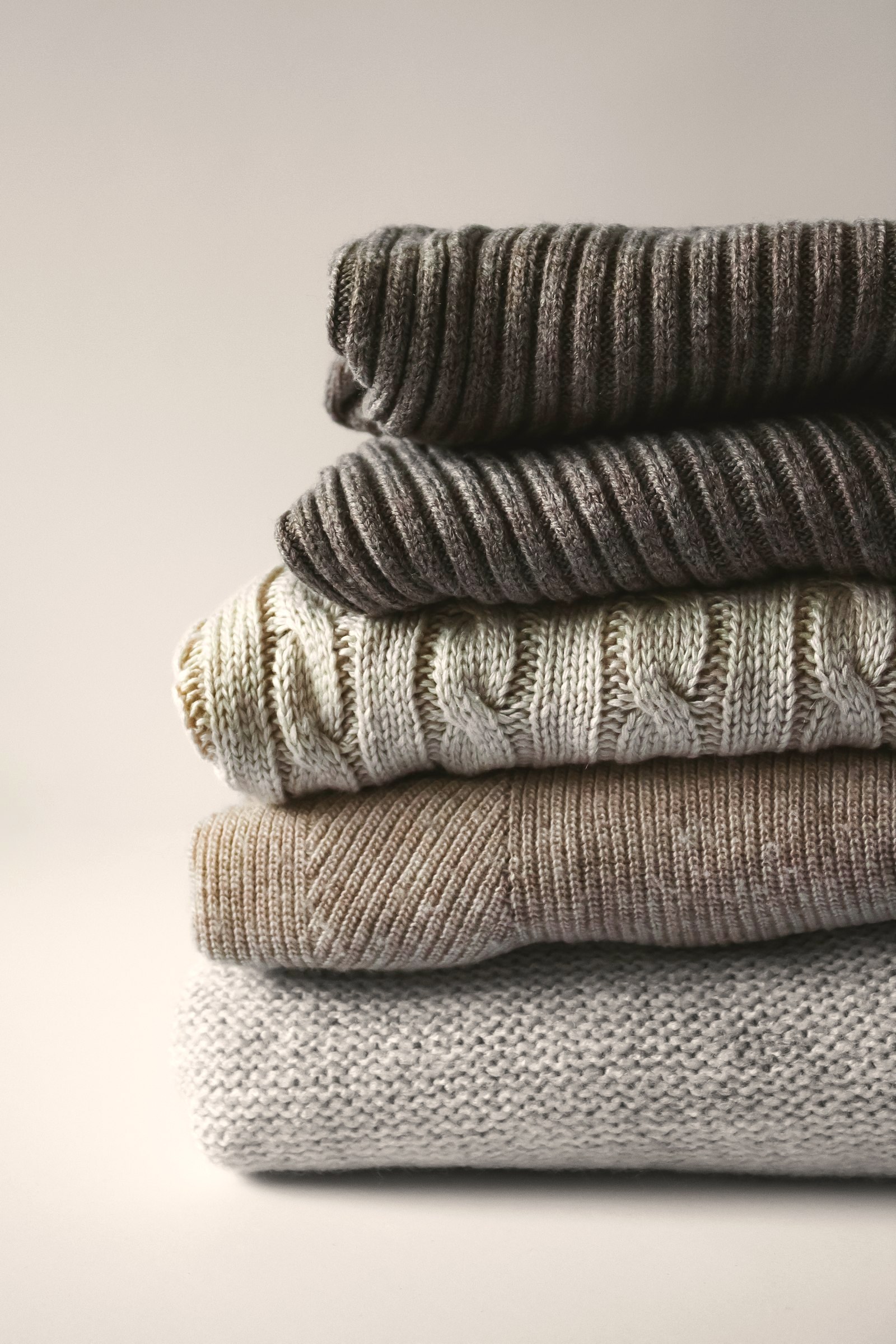
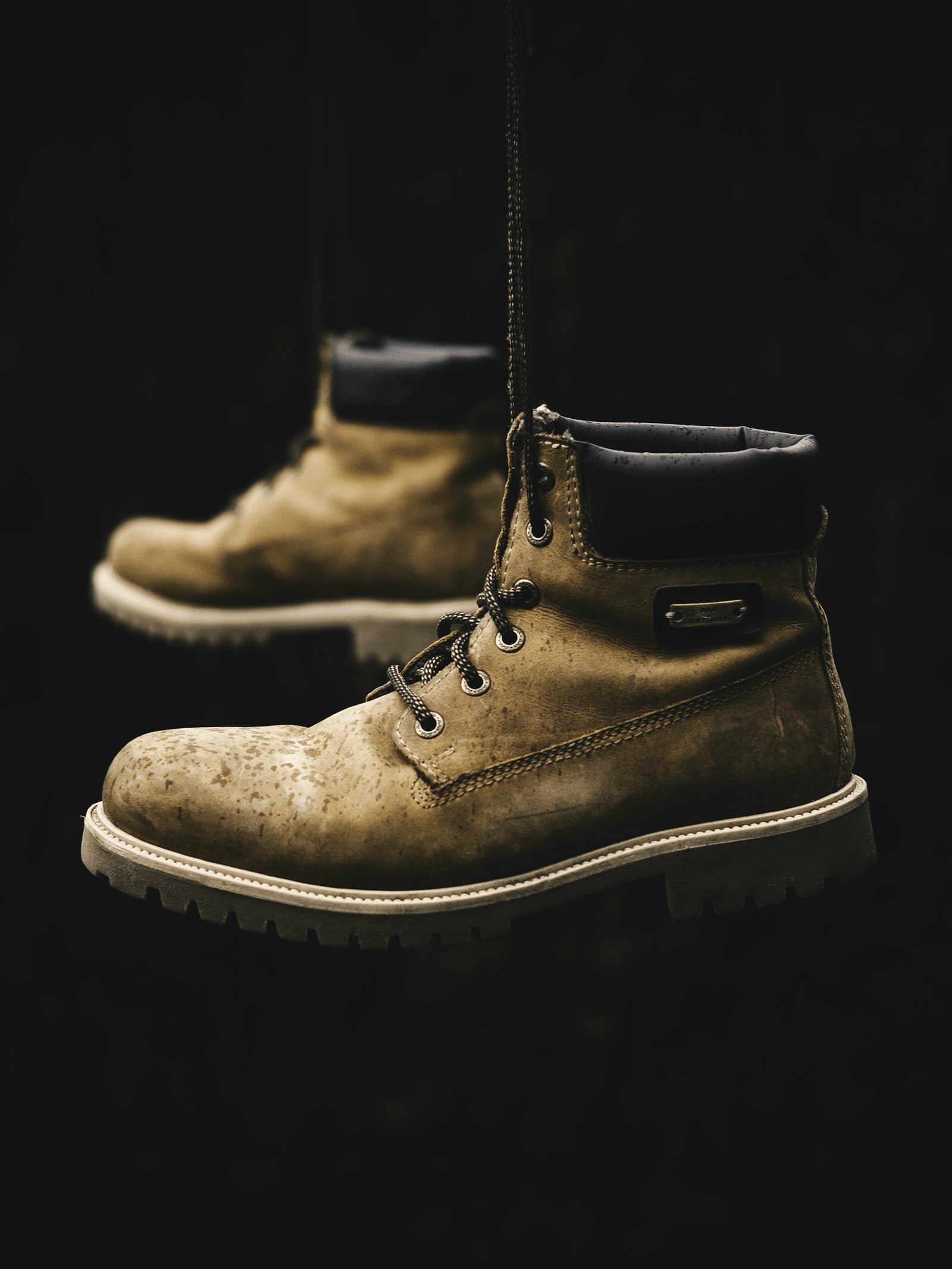
A note on our own photography: our photo bank holds no fleece frame in any species. There is no grid fleece under an open shell, no heathered pile pullover worn on a street, no high-loft face at macro range, no quarter-zip fleece over an Oxford in office light. The hero is knitwear texture at close range, captioned as texture; the figures inside are the stack's folded layers and a pair of worn work boots, captioned as layers and as footwear. This page will not caption a knit, a puffer or a sherpa-lined trucker as the fleece jacket to fill the slot, and it will take the harvest frames the week they exist: the grid worn under an open shell with the stack visible at the cuff, the classic pile in moss heather on a street in still air, and the high-loft face at the range where its depth, and its tax, can actually be seen.
Questions, answered
What is a fleece jacket?
A garment defined by its cloth rather than by a pattern: a knitted polyester pile, brushed to trap air, cut as a zip front, a pullover or a quarter-zip. Our jackets index files twelve types and the fleece jacket is not one of them: it owns no formality number, no warmth number and no buying rule there, because fleece is a cloth, and the cloth appears across the wardrobe as jackets, pullovers, linings and the inside face of sweatshirts. In the outdoor system it was born into, it is one posting: the warmth layer of the stack, worn over a base layer and under a shell. This brief styles the garment in its four species, grid, classic pile, high-loft and the quarter-zip, on the records this site prints for the layers above and below it.
Is a fleece jacket warm enough to wear as a coat?
In still air, at the temperatures of the shoulder seasons, yes. As a coat, no, and the construction says why. Fleece insulates with air trapped in its pile, and moving air is its examiner: wind passes through an open pile the way water passes through a net, which is why the system this garment was issued in never posted it outermost in weather. The shell that goes over it stands at warmth 1 on our jackets index by design, a weather instrument carrying almost no warmth of its own; the warmth in that assembly is the fleece's, and the weatherproofing is entirely the shell's. Worn alone on a calm day the fleece is a legitimate outer layer. Worn alone into wind or rain it is the stack's middle term pretending to be its whole, the specification error this brief opens with.
Can you wear a fleece under a coat?
One species can. How to Wear No. 33 prints the two-way law for the quilted liner, the insulated garment drawn to disappear under a coat; the fleece passes that under-coat test only in its thinnest species, the grid, whose low textured face is built close and slides against a lining instead of grabbing it. Classic pile under a coat fails the test twice: its bulk prints through the coat's line, and its raised face grips the coat's lining at every movement, so the stack binds instead of travelling. The coat it serves is bought on the jackets index rule, to fit over a blazer, and the grid fleece spends part of that allowance the way the liner does. Pile is the outermost warmth layer or it is nothing; grid is the species that travels inward.
Can you wear a fleece with a blazer or a tie?
The tie is refused over every species. It lives at the index formality 4 and above, in the trench and blazer rows, and a garment with no index number does not get to borrow it; a tie over a fleece quarter-zip is the office uniform at its most complete, and this brief names that assembly a costume in its ceiling section. The blazer is refused over pile, over high-loft and over the quarter-zip worn as outerwear. It is admitted over exactly one assembly: the thinnest grid fleece, zipped away between a shirt and the blazer, where it does a layer's warmth job invisibly, the same dressed trick No. 33 prints for the collarless liner. What no fleece does is replace the blazer, and what no blazer does is civilise a pile. The dressed ceiling of the fleece worn as outerwear is the quarter-zip species in its one room, ruled in the next answer's record and in this brief's ceiling section.
Full-zip, quarter-zip or pullover: which fleece should you buy?
The closure is the register, so buy the room first. The full-zip is a jacket: it opens to vent, it layers over a base and under a shell without being pulled over the head, and it is the equipment species' closure, grid and high-loft alike. The quarter-zip is a sweater substitute, and it is ruled by the zip law our quarter-zip brief prints for the silhouette: the zip borrows formality when it is up and returns it when it is down, and the banned state is the throat zipped over a bare tee. In fleece the quarter-zip is the office species, assigned its room by that same record: the conference. The pullover, including the snap-front pattern of the classic pile, is the heritage closure: worn closed like a sweater, it dresses one rung above the full-zip in the same cloth, and it travels worst as a layer, because changing it means undressing. For a first fleece, the full-zip in grid or pile is the garment that holds the most postings.
What trousers go with a fleece jacket?
Its home legs are the work family's: the fatigue trouser of our pants index, cotton sateen at formality 2, and the five-pocket leg, denim on the wash-break law or corduroy in the cold. The chino is the town translation, the ranked class of chino, because a quiet garment takes the register of its company and the chino is the cleanest lender it has. Pleated wool trousers are refused under grid, pile and high-loft worn as outerwear: they spend formality the fleece cannot return. One case is excepted, and it belongs to the office species alone: the quarter-zip fleece closed over a collared shirt, with pleated wool trousers, in the office and conference rooms that record assigns it. That assembly is a uniform, and a uniform is read by its room; worn as a style anywhere else, it is the costume this brief's ceiling section names.
Why does a fleece pill, and why does it hold a smell?
Both failures are the cloth's physics, and both are printed on this site before this brief. The pilling is the face: our sweatshirt record prints the law that a brushed fleece raises its inside into pile, warmer and softer at first touch, and the first surface to pill and mat. The classic pile wears that face outside, so the heritage species pays the pilling tax in public, fastest where straps, seatbelts and bag handles rub; the grid face, textured and low, resists it longest, which is part of why the equipment species is built that way. The smell is the fibre: our base layer ranking prints the physics that polyester is oleophilic, that sebum and bacterial byproducts bind to it and survive washing, the synthetic smell clock. A fleece is polyester pile, so the clock runs on it at jacket scale. Air it after wear, wash it before the clock compounds, and do not store it worn.
Has Young Cotton ranked fleece jackets?
Yes, since Verdict Card No. 54 ranked seven fleece jackets on their published fabric weights, the Patagonia R1 Air winning at 89. This brief predates the Card; what existed in print when it was written is the garment's record across the site: the houses that make it are ranked, Patagonia at 83 on its family page with the fleece dock printed in its fabric row, and the American ranking names the classic fleece pullover that house is known for, at about 139 dollars, as its key piece; the cloth's grid construction is graded next to skin in the base layer ranking, where the grid-backed crew stands at 76; the quarter-zip fleece is graded as a jersey inside the quarter-zip ranking, because the knitted version owns that silhouette; and this brief is the wearing system those records imply, the four species, the stack postings, the zip law and the outfit matrix, printed so any fleece can be judged on the wearing, with the Card now judging the buying.
Next
The garment's absence from the twelve types, and the ladders it is argued against, are printed whole in the jackets index. The layer beneath it is ranked in Verdict Card No. 45, the shell above it in Verdict Card No. 44, and the houses that make it are ranked in Brands Like Patagonia and Brands Like Arc'teryx. Its middle-posting rival is styled in How to Wear No. 33, the engine it warms in No. 32, the loft it defers to in No. 27, and its office species is ruled in No. 21. The stack all three postings belong to is ordered in the Fall Edit; the knit it replaces is styled in No. 09, and the coat its grid disappears under in No. 20.