
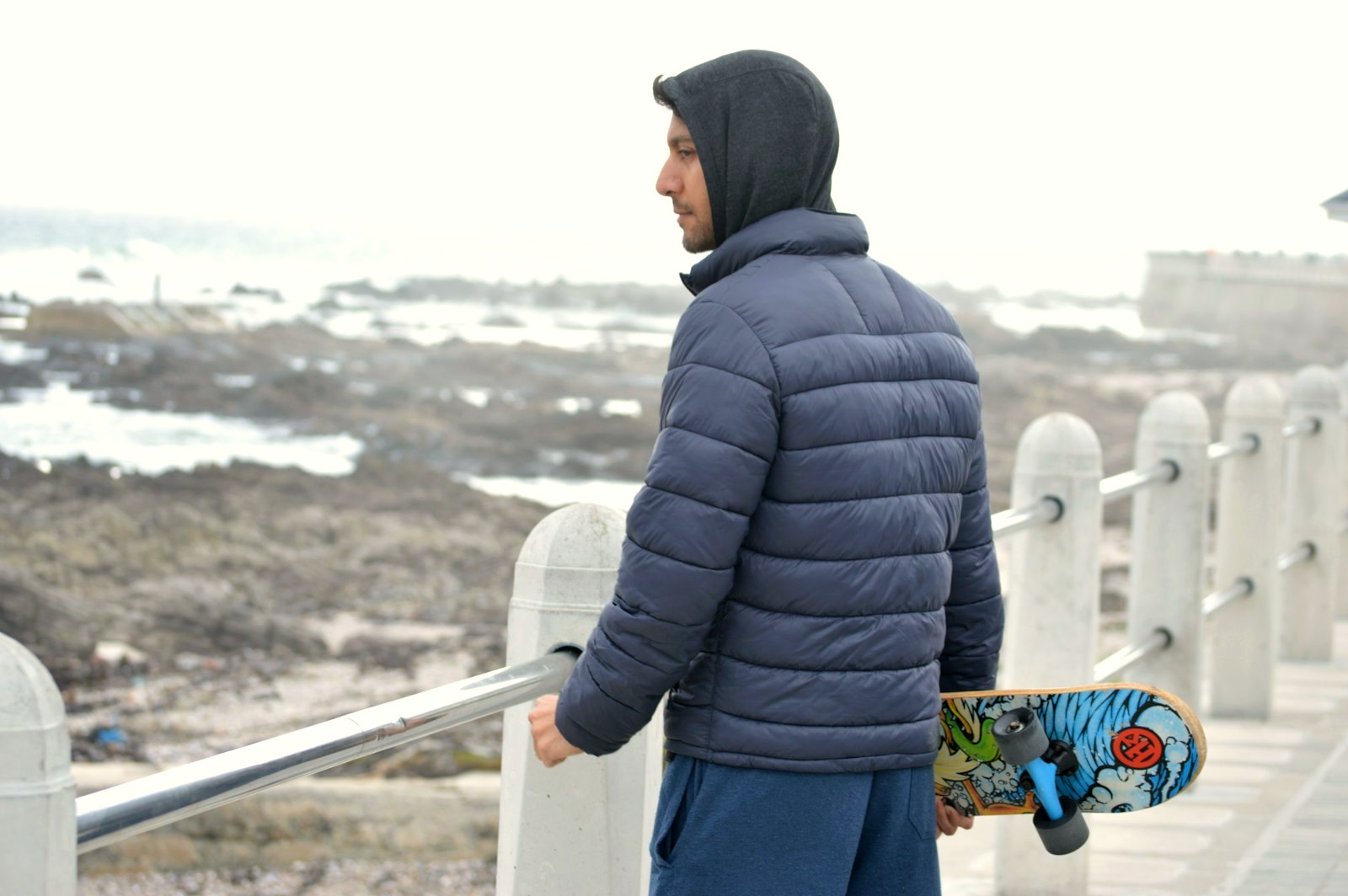
The anchor's register, captioned as exactly that: a man in a navy insulated jacket on a coast, in the weather this ranking grades cloth for. Our bank holds no photograph of a Patagonia garment, worn or folded, so no frame on this page is captioned as one. The ranking below is built from published fabric disclosure, the makers' own guarantee and warranty texts, six Patagonia garments this site has already scored, and the service pages of the seven houses.
Checked and updated October 2026
The verdict, up front: the anchor wins its own page, and after two pages in a row where the covenant houses lost at home, that result is worth stating as a finding rather than a courtesy: nobody in the technical register has yet matched the combination this page grades. Patagonia keeps its standing 83, audited in the open below against six ranked garments, one of them a category winner, and a repair covenant with no expiry date in it. Behind it, the page's one tie: Arc'teryx and the REI Co-op label both derive at 73, and the tie is broken on the fabric row, 25 to 19, in the open, because a clothing ranking breaks its ties on cloth. Fjällräven derives at 72, the European elder with a published cloth split and a warranty document that argues with itself. Cotopaxi derives at 66, the young house that copied the anchor's promise most faithfully. Marmot derives at 65: real figures, thin paperwork. The skip is a standing score, not a new sentence: The North Face keeps its 64 from our American brands ranking, where it finished last, and finishes last here, its rows derived to the standing total and labelled as such. The guarantee trilogy that the last three pages of this series graded, the Bean page, the Barbour page and the Filson page, is rested in prose below: this page grades the other covenant, the technical one.
What people actually want from Patagonia
Nobody searches for brands like Patagonia because they need a fleece either. They search because Patagonia sells the strongest version of the accounted purchase: cloth whose inputs are published down to the chemistry, a guarantee whose text contains no expiry date, and behind the garment a repair facility in Reno that the maker calls the largest clothing repair operation in North America, taking back anything the house has ever made and returning it mended. The want is a purchase whose maker has published, in advance, everything that will happen after the sale: what the cloth is, what it cost the world, and who answers when it tears.
The ceiling is real, and this page names it before the anchor's card can be accused of hiding it. The prices rise yearly, and the standing value row of 12 is that fact already priced. And the range's centre of gravity is not expedition cloth: it is fleece, shorts and lifestyle product sold to the faithful at faithful prices, which is why the alternatives below are graded on the three tests this search is really asking, the same tests the trilogy ran in its own register. Is the fabric disclosure published: membrane chemistry and recycled figures with a certifier named, or adjectives where the specification should be? Is the promise an instrument: a guarantee with machinery behind it, or a warranty whose fine print defines its own key word down? And does the garment record agree with the paperwork when the house's own products are graded one by one? Patagonia is the house that set those tests in this register. This page runs them on Patagonia first.
How the scores work
Every brand here is scored on the house basis for this series: fabric and cloth out of 30, construction and craft out of 20, fit range and sizing honesty out of 20, value out of 15, longevity out of 15. One score on this page is a standing score, audited in the open: the anchor's 83, set in our American brands ranking and audited once already on the Bean page. One is a standing score carried with its rows derived to it in the open: The North Face's 64. Five are new, derived in the open on their cards: Arc'teryx at 73, REI Co-op at 73, Fjällräven at 72, Cotopaxi at 66 and Marmot at 65. The tie at 73 is ruled where it occurs: on the fabric row, because that is the row a clothing ranking exists to grade.
The audit of the anchor, then, from its record, because an anchor in this series is audited where it stands. Patagonia's 83 was set as a total in the American brands ranking, which pins one row in its own text: longevity is 15, a clean score, printed there as earned on the strength of the repair system alone. The Bean page rebuilt the remaining rows from the record and landed on the total; this page re-runs that audit against a garment file that has deepened since, and prints the same rows, because the record has strengthened and not changed direction. The file now runs to six ranked garments. The Torrentshell 3L won our rain ranking at 86, the only shell in that field whose maker publishes what its membrane is made of, a polycarbonate-based polyurethane, 13 percent biobased, behind a 50-denier ECONYL face, PFAS-free. The Baggies scored 84 in our swim ranking, its NetPlus shell woven from 100 percent postconsumer recycled nylon, the only fully scored recycled claim in that field. The Down Sweater scored 82 and the Nano Puff 76 in our puffer ranking, the Fjord flannel 77, the Capilene midweight crew 76.
Fabric 24: the recycled-input programme remains the industry's reference, and the garment record is the proof at garment scale: a shell whose membrane chemistry is published, a short whose recycled claim carries a full figure and a named source. It stands below Filson's 27, which grades woven cloth of another order, and below the alpine house's 25 on this page, because the range's lifestyle end runs to ordinary fleece at faithful prices, the dock the Bean page printed and this audit keeps. Construction 17: bar-tacked, repairable making across the technical core, garments designed to be sent back and mended rather than replaced; the Torrentshell's own construction row in its ranking is 18, and the brand row grades the whole rail, lifestyle end included. Fit 15: a functional outdoor range, honestly described, and narrower than the catalogue libraries the trilogy graded, with no big and tall programme behind it. Value 12: the American ranking's printed deduction, confirmed rather than softened: prices rise yearly, the Down Sweater's list rose from $279 to $289 in our own checks this season, and the lifestyle end charges the faithful for colours. Longevity 15: the pinned row, and the machinery agrees with the paperwork at every point it can be tested: the Ironclad text quoted in the ledger below has no expiry in it, repair is named before replacement, wear and tear is repaired at a reasonable charge rather than excluded, the Reno facility repairs about 50,000 pieces a year on the maker's own account, and the Worn Wear programme resells what the repairs cannot save. Add them: 24, 17, 15, 12, 15. The audit lands where the number stands. The brand score is 83, and this desk commits in print to re-running the audit when the record moves, and to moving the rows in the open if they move.
Four names are answered in the open rather than ranked. The guarantee trilogy is rested as a field, with its numbers untouched: L.L.Bean at 87, Filson at 85 and Barbour at 81 grade the waxed and woven register, the covenant in wool and canvas; this page grades the technical register, and the two covenants are compared in the pattern section below rather than re-carded. The trilogy's derived field rests with them: Lands' End at 75, Peregrine at 76, Flint and Tinder at 74, Tom Beckbe at 72, Orvis at 70, Belstaff at 70, Duluth Trading at 68 and Eddie Bauer at 56. Pendleton keeps its standing 82 from the American ranking, a wool and blanket specialist whose story is told where the score stands. Columbia is answered from its garment record only: its Watertight II scored 69 in our rain ranking, its Omni-Tech membrane graded there as a claim rather than a specification, and this page creates no brand score for a house it has graded only as a garment. And Rab, whose Microlight Alpine scored 84 as a garment in our puffer ranking, is printed as the honest equipment answer rather than seated: the house's centre of gravity is expedition equipment, no brand score is created for it, and a reader who wants the alpine bench's other name will find its garments already graded here one by one.
The fast-fashion outdoor imitation is answered the way this series always answers it, in prose, because its brand number is a living derivation maintained on the H&M page of this series, from that house's ranked garments, and this page does not borrow it, restate it or re-derive it. Its method in this register is the method everywhere: the shell's silhouette and the fleece's colour, printed on cloth that publishes no weight and no split, under a returns window measured in days, sold beside a sustainability page whose claims publish no figures a reader could check. The reader who has followed the ledger below will know how to grade it without a number from us.
The service ledger, quoted from the houses' own pages today, is the spine of the ranking, so it is printed before the cards. This is the fourth ledger in the series and the first in the technical register: read down the instrument column and the ladder below explains itself, including the places where a house's own document argues with the house's own marketing.
| House | The instrument, as published | The term |
|---|---|---|
| Patagonia | The Ironclad Guarantee: "We guarantee everything we make. If you are not satisfied with one of our products at the time you receive it, or if one of our products does not perform to your satisfaction, return it to the store you bought it from or to Patagonia for a repair, replacement or refund. Damage due to wear and tear will be repaired at a reasonable charge." Behind it, the Reno repair facility and the Worn Wear resale programme. | No expiry; repair first |
| Arc'teryx | A limited warranty against manufacturing defects for the product's practical lifespan; the maker's own terms limit it to one repair or replacement per original purchase, and repairs outside the warranty are quoted and charged. The ReBIRD service, established 2021, runs wash, repair and used-gear resale. | The product's lifespan, capped per purchase |
| REI Co-op | The co-op's satisfaction guarantee, in its own words: "We stand behind everything we sell. If you are not satisfied with your REI purchase, you can return it for a replacement or refund within one year of purchase", and a manufacturing defect may be returned at any time. Gear repair services and the Re/Supply used-gear programme stand behind it. | One year for members, ninety days for non-members; defects at any time |
| Fjällräven | The maker's United States policy: "Fjällräven provides a LIMITED LIFETIME WARRANTY to the original purchaser against manufacturing defects", and, in the same document, "We do not perform nonwarranty related repairs or alterations." Flagship stores keep tailor services, and a take-back scheme runs at select stores. | The product's life, defects only |
| Cotopaxi | Guaranteed for Good, in the maker's own words: "We will replace any item that has been affected by a manufacturing defect for the lifetime of the product", with the product's lifetime defined on the same page as its functional life, judged by the maker's warranty team. Repairs, a trade-in for credit and the Más Vida resale rail stand behind it. | The product's lifetime, as the maker judges it |
| Marmot | The maker's own text: "We warrant every product we make to be free of manufacturer defects. Should you have a warranty issue, return the item to us. We will repair it if possible or replace all valid warranty items." Wear and tear is excluded, and no repair service beyond the warranty, and no resale or recycling service, is published. | Defects only |
| The North Face | A Limited Lifetime Warranty "against manufacturing defects in materials and workmanship for the practical and reasonably expected lifetime of the product", with the maker's own gloss printed beside it: "(This does not mean your lifetime, it means the reasonably expected lifetime of your product given normal, expected, and foreseeable uses.)" Paid repairs are offered for damage outside it. | The product's practical lifetime; footwear and Renewed one year |
Seven brands like Patagonia, ranked
Patagonia
US price at last check: the Synchilla Snap-T pullover about $139 at the maker's store.
Keeps its standing 83, audited in the open above: six ranked garments, a repair covenant with no expiry, and the deepest service machinery in the industry.
The case for the anchor is its machinery, and the machinery is unusually well documented because this site has graded its parts one by one. Yvon Chouinard founded the house in Ventura in 1973 out of a climbing-equipment forge, and the clothing company that followed rebuilt the heritage covenant as a system: the Ironclad Guarantee quoted in the ledger, a repair facility in Reno that handles about 50,000 pieces a year on the maker's own account and more than 100,000 across its repair centres worldwide by the house's own release, and the Worn Wear programme reselling the garments the repairs cannot save. In 2022 the founder gave the company away to environmental trusts, which means the promise is now the ownership structure and not a policy a future management can quietly retire, the failure mode the trilogy's pages documented at two older houses. The garment record agrees with the paperwork at every point it can be tested: a rain ranking won outright at 86, a swim short at 84 whose recycled shell is the fullest published claim in its field, two puffers in the eighties and seventies, a flannel and a base layer behind them, no embarrassments.
The deductions are the audit's, printed rather than whispered. Value 12 is the bill: the Snap-T at about $139, the Down Sweater's list rising from $279 to $289 in our own checks, a range whose lifestyle end, the colours and the collaborations, charges the faithful a premium the technical core does not need. Fabric 24 stands below the series ceiling because the rail's centre is fleece, and fleece, however honestly recycled, is not the cloth the ceiling was set by. And the register matters: this is the technical branch of the covenant family, shells and synthetics rather than flannel and canvas, so the reader whose want is the Maine register should read the 83 as the strongest alternative in this register, and the trilogy's pages as the other one. Buy the shell, the fleece and the short here before anywhere else on the page, then use the repair programme. It is half the product, and the score says so.

Arc'teryx
Price at last check: $400 at the maker's store.
Derived at 73 on this page: the finest published membrane paperwork and construction in the field, behind a limited warranty that caps its own promise.
The derivation, printed in full. The house was founded in 1989 in North Vancouver, in the Coast Mountains it still designs against, and it is the technical end of this search made flesh: the Beta jacket's product page publishes an 80-denier face fabric and a GORE-TEX ePE membrane, one of only two makers in our rain ranking whose waterproof figures exist anywhere a reader can find them, and its Cerium hoody's construction row in our puffer ranking, 18, was that field's best. Fabric 25: membrane type, face denier and fill power published as a matter of routine, the fullest specification habit in the technical register; docked for the silence our puffer ranking printed, a fill weight published nowhere at $400, and credited in the same breath for the honesty our rain ranking printed, a maker's FAQ that admits its water-repellent finish wears down. Construction 18: laminated, taped, articulated alpine assembly, the bench standard of the register. Fit 12: trim alpine blocks, honestly labelled as trim, cut for the body under a pack rather than the body in the mirror, with no tall or big library behind them. Value 7: the Beta at $400 ships without pit zips, a charge printed on its own ranking card here, and the Cerium asks the same $400 for a fill weight the maker declines to publish; the premium is charged in full, in a register where the anchor charges less for more paperwork. Longevity 11: ReBIRD is a real service, wash, repair and used-gear resale under one name since 2021, and the warranty is a real defects instrument; against the anchor the distance is legal form, a limited warranty whose own terms cap it at one repair or replacement per purchase, with wear-and-tear repairs quoted and charged. Add them: 25, 18, 12, 7, 11. The brand score is 73.
The tie with the co-op below is ruled on this card's strongest row, and the ruling is printed rather than buried: level at 73, Arc'teryx takes second place on fabric, 25 to 19, because a clothing ranking breaks its ties on cloth. What the 73 buys is the best shell in the field and the paperwork to prove it, from a house that will repair the shell, at a price, under terms it publishes. What it does not buy is the covenant. A reader whose Patagonia want is really about the garment as equipment should buy here and accept the terms with open eyes. A reader whose want is the promise should read the anchor's card again.

REI Co-op
US price at last check: the REI Co-op 650 Down Full-Loft Jacket $199 at the co-op's store.
Derived at 73 on this page and split from the alpine house on cloth: a retailer's own label with published spec tables, member prices and a one-year satisfaction sentence.
The third seat on this page belongs to a retailer's own label, and the derivation starts by saying why that is not a disqualification: this series has graded a retailer's house label before, at Flint and Tinder, and the co-op's label is the value end of the Patagonia search in its purest form, the same register of garment with the story priced out of it. The co-op was founded in Seattle in 1938 and is owned by its members, and its label's product pages publish the fullest spec tables at their prices in this field: the 650 Down Full-Loft jacket's page prints its fill power, its recycled polyester shell, its PFAS-free finish and its weight, at $199. Fabric 19: the disclosure habit is the point and it is genuine, fill powers and splits printed where houses twice the price print adjectives; the cloth itself is competent rather than exceptional. Construction 13: sound spec-sheet making throughout, nothing bench about it and nothing pretending to be. Fit 16: the co-op's range runs to extended sizes across the label with per-garment size data published, the widest honest library on this page after the catalogue houses of the trilogy. Value 14: co-op prices, an annual member reward of about a tenth of the purchase printed on the product page itself, and a used-gear rail that cuts the entry price a second time; docked one point because the label's best pieces have begun drifting upmarket. Longevity 11: repair services and the Re/Supply used-gear programme are real machinery, and REI-branded defects may be returned at any time; but the satisfaction sentence itself now runs one year for members and ninety days for everyone else, and the co-op made that retreat in 2013, five years before Bean's identical one, which makes this label the pattern's first instance in this whole series. Add them: 19, 13, 16, 14, 11. The brand score is 73.
The tie is this card's honest headline: a members' co-op label, selling a $199 down jacket with its specifications printed, stands level with the alpine bench on the total and loses only on cloth. That is the value argument for the entire register stated as a score. The reader whose Patagonia want is mostly about price, and for most readers it partly is, should read the 73 correctly: the co-op is the substitute that publishes its paperwork, and its one-year sentence, retreated though it is, still outruns every fashion house's window on this site by eleven months.

Fjällräven
US price at last check: the Keb Trousers $250 at US retail.
Derived at 72 on this page: a published cloth split, a wax the owner renews, and a lifetime defects warranty whose own document refuses non-warranty repairs.
The European answer, derived in the open. Åke Nordin founded the house in Örnsköldsvik, Sweden in 1960, and its signature cloth arrived in 1968: G-1000, whose split the maker publishes, 65 percent polyester and 35 percent cotton, with the Eco variant's split published beside it, 65 percent recycled polyester and 35 percent organic cotton. Fabric 22: a named cloth with a printed recipe, a wax finish the owner renews instead of a membrane that delaminates, traceable down at 800 fill in the Greenland line, and a fluorocarbon-free impregnation stance published by the house; docked below the anchor because a poly-cotton, however honestly specified, sheds weather rather than sealing it, and the membrane end of the range is a small part of the line. Construction 16: the Keb trousers' own copy publishes its reinforcements, pre-shaped knees, a second layer at the boot line, seams moved off the chafe points, the pattern discipline of a house that expects its trousers to be repaired rather than replaced. Fit 12: European trekking blocks in waist steps with short, regular and long legs on the Keb, honest and narrower in the body than the American libraries. Value 9: the Keb at $250 and a membrane jacket at $640 are heritage prices charged in full; the garments last for decades and the row credits the lasting, but the till is the till. Longevity 13: a limited lifetime warranty against manufacturing defects, tailor services in the flagship stores, a take-back scheme at select stores, and a cloth designed to be re-waxed by its owner for as long as the seams hold; docked two below the anchor on the maker's own words, because the same United States policy document that grants the warranty also prints that the house does not perform non-warranty repairs or alterations, and the repair an owner most often needs is the one that sentence refuses. Add them: 22, 16, 12, 9, 13. The brand score is 72.
Read the 72 as the waxed register's logic translated into the technical one: this is the Peregrine pattern at brand scale, an excellent cloth maintained by the owner's hands, with the maker's bench available for defects and closed for damage. The reader who re-waxes a Barbour at home will recognise the arrangement and may prefer it. The reader who wants the maker to answer for the tear as well as the seam should buy the anchor, whose guarantee prices wear and tear instead of refusing it.
Cotopaxi
US price at last check: the Allpa 35L Travel Pack, Del Día, $230 at the maker's store.
Derived at 66 on this page: a lifetime promise and a repair channel from a house founded in 2014, graded on the instrument's shape and its short history alike.
The youngest house on the page, and the one that copied the anchor's homework most carefully. Cotopaxi was founded in Salt Lake City in 2014 as a benefit corporation, and its Guaranteed for Good programme is the Ironclad's shape drawn by a young hand: the maker's warranty page promises to replace any item affected by a manufacturing defect for the lifetime of the product, repairs run through its stores and a repair partner, used gear is traded in for credit and resold on its Más Vida rail, and the fine print, to the house's credit, is printed on the same page rather than discovered later: the lifetime is the product's functional life, judged by the maker's warranty team. Fabric 19: the Del Día line is built from 100 percent leftover deadstock fabric, stated on the product page itself, recycled inputs are published per product, and splits are printed; docked because the cloth story is a packs story first and the technical apparel end of the rail is thin. Construction 13: competent travel-grade assembly with named hardware, a clear step below the alpine bench and the anchor's core. Fit 11: a young label's run, standard apparel blocks and one-size packs, the narrowest library on the page above the skip. Value 11: the Allpa 35L at $230 is fair money for its published build, and the trade-in credit returns value at the end of the garment's first life; docked because the apparel rail charges faithful prices for ordinary cloth. Longevity 12: the instrument is the right shape and the strongest in its age class, a lifetime promise with a repair channel and a resale rail, docked three below the anchor for the reason printed on the house's own page and in its founding date: a promise eleven years old has not yet been tested by a thirty-year-old garment, and the definition of its key term rests with the maker. Add them: 19, 13, 11, 11, 12. The brand score is 66.
The buy is the pack, and the page prints it plainly: the Allpa is the product the house's system was designed around, deadstock cloth, a lifetime promise, a trade-in at the end. The apparel is the promise's supporting act. A reader who wants to fund the covenant's next fifty years rather than buy into its first fifty will find no better candidate on this page, and the score's job is to make sure they do it knowing the difference between a promise kept for a decade and a promise kept for half a century.
Marmot
US list price at last check: the PreCip Eco jacket $135; the maker's own store page could not be captured at this check, so this card ships without a buy link.
Derived at 65 on this page: a maker that publishes its membrane numbers and almost nothing behind them, a defects warranty with no bench, no resale and no recycling service.
The derivation starts with the credit, because Marmot earns one that houses above it do not. In our rain ranking, the PreCip Eco scored 75 as a garment, and its maker is one of only two in that field whose waterproof figures exist anywhere: a NanoPro membrane published at 10,000 millimetres and 17,000 grams, printed where its rivals print adjectives. Fabric 20: membrane figures and down fills published across the technical line, the disclosure habit of a serious house; docked for the commodity fleece and tee end of the rail, which publishes nothing at all. Construction 13: competent mid-market making, the PreCip's garment construction row of 17 in its own field graded down to the brand the whole rail supports. Fit 13: a standard outdoor run, honestly sized, no extended library. Value 11: the PreCip's $135 list is honest money with its numbers showing, and the brand row is docked for the wider rail's drift through the discount channels of its parent company, where list prices read as opening bids. Longevity 8: the row the card turns on. The maker's own warranty text, quoted in the ledger, warrants against manufacturer defects and stops there: repairs are limited to warranty-covered items, and no repair bench, no resale programme and no recycling service stands behind it, while the parent conglomerate's impact reporting, on a third-party audit's reading, carries limited information about this house at all. The house was founded in 1974 and passed from its founders to the Jarden conglomerate and then to Newell Brands, and the paperwork thinned with each transaction. Add them: 20, 13, 13, 11, 8. The brand score is 65.
None of that makes the PreCip a bad buy; at $135 with its figures published it may be the most honest shell purchase on this page, and the derivation says so by grading the garment's evidence separately from the brand's paperwork. What the 65 grades is the distance between a specification and a service. Marmot will tell you exactly what its membrane does. It will not tell you who answers for the jacket in year nine, because on its own published record, nobody does.

The North Face
US price at last check: the 1996 Retro Nuptse about $330 at the maker's store.
Keeps its standing 64 from our American brands ranking, its longevity row pinned at 8 by that page's own text and the remaining rows derived on this card to the standing total: the logo business with an expedition department attached.
The provenance first, because this card grades a standing score and says so. The North Face stands at 64 in our American brands ranking, where it finished last of twenty and was that page's named skip, beaten on fabrics, repair and restraint by the anchor of this page and on cloth and construction by Filson. This page does not re-try that number. What it does, in the open, is print the rows the ranking left as a total. One row is pinned by the ranking's own text: longevity 8, printed there in so many words, because the styling is built to be replaced by next season's colours, on purpose. The remaining four are derived here to reproduce the standing total, and each is argued from the published record. Fabric 18: the technical top of the house, the Summit line, publishes real cloth, and the volume of the house, the logo fleece, the retro reissues and the collaboration rails that carry the revenue, publishes almost nothing; this series grades a house at its centre of gravity, and the centre of gravity here is a chest logo. Construction 13: competent at the top, commodity below it, the org chart sewn into the range. Fit 15: the card's fairest row, the widest lifestyle library on this page, extended sizes and every block from alpine trim to campus relaxed, honestly labelled. Value 10: the American ranking's arithmetic stands unchallenged, the 1996 Retro Nuptse at about $330 costed there at about $3.30 a wear on printed assumptions, sixteen times the figure of that page's winner. Add them: 18, 13, 15, 10, 8. The brand score is 64, the standing score, with its rows now printed.
Fairness requires the other half of the record, and the ledger above prints it: the house does publish a limited lifetime warranty against manufacturing defects, and its repair offer for damage outside the warranty is real. What the fine print also prints, in the maker's own parenthesis, is the definition: the lifetime is the product's reasonably expected lifetime, not yours, and footwear and the Renewed line carry one year. Set that beside the garment the house is famous for and the skip argues itself. The North Face was founded in San Francisco in 1966, named for the coldest and hardest side of a mountain, and its expedition credentials were earned at altitude over decades; it has been a VF Corporation brand since 2000, and the clothes now read like the org chart. The Nuptse at $330 competes directly with the anchor's Down Sweater and loses on the published record: no repair covenant behind it, a fill and a shell specified more thinly, and a design language whose first job is to be recognised across a campus and replaced next season. The mountain is better served at every seat above this one, and none of them will print their name across your back to do it.
The pattern under the ranking
Read the ladder as one argument about what stands behind a technical garment. The top answers with machinery: a guarantee with no expiry in its text and a repair facility repairing about 50,000 pieces a year behind it. The next three answer with services: a repair and resale programme capped by its own warranty terms, a co-op's repair bench and used-gear rail behind a one-year sentence, a wax cloth and a defects warranty whose own document closes the bench to the repairs owners actually need. The young covenant answers with the right instrument at a short history. And the bottom two answer with paperwork of decreasing substance: a defects warranty with no service behind it at 65, and at 64 a standing score for a house whose warranty exists and whose business is churn. In this register, as in the trilogy's, the brand score is the service promise wearing cloth. The reader does not need to memorise the arithmetic. The reader needs one habit: before paying anchor money for any house here, open its warranty page and read what the word lifetime is defined to mean. On this page, that single act of reading predicts the ladder almost exactly.
The second pattern is the redefinition itself, and it has a shape the trilogy's dates prepared us for. The older houses cut their promises: the co-op in 2013, Bean in 2018, Duluth in 2019, each replacing no expiry with a calendar. The technical houses mostly did something quieter: they kept the word and redefined it. Lifetime, in the current documents of three houses on this page, means the product's lifetime, a term the Fjällräven policy leaves at defects, the Cotopaxi page assigns to the maker's own warranty team, and The North Face's page glosses in a parenthesis, not yours. Against that drift the anchor's text is the anomaly worth the 83: a guarantee that names no lifetime at all because it sets no term, repair first, wear and tear priced rather than excluded, and an ownership structure, since 2022, in which no future management holds the pen that could cut it. The strongest promise in this market no longer belongs to the oldest houses. It belongs to the one that arranged to be unable to retreat from it.
| Brand | Score | The piece to buy | Price |
|---|---|---|---|
| Patagonia | 83 | The Synchilla Snap-T | About $139 |
| Arc'teryx | 73 | The Beta Jacket | $400 |
| REI Co-op | 73 | The 650 Down Full-Loft Jacket | $199 |
| Fjällräven | 72 | The Keb Trousers | $250 |
| Cotopaxi | 66 | The Allpa 35L Travel Pack, Del Día | $230 |
| Marmot | 65 | The PreCip Eco Jacket | $135 |
| The North Face | 64 | None | About $330 |
The one to skip: The North Face
The skip: The North Face, at its standing 64. The conviction rests on the published record and nothing else: last place in our American brands ranking, beaten there on fabrics, repair and restraint by the anchor of this page; a longevity row of 8 printed by that ranking because the styling is built to be replaced by next season's colours, on purpose; a flagship puffer at about $330 costed on that page at about $3.30 a wear; and a warranty whose own parenthesis defines its lifetime as the product's, not yours. The expedition heritage is real and the technical top of the range remains competent. Neither is what the volume of the house sells. At these prices, buy the mountain's tools from the six houses ranked above it.
Which one to buy
Buy Patagonia for the wardrobe and the covenant together: the shell, the fleece, the short, and a guarantee with no expiry standing behind all three in writing. Buy Arc'teryx for the one shell bought as equipment: the Beta, fitted close, on the fullest published membrane paperwork in the field, with the limited terms accepted in the open. Buy REI Co-op if the budget is the argument: the label's down jacket at $199 with its specifications printed, member prices, and a used-gear rail when even that is too much. Buy Fjällräven if the cloth is the argument and the maintenance will happen at home: the Keb's published split and a wax renewed by hand, for decades. Buy Cotopaxi for the pack and the principle: the Allpa in deadstock cloth, under a young lifetime promise whose fine print the house prints beside the promise. Buy Marmot for the attainable shell with its numbers showing: the PreCip Eco at $135, bought as a garment, with no illusions about the paperwork behind the brand. Skip The North Face at these prices, and let the six houses above it sell you the mountain.
Questions, answered
What brand is most like Patagonia?
Arc'teryx, at 73 out of 100 in this ranking, on the technical end: it out-publishes the anchor on membrane specification and builds the finest alpine construction on the page, and it stops there, with a limited warranty and no covenant behind it. The covenant answer is Cotopaxi at 66, the only other house here that writes a lifetime promise and staffs a repair channel behind it, from a company founded in 2014. The honest summary: nobody here matches the anchor on both axes at once. Arc'teryx beats it on cloth and loses on the promise; Cotopaxi matches the promise's shape and loses on the cloth; and the distance between 83 and the field is exactly the width of doing both for fifty years.
Is Patagonia worth it?
At the technical core, yes, and the audit on this page is the evidence: six garments ranked on this site, a category winner among them, and a longevity row of a clean 15, pinned by our American brands ranking on the strength of the repair system alone. The Ironclad Guarantee has no expiry, repair comes before replacement in its own text, and the maker's Reno facility is the largest clothing repair operation in North America on the maker's own account, at about 50,000 pieces a year. The standing deduction is value, 12 of 15: prices rise yearly, the Down Sweater's list rose from $279 to $289 in our own checks, and the lifestyle end of the range charges the faithful for colours. Buy the shell, the fleece and the short the record names, then use the repair programme. It is half the product, and the score says so.
Patagonia or Arc'teryx: which should I buy?
The rows print the split. Arc'teryx wins fabric, 25 to 24: it publishes membrane type and face denier on the product page, where the anchor publishes chemistry and recycled content, and its construction, 18 to 17, is the alpine bench standard. Patagonia wins everything behind the garment: fit, 15 to 12, a working range against alpine blocks; value, 12 to 7; and longevity, 15 to 11, a covenant against a limited warranty that the maker's own terms cap at one repair or replacement per purchase. So the answer follows the purchase. For the one shell bought as equipment, fitted close and used hard, buy the Beta and accept the paperwork. For the wardrobe, the fleece, the short, the jacket that will be repaired free in its second decade, buy the anchor. Most readers asking this question are buying the wardrobe.
What does the Ironclad Guarantee actually cover?
More than any instrument on this page, and its own text is the proof. It reads: we guarantee everything we make; if you are not satisfied with one of our products at the time you receive it, or if one of our products does not perform to your satisfaction, return it to the store you bought it from or to Patagonia for a repair, replacement or refund, and damage due to wear and tear will be repaired at a reasonable charge. Three things in that text matter. There is no expiry date in it. Repair is named before replacement and refund, which is the order the Reno facility works in. And wear and tear is not excluded, it is priced, at a reasonable charge, which is why thirty-year-old jackets come back from Reno with new zips. The used rail of the same system is Worn Wear, which resells the garments the repairs cannot save and credits the trade-in.
Why is The North Face the skip?
Because its standing score says so, and this page does not move standing scores. The North Face stands at 64 from our American brands ranking, where it finished last and was that page's named skip, beaten on fabrics, repair and restraint by the anchor of this page and on cloth and construction by Filson. One of its rows is pinned by that page's own text: longevity 8, because the styling is built to be replaced by the next season's colours, on purpose. The other four rows are derived on its card here to reproduce the standing total, and they are labelled as such. Fairness requires the other half of the record: the house does publish a limited lifetime warranty against manufacturing defects, quoted in the ledger above with its own defining sentence, that the lifetime is the product's, not yours. The instrument is real. What the 64 grades is the whole house, and the whole house is now mostly a logo business with an expedition department attached, charging $330 for a retro puffer our American ranking costed at about $3.30 a wear. Buy the mountain's tools from the houses ranked above it.
How this ranking stays honest
Two scores on this page are standing scores, and they are handled differently, in the open. Patagonia's 83 stands in our American brands ranking as a total; it was audited once on the Bean page of this series, and it is audited again in the method section above against a garment file that has since deepened from two ranked garments to six, landing on the same rows: fabric 24, construction 17, fit 15, value 12, and longevity 15, the last pinned by the American ranking's own printed words. The North Face's 64 stands in the same ranking as a total with one row pinned by that page's text, longevity 8; the remaining four rows on its card, fabric 18, construction 13, fit 15 and value 10, are derived on this page to reproduce the standing total, are labelled as derived wherever they appear, and will be corrected in the open if the house's record changes them. Five scores are new and labelled as such wherever they appear: Arc'teryx at 73, REI Co-op at 73, Fjällräven at 72, Cotopaxi at 66 and Marmot at 65, each derived in full on its card from the maker's published record, its own warranty and service pages read today, and the trade reporting of its programmes. The tie at 73 is ruled on the page, on the fabric row, by the precedent this series set on the Tyrwhitt page. Garment scores quoted on this page, 86, 84, 82, 77, 76 and 75, belong to the garments and the rankings that set them; brand and garment are kept separate throughout, and no garment number, including the PreCip Eco's 75, is used as a brand score anywhere on this page. The guarantee and warranty sentences in the ledger were read from the houses' own published pages at this check: the Ironclad text as this site first quoted it from the maker's customer pages, the Arc'teryx limited warranty terms, the co-op's satisfaction guarantee, the Fjällräven United States policy document, the Cotopaxi warranty page, the Marmot warranty text and The North Face warranty page with its own defining parenthesis. Doors: every card's button goes to the maker's own product page for the named garment where one exists, and three exceptions are printed rather than hidden: the anchor's card goes to the maker's storefront, the standing exception logged on the Bean page, because the maker's product pages have repeatedly served this desk a queue notice instead of a product; Fjällräven's card goes to the maker's storefront, because no stable United States product address for the Keb surfaced in our fetching, the Peregrine precedent; Marmot's card ships without a buy link at all, because the maker's own store page could not be captured at this check, the same reason this site printed on Marmot's garment card in our rain ranking. The North Face's card goes to the maker's United States men's category, the door our American ranking used. Prices were read from the makers' own stores and this site's checked records at this check, as the cards print them. Photography is from our credited bank throughout, credited to Unsplash, and no frame on this page is captioned as a garment it does not show: the bank holds no Patagonia garment frame, and the caption on the hero says so. When a maker changes cloth, price, guarantee or model materially, the score moves and the move is noted here.