
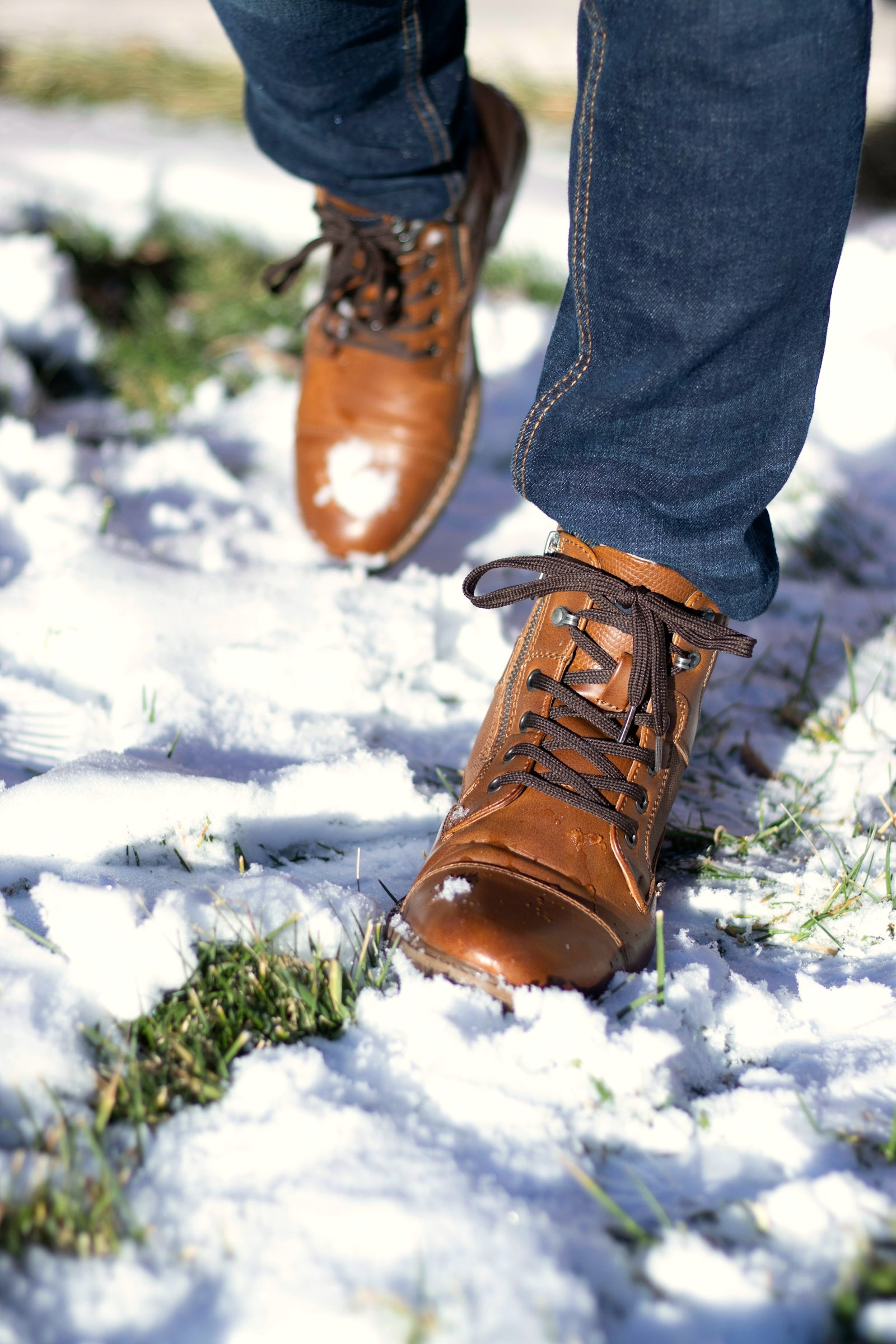
The Bean Boot's habitat, captioned as exactly that: boots in snow, in the weather the 1912 design was drawn for. Our bank holds no photograph of a Bean Boot itself, so no frame on this page is captioned as one. The ranking below is built from published cloth, prices and guarantee text, and from the ten Bean garments this site has already scored.
Checked and updated October 2026
The verdict, up front: the anchor wins its own page, which on this site is not a courtesy. L.L.Bean keeps its standing 87 from our American ranking, audited in the open below against the deepest garment record any house holds here: ten ranked Bean garments, three of them category winners. Filson stands second at 85, keeping the rows set on the Carhartt page: the heaviest cloth in the field and a lifetime guarantee, at two to four times the anchor's prices. Patagonia keeps its standing 83, audited below, its repair covenant intact. Lands' End is derived in the open at 75: weaker garments than the anchor's and the strongest sentence on the page, a guarantee with no expiry, printed since 1963. Orvis is derived at 70 and Duluth Trading at 68. The skip is Eddie Bauer at 56, derived in the open: the house that trademarked the unconditional guarantee now publishes a thirty-day return window and a restocking fee.
What people actually want from L.L.Bean
Nobody searches for brands like L.L.Bean because they need a catalogue. They search because Bean made a kind of purchase that is disappearing: the finished purchase. A boot designed in 1912 and still sewn in Maine, one pair at a time. A flannel in the line since 1936. A tote built the same way since 1944. Sizing that runs from regular to tall to genuinely big without apology, prices with no fashion premium in them, and behind all of it a house that answered for what it sold. The want is clothing bought once, from a company whose name is a promise rather than a label, in a register this page calls heritage because no shorter word covers it.
The ceiling is real, and this page names it before the anchor's card can be accused of hiding it. The catalogue now sells everything, and breadth dilutes: the icons are a fraction of a range that runs to furniture and dog beds, much of it imported and unremarkable. And in February 2018 the house cut the guarantee that built the legend, from no expiry to one year, which is why the alternatives below are graded on three tests this search is really asking. Is the cloth published: weights, fibres and ounces printed where the buyer can read them, or adjectives where the specification should be? Is the promise dated: a guarantee written in years, or in days? And is the icon still made the way the story says, in the place the story names? Heritage is a spec sheet or it is a costume. Every house below is graded on which of the two it is selling.
How the scores work
Every brand here is scored on the house basis for this series: fabric and cloth out of 30, construction and craft out of 20, fit range and sizing honesty out of 20, value out of 15, longevity out of 15. Three scores on this page are standing scores, because a score that changes from page to page is marketing. Two of them print totals without rows elsewhere on this site, so this page does to them what this series does to anchors in that position: it audits them in the open, rebuilding the rows from the published record and landing where the standing score stands. Filson's 85 arrives with its rows already printed, on the Carhartt page, and is reproduced exactly. Four scores are new on this page and derived in the open on their cards: Lands' End at 75, Orvis at 70, Duluth Trading at 68 and Eddie Bauer at 56.
The audit of the anchor, then, from its record. L.L.Bean's garment evidence on this site is ten ranked garments, the deepest file any house holds here: the Scotch Plaid flannel at 85 and the Chamois overshirt at 83, both category winners, the Wicked Good slippers at 88, a third winner, the Scotch Plaid pajamas at 79 and robe at 78, the Boat and Tote at 79, the Stretch Country corduroy at 75, the Unshrinkable henley at 74, the Irish Lambswool scarf at 73 and the deerskin gloves at 67. Two rows of the brand score are pinned by the American ranking's own text. Value is 15, printed there as a perfect score: almost nothing the house sells carries a fashion premium. Fit is 19: the American page prints that Bean's sizing, regular to tall to genuinely big, is why its fit range scores with the winner of that ranking, and the winner's fit row is 19, printed on the Buck Mason cards in this series. The remaining three rows are argued from the garment file. Fabric 23: the icons publish their cloth, the flannel's Portuguese longer-staple cotton brushed eight times on a side, the tote's 24-ounce canvas with handles tested to 500 pounds, the boot's full-grain leather over its rubber bottom; docked below Filson's 27 because the American page's own verdict is that the cloth is good rather than great, and docked again for the Wicked Soft crew our cashmere ranking exhibits in prose, a 95 percent cotton sweater sold inside the cashmere conversation. Construction 16: the boot is hand-sewn in Maine, triple-needle stitching the maker publishes, the tote double-layered at the base; against that stands a catalogue mostly made overseas and a henley whose own review page, quoted on its card, reports the pattern discipline slipping. Longevity 14: the service lives are the elite of this page, a tote costed over twenty years at about $3 a year, a flannel in the line since 1936, slippers scored 88; the missing point is charged in the open, and it is the guarantee. In February 2018 the house cut the promise that built it from no expiry to one year, and a row that grades how long a house stands behind its garments does not print full marks for that. Add them: 23, 16, 19, 15, 14. The brand score is 87, confirmed from the record up.
Patagonia's 83 is audited the same way. One row is pinned by the American ranking's text: longevity is 15, a clean score, printed there as earned on the strength of the repair system alone. Its garment evidence here is the Baggies at 84 in our shorts ranking, a recycled nylon short whose cloth refuses to wear out, and the Fjord flannel at 77. Fabric 24: the recycled-input programme is the industry's reference and the Baggies' shell is the proof at garment scale, docked below Filson because the range's lifestyle end runs to ordinary fleece at faithful prices. Construction 17: bar-tacked, repairable, built to be sent back and mended rather than replaced. Fit 15: a functional range, honest, and narrower than the anchor's library. Value 12: the American page's printed deduction, prices rising yearly, the lifestyle end charging the faithful for colours. Add them: 24, 17, 15, 12, 15. The brand score is 83, confirmed.
Three names are answered in the open rather than ranked. Pendleton keeps its standing 82 from the American ranking, where its Board Shirt's 6.2-ounce virgin wool scores 83 as a garment in our flannel ranking: a wool specialist, mill and blanket house first, rested here because this page grades the generalist outdoor catalogue, and its story is told in full where the score stands. The North Face keeps its standing 64 and its place as the American ranking's skip, beaten there on fabrics, repair and restraint by the houses ranked second and third on this page, and not re-tried here. And the fast-fashion outdoor imitation, the usual failure of this page's third test, is answered in prose on purpose: its brand number is a living derivation maintained on the H&M page of this series, from that house's ranked garments, and this page does not borrow it, restate it or re-derive it. The imitation's method is the same wherever it appears: the Bean Boot's silhouette and the flannel's check, printed on cloth that publishes no weight, under a guarantee measured in days.
The guarantee ledger, quoted from the houses' own pages today, is the spine of the ranking, so it is printed before the cards. Read down the term column and the ladder below explains itself.
| House | The sentence, as published | The term |
|---|---|---|
| Lands' End | "If you're not satisfied with any item, simply return it to us at any time for an exchange or refund of its purchase price." | No expiry |
| Orvis | "We will refund your money on any purchase that isn't 100% satisfactory. Anytime, for any reason." | No expiry |
| Patagonia | "We guarantee everything we make. If you are not satisfied with one of our products at the time you receive it, or if one of our products does not perform to your satisfaction, return it to the store you bought it from or to Patagonia for a repair, replacement or refund. Damage due to wear and tear will be repaired at a reasonable charge." | No expiry; repair first |
| Filson | A lifetime guarantee against failure of materials and workmanship, backed by a working repair service, under the founder's sentence: "We guarantee every item purchased from us. No more, no less. Your satisfaction is the sole purpose of our transaction." | The product's life |
| L.L.Bean | "If you are not 100% satisfied with one of our products, you may return it within one year of purchase for a refund. After one year, we will consider any items for return that are defective due to materials or craftsmanship." | One year; unlimited until February 2018 |
| Duluth Trading | "If you are not satisfied with any item you purchase from Duluth Trading, return it for a refund within one year. After one year, we will also consider returns for items that are defective or don't perform as designed." | One year; unlimited until August 2019 |
| Eddie Bauer | The return policy its store publishes today: thirty days, items unused, unworn and unwashed with tags attached, a $10 restocking fee. The trademarked sentence it replaced: "Every item we sell will give you complete satisfaction or you may return it for a full refund." | Thirty days |
Seven brands like L.L.Bean, ranked

L.L.Bean
US prices at last check: Bean Boots from $140 at the maker's store, the 8 inch at $150; the Scotch Plaid flannel $59.95; the Boat and Tote $59.95.
The anchor, keeping its standing 87, audited in the open above: ten ranked garments, three category winners, and a guarantee whose retreat is charged on its own card.
The case for the anchor is its file. No house on this site has been graded garment by garment as often, and the grades hold up under the accumulation: three winners across three categories, a pajama set and a robe in the same Scotch Plaid cloth as the winning shirt, a tote whose 24-ounce canvas and 500-pound handle test are printed by the maker, and a boot still sewn in Maine, one pair at a time, 113 years after the first hundred pairs came back and Leon Leonwood Bean refunded every buyer out of his own pocket and fixed the boot. That founding act is the house in miniature, and the catalogue's best garments still behave as if it happened: published cloth, honest prices, sizing that serves bodies other houses abandon. The American ranking calls it the institution, and its value row there is a perfect 15, because almost nothing in the store charges you for the story.
The deductions are the audit's, printed rather than whispered. The cloth is good rather than great; beside Filson's Mackinaw wool and tin cloth, Bean's fabrics are workmanlike, and the brand fabric row of 23 against 27 is that distance measured. The catalogue's breadth works against its icons: for every Scotch Plaid there is a rail of imported product trading on the same label, and our henley card prints the maker's own customers reporting the pattern discipline slipping. And the guarantee, the covenant that made the house a byword, is now a year and a consideration, graded in the longevity row at 14 rather than the clean 15 its garments would otherwise earn. Buy the icons first and the catalogue carefully: the boot, the flannel, the chamois, the tote, the slippers. They are the argument, and after a century they are still winning it.
Filson
US price at last check: the Wool Jac-Shirt $349 at the maker's store; the Mackinaw Wool Cruiser about $550.
Keeps its standing 85 and its rows from the Carhartt page of this series: the heaviest cloth in the field and a lifetime guarantee, at two to four times the anchor's prices.
Filson is what the Bean want becomes with the brakes off. C.C. Filson opened in Seattle in 1897 to outfit prospectors heading for the Klondike, customers for whom a failed seam was not an inconvenience, and the house has never entirely stopped designing for them: Mackinaw wool woven to a density modern mills rarely attempt, tin cloth finished until it sheds water like a roof, bridle leather from Wickett & Craig in the bags. Its rows are reproduced exactly from the Carhartt page: fabric 27, the field's ceiling, construction 19, and longevity a clean 15, because the guarantee is the strongest form on this page, a lifetime promise against failure of materials and workmanship with a repair service that darns, rebinds and resets hardware on garments decades out of production. Its garment evidence here matches the brand: the Rugged Twill briefcase won our bags ranking at 86, and its waffle henley won the henley ranking at 84.
The deduction is the bill, and it is printed in the standing rows rather than discovered at the till: value 9, the weakest row at the top of this page. The Cruiser at about $550 costs what nine Bean flannels cost; the Jac-Shirt at $349 costs what six do. At a thirty-year horizon the arithmetic forgives it, and the repair culture is precisely the machinery that makes the horizon real rather than rhetorical. But the reader whose Bean want is partly about price, and for most readers it is, should read the 85 correctly: it is the step up, not the substitute. Buy the Cruiser or the tin cloth jacket, register the purchase in your mind as furniture, and send it back for repair when the decade asks. The house is built to receive it.
Patagonia
US price at last check: the Synchilla Snap-T pullover about $139 at the maker's store.
Keeps its standing 83, audited in the open above: the Ironclad Guarantee read as a repair covenant, with the Baggies at 84 as its garment-scale proof.
Patagonia is the modern answer to the Bean want, the house that rebuilt the covenant as a system. The Ironclad Guarantee, quoted in the ledger above, has no expiry and a repair department behind it that is the largest garment repair operation in North America by the house's own account; the Worn Wear programme resells the used garments the repairs cannot save. The audit in the method section rebuilds its standing 83 from the record: longevity pinned at a clean 15 by the American ranking's own text, fabric 24 on the recycled-input programme and the Baggies' evidence, the short that scored 84 in our shorts ranking because its recycled nylon shell declines to wear out. Founded in Ventura in 1973 out of a climbing forge, and given away by its founder to environmental trusts in 2022, it is the one house here whose story since Bean's retreat has run in the opposite direction: the promise widened as the founder's ownership narrowed to nothing.
The deductions stand as the American ranking printed them. Value is 12: prices rise yearly, and the lifestyle end of the range, the colours and the collaborations, charges the faithful a premium the technical core does not need. Fit is 15, a functional outdoor range that serves the trail better than the tall and the genuinely big bodies the anchor's library was built around. And the register differs: this is the technical branch of the heritage family, shells and fleece rather than flannel and canvas, so the reader whose want is specifically Bean's, the Maine register, should read the 83 as the strongest alternative rather than the nearest one. Buy the fleece and the shell here before anywhere else on the page, then use the repair programme. It is half the product, and the score says so.
Lands' End
US prices at last check: the Volley swim trunk $49.95 and the knit pajama set $69.95 at the maker's store, both before the code that runs most weeks.
Derived in the open on this page: the anchor's oldest imitator and its guarantee's last keeper, graded from three ranked garments and a sentence that has not changed since 1963.
Lands' End began in Chicago in 1963 selling sailboat hardware by mail, Gary Comer's joke of a misprint in its own name, and became the catalogue that spent fifty years being compared to Bean. The comparison usually ends with the garments, so start with the sentence instead. The guarantee in the ledger above is Gary Comer's, and the house has never retreated from it: satisfied or not, return it at any time, for an exchange or refund of its purchase price. The house tells the story against itself with pride: a London taxi, sold off a 1984 catalogue cover for $19,000, returned by its buyer in 2005 and refunded in full, because the guarantee does not distinguish between a tote and a taxi. The derivation grades the house that kept that sentence. Fabric 19: the Supima cotton programme and the Oxford cloth heritage are real, and the maker publishes fibre lines on the garments we ranked; docked for the thinning of the Sears years and a swim fibre line our ranking could not capture from its own page. Construction 14: competent catalogue making throughout, its pajama set the honest baseline of our pajamas ranking at 66, its gloves at 63 in the gloves ranking carrying a published lining failure; nothing here is bench-grade and nothing pretends to be. Fit 17: the library is the house's genius, three inseam lengths inside a pajama set, the widest length library at the price in our swim ranking, big and tall without apology, second only to the anchor on this page. Value 12: fair list prices, docked for the code culture our swim ranking printed in the open, the list a reference figure and the promoted price the real one most weeks. Longevity 13: founded 1963, spun out of Sears in 2014, the guarantee unretreated through every owner, the garments honestly mid-life. Add them: 19, 14, 17, 12, 13. The brand score is 75.
What the 75 buys, stated plainly: garments a clear rung below the anchor's, under a promise a clear rung above it. The swim trunk at 68 is its best garment here, the honest family trunk in the field's widest length library; the gloves and the pajama set grade as baselines, well made, fairly priced, unremarkable. A reader building a household's basics, school clothes, swim, sleep, the unglamorous wardrobe that gets replaced by size rather than by fashion, is exactly the reader the unretreated guarantee was written for, and no other house on this page still offers it at these prices. Buy the basics here on the code, keep the receipts you will never need, and let the taxi story stand as the receipt for the sentence.
Orvis
US prices at last check: the Tech Chambray work shirt $98 at the maker's store; its shirt rail runs $89 to $119.
Derived in the open on this page: the oldest house here, founded 1856, its guarantee intact and its clothing range drifted from the sporting core that earned it.
Orvis is the elder of this entire register: founded in Manchester, Vermont in 1856 by Charles F. Orvis, a fly-fishing house before it was anything else, and the oldest mail-order company in America. Its guarantee, in the ledger above, is printed in the same register as Lands' End's and has been since the nineteenth century: any purchase that is not 100 percent satisfactory, refunded, anytime, for any reason, and its returns page today still opens with the sentence that 100 percent customer satisfaction has been the commitment since 1856. The derivation grades what stands around that sentence now. Fabric 20: the sporting core publishes real cloth, the Tech Chambray at $98 printing its UPF 40 rating and a recycled fibre built from bottles and oyster shell; docked because the general apparel rail runs to unremarkable private-label cloth at sporting prices. Construction 15: triple-stitched seams published on the work shirts, and the rod and wader benches are genuine; the clothing sits a step below them. Fit 13: classic cuts honestly described, a narrower library than the catalogue houses offer. Value 10: shirts at $89 to $119 stand against the anchor's $59.95 flannel class, the sporting premium charged on the clothing as well as the tackle. Longevity 12: continuous since 1856 with the covenant intact, docked for the drift, dog beds and home furnishings now share the catalogue's front ranks with the clothing, and in 2024 the house closed stores and ended the catalogue it had published for over a century and a half. Add them: 20, 15, 13, 10, 12. The brand score is 70.
The buy is the core, as it is at every house on this page, only narrower here. The fishing shirts, the waders, the country cloth with a spec printed on it: those are Orvis garments, made by a house that still answers for them in the old words. The lifestyle rail around them is a department store wearing a sporting name, priced accordingly, and the score's job is to make sure nobody pays tackle money for it. On promotion, in the core categories, Orvis remains what it has been since before the Civil War: the sporting house that answers. At list, in the clothing aisles, it is a pleasant store with a magnificent guarantee attached to ordinary cloth.
Duluth Trading
US prices at last check: the DuluthFlex Fire Hose cargo pants $84.95 at the maker's store, with clearance colourways printed at $40.99 on the same product page.
Derived in the open on this page: real published specifications under the jokes, and a guarantee that quietly became the anchor's.
Duluth Trading is the youngest house here by generations: founded in 1989 in Duluth, Minnesota, selling organisers to tradesmen before it sold them clothes, and famous since for cartoon beavers and garments named like punchlines. The derivation starts by crediting what the jokes conceal, which is the most spec-sheet behaviour at this end of the ladder. Fabric 19: the Fire Hose canvas is published at 8 ounces with its split printed on the product page, 97 percent cotton and 3 percent spandex in the flex version, a disclosure habit houses twice its age on this page do not match; docked because the treatment names, FendOff and DuluthFlex and the rest, do some of the talking the numbers should. Construction 15: triple-stitched seams and riveted stress points published in the open, a crouch gusset that is a real pattern answer to a real problem, workwear built by people who print their stress points. Fit 14: waists from 28 to 48 and three inseams on the work pants, work fits honestly drawn for working bodies. Value 11: $84.95 for the Fire Hose cargo is a fair price for the published build; docked for the duality printed on the same product page, clearance colourways at $40.99 under the $84.95 list, the two-price habit arriving at the workwear end of the market. Longevity 9: the house is thirty-six years old in a field of centenarians, and its guarantee made the anchor's retreat a year after the anchor did, in nearly the anchor's words. Its own guarantee page grandfathers purchases made before August 7, 2019, which dates the change from the house's own hand, and the current text adds an exclusion list that runs to ordinary wear and tear. Add them: 19, 15, 14, 11, 9. The brand score is 68.
None of that makes the Fire Hose pants a bad buy; at the clearance figure they may be the best-value work trouser on this page, and the derivation says so by grading the garment's evidence rather than the slogan. What the 68 grades is the distance between the brand's voice and its paperwork. No Bull is a fine slogan. The published terms are one year and a list of exclusions, which is bull of a perfectly ordinary kind, retail bull, and a house founded on the tradesman's distrust of exactly that should be graded when it adopts it. Buy the pants for the 8-ounce canvas and the printed seams. Read the guarantee the way you would read any other maker's: in the small print, where this one keeps its calendar.
Eddie Bauer
US price at last check: the CirrusLite down hooded jacket, 650 fill, $149 at the maker's store.
The skip, derived in the open: the house that patented America's first down jacket and trademarked the unconditional guarantee, graded on what its own pages publish today.
The history first, because the skip only makes sense against it. Eddie Bauer founded his Seattle shop in 1920, nearly died of hypothermia on a winter fishing trip in 1936, and answered in 1940 with the Skyliner, the first patented down jacket in America. The house he built made its guarantee a trademark, printed with the symbol: every item we sell will give you complete satisfaction or you may return it for a full refund. For most of a century that sentence was the strongest in American retail, stronger than Bean's, because Bean's was a policy and Bauer's was a boast. The derivation grades the house that publishes today's paperwork instead. Fabric 17: the down knowledge is real, the CirrusLite at $149 packing a published 650 fill, a century of insulation craft in the core line; docked because the apparel around it is commodity fleece and tees with nothing published at all. Construction 12: competent and unremarkable, nothing bench about it, nothing the price explains. Fit 14: the card's fairest row, the tall and big ranges genuinely persist from the house's serious years. Value 8: list prices are opening bids under promotions that run most weeks, so the figure on the tag describes a price the house does not expect anyone to pay, the reference-pricing habit this series convicts wherever it finds it. Longevity 5, the row the whole card turns on: the name dates to 1920, and the company has passed through bankruptcy and a line of owners into its present life as one brand inside a retail holding group, its garments unproven under each successive management; and the guarantee that was the house's longevity argument, the trademarked sentence above, now runs to thirty days. Add them: 17, 12, 14, 8, 5. The brand score is 56.
Set the two documents side by side and the skip argues itself. The current return policy, on the maker's own store today, offers a hassle-free thirty-day return period, and the fine print under the slogan requires items unused, unworn and unwashed with tags attached, and deducts a $10 restocking fee from the refund. Thirty days, unworn, with a fee, from the house that trademarked satisfaction or a full refund. Every other house on this page, including the two that retreated, still measures its promise in years or in lifetimes; the covenant keepers measure theirs in no unit at all, because it has no end. Eddie Bauer measures its in days, and charges for the envelope. The down jacket is fine. Buy it on promotion, as the value row instructs, and it will keep you warm. What you must not do is pay the heritage price, the premium the 1920 story and the trademarked sentence were built to justify, because the house sold the sentence and kept the story. On this page, that is the definition of the skip.
The pattern under the ranking
Read the ladder as one argument about what a heritage house is answerable for. The top of the page answers with objects and machinery: a boot sewn in Maine and a tote costed over twenty years, cloth at 27 and a repair bench in Seattle. The middle answers with sentences: Lands' End and Orvis hold mid-table scores on garments nobody would call the field's best, because the promise each prints has no expiry and each has the receipts, a taxi refunded after twenty-one years, a commitment dated 1856. Duluth answers with specifications under the comedy, real ounces and printed seams, and a promise that quietly joined the majority. The bottom answers with a story whose paperwork has expired. Eddie Bauer's garments are not the worst made on this page; its construction row is not the lowest here. What it cannot produce is the document its own name was priced on. In this register, where the product is a promise repeated over decades, the guarantee is part of the garment, and the scores are that fact measured seven times.
The second pattern is the retreat itself, and it has dates. February 9, 2018: the anchor ends 106 years of no-expiry returns, citing abuse and a cost reported at $250 million over five years. August 7, 2019: Duluth's grandfather date, printed on its own page, marks the same change made quietly, in nearly the same words. Between them the two most famous guarantees in American outdoor retail became one-year policies with defect consideration, which is to say they became ordinary. What did not move is as instructive: Lands' End, the imitator, kept the original sentence through a spin-off and every change of ownership, and Orvis kept its own through a retrenchment that cost it stores and its catalogue. The strongest promise in this market now belongs to the houses ranked fourth and fifth, not first, and that inversion is the most useful fact on the page. A guarantee costs nothing to print and a fortune to honour. The scores grade the honouring, where the record shows it.
| Brand | Score | The piece to buy | Price |
|---|---|---|---|
| L.L.Bean | 87 | Bean Boots, the 6 inch | $140 |
| Filson | 85 | The Mackinaw Wool Cruiser | About $550 |
| Patagonia | 83 | The Synchilla Snap-T | About $139 |
| Lands' End | 75 | The Volley swim trunk, on the code | $49.95 |
| Orvis | 70 | The Tech Chambray work shirt | $98 |
| Duluth Trading | 68 | DuluthFlex Fire Hose cargo pants, clearance colourway | $40.99 |
| Eddie Bauer | 56 | None | $149 |
The Skip · 56/100
Eddie Bauer. The house that patented the American down jacket and trademarked the unconditional guarantee, complete satisfaction or a full refund, now publishes a thirty-day return window, unworn items only, with a $10 restocking fee deducted. The story is a century long. The promise is thirty days. This page does not pay heritage prices for a calendar month.
Which one to buy
Buy the institution: L.L.Bean (87), the boot, the flannel, the tote and the slippers, icons bought once and handed down.
Buy the cloth: Filson (85), the Cruiser and the tin cloth, and use the repair service when the decade asks. Buy the repair covenant: Patagonia (83), the fleece and the shell, with the Ironclad Guarantee behind them. Buy the promise: Lands' End (75), a household's basics under the only unretreated sentence in the catalogue business. Buy the sporting core: Orvis (70), the fishing shirts and the country cloth, on promotion. Buy the work spec: Duluth Trading (68), the Fire Hose pants at the clearance figure, for the printed ounces. The rest of the family: brands like Carhartt, brands like Buck Mason, brands like H&M and the American brands ranking where three of these scores stand.
Questions, answered
What brand is most like L.L.Bean?
Lands' End, at 75 out of 100 in this ranking: the other catalogue house, founded on the same wager, a fair price, a fit library that runs to big and tall, and a guarantee with no expiry date. It is the only house on this page that still prints the sentence L.L.Bean retired in 2018: if you are not satisfied with any item, return it at any time for an exchange or refund of its purchase price. The step up is Filson at 85, heavier cloth and a lifetime guarantee at two to four times the price. The anchor itself stands at 87, and the honest summary of the page is that nobody here beats Bean at Bean's prices; the argument is about which promise you want standing behind the purchase.
Is L.L.Bean worth it?
At the icons, yes, and the record is why. Ten Bean garments are ranked on this site and they include three category winners: the Scotch Plaid flannel at 85, the Chamois overshirt at 83 and the Wicked Good slippers at 88, plus a Boat and Tote costed at about $3 a year over a twenty-year life. The house's standing brand score is 87, audited in the open on this page. The caveat is printed there too: the guarantee that built the legend was cut in February 2018 to one year, with defects considered after that, so buy the icons for the cloth and the making, and treat the modern promise as a good retailer's promise rather than the covenant your grandfather bought under.
L.L.Bean or Lands' End: which catalogue house should I buy?
L.L.Bean for the garments, Lands' End for the guarantee, and the scores print the split: 87 to 75. Bean's ranked record is deeper and its icons are stronger, the Maine-made boot, the flannel in the line since 1936, the tote sewn the same way since 1944. Lands' End kept the stronger sentence. Its guarantee still reads, in full, that if you are not satisfied with any item you may return it at any time for an exchange or refund of its purchase price, no expiry, no receipt window, and it has read that way since 1963. If the purchase is a boot or a flannel, buy Bean. If the purchase is a decade of basics for a household, and the promise matters as much as the cloth, the 75 is the honest buy.
What happened to the L.L.Bean lifetime guarantee?
It ended on February 9, 2018, after 106 years. The sentence that replaced it reads: if you are not 100 percent satisfied with one of our products, you may return it within one year of purchase for a refund; after one year, we will consider any items for return that are defective due to materials or craftsmanship. The house blamed abuse, returns run as a lifetime replacement programme, and the cost reported at the time ran to $250 million over five years. Two houses on this page still print the older covenant in substance: Lands' End, at any time with no expiry, and Orvis, anytime, for any reason. Duluth Trading made the same retreat as Bean a year later; its own guarantee page grandfathers purchases made before August 7, 2019, which is the date of the change printed by the house itself.
Why is Eddie Bauer the skip?
Because its guarantee is the shortest document on this page and it used to be the longest promise in American retail. The house trademarked the sentence: every item we sell will give you complete satisfaction or you may return it for a full refund. The return policy its own store publishes today offers thirty days, on items unused, unworn and unwashed with tags attached, with a $10 restocking fee deducted from the refund. The derivation on its card lands at 56: fabric 17, construction 12, fit 14, value 8, longevity 5. The down expertise is real, and the CirrusLite at $149 is a competent jacket. What is gone is the thing the name was priced on, a house that answered for its garments without a calendar. Buy the jacket on promotion if you want it. Do not pay a heritage premium to a thirty-day policy.
How this ranking stays honest
Three scores on this page are standing scores. Filson's 85 is reproduced with its rows exactly as printed on the Carhartt page of this series. L.L.Bean's 87 and Patagonia's 83 stand in the American ranking as totals, and are audited in the open in the method section above, the rows rebuilt from the published record, two of the anchor's rows pinned by that ranking's own printed words: its value score of 15, stated there as perfect, and its fit range, stated there to score with that ranking's winner, whose fit row of 19 is printed on the Buck Mason cards. Four scores are new and labelled as such wherever they appear: Lands' End at 75, Orvis at 70, Duluth Trading at 68 and Eddie Bauer at 56, each derived in the open on its card and each open to re-derivation when a garment from those houses is ranked here. Garment scores quoted on this page, 88, 85, 84, 83, 79, 78, 75, 74, 73, 68, 67, 66 and 63, belong to the garments and the rankings that set them; brand and garment are kept separate throughout, and no garment number, including the Lands' End swim trunk's 68, is used as a brand score anywhere on this page. The guarantee sentences in the ledger were read from the houses' own published pages at this check: Bean's current guarantee text, the Lands' End guarantee as the house prints it, Patagonia's Ironclad text from its own customer pages, the Orvis returns page and its printed formula, the Duluth guarantee page and FAQ, and Eddie Bauer's own refund policy page, with its historic sentence quoted from the house's own vintage copy. Prices were read from the makers' own stores at this check, as the cards print them. Three names are answered in prose and left unranked for stated reasons: Pendleton and The North Face, whose standing scores this page does not disturb, and the fast-fashion imitation, whose number is a living derivation maintained on its own page of this series and is neither borrowed nor restated here. The doors are what they are and are named: the anchor links to its maker's US rain-boots category, Filson and Eddie Bauer to exact product pages at their makers' stores, Lands' End to the exact product page our pajamas ranking verified, Orvis to its US shirt category, and Patagonia and Duluth Trading to their makers' storefronts, as elsewhere in this series. The photography is this magazine's licensed bank photography throughout; no brand's campaign imagery is used, the bank holds no photograph of a Bean Boot, and the hero caption says so. When a maker changes cloth, price, guarantee or model materially, the score moves and the move is noted here.