
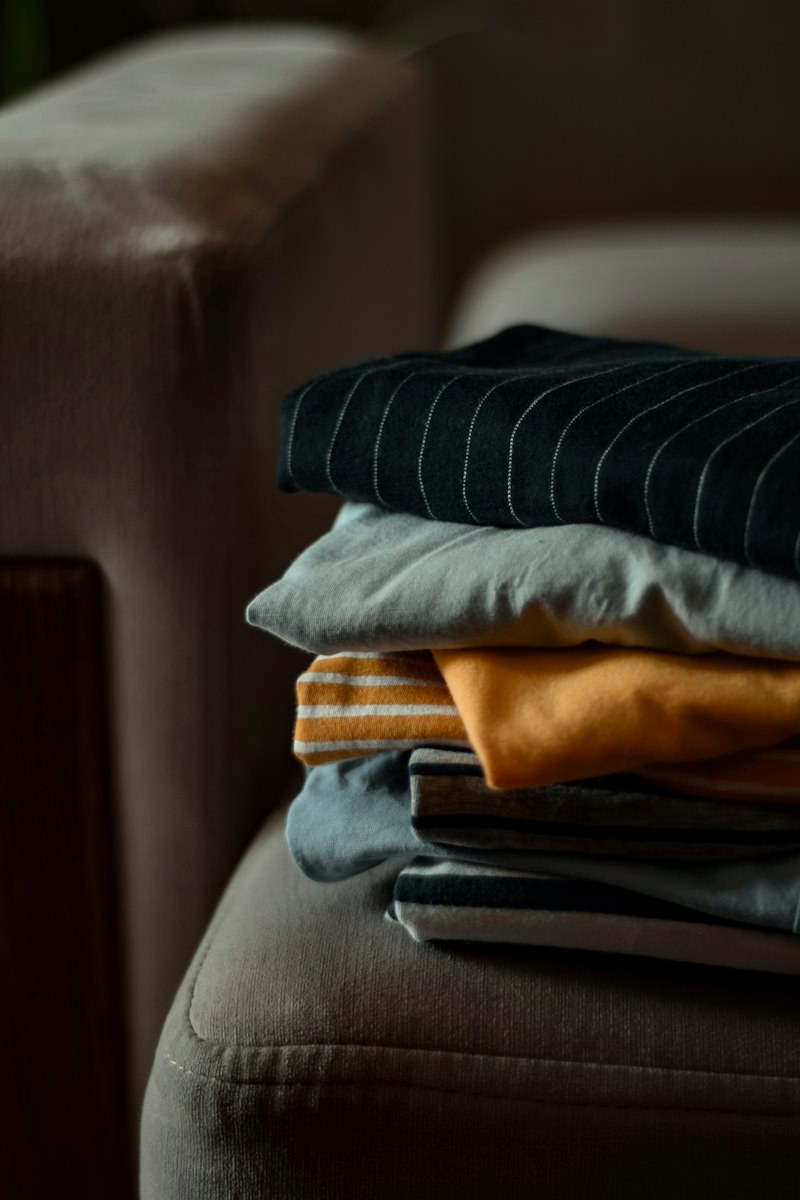
A slipper is graded on its lining and its sole, because those are the whole garment: there is no tailoring to hide behind, only what touches the foot and what touches the floor. A note on photography, printed because this page believes in saying so: our photo bank holds no slipper or fireside photography, on a foot or off one, so no ranked pair is pictured anywhere on this page. The hero is a folded lounge still life from the bank, captioned as what it is, and the frames this page actually needs head the harvest list in the honesty section.
Checked and updated October 2026
The basis: a slipper is graded on its lining before its softness, because softness is free in this category and the lining is what decides whether the pair is still warm in year two. Every pair is also graded by the sole ruling, this pillar's standing line, inherited from the door test on the pajama flagship and the sweatpants Card: a slipper that cannot step outside for the bins and the coffee is a sock with ambitions. The winner: the L.L.Bean Wicked Good Moccasins at 88, the field's only genuine shearling, hand-stitched over a rubber outsole, at $99.95. It is the one pair to buy if you buy one. The skip: the Versace Barocco-Print Mule Slippers at 30, named in the verdict box below: a $150 printed mule in the format hotels give away, sold on its print. In between, a one-piece wool felt takes the breathability altitude at second, a $67.95 suede moc takes third and the attainable slot with it, the famous name is graded on its current spec sheet at fourth, the fleece sofa classic takes fifth, and a lined clog is graded as the slipper its maker claims it is, at sixth.
First, the decision
Every slipper argument is really three arguments, and this page settles all three before it scores anything. The first is the only question most readers actually have: if you buy one pair, buy the L.L.Bean Wicked Good Moccasins. It is ranked first below on the published evidence, and it is named here, in the first screen, because a page that buries its answer under seven cards has not answered it. Its lining is the genuine article, a shearling lamb fur the maker publishes down to the fur's origin, its upper is premium suede, its construction is genuinely hand-stitched, and its sole is rubber. At $99.95 it costs less than the famous name in fourth and two thirds of the skip.
The second argument is the sole ruling, and it fits in one line: a slipper that cannot step outside for the bins and the coffee is a sock with ambitions. The indoor-outdoor line is drawn at the doorstep, plainly. Bins, mailbox, the doorstep with a coffee in hand: yes, and a sole that cannot do that much fails the garment's one public job. Pavement all day: no, and a sole built for that is a shoe's. The door test this pillar applies to pajamas and sweatpants, whether a pair can answer the door without apologising and hold up at the cafe, shrinks honestly for a slipper, because a slipper is not cafe wear and this page enjoys saying so. The pair that can sit in a cafe has stopped being a slipper; it is a shoe wearing the name, and one such pair is ranked below, graded as a slipper anyway, because its maker sells it as one. Comfort cannot look sloppy starts at the front door. For slippers, it also ends there, and the grading is better for admitting it.
The third argument is the lining ruling, and it is the economics of the whole category: genuine shearling and wool felt are the two honest warmths; everything else is a countdown. A shearling lining is a skin, and it packs slowly and keeps working as it does. A wool felt is a fibre mat with the same manners, and it breathes better than any pile. A synthetic pile or a memory foam footbed is plushest on the first evening and flattest by the second winter, and when the lining goes, the pair is done, whatever the sole still promises. A slipper whose lining dies in a season is a subscription, and this page grades it as one: the longevity row costs the pack-out, and the per-year table below sends the bill.
One boundary, printed because this desk prints its boundaries: this page grades materials, construction and warmth as the makers publish them. It makes no claim about arches, posture or anything medical, because a slipper is a house garment with a doorstep life, not equipment, and any seller who tells you otherwise is selling the garment harder than the garment deserves.
How the scores work
Every pair is scored out of 100 on the same five rows, and the rows are printed on every card, so the reader can disagree with the weighting and still use the evidence.
Materials, 30 points. The upper and the lining as the maker publishes them: genuine shearling graded as shearling, suede as suede, wool felt as wool felt, EVA as EVA. The lining carries the row, because the lining is the garment. A textile blend wearing a shearling story is graded as the textile on the spec sheet, an unpublished fibre line is graded as unpublished, and a house that prints its materials down to a fur's origin earns what that candour earns.
Construction, 20 points. The build as published: the sole first, a stitched or moulded rubber sole against a cemented one, a leather sole graded as the indoor build it is; then the upper's making, hand-stitched moccasin construction against a glued assembly, a one-piece felt against a seamed one.
Warmth and breathability, 20 points. The pair graded as a climate, not a cushion: warmth that arrives with regulation, the shearling and wool that wick and breathe as they warm, against warmth that arrives as a sealed pile and turns clammy by midnight. A pair can be too warm to score here, and the field's breathability champion is not its thickest pair.
Value, 15 points. The price as a reader first meets it, printed on every card with its seller. A list price that the seller's own channel undercuts with a twin listing is graded at the list and convicted by the twin, in the open, on the same card.
Longevity, 15 points. How the pair ages on the foot and the floor: sole wear, and above all lining pack-out, costed as the subscription it is. Stated lives in the per-year table are this desk's, printed beside the figures so the reader can argue with the life rather than the arithmetic.
The rows sum to the score. Maker figures are labelled maker figures throughout, and three kinds of number appear on this page, kept separate on every card: garment scores, set fresh here on this basis; brand scores, set on the brand pages and cited for the record only; and garment evidence from a sibling garment, cited as evidence and never inherited as a score.
Seven slippers, ranked
L.L.Bean Wicked Good Moccasins
The Winner · The One Pair to Buy
$99.95 at L.L.Bean
The call: the winner is the only pair in the field whose lining is the thing the whole category is named for. The maker publishes the build without flinching: a premium suede upper with rawhide laces, genuine hand-stitched moccasin construction, a rubber outsole, and a lining of genuine shearling lamb fur, dyed and treated, with the fur's origin printed as Australia. The maker's own line for that lining is that it regulates foot temperature and wicks away moisture, printed here as a maker's claim, and it is the claim this category exists to make: warm in January, not a swamp in March. This house has now been ranked by this desk three times in a week, the Chamois cloth overshirt at 83 on its Card and the flannel at 79 on the pajama flagship, both garment scores, cited as evidence of a house standard and inherited as nothing: this pair was scored fresh, on this page's basis, and it won on its own sheet.
The sole ruling is passed outright. The rubber outsole does the bins, the mailbox and the doorstep coffee without a thought, and the moc shape answers the door like clothing rather than bedding. The deductions are printed with the praise. The price sits a dollar under a hundred, and the value row of 12 is what honest materials at an honest price earn next to a $67.95 attainable pair. The longevity row of 13 rather than higher prices the one known arc: shearling packs somewhat over the years, as every skin does, and buyers on the maker's own page report second pairs bought after years of nightly wear, printed as a report because it is one. Five years at $19.99 a year, $0.20 a wear, the cheapest year on this page, and the arithmetic is in the table further down.
Glerups Slip-On with Leather Sole
The Wool Altitude · The Breathability Answer
$105 at Glerups
The call: the wool altitude, and the warmth row's champion, which on this page is a different thing from the warmest pair. The garment is a single piece of 100 percent pure wool felt, felted into shape rather than cut and seamed, over a sole of chrome-free calfskin leather. There is no lining to grade separately because the upper is the lining: wool against the foot on every surface, which is why the maker's published claims for the material, temperature regulation, moisture wicking, odour resistance, read like a description of the category's ideal rather than a hope. The care is the maker's too: air them out, and expect some shedding in the first weeks while the felt settles, both printed by the house as normal. For the reader whose feet overheat in every lined pair he has ever owned, this is the answer the field has been holding.
The deduction is the sole, and the page draws the indoor-outdoor line exactly where the maker draws it. A leather sole is the indoor side of the line: it does the house and the dry doorstep, and the maker itself cautions that leather soles can be slippery on wet and icy surfaces, which is printed here as the maker's own caution rather than this desk's discovery. The house sells a rubber-sole sibling for the reader who wants the outdoor side, at $135 to $155 in current listings; it is noted in the honesty section and not scored, because this card grades the $105 original the line is known by. The construction row of 16 credits a one-piece felt with no seams to fail and prices the flat build honestly: there is no footbed architecture here, and feet that want structure should read the winner's card again. Five years at $21.00 a year, $0.21 a wear.
Minnetonka Pile Lined Hardsole Moc
The Attainable Answer · Real Suede at $67.95
$67.95 at Target
The call: the attainable answer, and the proof that the moc build is a design decision rather than a budget. The listing's own copy could be this page's ruling with the nouns changed: a traditional moccasin design, a supple suede upper, a thick pile lining, a cushioned insole, and soles the seller describes as specially constructed for indoor and outdoor use, pitched in so many words at walking the dog and grabbing coffee, which is the doorstep test passed by design. The suede is real, the build is the real moc pattern, the hardsole is a real sole, and at $67.95 this is the cheapest honest construction in the field: the pair a reader can buy tonight, in his size, without a ceremony.
The compromise is printed on the card rather than discovered in February. The lining is pile, a synthetic pile, and the card grades it as pile: warm on the first evening, without a shearling's regulation, and with a pack-out clock that runs faster than any natural fibre in the field. The longevity row of 6 is that clock priced, and the per-year table below sends the bill the ticket hides: at a stated two years this pair costs $33.98 a year, more per year than the $99.95 winner, which is the subscription arithmetic this pillar exists to print. The maker sells a sheepskin-lined sibling at $99.95 for the reader who wants this build with the honest lining, and at that price the winner's card is waiting. Buy this pair for the build and the ticket, knowing the lining is the two-year part of the bargain.
UGG Ascot
The Famous Name · Graded on Its Current Spec Sheet
$119.95 at Footwear etc.
The call: the famous name, graded on its current materials honesty, which is the instruction this card was always going to test. The Ascot's upper is a real suede, pre-treated with a water-repellency finish, over a moulded rubber outsole, and none of that is the story. The story is the lining. On the maker's current published specification, the lining and the sockliner are 17mm UGGplush: 80 percent upcycled wool, 20 percent lyocell. The brand's own description of that textile, carried in its retail copy, is that it is crafted to feel and wear like genuine shearling. Read that sentence twice. It is an honest sentence, and it says the lining is a wool-rich textile doing an impression, at $119.95, twenty dollars above the genuine shearling ranked first. Older retail copy still says sheepskin, and the memory of those years is what the price trades on. This page grades the sheet, not the memory, and no UGG score stands anywhere on this site to inherit from: the 59 is fresh.
What the textile earns, it keeps. The warmth row of 14 credits a 17mm wool-rich pile that is genuinely warm and wicks better than the synthetic pile ranked above it, and the suede and the moulded sole pass the doorstep outright. The deductions are the foam footbed under that lining, the cheapest cushioning class in the field, which compresses permanently and sets the pair's clock, and a cemented build with no stitching story the maker publishes. Three years at $39.98 a year, $0.40 a wear, the dearest year among the honest pairs: the reader who loves this silhouette should buy it with his eyes open, knowing he is paying altitude money for a lining the winner beats at a lower price. The honest version of the want underneath it is ranked first.
Acorn Moc
The Sofa Classic · Fleece and Memory Foam at $39.99
$39.99 at Footwear etc.
The call: the sofa classic, the padded moc pattern this category has sold for decades, graded as what it is. The retailer's published description is the whole garment in one line: fleece uppers, moisture-wicking fleece linings, a memory foam footbed the maker brands Cloud Cushion, and a nonslip indoor-outdoor outsole. It holds a 4.3 from 409 buyers on that retailer's page, printed as a report because it is one, and the warmth row of 13 is real: fleece is warm, immediately and completely, which is why this pattern owns the sofa end of the market. At $39.99 it is the cheapest ticket in the field, and for a reader whose slippers live within ten steps of the sofa, that is a coherent purchase.
The grading is equally plain about the two clocks inside it. The materials are synthetic top to toe, and the memory foam footbed is the fastest pack-out in the field: the cloud is a first-season experience, and by the second winter the pair is a fleece sock with a sole. The longevity row of 6 and a stated life of eighteen months price that arc, which makes the cheapest ticket cost $26.66 a year, more than the winner costs. The sole passes the doorstep and declines wet pavement, and the construction is a soft build that was never pretending to be a stitched moc. Buy it as the sofa pair, at the sofa price, with the replacement already in the arithmetic, and it is an honest bargain. Buy it as your one pair and the winner's card is the correction.
Crocs Classic Lined Clog
The Boundary Case · A Clog at a Slipper Ranking
$59.99 at Crocs
The call: the boundary case, ranked because its maker sells it as a slipper, in the maker's own words: great as a slipper, yet capable to run errands, too. That sentence is the whole argument of this page wearing one product. The garment is one moulded piece of Croslite foam, a thermoplastic EVA, with a soft fuzzy liner the retail spec sheets name as faux fur, a cushioned footbed moulded into the piece, and a pivoting heel strap. It holds 10,957 reviews on the maker's own page, printed as a report. Graded as a slipper, which is this page's job, the materials row decides it: foam and faux fur against a field of suede, shearling and felt is not a close contest, and the warmth it offers is a sealed warmth, warm the way a plastic box is warm.
What it wins, it wins outright, and the card says so. It passes the doorstep, the garden, the wet pavement and, yes, the cafe, which by this page's ruling is precisely the disqualification: it is a shoe, a good and nearly indestructible one, whose shell will outlive its liner by years, and the longevity row grades the pair on the liner, as every pair here is graded, because the lining is the garment. Three years at $20.00 a year, $0.20 a wear, a cent a year more than the winner. Buy it as the doorstep and garden pair and it may be the best value on the page. Buy it as the thing your feet live in all evening and the wool ranked second is the answer it cannot give.
Versace Barocco-Print Mule Slippers
The Skip · The Print Is the Product
$150 at Neiman Marcus
The call: skip it, and the conviction is the format. This is a flat printed mule: the shape a good hotel leaves folded on the bed, disposable by design, here carrying the Barocco print and a $150 list price in the department-store channel. What the channel publishes about the garment is the print and the price: no lining story, no sole story, no warmth claim, no construction claim that separates the build from the giveaway it imitates. The materials row of 8 and the construction row of 8 are what a print earns when it enters a ranking that grades linings and soles. The warmth row of 7 grades a mule that covers the toes and leaves the heel to the room, which is a summer answer sold into a winter category.
Run the channel's own arithmetic and the case closes. The same channel lists a twin of this mule at $75, which means the house's own shelf grades the list price the way this page does. At the $150 list over a generous two years, the fashion life of a printed piece, this is $75.00 a year, $0.75 a wear: nearly four winners a year, for the field's thinnest slipper evidence. This site keeps an anti-award for exactly this transaction, the Logo Tax, and this mule is the tax in printed form. The honest versions of the want underneath it are ranked above: the winner at $99.95 for the reader who wants a beautiful object that is also a slipper, and the wool felt at second for the reader who wants the quiet version. Buy either. Let the $150 go unpaid.
The numbers, side by side
Maker figures, checked against the makers' and sellers' own pages this month, with the claims labelled as claims: where a maker publishes a lining, a sole build or a material's origin, it is printed as theirs, and where a maker publishes nothing, the nothing is printed too.
| Slipper | The materials | The build | The sole ruling | The fine print |
|---|---|---|---|---|
| L.L.Bean Wicked Good Moccasins | Premium suede upper; genuine shearling lamb lining, dyed and treated, fur origin Australia as the maker prints it | Genuine hand-stitched moccasin construction, rawhide laces | Rubber outsole: the full doorstep, bins, mailbox and doorstep coffee | The house's third ranked garment appearance this week, after the overshirt at 83 and the flannel pajama at 79, both garment scores, evidence only |
| Glerups Slip-On with Leather Sole | 100% pure wool felt upper; chrome-free calfskin leather sole | Felted in one piece, no seams to fail; flat, with no footbed structure | Leather sole: indoors and the dry doorstep; its maker cautions against wet and icy surfaces | The rubber-sole sibling runs $135 to $155 in current listings and is noted, not scored |
| Minnetonka Pile Lined Hardsole Moc | Suede upper; thick pile lining, a synthetic pile, printed as pile | Traditional moccasin build, cushioned insole | Hardsole: indoor-outdoor by design; the listing itself pitches the dog walk and the coffee | The maker's sheepskin-lined sibling sells at $99.95; this card grades the pile garment that was priced |
| UGG Ascot | Suede upper with a water-repellency treatment; 17mm UGGplush lining and sockliner, 80% upcycled wool and 20% lyocell, as the current spec publishes | Moulded rubber outsole, foam footbed, cemented build | Rubber outsole: the full doorstep | Older retail copy still says sheepskin and UGGpure; graded on the current sheet, and no UGG record stands on this site to inherit |
| Acorn Moc | Fleece upper and moisture-wicking fleece lining; memory foam footbed | A soft padded build over a nonslip outsole; the classic sofa pattern | Nonslip indoor-outdoor outsole: the doorstep yes, wet pavement no | 4.3 stars from 409 buyers on the retailer's page, as reported |
| Crocs Classic Lined Clog | Croslite foam, a thermoplastic EVA, in one piece; faux fur liner | Moulded in one piece, pivoting heel strap; nothing to stitch, nothing to delaminate | A shoe sole: it passes the cafe test, which is the disqualification as a slipper | 10,957 reviews on the maker's page, as reported; the shell outlives the liner and the pair is graded on the liner |
| Versace Barocco-Print Mule Slippers (the skip) | A printed mule; the channel publishes the print and the price, and no lining or sole story to grade | A flat mule build, the hotel format | A house sole: the doorstep is a favour, not a feature | A twin listing in the same channel shows $75; the card is costed at the $150 list |
Read the materials column and the ranking explains itself. The top of the table is genuine shearling and one-piece wool felt, the two honest warmths; the middle is a real suede build over a synthetic pile and a wool-rich textile wearing a shearling story; the bottom is foam, fleece and a print. Evidence, all the way down, is the ranking.
Cost per year, in the open
The table divides each price by a stated working life for its lining and build, printed beside the figure so the reader can argue with the life rather than the arithmetic. Wear counts assume a lead pair in nightly rotation, worn about a hundred times a year. The hand-stitched shearling and the wool felt are costed at five years, the foam-footbed pair and the clog, graded on its liner, at three, the pile-lined moc at two, the memory foam classic at eighteen months, and the print at the two years of a fashion life.
| Slipper | Price | Stated life | Cost per year | Cost per wear |
|---|---|---|---|---|
| L.L.Bean Wicked Good Moccasins | $99.95 | 5 years | $19.99 | $0.20 |
| Glerups Slip-On with Leather Sole | $105 | 5 years | $21.00 | $0.21 |
| Minnetonka Pile Lined Hardsole Moc | $67.95 | 2 years | $33.98 | $0.34 |
| UGG Ascot | $119.95 | 3 years | $39.98 | $0.40 |
| Acorn Moc | $39.99 | 18 months | $26.66 | $0.27 |
| Crocs Classic Lined Clog | $59.99 | 3 years | $20.00 | $0.20 |
| Versace Barocco-Print Mule Slippers (the skip) | $150 at list | 2 years | $75.00 | $0.75 |
Two headlines live in that table. The winner's year is the cheapest year among the lined pairs, and the clog's year costs exactly one cent more, which is the boundary case in a single figure. And the attainable pair tells the pillar's whole sermon in one row: the $67.95 moc is the cheapest honest ticket in the field and the third-dearest year, because two years divide worse than five. Cheap slippers are a subscription. The table is the receipt.
Wearing them, and where they stop
The styling question is this pillar's standing homework, so it gets its own answers rather than a shrug. The range: a slipper's public life is the doorstep, and it is a real life: the bins, the mailbox, the neighbour at the gate, the coffee taken on the step in the cold. Dress for that range and the pair reads as clothing; the brown suede moc over the sweatpants Card's passing pairs answers the door like an outfit, and the printed novelty mule answers it like a joke, which is fine exactly once. The sock ruling: shearling and wool felt are built to be worn on bare feet, that is what temperature regulation means in practice; pile and fleece take a thin sock better, because synthetic warmth turns clammy against skin by midnight; foam takes anything and forgives nothing. The pairing: below the pajama flagship's flannels and the sweatpants above, a moc in a sober colour is the pillar's whole uniform, and the discipline is the same one the rest of the pillar runs on: the house clothes are real clothes, in house colours, and the print stays home. The cafe line, one last time: if the evening genuinely extends to the cafe, change into shoes, and let the slipper keep its dignity and its job. The one pair here built for that errand is ranked sixth and is, by its maker's own copy, a clog.
Which one to buy
Buy one pair only: the L.L.Bean Wicked Good Moccasins at 88. Genuine shearling, hand stitching, a rubber sole, $19.99 a year, and the cheapest year on the page.
Feet that run hot: the Glerups Slip-On at 84. One piece of wool felt that regulates instead of sealing, bought knowing the leather sole keeps it an indoor pair.
The budget, honestly: the Minnetonka Pile Lined Hardsole Moc at 60. Real suede and the real moc build at $67.95, bought knowing the pile lining is a two-year proposition.
The famous name, eyes open: the UGG Ascot at 59. A warm, well-shaped suede slipper whose current lining is a wool-rich textile, bought at $119.95 for the silhouette, not the shearling story.
The sofa, honestly: the Acorn Moc at 53. Fleece and memory foam at $39.99, the cheapest ticket in the field, with the eighteen-month clock printed on its card.
The doorstep and the garden: the Crocs Classic Lined Clog at 49, bought as the clog it is. Nearly indestructible, honestly warm enough for the step, and not the evening pair.
The rest of the pillar: what you sleep in is ranked on the pajama flagship and its cooling sibling, what goes over them is ranked on the sweatpants Card and the hoodie Card, and the layer under everything, where the organic argument starts, is the underwear ranking. Where every layer sits is mapped on the Body Map, and the full method behind these scores is on the methodology page.
How we know: the honesty section
The scores are this desk's own, computed on the basis printed above from maker-published materials, sole builds, construction details and care instructions, checked against the makers' and sellers' own pages this month. Prices were verified on the seller page at check time, and the exceptions are printed rather than smoothed over.
Six disclosures specific to this page. First, prices. The Bean at $99.95, the Glerups at $105 and the Crocs at $59.99 were read off the makers' own product pages today. The Minnetonka at $67.95 is the standing price across the retail listings checked today; its buy link lands on a size-specific listing because that is the form the channel sells it in, and the price is the same across the sizes checked. The UGG at $119.95 and the Acorn at $39.99 were read off live retailer pages today; the UGG is priced at a named retailer because the maker's own storefront figure could not be captured to this desk's standard today, and no dollar figure is guessed where one could not be verified. The Versace at $150 is the department-store channel's own list figure, read in that channel's live listings today, twin listing and all.
Second, the UGG specification, because it is the page's live wire. The Ascot's current published spec, carried in the maker's retail listings, reads: suede upper, a post-applied water-repellency treatment, 17mm UGGplush lining and sockliner at 80 percent upcycled wool and 20 percent lyocell, a foam footbed, a moulded rubber outsole. Older retail copy for the same model still describes sheepskin and the earlier UGGpure wool lining. Both cannot be the current garment; this page grades the current sheet and says so on the card, and the November check will re-read the specification, because a lining that changed once can change again.
Third, the Glerups sole. The ranked garment is the leather-sole original at $105. The house's rubber-sole version, $135 to $155 in current listings, redraws the sole ruling in the wearer's favour and would score its own card on its own evidence; it is noted here so the reader knows the option exists at the maker's own shelf, and it is not scored, because a ranking grades the garment it priced.
Fourth, the three kinds of number, because this page is where several of them meet. The garment scores are fresh, set here on this page's basis. No brand score is cited anywhere on this page, because none of these houses carries one on this site. And two sibling garment scores are cited as evidence only: the L.L.Bean Chamois overshirt at 83, from its Card, and the L.L.Bean flannel at 79, from the pajama flagship. Neither was inherited by, or lent to, any score here; a house's standard is evidence, and one garment against six others is a measurement, and this page keeps the two apart on purpose.
Fifth, two rested names. The Birkenstock Zermatt, a wool felt clog with a shearling footbed option, verifies today at $99.95 and is a genuinely good slipper; it is rested rather than ranked because its clog shape duplicates the boundary argument the Crocs card already carries, and seven is this Card's shape. The field's cheapest verified pair, a two-tone memory foam moc sold at $24.99 at Walmart under the RockDove name, is likewise rested: its lesson is the Acorn card's lesson, told at a lower price and a thinner standard of published evidence. No derived brand arithmetic moves because of this page, and no fast-fashion garment was scored, considered or needed: the field convicts its skip on price evidence that needs no exhibit.
Sixth, photography: the bank holds no slipper or fireside photography, no shearling lining macro, no moc stitching detail, no felt pair on a wood floor by a hearth, and this page does not pretend otherwise. The cards run without images rather than borrow a wrong frame, the hero is a folded lounge still life captioned as what it is, and the harvest list for this category names what is missing: a shearling moc worn on a cold doorstep in real light, a lining close-up that shows shearling against pile, and a fireside frame with the pair at rest by the hearth.
Questions the desk hears
What are the best slippers for men?
The L.L.Bean Wicked Good Moccasins, 88 out of 100: a premium suede upper over a genuine shearling lamb lining, hand-stitched, on a rubber outsole, at $99.95. It is the only genuine shearling in the field and the cheapest year on the page. Second is the wool altitude, the Glerups Slip-On with Leather Sole at 84, a one-piece wool felt that breathes better than anything else here. Third is the attainable answer, the Minnetonka Pile Lined Hardsole Moc at 60 and $67.95, real suede and a traditional moc build whose synthetic pile is the one honest compromise.
Can you wear slippers outside?
To the doorstep, yes; to the cafe, no, and the line is this page's standing ruling. A slipper that cannot step outside for the bins and the coffee is a sock with ambitions, so every pair here is graded on whether its sole can do the doorstep: the rubber soles pass, the leather sole passes indoors and stops at wet pavement, by its maker's own caution. But a slipper is not cafe wear. The pair that can sit in a cafe has stopped being a slipper and become a shoe, and shoes are ranked on other pages of this site. Comfort that cannot look sloppy starts at the front door, and it also ends there.
Shearling, wool felt or pile: which slipper lining lasts longest?
Genuine shearling and wool felt, and the gap is the whole economics of this category. A shearling lining is a skin: it packs slowly, keeps regulating temperature as it does, and is still working in year four. Wool felt is a fibre mat with the same manners. A synthetic pile lining and a memory foam footbed are the opposite bargain: plushest on the first evening, flat within a season or two, and the pair is done when they go, whatever the sole still promises. A slipper whose lining dies in a season is a subscription, and this page grades it as one, in the longevity row and in the cost per year.
Is the UGG Ascot still lined with real shearling?
Not on the maker's current published specification, and this page grades the current sheet. The Ascot's lining and sockliner are now published as 17mm UGGplush, 80 percent upcycled wool and 20 percent lyocell, a textile the brand itself describes as crafted to feel and wear like genuine shearling. Older retail copy still says sheepskin, and the memory of the shearling years is what the $119.95 trades on. The wool-rich textile is warm and honest on the spec sheet; it is graded here as a textile, at 59, behind a genuine shearling at $99.95. Buy the specification, not the memory.
How long should slippers last, and what do the good ones cost per year?
A hand-stitched shearling moc or a wool felt pair in nightly rotation should give five years; a foam-footbed pair gives about three, a pile-lined pair about two, and the per-year table on this page is the honest comparison: the $99.95 winner costs $19.99 a year over five, the $67.95 attainable pair costs $33.98 a year over two, and the $150 skip costs $75.00 a year over a generous two. The replacement signal is not a hole in the sole. It is the lining: when the inside has packed flat and the warmth has gone out of the pair, the slipper has retired, whatever the outside still looks like.
Should I buy slippers or a lined clog?
Buy the clog as a clog and it is a fine purchase; buy it as your winter slipper and wool beats it. The Crocs Classic Lined Clog is ranked here at 49, graded as a slipper, because its maker sells it as one: one piece of EVA foam and a faux fur liner against a field of suede, shearling and felt. As a doorstep and garden shoe it is nearly indestructible and its own maker's copy says it can run errands. As the thing your feet live in all evening, the materials row decides it, and foam is not a lining. The desk's ruling: the clog is the doorstep pair, the moc is the evening pair, and a house that can only have one should have the moc.
Seven slippers, one genuine shearling, one print at $150, and a winner that costs less a year than the budget pair. Buy the lining, mind the sole.
Checked and updated October 2026