
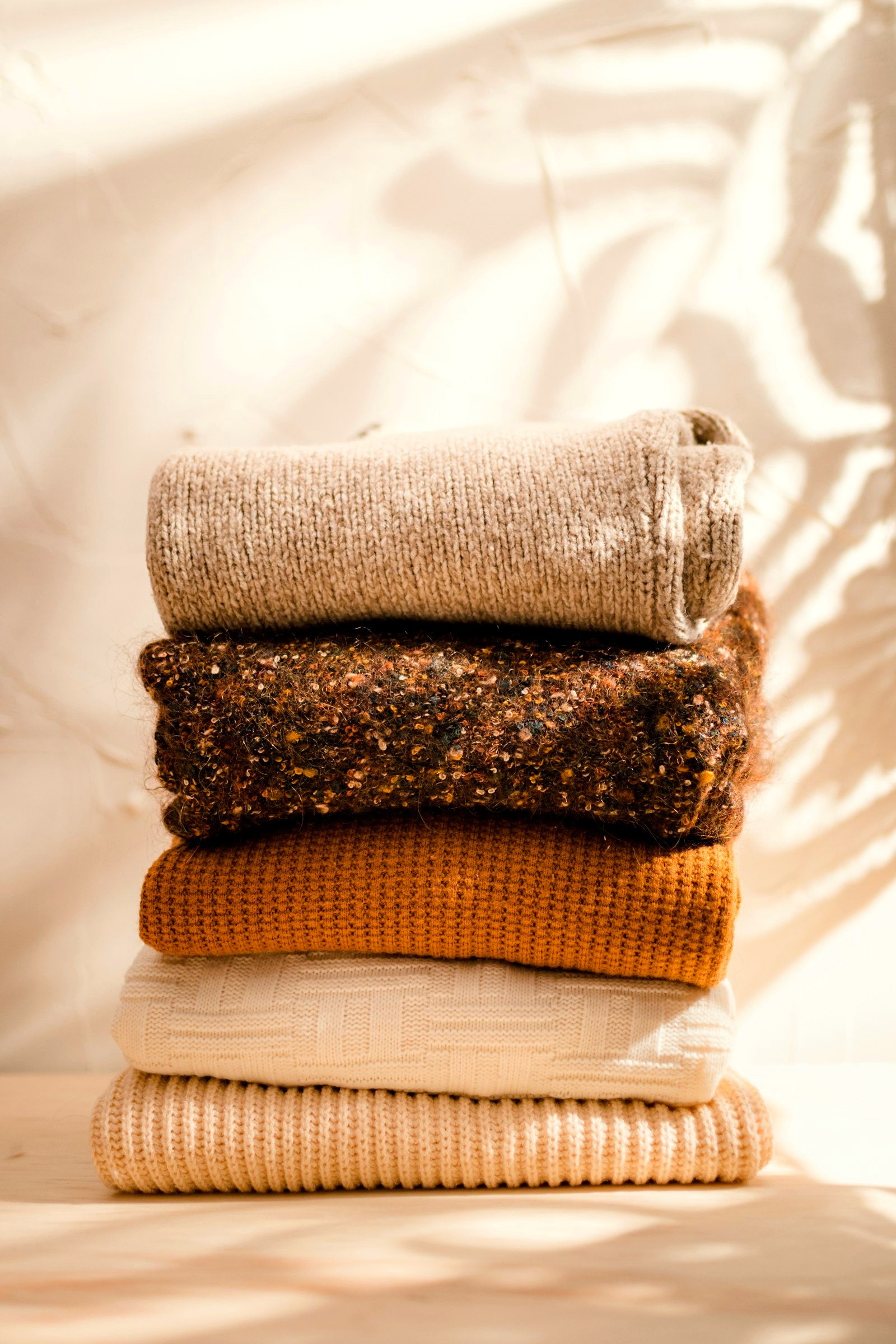
A sweatpant is graded on its cloth and its silhouette, because those are the whole garment: there is no tailoring to hide behind, only the weight of the knit, the line of the leg, and whether the pair still looks like clothing at the cafe. A note on photography, printed because this page believes in saying so: our photo bank holds no sweatpants photography, on a body or off one, so no ranked pair is pictured anywhere on this page. The hero is a folded-knit still life from the bank, captioned as what it is, and the frames this page actually needs head the harvest list in the honesty section.
Checked and updated October 2026
The basis: a sweatpant is graded on its cloth before its comfort, because comfort is free in this category and cloth is what decides whether the pair still looks like clothing in year two. Every pair is also graded by the door test, this pillar's standing question, carried over from the pajama ranking: could this pair answer the door, take the coffee run, and sit in a cafe without reading as sleepwear? The winner: the Reigning Champ Midweight Terry Slim Sweatpant at 86, a 100 percent cotton loopback terry at a published 390 grams per square metre, flatlock seamed and made in the maker's own factory, at $118. It is the one pair to buy if you buy one. The skip: the Palm Angels Classic Logo Gingham Seersucker Track Pants at 47, named in the verdict box below: a $535 track pant whose product name is its logo programme, cut from a warm-weather suiting cloth that was never a sweatpant cloth. In between, a Supima loopback takes the tailored altitude at second, a $39.90 tapered pair takes third and the attainable slot with it, a five-pocket terry trouser cheats the category in fourth, an organic fleece with its weight printed takes fifth, and the only real length system in the field takes sixth.
First, the decision
Every sweatpant argument is really three arguments, and this page settles all three before it scores anything. The first is the only question most readers actually have: if you buy one pair, buy the Reigning Champ Midweight Terry Slim Sweatpant. It is ranked first below on the published evidence, and it is named here, in the first screen, because a page that buries its answer under seven cards has not answered it. Its cloth is the same Midweight Terry this desk graded on the hoodie ranking, a 100 percent cotton loopback whose weight the maker publishes, and the build below the waist matches the build above it: flatlock seams, a gusset where the legs meet, a waistband with substance. At $118 it costs a third of the tailored pair in second and a fifth of the skip.
The second argument is the door test, and it is the spine of this page, so it is printed as a ruling rather than a vibe. A pair passes if it can answer the door, take the coffee run, and sit in a cafe without reading as sleepwear. Three things decide it, and every card below is graded against them. The cloth: loopback terry holds a smooth surface and a clean line out of the house, while brushed fleece, raised pile and all, reads as the sofa it belongs on. The silhouette: a taper is what separates lounge from sloppy, a leg that narrows to a ribbed cuff or a clean hem and ends where the pattern says, never a pool of cloth breaking over the shoe. And the state of the pair: a sweatpant's door-test score decays with its knees, which is why the longevity row and the fit row are not separable on this page. Five of the seven pairs here pass outright. One passes at home and argues at the cafe. One passes the door and fails the point, and it is the most expensive pair in the field.
The third argument is the weight ruling, and it fits in one line: loopback terry is the leaving-the-house cloth; brushed fleece is the sofa cloth. The loopback leaves its loops uncut, breathes, holds its surface and has no pile to pill. The brushed fleece raises its inside into pile: warmer, softer on the first touch, and the first surface in the garment to pill, mat and thin, with a knee that bags by spring. Neither is a defect. They are two different bargains, and this page prices them as such: brushed fleece bought for the sofa, at sofa prices, is an honest purchase, and the organic pair in fifth is graded as exactly that. Brushed fleece bought for the street is a countdown. What is not graded anywhere on this page is a weight nobody published. Two makers here print theirs. The rest are scored with the absence on the card, because an unpublished weight is data too.
One boundary, printed because this desk prints its boundaries: this page grades cloth, construction and comfort. It makes no claim about training, recovery or anything athletic, because a sweatpant is a lounge garment with a public life, not equipment, and any seller who tells you otherwise is selling the garment harder than the garment deserves.
How the scores work
Every pair is scored out of 100 on the same five rows, and the rows are printed on every card, so the reader can disagree with the weighting and still use the evidence.
Cloth, 30 points. The fleece or terry as the maker publishes it: its weight in grams per square metre where a weight is published, with loopback against brushed graded as the bargain each is, per the ruling above. The fibre line is graded as printed: an all-cotton cloth earns what all-cotton earns, a blend earns its ratio, an organic line earns its certification where the certification is printed, and a house that publishes neither weight nor fibre story is graded on the silence.
Construction, 20 points. The build as published: the waistband first, because the waistband is the garment's signature, its substance, its drawcord and where the cord lives; then the cuff or hem build, the pocket construction, slash against welt against five-pocket, and the seams where the maker prints them.
Fit and silhouette, 20 points. The leg graded against the door test printed above: the taper is what separates lounge from sloppy, so a leg that narrows with intent, ends cleanly and keeps its line at lunchtime scores; a leg that pools, bags or balloons scores as what it is. Size systems count here: a published chart, real inseam choice and tall lengths are fit evidence, not marketing.
Value, 15 points. The price as a reader first meets it, printed on every card with its seller. A list price that the maker's own channel permanently marks down is graded at the list and convicted by the markdown, in the open, on the same card.
Longevity and wash, 15 points. How the pair ages in the machine and on the leg: the care line ceremony or lack of it, the fibre's known arc, and the failure mode this category dies of, bagging at the knee and the seat, where the knit stretches under every sit and bend and a spongy cloth never comes back. Stated lives in the per-year table are this desk's, printed beside the figures so the reader can argue with the life rather than the arithmetic.
The rows sum to the score. Maker figures are labelled maker figures throughout, and three kinds of number appear on this page, kept separate on every card: garment scores, set fresh here on this basis; brand scores, set on the brand pages and cited for the record only; and garment evidence from a sibling garment, cited as evidence and never inherited as a score.
Seven sweatpants, ranked
Reigning Champ Midweight Terry Slim Sweatpant
The Winner · The One Pair to Buy
$118 at Backcountry
The call: the winner is the pair whose cloth this desk has already graded from the other end of the body. The Midweight Terry is a 100 percent cotton loopback, loops uncut on the inside, and the maker's published weight for the cloth is 390 grams per square metre, the figure carried on the hoodie ranking where the same cloth, in hoodie form, scored 74 as a garment. That hoodie score is garment evidence only, printed here as evidence and inherited as nothing: this pair was scored fresh, on this page's basis, and it out-scores its sibling because a sweatpant asks less of its cloth than a hoodie asks of its hood. The build is the athletic tailor work the house is known for: flatlock seams, a rib gusset where the legs meet, a substantial waistband, ribbed ankle cuffs, cut and sewn in the maker's own factory in Vancouver. If you buy one pair, buy this one.
The door test is where it separates from the field. The tight weave reads dense and smooth rather than soft and spongy, the slim leg tapers to the cuff without pooling, and testers in the trade coverage this desk read reached for the same sentence independently: you can run to the store in these without looking like you gave up. The deductions are printed with the praise. The cut is the slim pattern, and the house steers broader bodies to its Relaxed fit, the same narrowness this desk priced on the hoodie card; the fit row of 16 is that welcome priced, one point of it returned because a sweatpant's slim leg is an easier wear than a hoodie's slim body. The cuffs can loosen a little with age, reported in the same coverage, and the longevity row of 14 prices it. Five years at $23.60 a year, $0.24 a wear, and the arithmetic is in the table further down.
Sunspel Supima Loopback Sweatpants
The Tailored Altitude · The Sweatpant Cut Like a Trouser
A$360 at Sunspel
The call: the tailored altitude, and the best door-test performance in the field. The cloth is a loopback developed by the house from 100 percent Supima cotton, the long-staple fibre this site has graded before on the underwear ranking, where this house's boxer brief scored 76 as a garment; that score is evidence of the cotton programme, cited as evidence, and this pair's 81 was scored fresh here. What the maker does with the cloth is the story: a flat front, slanted pockets, two back welt pockets, a rib waistband with the drawcord hidden inside it, a straight leg on a mid-to-low rise, made in Portugal. Read the specification cold and it is a trouser's. That is the point of the garment, and of its price.
The deductions are the price and the ceremony, and both are printed. The price on the card is the maker's own storefront figure in Australian dollars, because that is the storefront whose price this desk could verify to the dollar today; the house runs a US store, and the honesty section below explains why no dollar figure is printed here rather than converted or guessed. At any exchange rate this is altitude money for a sweatpant, and the value row of 7 is what altitude money earns next to a winner at $118. The care line is a gentle wash with no tumble drying, the field's only real ceremony among the honest pairs, and the longevity row of 12 prices it against the loopback's otherwise long arc. Five years at A$72.00 a year, and the pair a reader buys when the cafe test is the whole point.
Uniqlo Sweatpants
The Attainable Answer · The Taper at $39.90
$39.90 at Uniqlo
The call: the attainable answer, and the proof that the door test is a design decision rather than a budget. The maker's own description of this pair reads like the ruling printed above: a smooth touch inside and out, a ribbed waist and hems, an inner waist drawstring, side and back pockets, and a looped lining the maker credits with resisting pilling. The silhouette is a regular fit with a proper taper, the shape this page grades as the standard, and the fit system behind it is the best published at any price here: a full product-measurement chart in inches, waist, hip, total length, hem width and inseam, running XS to 3XL, with tall lengths sold as their own line. The fit row of 18 is the highest awarded on this page, because this is the pair a reader can actually buy in his own length.
The rest of the card is the forty dollars' other side, printed as plainly. The maker does not publish a cloth weight for this pair on the surfaces this desk could check, and its fibre line is not printed here because it could not be verified to the desk's standard today; the cloth row of 19 grades the looped construction and the hand the description promises, as a description. The longevity row of 10 prices the class arc honestly: the taper is the selling point, and a mass-market knit keeps its line for about two years before the knee starts its argument. Costed at two years, this is $19.95 a year, the cheapest year in the field, which makes it the rare attainable pick that wins its own arithmetic outright. The house's pricing churns through limited-time offers, and the honesty section prints what that means for the figure on this card. Uniqlo standing brand score on this site is 84, recorded here for the record from brands like Uniqlo; the garment was scored fresh.
Quince French Terry 5-Pocket Pants
The Cheat · A Trouser Wearing Sweatpant Cloth
$60 at Quince
The call: the cheat, graded as a cheat and ranked for it. This is a French terry knit built into a five-pocket trouser: the classic five-pocket layout, a zip fly, garment-dyed for a denim-adjacent finish, in a slim fit the maker sells on the honest pitch that it delivers sweatpant comfort with a put-together look. Against the door test it does not merely pass; it disguises. At the cafe table it reads as a trouser, because by every visible signal it is one, and for the reader whose whole problem is that sweatpants read as sleepwear, this card is the direct answer: keep the knit, lose the signal. Its 4.7 from 275 buyers on the maker's page is printed as a report, because it is one.
The deductions are about what the disguise costs. The cloth is a stretch terry whose fibre line this desk could not verify on the maker's surfaces today, so the cloth row of 18 grades the terry class and the garment-dyed finish, with the weight unpublished and graded as unpublished. A five-pocket build in a knit is also a promise with a deadline: the pocket bags and the knee work harder than they do in woven denim, and the longevity row of 10 prices the knit arc rather than the trouser shape. Three years at $20.00 a year, $0.20 a wear, and the pair to buy when the trouser days outnumber the sofa days.
Roots Organic Heritage Sweatpant
The Organic Bridge · The Sofa Cloth, Weight Printed
$88 at Roots
The call: the organic bridge, arriving inside this ranking rather than waiting for its own spoke, because its cloth and its price both verify and the bridge is the pillar's promise. The fibre line is printed by the maker: 55 percent organic cotton and 45 percent recycled polyester, in a fleece whose weight the maker also publishes, 360 grams per square metre, one of only two published weights in this field. This is the Cotton Standard's cloth argument in sweatpant form, the same argument the underwear ranking makes at the skin layer: certified organic fibre where the garment touches you most, with the certification and the number on the page. The care line is the easiest in the field, machine wash cold and tumble dry low.
The grading is equally plain about the other 45 percent and the face it makes. This is a brushed fleece, the sofa cloth by this page's ruling, and the relaxed fit and the pile together mean the door test verdict is a pass at the door and a generous maybe at the cafe: it reads as a good sweatpant, not as a trouser, and it is bought for the house first. The recycled polyester half earns its keep in shape retention and costs its share in the cloth row, because a blend is a blend and this desk grades ratios, not intentions. Three years at $29.33 a year, $0.29 a wear, the dearest year among the five honest pairs below the altitude, and the right buy for the reader who wants the organic line and the sofa in the same garment.
American Tall French Terry Straight Leg Sweatpants
The Long Answer · The Only Real Length System Here
$69 at American Tall
The call: the long answer, ranked because fit is a row on this page and this is the only maker in the field that treats length as a system. The pair is a French terry in 70 percent cotton and 30 percent polyester, pre-washed with shrinkage controlled, in a relaxed straight leg with an elastic waistband, an external drawcord and front and back pockets, and it is sold in three lengths, Semi Tall, Tall and Extra Tall, for frames from six feet upward, with the inseams printed: the fit problem the pajama ranking praised one maker for solving with three inseam lengths, solved here for the daytime half of the pillar. A tall reader in a standard sweatpant wears a flood by design; this pair simply offers his length, and the fit row of 16 is that fact priced.
The rest of the card is the specialist's usual trade. The cloth is a midweight blend with no weight published, graded as unpublished, and the 30 percent polyester face is a step down the fibre order from every pair above it. The construction is competent and unremarkable: no flatlock story, no gusset, a standard pocket set. And the door test passes on the straight leg and the correct length rather than on any refinement of cloth, which is the honest summary of the garment: the right shape, in an ordinary knit, at a fair $69. Three years at $23.00 a year, $0.23 a wear.
Palm Angels Classic Logo Gingham Seersucker Track Pants
The Skip · The Logo Tax, Checked
$535 at Neiman Marcus
The call: skip it, and the conviction is the product name, again. This house was the skip of the hoodie ranking for a $595 track hoodie named for the logo across its chest, and its track pant runs the same programme at $535: the words Classic Logo are not a detail of the garment, they are the garment, the thing the price buys. What the price does not buy is a sweatpant. The cloth is a gingham seersucker, a puckered warm-weather suiting cotton, pretty in a summer trouser and simply not the category: no terry, no fleece, no knit structure to grade against this page's basis, no published weight, no construction claim that separates the build from a standard track bottom. The cloth row of 13 and the construction row of 12 are what a fine warm-weather cloth earns when it enters the wrong ranking and declines to publish its evidence.
Run the year and the case closes, with help from the house's own channel. The department store that sells this pant lists it at $535 and already marks it to $347.75 in season, a 35 percent cut printed in the retailer's own listings, which means the market grades the list price the way this page does. At list over a generous three years, the fashion life of a checked logo piece, this is $178.33 a year, $1.78 a wear: the dearest year in this ranking by a factor of seven over the winner, for the field's thinnest sweatpant evidence. This site keeps an anti-award for exactly this transaction, the Logo Tax, and this pant is the tax in checked cotton. The honest versions of the want underneath it are ranked above: the tailored loopback in second for the reader who wants a sweatpant that reads as a trouser, and the winner at $118 for the reader who wants the garment itself. Buy either. Let the $535 go unpaid.
The numbers, side by side
Maker figures, checked against the makers' and sellers' own pages this month, with the claims labelled as claims: where a maker publishes a weight, a fibre line or a size chart, it is printed as theirs, and where a maker publishes nothing, the nothing is printed too.
| Sweatpant | The cloth | The build | Fit system | The fine print |
|---|---|---|---|---|
| Reigning Champ Midweight Terry Slim Sweatpant | 100% cotton loopback terry, 390 GSM published by the maker for the cloth | Flatlock seams, rib gusset, substantial waistband, ribbed cuffs, made in the maker's Vancouver factory | Slim fit; the house steers broader bodies to Relaxed; XS to XXL | Priced at the stocking retailer named on the card; the same cloth scored 74 as a hoodie garment, evidence only |
| Sunspel Supima Loopback Sweatpants | 100% Supima cotton loopback, house-developed; no weight published | Flat front, slanted pockets, two back welt pockets, internal drawcord, made in Portugal | Regular fit, straight leg, mid-to-low rise | Priced on the maker's own storefront in Australian dollars, unconverted; gentle wash, no tumble dry |
| Uniqlo Sweatpants | Looped lining, per the maker, credited with resisting pilling; fibre line and weight not verified today | Ribbed waist and hems, inner drawstring, side and back pockets | Regular tapered fit; published measurement chart in inches, XS to 3XL; tall lengths sold separately | House pricing churns through limited-time offers; the card is costed at the standing list, per the honesty section |
| Quince French Terry 5-Pocket Pants | French terry knit, garment-dyed; fibre line and weight not verified today | Five-pocket layout, zip fly, trouser hardware in a knit | Slim fit; waist sizing | 4.7 from 275 buyers on the maker's page, as reported |
| Roots Organic Heritage Sweatpant | 55% organic cotton, 45% recycled polyester fleece, 360 GSM published by the maker | Relaxed build, published inseams by size | Relaxed fit; gender-free sizing run | The organic bridge of this ranking; machine wash cold, tumble dry low |
| American Tall French Terry Straight Leg Sweatpants | 70% cotton, 30% polyester French terry, pre-washed; no weight published | Elastic waistband, external drawcord, front and back pockets | Relaxed straight leg in three lengths, Semi Tall, Tall and Extra Tall, inseams printed | Built for frames from six feet upward; an ordinary knit in the right lengths |
| Palm Angels Classic Logo Gingham Seersucker Track Pants (the skip) | Gingham seersucker, a warm-weather woven; no weight published, no sweat construction | A standard track build with a logo programme | Track fit | The product is the classic logo; the channel's own markdown is $347.75 in season |
Read the cloth column and the ranking explains itself. The top of the table is the field's published loopback and its long-staple refinement; the middle is the looped lining, the terry trouser and the one printed organic weight; the bottom is a summer suiting cloth priced as a sweatpant. Evidence, all the way down, is the ranking.
Cost per year, in the open
The table divides each price by a stated working life for its cloth and build, printed beside the figure so the reader can argue with the life rather than the arithmetic. Wear counts assume a lead pair in heavy rotation, worn about a hundred times a year. Dense loopback builds are costed at five years, the midweight knits and the fleece at three, the mass-market taper at two, and the logo piece at the three years of a checked fashion life. The Sunspel row is printed in the maker's Australian dollars, unconverted, like its card.
| Sweatpant | Price | Stated life | Cost per year | Cost per wear |
|---|---|---|---|---|
| Reigning Champ Midweight Terry Slim Sweatpant | $118 | 5 years | $23.60 | $0.24 |
| Sunspel Supima Loopback Sweatpants | A$360 | 5 years | A$72.00 | A$0.72 |
| Uniqlo Sweatpants | $39.90 | 2 years | $19.95 | $0.20 |
| Quince French Terry 5-Pocket Pants | $60 | 3 years | $20.00 | $0.20 |
| Roots Organic Heritage Sweatpant | $88 | 3 years | $29.33 | $0.29 |
| American Tall French Terry Straight Leg Sweatpants | $69 | 3 years | $23.00 | $0.23 |
| Palm Angels Classic Logo Gingham Seersucker Track Pants (the skip) | $535 at list | 3 years | $178.33 | $1.78 |
Two headlines live in that table. The cheapest ticket in the field is again the cheapest year: the $39.90 Uniqlo costs $19.95 a year even at a short stated life, because forty dollars divided by anything reasonable stays small, and this page says so without flinching. And the dearest year is not close: the $535 logo pant costs seven winners a year, for a garment that is not, on its own cloth evidence, a sweatpant at all. Between them sits the quiet fact of the ranking: the best-built pair in the field costs $23.60 a year, less than the organic sofa pair, because five honest years divide better than three soft ones.
Wearing them past the front door
The styling question is this pillar's standing homework, so it gets its own answers rather than a shrug. The shoe: a clean minimal sneaker or a suede loafer carries every passing pair on this page; a technical running shoe drags the whole outfit back to the gym, and a battered trainer drags it to the sofa. The top: the pair is the bottom half of an outfit, not the outfit: the hoodie ranking's winner over the Reigning Champ is a full loopback answer, a crew neck sweater over the Sunspel is the cafe version, and a clean Oxford under an overshirt is the version that survives a lunch. The tuck and the cuff: nothing tucks into a sweatpant, ever; the top ends at the waistband, and the cuff or hem ends at the shoe, not on it. The colour discipline: grey marl, navy, black and olive are street colours in this category; the pair with the print, the stripe programme or the holiday history stays home, where it was always meant to live.
Which one to buy
Buy one pair only: the Reigning Champ Midweight Terry Slim at 86. A published-weight loopback, flatlock seams, a gusset, $23.60 a year, and the door test passed on cloth alone.
The cafe is the point: the Sunspel Supima Loopback at 81. A flat front, welt pockets and a hidden drawcord: the sweatpant that reads as a trouser, bought at altitude money with the ceremony stated.
The taper on a budget: the Uniqlo Sweatpants at 76. The looped lining and the published chart at $39.90, the cheapest year in the field, bought knowing its line is a two-year proposition.
The disguise: the Quince French Terry 5-Pocket at 74. Five pockets and a zip fly in a terry knit, for the reader whose sweatpants must never be caught being sweatpants.
The sofa, honestly: the Roots Organic Heritage at 70. The organic fleece with its weight printed, bought for the house first and the door second, exactly as its card grades it.
Tall, and tired of floods: the American Tall French Terry at 68. Three lengths with the inseams printed, the only fit system in the field built for your frame.
The rest of the pillar: what you sleep in is ranked on the pajama flagship and its cooling sibling, what goes over these is ranked on the hoodie Card, and the layer under everything, where the organic argument starts, is the underwear ranking. Where every layer sits is mapped on the Body Map, and the full method behind these scores is on the methodology page.
How we know: the honesty section
The scores are this desk's own, computed on the basis printed above from maker-published fibre lines, weights, construction details, size systems and care instructions, checked against the makers' and sellers' own pages this month. Prices were verified on the seller page at check time, and the exceptions are printed rather than smoothed over.
Six disclosures specific to this page. First, prices. The Reigning Champ at $118 and the American Tall at $69 were read off live retailer and maker pages today. The Quince at $60 and the Roots at $88 were read off the makers' own product pages, the Roots fibre line and its 360 grams per square metre with them. The Palm Angels at $535 and its $347.75 markdown are the department-store channel's own list and sale figures, read in that channel's listings today. The Uniqlo at $39.90 is the standing list on the maker's own men's sweatpants listing at check time; the same listing churns through limited-time offers, $19.90 to $29.90 in recent weeks, and this page grades the standing list a reader can plan on, not the luck of a Tuesday.
Second, the Sunspel price, printed in Australian dollars on its card because that is the maker's storefront whose figure this desk could verify to the dollar today. The house runs a US store and its loopback line sells there; the sweatpant's dollar price could not be captured to this desk's standard, so no conversion is printed and no dollar figure is guessed. The garment's specification, fibre, build, origin and care were verified in full on the maker's own product page; only the currency is foreign, and it is labelled wherever it appears.
Third, weights. Exactly two cloths in this field publish one. Reigning Champ's Midweight Terry is published at 390 grams per square metre, the maker figure for the cloth, carried from the hoodie ranking where the same cloth was graded. The Roots fleece is published at 360 grams per square metre by its maker. Every other cloth on this page is graded with its weight unpublished, and no weight has been estimated from a photograph, a review or a reputation anywhere in the scoring. Two fibre lines, the Uniqlo's and the Quince's, likewise could not be verified on the makers' surfaces today and are printed as unverified rather than reconstructed from memory.
Fourth, the three kinds of number, because this page is where several of them meet. The garment scores are fresh, set here on this page's basis. The brand score cited on the Uniqlo card, 84, was set on the brand pages of this site on the brand basis. And two sibling garment scores are cited as evidence only: the Reigning Champ terry hoodie at 74, from the hoodie ranking, and the Sunspel boxer brief at 76, from the underwear ranking. Neither was inherited by, or lent to, any score here; a house's cloth programme is evidence, and one garment against six others is a measurement, and this page keeps the two apart on purpose.
Fifth, a rested name. Pact makes the field's other organic answer, a men's sweatpant in 100 percent GOTS-certified organic loop-back terry from a Fair Trade factory, and no Pact garment is scored on this page, deliberately: its maker's own storefront price could not be verified to this desk's standard today, and a ranking that cannot print a verified price does not print the card. It is discussed here so the reader knows it exists, and it will be scored on the day its price verifies. No derived brand arithmetic moves because of this page, and no H&M garment was scored, considered or needed: the field convicts its skip on price evidence that needs no fast-fashion exhibit.
Sixth, photography: the bank holds no sweatpants photography, no tapered leg on a city street, no cafe-table door-test frame and no loopback-against-brushed macro, and this page does not pretend otherwise. The cards run without images rather than borrow a wrong frame, the hero is a folded-knit still life captioned as what it is, and the harvest list for this category names what is missing: a loopback sweatpant worn on a coffee run in real light, a knee close-up that shows bagging against a cloth that holds, and a waistband detail frame with the drawcord tied.
Questions the desk hears
What are the best sweatpants for men?
The Reigning Champ Midweight Terry Slim Sweatpant, 86 out of 100: a 100 percent cotton loopback terry whose cloth the maker publishes at 390 grams per square metre, flatlock seamed, gusseted, and cut and sewn in the maker's own Vancouver factory, at $118. Second is the tailored altitude, the Sunspel Supima Loopback at 81, a flat-front sweatpant with welt back pockets that reads as a trouser. Third is the attainable answer, the Uniqlo Sweatpants at 76 and $39.90, a tapered loop-lined pair with a published size chart and tall lengths, at a third of the winner's price.
Can you wear sweatpants out of the house?
Yes, if the pair passes the door test, which is this page's standing ruling: could this pair answer the door, take the coffee run, and sit in a cafe without reading as sleepwear? Three things decide it. The cloth: loopback terry holds a surface and a line, brushed fleece reads as the sofa. The silhouette: a taper that ends where the pattern says, at a ribbed cuff or a clean hem, never a pool of cloth at the shoe. And the colour: grey marl, navy, black and olive pass, the faded pair with the holiday print does not. Five of the seven pairs on this page pass outright. The pair that fails the spirit of the test is the $535 skip, which passes the door and reads as a billboard instead.
Loopback or brushed fleece: which sweatpants last longer?
Loopback, and it is not close. A loopback or terry cloth leaves its loops uncut on the inside: there is no raised pile to pill, the surface stays smooth, and the knee keeps its shape longer because the cloth itself is denser and less spongy. A brushed fleece has its inside raised into pile, which feels warmer and softer on the first wear and is the first surface to pill, mat and thin, which is the failure this page costs in the longevity row. The ruling of this page is printed plainly: loopback terry is the leaving-the-house cloth, brushed fleece is the sofa cloth. Buy brushed for the sofa on purpose, at sofa prices, and it is a fair bargain. Buy it for the street and it will tell on you by spring.
Why do sweatpants bag at the knee and seat, and how do you stop it?
Because cotton knit stretches where you bend it and recovers slowly, and a loose, spongy cloth recovers slowest of all. Every sit and every knee-bend pushes the loops out of line; a dense loopback terry pushes back, a thin brushed fleece gives up, and a pair with no elastane anywhere in its build has nothing to pull it home. The defences are printed on the cards: a published cloth weight at the heavier end, a taper that carries less spare cloth at the knee, a rib cuff or hem that holds the leg's line, and a wash that ends in a rest day rather than a second wearing straight out of the drawer. When the knee bags by lunchtime on a clean pair, the cloth has ended, whatever the waistband still promises.
What is the difference between sweatpants and joggers?
On this desk, one garment and two endings. A jogger is a sweatpant finished with a ribbed cuff at the ankle and usually a harder taper, built to show the shoe. A sweatpant is the wider family: cuffed, hemmed or open at the ankle, straight or tapered through the leg. The word on the label is marketing; the facts that matter are the three this page grades, the cloth, the silhouette and the ending. An open hem on a straight leg reads closest to a trouser, which is why the tailored pair in second place is cut that way, and a cuff reads athletic, which is why the winner wears one and still passes the door test on the strength of its cloth.
How long should sweatpants last, and what do the good ones cost per year?
A heavy loopback cotton pair in regular rotation should give five years; a mass-market pair gives two, and the per-year table on this page is the honest comparison: the $118 winner costs $23.60 a year over five, the $39.90 attainable pair costs $19.95 a year over two, and the $535 skip costs $178.33 a year over a generous three. The replacement signal is not a hole. It is the knee and the seat: when the cloth bags there by lunchtime and the cuff no longer grips, the pair has retired, and it should be replaced by cloth with a published weight, which is the one number that predicts the next pair's life.
Seven sweatpants, two published weights, one hidden drawcord, and a winner that prints its number where anyone can check it. Buy the cloth, pass the door test.
Checked and updated October 2026