
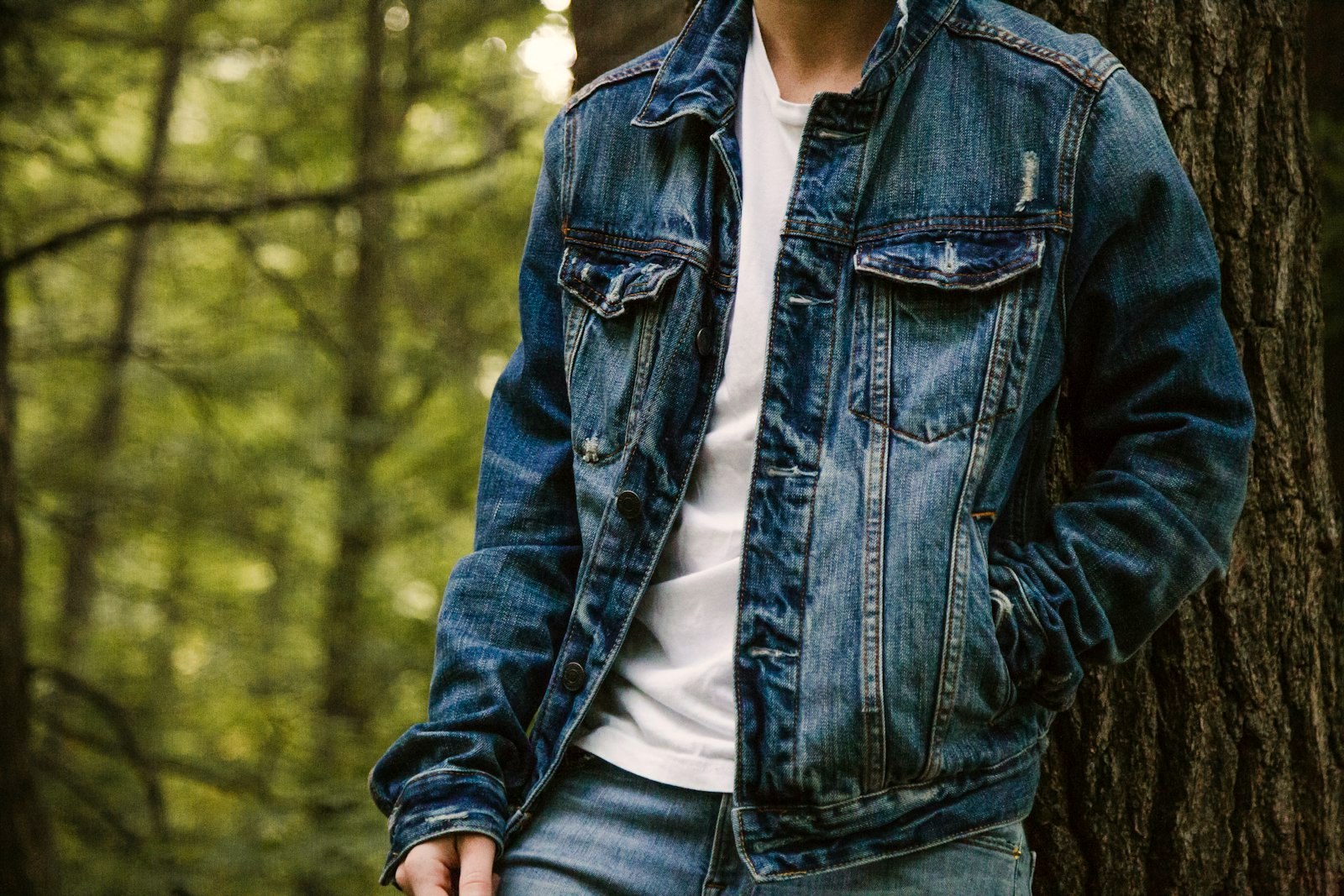
The waxed jacket's habitat, captioned as exactly that: a denim jacket in woodland, in the weather the Bedale was drawn for. Our bank holds no photograph of a waxed jacket, worn or folded, so no frame on this page is captioned as one. The ranking below is built from published cloth weights, the makers' own service pages, and the one Barbour garment this site had already scored.
Checked and updated October 2026
The verdict, up front: the anchor does not win its own page, and the reason is printed in the rows rather than discovered at the till. Filson keeps its standing 85 and its rows from the Carhartt page: the heaviest cloth in the field and a lifetime guarantee. Barbour had no standing brand score on this site, so it is derived in the open at 81: a 6-ounce Sylkoil cloth published to the ounce, a bench at South Shields, and the repair and re-waxing service the whole category copied, docked for a range whose edges do not publish what its classics publish. Peregrine is derived at 76, 8 ounces of named Millerain cloth made in England at Bedale money. Flint and Tinder is derived at 74 and Tom Beckbe at 72. Belstaff is derived at 70: the other founding house of the waxed jacket, now selling a membrane behind the wax at nearly twice the anchor's price. The skip is Zara at 48, keeping its standing score: its own product names say waxed-effect, and an effect is not a wax.
What people actually want from Barbour
Nobody searches for brands like Barbour because they need a jacket. They search because Barbour sells a kind of purchase that is disappearing: the maintained purchase. A Bedale designed in 1980 and still in the catalogue, largely unchanged. A cloth whose weight is printed on the product page, 6 ounces of Sylkoil waxed cotton, applied, in the maker's words, to cotton straight from the loom. And behind the garment, a standing offer no other category of clothing makes: send it back, at any time, and the house that made it will re-wax it, repair it or alter it, on benches it publishes turnaround times for. The want is a jacket bought once and serviced for decades, from the house that invented the arrangement.
The ceiling is real, and this page names it before the anchor's card can be accused of hiding it. The classics are a fraction of a range that now runs to fashion collaborations, quilted nylon and logo product, much of it imported and little of it published to the classics' standard. And the one Barbour garment this site had scored before today is a warning from inside the house: a burnished leather glove sent home at 54 in our gloves ranking, convicted on a leather line that names no animal. So the alternatives below are graded on the three tests this search is really asking. Is the cloth published: the mill named, the weight printed in ounces, or adjectives where the specification should be? Is the finish renewable: a wax that can be dressed again, or a coating that wears off and takes the garment with it? And is the service staffed: a repair bench with published terms, or a returns window? Heritage is a service ledger or it is a costume. Every house below is graded on which of the two it is selling.
How the scores work
Every brand here is scored on the house basis for this series: fabric and cloth out of 30, construction and craft out of 20, fit range and sizing honesty out of 20, value out of 15, longevity out of 15. Two scores on this page are standing scores, because a score that changes from page to page is marketing: Filson's 85 arrives with its rows already printed, on the Carhartt page, and Zara's 48 stands across this series with its rows set. The anchor had no standing score, so this page does to it what this series does to anchors in that position: it derives the number in the open, from the published record, and prints the arithmetic. Four more scores are new on this page and derived in the open on their cards: Peregrine at 76, Flint and Tinder at 74, Tom Beckbe at 72 and Belstaff at 70.
The derivation of the anchor, then, from its record. Barbour's published cloth story is the strongest in this category and it is printed by the maker, not inferred by us: the Bedale and the Classic Bedale are 6-ounce waxed cotton, the Classic in Sylkoil with its matte finish, the standard in the dress wax the trade calls thornproof, and the maker's own guide prints the distinction, the weights and the method, wax applied to cotton straight from the loom. Fabric 24: docked below Filson's 27 because 6 ounces is a midweight shell beside tin cloth and Mackinaw wool, and docked again because the discipline lapses at the range's edges, where a leather glove can be sold on the words fine, yet durable leather with no animal named, a datum this page charges once, at its weight, neither hidden nor inflated. Construction 16: the classics are handmade at the maker's Simonside factory in South Shields, 36 people touching a jacket built from 160 parts in the Bedale's case; against that stands a wider range substantially made overseas, its own retail listings printing Imported on current wax styles, so the bench is real and partial. Fit 15: the Bedale's product page runs sizes 30 to 52 in two-inch steps, a genuine library, and the classic cuts are honestly described, relaxed fits drawn for riding and layering; the boxiness is the design, printed rather than disguised. Value 12: the Bedale at $425 and the Beaufort at $450 are the reference prices of the entire register, the figures every rival on this page is priced against; docked for the system pricing that sells the liner and the hood separately, and for the collaboration tax, a long Bedale with a Paris label at €799.95 in a current retail listing. Longevity 14: the service ledger below is the field's founding document and the maker still staffs it, a United States repair department and the South Shields bench between them handling, by the maker's account, some 13,000 jackets a year; the missing point is charged in the open, and it is the instrument's form. Filson's promise is a guarantee. Barbour's is a price list, quoted after inspection and paid by the owner, however good the work. Add them: 24, 16, 15, 12, 14. The brand score is 81, derived from the record up.
Three names are answered in the open rather than ranked. Private White V.C., the Manchester maker whose factory also produces for half the names in this category, is the connoisseur's answer and is rested on a point of taxonomy this page exists to enforce: its Twin Track is Ventile cotton with a water-repellent finish, not a waxed cloth, a distinction its own chroniclers print. The desk does not grade a house down for a claim it never made, and it does not grade it here at all; if you want the Manchester bench without the wax, that is the door, at luxury prices. L.L.Bean keeps its standing 87 from the L.L.Bean page of this series, where its record is audited in full; the catalogue's centre of gravity is flannel, canvas and the boot rather than waxed cotton, so it is rested here with its number untouched. And the working rider's oilskin, Outback Trading's 12-ounce dusters at about half a Beaufort's price, is printed as the field's budget evidence rather than seated: a long riding coat is a different garment class from the jackets this page grades, and its cloth is honestly published, which is more than the skip below can say. The fast-fashion waxed imitation is answered the same way: its brand number is a living derivation maintained on the H&M page of this series, and this page does not borrow it, restate it or re-derive it. Its method here is the category's method everywhere: the Bedale's silhouette and the corduroy collar, printed on cloth that publishes no weight, under a finish that cannot be renewed.
The service ledger, quoted from the houses' own pages today, is the spine of the ranking, so it is printed before the cards. Read down the instrument column and the ladder below explains itself.
| House | The instrument, as published | The term |
|---|---|---|
| Filson | A lifetime guarantee against failure of materials and workmanship, backed by a working repair service, under the founder's sentence: "We guarantee every item purchased from us. No more, no less. Your satisfaction is the sole purpose of our transaction." | The product's life |
| Barbour | The maker's own service page: customers may return a jacket "at any time to be re-waxed, repaired or altered", a re-wax is recommended annually depending on wear, and the turnaround targets are published, seven business days for a re-wax in the quiet season, six to eight weeks for heavy repairs at the peak. | No expiry; the work is quoted and paid |
| Peregrine | Re-waxing guidance published and the jackets built to take it, an 8-ounce cloth that, in the trade's phrase, only gets better every time you re-wax it. No repair department is published. | The owner's own hands |
| Tom Beckbe | Reproofing wax sold by the maker and full care instructions printed on the product page itself, down to the warning against hot water and dry cleaning. No repair service is published. | The owner's own hands |
| Belstaff | The current Trialmaster's waterproofing is done by a Miporex membrane behind the wax finish, with D3O armour certified at AA under EN17092. A membrane cannot be re-waxed back to life. | The membrane's life |
| Flint and Tinder | A re-waxable exterior, printed in the maker's own product copy, behind a retailer's returns and exchange policy. No bench, no service department. | A retail policy |
| Zara | Nothing is published: no wax, no weight, no service, no repair. The finish is described by the maker as an effect. | The season |
Seven brands like Barbour, ranked
Filson
US price at last check: the Wool Jac-Shirt $349 at the maker's store; the Mackinaw Wool Cruiser about $550.
Keeps its standing 85 and its rows from the Carhartt page of this series: the heaviest cloth in the field and a lifetime guarantee, at two to four times the anchor's prices.
Filson wins this page the way it won the L.L.Bean page: on weight and on paperwork. C.C. Filson opened in Seattle in 1897 to outfit prospectors heading for the Klondike, and the house has never entirely stopped designing for them: tin cloth, a waxed canvas finished until it sheds water like a roof, Mackinaw wool woven to a density modern mills rarely attempt, bridle leather from Wickett & Craig in the bags. Its waxed entry, the lined Tin Cloth Cruiser at about $429, is the heavier shell beside the Bedale's 6 ounces, and its guarantee is the strongest instrument in the ledger above, a lifetime promise against failure of materials and workmanship with a repair department behind it that darns, rebinds and resets hardware on garments decades out of production. Its garment evidence here matches the brand: the Rugged Twill briefcase won our bags ranking at 86, and its waffle henley won the henley ranking at 84.
What the win means for the anchor is worth printing plainly, because it is the page's whole argument in one comparison. Barbour invented the service this category runs on: the standing offer to take the jacket back, re-wax it and rebuild it, decades after the sale. Filson took that idea and gave it the stronger legal form, a guarantee, and the heavier cloth. The four points between 85 and 81 are exactly that distance, no more and no less: the anchor's service is a quoted price list where the winner's is a covenant, and the anchor's standard cloth is 6 ounces where the winner's is tin. The deduction on this card is the standing one, value 9: the Cruiser costs what the Bedale costs before the argument starts, and the range above it runs to two and four times the anchor's prices. Buy the tin cloth if the jacket is for weather and decades. The house is built to receive it back.
Barbour
US prices at last check: the Bedale $425 and the Beaufort $450 at the maker's store.
The anchor, derived in the open on this page at 81: the house that invented the maintained jacket, graded on whether it still runs the service it invented.
The case for the anchor is its machinery. J. Barbour & Sons was founded in 1894 in South Shields, on England's northeast coast, importing oilcloth for people who worked outdoors in bad weather, and it remains a family house holding three Royal Warrants. The Bedale, designed by Dame Margaret Barbour in 1980 as a riding jacket, is still sewn at the Simonside factory the house moved to in 1981: a shorter length, rear vents, a nylon drip strip, a corduroy collar, and the 6-ounce Sylkoil cloth whose specification the maker prints on the product page rather than in the advertising. Around the garment stands the arrangement this page's ledger prints in the maker's own words: return the jacket at any time, and it will be re-waxed, repaired or altered, with the turnaround targets published by season and a Re-loved programme reselling the jackets the service restores. No other house in this category offers the full circuit, manufacture, maintenance and resale, under one roof it has occupied for over a century.
The deductions are the derivation's, printed rather than whispered. The bench is partial: the classics are handmade in South Shields and much of the modern range is not, and the fashion end of that range, the collaborations and the quilted rails, does not publish cloth the way the classics publish Sylkoil. The glove this site sent home at 54 is charged in the fabric row as what it is, one garment whose leather line names no animal, evidence that the publishing discipline the classics are graded on is a classics discipline, not yet a house discipline. And the service, for all its staffing, is a price list: the work is quoted after inspection and paid by the owner, which is why longevity stands at 14 under a rival's guarantee of 15. Buy the Bedale or the Beaufort, register the purchase in your mind as a thirty-year arrangement, and use the service the year the creases start drinking rain. It is the original of the species, and on the evidence of its own pages, it is still running.

Peregrine
US price at last check: the Bexley $440 at the maker's store.
Derived in the open on this page: a Manchester mill family selling the anchor's recipe at the anchor's price, in a heavier cloth, without the anchor's service department.
Peregrine is the answer the search is actually looking for, hiding in plain sight. The firm behind it, J.G. Glover of Manchester, has been family-run since 1796, which makes the anchor the younger house by ninety-eight years, and its flagship Bexley jacket is built the way the recipe reads: an antique 8-ounce waxed cotton from British Millerain, the mill named, two ounces heavier than the Bedale's standard cloth, with solid brass hardware and a tartan-checked sibling in Halley Stevensons cloth, made in England in the firm's own factory. The derivation grades that file. Fabric 23: the named mill and the published 8 ounces, docked because the line is one cloth story deep where the anchor publishes a ladder of weights and finishes. Construction 17: English manufacture in the maker's own mill building, small runs, hardware that is metal where the fashion end of this category uses plastic. Fit 13: slim modern cuts honestly drawn, a narrower library than the anchor's numbered chest sizes. Value 12: $440 for 8 ounces of England-made Millerain cloth is Bedale money for heavier goods, the fairest exchange on this page. Longevity 11: the mill's two centuries are real and the jackets are built to be re-waxed for decades; what does not exist is a repair department, so the ledger is a tin of wax and the owner's own hands. Add them: 23, 17, 13, 12, 11. The brand score is 76.
Read the 76 correctly: it is the highest score on this page that a first-time buyer can act on without an asterisk. It beats the famous moto house below it by six points on cloth weight, origin and price, and it loses to the anchor on exactly one thing, the service, which is the thing the anchor invented. If the jacket will be worn hard and re-waxed at home, the Bexley is the buy the ranking points to. If the jacket will be sent away to be maintained by the people who made it, that is a Barbour arrangement and Peregrine does not pretend otherwise, which is itself worth points this page cannot give it in the rows.

Flint and Tinder
US price at last check: the Flannel-Lined Waxed Trucker $298 at Huckberry.
Derived in the open on this page: the cheapest jacket here, seated as the test of whether the word waxed means anything at $298. It does.
This card exists to grade a claim. The attainable end of the waxed market is where the word usually goes to die, in coated cloth and printed finishes, so the desk put the best-known attainable jacket through the page's three tests and prints the results in order. Is the cloth published? Yes, completely: a 7-ounce Martexin Original Wax sailcloth from Fairfield Textile of Bridgeton, New Jersey, a mill weaving weather cloth since 1930, named in the product copy with the finish named beside it. Is the finish renewable? Yes: the shell is waxed on both sides and the maker's copy prints re-waxable as a property of the garment, not a hope. Is it made where the story says? Yes: cut and sewn in Los Angeles from American cloth. The derivation follows. Fabric 21: a real, named, published waxed cloth, docked because 7 ounces of trucker sailcloth is a lighter garment class than the field coats above it and the lining is a polyester blanket cloth. Construction 15: one Los Angeles factory since the jacket's launch, by the retailer's account. Fit 17: extra small to 3XL with tall sizes published, the widest library on this page. Value 13: $298 is the lowest price here for a wax claim that survives audit in full. Longevity 8: a retailer's house label, barely a decade into its story, with no bench and no service ledger behind the cloth. Add them: 21, 15, 17, 13, 8. The brand score is 74.
Sit with what the arithmetic just did, because it is the page's second argument. A $298 trucker from a retailer's own label outranks two houses founded on this cloth, one of them a century old and twice its price, and it does so without a single courtesy point: the rows are published above and the reader can re-derive them. What it cannot do is be maintained by its maker, and the longevity row of 8 is that fact priced. The jacket is the honest floor of the category: everything the word waxed promises, at the lowest price the promise can currently be kept for, with the service left as an exercise for the owner.
Tom Beckbe
US price at last check: the Tensaw $495 at the maker's store.
Derived in the open on this page: the anchor's recipe rebuilt in Alabama, heavier cloth and a modern pattern, from a house a decade old.
Tom Beckbe is what the Barbour want becomes when an American sporting house rebuilds it without nostalgia. The Tensaw, its flagship, is specified the way this page wishes every jacket were specified, on the maker's own product page: a durable, weatherproof 8-ounce waxed shelter cloth, and the mill named in the description, Halley Stevensons of Scotland, the Dundee house that has waxed cotton since the nineteenth century. Around the cloth, a pattern drawn for the field rather than the high street: set-in sleeves, gusseted underarms, a bi-swing back, a stand collar lined with Bedford corduroy, bellows pockets and a hidden Napoleon pocket, made in the U.S.A. with imported materials, in the maker's own words. The derivation: Fabric 22, the heaviest published cloth in the American half of the field with its mill named, docked for a line one cloth deep. Construction 16: American manufacture and a published movement pattern, a step below the benches with a century of jackets behind them. Fit 15: a classic fit with tall sizes published on the product page, two inches of length and one of sleeve, the anchor's own trick learned well. Value 10: $495 is $70 over the Bedale, and the cloth and the pattern carry most of it. Longevity 9: the house is barely a decade old, founded in Birmingham, Alabama; it sells reproofing wax and prints full care instructions on the product page, which is the right beginning, and there is no repair bench and no fleet of thirty-year-old jackets yet, which is the honest end of the row. Add them: 22, 16, 15, 10, 9. The brand score is 72.
The buy is the pattern. A reader who shoots, fishes or works out of a jacket, and who has always found the Bedale's riding cut a compromise, is the reader the Tensaw was drawn for, and the rain tests the sporting press has run on it say the shelter cloth keeps weather out at the shoulders where waxed jackets usually fail. What the 72 asks in return is faith: the ledger is a promise a young house has not yet had the decades to keep. The cloth is published, the maker is named and the wax can be renewed at home. On this page's tests, that is already more than the famous name below it currently offers.

Belstaff
US price at last check: the Trialmaster about $675 at the maker's US store; £595 in the UK, cut from £650.
Derived in the open on this page: the moto branch of the founding family, graded on what its own specialist retailers publish about the current jacket.
The history first, because this card only makes sense against it, and it is better than the marketing. The long, four-pocket, belted waxed jacket was born as a Barbour garment: the one-piece Ursula suit Barbour made for U-class submarine crews, cut down into a jacket at a submariner captain's request, and Belstaff, founded in Staffordshire in 1924, carried the pattern into the motorcycle trials world, where the Trialmaster of 1948 became the species' other founding document. Two houses, one pattern, a century of rain. The derivation grades the current Belstaff against that inheritance. Fabric 22: the cloth is still British Millerain after decades, now the lighter Ultracore wax cotton at 8 ounces, and the specialist retailer's own description prints the quiet change underneath the name: the current outer is a mix of cotton and polyester, and the waterproofing is done by a Miporex membrane behind the wax. The cloth story is published, which earns the row; it is no longer the whole story, which caps it. Construction 15: the 1948 pattern is a genuine bench design, belt, throat latch and football shoulders, now carrying D3O armour certified at AA under EN17092; production has long since left the Staffordshire factory, and the jacket is built as much for the pavement café as the trials section. Fit 13: a long, belted body that its own retailers warn can swamp a shorter frame. Value 7: £595 in the UK, cut from £650, and about $675 in the United States, half again to near double the Bedale for the same species of garment; the difference buys the belt, the badge and the photograph of Steve McQueen, who, the record should note, wore the anchor's International for the American team in 1964. Longevity 13: a century of trading through a procession of owners, from the founding family to Italian buyers in 2004 to its present home inside the INEOS group, the Trialmaster in continuous production since 1948 and its cloth re-waxable for decades; docked because the service is a retailer's favour where the anchor's is a published department with turnaround targets. Add them: 22, 15, 13, 7, 13. The brand score is 70.
None of that makes the Trialmaster a bad jacket; at the current cloth it is a better riding jacket than it has ever been, lighter, armoured and properly waterproof in the modern sense. What the 70 grades is the distance between the name's implication and the garment's paperwork. A waxed jacket whose waterproofing is a membrane is a membrane jacket wearing wax as a finish, and a membrane cannot be re-waxed, repaired by a bench or handed down in working order when it delaminates. The anchor above it sells the older technology at half the price with the service to maintain it forever. Belstaff sells the newer one at a premium with a famous silhouette. Readers who ride will know which they need. Readers who want the heritage garment should read the rows.
Zara
US prices at last check: the waxed-effect pocket jacket $179 and the waxed-effect relaxed jacket $149 at the maker's store.
The skip, keeping its standing 48 and its rows from across this series: the waxed look, sold under a name that confesses it.
Every other card on this page had to be researched. This one's conviction is printed on the maker's own website, in the product names themselves: waxed-effect pocket jacket, waxed-effect relaxed fit jacket, a whole rail of them at $149 to $179. The descriptions complete the sentence the names begin. The cloth story, in full, is cotton fabric with a waxed-effect finish. No mill is named, because there is no mill story. No weight is published, because the cloth is not the product. No wax is specified, because, by the maker's own wording, there is an effect where the wax should be. The rows are the house's standing rows, reproduced exactly as this series prints them: fabric 13, construction 8, fit 15, value 9, longevity 3, and it is the last of them that this page exists to explain. A waxed jacket's longevity is a mechanism: the finish wears, the finish is renewed, the garment continues. An effect has no mechanism. When the coating dulls at the creases and the rain starts coming through, there is nothing to dress, nothing to send anywhere, no bench, no tin, no service page, because the garment was never the substance the silhouette advertises. It was a picture of it.
Set the two documents side by side and the skip argues itself, the way the skip argued itself on the L.L.Bean page with a guarantee. The anchor's service page offers to take its jacket back at any time, forever, and publish how long the work will take. Zara's product page offers a jacket named for the appearance of that arrangement's raw material. Between them sit five houses that publish a mill, a weight or a bench. This page's tests were not invented to convict Zara; they are the tests the category itself runs on, cloth, finish, service, and Zara fails them in its own words, at prices that reach a third of the way to a Bedale. Buy the shape if the shape is what you want, eyes open, as a fashion jacket with a season in it. Do not buy it as a waxed jacket. The maker, to its credit, never quite said it was one. The word effect is the most honest word on this page, and it is printed by the skip.
The pattern under the ranking
Read the ladder as one argument about what a waxed jacket is. The top of the page answers with machinery: cloth at 27 with a lifetime guarantee, and the founding service itself, staffed, published and priced, at 81. The middle answers with specification: two small makers, one in Manchester and one in Alabama, printing a mill's name and an ounce weight on the product page and taking their scores on the strength of it, and a retailer's house label at $298 proving that the full specification can be published at the bottom of the market as well as the top. The famous name answers with a membrane. And the bottom answers with a word, effect, printed in its own product names. The scores are that argument measured seven times: in this category, the product is a cloth and a service, and everything else is a photograph of them.
The second pattern is the quiet substitution, and it has a direction. Barbour's cloth story has not changed in the buyer's favour or against it: 6 ounces, named finishes, the same bench. What has changed around it is the meaning of the word waxed as the category's centre of gravity moved from service to surface. The Trialmaster's waterproofing migrated from the wax to a membrane while the name stayed on the door. The fashion rail's finish migrated from a substance to an effect while the silhouette stayed in the window. Neither migration was announced, because neither needed to be: both are printed, in the specialist retailer's fabric line and in the product name itself, for any reader who reads the specification instead of the story. That is the whole method of this page, and of the series it belongs to. The makers publish the truth. The scores are what happens when somebody adds it up.
| Brand | Score | The piece to buy | Price |
|---|---|---|---|
| Filson | 85 | The Lined Tin Cloth Cruiser | About $429 |
| Barbour | 81 | The Bedale | $425 |
| Peregrine | 76 | The Bexley | $440 |
| Flint and Tinder | 74 | The Flannel-Lined Waxed Trucker | $298 |
| Tom Beckbe | 72 | The Tensaw | $495 |
| Belstaff | 70 | The Trialmaster, if you ride | About $675 |
| Zara | 48 | None | $179 |
The Skip · 48/100
Zara. The jackets are named waxed-effect by their own maker, and the description completes the confession: cotton fabric with a waxed-effect finish. No mill, no weight, no wax, and nothing to renew when the effect wears off, because an effect is not a substance. The silhouette is a century old. The finish is a season long. This page does not pay waxed-jacket money for a resemblance.
Which one to buy
Buy the cloth and the covenant: Filson (85), the tin cloth, and use the repair service when the decade asks.
Buy the original arrangement: Barbour (81), the Bedale or the Beaufort, and send it home for wax when the year asks. Buy the recipe at the price: Peregrine (76), the Bexley, 8 ounces of named Millerain cloth made in England. Buy the honest floor: Flint and Tinder (74), the waxed trucker, the full specification at $298, and re-wax it yourself. Buy the field pattern: Tom Beckbe (72), the Tensaw, for the shoulders and the movement built into it. Buy it if you ride: Belstaff (70), the Trialmaster, armour and membrane, eyes open about which technology is keeping you dry. The rest of the family: brands like L.L.Bean, brands like Carhartt, brands like H&M, and the membrane side of the weather argument, ranked in our rain jackets Verdict Card.
Questions, answered
What brand is most like Barbour?
Peregrine, at 76 out of 100 in this ranking: the same recipe read off a smaller label, an 8-ounce British Millerain waxed cotton where the anchor's standard cloth is 6, made in England in the firm's own Manchester factory, and priced at $440, inside fifteen dollars of the Bedale. The step up is Filson at 85, heavier cloth and a lifetime guarantee at two to four times the price. The anchor itself is derived in the open at 81 on this page, from its published Sylkoil record and its repair ledger. The honest summary: nobody here beats Barbour at being Barbour; the argument is about which part of the recipe you want more of, the cloth, the service or the saving.
Is Barbour worth it?
At the classics, yes, and the record is why. The Bedale at $425 is sewn at the maker's South Shields bench from a 6-ounce Sylkoil cotton whose weight is printed on the product page, and behind it stands the service this page's ledger prints: the jacket can be returned at any time to be re-waxed, repaired or altered, with published turnaround targets and some 13,000 jackets a year passing through the maker's benches. The derivation on this page lands the house at 81. The caveats are printed there too: the liner and hood are sold separately, the fashion end of the range does not publish what the classics publish, and the one Barbour garment this site had ranked before today, a leather glove at 54, was sent home for a leather line that names no animal. Buy the classics for the cloth and the service. Read the rest of the catalogue the way you would read anyone else's.
Barbour or Filson: which waxed jacket should I buy?
The scores print the split: Filson 85, Barbour 81, and the four points are cloth and covenant. Filson's tin cloth is the heavier shell and its guarantee is a lifetime promise against failure of materials and workmanship, the strongest instrument on this page; its lined Tin Cloth Cruiser runs about $429. Barbour's 6-ounce Sylkoil is the lighter, more wearable cloth, its bench service is the original of the species, and the Bedale at $425 is the reference price of the whole register. If the jacket is for weather and decades, buy Filson and register it as furniture. If it is for wearing, in town and country, three seasons a year, buy the Bedale and send it home for wax when the year asks. Both houses will still be answering for the garment when the fashion in this category has changed twice.
How long does a Barbour jacket last, and what does re-waxing do?
Decades, if the wax is kept up, and the maker's own service page is the evidence: Barbour recommends a re-wax annually depending on wear, accepts jackets back at any time for re-waxing, repair or alteration, and publishes its turnaround targets, seven business days for a re-wax in the quiet season and six to eight weeks for heavy repairs at the peak. The wax is the garment's waterproofing; as it dries and wears at the creases, rain stops beading and starts soaking, and a fresh dressing restores the finish and darkens the cloth back toward its first colour. The maker reports some 13,000 jackets a year through its repair and re-wax benches, which is the number that separates a service from a slogan: the ledger is staffed.
Why is Zara the skip?
Because its own product names confess. The jackets are called waxed-effect, and the maker's descriptions print the whole cloth story in one phrase: cotton fabric with a waxed-effect finish. No mill is named, no weight is published, no wax is specified, and there is nothing to re-wax when the finish wears, because an effect is a surface treatment, not a substance that can be renewed. Every other house on this page publishes the cloth and the service behind it; Zara publishes a resemblance, at $149 to $179, priced like a jacket and specified like a finish. The house keeps its standing brand score of 48 here, with its rows as printed across this series: fabric 13, construction 8, fit 15, value 9, longevity 3. Buy it as a fashion jacket if the shape is what you want. Do not buy it as a waxed jacket. By the maker's own wording, it is not one.
How this ranking stays honest
Two scores on this page are standing scores, reproduced with their rows exactly: Filson's 85, set on the Carhartt page of this series, and Zara's 48, printed across the series since its own page. The anchor's 81 is new, derived in the open in the method section above from the maker's published record, and it is labelled as a derivation wherever it appears; the four other new scores, Peregrine 76, Flint and Tinder 74, Tom Beckbe 72 and Belstaff 70, are derived in the open on their cards, each open to re-derivation when a garment from those houses is ranked here. The one Barbour garment previously ranked on this site, the burnished leather glove at 54 in the gloves ranking, is a garment score and is used on this page only as what it is, a single charged datum inside the anchor's fabric row; no garment number is used as a brand score anywhere on this page, and no brand number is borrowed from a garment. The service sentences in the ledger were read from the houses' own published pages at this check: Barbour's re-wax and repair page, with its United States repair address and its turnaround targets; Filson's guarantee as printed in this series; the Beckbe product page's care instructions and reproofing offer; and the Zara product names and descriptions as the maker's United States store prints them today. Prices were read from the makers' own stores or their national retail listings at this check, as the cards print them: the Bedale at $425 on the maker's United States page, the Tensaw at $495 on the maker's page, the Trialmaster at £595 at its specialist retailer with the United States figure stated as approximate, because the two United States listings read at this check disagree and the disagreement is recorded in our files rather than resolved by preference. The doors are what they are and are named: Barbour, Filson and Tom Beckbe link to exact product pages at their makers' stores, Tom Beckbe's being the maker's own listing; Belstaff and Flint and Tinder link to exact product pages at retail listings carrying the makers' own copy, the specialist motorcycle retailer and the national sporting retailer respectively; Peregrine links to its maker's storefront, the one homepage door on this page, because no product page for the Bexley surfaced in our checks and the desk does not guess at addresses. The photography is this magazine's licensed bank photography throughout; no brand's campaign imagery is used, the bank holds no photograph of a waxed jacket, and the hero caption says so. When a maker changes cloth, price, service or model materially, the score moves and the move is noted here.