
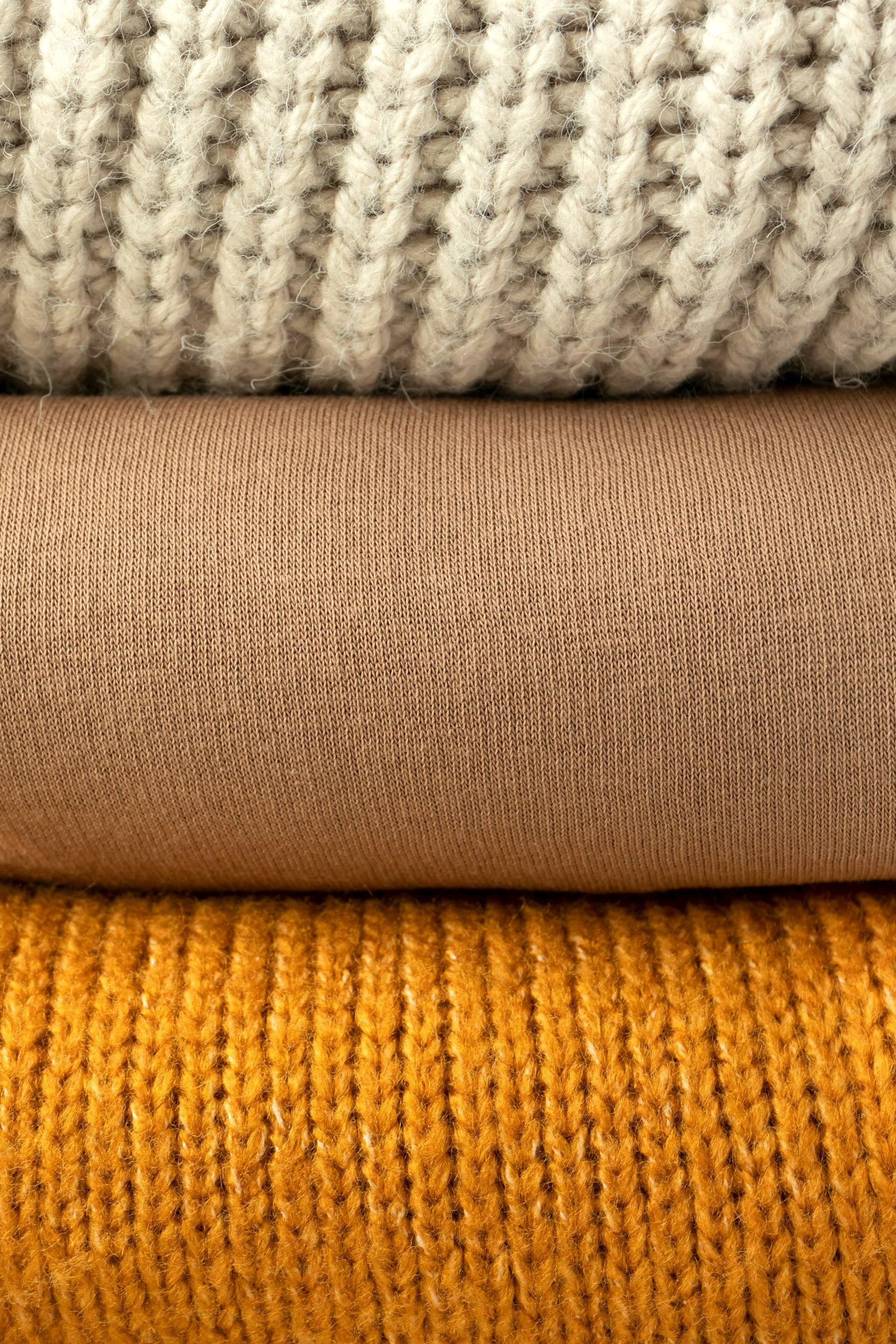
The subject of this page is cloth: knitted jersey at macro range, a chunky rib, a fine jersey and a rib again, the weights and weaves the ranking grades. Our bank holds no photograph of a base layer, worn or folded, so no ranked top is pictured anywhere on this page and no frame here is captioned as one. The honesty section prints the gap and the harvest list.
Checked and updated October 2026
The verdict, up front: seven base layer tops scored out of 100 on cloth 30, construction 20, fit 20, value 15, longevity 15, plus the fashion thermal sent home. The Icebreaker Merino 200 Oasis Crew wins at 82: not because its wool is magic, but because its maker publishes the complete claim set on the product page, 200 g/m2 of cloth, 100 percent merino, an 18.9-micron fibre, flatlock seams and offset shoulders, and charges $120 for a garment a buyer can fully check before buying. The Smartwool Classic Thermal is second at 80, the heaviest pure merino in the field at 250 g/m2, and it is charged in the open for the one figure it withholds: no micron appears in its product copy. And the top sent home, at 32, is a $125 waffle crewneck whose maker's page publishes no fibre line and no weight, at the exact price of the merino standard. It is late October. The layer against the skin is the foundation the whole winter system stands on, and this is the garment graded on the specification it makes about itself.
First, know what a base layer claims to be
A base layer is a promise worn against the skin, and this page grades the promise before the garment. The promise has three parts, and a maker can publish or withhold each one. The weight: the cloth in grams per square metre, the only warmth figure that compares across brands, published as a product name by Icebreaker, as a specification by Smartwool and Ridge, and withheld entirely by two makers in this field. The fibre: what the cloth actually is, merino, a nylon-cored blend, recycled polyester, an acrylic-rayon recipe, with the split printed or left as a brand word, HEATTECH, Capilene, behind which the recipe may be excellent and is partly unpublished. And the fineness: the micron, the wool fibre's diameter, the number that decides whether wool against skin reads as comfort or as a hair shirt, printed by three makers here and withheld by the most expensive merino in the field. Every card below reads the promise first and the garment second. The silences are not gaps in this page's research. Read as a set, they are the research.
Two boundaries, drawn in the open. This is not the undershirt ranking: Verdict Card No. 31 grades a garment worn for a different job, a modal layer built to disappear under a shirt and stay tucked doing it. A base layer is graded to manage heat and sweat as a system's foundation, and half the tops below are cut to be seen and worn alone in cold rooms and on cold starts. And the merino in this site's knitwear rankings, the crews of Verdict Card No. 10 and the knits of No. 42, stands as evidence of what the fibre does at sweater gauges; no sweater score is transferred to a skin layer here, because a base layer is a different garment worn for a different job, and this desk does not move numbers between jobs.
The physics, briefly. A base layer does three things: it moves liquid sweat off the skin, it holds a layer of still air in its knit, and it manages what the first two make inevitable, smell. Wool performs the first by absorbing vapour into the fibre itself, up to roughly a third of its weight before it feels wet, and insulates while damp, which no synthetic matches. Polyester performs it by moving liquid along the fibre's surface and drying in a fraction of the time, and insulates barely at all when wet. The knit is the insulation in both cases: the air in the cloth does the warming, which is why the weight of the cloth, the amount of knitted air a maker is selling you, is the figure this page grades first.
How the scores work
Every top is scored out of 100 on the same five rows. Cloth (30) reads the published specification as a claim: a printed fabric weight scores, a printed micron scores, a printed fibre split scores, and a brand word standing where the figures should be is scored as the word it is; the odour behaviour of the fibre class is read here too, as a property or as a treatment. Construction (20) reads the seams and the systems: flatlock against raised seams under straps and layers, offset shoulders, gussets, thumb loops argued rather than assumed, the zip-neck and the crew read as two venting systems. Fit (20) is the next-to-skin test: a base layer works by contact, a maker who prints a relaxed or slightly loose cut for a skin layer is scored on the admission, and the width of the size run is credited where a maker publishes it. Value (15) is the score divided by the bill, with promotional pricing printed where a maker's list price is a rumour. Longevity (15) is the fibre audit: merino's pilling and moth honesty, the blend's core, the synthetic's permanence and its smell clock, costed per season in the table below. Row scores add to the total, on every card.
The ranking
Icebreaker Merino 200 Oasis Long Sleeve Crew
The Winner
US list price at last check: $120.
Buy it as the default midweight merino. The fullest published specification in the field, a real next-to-skin cut, and the number in its name is a weight you can check.
The cloth: the maker's product page is the disclosure standard for the whole category, and it is worth reading as one: a warmth system printed as a ladder, 150, 200, 260, 300 and 460-plus grams per square metre, with this garment named for its rung; a fabric line that reads 100 percent merino wool, exclusive of decoration; and a fibre diameter printed on the same page, 18.9 microns, the figure most wool brands treat as a trade secret. The 200 weight is the versatile rung, the midweight that works from October through the spring, and the cloth row scores what the page publishes: weight, fibre and fineness, the complete set, which no other maker in this field assembles in one place. One charge, printed in the open: the cloth is pure merino jersey with no reinforcing core, and the longevity row below prices what that means under straps.
The build and the fit: flatlock seams to reduce friction, offset shoulder seams placed to sit clear of pack straps, gusseted underarms, a drop tail hem for coverage, in a slim fit the maker names as such, next-to-skin as the class requires. There are no thumb loops, and the construction row notes the absence without drama; the venting system is the crew neck, and the same cloth in a half-zip stands one rung up the maker's own ladder at $130 for the reader who wants the zip's vent. Longevity is the pure-merino clock: the jersey pills at strap lines, the fibre is the field's finest-feeling and not its strongest, and a moth can eat what polyester survives, so the garment is costed at five scored seasons, stored clean and closed, a care condition the maker prints and this page repeats as a cost of ownership.
Smartwool Classic Thermal Merino Base Layer Crew
The Heavyweight Standard
US list price at last check: $125.
Buy it for the coldest use and the longest sits. The heaviest pure merino here, cut slim and seamed like equipment, at a price that has risen across the maker's whole line.
The cloth: 250 g/m2 of 100 percent merino in an interlock knit, the heaviest pure-wool cloth in the field and the warmest foundation here, with the interlock's double face giving the jersey a density the 200 class does not attempt. The maker's certification is a sourcing standard, ZQ, printed where the fibre line stands. Now the finding this page exists to print. In the product copy read for this check, the maker publishes the weight, the fibre and the sourcing, and nowhere a micron: the fineness of the wool in the field's joint-most-expensive merino is a figure the buyer is asked to take on faith, on a page where three rivals print theirs. The cloth row scores the published 250 and the unpublished diameter together, and lands one point behind a lighter cloth whose maker prints everything.
The build and the fit: the construction is the complete cold-weather set, all of it published: flatlock seam construction, shoulder panels that eliminate the seam on top of the shoulder where straps sit, offset side seams that wrap to the front, in a slim fit the maker describes as following the contours of the body, at a listed garment weight of 276 grams in a medium. The same garment in a quarter-zip stands at $130 on the maker's store for the reader who vents. On price, the desk prints what it found rather than a rumour: the line has risen across the board, the bottoms now list at $125 where they listed at $110, one national door still showed this crew at $115 in early October, and the value row scores the $125 the maker's current range supports. Longevity is the interlock's: denser than a jersey, slower to pill, costed at six seasons, with the pure-merino moth condition applying in full.
Ridge Merino Aspect Midweight Crew
The Engineered Blend
Price at last check: $80 at the maker's store.
Buy it as the blend argument made honestly: wool's manners on a nylon spine, every figure published, at the price the big houses charge for a logo.
The cloth: 180 GSM, printed; 84 percent merino and 16 percent nylon, printed; 18.5 microns, printed; and the merino is RWS-certified with the certification number, TE-00339331, printed beside the claim, the only maker in the field who hands a reader the means to check the certificate itself. The engineering is the argument: the nylon is placed in the yarn's core, the maker's (m)Force construction, so the fibre that touches skin and manages vapour is wool, and the fibre that takes abrasion and holds the knit together is nylon, each doing the job the other is bad at. The weight is the light end of midweight, a rung below the two pure merinos above it, and the cloth row scores the class honestly: this is the high-output, three-season cloth, not the deep-winter one, and the maker's heavier Inversion line, 270 GSM in pure merino at $110, is the same house's answer when the cold is the point.
The build and the fit: flatlock seams, a backpack-friendly raglan construction that takes the shoulder seam off the strap line by geometry rather than by offset, thumb holes that keep the sleeves in place under layers, and a longer cut that stays tucked, in a fit the maker describes as close to the body, which is what the class requires. The house is a small California operation against three multinationals on this page, and its publication standard is the field's most complete relative to its size: weight, split, micron, certificate. The value row is where that lands: $80 is forty dollars under the winner for a cloth one class lighter and engineered to outlast it, and the longevity row credits the core while charging the lighter knit, five scored seasons.
Patagonia Capilene Midweight Crew
The Synthetic Standard
Price at last check: $95 at the maker's current retail listings, up from $89.
Buy it for high output and hard use. It dries before the merinos have started, it will outlast everything above it, and it will smell like it by the third day. All three facts are the fibre.
The cloth: 100 percent recycled polyester in the maker's hollow-core yarns with a diamond-grid back, the grid trapping air against the skin and the channels moving liquid off it, the most considered synthetic architecture in the field. Two charges, printed in the open. The maker's current copy leads with a recycled-content band, 50 to 100 percent depending on colour, which is a range where a figure should be, and prints no fabric weight in the copy read for this check: the house that taught this category to publish its ounces now asks for trust on the two numbers this page grades first. And the odour system is a treatment with a version history: the previous generation carried Polygiene, a silver-salt finish, and the current one carries HeiQ Fresh durable odor control. A named treatment is a checkable claim and scores as one; a finish is also a consumable with a wash count, and the smell section below prints why that distinction is the synthetic's whole story.
The build and the fit: raglan shoulder seams with a full underarm gusset, elastic thumb loops, internal neck tape, a locker loop for hang drying, Fair Trade Certified sewing, at a listed garment weight of 176 grams, the lightest full system here. The fit is this card's debit: the current cut runs looser than the class standard, and more than one long-term review of the garment notes bunching under layers, which for a garment whose job is contact is a functional charge, printed rather than discovered for you. Longevity is the synthetic's permanence, costed at seven seasons, the longest clock on the page, with the maker's repair culture behind it; what retires this garment is not the cloth, which will hold its shape for a decade, but the odour the fibre keeps, and the longevity row scores both halves of that sentence.
Minus33 Chocorua Midweight Crew
The Attainable Merino
Price at last check: $79.99 to $89.99 across the maker's doors; this card ships without a buy link, for the reason printed on it.
Buy it as the most merino per dollar in the field, sized for the bodies the other makers stop at, and read the fit line before you layer it tight.
The cloth: the maker's midweight interlock, 100 percent merino at a published 18.5 microns, Australian wool, Woolmark and RWS certified, machine washable and machine dryable by the maker's own care line, the only pure merino here whose maker lets you tumble it. One discrepancy, printed rather than resolved: the weight figure appears two ways in the maker's own ecosystem, 230 g/m2 in the line's published description and 245 g/m2 in current retail listings of this crew, and the desk prints both because picking one in the dark is how errors get published. Either figure puts the cloth within a step of the Smartwool's 250 at roughly thirty dollars less, which is the card in one sentence: the same class of cloth, the micron printed, the interlock knit, at the attainable price.
The build and the fit: flatlock seams and a tagless label, and then the honest debits. No thumb loops are published, no offset shoulder is published, and the fit is the maker's Regular, which its own fit taxonomy defines as a standard fit with a little room to breathe: room is a virtue in a mid layer and a charge in a skin layer, and the fit row scores the garment as the maker describes it, not as the category wishes it were. Against that stands the widest size library in the field, XS to 6XL with tall sizes, published by the maker while the technical houses stop at XXL: a base layer that does not exist in your size has a specification of zero, whatever its cloth. One capture note, on the card rather than buried: the maker's own store would not render this crew's page to our reader at this check, so the card ships without a buy link rather than with an unverified door, and the price band above is the band its doors printed.
Uniqlo HEATTECH Extra Warm Cotton Crew Neck T-Shirt
The Technology Claim, Graded
List price at last check: £19.90 at the maker's UK store, about $24; the maker's US page showed it at $5.90 on clearance, out of stock, as this was checked.
Buy it for the commute and the cold office, at the price of one, with the maker's own footnote read and understood. Do not buy it as an exertion layer: the skin side is cotton, and cotton is the fibre this category exists to replace.
The cloth: this is the card where the page grades a technology claim on its maker's own published terms, and the terms are more honest than the shelf talk around them. The mechanism has a name, Heat of Absorption: fibres that take up moisture release heat as they absorb it, real physics, printed in the section below with its limits. The maker's number is a ratio, approximately 1.5 times warmer than standard HEATTECH, based on CLO values, the laboratory insulation unit, which the maker's footnote names outright. What the ratio compares against is the maker's own thinnest shirt, and what the page withholds is everything this desk grades first: no fabric weight is published for the garment, and the copy read for this check describes a 100 percent cotton inner layer without printing a complete fibre split a reader can total. The brushed, cotton-faced build is genuinely warm at rest, and the skin side being cotton is the honest limitation: cotton holds the water the category exists to move. The brand stands at 84 in Brands Like No. 08 as the value benchmark, and this is that house's method at the skin: a real mechanism, a footnoted ratio, and a fibre line you have to take on trust.
The build and the fit: the maker's Ultra Stretch cloth, in sizes XS to 3XL, the joint-widest run in the field, with one admission in its own copy that the fit row scores as printed: the cotton version carries a slightly loose silhouette, offered by the maker as a virtue for wearing as a T-shirt, and read by this page as what it is in a base layer, air where contact should be. The class ladder above it is published in the same terms: standard HEATTECH at $19.90 on the maker's US store, this Extra Warm class, and Ultra Warm at $34.90, billed at approximately 2.25 times the standard on the same CLO basis. Longevity is costed at three seasons: the cotton face pills and thins, the stretch tires, and the garment's price makes the short clock a term of the deal rather than a betrayal of it.
32 Degrees Lightweight Baselayer Crew Top
The Eight-Dollar Specification
Price at last check: $7.99 at the maker's store.
Buy it by the handful as the honest floor of the category: a published recipe, a real next-to-skin fit, and a cloth thin enough that the price is the specification.
The cloth: the surprise of this ranking, and it is printed without embarrassment: the eight-dollar shirt publishes more of its specification than the technology brand above it. The recipe is printed wherever the garment is sold, 40 percent polyester, 34 percent acrylic, 22 percent rayon, 4 percent spandex, which is the HEATTECH recipe's family, acrylic and rayon doing the moisture-uptake work, polyester the frame, and Costco's listing for the same Heat cloth prints the figure Uniqlo withholds: a fabric weight, 140 GSM, the light class stated as a number. The cloth is thin, and the row scores it as thin; what the row credits is that a buyer can know it is thin before paying, which is the whole of this page's doctrine. Two charges. The anti-odor property is claimed with no chemistry named, an unnamed claim graded below every named treatment here. And the maker's pricing is a theatre its own policy page confesses: the comp values beside its prices are, in the maker's published words, a good-faith estimate of prices for comparable items, which is why this card prints the $7.99 the garment transacts at and ignores the struck figure beside it. A capture note: the maker's own page did not render its fabric block to our reader, so the split and weight above are the figures its retail doors publish for the same cloth, flagged for direct re-verification.
The build and the fit: four-way stretch, a tag-free label, and a form fit the maker publishes as the garment's design, next-to-skin as the class requires, in sizes to XXL: the fit row gives the cheapest garment here its best mark, because contact is the one specification money cannot be charged with skipping at this price. No flatlock construction is published and none is claimed on this card. Longevity is costed at two seasons and the row explains itself: the knit is a 140-weight cloth at an eight-dollar build, it will pill and thin on a short clock, and at this price the replacement is the warranty. The value row is the field's only perfect score, and it is earned arithmetically: a published split, a published weight and a true fit for the price of the winner's shipping.
RRL Waffle-Knit Crewneck
The Skip
Price at last check: $125 at the maker's store, all sizes unavailable.
Leave it. At $125 the garment should publish a specification. Its maker's page publishes a colour, a size run that is sold out, and the word waffle.
The cloth: there is no cloth claim to grade, and that is the grade. The maker's own product page, read in full for this check, offers the garment's name, Waffle-Knit Crewneck, one colour, Paper White, a price of $125, and a size run in which every size stands unavailable. No fibre line appears in the copy a buyer can read. No fabric weight appears. No warmth claim is made, no seam is described, no system is named. Set it against the field it prices itself into: $125 is the Smartwool's price, five dollars above the Icebreaker's, for garments whose makers publish their weight, their fibre and their fineness down to the micron. The waffle knit itself is an honest old mechanism, a grid of pockets that holds still air, and in a published cotton or wool at a published weight it earns its place in this category's history. Here it is a texture with a price where a specification should be, sold by a house whose clothing this site scores at 70 in Brands Like Ralph Lauren when it publishes enough to grade.
The build and the fit: the maker files the garment under its T-shirts, which is the fit row's whole evidence: a base layer is a system component with a size library and a next-to-skin cut, and this is a fashion crewneck in a seasonal drop, unavailable in every size at the check, a garment whose relationship to winter is that it was photographed near one. The longevity row gives the object its due, seven points for a heavily built fashion knit that will outlast its moment, and the value row gives the transaction its due, which is one point: at this price the buyer is purchasing the absence of information at the exact rate the field's best-documented garments charge for its presence. It ships without a buy link, the way this desk sends home the garments it convicts, and in this case the maker's own stock position has made the same decision.
The claim table: what each maker actually publishes
Every cell below is the maker's own published position at this check. Where a maker publishes nothing, the table prints the silence rather than an estimate: the silences are this page's findings, and they are printed in the same size of type as the figures.
| Top | Fabric weight, as published | Fibre line, as published | Micron published | Odour claim, as published |
|---|---|---|---|---|
| Icebreaker 200 Oasis Crew | 200 g/m2, the garment's name; the ladder printed to 460-plus | 100% merino wool | 18.9 microns, on the product page | Naturally odour resistant, a fibre property |
| Smartwool Classic Thermal Crew | 250 g/m2 | 100% merino wool, ZQ certified | None in the product copy read | Natural odor resistance, a fibre property |
| Ridge Aspect Midweight Crew | 180 GSM | 84% RWS merino, 16% nylon; certificate number printed | 18.5 microns | Odor resistant, a fibre property of the wool share |
| Patagonia Capilene Midweight Crew | None in the maker's current copy; garment weight 176 g printed | 100% recycled polyester; content given as a 50 to 100% band by colour | Not applicable | HeiQ Fresh durable odor control, a named treatment; Polygiene on the previous generation |
| Minus33 Chocorua Midweight Crew | 230 g/m2 in the line's description; 245 g/m2 in its current retail listings | 100% merino wool, Australian, Woolmark and RWS certified | 18.5 microns | Natural odour resistance, a fibre property |
| Uniqlo HEATTECH Extra Warm Cotton | None published | 100% cotton inner layer described; no complete split printed in the copy read | Not applicable | Odor control functions claimed; Heat of Absorption named as the warmth mechanism |
| 32 Degrees Lightweight Baselayer Crew | 140 GSM, published for the same Heat cloth at its retail doors | 40% polyester, 34% acrylic, 22% rayon, 4% spandex | Not applicable | Anti-odor claimed, no chemistry named |
| RRL Waffle-Knit Crewneck | None published | No fibre line in the maker's copy read | None published | None claimed |
Read the table as the ranking does. Three makers publish a micron. Five publish a weight, one of them two different weights in two of its own doors. One maker publishes a certificate number a stranger can verify. And the bottom row publishes, in total, a colour and a price.
The smell question, printed plainly
Every base layer conversation ends at odour, so this page prints the mechanism instead of the etiquette. Sweat itself is nearly odourless; the smell is bacterial byproduct, and what a fibre does with skin oil decides how much of it stays. Polyester is oleophilic, oil-loving: sebum binds to the fibre's surface, the bacteria that feed on it colonise the cloth, and their byproducts bind with the oil, which is why a synthetic base layer can smell fresh from the wash and turn by noon, the residue surviving the laundry that was supposed to clear it. Wool runs the opposite system: the fibre absorbs water vapour into its core, odour compounds travel with it, and the wash releases them, which is why a merino top can be worn for days and cleared with one wash. This is not a preference and it is not marketing; it is the two fibres' published chemistry, and it is why the multi-day answer and the high-output answer on this page are different garments.
The industry answers the polyester problem with finishes, and the finishes are graded here as what they are. Polygiene, the previous Capilene generation's system, is a silver-salt treatment that suppresses the bacteria on the cloth. HeiQ Fresh, the current generation's, is the same vendor-class answer under a newer name, sold as durable. A named treatment outranks an unnamed anti-odor claim, which is why the Capilene's odour paperwork scores and the 32 Degrees crew's bare claim does not. But a finish is a consumable: it has a wash count, it fades on a schedule the vendor does not print in the copy a buyer reads, and when it is gone the fibre underneath is the same oleophilic polyester it always was. The wool's resistance is not applied to the garment. It is the garment. That asymmetry is the cloth row's odour arithmetic, and no treatment roadmap published in this field closes it.
The heat-generation claim, graded as physics
One claim in this field deserves its own hearing, because it is the rare technology claim with a real mechanism inside it. Heat of Absorption, Uniqlo's name for the HEATTECH effect, is the heat of sorption: when a dry, water-loving fibre takes up moisture, the binding of water molecules to the fibre releases energy as heat. The effect is measurable in a laboratory, it is strongest in the most hygroscopic fibres, and its ranking is a matter of record: wool takes up the most vapour, roughly a third of its weight before it feels wet, rayon takes up a useful share, cotton less, polyester almost none, which is the same table as the odour section's, read from the other side. A HEATTECH recipe of acrylic and rayon is, in physical terms, an attempt to buy a fraction of wool's native behaviour at a fifth of wool's price, and graded as that attempt, it is a legitimate piece of engineering.
The limits are as physical as the mechanism. Sorption heat fires while the fibre is absorbing and stops when it is saturated: it is a warming of minutes at the start of wear and at the start of effort, not a furnace that runs all day, and its total energy is small against the body's own output. The maker's published number respects exactly that boundary, and the desk credits it: Extra Warm is rated at approximately 1.5 times standard HEATTECH on CLO values, a laboratory insulation ratio against the maker's own thinnest product, with the basis named in the footnote. What the number cannot do is compare across the shelf: a ratio against an unweighed house product tells a buyer nothing about the garment against 200 published grams of merino, and the absence of a fabric weight for the HEATTECH line is the silence that keeps the claim in its own league. Buy the shirt for what the physics supports, a brushed, inexpensive layer that takes the edge off a cold room and a cold commute. The section above this one explains why the exertion answer is a different fibre.
Cost per wear, printed in the open
The assumption, printed before the numbers: a base layer in rotation is worn about 50 times a cold season, October through April, commutes, workdays and weekends together. The life column is the service life our longevity row scores for, counted in seasons before pilling, thinning or the smell clock retires the garment from rotation, not a promise. The Uniqlo is costed at its UK list converted at the check, about $24, with its American clearance state printed on its card. The Minus33 is costed at the top of its published door band.
| Top | Price | Scored life | Cost per wear |
|---|---|---|---|
| 32 Degrees Lightweight Baselayer Crew | $7.99 | 2 seasons | $0.08 |
| Uniqlo HEATTECH Extra Warm Cotton | £19.90 (about $24) | 3 seasons | $0.16 |
| Patagonia Capilene Midweight Crew | $95 | 7 seasons | $0.27 |
| Ridge Aspect Midweight Crew | $80 | 5 seasons | $0.32 |
| Smartwool Classic Thermal Crew | $125 | 6 seasons | $0.42 |
| Minus33 Chocorua Midweight Crew | $89.99 | 4 seasons | $0.45 |
| Icebreaker 200 Oasis Crew | $120 | 5 seasons | $0.48 |
| RRL Waffle-Knit Crewneck | $125 | 2 seasons | $1.25 |
The table's shape is the category's economics in one view. The synthetics amortise on permanence: the Capilene's twenty-seven cents buys seven seasons of a garment whose only failing is a smell with a head start. The merinos cluster between forty-two and forty-eight cents, paying for vapour management and multi-day manners with a shorter, moth-guarded life. The 32 Degrees crew's eight cents is real and so is its 140-weight ceiling: the table prices the garment, not the warmth, and the warmth is the cloth row's department. And the skip costs a dollar twenty-five a wearing across the two seasons a fashion drop stays current, for a specification its maker never published.
The skip: RRL's Waffle-Knit Crewneck at 32
Every house rule that governs this site's rankings lands on this garment at once. The specification is absent: at $125, the joint-highest price in the field, the maker's page publishes no fibre line a buyer can read, no fabric weight, no warmth claim, no seam, no system. The category is wrong: its own maker files it among T-shirts, it is cut and sold as a fashion crewneck in a seasonal drop, and at this check every size stood unavailable, which is a stock position for a collectible and an impossibility for a layering system. And the comparison convicts it without outside witnesses: for the same $125, the Smartwool publishes 250 grams of certified merino and the architecture to wear it under straps; for five dollars less, the Icebreaker publishes its weight, its fibre and its micron on one page. The waffle knit is not the fraud; it is an honest, century-old way to hold still air, and in a published cloth at an honest price it would be ranked here like anything else. The fraud is the rate: merino money, charged for the space where a specification should be. Buy the Icebreaker and keep the five dollars. Buy the 32 Degrees fifteen times over and know exactly what you bought, which is fifteen times more than this garment tells you.
Which base layer to buy
If you buy one: the Icebreaker 200 Oasis. It is the only top here a buyer can fully verify from the maker's own page, and its 200 weight is the class that covers the most of the cold season. If the cold is serious and output is low: the Smartwool Classic Thermal, 250 grams of interlock merino, accepting the unpublished micron as the price of the heaviest cloth. If you wear a pack and wear it hard: the Ridge Aspect, the nylon core being the only durability argument in the field that is engineered rather than asserted. If you run hot and move fast: the Capilene Midweight, and launder it like you mean it. If the budget is the argument: the Minus33 for real merino at a working price, or the 32 Degrees by the handful when the job is a layer under office clothes. If your winter is a commute: the HEATTECH Extra Warm, bought as the footnoted ratio it is. The rest of the cold system is ranked and briefed too: the knits that go over these are scored in Verdict Card No. 10, the coats that close over all of it in How to Wear No. 20, and every layer in the wardrobe is mapped in the Body Map.
Questions, answered
What are the best base layers for men?
The Icebreaker Merino 200 Oasis Crew, scored 82 out of 100: the only top in the field whose maker publishes its full claim set on the product page, a 200 g/m2 fabric weight, a 100 percent merino fibre line and an 18.9-micron fibre diameter, with flatlock seams and offset shoulders, at $120. The Smartwool Classic Thermal follows at 80, the heaviest pure merino here at 250 g/m2, charged for printing no micron. The top sent home, at 32, is a $125 waffle crewneck whose maker's page publishes no fibre line and no weight at all.
What do base layer fabric weights like 150, 200 and 250 mean?
The number is the cloth's weight in grams per square metre, and it is the closest thing this category has to a warmth figure that can be compared across brands. The classes run in bands: roughly 150 to 180 is the light class, 200 to 250 the midweight class this page is built on, and 260 and above the heavy class. Icebreaker prints the ladder on its product page (150, 200, 260, 300, 460-plus) because the number is its product name. Smartwool prints 250 g/m2 for its Classic Thermal. Ridge prints 180 GSM for its Aspect. Two makers here print no fabric weight at all in the copy a buyer can read: Patagonia's current Capilene Midweight copy leads with a recycled-content band instead, and Uniqlo grades its own HEATTECH classes against each other rather than against a scale. A maker who will not weigh the cloth is asking you to buy the adjective.
Is merino or synthetic better for a base layer?
They fail in opposite directions, and the failure is fibre physics, not preference. Polyester is oleophilic: it binds skin oils, and the bacterial byproducts that carry sweat's smell bind with them and survive the wash, which is why a synthetic base layer smells sooner and keeps a background odour a merino never develops. Wool absorbs water vapour into the fibre itself, odour compounds with it, and releases them in the wash. The synthetic answers with speed and permanence: it dries in a fraction of merino's time and does not pill, hole or meet a moth. The treatments sold to close the smell gap, Polygiene's silver salt on one generation of Capilene, HeiQ Fresh on the current one, are finishes with wash counts, graded on this page as claims; the wool's resistance is a property of the fibre and does not rinse out. Buy merino for multi-day wear and low output, synthetic for high output and hard use, and blends, Ridge's nylon-core Aspect at 79 is the proof, when you want wool's manners with a synthetic's spine.
Does HEATTECH really generate heat?
The mechanism is real and the magnitude is small, and Uniqlo's own published terms let you grade both halves of that sentence. The maker's name for it is Heat of Absorption: fibres that take up moisture, rayon above all, release a small amount of heat as they absorb it, the heat of sorption, the same physics wool performs natively and better, since wool can take up roughly a third of its weight in water vapour. The effect fires while the fibre is absorbing, which is the first minutes of wearing or sweating, and then it is spent. What Uniqlo actually publishes as its number is a ratio: Extra Warm is approximately 1.5 times warmer than standard HEATTECH, based on CLO values, the laboratory insulation unit. That is a comparison against the maker's own thinnest shirt, not a warmth figure you can hold against a 200 g/m2 merino, and no fabric weight is published for the garment at all. Graded as a claim: honest physics, honestly footnoted, marketed at a size the physics does not support.
What micron count should you look for in a merino base layer?
The micron is the wool fibre's diameter, and against skin it is the difference between wool and itchy wool: the finer the fibre, the less it prickles. The published class in this field is tight and checkable. Icebreaker prints 18.9 microns on the Oasis product page. Minus33 prints 18.5 for its midweight interlock. Ridge prints 18.5 for the Aspect's RWS-certified merino and prints the certification number beside it. The notable silence is Smartwool's: the Classic Thermal's product copy certifies its wool's sourcing, ZQ, and prints no diameter a buyer can hold, at the field's joint-highest price. Fineness below about 18 microns buys softness at the cost of fibre strength, which is one reason the durable blends put their wool around a nylon core instead of simply going finer.
How long does a base layer last, and what kills it?
Each fibre class has its own clock, and this page costs them separately. Pure merino pills first, at the strap lines and the side seams, and a 200 g/m2 jersey can hole inside four to five hard seasons; it is also the only cloth here a moth can eat, so it is stored clean and closed, a care cost printed rather than discovered. A nylon-core blend stretches that clock by putting the abrasion on the core. Polyester's clock is the longest and the least graceful: the garment will hold its shape for seven seasons and more, and what retires it is the odour that no wash fully clears, the smell clock running out before the cloth does. The cost-per-wear table on this page prints the arithmetic at fifty wears a season: the eight-dollar 32 Degrees crew amortises to eight cents a wear, the $120 Icebreaker to forty-eight, and the sent-home RRL, priced like the merino standard and specified like a rumour, to a dollar twenty-five.
How this ranking stays honest
Four rests and five capture notes, printed. H&M was rested deliberately: the desk chose to grade the whole price ladder's claims rather than add a fourteenth garment to the running H&M derivation, which stands untouched on Brands Like H&M. Wool & Prince was answered by category rather than ranked: its published merino-nylon blend, 78 and 22, is a T-shirt's specification, and a tee is graded on this site's tee pages, not as a thermal system. Patagonia's Capilene Air, the seamless merino-polyester experiment, is not in the maker's current base layer line as this was checked, and this page does not rank remnants. The compression school, Under Armour's ColdGear class and its kin, was rested because a compression fit is a different garment contract from the next-to-skin class graded here. On capture: Patagonia's own product page served its queue notice at this check, so its current specification was verified across the maker's current retail listings and is flagged for direct re-verification in the November pass, as are the Minus33 crew's maker page and its two printed weights, the Smartwool crew's price across its doors, the 32 Degrees fabric block on the maker's own page, and a live American door for the HEATTECH Extra Warm Cotton, which stood at clearance in the maker's US store. On photography: the magazine's bank holds no base layer, no thermal flat lay and no flatlock seam to photograph, a gap the desk admits here rather than covering with a mislabelled picture; the hero is knitted cloth at macro range, the cards run without images, and base layer frames stand on the harvest list: a merino crew worn under an open overshirt, a flatlock seam at macro range, a waffle knit beside a jersey at the same scale. Prices and specifications were checked against the makers' own listings in October 2026; where a figure could not be verified from the maker's page, the page says so at the figure's elbow. The full method is written out on the methodology page.