
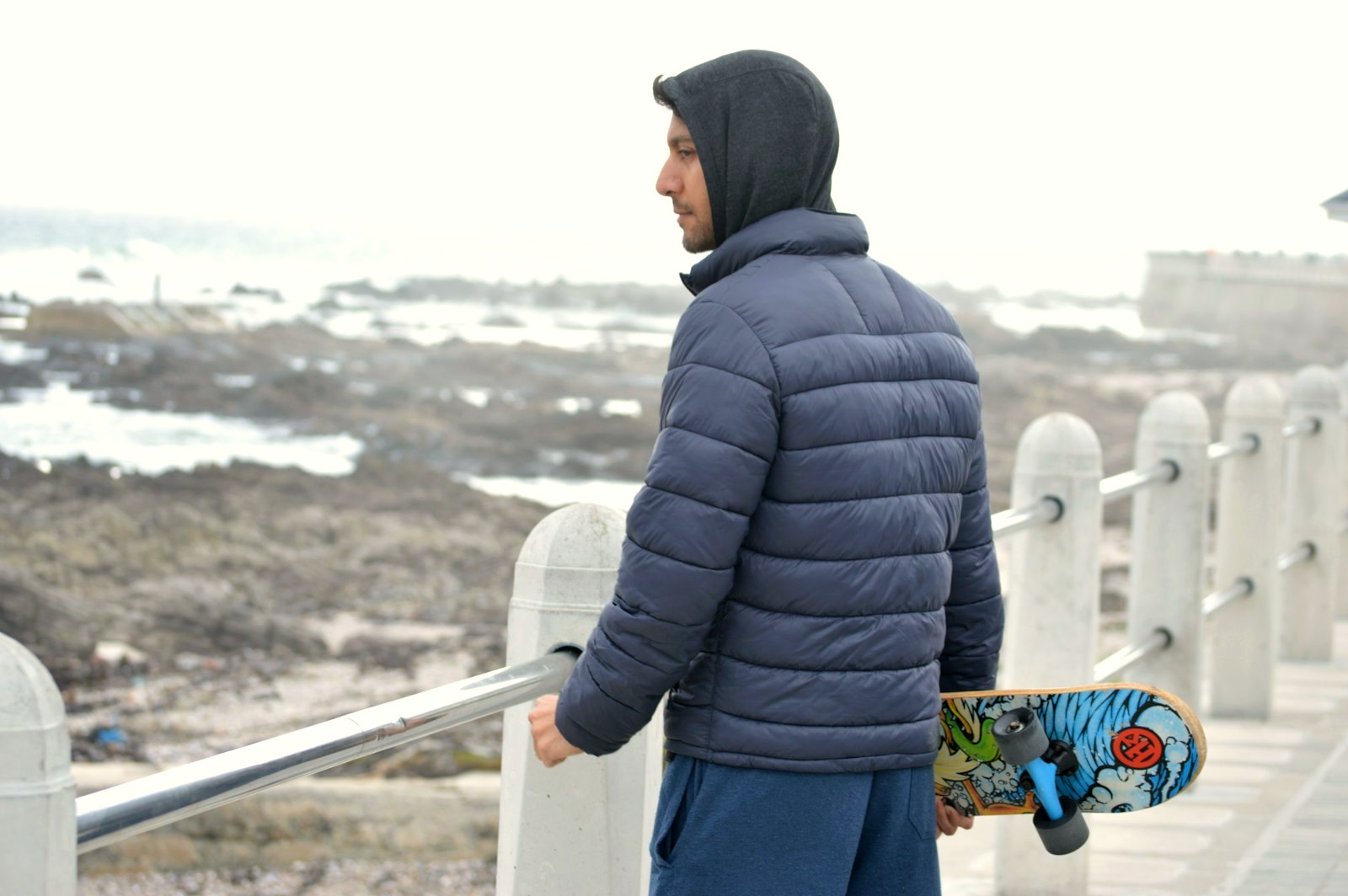
The puffer in its working register: a navy down jacket worn on a coast path, on body, in real light. It is not any ranked jacket; our bank holds no photograph of the seven below, no baffle macro and no lofted down, and the honesty section prints that gap and the harvest list rather than let a stranger's jacket stand in for a ranked one.
Checked and updated October 2026
The verdict, up front: seven puffer jackets scored out of 100 on cloth 30, construction 20, fit 20, value 15, longevity 15, plus the fashion puffer sent home. The Feathered Friends Eos wins at 88, and it wins on paperwork before it wins on warmth: 900-plus fill power, a fill weight printed in its maker's specification table, down certified to the Responsible Down Standard, and a shell whose weight its maker publishes to the gram, at $429. The Rab Microlight Alpine is second at 84, the field's other complete record, 700 fill and 153 grams of it, published. And the jacket sent home, at 52, is the Moncler Maya, a well made garment at about $1,900 whose maker publishes no fill power and no fill weight: the warmth claim cannot be checked, divided or compared, at four times the winner's price. The season is turning. The puffer is the winter garment whose specification exists in full, and this page's finding is how much of it the industry agrees to show you.
First, know what a puffer claims to be
A down jacket is two numbers wearing a third. The first number is fill power: the cubic inches one ounce of the down lofts into, the quality of the cluster, the figure every maker prints in the largest type the page allows. The second number is fill weight: how many ounces of that down are actually inside the jacket, the quantity, and the figure that decides whether the first number matters. Warmth is the product of the two, and only of the two. A 900-fill jacket holding two ounces is a lighter garment than a 700-fill jacket holding five, and any ranking that reads the power alone is reading the advertisement. Around the pair stand the supporting claims: where the down came from and under what certification, RDS or a house standard graded as a house claim; what the shell is and what its water finish honestly promises; and how the baffles are built, because the stitching that holds the down is also where the down escapes and the cold enters. Every card below reads the record first and the jacket second. Where a maker publishes nothing, the card prints the silence at the same size as the figures, because on this page the silences are the findings.
Two boundaries, drawn in the open. The synthetic is ranked as its own species: the Patagonia Nano Puff carries no fill power, because no such number exists for a polyester fill, and this page does not convert its published insulation weight into a pretend one. Its case is wet warmth and permanence, argued on its own record at No. 5. And the layer under all of these is graded elsewhere: the base layers of Verdict Card No. 45 are the system's foundation, and the shell that closes over a puffer in real weather is ranked in the rain jackets ranking. This page grades the insulation layer itself, the garment October asks for by name.
The physics, briefly. Down insulates by holding still air in a three-dimensional cluster, and nothing synthetic yet matches its loft per ounce or its recovery from compression, which is why expeditions and gram counters both end at down. Its weakness is the same structure: water collapses the cluster, and a wet down jacket insulates at a fraction of its rating until it is dried and re-lofted. The industry answers with hydrophobic treatments, named and graded here as claims, and with shells and finishes whose promises decay on a schedule. A puffer is therefore a claim about a dry day, maintained by a finish, and the makers who print that sentence on their own pages score for printing it.
How the scores work
Every jacket is scored out of 100 on the same five rows. Cloth (30) reads the down record as a claim: a published fill power scores, a published fill weight scores again, a named certification with a checkable number scores above a house word, the shell's published fabric and finish are read here, and each withheld figure is charged in the open. Construction (20) reads the baffle architecture, stitch-through against bonded and channel builds, the zip and storm systems, the hood, and the pockets a cold hand actually uses. Fit (20) is the layering test: a puffer earns its place over knitwear and under a shell, the maker's stated cut is scored as printed, and the width of the size library is credited where a maker publishes one. Value (15) divides the price by the published fill power where both exist, and prints the rate on the card; where a maker withholds the power, the rate is uncomputable and the row scores that fact. Longevity (15) is the decade audit: down migration at the seams, re-lofting and the maker's care line, the finish's decay, the model's continuity and the house's repair bench. Row scores add to the total, on every card.
The ranking
Feathered Friends Eos Down Jacket
The Winner
US list price at last check: $429 at the maker's store.
Buy it as the reference puffer: the fullest published down record in the field, made by a down specialist on the same continent, warm past freezing at under twelve ounces.
The cloth: begin with what the maker's own page publishes, because this card is the standard the rest of the page is measured against. Fill power: 900-plus, the highest figure in the field. Fill weight: printed in the maker's specification table, 3.7 ounces in the medium, the number five of the eight houses here will not give you at any price. Certification: the down is Responsible Down Standard certified, stated on the product page. Shell: Pertex Quantum brushed nylon at a published 37 grams per square metre, 12 by 20 denier, with a water repellent finish made without intentionally added PFCs, and the maker's own sentence beside it: for sustained rain, bring a waterproof shell. That sentence is worth points on this page, because it is the claim's limit printed by the claimant. Two charges, printed in the open: the down is untreated, no hydrophobic finish, so the jacket's wet answer is the shell and the advice; and one figure on this card, the fill weight, reached us through the maker's specification table as its reviews and spec sheets carry it, flagged for direct re-verification in the November pass rather than silently rounded into fact.
The build and the fit: sewn-through baffles, the honest light construction, with the cold-seam cost that construction carries and this page charges every maker for alike; a fixed low-profile hood with dual drawcords, two zippered hand pockets and a zippered chest pocket placed to clear a pack's hip belt, Lycra cuffs and a drawcord hem, at a published average weight of 11.8 ounces in a medium. The fit is the maker's lightweight pattern, cut close to serve as an outer layer in mild cold or a mid layer under a shell, in sizes XS to XXL. The house designs, tests and sews the jacket in Seattle and Vancouver, has made down garments since 1972, and services what it sells: the longevity row scores the specialist's bench and the model's continuity, fourteen of fifteen, docked for the untreated down's care discipline. At about 48 cents per published fill power point it is not the cheapest warmth here. It is the most completely described, and on this page that is the same competition.
Rab Microlight Alpine Jacket
The Other Complete Record
US list price at last check: $295 at the maker's US store.
Buy it as the mountain standard at a working price: both numbers published, a hydrophobic finish on the down, and a shell built a class tougher than the ultralight school.
The cloth: the second complete record in the field, and the comparison teaches the first lesson of this page: a lower power, honestly weighed, beats a higher power left unweighed. The maker publishes 700 fill power and a fill weight of 153 grams in the medium, and the down is recycled, certified under the Global Recycled Standard, with a Nikwax hydrophobic finish that is the field's most practical answer to damp cold short of a synthetic. The shell is a 30-denier recycled Pertex Quantum ripstop, a full class heavier than the 10 and 15 denier shells the premium rows wear, and the maker's sustainability block prints fluorocarbon-free fabric and finish and a recycled content above 75 percent. The cloth row lands at 26: the power is the field's median, the weight is published to the gram, the treatment is named, and the recycled claim carries a certification a reader can check. What it does not carry is the Eos's altitude: 700 fill at 153 grams is a warm jacket, not a phenomenon, and the row scores the record's completeness and the cloth's class separately.
The build and the fit: the baffle architecture is the card's argument: micro baffles across the body and shoulders, smaller nano baffles under the arms where heat and movement argue for less fill, a zoned construction most makers describe and this one publishes. An adjustable down hood with a stiffened peak, zippered hand and chest pockets, elasticated cuffs and a drawcord hem, in a regular fit the maker names as such, sized XXS to XXL, the joint-widest library in the technical field. Total weight 466.5 grams on the maker's page, the heaviest of the light class, and the longevity row prices the trade honestly: the 30-denier shell will outlast the gossamer shells above and below it on this page, the stitch-through seams will migrate down on the usual schedule, and the model has been refined across more seasons than any jacket here, which is its own kind of evidence. At about 42 cents per published point, it is the value pick of the honest publishers.
Patagonia Down Sweater
The Institution
US list price at last check: $289 at the maker's current listings.
Buy it as the default down jacket of the decade: certified down with the certificate number printed, a shell made from fishing nets, and a repair culture behind it. Read the one silence on this card before you buy.
The cloth: 800 fill power, printed; 100 percent Responsible Down Standard down, printed; and the certification's number, certified by Control Union CU 880272, printed in the maker's own copy, a figure a stranger can verify, which puts this house in the small company of makers who hand you the means to check them. The shell is the category's best story told in a fibre line: NetPlus, 100 percent postconsumer recycled nylon ripstop made from recycled fishing nets, with a DWR finish made without intentionally added PFAS. Now the silence, charged in the open because this page charges it everywhere: the maker's current product copy prints no fill weight. The figure its channels confirm for the current, fuller generation is roughly 150 grams in a large hoody, which a buyer cannot read on the page that sells the jacket. The cloth row scores the published 800, the printed certificate and the withheld weight together, and lands one point behind a 700-fill jacket whose maker publishes both numbers. That is this page's doctrine in a single row: completeness is a specification.
The build and the fit: stitch-through quilting patterned for warmth and movement, a centre-front zip with an interior storm flap and a garage at the chin, two zippered handwarmer pockets, an interior chest pocket that converts to the jacket's own stuff sack, elastic cuffs and an adjustable hem, at 13 ounces in a medium, with a repair patch included in the pocket for the field fix. The current cut is the trimmer fit the maker now prints, with its own advice to size up for room at the hips, and the fit row scores the admission as printed: it layers under a shell cleanly and over a heavy knit with less grace than the boxy original. This card ships without a buy link, and the reason is printed rather than buried: the maker's own store served its queue notice at this check and no exact door for this jacket was verified to this desk's standard, so the card goes without rather than with a guessed one. The house stands at 83 in the American ranking as a brand record; this 82 grades the jacket, and the two numbers are kept separate here as everywhere on this site. Longevity is the house's repair bench and a model line measured in decades, twelve of fifteen, the fill increase of the current generation noted as the record's moving part.
Arc'teryx Cerium Hoody
The Premium Silence
US list price at last check: $400.
Buy it for the cut and the hybrid build, the best patterning in the field, and buy it knowing its maker publishes the power and withholds the weight. At $400, that withholding is the card.
The cloth: 850 fill European white goose down, responsibly sourced and RDS certified, printed; a recycled 15-denier Arato nylon shell, printed; an FC0, PFC-free DWR finish, printed; a bio-derived liner from castor bean oil, printed. And there the published record stops, one number short: no fill weight appears anywhere in the maker's product copy for this jacket, at $400, from the house with the most engineering-forward reputation in the field. The maker's own FAQ performs the omission in public: asked whether the 1000-fill Cerium SV is warmer than this 850, the house answers on fill power alone, explaining that the higher number gives more warmth for less weight, and never mentions how much down either jacket holds. The warmth of a jacket is power times weight, and the premium house publishes half the multiplication. The cloth row scores the excellent half at 25 and charges the missing half in the value row, where 47 cents per published point buys a number the buyer cannot complete.
The build and the fit: what the money visibly buys is mapping. Down Composite Mapping places Coreloft 80 synthetic insulation where moisture gathers, the shoulders, the underarms, the collar's edge at the chin, and down where warmth is the job, the most considered hybrid architecture in the field and a genuine answer to down's wet weakness inside a down jacket. A helmet-compatible insulated StormHood on a single pull, a reverse-coil front zip with TPU pulls, stretch cuffs, an adjustable hem and an included stuff sack, at 338 grams total, the lightest full system here. The fit is the maker's fitted cut, patterned to stay close through chest, waist and hip for clean layering, and it is the best patterning on this page: the construction row gives the field's highest mark, 18. The longevity row credits the house's warranty and repair programme and the model's long continuity, thirteen. The card's verdict is the field's tension in one garment: superbly built, impeccably cut, and specified like a fashion jacket at the one figure that decides warmth.
Patagonia Nano Puff Jacket
The Synthetic, On Its Own Record
US list price at last check: $239, up from the $199 this jacket held for a decade.
Buy it for wet cold, high output and the decade: the fill that keeps working damp, in the field's most proven synthetic build. Do not buy it as cheap down. It is a different animal and this card grades it as one.
The cloth: there is no down in this jacket and no fill power on this card, and the absence is the point of the species. The insulation is PrimaLoft Gold Insulation Eco, a polyester fill the maker specifies the honest way for a synthetic: by weight per area, 60 grams per square metre, with 55 percent postconsumer recycled content, inside a 100 percent recycled polyester ripstop shell with a PFC-free DWR. A synthetic cannot be graded on loft per ounce against down without fraud, so the cloth row grades what the record offers: a named fill from the class's benchmark maker, a published areal weight, a recycled shell, and the property no down on this page can claim, loft that survives getting wet. The physics is printed in the opening section and scored here without romance: in dry cold this jacket is warmer per dollar than per ounce, it packs to a brick where the down jackets pack to a loaf, and its warmth ceiling is the lightest in the field. The reader whose winter is dry and still should buy down. The reader whose winter is wet, or whose output soaks a layer from inside, is this card's reader.
The build and the fit: brick quilting that holds the fill in place without stitch-through cold lines doing down's damage, a centre-front zip with a wicking interior storm flap and a chin garage, two zippered hand pockets and a chest pocket that takes the jacket as its own stuff sack, elastic cuffs and a drawcord hem, in a regular fit across the field's standard library, sewn under Fair Trade Certified conditions. The construction is a decade and a half of refinement of one pattern, and the longevity row scores the synthetic's clock honestly: the fill will not migrate, cannot be eaten, and asks nothing of a dryer but time; what retires it is the slow flattening of a polyester batt across seven scored seasons and the shell's face wear, twelve of fifteen. The value row prints the price's own news: $239, the jacket having held $199 for roughly a decade, a rise the desk prints because the value of a benchmark is partly that its price used to be one.
Uniqlo Seamless Down Parka
The Attainable Claim, Graded
US list price at last check: $179.90 at the maker's US store.
Buy it as the cheapest published warmth in the field: a certified 750-plus fill with the certificate number printed, at 24 cents a point. Buy it as a three to four season garment, because its maker prints that too.
The cloth: this is the card where the page grades the attainable claim on its maker's own published terms, and the terms are better than the price suggests. Fill power: 750-plus, printed, with the method named in the maker's own asterisk, measured by the IDFB method at the raw material stage. Ratio: 90 percent down to 10 percent feathers, the golden ratio the maker's feature copy names. Certification: Responsible Down Standard, with the certificate number printed in the product copy, Control Union CU1323320, a figure a buyer can check, at $179.90, from the house the rest of this site knows for footnoted ratios. The silences are the class's usual two: no fill weight is published, so the warmth the 750 promises cannot be totalled, and the water-repellent finish is stated by the maker to be not permanent, an honesty the cloth row credits and the longevity row charges. The brand stands at 84 in Brands Like No. 08 as the value benchmark; this garment score, 74, is the jacket's own, and the gap between them is the difference between a house's method and one garment's record.
The build and the fit: the construction is the card's genuine idea: heat-bonded baffles in place of stitching across the body, so the needle holes that leak cold air and shed down in a stitch-through jacket are engineered out, with the maker's own footnote conceding the seams that remain at sleeves, sides and hood. A waterproof front fastener by the product copy's description, a cushioned collar and a three-dimensional hood built to keep the neck sealed, brushed pocket pouches, in a regular fit across sizes XS to 3XL, the widest library in the field alongside the Crofton's. The value row is where the arithmetic lands: about 24 cents per published fill power point is the cheapest checkable warmth on this page, undercut only by the catalogue houses' code prices in the honesty section, whose claims cannot be checked the same way. Longevity is costed at the class's honest clock, three to four seasons before the finish, the bonding and the loft have each given something back, seven of fifteen: at this price the shorter clock is a term of the deal, printed by the maker in pieces and assembled here.
Canada Goose Crofton Hoody
The Price Test
US list price at last check: $950 at the maker's US store.
Buy it, if you buy it, for the make and the library: Canadian sewing and the widest size run here. Do not buy it as warmth per dollar. On its maker's own published numbers, it is the most expensive warmth in the field by a factor of three.
The cloth: the price test, run on the maker's published record and nothing else. The house publishes 750 fill power for this model in its materials library, a good figure, the field's median class, and prints on the product page a warmth rating from its own Thermal Experience Index, TEI 1 of 5, a house scale no other maker shares and no buyer can divide against a rival. No fill weight is published, so the 750 cannot be totalled. The down's certification is claimed at the level of the house's programme rather than printed as a checkable number on the product page, in a field where a $179.90 jacket prints its certificate number in the copy. The shell is a recycled feather-light ripstop, water-repellent and wind-resistant by the maker's description. Set the record beside the bill: $950, for a published power the Uniqlo matches at $179.90 and the Rab exceeds in completeness at $295. The division this page prints on every card gives $1.27 per fill power point, the worst rate among the makers who publish a power at all, nearly three times the Cerium's rate for a lower figure. The cloth row scores the published 750 and the house scale together at 20, and the value row gives the transaction 4, the lowest mark any ranked jacket takes here.
The build and the fit: what the record does support, it supports well. Channel-fill construction in lightweight fabrics, a jacket that packs into itself, stretch cuffs with reflective detail, a two-way zip and a drawcord hem, sewn in Canada by a house that has made parkas since 1957 and stands behind them with a warranty and repair culture the longevity row credits at thirteen. The fit library is the widest in the field outright: the maker's own size chart, read in full for this check, runs 3XS to 3XL with measurements printed for every size, a library no technical house here matches, and the fit row scores it at 15. One boundary, printed because this site keeps it everywhere: Canada Goose holds no standing brand score on this site, and none is created by implication here. This 68 is a garment score, the Crofton's own, derived from its published record at its published price. The house may earn a brand number when this desk grades the house. What it cannot do is borrow warmth it has not published to defend a price it has.
Moncler Maya Short Down Jacket
The Skip
US price at last check: about $1,900 at the maker's US store.
Leave it, on the record: at about $1,900 the warmth claim cannot be checked, because its maker publishes neither the power nor the weight of the down inside it. The well made jacket underneath the silence is ranked, and sentenced, on our Italian page and our awards page; this card grades the garment's paperwork.
The cloth: read the maker's published record for its flagship puffer in full, because the record is the conviction. The filling is published as a ratio: 90 percent goose down, 10 percent goose feathers. The sourcing is published as a claim: down exclusively from DIST-certified suppliers, the house's own traceability standard, graded here as a house claim beside the RDS numbers other makers print. And then the record ends. No fill power is published in the maker's copy or in any retail listing read for this check: not 700, not 800, no number at all. No fill weight is published. The two figures whose product is warmth, the entire specification this page exists to read, are absent at about $1,900, which is four and a half times the winner's price and twice the Crofton's. The shell is nylon laqué, the glossy lacquered nylon of the boudin quilting, a fashion finish whose shine is the garment's loudest specification. The cloth row gives the real ratio and the real claim their due, fifteen, and the value row gives the uncomputable rate its due, which is one: a price per fill power point cannot be printed for this jacket because the divisor is a secret.
The build and the fit: the garment under the paperwork is genuinely well made, and this page concedes what our awards page concedes in naming the house for the Logo Tax Award at a brand score of 55: the Maya is well sewn, its two-way zip, detachable hood, snap collar and adjustable hem are properly executed, and its construction row, fifteen, is the highest mark on this card. The fit is a short, regular, hip-length fashion cut, sized on the house's own numbered scale, cut for the photograph the Italian ranking describes. The longevity row gives the object nine: the jacket will last, the finish's fashion will date it first, and the down inside it will outlast every claim made for it, none of which can be checked. It ships without a buy link, the way this desk sends home the garments it convicts. The brand's sentencing stands where it was handed down, in the Italian ranking and on the awards page, and is not re-litigated here: this card adds only the garment's own arithmetic, which is that at the highest price in the field, the warmth is the one thing not for sale in writing.
The claim table: what each maker actually publishes
Every cell below is the maker's own published position at this check. Where a maker publishes nothing, the table prints the silence rather than an estimate: read down the fill weight column and you have read this page's findings.
| Jacket | Fill power, as published | Fill weight, as published | Certification, as published | Price per published fill power point |
|---|---|---|---|---|
| Feathered Friends Eos | 900-plus | 3.7 oz in the medium, in the maker's specification table | RDS, stated on the product page | About $0.48 |
| Rab Microlight Alpine | 700 | 153 g, in the maker's specification | GRS-certified recycled down, Nikwax hydrophobic finish | About $0.42 |
| Patagonia Down Sweater | 800 | None in the maker's current product copy; its channels confirm roughly 150 g in a large hoody | RDS, certificate number printed: Control Union CU 880272 | About $0.36 |
| Arc'teryx Cerium Hoody | 850 | None published | RDS, stated on the product page | About $0.47 |
| Patagonia Nano Puff | None exists: synthetic fill, graded as its own species | 60 g/m2 of PrimaLoft Gold Eco, the synthetic's honest figure | Not applicable; 55% postconsumer recycled fill | Not applicable |
| Uniqlo Seamless Down Parka | 750-plus, IDFB method, at the raw material stage | None published | RDS, certificate number printed: Control Union CU1323320 series | About $0.24 |
| Canada Goose Crofton Hoody | 750, in the maker's materials library; the product page leads with a house warmth index, TEI 1 | None published | Claimed at house programme level; no number printed on the product page | About $1.27 |
| Moncler Maya | None published | None published | DIST, the house's own supplier standard, as a claim | Cannot be computed: no power published |
Read the table as the ranking does. Two makers publish both numbers. Two print a certificate number a stranger can verify, one of them at $179.90. One premium house publishes the power and withholds the weight at $400. One house substitutes its own warmth index for the industry's arithmetic at $950. And the most expensive jacket in the field publishes, in total, a ratio and a supplier claim.
The house scale, and why this page refuses it
Two of the eight jackets here arrive with their own private arithmetic. Canada Goose's Thermal Experience Index sorts its line from 1 to 5, lightest to warmest, and as a way to choose inside one maker's catalogue it is harmless. As a warmth claim it is a wall: TEI 1 cannot be set beside 700 fill, or 800, or any figure another maker publishes, because the index is defined by the house, measured by the house and revised by the house. Moncler's record is the same refusal carried further, a ratio and a supplier standard where the numbers should be. The pattern is worth naming because it is spreading: when a maker replaces a shared measurement with a house scale, comparison itself becomes the thing being sold against. The buyer is asked to trust the brand in place of the figure, which is a fair request at $89.90 and a very different one at $950 and about $1,900. This page's rule is printed on every card: a house claim is graded as a house claim, a certified number as a certified number, and a silence as a silence, at every price, especially the high ones.
The down establishment's own history argues the same way. Eddie Bauer patented the first American down jacket in 1940 and built a house on published warmth; the catalogue school that followed printed fill powers in newsprint for decades because the number was the sales pitch a cold reader could check. The figures were never the embarrassment of this category. They were its literature. What changed is which end of the market writes in numbers and which writes in adjectives, and the claim table above is that change measured: the complete records now stand at $295 and $429, the adjectives at $950 and above, and a certificate number is printed in full by the $179.90 jacket. A reader who learns to ask for the second number, the weight, has learned the whole of this page.
Cost per wear, printed in the open
The assumption, printed before the numbers: a puffer in rotation is worn about 40 times a cold season, October through April. The life column is the service life our longevity row scores for, counted in seasons before migration, finish decay or the flattening of the fill retires the garment from the front of the rotation, not a promise. The Maya is costed at the maker's US price at this check, about $1,900.
| Jacket | Price | Scored life | Cost per wear |
|---|---|---|---|
| Patagonia Nano Puff Jacket | $239 | 7 seasons | $0.85 |
| Patagonia Down Sweater | $289 | 8 seasons | $0.90 |
| Rab Microlight Alpine Jacket | $295 | 7 seasons | $1.05 |
| Feathered Friends Eos | $429 | 10 seasons | $1.07 |
| Uniqlo Seamless Down Parka | $179.90 | 4 seasons | $1.12 |
| Arc'teryx Cerium Hoody | $400 | 8 seasons | $1.25 |
| Canada Goose Crofton Hoody | $950 | 10 seasons | $2.38 |
| Moncler Maya Short Down Jacket | About $1,900 | 8 seasons | $5.94 |
The table's shape is the ranking's economics in one view. The honest publishers cluster between ninety cents and a dollar twenty-five a wear, paying for records a buyer can check with the garment's own life. The Uniqlo's dollar twelve buys the field's cheapest checkable warmth on a shorter clock, which its maker prints in pieces. The Crofton's $2.38 is what a house scale costs when it is amortised. And the Maya's $5.94 a wearing purchases, per wear, a warmth claim that was never published once.
The skip: Moncler's Maya at 52
Every house rule that governs this site's rankings lands on this garment at once. The specification is absent at the field's highest price: no fill power, no fill weight, a ratio and a supplier claim where the warmth arithmetic should be. The comparison convicts it without outside witnesses: for a quarter of its price, the Feathered Friends Eos publishes a 900-plus power, a weighed fill, a certification and a shell weighed to the gram; for a tenth of it, the Uniqlo prints a certificate number in its product copy. And the house's own record on this site argues the same verdict from the brand side: Moncler stands at 55 in the Italian ranking and holds the Logo Tax Award, sentenced there and not re-tried here. The Maya is not a bad jacket. It is a well made jacket sold as a logo with a warmth claim attached, and the claim is the part that cannot be checked. Buy the Eos and a decade of winters. Buy the Rab and the Uniqlo both, one for the mountain and one for the street, and keep the change. The down inside the Maya is probably good down. Probably is what $1,900 buys when a maker will not publish.
Which puffer to buy
If you buy one: the Feathered Friends Eos. It is the warmest completely described jacket in the field, and the description is the warmth's evidence. If the budget is a working one: the Rab Microlight Alpine, both numbers published, a hydrophobic finish, at $295. If you want the institution: the Patagonia Down Sweater, accepting the unpublished fill weight as the price of the certificate number and the repair bench. If your winter is wet: the Nano Puff, the synthetic that keeps its loft damp, and a shell from the rain ranking over any down here when the rain is real. If you layer precisely and climb: the Cerium, bought for its patterning with its silence priced in. If the money is the argument: the Uniqlo, the cheapest checkable warmth in the field, bought as the four-season garment its maker describes. The Crofton is bought for its make and its size library by readers who have read its rate on this page and chosen it anyway, which is the only honest way to buy it. The layer beneath all seven is ranked in Verdict Card No. 45, and every layer in the wardrobe is mapped in the Body Map.
Questions, answered
What are the best puffer jackets for men?
The Feathered Friends Eos, scored 88 out of 100: the fullest down record in the field, 900-plus fill power, a fill weight published in the maker's specification table, Responsible Down Standard certified down and a shell weighed in print at 37 grams per square metre, at $429. The Rab Microlight Alpine follows at 84, the other maker here who publishes both numbers. The jacket sent home, at 52, is the Moncler Maya: a well made garment at about $1,900 whose maker publishes no fill power and no fill weight at any price.
What does fill power mean, and why is it only half a warmth claim?
Fill power is the volume one ounce of down lofts into, in cubic inches: it measures the quality of the down, not the quantity in the jacket. Warmth is the product of the two, power times weight, and a maker can print a heroic power figure over a thimbleful of down. That is why this page grades the pair. Of the eight jackets ranked and sent home here, exactly two makers publish both figures on the record a buyer can check: Feathered Friends and Rab. Patagonia prints 800 fill and its certification number, and leaves its fill weight to its retailers. Arc'teryx, Uniqlo, Canada Goose and Moncler publish no fill weight at all, and Moncler publishes no power either.
Is a synthetic puffer warmer than a down puffer?
In dry cold, no: ounce for ounce, good down lofts higher and packs smaller than any synthetic yet made, which is why the top of this ranking is down. Wet, the answer reverses. Down's loft is air held in a cluster's structure, and water collapses the structure; a soaked down jacket is a wet blanket with a zip. A synthetic fill like the PrimaLoft Gold in the Patagonia Nano Puff, ranked here at 76 as its own species, holds its loft damp and keeps insulating, which is the whole of its case. The honest rule: down for dry cold and packability, synthetic for wet cold and high output, and never convert a synthetic's published weight into a fake fill power to compare the two, because the numbers measure different things.
Why do Canada Goose and Moncler not publish a fill weight?
Each house substitutes its own scale for the industry's numbers. Canada Goose publishes 750 fill power for the Crofton in its materials library but leads its product page with the Thermal Experience Index, a five point house scale no other maker shares, so its warmth cannot be divided against anyone else's; no fill weight is published at any price, and the Crofton costs $950. Moncler goes further: its product copy publishes a fill ratio, 90 percent down to 10 percent feathers, and a supplier certification claim, and no fill power and no fill weight at all, at about $1,900. A house scale is not a lie. It is a refusal to be compared, and this page scores the refusal as what it costs the buyer: the garment cannot be checked before it is bought.
What does a point of fill power cost across this field?
Where a maker publishes both a price and a fill power, the division is printed on this page, and it is the field's most useful single column. Uniqlo's Seamless Down Parka is the cheapest published warmth here at about 24 cents per fill power point: $179.90 over a published 750-plus. The Patagonia Down Sweater is about 36 cents, the Rab Microlight Alpine about 42, the Arc'teryx Cerium about 47 and the Feathered Friends Eos about 48, the premium for the fullest records in the field. Canada Goose's Crofton is $1.27 per point, nearly three times the Cerium's rate for a lower published power. And the Moncler Maya's rate cannot be computed at all, because at about $1,900 its maker publishes no power to divide by.
How long does a puffer jacket last, and what kills it?
Down itself is nearly immortal; the systems around it are not. What retires a puffer is compression first: a jacket stored crushed in its stuff sack loses loft a season at a time, and the fix is the makers' own care line, storage loose and a low tumble dry with balls to re-loft the clusters. Second is migration: stitch-through baffles, the light construction most of this field uses, let down work through the seam lines over years, which is why the better makers publish their baffle architecture. Third is the shell: the DWR finish that keeps the down dry decays on a wash count no maker prints, and Uniqlo is the one house here that says so on its product page. Costed on this page at forty wears a season, the field's serious jackets run between about 85 cents and $1.25 a wear across their scored lives; the sent-home Maya runs about $5.94.
How this ranking stays honest
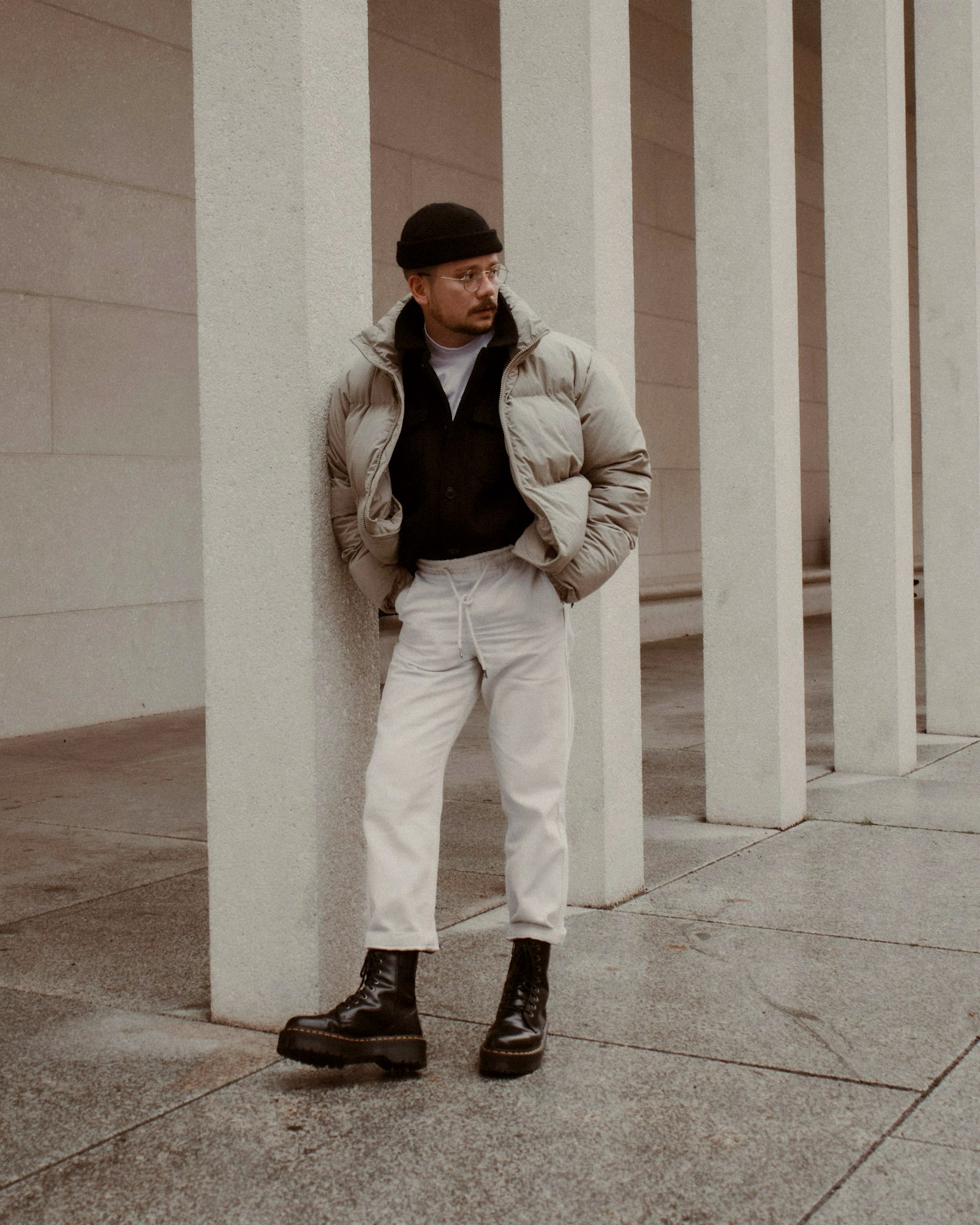
The rests, the prose answers and the capture notes, printed. Lands' End and Eddie Bauer, the down houses of Brands Like L.L.Bean, are answered here rather than ranked, and their records are printed in full so nothing is hidden by the resting. The Lands' End Wanderweight publishes the fuller attainable claim: 800 fill power HyperDRY down, a body insulation of 90 percent down and 10 percent feathers, an interior storm flap and the fit libraries, Regular, Tall, Big and Short, that its brand card scores at 75; its list is $199.95 and it transacted at $89.97 on code at this check, the code culture that page prints. No fill weight is published and no certification is named in the maker's copy. The Eddie Bauer CirrusLite publishes 650 fill power and a StormRepel finish at a $149 list, and the maker's own store showed $89.40 at this check: the house that patented the American down jacket in 1940 now sells its descendant the way its brand card, at 56, describes, on promotion, with no fill weight and no certification named. Those are brand records and garment records kept separate, as this site keeps them everywhere: neither jacket is scored here, because the attainable seat went to the garment that prints a certificate number, and because both houses' full stories, guarantees included, already stand on their own page. The North Face keeps its standing 64 from the American ranking and is not re-tried: its down line publishes powers in the 550 to 700 class and its warmth story is a brand story, told where the score stands. Peak Performance stands at 66 on the Scandinavian ranking and is rested; its insulated line is ski shell territory, a different garment contract from the layering puffer graded here. Montbell is named as the disclosure school's other member rather than ranked: its Plasma line publishes powers to 1000 and fill weights with them, the specialist's record this page's doctrine honours, rested because the field's seven seats were filled by the houses a reader cross-shops first and its American doors run thin. H&M was rested deliberately: the desk chose to grade the whole price ladder's down records rather than add a fourteenth garment to the running H&M derivation, which stands untouched on Brands Like H&M. On capture: the Canada Goose product page rendered its size chart and price to our reader but not its descriptive spec block, so its fill figure is printed as the maker's materials library publishes it and flagged, with the Feathered Friends fill weight and the Patagonia prices, for direct re-verification in the November pass; the Arc'teryx door on its card is the maker's US storefront listing for the garment, its product page having been read in the maker's UK store, same model. On photography: the magazine's bank holds two puffer frames and no photograph of any ranked jacket, no baffle at macro range and no lofted down beside a scale; the hero and the one body frame are the bank's honest frames, captioned for exactly what they show, the cards run without images, and the harvest list names what is missing: a stitch-through baffle at macro range, lofted down beside a ruler, and a puffer worn over knitwear in street light. Prices and specifications were checked against the makers' own listings in October 2026; where a figure could not be verified from the maker's page, the page says so at the figure's elbow. The full method is written out on the methodology page.