
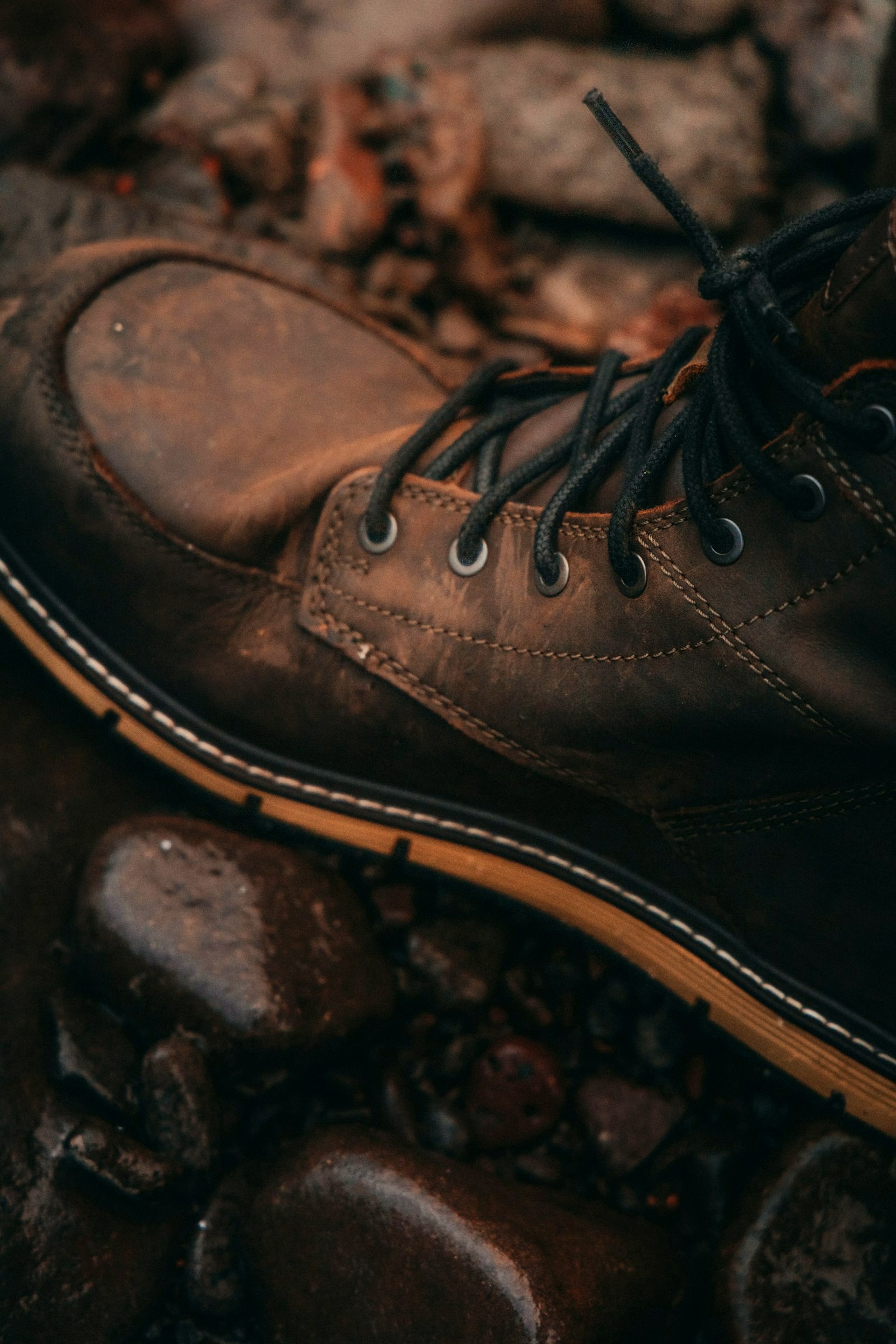
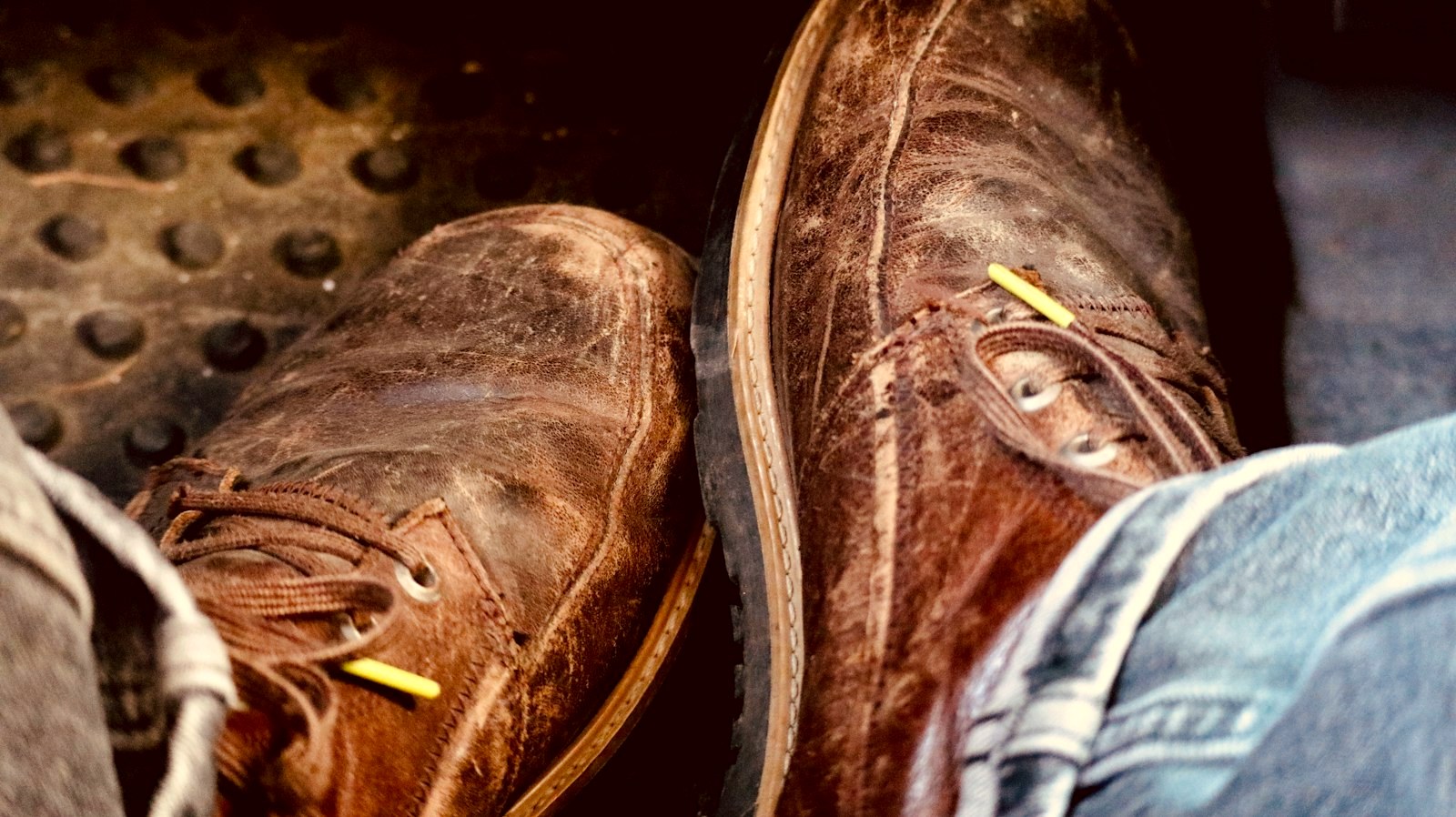
The anchor's habitat, captioned as exactly that: a worn boot on wet ground, the weather Filson cloth is weighed for. Our bank holds no photograph of a Filson garment, worn or folded, so no frame on this page is captioned as one. The ranking below is built from published cloth weights, the maker's own guarantee, six Filson garments this site has already scored, and the service pages of the seven houses.
Checked and updated October 2026
The verdict, up front: the anchor does not win its own page, and it is the second page in a row where that has happened to a house in this trilogy, which tells you the trilogy is honest. L.L.Bean keeps its standing 87 and wins here the way it won at home: a fit library that runs to big and tall, a value row of a clean 15, and ten ranked garments deep. Filson keeps its standing 85, audited in the open below against the deepest work-cloth record in American clothing: fabric 27, the ceiling of this series, and longevity a clean 15 under a lifetime guarantee. Barbour stands at its derived 81, the service-ledger rematch from the Barbour page, and the three small makers derived there hold their numbers: Peregrine 76, Flint and Tinder 74, Tom Beckbe 72. The skip is new, and it is the oldest name on the page: Woolrich, founded in 1830, is derived in the open at 53. The house that supplied the Union Army closed America's oldest woolen mill in 2018 and now sells the silhouette at luxury prices with nothing published standing behind it. This page closes the guarantee trilogy: the Bean page opened the ledger, the Barbour page continued it, and this one grades the house that wrote the covenant.
What people actually want from Filson
Nobody searches for brands like Filson because they need a jacket either. They search because Filson sells the strongest version of the maintained purchase: cloth weighed like equipment, Mackinaw wool at 24 ounces, tin cloth at 14, and behind the garment a promise with no expiry date on it, a lifetime guarantee against failure of materials and workmanship, staffed by a repair department in the maker's own Seattle factory that will darn, rebind and reset the hardware on a coat older than its owner's children. The want is a purchase that ends purchasing: buy the Cruiser once, and the house answers for it for the rest of its life, which the house expects to be measured in decades.
The ceiling is real, and this page names it before the anchor's card can be accused of hiding it. The prices are the field's highest, and the standing value row of 9 is that fact already priced. And the modern catalogue runs well past the work core that earned the number, into lifestyle product, fashion collaborations and licensed goods that this audit does not grade and the reader should not buy on the core's reputation. So the alternatives below are graded on the three tests this search is really asking, the same tests the trilogy has run on every house. Is the cloth published: the mill named, the weight printed in ounces, or adjectives where the specification should be? Is the promise an instrument: a guarantee, a staffed bench, or a returns window? And does the garment record agree with the paperwork when the house's own products are graded one by one? Filson is the house that set those tests. This page runs them on Filson first.
How the scores work
Every brand here is scored on the house basis for this series: fabric and cloth out of 30, construction and craft out of 20, fit range and sizing honesty out of 20, value out of 15, longevity out of 15. Five scores on this page are standing scores, because a score that changes from page to page is marketing: Bean's 87, the anchor's 85, and the three derivations set on the Barbour page, Barbour 81, Peregrine 76, Flint and Tinder 74 and Tom Beckbe 72, four derivations in fact, each reproduced with its rows exactly. One score is new, derived in the open on its card: Woolrich at 53.
The audit of the anchor, then, from its record, because Filson's 85 was set on the Carhartt page and this series audits its anchors where they stand. The garment file is the deepest work-cloth file any house holds here: six ranked garments across six categories. The Rugged Twill Original Briefcase won our bags ranking at 86, its cloth a British Millerain twill with a tear strength the maker rates above 1,400 pounds, trimmed in Wickett & Craig bridle leather. The waffle knit henley won its ranking at 84. The Wool Jac-Shirt scored 82 as an overshirt, 18 ounces of wool at $349, with its insulated sibling at 81. The Vintage Flannel Work Shirt scored 81, the dopp kit 78, and the Tin Cloth Short Lined Cruiser scored 75 as a chore coat, the field's heaviest cloth at 14 ounces, charged on its own card for a pocket architecture with no inside pocket, a charge this audit weighs rather than waves away: it is a garment deduction, honestly printed, against a brand whose other five garments carry no such charge.
Fabric 27: the ceiling of this series, and the audit finds it where it was set. No other house publishes cloth like this as a matter of routine: Mackinaw wool woven at 24 ounces for the Cruiser, tin cloth at 14 ounces finished until it sheds water like a roof, an 18-ounce wool in a shirt jacket, a luggage twill rated by tear strength. Bean's 23 and Barbour's 24 are the measured distances, workmanlike cloth and a fine midweight shell against a house whose standard is the heaviest cloth in every category it enters. Construction 19: the briefcase's own construction row on its Verdict Card is 19, one point off perfect, the deduction printed there (a single zip under a storm flap), and the same standard runs through the file, flat-felled seams and double-needle work on the flannel, sand-cast brass on the bags, and behind all of it a repair department that rebuilds the garments it sells. Fit 15: honest work cuts, relaxed and described as relaxed, sized for the body in the garment rather than the body in the mirror; what it is not is a library, and Bean's 19, with its big and tall ranges, is exactly the distance. Value 9: the standing deduction, confirmed by the audit rather than softened by it. The Cruiser at about $550, the briefcase at $499, the Jac-Shirt at $349 are the highest entry prices on this page, and the best defence the record offers, the briefcase at $24.95 a year over a twenty-year life, is a defence that takes twenty years to finish making. Longevity 15: a clean score, the only one at the top of this page. The instrument is the strongest in the ledger below, a lifetime guarantee against failure of materials and workmanship, and the garment record agrees with the paperwork at every point it can be tested: the chore coat costed over a twenty-year life, the Jac-Shirt over fifteen seasons, the briefcase over twenty years. Add them: 27, 19, 15, 9, 15. The audit lands where the number stands. The brand score is 85, and the two points Bean holds over it are fit and value, which is to say the catalogue virtues, against cloth and covenant, which is to say the Filson ones.
Four names are answered in the open rather than ranked. Patagonia keeps its standing 83, audited on the Bean page: its repair covenant is real and its Worn Wear programme is the industry's reference, and it is rested here because its centre of gravity is recycled technical cloth, a different weather argument from the waxed and wool work cloth this page grades; its number is untouched and its covenant is graded in full where it stands. Carhartt keeps its 77 and its family rows from the Carhartt page, the workwear sibling whose Detroit arithmetic is printed there; this page grades the service-ledger field, and the work line's ledger is a price, which is a fine thing to be and a different thing from a covenant. The rest of the Bean page's catalogue field is rested with its numbers untouched: Lands' End at 75, whose unretreated guarantee sentence would seat it fourth here and whose catalogue does not attempt the cloth this page grades, Orvis at 70, Duluth Trading at 68 and Eddie Bauer at 56. Belstaff keeps its derived 70 from the Barbour page, a motorcycle specialist whose membrane argument is graded there. And Stormy Kromer, the Michigan cap maker, still family-run and still sewing in Ironwood, is printed as the honest small answer rather than seated: a cap is not this page's garment class, no score is created for it, and a reader who wants the covenant ethic at a cap's price will find the house keeps its promises in the same spirit as the anchor's, at a tenth of the money. The fast-fashion workwear imitation is answered the same way it was answered on the Barbour page: its brand number is a living derivation maintained on the H&M page of this series, and this page does not borrow it, restate it or re-derive it. Its method here is the trilogy's method everywhere: the cruiser silhouette and the plaid, printed on cloth that publishes no weight, under no promise at all.
The service ledger, quoted from the houses' own pages today, is the spine of the ranking, so it is printed before the cards. This is the third ledger in the trilogy, and it is the one the first two were building toward: read down the instrument column and the ladder below explains itself.
| House | The instrument, as published | The term |
|---|---|---|
| Filson | A lifetime guarantee against failure of materials and workmanship, backed by a working repair service, under the founder's sentence: "We guarantee every item purchased from us. No more, no less. Your satisfaction is the sole purpose of our transaction." | The product's life |
| L.L.Bean | Return within one year of purchase for a refund; after one year, items defective in materials or craftsmanship will be considered. The sentence that replaced the covenant in February 2018, printed plainly by the house that retired it. | One year, then defects |
| Barbour | The maker's own service page: customers may return a jacket "at any time to be re-waxed, repaired or altered", a re-wax is recommended annually depending on wear, and the turnaround targets are published, seven business days for a re-wax in the quiet season, six to eight weeks for heavy repairs at the peak. | No expiry; the work is quoted and paid |
| Peregrine | Re-waxing guidance published and the jackets built to take it, an 8-ounce cloth that, in the trade's phrase, only gets better every time you re-wax it. No repair department is published. | The owner's own hands |
| Flint and Tinder | A re-waxable exterior, printed in the maker's own product copy, behind a retailer's returns and exchange policy. No bench, no service department. | A retail policy |
| Tom Beckbe | Reproofing wax sold by the maker and full care instructions printed on the product page itself, down to the warning against hot water and dry cleaning. No repair service is published. | The owner's own hands |
| Woolrich | Nothing is published: no product guarantee, no repair service on the maker's store at this check. The mill that wove the house's name for 173 years closed in December 2018. | The returns window |
Seven brands like Filson, ranked

L.L.Bean
US prices at last check: Bean Boots from $140 at the maker's store, the 8 inch at $150; the Scotch Plaid flannel $59.95; the Boat and Tote $59.95.
Keeps its standing 87 and its rows, audited on its own page of this series: the catalogue virtues, fit and value, beat the anchor's cloth and covenant by two points.
Bean wins Filson's page the way it won its own, on the rows the anchor cannot match. Fit 19 against the anchor's 15: a library that runs from regular to tall to genuinely big without apology, against honest work cuts in a standard run. Value a clean 15 against 9: the boot at $140 to $150, the winning flannel at $59.95, a tote at $59.95 costed at about $3 a year, a store in which almost nothing charges you for the story. And the garment file behind the brand number is the deepest on this site: ten ranked garments, three category winners, the Scotch Plaid flannel at 85, the Chamois overshirt at 83, the Wicked Good slippers at 88, a boot still sewn in Maine one pair at a time, 113 years after the first hundred pairs came back and the founder refunded every buyer and fixed the boot.
What the win means is worth printing plainly, because it is the trilogy's whole finding in one comparison. Bean's covenant is the weaker instrument now: the lifetime sentence was retired in February 2018, and what replaced it, one year and a consideration for defects, is graded in its longevity row at 14 against the anchor's clean 15. Bean wins anyway, because a brand is bought at the rail and the till more often than it is redeemed at the repair desk, and at the rail and the till Bean's virtues are the ones a household uses weekly. The anchor's answer is on its own card below, and it is a real answer: no house on this page publishes cloth like Filson's, and no house's promise outlives Filson's. But the ladder is the ladder. The institution beats the covenant by two points, on fit and on price, and this page prints it at the top of the anchor's own ranking rather than in a footnote.
Filson
US price at last check: the Wool Jac-Shirt $349 at the maker's store; the Mackinaw Wool Cruiser about $550.
The anchor, audited in the open above and landed at its standing 85: the heaviest cloth in American clothing and the strongest promise standing behind it.
The case for the anchor is its machinery, and the machinery is unusually well documented because this site has graded its parts one by one. C.C. Filson opened in Seattle in 1897 to outfit prospectors heading for the Klondike, customers for whom a failed seam was not an inconvenience, and the house has never entirely stopped designing for them. The cloth comes first in its own catalogue and in this audit: 24-ounce Mackinaw wool in the Cruiser, a cloth woven to a density modern mills rarely attempt; 14-ounce tin cloth, a waxed canvas finished until it sheds water like a roof; Rugged Twill in the bags, woven by British Millerain and rated by the maker above 1,400 pounds of tear strength, trimmed with bridle leather from Wickett & Craig. Six garments from that catalogue are ranked on this site and none of them embarrasses the brand number: two category winners, an 82 and an 81 in the shirt categories, and a chore coat whose only printed charge is a missing inside pocket. Behind the garments stands the instrument the ledger prints at the top: a lifetime guarantee against failure of materials and workmanship, and a repair department at the Seattle factory that darns, rebinds, replaces panels and resets hardware, on garments decades out of production, as a matter of routine business.
The deductions are the audit's, printed rather than whispered. Value 9 is the bill: the Cruiser costs what nine Bean flannels cost, and the reader whose want is partly about price, which is most readers, should read the 85 as the step up and not the substitute. Fit 15 is the standard run: the cuts are honest and honestly described, and they are work cuts, drawn for the body in the garment, with no big and tall library behind them. And the range's modern edges, the lifestyle product and the collaborations that trade on the name, are not graded by this audit and should not be bought on its authority: the 85 belongs to the work core, the cruisers and the twill and the wool, and the reader who sticks to the core is buying the thing the number describes. Buy the Cruiser or the tin cloth, buy the briefcase if a bag is the purchase, and register each in your mind as furniture. The house is built to receive it back, and unlike every other house in this trilogy, it has promised in writing to do so for free, forever.
One sentence on what second place means here, because the anchor has now dealt it twice from the other side. On the Bean and Barbour pages Filson was the guest that won. At home it is beaten by the only house in the field whose virtues are the mirror of its own: where Filson is cloth and covenant, Bean is fit and value, and the two-point gap is the honest distance between the best garment and the best catalogue in American outdoor clothing. The desk prints that without flinching, because a ranking that protects its anchor is not a ranking.
Barbour
US prices at last check: the Bedale $425 and the Beaufort $450 at the maker's store.
Keeps its derived 81 and its rows from its own page of this series: the same recipe one register lighter, the original service at a quoted price.
This is the trilogy's rematch, and it arrives with the paperwork already public: on the Barbour page the anchor there was derived at 81 in the open and beaten by this page's anchor at 85, the four points measured as cloth and covenant. Nothing in either house's record has moved since, so the rows are reproduced exactly and the comparison can be read at its sharpest here. Barbour's cloth is the lighter shell, 6 ounces of Sylkoil against tin cloth's 14, which is a genuine virtue three seasons a year and a genuine deduction in the fourth. Barbour's service is the founding document of the whole category, the standing offer to re-wax, repair or alter the jacket at any time, and it is a price list: the work is quoted after inspection and paid by the owner. Filson's is a guarantee. That difference in legal form, plus eight ounces of cloth, is the entire distance between the two cards, and a reader who has followed the trilogy now owns the whole argument.
Read the 81 as the wearable answer. The Bedale at $425, sewn at South Shields from a cloth whose weight the maker prints on the product page, maintained by a bench that handles some 13,000 jackets a year, is the jacket a man can wear in town and country without dressing as a profession. The anchor above it is the jacket as equipment. Between them they hold the top of the waxed register between them, and the choice is the one the Barbour page printed: weather and decades, buy Filson; wearing, three seasons a year, buy the Bedale and send it home for wax when the year asks.

Peregrine
US price at last check: the Bexley $440 at the maker's store.
Keeps its derived 76 from the Barbour page: 8 ounces of named Millerain cloth made in England, at Bedale money, without a service department.
Peregrine holds the number the Barbour page derived for it, rows exact: fabric 23 on a named mill and a published 8 ounces, construction 17 on English manufacture in the firm's own Manchester factory, fit 13, value 12, longevity 11. Against this page's anchor the comparison narrows to one question, and it is the trilogy's question. The Bexley is a real cloth story, heavier than the Bedale's and honestly published, from a firm, J.G. Glover, family-run since 1796, which makes both founders on this page the younger houses. What Peregrine does not have is the instrument: no repair department, no guarantee beyond the statutory, the ledger kept in a tin of wax and the owner's own hands. Nine points of the gap to Filson live in that absence and in the cloth weights above it, and the card prints them rather than discovering them later.
The buy is unchanged from the Barbour page, and it survives the change of anchor: if the jacket will be worn hard and re-waxed at home, the Bexley at $440 is the fairest exchange in the waxed register, England-made cloth at the reference price. If the jacket will be sent away to be maintained by the people who made it, that arrangement exists at exactly two houses in this field, and Peregrine, to its credit, does not pretend to be either of them.

Flint and Tinder
US price at last check: the Flannel-Lined Waxed Trucker $298 at Huckberry.
Keeps its derived 74 from the Barbour page: the full waxed specification published at $298, and the widest fit library on this page.
The attainable test holds its number against a sterner anchor. On the Barbour page this card proved that the word waxed can survive audit at $298: a 7-ounce Martexin Original Wax sailcloth from Fairfield Textile of Bridgeton, New Jersey, the mill named in the product copy, the finish named beside it, waxed on both sides and re-waxable, cut and sewn in Los Angeles. Against Filson the same file produces the page's most instructive row: fit 17, extra small to 3XL with tall sizes published, beats the anchor's 15 outright. A retailer's house label, barely a decade old, publishes a wider library than the 128-year-old covenant house, and the rows print it without commentary, because the rows are the commentary.
What the label cannot do is be maintained by its maker, and longevity 8 is that fact priced, the lowest at the top of this page. The jacket is the honest floor of the category and the correct first waxed purchase for a reader whose budget is real: everything the word promises, at the lowest price the promise can currently be kept for, with the service left as an exercise for the owner. The anchor's buyer is paying, in part, to never be that exercise. Both purchases are defensible. The scores say which is which.
Tom Beckbe
US price at last check: the Tensaw $495 at the maker's store.
Keeps its derived 72 from the Barbour page: the field pattern rebuilt in Alabama, with the mill named on the product page.
Beckbe holds its derivation, rows exact, and against this anchor its file reads as the American answer to the same recipe: the Tensaw's 8-ounce waxed shelter cloth with the mill, Halley Stevensons of Scotland, named on the maker's own product page, a pattern drawn for the field with gusseted underarms and a bi-swing back, tall sizes published, made in the U.S.A. with imported materials, in the maker's own words. Fabric 22 is the strongest cloth row in the page's derived half, and construction 16 stands a step below the benches with a century behind them, which is where a decade-old house from Birmingham, Alabama honestly stands.
The gap to the anchor is the ledger again: reproofing wax sold by the maker and full care instructions on the product page are the right beginning, and there is no repair bench and no guarantee behind them, so longevity stands at 9 against the anchor's 15. The buy is the pattern, for the reader who shoots, fishes or works out of a jacket and has always found the Bedale's riding cut and the Cruiser's logging cut compromises in opposite directions. The cloth is published, the maker is named, and the faith the 72 asks for is the faith every young house in this trilogy asks for: that the promise will still be staffed when the jacket is old enough to test it.

Woolrich
US price at last check: the Arctic Parka about $955 at US retail. The maker's own store lists the current Cloud Arctic Parka at £785 in the UK.
Derived at 53 on this card and skipped: the mill closed in 2018, and nothing stands behind the name now but the name.
The derivation, printed in full, because this desk does not sentence a house founded in 1830 without showing the working. John Rich founded the firm in 1830 at Plum Run, Pennsylvania, and built the mill at Woolrich in 1845. The house invented the Buffalo Check in 1850, the red and black plaid that still fronts every flannel in America, including the one in this card's photograph, which is captioned as a frame and not as any house's garment. It supplied blankets to the Union Army, outfitted Admiral Byrd's Antarctic expeditions, and in 1972 built the Arctic Parka for the crews on the Alaska pipeline, a garment as serious as anything the anchor on this page has ever sewn. The mill at Woolrich operated from 1845 and was, at the end, the oldest continuously operating vertical woolen mill in the United States. Woolrich International, majority-owned by the investment firm L-GAM from September 2018, closed it that December. The company's own president, in the published statement, called the future the globalization of the brand. The house's own history page, read today, still celebrates the mill it no longer owns, and in 2023 records the appointment of a fashion creative director for its Black Label line.
What stands there now is graded on the published record of what stands there now. Fabric 18: Ramar Cloth, the parka's shell, is a genuine proprietary cloth with a fifty-year record, and wool shirting remains in the line, but the wool is no longer the house's own, the mill is a paragraph in the history section, and the maker's current product copy names no cloth weight, no fill power and no mill for its flagship, a shell described as water-resistant, windproof and breathable, which is the adjective language this whole trilogy grades against. Construction 12: competent fashion-grade assembly, imported, with no bench behind it. Fit 12: a fashion size run, no work library, no tall programme. Value 5: the Arctic Parka at about $955 is priced by the luxury market the house now plays in, at one and three quarter times the anchor's Cruiser, for a fraction of the published specification. Longevity 6: no product guarantee and no repair service are published on the maker's store at this check, and the survival of the old garments, which is real and remarkable, is the old company's evidence, earned in a mill that no longer weaves. Add them: 18, 12, 12, 5, 6, a brand score of 53.
The skip, then, is not nostalgia punished. It is arithmetic published. Woolrich asks Filson money, and then some, for a silhouette whose substance was a mill, and the mill is closed, and nothing, no guarantee, no bench, no published cloth weight, stands where it stood. The Buffalo Check belongs to the house that invented it, and the reader who wants it should buy it from any of the honest makers ranked here, Bean's flannel at $59.95 first among them, and know that the plaid is public property now, whatever the label says. A name can be bought in a transaction. A covenant cannot, and this trilogy exists to print the difference.
The pattern under the ranking
Three pages into the trilogy, the pattern can be stated as a law rather than an observation. In this corner of the market, the brand score is the service promise wearing cloth. Filson's 85 and Bean's 87 are within two points of each other because their instruments are within one row of each other, a lifetime guarantee and a retired covenant's residue, and because both houses back the promise with garments that keep scoring when they are graded one by one: twelve ranked garments between them, three category winners, no embarrassments. Below the covenant line the scores sort almost exactly by the ledger: the service at a price list at 81, the owner's-hands houses in the seventies, the retail policy below them, and at the bottom of the page a house with the ledger of a fashion label and the prices of the anchor, at 53. The reader does not need to memorise the arithmetic. The reader needs one habit: before paying anchor money for any house in this register, open its service page. If the page exists, the house is in the argument. If the page does not exist, the price is a costume rental with the rental part left out.
| Brand | Score | The piece to buy | Price |
|---|---|---|---|
| L.L.Bean | 87 | The Bean Boot, 8 inch | $150 |
| Filson | 85 | The Mackinaw Wool Cruiser | About $550 |
| Barbour | 81 | The Bedale | $425 |
| Peregrine | 76 | The Bexley | $440 |
| Flint and Tinder | 74 | The Flannel-Lined Waxed Trucker | $298 |
| Tom Beckbe | 72 | The Tensaw | $495 |
| Woolrich | 53 | None | About $955 |
The one to skip: Woolrich
The skip: Woolrich, derived at 53 on this page. The conviction rests on the house's own published record and nothing else: the mill at Woolrich, Pennsylvania, woven in since 1845 and the oldest of its kind in America, closed by its owners in December 2018; the flagship parka's current product copy names no cloth weight and no mill; no product guarantee and no repair service are published on the maker's store at this check. Against that record the house charges about $955 for the Arctic Parka, Filson money and then some, for the silhouette of a garment whose substance was a working mill. The old garments deserve their reputation. The current label has not earned it, and this desk does not transfer reputations across factory closures.
Which one to buy
Buy L.L.Bean for the household's working wardrobe: the boot, the flannel, the tote, the overshirt, fit for every body in the family and priced so the story is free. Buy Filson for the one garment or bag that is bought once: the Cruiser, the tin cloth, the briefcase, and a lifetime guarantee standing behind all three in writing. Buy Barbour if the jacket must be wearable in town three seasons a year and maintained by its maker at a quoted price, and the Bedale is the pattern. Buy Peregrine if the cloth is the argument and the re-waxing will happen at home: 8 ounces of named Millerain cloth, England-made, at the reference price. Buy Flint and Tinder if $298 is the budget and the full published specification is the requirement: it is the honest floor of this category, and its fit library beats the anchor's. Buy Tom Beckbe if the field pattern is the point: the Tensaw's gussets and bi-swing back, on named Halley Stevensons cloth, from a young American house whose promise deserves the test. Skip Woolrich at these prices, and buy the Buffalo Check from Bean.
Questions, answered
What brand is most like Filson?
Barbour, at 81 out of 100 in this ranking: the same recipe one register lighter, a published waxed cloth (6-ounce Sylkoil), a bench that takes the jacket back at any time to be re-waxed, repaired or altered, and prices a step below the anchor's. It is the runner-up trade: Filson's cloth is heavier and its instrument is a lifetime guarantee where Barbour's is a quoted price list, and the four points between 85 and 81 are exactly that distance. The catalogue answer is L.L.Bean at 87, which wins this page outright on fit range and value. The honest summary: nobody beats Filson at being Filson; the argument is whether you want the covenant, the service or the saving standing behind the jacket.
Is Filson worth it?
At the heritage core, yes, and the audit on this page is the evidence: fabric 27 and longevity 15 are the ceilings of this series, earned on published cloth (14-ounce tin cloth, 24-ounce Mackinaw wool, an 18-ounce wool jac-shirt) and on a lifetime guarantee with a repair department that darns, rebinds and resets hardware on garments decades out of production. The standing deduction is value, 9 of 15: the Mackinaw Wool Cruiser runs about $550, the briefcase $499, the Jac-Shirt $349, and the range now runs well past the work core into lifestyle product this page does not grade. Buy the icons, the Cruiser, the tin cloth, the briefcase, and register each purchase as furniture. The arithmetic that defends the prices is printed in our garment rankings: the briefcase costs $24.95 a year over a twenty-year life.
Filson or L.L.Bean: which should I buy?
The scores print the split: Bean 87, Filson 85, and the rows say why. Bean wins fit, 19 to 15, a library that runs to big and tall, and value, a clean 15 to 9, because almost nothing in its store charges for the story. Filson wins cloth, 27 to 23, and construction, 19 to 16, and its guarantee is the stronger instrument today: a lifetime promise, where Bean's covenant was cut in February 2018 to one year with defects considered after. So the answer follows the purchase. For the catalogue, the boots, the flannel, the household's working wardrobe, buy Bean. For the one jacket or bag that is bought once and answered for forever, buy Filson. The two houses are not rivals so much as adjacent answers, and this page is the first in the series where the anchor has had to print that about a guest.
How long does a Filson jacket last, and what does the guarantee cover?
The maker's instrument is a lifetime guarantee against failure of materials and workmanship, for the life of the product, under the founder's printed sentence: we guarantee every item purchased from us; no more, no less; your satisfaction is the sole purpose of our transaction. Behind the sentence stands a working repair department at the maker's Seattle factory, which darns, rebinds, replaces panels and resets hardware, including on garments decades out of production. The garment record agrees with the paperwork: our chore coat ranking costs the Tin Cloth Cruiser over a twenty-year life, our overshirt ranking over fifteen seasons, and the briefcase over twenty years. Normal wear is not failure, and the department's existence is the point either way: the house has arranged to keep answering for the garment after the sale, which is the arrangement this whole trilogy of pages grades.
Why is Woolrich the skip?
Because the house closed the mill its own history page celebrates and publishes nothing in its place. Woolrich wove in Woolrich, Pennsylvania from 1845, in what became America's oldest continuously operating vertical woolen mill; its owners closed the mill in December 2018, and the brand's own statement called the future the globalization of the brand. What stands there today is a fashion house: an Arctic Parka at about $955 whose maker's copy names no cloth weight and no mill, a Black Label under a fashion creative director, and no product guarantee or repair service published on its store at this check. The derivation on its card lands at 53: fabric 18, construction 12, fit 12, value 5, longevity 6. The Buffalo Check is a genuine invention and the old garments were genuinely great. Neither is a reason to pay Filson money for a name whose factory is a paragraph in its own history section.
How this ranking stays honest
Five of the seven scores are standing scores, reproduced with their rows exactly: L.L.Bean's 87 was audited on its own page of this series, the anchor's 85 was set on the Carhartt page and is audited, not altered, in the prose above, and Barbour's 81, Peregrine's 76, Flint and Tinder's 74 and Tom Beckbe's 72 were derived in the open on the Barbour page and are carried here unchanged. The one new score, Woolrich's 53, is derived in full on its card from the maker's published record, its own history page and current product copy read today, and the trade reporting of the mill's closure in December 2018, and the derivation will be corrected in the open if the house publishes an instrument, a cloth weight or a repair service that changes it. Filson's garment scores, the briefcase at 86, the henley at 84, the Jac-Shirt at 82, the flannel at 81, the dopp kit at 78 and the Tin Cloth Cruiser at 75, are cited as garment scores throughout and never averaged into the brand number; the audit weighs the record and lands where the standing number stands. Doors: every card's button goes to the maker's own product page for the named garment where one exists, and two exceptions are printed rather than hidden: Peregrine's card goes to the maker's storefront, because no stable product address for the Bexley surfaced in our fetching, the same exception logged on the Barbour page, and Woolrich's card goes to the maker's own United Kingdom product page for the current Arctic Parka, with the price in pounds disclosed in the price line, because the maker's United States storefront served its catalogue without a stable product address in our fetcher; the United States retail figure of about $955 is printed alongside it. Flint and Tinder's card keeps the retail listing that carries the maker's own copy verbatim, the precedent logged on the Barbour page. Photography is from our credited bank throughout, credited to Unsplash, and no frame on this page is captioned as a garment it does not show: the bank holds no Filson garment frame, and the caption on the hero says so. Prices were checked against the makers' own stores on the date stamped at the top of this page and move with seasons and sales. One of the houses rested in prose, Stormy Kromer, was left unscored deliberately: this desk does not create a number for a house whose garment class a page does not grade.