
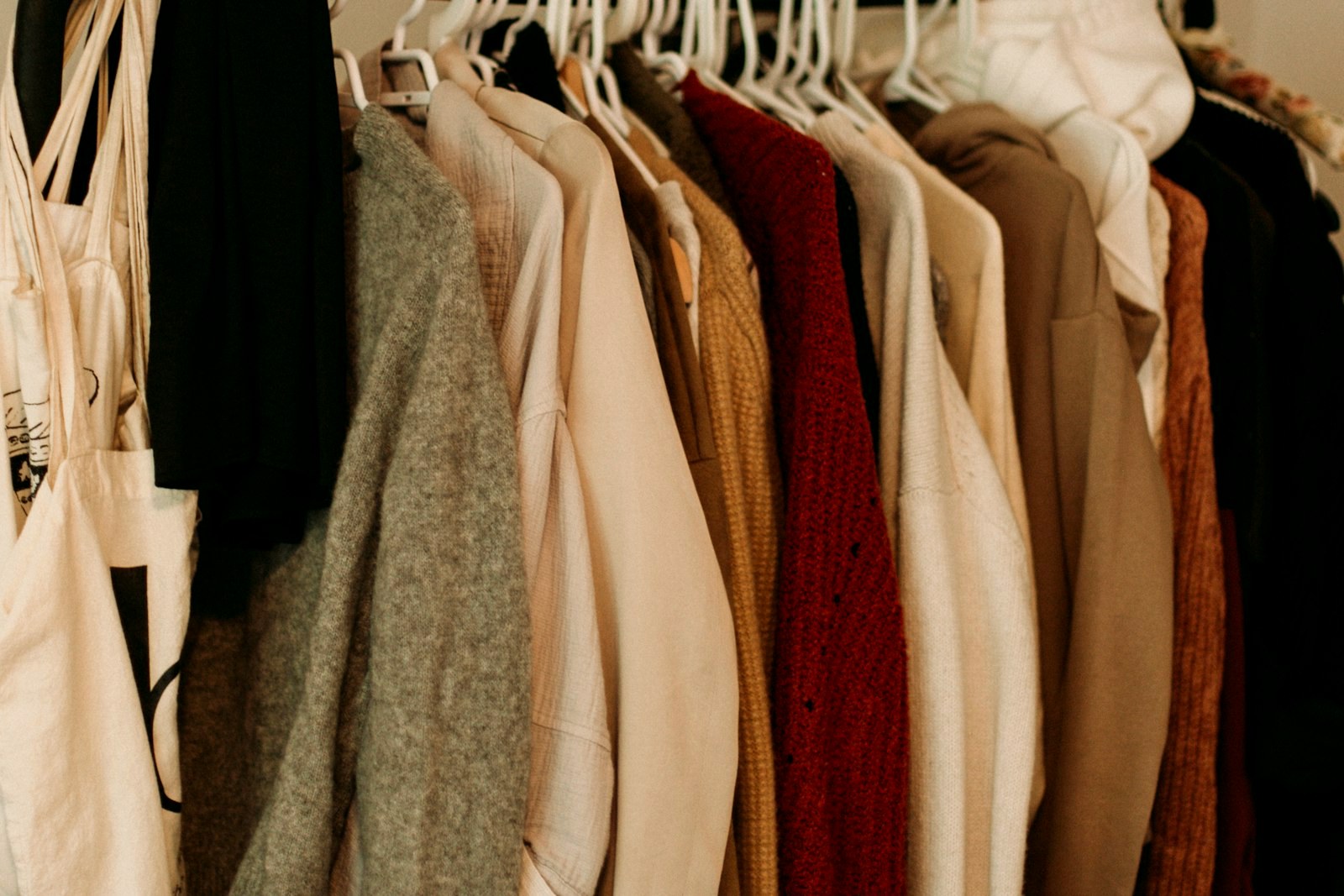
The wardrobe the garment moves through, captioned as exactly that: a rail of neutral coats. The quilted jacket's whole argument is positional, the layer that travels between the knits and the coats on this rail. Our bank holds no photograph of a quilted jacket in either species, and the care section prints that gap and the harvest list rather than dress a puffer or a waxed coat as the subject.
Checked and updated October 2026
The ruling, up front: the quilted jacket is the country jacket civilised, and the only insulated garment in the wardrobe that layers in both directions. It sits between its two neighbours on the record this site prints for each: the waxed jacket, a weatherproofed cloth with no insulation, ruled in No. 28, and the puffer, insulation at full loft, ruled in No. 27 and ranked in Verdict Card No. 46. The quilt is insulation with the loft pressed out of it, and the pressing is the point: stitched thin enough to go over a knit as outerwear and under a coat as a layer, the two postings no other warm garment can hold at once. One honesty entry before anything else: our jackets index files twelve types and this garment is not one of them. It owns no formality number and no warmth number there, and this brief assigns it none. Quilting is a construction, and this brief styles it as one, in its two species: the country diamond quilt and the liner jacket, which share a build and almost nothing else.
This brief: the decisive rule · the two species · the two-way stack · trousers and footwear · the ceiling · the looks · the mistakes · care and our photography
The decisive rule: the thinness is the mechanism
Begin with the construction, because the construction is the whole garment. A quilted jacket is two shells with insulation stitched between them in a grid, and the stitching is not decoration on the insulation. It is a decision about it. Every seam line pinches the fill to nothing at the stitch, parcel by parcel, which is why the puffer brief names the build plainly in its own field's record: the Down Sweater at 82 on Verdict Card No. 46 is built by patterned stitch-through quilting. The puffer at the top of that ranking insulates the other way, by loft: baffles drawn to hold air away from the body, graded on fill power and fill weight, the Eos at 88 publishing a 900-plus fill and its fill weight in the maker's table. Loft is warmth bought with volume. Stitch-through quilting is warmth sold back for profile. The quilted jacket is what remains when a wardrobe decides the profile is worth more: a thin insulated sheet that moves like cloth, folds like cloth, and disappears under other cloth.
That trade is this brief's decisive rule, printed as new: the quilted jacket is not a warm jacket that happens to be thin. It is a thin jacket that happens to be warm, and everything about wearing it follows from the order of those clauses. Its warmth is real and it is capped, capped by the same seams that make it useful, and the man who buys it as a winter coat has repeated the field jacket's specification error in a softer cloth: the sateen shell of No. 32 was a layer read as a coat, and the quilt is insulation read as loft. What the thinness buys, and buys outright, is position. In the Fall Edit's stack order, base, warmth, structure, weather, every other insulated garment can only hold the weather posting, the outside. The quilt holds the warmth posting too, inside the stack, under the structure and weather layers, which is why its wardrobe runs from the field to the inside of an overcoat without changing garments. It is the layering engine's insulated sibling: No. 32's field jacket climbs in warmth with what is under it, and the quilted jacket is very often the thing under it, and over the knit beneath that. The engine and its fuel are different garments. This brief styles the fuel.
The garment, against the records of its neighbours:
| The garment | Its record | What it contributes | Its posting |
|---|---|---|---|
| The quilted jacket | No index row: a construction, not one of the twelve types, and this brief assigns it no number | Insulation at cloth thickness: stitch-through warmth, capped by its seams, travelling in both directions | Warmth layer inside the stack, or light outerwear over a knit: the only insulated garment that holds both |
| The waxed jacket | The Barbour ranking's record, styled in No. 28: Filson 85, Barbour 81, Sylkoil published to the ounce | Weather: a waxed cloth that sheds, carrying no insulation of its own | Weather layer only: its warmth is whatever is layered under it, its liner sold separately |
| The puffer | Index formality 1, warmth 5; Verdict Card No. 46's field, Eos 88 to the Maya at 52 | Warmth at full loft: the coldest-week instrument, graded on the fill numbers its makers publish or withhold | Weather layer only: No. 27 refuses it anything tailored over it and the overcoat assembly outright |
| The field jacket | Index formality 2, warmth 3, the layering engine of the work family | Carriage and wind: four pockets and a sateen shell, issued over a quilted liner | Weather layer of the work family: the shell the quilt was first issued to insulate |
| The overcoat | Index formality 5, warmth 4; No. 20's length floor at the knee or below | Structure and dressed warmth: bought on the index's rule, to fit over a blazer | The structure and weather layers in one garment: the coat the liner species was drawn to serve |
The two species, separated
The rail sells two garments under this construction, and confusing them is the species error this brief exists to prevent. They share a build the way the field jacket's species share pockets: as mechanism, not as identity.
| Species | What it is | Its register | The ruling |
|---|---|---|---|
| The country diamond quilt | The founding species: diamond or box quilting on a matte shell, a proper collar often in corduroy, snap front, patch pockets, a vented back, cut at the hip as light outerwear | The field family's civilised end: the country wardrobe's jacket with the mud washed off it, one register below the waxed coat it hangs beside | The default and the first buy. It is outerwear and is judged as outerwear: worn over knits and shirts, closed against the shoulder seasons, and translated into town on the terms the ceiling section prints. Its founding house's record carries the species' caution, printed in the Barbour ranking: the quilted rails are the fashion end of that range, the end that does not publish cloth the way the waxed classics publish Sylkoil, so the species is bought on fit, fill and finish in the hand more than on paperwork, and this brief says so rather than pretend otherwise |
| The liner jacket | The insulation species: channel or box quilting, collarless or a low stand collar, zip front, no patch pockets to print through, cut close and a touch shorter than the coats it serves | A layer's register, not a jacket's: it takes the formality of whatever covers it, and worn alone it reads as what it is, the inside of something | The two-way species and the brief's second buy. Its home postings are inside the waxed country coats, whose systems sell it separately, and inside the overcoat, where it posts as the warmth layer under the structure. Worn alone on mild days it is legal and reads as minimal equipment; worn alone as a statement it is a coat lining at large. Buy it for the coats it will serve, in navy or black, and let it disappear |
| The fashion quilt | The construction redrawn as surface: oversized diamonds, glossy shells, cropped bodies, quilting printed or embossed on uninsulated cloth | Borrows the country species' read and the puffer's gloss at once, and cashes neither | The trap species, and its tell is the same tell No. 27 prints for the puffer: gloss is fashion, matte is equipment. A glossy quilt is the diamond's photograph, and a printed quilt with no fill behind the stitching is the feature resigned from its job, the issued garments' law from the pants index applied whole: a feature that stops working is a costume. Bought knowingly as a light fashion layer it is a legal garment. Bought as insulation it is the season's most padded disappointment |
On provenance, because this garment's is a position rather than a pattern. The quilted liner enters the written record of this site inside another garment's specification: the field jacket of No. 32 was issued over a quilted liner, the insulation its sateen shell never carried, and the waxed country system of No. 28 still sells its liner as a separate part beside the Bedale's $425 ticket. The country diamond quilt is the liner that escaped: the inside layer given a collar, pockets and a finished face, and promoted to outerwear for the seasons when the coat over it is unnecessary. That is the whole of its elegance and the limit of it. It was drawn to be the warm half of somebody else's system, and it wears best when it keeps the layer's virtues, closeness, quietness, indifference to being seen, even on the days it is the outermost thing on the body.
The two-way stack: over the knit, under the coat
The stack is the garment's home ground, and it runs in both directions from the middle of the Fall Edit's order. The field jacket of No. 32 tops a stack of base and warmth. The puffer of No. 27 tops a stack and accepts nothing over itself. The quilted jacket is the only insulated garment that can be posted at warmth, in the middle, with structure and weather still to come over it, and the only one that can step outward to weather when the day does not require the heavier coats. Worn well, it is less a jacket than a posting: the same garment, re-posted across the season as the stack around it changes.
Outward: over the knit. The bands are No. 09's and they transfer whole: fine gauge, roughly 24 to 30, under the liner species when the quilt is doing dressed work; mid gauge, 12 to 20, as the default warmth under the country diamond, the layer the fit law sizes the jacket over; heavy gauge, 7 and below, licensed under the diamond quilt on the cold rows, the country assembly it shares with No. 28's waxed species, chunky knit and a country shell as the deep shoulder-season uniform. The shirts sit beneath the knits or alone under the shell in the mild months, on the work family's rail the field brief prints: the Oxford on its dressed days, the flannel in the cold, the plain tee of the ranked class when the quilt is being carried as much as worn. The shirt question, asked of this garment specifically, answers itself by species: under the diamond quilt a collared shirt is the country register and reads correctly; under the liner, a collar stacks against the liner's collarless neck and the tee or the fine knit is the cleaner base. Two collars at one neck is the stack's smallest costume, and it is refused.
Inward: under the coat. This is the direction the whole species exists for, and it is ruled by the coat, not by the quilt. The overcoat of No. 20 is bought on the index's rule whole: buy it to fit over a blazer; a coat that only fits over a t-shirt is a costume. That allowance is the liner's budget. Posted under the overcoat in place of the day's heavier knit, the liner buys winter range for a coat whose own warmth is fixed at the index's 4, and it buys it invisibly, provided the under-coat test of the fit law is passed: the coat closes, its line unbroken, the quilt's grid nowhere printing through. Under the waxed country coats the posting is not an improvisation but the manufacturer's own architecture, the liner sold separately beside the waxed ticket on the Barbour record, and the assembly is the country system's cold setting entire. Under a blazer the liner owns the one dressed trick the FAQ prints: collarless, zipped away, a waistcoat's warmth without a waistcoat's statement. What never goes over a quilted jacket of either species is a second insulated garment: quilt under puffer is two insulation systems arguing in one stack, all bulk and no posting, and it is refused the way No. 27 refuses the overcoat over the puffer, as a category error rather than a taste.
The fit law, printed once and applied in both directions: the anti-puffer law. The puffer is bought with its volume argued for, loft needing room to stand. The quilt is bought against volume. Over the knit it should follow the body the way the country species' snap front invites, closed without strain over the mid gauge and never swimming over the fine; the diamond quilt worn open and oversized reads as a borrowed blanket with pockets. Under the coat it should vanish: a liner that announces itself through the coat's chest has failed its only examination. Size the country quilt over the mid-gauge knit you will actually wear. Size the liner under the coat you will actually serve. The two garments are bought on two different bodies, the day's and the coat's, and a man who owns both species owns the whole two-way argument.
Trousers and footwear: the country leg, translated
The trousers follow the species, and the colour order is ruled by them. Under the country diamond quilt the leg is the country wardrobe's own: corduroy on No. 24's terms for the cold rows, the fatigue and the chino in the mild ones, denim on No. 05's wash-break law as the family's home leg. Under the liner worn alone, the leg is the town's: dark chinos of the ranked class, the Spier & MacKay high-rise at 84 in its ranking as garment evidence, because a layer worn as outerwear borrows its register from everything around it and the chino is the cleanest lender it has. Wool trousers belong to the liner's inward posting, where the tailoring is the coat's and the quilt is invisible; worn under the diamond quilt as outerwear they spend formality the quilt cannot return, the same refusal the field brief prints at the leg, and they are refused there. The colour order, this brief's ruling, printed as new: the country quilt is bought olive first, the service colour of its whole family and the shade its diamond reads as equipment in; navy second, the town translation, the quilt's city colour; black last and only matte, black being the liner's colour before it is the diamond's, and a black diamond quilt in gloss is the fashion species wearing the country's pattern. The liner reverses the order: navy first, black second, both bought to disappear, and olive only where the coat it serves is a country coat that can carry the note.
The footwear: boots at home, and the town translation. The country species stands over boots the way its waxed sibling does in No. 28: the plain work boot and the lug-soled Chelsea of No. 15's scale, the lug at 2.5 taking its native posting under a country shell, the suede Chelsea at 4 on dry town ground. The translation question, when the diamond quilt reads field and when it reads town, is answered by the whole outfit rather than by the jacket: the same navy diamond that reads field over corduroy and lug boots reads town over dark chinos and suede, because the quilt is a quiet garment and takes the register of its company, which is the civilised half of its nature. The sleek calf Chelsea at 4.5 is refused under the diamond quilt for the field brief's reason, a dressed shoe travelling down to visit, and licensed only under the liner's inward posting, where the shoe answers the coat and not the quilt. Sneakers close the rail on No. 12's scale, the clean leather court shoe at 3 under the liner worn alone or the diamond on its mildest rows. The loafer is refused under the country quilt and admitted under no quilted outerwear: ease beneath insulation reads as the outfit giving up at the ground, the one pairing in the matrix with no honest read, printed as a refusal rather than left for the matrix to imply.
The ceiling: a layer's ceiling, in both directions
Plainly, as the garment's unnumbered state requires: the quilted jacket owns no rung of its own, so its ceiling is set by its posting. Posted inward, under a coat, it has no ceiling of its own at all: it can stand inside the overcoat's formality 5 rooms because in those rooms it is not being read, and a layer's discretion is its whole virtue. Posted outward, as the country species, its ceiling is the country wardrobe's town row: the smart-casual room, the dressed lunch in a country town, the office whose code is the chore coat's and the Harrington's rather than the blazer's. There the navy diamond over a fine-gauge knit is not a casual substitute for a better jacket. It is the correct instrument, the civilised end of the field family doing the job the waxed coat does too loudly indoors and the puffer does too warmly.
Where it stops, in both directions. Upward, it stops at tailoring worn as company: the blazer over the diamond quilt and the tie over either species are refused on the FAQ's arithmetic, the tie living at formality 4 and above in a wardrobe where the quilt files nowhere, and a garment with no number does not get to borrow the tie's. The liner's dressed trick, zipped away under the blazer, is a layer serving tailoring, not a quilt attending in its own right, and the distinction is the garment's honesty entire. Downward, it stops at weather and at cold, and the stops are cloth law. Its shell sheds a shower the way every finished shell does, briefly and on credit; the index owns a rain instrument for standing rain, and No. 28's wax is the country wardrobe's own shed layer, with the quilt posted under it rather than instead of it. And its warmth, capped by its seams, stops where the puffer's begins: the coldest week of the year belongs to loft, the Eos's published 900-plus fill and the field of No. 46, and a quilted jacket worn as the answer to that week is the specification error this brief opened with, insulation read past its construction. The quilt's empire is the long shoulder seasons and the inside of other coats. Inside that empire it is close to irreplaceable. Outside it, it is a layer pretending, and the wardrobe owns better pretences.
The costume line, printed plainly. The country diamond quilt carries a heritage charge its liner sibling escapes: tweed's neighbour, the shooting party's silhouette, a whole ready-made countryman sold in one garment. Worn as equipment, one piece of the country wardrobe at work among town clothes, it is this brief's subject and it is a good one. Worn as a costume, the full assembly at once, diamond quilt over tweed over corduroy over boots, in a city where none of it is working, it is the issued garments' law in reverse: every feature present, none of them doing its job, a uniform of leisure rather than of work. The rule that keeps the garment honest is the field brief's rule translated: one heritage signal at a time. The quilt is the signal. Everything else in the outfit is contemporary and quiet, and the moment the outfit starts agreeing with the jacket about the countryside, the man has dressed as a place rather than for a day.
The looks: the layer, worn
Four assemblies from this brief's rulings, each built on the records around the garment. No quilted garment is scored in this brief; the numbers in the judgments are the neighbours' records, reproduced from their own pages.
| Setting | The jacket | With | The judgment |
|---|---|---|---|
| The country default | Olive diamond quilt, snapped closed | A mid-gauge crew in ecru, corduroy trousers, lug-soled Chelsea boots | The species in its home register: the knit the fit law sizes it over, the cord leg on No. 24's terms, the lug boot at its native posting. The assembly No. 28's waxed species wears in worse weather, at one weather grade less and one comfort grade more |
| The town row | Navy diamond quilt, open over the layer | A fine-gauge roll neck folded once, dark navy chinos, suede Chelsea boots on a dry day | The translation entire: every companion garment at the town end of its own register, the quilt reading as the civilised country note rather than the field. The chino is the ranked 84 class; the boot is No. 15's suede at 4, licensed by the dry ground |
| The inward posting | Black liner jacket, zipped, under a navy overcoat | A fine-gauge knit beneath it, wool trousers, the coat closed over all of it to No. 20's length floor | The two-way argument's proof: the overcoat bought over a blazer spends its allowance on the liner instead, its fixed warmth 4 extended into the puffer's weather without a baffle in sight. The quilt is doing the most work in the outfit and is the only part of it nobody sees |
| The mild day alone | Navy liner jacket worn as outerwear, open | A plain tee of the ranked class, stone chinos, clean leather court sneakers | The liner's legal solo posting: minimal equipment over the summer leg, the sneaker at No. 12's court 3. The row works because nothing in it asks the liner to be a coat; it is a layer, worn outermost on a day that needs exactly one |
The ruling
Buy the country diamond quilt first, in olive, matte, sized over the mid-gauge knit you will actually wear under it, judged by the fit law before the mirror gets a vote: close over the knit, silent at the snaps, the grid lying flat because the fill behind it is working. Buy the liner second, in navy or black, sized under the coat it will serve, and judge it by the under-coat test alone: the coat closes, the line holds, the quilt is nowhere. Wear the diamond as the country wardrobe's civilised outer layer through the long shoulder seasons, over knits and under nothing, translated into town by the company it keeps. Wear the liner as the wardrobe's travelling warmth, inside the waxed coats whose makers sell it separately and inside the overcoat whose allowance it spends, the one insulated garment the tailored stack admits. Refuse the fashion quilt whose stitching holds no fill, refuse the reproofing spray sold against a garment with no wax, refuse the oversized fit that fails both directions of the stack at once, and refuse the heritage assembly that dresses as a place. Every failure of this garment is a refusal of its construction: loft expected of a stitched sheet, weather expected of a finish, a number expected of a garment the index honestly leaves unnumbered. Worn on its record, the quilted jacket is the wardrobe's diplomat, the layer that goes everywhere the puffer cannot and under everything the waxed jacket needs, and its honesty is testable in the shop with two hands: close it over the knit, then close the coat over it. The thinness is not the compromise on the ruling. The thinness is the ruling.
The mistakes
Bought as a winter coat. The first and commonest error, and the one the decisive rule exists to prevent. The quilt's stitch lines are thermal bridges drawn across its whole surface, and no fill behind them changes the arithmetic: the garment was pressed thin on purpose, for position, and deep cold is the posting it traded away. The man shivering in a diamond quilt in the coldest week of the year is wearing the puffer's job in the liner's cloth, and the fix is not a thicker quilt, which is only a worse puffer, but the honest division of the wardrobe: the quilt for the shoulder seasons and the inside of coats, the baffled field of No. 46 for the week the temperature makes the decision for him.
The reproofed quilt. A small fraud with a spray can. The waxed jacket's maintenance, re-waxing, belongs to a cloth whose weatherproofing is a renewable substance worked into its fibres, and No. 28 prints that law whole. The quilted shell's water resistance is a finish applied at the factory, kin to the finishes the puffer Card watches decay across a wash count, and no aftermarket spray restores a substance that was never in the cloth. The man who reproofs his quilted jacket has bought the waxed garment's ritual for a garment with a different physics, and the first standing rain files the correction: the quilt goes under the waxed coat or under the ranked rain shell, where its insulation was always supposed to work, dry because something else is doing the shedding.
The liner worn as a statement. The liner species' solo posting is legal on mild days and narrow even then, and the mistake is promoting it: the collarless zip front presented as minimalism at rooms and temperatures that read it correctly as the inside of a coat. A layer's elegance is discretion, and a liner worn where it will be studied has been posted wrong in the outward direction just as surely as a diamond quilt stuffed under a blazer is posted wrong in the inward one. The species are bought for different bodies and different days, and the wardrobe that owns only the liner, because it photographed cleaner, owns half the argument and the colder half of the year is not in it.
The heritage assembly, entire. The costume the ceiling section names, worn unknowingly: diamond quilt, tweed cap, corduroy, boots, a dog optional and somehow present, in a city where the whole cast is decorative. Each garment in the assembly is honest in its own posting, and the failure is arithmetic, five heritage signals summing to a fancy-dress countryman no single one of them intended. The quilt is the signal the outfit gets. The rest of the outfit is the man's own century, quiet and contemporary, and the test is the one this series applies to every issued and inherited garment: the features are tools, and an outfit in which nothing is working is a costume, whatever its individual prices were.
Care, and the two laws that are not this garment's
The quilted jacket's care begins by refusing its neighbours' rituals, because the country wardrobe hangs three different maintenance laws on one rail and applying the wrong one is the commonest way these garments die. The waxed law is not this garment's: nothing on a quilted jacket is re-waxed, re-proofed or fed; there is no substance in its cloth to renew, and No. 28's sponging and re-wax cycle belongs to the Bedale and its family alone. The down law is only partly this garment's: where the fill is down, the puffer record's maker terms apply in full, the low tumble dry with balls to re-loft and the loose storage, because a stitched parcel of down dies compressed exactly as a baffle of it does. Where the fill is synthetic, which is most of the country species, the terms are simpler and they are the maker's own.
The maker's terms, as published for the founding line: machine wash at 30, wash separately. That is the whole of the country quilt's washday, printed on the care panel of the house that founded the species, and it is worth pausing on how unceremonious it is next to the waxed ritual: this garment was built to be washed like the layer it is. Wash it cold and infrequently all the same, because its shell's finish is spending itself a little with every wash, the decay the puffer Card prints for water-resistant finishes, and a quilt washed monthly is a quilt retiring its weather credit early. Between washes it asks for the layer's small attentions: the cord collar brushed, the snaps checked the way this series checks the pea coat's buttons, a loose stitch at a grid corner caught before the parcel behind it migrates, the whole garment hung by its shoulders and never crushed into the bottom of a drawer, synthetic or down, because a crease pressed into stitched insulation is a thin spot the next cold day will find.
The liner's care is its coats' care, read in reverse. A liner that serves inside a waxed coat picks up the country system's weather on its face and is sponged, not soaked, at the season's turn; a liner that serves inside an overcoat lives a clean indoor life and is washed on the down or synthetic terms above at the season's end, dried fully before storage, and stored with the coat it serves so the system is never separated by a house move or a borrowed rail. None of this is precious. It is the position this site takes on every garment it rates: the care is printed because the lifespan is part of the verdict, and this garment's lifespan is long precisely because its maintenance is small, provided the small maintenance is its own.
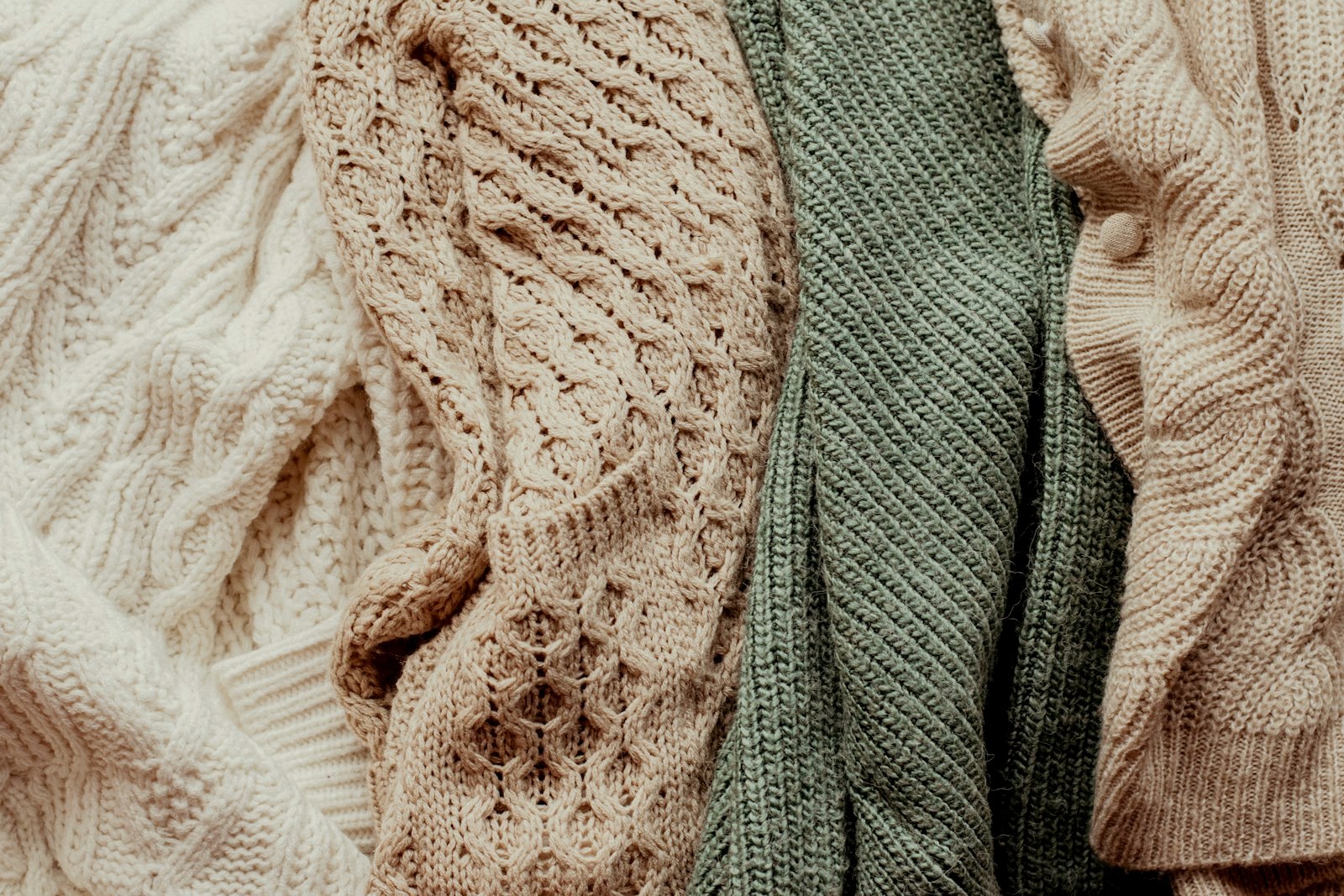
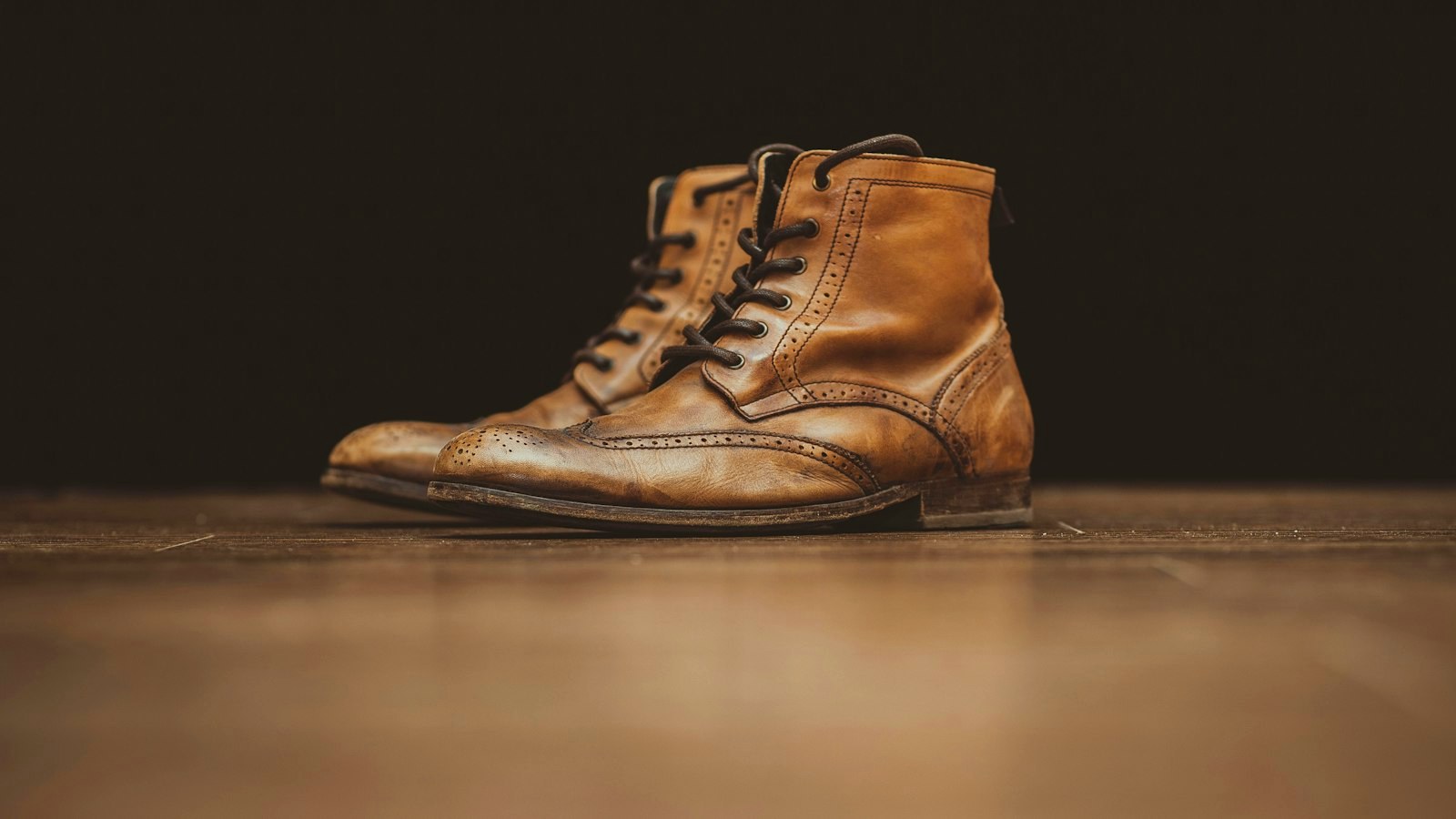
A note on our own photography: our photo bank holds no quilted jacket frame in either species. There is no diamond quilt on a body, no liner disappearing under a coat, no stitched grid at macro range with its fill behind it. The hero is the wardrobe rail the garment travels along, captioned as the rail it is; the figures inside are the knit layer it runs over and a pair of country boots, captioned as a layer and as footwear. This page will not caption a puffer, a waxed coat or a padded fashion jacket as the quilted jacket to fill the slot, and it will take the harvest frames the week they exist: the navy diamond worn in town over a fine knit, the liner half-zipped under an overcoat's open front, and the grid at macro range where the stitch-through pinch this whole brief argues from can actually be seen.
Questions, answered
What is a quilted jacket?
A garment defined by its construction rather than by a pattern: two shells with insulation stitched between them in a grid, diamond or box or channel, the stitching holding the fill in parcels. Our jackets index files twelve types and the quilted jacket is not one of them: it owns no formality number, no warmth number and no buying rule there, because quilting is a way of building insulation, not a species of coat. In the wardrobe it appears in two species: the country diamond quilt, collared and snap-fronted, cut as light outerwear, and the liner jacket, collarless or nearly so, drawn to be worn inside another coat. This brief styles both, on the records the site prints for the garments around them.
Quilted jacket or puffer: which is warmer?
The puffer, and the puffer's own record says why. The puffer stands at formality 1 and warmth 5 on our jackets index and insulates by loft: baffles sized to the cold, fill power and fill weight the deciding numbers, the Feathered Friends Eos at 88 and the Rab Microlight Alpine at 84 the fullest published records on Verdict Card No. 46. The quilted jacket insulates by stitch-through construction, the build the puffer brief names in the Down Sweater's record, patterned stitch-through quilting: the seams pinch the fill at every line, which caps the warmth and buys the profile. The quilt is the warmest thing that still fits under a coat and the thinnest thing that still works over a knit. Standing still below freezing, loft wins and it is not close. In the shoulder seasons, and wherever a layer has to travel in both directions, the quilt is the instrument.
Quilted jacket or waxed jacket: what is the difference?
Neighbours in one country wardrobe, separated by mechanism and by washday. The waxed jacket, ruled whole in How to Wear No. 28 on the Barbour ranking's record, Filson at 85 and Barbour at 81 with the Bedale at $425 in 6-ounce Sylkoil, is a weatherproofed cloth carrying no insulation of its own: wax sheds rather than seals, and the warmth is layered underneath it. The quilted jacket is insulation carrying no weatherproofing worth the name: its shell holds a finish, not a seal, and in standing rain the rain law applies, taped seams and a named membrane or it wets through in twenty minutes. The two garments share architecture: the waxed system sells its liner separately, and that liner is a quilted jacket. Their care divides absolutely, and this brief's care section prints the boundary: the waxed jacket is re-waxed and never washed; the quilted jacket is washed and never re-waxed.
How should a quilted jacket fit?
Close, because the insulation is thin: the anti-puffer law. A puffer's volume is its mechanism, loft held off the body in baffles; a quilted jacket's mechanism is a thin insulated sheet, and volume in it is only air standing where warmth should be. The test is the stack test this series prints for the field jacket, run in both directions. Over: the jacket should close over the mid-gauge knit of No. 09's bands, 12 to 20, without strain and without swimming. Under, for the liner species: the coat it serves must close over it with the quilt's grid nowhere printing through the coat's line. A quilted jacket bought oversized for ease fails both tests at once, too loose to insulate as outerwear and too bulky to disappear as a layer.
Can you wear a quilted jacket under a coat?
Yes: it is the one insulated garment that can, in the direction the puffer is refused. How to Wear No. 27 refuses the overcoat over a puffer outright, because loft under a tailored coat breaks the coat's line at every seam. The quilted liner is drawn for exactly that posting: thin, close, collarless or low-collared, its warmth arriving without a silhouette. The overcoat it serves is bought on the jackets index's rule, to fit over a blazer, and the liner spends part of that layering allowance in place of a heavier knit. Under the waxed country coats it is not a styling trick at all but the system's own part, the liner the waxed record prints as sold separately. Rule the assembly by the coat: the quilt disappears, the coat keeps its line, and the stack keeps the Fall Edit's order, base, warmth, structure, weather, with the quilt posted as the warmth layer.
Can you wear a quilted jacket with a blazer or a tie?
The species decide. The country diamond quilt worn over a blazer fails the way every field garment fails over tailoring: patch pockets and a snap front drawn over a tailored shoulder read as equipment worn over a decision. The tie is refused over the quilt itself in both species; it lives at the index's formality 4 and above, and no quilted garment files there. The liner species owns one dressed trick, and it is a layer's trick rather than a jacket's: collarless and zipped away between a shirt and a blazer, it does a waistcoat's warmth job without a waistcoat's statement, provided the blazer closes over it as cleanly as the under-coat test requires. What neither species does is replace the blazer. Worn as outerwear, the quilted jacket's dressed ceiling is the country wardrobe's town row: a fine-gauge knit, dark chinos, and the diamond quilt reading as the civilised end of the field family.
How do you wash a quilted jacket?
By its own law, which is neither the waxed law nor the down law whole. The synthetic country quilt washes: the founding house's published care for its quilted line reads machine wash at 30, wash separately, and there is no re-proofing anywhere in the panel, because there is no wax to renew. A reproofing spray sold for a quilted jacket is the waxed garment's maintenance mis-sold; the quilted shell's finish fades across washes, the decay the puffer Card prints for water-resistant finishes generally, and when it fades the garment is a layer again, honestly. The down-filled liner follows the down record's maker terms instead: a low tumble dry with balls to re-loft the clusters, and storage loose, never stuffed, because loft dies compressed a season at a time. And the boundary runs both ways: never put the waxed jacket through this garment's wash. The two country garments share a wardrobe and no washday.
Has Young Cotton ranked quilted jackets?
Yes, since Verdict Card No. 53 ranked seven quilted jackets on their published fills, the Montbell Superior Down Jacket winning at 87. This brief predates the Card; what existed in print when it was written is the garment's record across the site: the jackets index files its twelve types with the quilted jacket absent, a construction rather than a type; the Barbour ranking prints the founding house's quilted rails as the fashion end of its range, the end that does not publish cloth the way its waxed classics publish Sylkoil; the waxed brief styles the liner the waxed system sells separately; the puffer Card grades stitch-through quilting inside the Down Sweater's record at 82; and this brief is the wearing system those records imply, the two species, the two-way stack, the fit law and the outfit matrix, printed so any quilted jacket can be judged on the wearing, with the Card now judging the buying.
Next
The garment's absence from the twelve types, and the ladders it is argued against, are printed whole in the jackets index. Its weather neighbour is ruled in How to Wear No. 28 and ranked in Brands Like Barbour; its loft neighbour is styled in No. 27 and ranked in Verdict Card No. 46. The shell it insulates is briefed in No. 32, the coat it disappears under in No. 20, and the stack both postings belong to is ordered in the Fall Edit. The layers at its collar are ruled in No. 08 and No. 09; the boots beneath its country species are ruled in No. 15.