
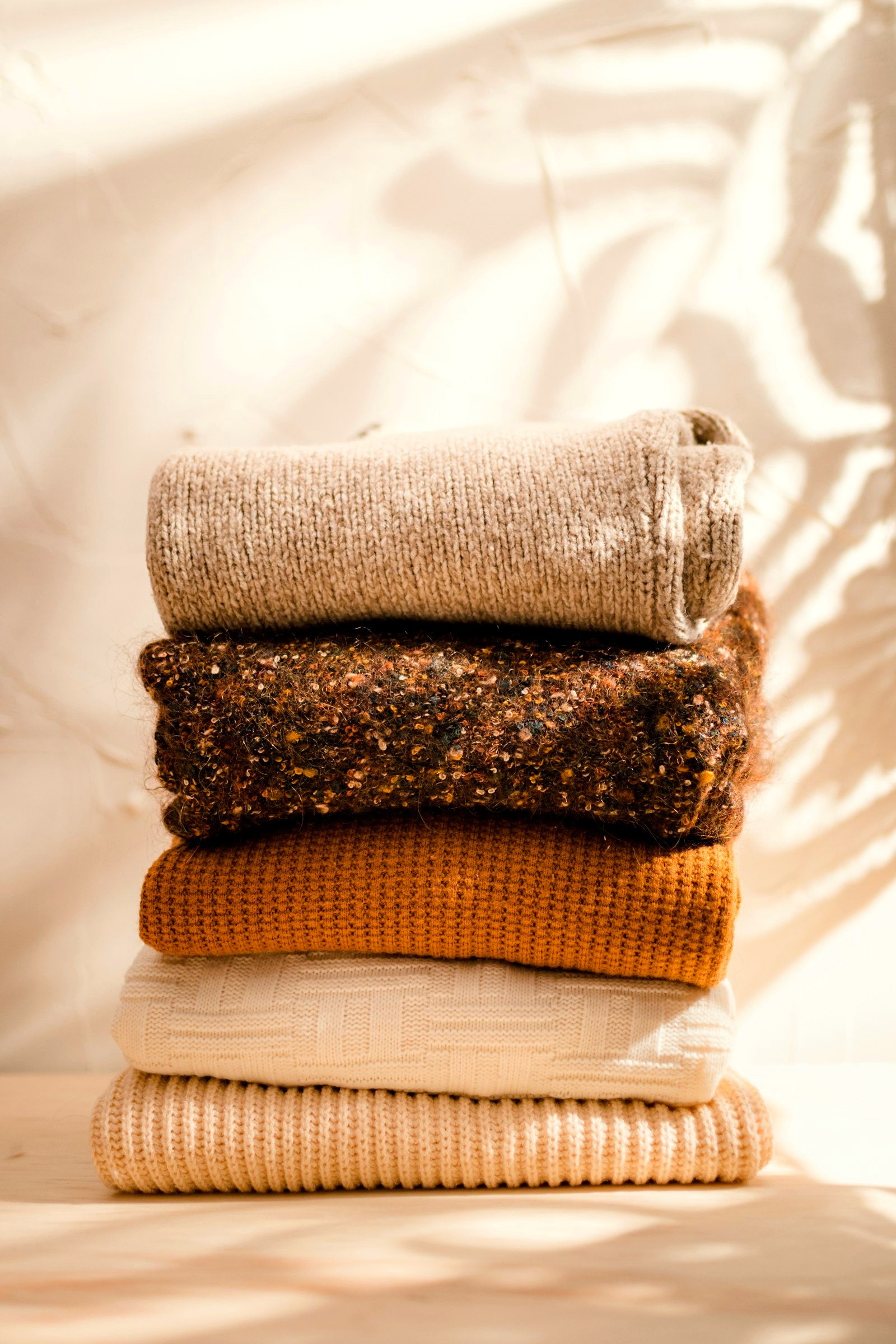
The layers, captioned as exactly that: a folded stack of knits in the field jacket's own earth tones. The field jacket is the layering engine of its family, and this is what it runs over. Our bank holds no photograph of a field jacket in any species, and the care section prints that gap and the harvest list rather than dress a different jacket as the subject.
Checked and updated October 2026
The ruling, up front: the field jacket is not a coat with pockets. It is a layering system with a shell, and it is worn on the numbers our jackets index prints for it: formality 2, warmth 3, cotton sateen, season spring and autumn, over layers, bought on the index's rule, printed whole: four pockets you will actually use, cut closer than the surplus original. The index calls it the layering engine of the work and field family, and the engine is the doctrine of this brief: its warmth 3 is a base number that climbs with what is under it, its four bellows pockets are tools with an expansion budget, its drawstring waist is a fit instrument, and its formality 2 is a ceiling that no styling promotes it past. A note on the number itself: this brief was announced beside the pea coat, and the pea coat already owns a full brief, How to Wear No. 19, which stands untouched. The field jacket was the family's unwritten brief, and it is written here.
This brief: the decisive rule · the three species · the pocket law · the stack it runs · trousers and boots · the ceiling · the looks · the mistakes · care and our photography
The decisive rule: warmth 3 is a base number, not a verdict
Every other jacket on the index carries its warmth in its cloth: the pea coat in melton's density, the puffer in its fill, the Harrington in almost nothing, honestly. The field jacket is the exception the index prints in its own prose: a warmth of three that climbs with what is under it. Read that sentence as the garment's whole design brief. The sateen shell contributes wind resistance and abrasion armour and almost no insulation. The warmth of the outfit is built underneath it, layer by layer, which is why the index files its season not as a temperature but as a configuration: spring and autumn, over layers. A field jacket bought to be warm by itself has been bought against its record, and it will disappoint in exact proportion to the cold. A field jacket bought as an engine, sized over the stack and closed over it, covers more of the year than coats with higher numbers, because its number is adjustable and theirs are fixed.
The fit test is the stack test, and it is this brief's own ruling, printed as new. The index's rule has two halves and both are fit instructions. Cut closer than the surplus original is the ceiling: the issue pattern was drawn to close over a uniform, a quilted liner and everything a soldier carried, and that volume over civilian clothes is the borrowed-uniform read named in the mistakes. Over layers is the floor: a field jacket that only closes over a tee has been sized as a shirt with pockets, and it will strain over the mid-gauge knit that autumn actually requires. The test in the shop is the same test No. 19 sets for its coat, translated down the calendar: wear the heaviest layer the garment will honestly cover, in this case the mid gauge of No. 09's bands, load the pockets flat, and close the front. No strain at the zip, no swimming at the shoulder. The drawstring waist then does the fine work across the season: cinched over a tee in spring, it gives the shell a waist; released over a knit in autumn, it returns the room the layer needs. One jacket, two settings, and the string is the adjustment, not a decoration.
The numbers, against the family it heads:
| The jacket | Formality | Warmth | What the numbers mean |
|---|---|---|---|
| The field jacket | 2 | 3 | The subject. The family's layering engine: the only type on the index whose warmth is printed as a variable, climbing with the stack under it |
| The chore coat | 2 | 2 | The same rung, one warmth point lower and a softer read: the workshop's jacket, patch pockets on canvas, the family's quiet-room member per How to Wear No. 13 |
| The bomber | 2 | 3 | The same two numbers by the opposite mechanism: warmth carried in its own cropped body, nothing layered, nothing carried. The field jacket is the bomber's numbers with a job attached |
| The leather jacket | 3 | 3 | The same warmth one rung up: the hide buys the formality point the sateen cannot, which is why leather is the family's dressed exit and the field jacket is not |
| The rain shell | 1 | 1 | The instrument the field jacket is confused with in wet weather: warmth 1 by design, all seal and no insulation, worn over the stack the field jacket would have topped |
The three species, separated
The rail sells three garments under this name, and they share a pocket layout the way the pea coat's species share buttons: as furniture, not as identity. The species error is buying the silhouette in the wrong cloth and discovering the numbers were the cloth's all along.
| Species | What it is | Its numbers | The ruling |
|---|---|---|---|
| The sateen original | The M-65 pattern as the index files it: cotton sateen or the cotton and nylon cloth, four bellows pockets, drawstring waist, concealed hood in the collar, zip and storm flap, cut over layers | Formality 2, warmth 3, the index's own numbers for the type | The default and the first buy, and the only species this brief's matrix is written for. Olive is its honest colour, the service colour, with field tan and stone as its civilian translations. Judged by the index's rule: pockets that will be used, cut closer than surplus |
| The waxed field coat | The same architecture weatherproofed: the four-pocket field pattern cut in waxed cotton, the British and American country species, game pockets where the bellows were, a corduroy collar against the neck | Ruled by How to Wear No. 28 on the waxed record: its house stands in the family rankings, the Tom Beckbe card at 72 tagged the American field jacket, a brand score, printed there and touched nowhere here | The weather species, and the separation matters: waxed cloth sheds where sateen only layers, and its care is the waxed law, re-waxed and never washed, against sateen's washability. It is this garment's wet-weather form, not a different wardrobe's coat, and No. 28's brief governs its wearing whole |
| The fashion field jacket | The pocket layout redrawn as silhouette: four flapped pockets, often flat or sewn shut, on suede, linen blends or fashion cotton, cut slim, the safari and utility jackets of the high street | Below the type's numbers in practice, this brief's grade, printed as new: the pockets fail the index's use test and the cloth fails the family's first law, so the formality 2 it borrows is a claim the garment cannot cash | The trap species, because it photographs like the original and performs like a shirt. Its tell is the pocket: press one, and it is a flap over nothing. Bought knowingly as a light overshirt-weight layer it is a legal garment. Bought as a field jacket it is the season's most decorated disappointment |
On provenance, because this garment's is unusually functional. The American ranking prints the field jacket in its founding list, among the garments America invented as equipment and priced as tools, and the pattern's every famous feature is a job: the bellows pockets for carried kit, the drawstring for a waist that changed with the load, the hood folded into the collar against weather that had not been forecast, the sateen woven tight because it had to survive being lived in. The Japanese ranking prints the pattern's second life: houses like OrSlow rebuilding military patterns in Japanese mills to a standard the originals never reached, provenance as workmanship rather than as costume. None of this is scored, and none of it asks to be re-enacted. It is printed because it explains the garment's working property, the one the index names first: it was built to be used, and it reads wrong exactly when it is not being used, which is the pocket law of the next section.

The pocket law: four pockets you will actually use
The buying rule's first half is a use test, and this brief prints it as the garment's constitution: four pockets you will actually use. The bellows pocket is the pattern's signature because it is a piece of engineering, a flat pocket that expands on pleated sides to swallow a carried load and lies flat again when the load is gone. The pants index prints the law for all the issued garments in one sentence: the features are tools, and a feature that stops working is a costume. Applied here, the law has three readings. A pocket that carries is architecture. A pocket stuffed to manufacture a silhouette is a lie told in cloth, the load replaced by padding. And a pocket sewn shut, or a flap sewn over nothing, is the fashion species' confession, furniture that has resigned from the garment's job while keeping its uniform.
What legitimately lives in them, because the question decides the fit. The two chest pockets take the flat day: notebook, phone, glasses, the things carried against the body. The two skirt pockets take the hand-sized day: gloves, keys, a folded map, the dog's lead. Loaded that way, flat and distributed, the pockets disappear into the pattern's read, which is the test: a working field jacket looks no fuller loaded than empty, because the bellows were drawn for exactly that load. What the pockets are not is luggage. The travel look in the matrix uses them as a day system inside a carried bag's orbit, not as a substitute for the bag, and the man who boards a plane wearing his whole itinerary in four pockets has confused the engine with the cargo. Carry the day. Check the week.
The rest of the furniture, ruled briefly. The storm flap over the zip is weather furniture: buttoned in wind and rain-spray, open in mild air, always a fastening and never a trim. The epaulettes were strap keepers and are now the pattern's memory of one; on the sateen original they are small, flat and silent, and the moment they grow buttons, braid or shine they have joined the costume named in the mistakes. The concealed hood is the honest piece of the kit: invisible in the collar for the ninety days it is not needed, and on the day it is needed it is worth every gram of the collar's bulk. Judge a candidate by it the way the index judges the rain shell by its seams: if the hood is a decorative roll with a drawstring to nowhere, the maker has kept the silhouette and resigned from the specification, and the jacket will do the same in every other particular.
The stack it runs: base, warmth, and the shell on top
The field jacket is the weather layer of the Fall Edit's four-layer order, base, warmth, structure, weather, with one structural difference from the pea coat's posting: there is no structure layer under it. Nothing tailored goes beneath a formality 2 shell, so the stack it completes is base and warmth only, and the outfit under it has to be complete at two layers, which the Fall Edit's test enforces without appeal: if taking the jacket off ruins the outfit, the stack was a costume, not a system. Under a field jacket the knit and the trouser are the outfit. The jacket is their roof and their transport.
The knits: the full gauge range, rationed by season. The bands are No. 09's and they transfer whole: fine gauge, roughly 24 to 30, for the town rows and the mildest days, the roll neck folded once under the collar on No. 08's rule; mid gauge, 12 to 20, as the default warmth layer, the knit the stack test sizes the jacket over; heavy gauge, 7 and below, licensed on the cold rows where the drawstring releases to admit it, the same assembly No. 28 prints at full strength for the waxed species, the chunky knit and the field jacket as the deep-cold country assembly. The sateen original runs that assembly as a fair-weather version of it: all of the layering, none of the wax's weather seal, which is the honest boundary between the two species and is printed in the ceiling section as weather law.
The shirts: the working rail. Under the knit, or alone under the shell in spring, the shirt rail is the work family's own: the Oxford on its dressed days, the flannel in the cold months, the plain tee of the ranked class when the day is warm and the jacket is being worn as carried shade and pockets. The overshirt sits on the family's border the index prints, a layer rather than weather protection, and under a field jacket it doubles the pocket architecture to no purpose: two utility systems in one outfit is the surplus error worn in layers, and it is refused. One working garment per outfit carries the tools. The other layers carry the man.
Trousers and boots: the issued leg and its alternatives
The fatigue is the jacket's own trouser, and the index files the pair together. The pants index gives the fatigue pant the field jacket's own cloth and number: cotton sateen, formality 2, patch pockets and a straight leg, kept honest, with the jacket's season logic in its hem rule, taper a little if you must, taper a lot and the garment is gone. Worn together, sateen over sateen in the service colour or one tone removed, the two issued garments read as what they are: a working uniform civilianised by fit, and the colour rule is the trucker's rule translated, a break between the surfaces, olive over stone, olive over tan, never olive over its own exact shade, where the outfit stops being two garments and becomes a costume of one idea.
Chinos hold the town rows. The chino is the leg that takes the field jacket furthest into the city: the ranked class of How to Wear No. 29, the Spier & MacKay high-rise at 84 in its ranking, garment evidence, in stone and navy under the olive shell. The pairing works because the chino's twill answers the sateen's weave at the same formality, and because the chino's cleaner leg sets off the jacket's furniture by contrast. Denim runs on How to Wear No. 05's law as the family's home leg: dark indigo under olive is the classic break, the two work cloths separated by colour the way the index's trucker rule separates them by wash. Corduroy takes the cold rows on No. 24's terms, the winter trouser under the country assembly. Wool trousers are the refusal at the leg: the tailored trouser under a formality 2 shell spends its formality on a jacket that cannot return it, the chino span's hovering error from No. 29 worn at full length, and it is refused for the same reason the blazer is refused above it.
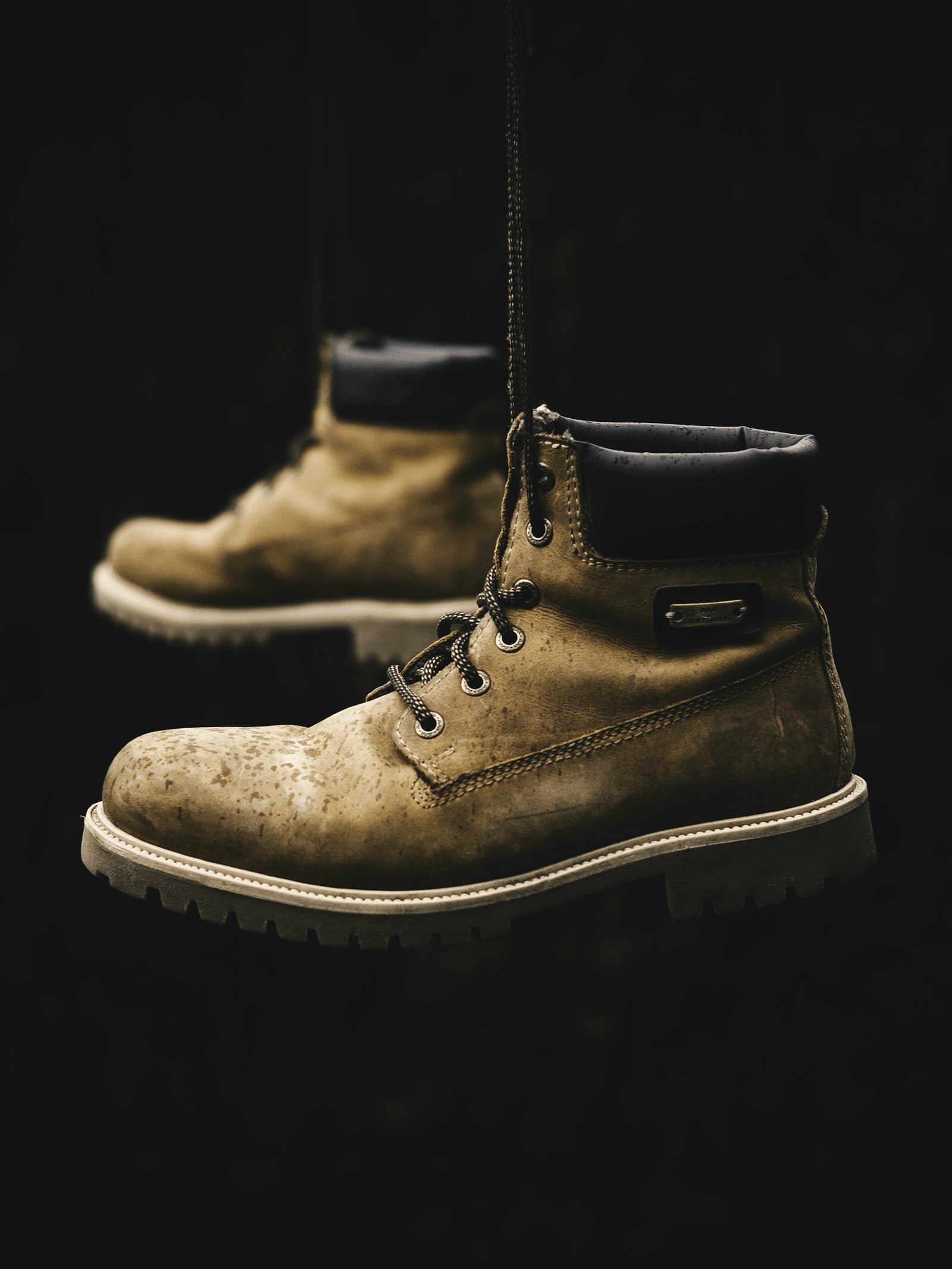
The boots: the lug is home here. How to Wear No. 15's scale grades the Chelsea species, and under this jacket the order of merit inverts the dressed wardrobe's: the lug-soled boot at 2.5, the species No. 15 files as a different animal, is the field jacket's native footwear, a working sole under a working jacket, both garments reading as equipment honestly worn. The plain work boot stands beside it as the fatigue's own partner. Suede Chelsea at 4 takes the dry town rows, its nap answering the chino leg. The sleek calf at 4.5 is refused, not for its height but for its direction: it is a dressed shoe travelling down to visit, and the notch arithmetic that governs loafers and shorts has no purchase here, because the clash is of register, not of rungs. Sneakers close the rail on No. 12's scale, the clean leather court shoe at 3 as the travel row's ground, canvas below it for the field rows in summer. The loafer is refused outright: a slip-on built for ease under a jacket built for loads is the one pairing in the matrix with no honest read, and this brief prints the refusal rather than let the matrix imply it.
The ceiling: formality 2, and what it stops
Plainly, as the number requires: the field jacket works exactly where formality 2 is the room's code, and its empire is larger than the number suggests, because its empire is not rooms at all. It is the shoulder seasons outdoors: the field, the site, the dog, the market, the train platform, the working day spent moving between inside and outside. In those places it is not a casual substitute for a better jacket. It is the correct instrument, the one the index's three-jacket set implicitly assigns to the weather-and-work storey, and the dressed coats are the substitutes there, overdressed and under-pocketed at once.
Where it stops is structure, in both directions. Over a blazer it fails the way the pea coat fails over a suit, by silhouette: four bellows pockets and a drawstring waist drawn over a tailored shoulder reads as equipment worn over a decision, and the blazer's line breaks at the collar, the chest and the hem simultaneously. Under a blazer it fails by bulk, a working collar and storm flap stuffed inside a formality 4 frame. The tie is refused on the arithmetic the FAQ prints: the tie lives at formality 4 and above, the jacket stands at 2, and no accessory moves a garment two rungs. Its office is the field office, the studio, the workshop floor and the creative room where the Harrington would be underdressed for the weather and the chore coat under-pocketed for the day. In the smart-casual office its life is the commute and the site visit, and the coat that goes indoors there is the chore coat, which shares its rung and reads quieter in a chair. That is the family's internal diplomacy, printed without embarrassment: the chore is the better room garment, the field is the better outdoor one, and owning both is the wardrobe taking the index's family section seriously.
The weather ceiling is the second stop, and it is cloth law. Sateen sheds a shower the way a tight weave sheds anything, briefly and on credit. The index files the rain instruments at the bottom of the warmth ladder by design, and the shell at warmth 1 is the tool for standing rain, worn over the same stack the field jacket would have topped. Inside the family, the weatherproofed form is the waxed species of the species table, ruled whole by No. 28: wax sheds where sateen merely delays. The field jacket worn as a rain coat, soaked through at the seams by the second hour, is not a styling failure. It is a specification error, the same error as the trench worn as a winter coat, and it is charged to the buyer who read the silhouette and skipped the cloth, against this site's standing rule: cloth first, hardware second, silhouette third.
The looks: the family, worn
Four assemblies from this brief's rulings, each built on the index's record. No garment here is scored in this brief; the numbers in the judgments are the index's and the cross-read briefs', reproduced from their own pages.
| Setting | The jacket | With | The judgment |
|---|---|---|---|
| The default | Olive sateen field jacket, drawstring set at the waist | A mid-gauge crew in grey or ecru, fatigue pants in stone sateen, plain work boots | The issued assembly civilianised by fit: the jacket's own trouser one tone removed on the colour break, the knit the stack test's reference layer, the pockets carrying the day flat. The row the pattern was drawn for |
| The town row | Olive or navy field jacket, front closed, collar down | A fine-gauge roll neck folded once, dark navy chinos, suede Chelsea boots on a dry day | The jacket's dressed ceiling: every layer at the top of its own register and none borrowed from tailoring. The chino is the ranked 84 class; the boot is No. 15's suede at 4, licensed by the dry ground |
| The country assembly | The waxed field coat, on No. 28's record | A heavy-gauge crew in the 7-and-below band, corduroy trousers, lug-soled boots | The deep-cold form of the family, printed in No. 28 as the country assembly entire: the waxed cloth sealing what the sateen only layers, the lug boot taking its native posting, the whole row built for weather rather than rooms |
| The travel row | Olive field jacket worn open over the day's layers | A plain tee or flannel shirt, dark indigo jeans on the wash break, clean leather court sneakers | The engine as a carry system: the pockets holding the day's flat kit inside a real bag's orbit, the jacket the layer that comes off in the cabin and goes on at the platform. The sneaker is No. 12's court shoe at 3, the row's ceiling at the ground |
The ruling
Buy the sateen original, in olive, cut closer than the surplus pattern and sized over the mid-gauge knit you will actually wear under it, judged by the index's rule before the mirror gets a vote: four pockets you will use, or it is not this jacket. Wear it as the engine it is, the shell over a stack that stands on its own, the drawstring set to the day's layers, the pockets loaded flat with the day's tools and never stuffed into scenery. Run it over fatigues on the colour break, chinos into town, denim on the wash law, and boots at the ground, the lug first. Let its waxed species take the rain and its ranked rain shell take the downpour, and let the chore coat take the quiet rooms they share a rung in. Refuse it the two promotions it cannot cash, the blazer and the tie, and refuse the fashion species whose pockets are flaps over nothing. Every failure of this garment is a refusal of its specification: volume kept as provenance, pockets kept as decoration, a layer read as a coat, a shell read as waterproof. Worn on its numbers, the field jacket is what the jackets index calls it, the layering engine of the work family, the rare garment whose warmth is a system rather than a claim, and whose honesty is testable in the shop with two hands: close it over the knit, and press a pocket. The cloth is not the decoration on the ruling. The cloth is the ruling.
The mistakes
The surplus original worn as found, two sizes of provenance. The genuine issue M-65 in a surplus bin is a real garment in a real cloth at a kind price, and the mistake is not buying it. The mistake is wearing its size as a credential: a pattern cut to close over a uniform, a liner and carried equipment, worn unaltered over civilian layers, hangs past the architecture the pattern specifies, drowns the shoulder, and turns the stack test inside out, volume where the design wanted adjustment. It reads as what it is, a borrowed uniform, and the index's rule was written for exactly it: cut closer than the surplus original. A surplus jacket in your size, or taken in to it, is a fine coat. Provenance is the cloth and the pattern. It is not the volume.
Pockets as decoration. The bellows pocket is this garment's argument, and it fails in two directions at once. Stuffed for the photograph, pads and props manufacturing a working silhouette over an empty day, it is the feature pretending to work, the exact costume the pants index's law names. And at the other rail, the fashion species' sewn-shut pocket, a flap over nothing, is the feature resigned entirely. Both are the same error at different prices: the pocket as a picture of use. The honest state is unremarkable, flat when empty, working when loaded, and a buyer can audit it in the shop in five seconds, which is more due diligence than most garments on the rail permit.
The field jacket dressed up as a system. Not the town row, which this brief licenses at its ceiling, but the promotion campaign: the tie knotted under the storm flap, the loafer polished beneath the bellows pockets, the jacket pressed and presented as a blazer alternative for rooms that read formality. It fails the index's plainest arithmetic, a formality 2 garment presented at 4, and it fails visually in a way confidence does not repair, because the room reads the pockets before it reads the intention. The man who needs one jacket to cover the field and the dressed room owns the Harrington's argument, not this one's. The field jacket is the outdoor half of the work family, and pretending otherwise demotes both it and the rooms.
Worn as a rain coat until it soaks. The sateen's tight weave sheds the first shower handsomely, which is how the error gets started, and by the second hour of real rain the seams and the zip track have admitted what the cloth delayed, and the stack under it, the whole system the jacket exists to protect, is wet. It is the specification error the ceiling section prints: the index owns a rain instrument, scored warmth 1 without apology, and the family owns a waxed species for weather that stops short of the downpour. The field jacket's weather honesty is part of its record, warmth that climbs and a shell that does not seal, and wearing it past that record is not loyalty to the garment. It is a refusal to read it.
Care, and the drawstring
Sateen's care is the work family's care: it washes. Wash the jacket as the cloth asks, cold and infrequently, because cotton sateen's whole ageing contract is the family law the chore coat's rule prints for its own cloth: it should fade, not pill. The fade is the garment's service record written on itself, olive softening at the folds and the pocket edges first, and it is earned the way the denim brief's fades are earned, by wear rather than by purchase. A field jacket bought pre-faded to a costume softness has spent its record before its owner could write any of it. Dry it flat or on the line, keep it off radiators, and brush the pockets out before washing, because a bellows pocket is a trap for the day's grit and the grit is abrasive in the wash.
The hardware is the scheduled maintenance, and this garment's is specific. The zip carries a working load across a loaded body and is inspected the way this series inspects the pea coat's buttons: a zip that hesitates gets wax or a tailor's attention before it fails in weather. The drawstring is a consumable with a date on it: a cord that has lost its spring or frayed at the eyelet is replaced for pennies, and a field jacket with its waist cord dangling snapped is wearing its maintenance undone in public. The storm flap's buttons and the collar's hood are checked at the season's turn, the hood unrolled and aired once a year so the one day it is needed is not the day its state is discovered. None of this is precious. It is the position this site takes on every garment it rates: the care is printed because the lifespan is part of the verdict.
The waxed species keeps its own law, and the two do not mix. Everything above is the sateen original's care. The waxed field coat is never washed at all: How to Wear No. 28 prints its makers' terms whole, sponged cold, re-waxed on its cycle, its finish renewed rather than cleaned, and a waxed jacket put through a wash has had its weatherproofing removed by the one process its maker forbids. The species share a silhouette and a family. They do not share a washday, and the care section of a brief that styles both prints the boundary rather than let one garment's routine ruin the other.
A note on our own photography: our photo bank holds no field jacket frame in any species. There is no M-65 on a body in olive sateen, no bellows pocket loaded and flat, no drawstring waist cinched over a knit, no waxed field coat in rain. The hero is the layer stack the engine runs over, folded knits in the garment's own earth tones, captioned as the layers they are; the figures inside are the turtleneck layer and a pair of worn work boots, captioned as a layer and as footwear. This page will not caption a denim trucker, a puffer or a waxed country coat as the field jacket to fill the slot, and it will take the harvest frames the week they exist: the sateen original worn outdoors, the pocket at macro range, the waist cinched over mid-gauge knit.
Questions, answered
What is a field jacket?
A four-pocket military working jacket on the M-65 pattern: cotton sateen, four bellows pockets on the chest and skirt, a drawstring at the waist, a zip and storm flap in front, cut to be worn over layers. Our jackets index files the type at formality 2 and warmth 3, cloth cotton sateen and cotton and nylon, season spring and autumn over layers, and prints its buying rule whole: four pockets you will actually use, cut closer than the surplus original. It heads the index's work and field family, where it is judged by workwear's laws: cloth first, hardware second, silhouette third.
How warm is a field jacket?
Warmth 3 on our jackets index, and the index prints the mechanism beside the number: it is the layering engine of its family, a warmth of three that climbs with what is under it. The 3 is the shell's own contribution, a wind-cutting sateen with no insulation worth the name. Over a tee it is a spring jacket; over a mid-gauge knit it works through autumn; over a heavy knit, in its waxed species, How to Wear No. 28 prints it as the deep-cold country assembly. It is not a winter coat worn alone, and it was never issued as one: it was issued as the top of a layering system, and it is bought and worn as one.
How should a field jacket fit?
Over layers, because the index prints its season as spring and autumn, over layers, and cut closer than the surplus original, because the index prints that as the second half of its buying rule. The fit test is the stack test: try it over the mid-gauge knit you will actually wear under it, with the four pockets loaded flat, and the body should close without strain and without swimming. The drawstring waist is the fit instrument, cinched over a tee in spring, released over a knit in autumn, so one jacket covers both settings. The surplus original worn unaltered fails the rule on volume alone: it was cut to go over a uniform and everything a soldier carried, and worn over civilian clothes the extra room reads as a borrowed uniform, not as ease.
Field jacket or chore coat?
Two members of one family at one formality, separated by architecture and by one warmth rung. The chore coat is the French workshop's jacket: three or four patch pockets on heavy cotton canvas, formality 2 and warmth 2, the softest shoulder in the family, the type the wardrobe reaches for when a blazer is too much and a shirt is not enough. The field jacket is the army's answer to the same problem: four bellows pockets, a drawstring waist, formality 2 and warmth 3, cut as the top of a layering system rather than as a room garment. Buy the chore for texture and quiet rooms, the field for pockets, weather furniture and the colder half of the shoulder seasons. They share a rung and a family law; they do not share a job.
Can you wear a field jacket with a blazer or a tie?
No, and the reason is its printed number, not taste. The field jacket stands at formality 2, the work family's rung, two rungs below the blazer at 4. Over a blazer its bellows pockets and drawstring read as equipment worn over a decision; under a blazer its collar and bulk break the blazer's line at every point. The tie belongs to formality 4 and above, and no styling argument moves a garment two rungs. The field jacket's dressed ceiling is the fine-gauge knit and the dark chino on a dry day, printed in this brief's town row. Above that ceiling the wardrobe owns better instruments, the Harrington at formality 3 and the blazer itself at 4, and the honest move is to change jackets, not to promote this one.
Surplus or new: which field jacket should you buy?
The index's rule decides it: cut closer than the surplus original. A genuine surplus M-65 is a real garment in a real cloth, and its failure is volume: it was patterned to close over a uniform, a liner and carried equipment, so over civilian layers it hangs past its own architecture. Bought in your size and taken in by a tailor, it is a legal coat with honest provenance. Bought oversized and worn as found, it is the costume this brief names in its mistakes. The new makers cut to the rule from the start, and the Japanese ranking's record names the standard: military patterns rebuilt in Japanese mills to a standard the originals never reached. Buy the pattern, not the provenance, and let the fit rule judge both.
Is a field jacket waterproof?
No. Cotton sateen is a tight weave that shrugs off a light shower for a while, and it is a layer, not a shell. Our jackets index puts the rain instruments at the bottom of the warmth ladder by design, the rain shell at warmth 1 with its buying rule printed whole: taped seams and a named membrane, or it wets through in twenty minutes. The field jacket answers weather the way its family answers it, by layering and by its waxed species: the waxed field coat, ruled in How to Wear No. 28, is the family's weatherproofed form, shed rather than sealed. In real rain, wear the shell over the stack and let the field jacket wait for the weather it was issued for.
Has Young Cotton ranked field jackets?
Not as a Verdict Card, and this page will not pretend otherwise. What exists in print is the garment's record across the site: the jackets index files the field jacket among the twelve jacket types at formality 2 and warmth 3 with its cloth and its buying rule; the waxed species is styled in How to Wear No. 28 and its house record stands in the Barbour and Filson family rankings; the fatigue trouser it was issued with is indexed with the pants; and this brief is the wearing system those records imply, the engine doctrine, the pocket law, the fit test and the outfit matrix, printed so any field jacket can be judged before a ranking exists.
Next
The jacket's place among all twelve types, with its formality and warmth in the table, is the jackets index. Its family sibling in the quiet rooms is briefed in How to Wear No. 13, and its weatherproofed species is ruled whole in No. 28. The brief this number was announced beside, the pea coat's, is No. 19, and it stands as written. The stack beneath the jacket is ordered in the Fall Edit; the layers at its collar are ruled in No. 08 and No. 09; the trousers under it are indexed in the types of pants index and briefed in No. 29; the boots beneath it are ruled in No. 15.