

The chino at its middle register, captioned as exactly that: rust chinos worn on body, with a knit and a dark jacket, the frame the chinos ranking itself uses for its rust pair. Our bank holds two true chino frames and both are outfit frames like this one; no trouser-led frame, with the chino as the sole subject, exists in the bank, and no frame on this page is captioned as anything it is not. The care section prints the gap and the harvest list.
Checked and updated October 2026
The ruling, up front: the chino is the only trouser in the wardrobe whose formality is a span rather than a rung, and wearing it well is mostly the management of that span. Our types of pants index files the type at formality 3 of 5, between the pleated trouser at 4 and the five-pocket at 2, and Verdict Card No. 04 has already ranked the pairs: the Spier & MacKay high-rise at 84 the winner, the Asket Loose Twill at 82, the Bonobos at 78, the J.Crew at 76, the Luca Faloni at 74, the Uniqlo at 72, and the H&M at 48 sent home, the cheapest pair on the page and one of the dearest per wear. Four dials move a chino along its span. The rise: the Card's own law is that the score climbs with it, and the natural waist is the single change that moves the garment from off-duty to tailored. The finish: a smooth cloth pressed reads dress, a washed cloth reads field, and the same colour in the two finishes is two different trousers. The hem: the break ladder and the turn-up decide at the ankle what the rise decided at the waist, and a chino's crease is rented by the day, never owned. And the shoe: the loafer is the span's ceiling, the clean sneaker its honest floor, and between them the garment crosses from the blazer to the tee in a single week, which no other trouser it borders can do. The chino is the middle of the whole rotation. This brief is the map of its middle.
This brief: the span · the hem decides · cloth and sheen · the pairings · the colour order · the looks · the mistakes · care, and the rented crease
The decisive rule: the formality is a span, not a rung
Every other trouser in the index holds its rung. The dress trouser stands at 5 and stays there, the cargo at 1, the corduroy at 3 with its wale moving it a rung in either direction on the index's printed mechanism. The chino is filed at 3 as well, and the filing is true of the type and false of almost every pair in it, because the chino's pattern varies further than any other trouser's. The index prints the engine beside the type: cloth moves a type a rung in either direction. For this garment the cut moves it further, and a chino's actual register is set less by the word on the rail than by which of its two parent garments the pattern was copied from.
The tailored end: the chino built like a trouser. A rise at or near the natural waist, in the index's high band at 11.5 inches and up. A constructed waistband rather than a jean's folded band. Pleats on the menu. A plain hem landing at a chosen break. A smooth twill, pressed before wearing. That pattern is not an interpretation of the record; it is the pattern the Card rewards, in its own words: the score climbs with the rise, the two pairs built around a natural-waist rise finish first and second, and the winner is praised as the only pair cut like a trouser instead of a jean. Worn at this end, the chino stands where the index's ladder puts the pleated trouser, one rung under the dress trouser, and it carries the blazer rows and office rows this brief assigns it below. The Asket at 82 is the same end argued in cloth: the field's densest twill, corozo buttons, a half lining, a trouser's furniture at a trouser's price.
The field end: the chino built like a jean. Five pockets on the jeans pattern, or a jean's cut in twill. A low or low-mid rise, in the index's low band. A garment-washed or garment-dyed finish that starts soft and fades. The index's verdict on this pattern is printed and blunt: the five-pocket twill is a useful and honest trouser as long as nobody asks it to be more, it has no crease to keep and no waistband construction to speak of, and it is judged by jeans rules. The Card's FAQ says the same thing from the ranking's side: low-rise chinos are jeans logic applied to a trouser. A jean in khaki is not a failed dress trouser. It is a successful jean in a different cloth, and it is worn where jeans are worn, under tees and knits and overshirts, with the shoes the casual rows name. The failure is only ever the impersonation, and the mistakes section names it.
The middle is the rotation's centre, and it is earned, not defaulted. Between the two ends sits the mid-rise, straight-to-tapered rail the index prints as the type's compiled shape, and the Card's middle field lives there: the Bonobos at 78, the fit-range champion, whose curved waistband and four cuts make it the pair most legs can actually buy; the J.Crew at 76, the default American chino, garment-washed softness on a 7.9-ounce twill; the Faloni at 74, a tailored Italian make with a mid-high rise and the field's longest expected life; the Uniqlo at 72, the honest budget pair. The middle is where most chinos are worn most days, and this brief's discipline for it is a direction chosen each morning: dressed toward the tailored end with a press, a tuck and a loafer, or eased toward the field end with a washed finish and a sneaker, but never left hovering, pressed at one end and washed at the other, which is the half-pressed state the mistakes section convicts. The span is the garment's gift. Hovering in it is the garment's curse.
| The end | The pattern | Its register | The ranked evidence |
|---|---|---|---|
| The tailored chino | High rise at the natural waist, constructed waistband, pleats offered, plain hem, smooth cloth pressed | Beside the pleated trouser: the blazer rows, the office bridge, the tucked shirt | Spier & MacKay 84, Asket 82 |
| The middle rail | Mid rise, straight to tapered, the default American pattern | The rotation's centre: knit, Oxford, loafer or sneaker by the morning's direction | Bonobos 78, J.Crew 76, Faloni 74, Uniqlo 72 |
| The jean in khaki | Five pockets or a jean cut, low rise, garment-washed finish | Judged by jeans rules: the tee, the overshirt, the weekend | The Card's low-rise pairs cluster at the field's foot; the H&M at 48 is named here as a warning and styled nowhere |
The hem decides: the break ladder, in cotton
The break is where a trouser's intentions become visible, and the ladder is already printed on this site. How to Wear No. 04 runs it in four rungs: no break, the hem clearing the shoe, the modern and cropped read; a slight break, one small fold where the cloth meets the shoe, the house default; a medium break, the traditional, deeper fold; and a full break, cloth pooling over the shoe, which belongs to a wide trouser worn deliberately and reads as a mistake on a standard one. This brief adopts the ladder whole and changes only the physics, because the chino's cloth is not the suit's cloth. The wool of Verdict Card No. 15 is high-twist and springy: its winner's leg falls in one line from hip to shoe, and even its fuller breaks are drape, cloth with a memory arranging itself. Cotton twill has no such spring. It folds where it is told to fold and stacks where there is too much of it, which is why the ladder's top rung, legal on wool worn deliberately, is refused on a chino outright.
The slight break is the chino's default, and the Card already set it. Its fit answer prints the landing in its own words: a hem that kisses the shoe with one small break or none. The small fold is the tailored and middle registers' landing: it survives sitting and walking, it keeps the leg's line unbroken from the rise the Card rewards to the shoe the matrix below assigns, and it is the hem the office and blazer rows in this brief are drawn at. Its companion order is also the Card's: buy the seat, tailor the hem. The seat cannot be altered into fitting; the hem is the one fit a tailor can still set after the purchase, on the pants index's own buying order, rise first, cloth second, taper last, and a chino bought well and hemmed never is a ranking's winner worn as its skip.
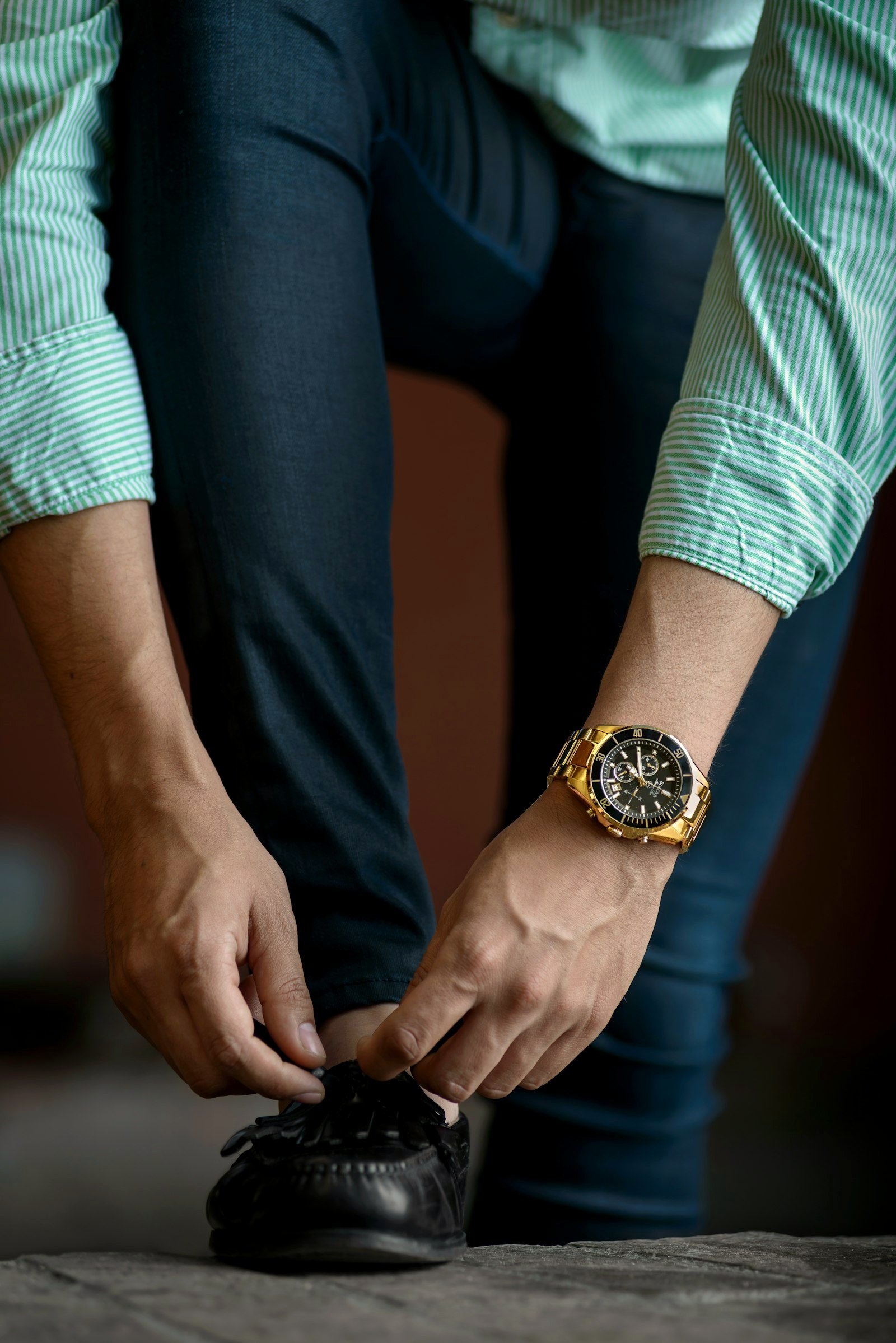
No break is the casual rung, and it is a decision with shoes attached. The hem clears the shoe, the ankle shows, the leg reads shorter and more deliberate. No. 04's ladder assigns it its footwear in its own table: loafers and clean minimal shoes, because there is no cloth to spare over a heavy shoe. On a chino the rung belongs to the washed and summer registers, the pair worn with the loafer of the looks below or the minimal sneaker, and to tapered legs, where the narrow opening the pants index bands at 6 to 7 inches lands cleanly on the shoe instead of swinging above it. Worn on a straight or wide leg it is severity without the silhouette to fund it, No. 04's warning translated: sharp on a tapered leg, severe on a wide one.
The full break is refused, and the medium is on notice. Pooling on cotton is not drape; it is stacking, fold on fold over the shoe, and because twill takes a set where it folds, the stack prints itself into the cloth by evening as a crease map at the ankle. The read is never the drape era's elegance. It is the unhemmed trouser, the pair worn at the length it was sold at, the one fit decision the Card and the index both leave to the buyer visibly unmade. The medium break survives only on the middle rail's straight legs, where a deeper single fold reads as tradition rather than as excess, and even there it is the rung of a man who has chosen it, not of a man who has not yet visited the tailor. Every other chino on this page is hemmed to slight or none.
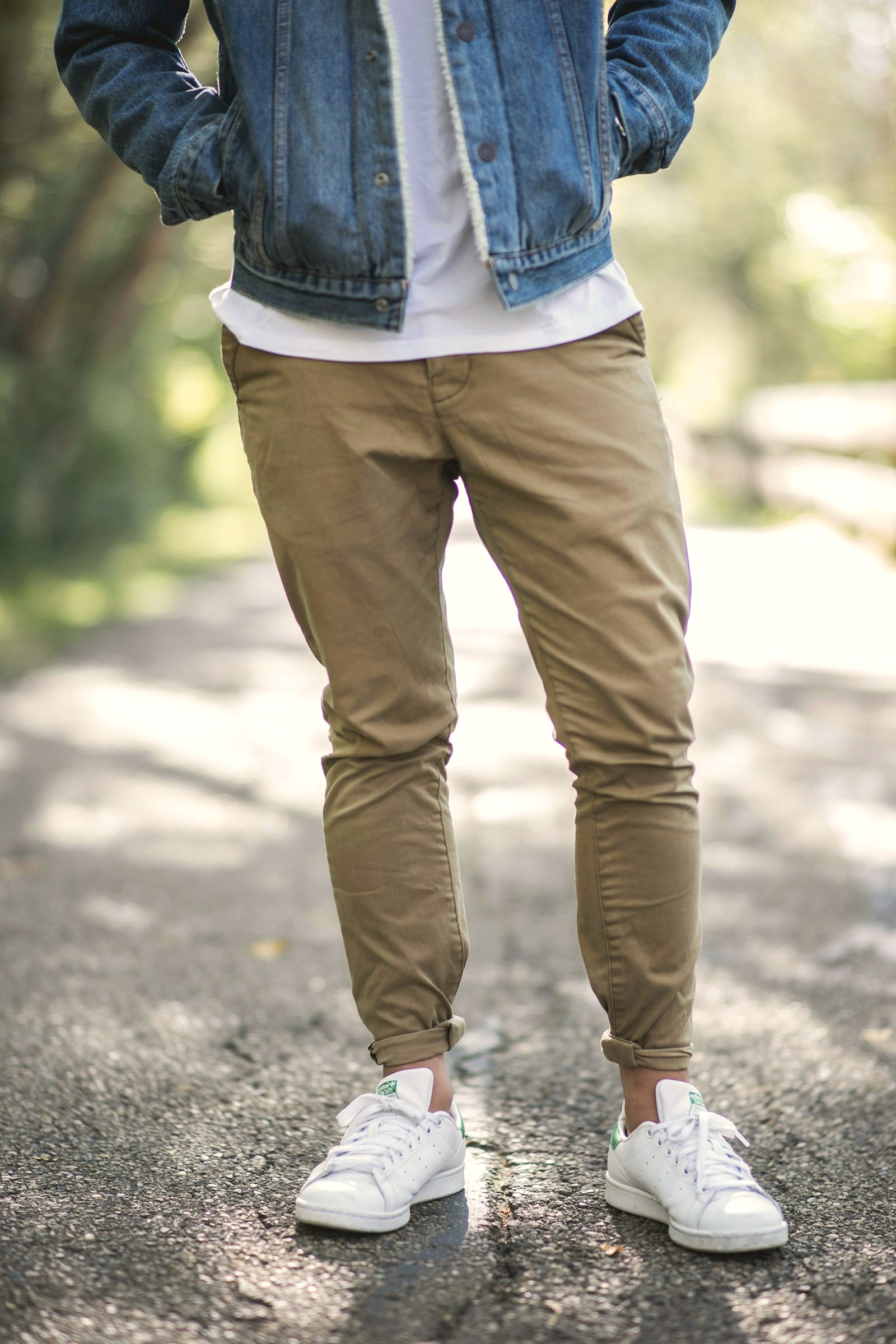
The turn-up is a register signal, not a finish. No. 04 prints the mechanics for the suit trouser: turn-ups add a horizontal line and a little weight at the ankle, they belong on pleated or fuller trousers where they finish the leg, on a slim tapered trouser they usually crowd it, and plain hems are the safer default, because the break matters more than either. Read across to cotton, the mechanics become a declaration. A turn-up shortens the leg visually and announces that the pair is off duty: on the washed end of the field, over sneakers or boots, it is the honest finish, the field pair's own punctuation, and the bank's street frame below shows it worn exactly so. At the tailored end it is refused, not because it is wrong in itself but because it spends what the tailored pattern bought: the rise lengthened the leg line, the plain hem delivers it unbroken to the shoe, and the fold at the ankle is a horizontal interruption in the one silhouette that needs the vertical line entire. And the standing prohibition, printed plainly: a turn-up rolled or sewn to rescue a trouser that is simply too long is not a cuff. It is an admission, worn at ankle height, that the hem ruling above was skipped.
Cloth and sheen: the polished pair and the washed pair
The Card's second FAQ is the seed of this whole section: chino is the cloth and khaki is a colour, and a khaki-coloured pair in a dress-trouser cut and a tan pair cut like jeans are different garments wearing the same name. The finish is the third term of that sentence. Hold the colour constant, hold even the maker constant, and change only the surface, and the garment changes register: a smooth twill, ironed flat so the diagonal weave lies quiet with a faint lustre off its face, reads as a dressed cloth; the same twill garment-washed, its surface softened and matte, its colour already a season into its fade, reads as a field cloth. The sheen is not a quality signal. The washed pair is not the polished pair gone wrong. They are the span's two surfaces, and the wardrobe that owns one of each owns the garment twice, which is more than the wardrobe that owns two of one.
The polished pair is the tailored end's surface. Smooth, dense, pressed before wearing: the Asket's cloth is the field's reference, a dense Italian organic cotton twill whose hand the Card scores the best in the ranking, and the Faloni's Italian cotton is the same argument at the connoisseur's price. A polished surface is also a maintained state, which is the care section's subject: cotton's lustre is the iron's work, renewed per wearing, and the pair that is worn polished on Tuesday and crumpled on Friday has not changed garments, only registers, downward, without choosing to. The polished pair's partners are the pressed end of everything else in this brief: the tucked shirt, the plain hem at a slight break, the calf loafer.
The washed pair is the field end's surface. Garment-washing is a maker's decision to sell the cloth pre-softened, and the Card prints its terms in the field's middle: the J.Crew is garment-washed so it starts soft, the Bonobos is a washed cotton with a seasoning of stretch, softer and more casual than the top two, and it fades like it. The washed pair's honesty is that it never pretends to the polished register: its crease is declined in advance, its fade is part of its design, and its partners are the turn-up, the untucked hem and the sneaker. What the Card charges the finish with, it charges precisely: garment-dyed and stretch pairs fade faster, so the washed pair's colour is a depreciating asset from the first wash, and the colour order below is written for pairs whose colour is still theirs.
Weight and stretch, the spec sheet's two honest numbers. Of the seven pairs the Card ranks, exactly one publishes a cloth weight: the J.Crew, at 7.9 ounces, printed on its card. The rest sell the cloth by adjective, and this brief inherits the Card's discipline rather than inventing figures: a chino's weight is read in the hand as heft and drape, a heavier twill holding the leg's line and the day's press longer, a lighter one collapsing sooner at the knee, and the reader in a shop has the evidence in his fingers that the spec sheets withhold. The stretch number, where it is published, the Card rules outright: one to three percent of elastane is a seasoning that helps a twill move and recover; beyond it the cloth stops being twill with assistance and becomes a knit with ambitions, and it bags, it shines at the seat, and it ages in dog years. The shine is the tell to watch in the wild: a seat polished to a sheen on a matte cloth is stretch and thinness announcing themselves, the H&M's printed failure at 48, thin cloth that shines at the seat inside a season.
The pairings, ruled garment by garment
Under a blazer: the ceiling, printed by the blazer brief itself. The answer is the FAQ's, and the evidence is How to Wear No. 03's own matrix. Chinos carry the blazer's weekend, travel and summer rows: the unstructured, textured jacket, hopsack or flannel or cotton twill, over the chino, with the trouser differing from the jacket in colour and texture clearly enough that nobody reads the outfit as a suit that missed. The chino that does this work is the tailored end of the Card's field, pressed, plain-hemmed, at a slight break; the washed pair under a blazer is the span hovered across two garments, the jacket dressed and the trouser field, each spending the other. And the ceiling is No. 03's, stated here as this brief's law: its office and evening rows are drawn around the tailored wool trouser, the Spier & MacKay at 87, not around any chino, because in the rows where formality is measured the chino is the honest casual partner, not the formal leg. Above the blazer in real cold, the stack closes with the overcoat of How to Wear No. 20, the weather layer over the whole assembly, chino included, on the same terms No. 24 prints for the country stack.
The shirt and knit above it. At the tailored end the shirt is the Oxford, and the pairing's reference is the one No. 24 prints for the bridge trouser: the Oxford Verdict Card's winner, the Kamakura button-down at 93, its basket weave reading smooth beside the twill and its collar giving the outfit its dressed frame; it is also the shirt the business-casual capsule builds this garment's office rotation on. The knit above a chino follows How to Wear No. 09's bands with the parity inverted from corduroy's rule: the twill's surface is fine and quiet, so every gauge is legal, and the choice is register rather than rescue, fine gauge at 24 to 30 under the blazer and at the dressed end, mid gauge at 12 to 20 as the middle rail's standard, the heavy gauges reserved for the washed pair's field register, where a chunky knit over a polished chino would out-dress the trouser from above. The polo worn with chinos obeys its own brief, No. 06, whose tuck rule the next paragraph extends to every top.
The tuck rule: the rise decides, the shoe confirms. No. 06 prints the rule for the polo as a property of the bottom half: tailored trousers, a belt, leather shoes, tuck; shorts, denim and chinos worn open and casual, leave it out. This brief extends it across the chino's span, and adds the mechanism the Card supplies. The tailored end tucks, because its whole assembly has asked for a clean waist, and because its rise can hold the tuck: the Card's rise answer is explicit that a rise at the natural waist keeps a tucked shirt tucked. The jean-cut pair cannot hold one: a low rise spends the day ejecting the shirt in small instalments, and the man re-tucking at every doorway is wearing the span's two ends in one garment. So the low-rise and washed pairs are worn untucked or not worn with shirts at all, and the untucked hem earns its place by No. 06's measure, ending around the belt line, a sliver below at most, never past the fly. The belt at the tucked end is ranked on this site in Verdict Card No. 17, whose winner, the Tanner Goods Standard at 86, is the full-grain bridle leather the tailored chino's waistband deserves. The half-tuck is refused here as No. 06 refuses it: not a third option, an accident photographed too often.
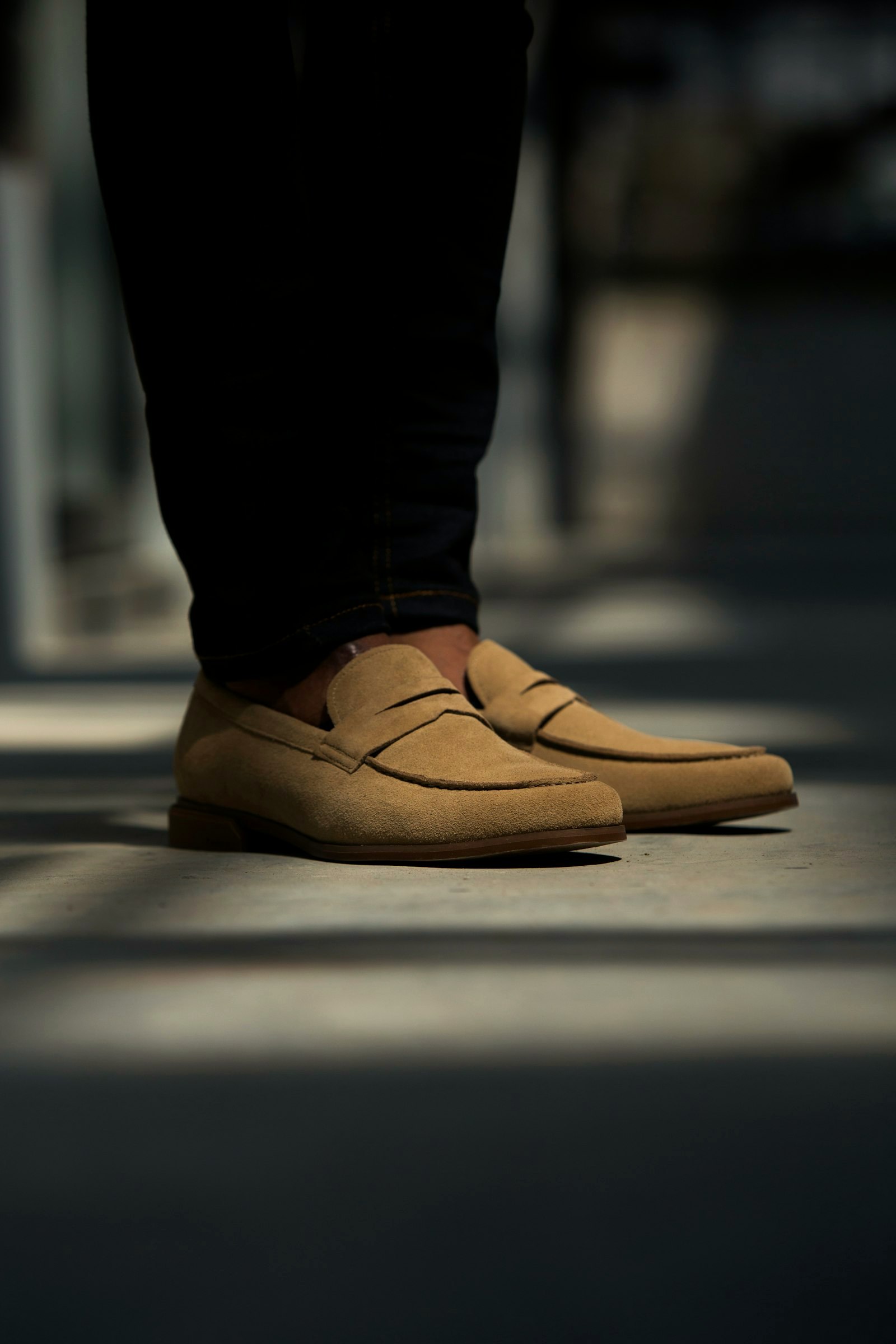
At the feet: the matrix, ruled as styling. Nothing in this section is scored; footwear beside a trouser is register, argued the way No. 24 argues it beside corduroy and No. 28 beside the waxed jacket. The loafer is the ceiling and the best partner: How to Wear No. 11's one-notch rule moves an outfit exactly one notch, and over a chino the notch is upward, from the trouser's ease toward tailoring, the penny in polished calf at 3.5 on that brief's desk scale carrying the tailored and middle pairs into their dressed rows, the suede penny half a rung lower as the soft answer, worn with the no-show sock No. 11 rules for tailoring. The minimal white sneaker is the floor, done properly: No. 12's solvent rule dissolves one level of formality and adds none, so the clean minimal leather shoe at its formality 3 lands the washed and middle pairs at full casual by decision, the pairing the relaxed assemblies in this series keep printing; a gym shoe or a chunky runner under a chino is the solvent spilled, the level dissolved and nothing bought back. The boot takes the field end: the washed pair, the turn-up, the overshirt above, the boot's shaft and substance answering the casual register entire; and the suede Chelsea of No. 15 already wears chinos in its own knit-weekend row, the hem landing at the shaft, which is this matrix's boot ruling at its dressed edge. The polished dress Oxford is refused: the ladder's 5, a shoe built for the dress trouser at formality 5, against a matte cotton twill at 3, is the sheen error at ground level, each finish making the other look mistaken, the mirror shine accusing the twill of slovenliness and the twill accusing the shine of costume. The chino's dressed rows top out at the loafer and the soft derby. The Oxford belongs to the wool trouser above it on the ladder, and the boundary section of any honest wardrobe keeps them apart.
The colour order: stone, navy, olive, and black last
First buy: stone or khaki. The dusty tan the cloth was first dyed, the colour the Card's own buying answer names for its winner beside navy, and the most permissive trouser colour in the wardrobe: it takes the navy blazer of the pairing above it, every knit colour from charcoal to cream, both brown shoe families and the white sneaker, without a single negotiation, and it reads as a chino at a glance, which the first pair should, because the wardrobe is learning the garment's span and the colour that teaches it is the one that announces the cloth rather than disguising it. Stone is the lighter, cleaner cut of the same idea for the tailored end; khaki is the deeper original for the field end; the first buy is one of them, in the pattern the buyer's life specifies.
Second buy: navy, the office read, with one prohibition. Navy is the colour that carries the tailored end into rooms where tan reads as leisure: it is the office bridge's trouser in the looks below, the pair the cold rotation leans on when the wool trouser rests. The prohibition is imported whole from How to Wear No. 05's wash break, because the law is the same law in another cloth: distance is the outfit. A navy chino under a navy blazer is the near miss, two pieces a shade apart reading as an accident of matching, the orphan read from below that No. 03's FAQ names. Navy's partners are the grey and brown jackets, the cream and charcoal knits, the burgundy and brown shoes: everything, that is, except its own colour worn above it at a distance too small to name.
Third buy: olive, the field colour. Olive runs on the colour logic No. 05 prints for black denim: not a wash but a colour system, a ground that dark tops and country cloths organise themselves over. It is the washed end's best colour and the middle rail's autumn pair, the trouser for the overshirt, the flannel and the boot, and its fade, when the washed finish takes it, reads as patina sooner than any other colour's. Charcoal is the tailored end's second colour, flannel's understudy: the grey that stands in for the wool trouser in the weeks it rests, takes the black and burgundy shoes the tan refuses, and carries the blazer rows in winter light. Between stone, navy, olive and charcoal the span is covered at both ends, and everything after them is taste.
Black last, on the standing logic. This series prints the same ruling for black in cloth after cloth, and the chino is no exception: it fades grey at the seat and the thigh the way black denim fades, on No. 05's own map of that colour; it shows every pale fibre the day collects; and at conversational distance it reads as a black jean that has lost its nerve, a trouser impersonating the garment below it on the ladder instead of standing on its own rung. The rust and the bright colours are the statement end, bought the way No. 24 buys wide wale: one pair, deliberately, with quiet company, the hero frame's rust pair being the register exactly, a colour with an outfit built around it rather than a colour looking for one. Bought first, as a default, black is the one chino colour that argues with the garment's whole idea, a span trouser pinned to the rung where its span cannot be seen.
The looks: the field, worn
Four assemblies, each built from Verdict Card No. 04's ranked field and this brief's rulings. The frames are the bank's honest chino and footwear frames, captioned for what they show; the bank holds no trouser-led frame, and the care section prints that gap rather than let a wool trouser or a flat-lay stand in for the garment itself.
Look one: the office bridge. The Spier & MacKay high-rise at 84, in navy or stone on the Card's own buying answer: pressed, plain-hemmed, landing at the slight break this brief rules the default, the Kamakura Oxford at 93 tucked into the natural waist the rise was bought for, the Tanner Goods belt at 86 at the waist, a penny loafer in calf below on No. 11's upward notch, and the unstructured blazer of No. 03 over it on the days the room asks. This is the assembly the business-casual capsule builds its trouser rotation on and the leg the Body Map's figure wears by default, and it is the tailored end of the span at full strength: every decision in it, rise, press, hem, tuck, shoe, is the same decision, a trouser worn as a trouser. At $88 and 22 cents a wear it is also the cheapest complete version of that decision this site has ranked.
Look two: the cloth pick, dressed down one notch. The Asket Loose Twill at 82, in its dark navy: the field's best cloth worn at its softest legal register, a fine-gauge knit untucked over the higher rise, or tucked on the cleaner days, a suede loafer with its colour kept clear of the trouser's, the hem at a slight break or none. The look's argument is the Card's own: this is the definitive pair, the dense Italian twill and the graded sizing, and worn with a knit and suede it spends none of its cloth quality proving it. Where the budget is the season's argument, the Faloni at 74 is the same look in its Italian form, a tailored make and the field's longest life, five years, under a knit polo and the same suede shoe.
Look three: the washed weekend. The Bonobos at 78, in whichever of its four cuts the wearer's legs vote for, or the J.Crew at 76 on its 7.9-ounce washed twill: garment-washed, the turn-up legal and worn, a plain tee or an untucked polo above it on No. 06's hem rule, and the clean minimal white sneaker below on No. 12's solvent terms, the level dissolved deliberately and the outfit landed at full casual as a decision. This is the jean-in-khaki end worn honestly as itself, the span's lower register at its best, and it fails only when it is asked to be look one. Where the budget is the budget, the Uniqlo at 72 is the same assembly bought at $49.90 and the field's best cost per wear, 20 cents, the floor that embarrasses the middle, as the Card prints it.
Look four: the field standard. The middle rail in stone or olive, the washed or unwashed pair the rotation actually lives in: an overshirt or a mid-gauge knit above it, the boot at the ground on the matrix's field ruling, the suede Chelsea at the dressed edge of the same look with the hem landing at its shaft, and in real cold the overcoat of No. 20 closed over the whole stack. Styled as what the record proves the garment is: the middle of the whole rotation, the trouser the week is built around, at home in more assemblies than any other leg in the index. The skip appears in no look: a pair sent home for costing more per day than the winner does not get styled into the winner's brief. It gets cited, as the standing proof that a chino's price and a chino's cost are different numbers.
The ruling
Buy the chino by its pattern and wear it by its span. Choose the end before the colour: the tailored pattern, a rise at the natural waist, a constructed waistband, a plain hem, for the blazer rows and the office bridge; the washed, jean-cut pattern for the weekend, judged by jeans rules and worn where jeans are worn; and never ask either pattern to impersonate the other, because the room reads the pattern first. Hem it on the ladder: a slight break by default, no break for the casual rung with loafers and minimal shoes, the full break refused on cotton outright, and the turn-up worn as the register signal it is, legal at the field end and refused where the line must run unbroken to the shoe. Press the polished pair and decline the crease on the washed one, knowing the crease is rented by the day either way. Tuck by the rise, shoe by the matrix, colour by the order, stone, navy, olive, charcoal, black last. The field is ranked and this brief has not touched a number: the Spier & MacKay at 84 is the pattern proved, the Asket at 82 the cloth proved, the Bonobos at 78 the fit range proved, the Uniqlo at 72 the honest floor, and the H&M at 48 the arithmetic that keeps the category honest. The chino is one word covering two garments and the whole middle between them. Wear the one you bought, at the end you bought it for, and the hardest-working trouser in the closet earns the title.
The mistakes
The jean in khaki at the formal room. The five-pocket or low-rise pair, washed and untucked by construction, carried into the office, the dinner, the room that measures formality, on the theory that the colour is a trouser's colour. The room reads the pattern, not the dye: it sees a jean that changed its cloth, which is the index's own description of the garment, and the wearer's whole assembly is demoted to the jean's rung. No. 05 prints the honesty from the denim side: in a room that measures formality the answer is the chino or the dress trouser. This is the same ruling from the chino's side: the answer is the tailored chino, the pair built for the room, and the jean-cut pair's presence there is not a loophole in the dress code. It is a misreading of which garment is on the leg.
The orphan suit jacket over chinos. No. 03 names this mistake from the jacket's side: the smooth worsted jacket, separated from its trousers, worn over chinos in the hope that nobody notices the flap pockets, the padded shoulder and the sheen. Everybody notices. From the trouser's side the failure is the span's: the chino is asked to pull a formality-5 garment's lower half at formality 3, and the two halves argue across the waistband for the whole day. The fix is not a better chino. It is the blazer, the jacket that was born alone, unstructured and textured, in the rows No. 03 assigns, where the chino is the jacket's legitimate partner and the pairing is a decision instead of a hope.
The pooled hem. The chino worn at the length it was sold at, cloth stacking over the shoe in folds that set into the twill by evening. It is the cheapest mistake in this brief and the most common, because it costs nothing but a tailor's visit to fix and announces itself in every photograph: the one fit decision both the Card and the index leave to the buyer, visibly unmade. On wool a full break can be argued as drape on a wide leg worn deliberately. On cotton it cannot be argued at all. Hem the pair to the slight break or the clean no-break, on the ladder, and the trouser's whole line, bought at such trouble at the rise, is delivered to the shoe intact.
The half-pressed crease. The washed pair pressed with a knife crease it cannot hold, or yesterday's crease map worn as today's press: a leg that is neither tailored nor relaxed, its front line wandering in and out down the shin, the garment's register hovering at the exact middle this brief's span section convicts. Cotton's crease is rented by the day, and the rental has two honest ways to be paid: press the pair fully in the morning and wear the tailored register whole, or decline the crease entirely and wear the soft line, the honesty No. 24 prints for corduroy in another cloth, where formality is carried by the cut and never by the crease. The half-pressed leg pays the rent and does not get the room.
Care, and the rented crease
The index prints the chino's crease doctrine in one subordinate clause: a chino is a cotton twill trouser, usually without a crease it intends to keep. Set that beside the dress trouser and the whole care regime follows. The wool trouser's crease is owned: high-twist cloth springs back from a fold, the construction holds the line, and Verdict Card No. 15 scores exactly that memory in its longevity row. The chino's crease is rented. Cotton twill takes a press in the morning, holds it through the middle of the day, and returns it spent by evening, every wearing, on every pair in the field from the winner down. Neither fact is a defect. They are the two cloths' published terms, and care is the administration of the chino's terms rather than a campaign against them.
The administration, in the order of the wears. Press the tailored and middle pairs before the dressed wears, the iron being the rent paid on the register the day intends; a polished surface is a maintained state, and the pair that skips the iron has chosen the softer register whether it meant to or not. Decline the crease on the washed pairs entirely and hang them for the soft front line, on the corduroy brief's precedent: the line suggested, the cloth left to be cloth. Rest every pair a day between wears, the rotation the Card's cost-per-wear table assumes at two wears a week, because the Card also prints the failure order: the seat and the inner thigh wear thin first, and daily wear walks a pair to that appointment at double speed. Wash cold and less often than instinct says, because the second failure is the colour going, garment-dyed and stretch pairs fastest, and every wash is a withdrawal from the colour account the colour order above spends. And keep the hem's appointment: the seat is bought once, the hem is tailored once, and the pair that is re-hemmed as its owner's shoes change outlives the pair that is replaced.
The stretch warning, repeated as care. The Card's stretch law is a care instruction in disguise: the pair past three percent elastane is aging in dog years whether it is worn or not, its cloth losing the recovery the seasoning was bought for, bagging at the knee and shining at the seat on a schedule no rotation slows. The defence is at the till, not in the laundry: read the fibre line out loud, buy the twill with assistance rather than the knit with ambitions, and the care regime above will hold for the four and five years the Card's table promises the field's honest pairs.
A note on our own photography: our photo bank holds two true chino frames, the hero's rust pair and the street frame's turned-up khaki pair, and both are outfit frames, the garment worn inside an assembly rather than photographed as a subject. No trouser-led frame, with the chino alone in the frame, no hem landing at the slight break at macro range, and no polished pair hung beside its washed twin exists in the bank. The tailored hem inside this page is a wool trouser's, borrowed from that ranking's field and captioned as such, because this page will not caption a wool trouser as a chino to fill a slot. The harvest list names what is missing, a chino-led street frame in stone and in navy, a break macro at the shoe, and the same pair pressed and garment-washed side by side, and this page will take those frames the week they exist.
Questions, answered
When is a chino a dress trouser, and when is it just a jean in khaki?
The cut and the finish decide, and the index prints the machinery: our types of pants index files the chino at formality 3 of 5 and rules that cloth moves a type a rung in either direction. A chino climbs when it is built like a trouser: a rise at the natural waist, a constructed waistband, a plain hem, a smooth cloth pressed before wearing. That is the pattern Verdict Card No. 04 rewards, where the score climbs with the rise and the Spier & MacKay high-rise wins at 84. A chino falls when it is built like a jean: five pockets, a low rise, a washed finish. The index judges the five-pocket twill by jeans rules in its own words, and a jean in khaki obeys them whatever colour it is dyed. Same word, same cloth family, two garments: the tailored chino stands beside the pleated trouser, the five-pocket stands beside the jean, and the question is never the colour. It is which pattern is on the rail.
What break should chinos have?
A slight break, by the ladder How to Wear No. 04 prints for the suit and this brief applies to cotton: one small fold where the hem meets the shoe, the rung that survives sitting, walking and weather. Verdict Card No. 04's own fit answer sets the same landing, a hem that kisses the shoe with one small break or none. The no-break rung is the casual read: the hem clears the shoe, the ankle shows, and it belongs with loafers and clean minimal shoes, the shoes No. 04's ladder names for it. The full break is refused on a chino. On a wide wool trouser worn deliberately it is drape; on cotton twill it is stacking, cloth pooling over the shoe in folds the lighter cloth cannot carry, and it reads as a hem that was never finished rather than a length that was chosen. Buy the seat, tailor the hem: the Card's order, and the cheapest ruling on this page to obey.
Should chinos have turn-ups?
Only when the pair is off duty, because on this garment the turn-up is a register signal. How to Wear No. 04 prints the mechanics for tailoring: turn-ups add a horizontal line and a little weight at the ankle, they belong on pleated or fuller trousers, and they crowd a slim tapered leg. The chino translation is direct. On the washed, relaxed end of the field a turn-up finishes the leg and declares the outfit casual, which is honest. On the tailored end, the high-rise pair worn under a blazer, the same fold spends the clean line the rise bought, breaking the leg at the ankle in the one place the tailored read needs it unbroken. Plain hem at the dressed end, turn-up at the field end, and never a turn-up added to rescue a trouser that is simply too long: that is not a cuff, it is an admission.
Can you wear chinos with a blazer?
Yes, in the rows the blazer brief itself assigns them, and no further. How to Wear No. 03 carries chinos in its weekend, travel and summer rows, under an unstructured, textured blazer, with the break of colour and texture between jacket and trouser kept wide, because the trouser that almost matches the jacket is the orphan read from below. The conditions from the chino's side: the pair is the tailored end of Verdict Card No. 04's field, pressed, plain-hemmed, landing at a slight break, not the washed pair from the weekend. And the ceiling is printed in the same brief: its office and evening rows are drawn around the tailored wool trouser, the Spier & MacKay at 87 in Verdict Card No. 15, not around any chino. The chino carries a blazer as a partner in the casual rows. Asked to carry tailoring's formal rows, or to make a separated suit jacket look intentional, it drags the jacket down to its own rung, which is No. 03's orphan mistake read from the trouser's side.
What shoes go with chinos?
Ruled as styling, the way this site rules footwear beside every trouser, and no shoe here is scored. The loafer is the chino's ceiling and its best partner: How to Wear No. 11's one-notch rule moves the outfit up one notch over the chino's ease, the penny in polished calf at 3.5 on that brief's scale, the suede penny half a rung lower and the soft answer. The minimal white sneaker is the floor done properly: No. 12's solvent rule dissolves one level of formality and adds none, so a clean leather sneaker at its formality 3 lands the chino at full casual, deliberately. The boot takes the washed, field end of the field, and the suede Chelsea of No. 15 already wears chinos in its knit-weekend row, the hem landing at the shaft. The refused shoe is the polished dress Oxford: the ladder's 5 against a matte cotton twill is the sheen error at ground level, a shoe dressed for the dress trouser at formality 5, spending itself on a trouser that cannot answer it. Between the loafer and the sneaker, the chino's whole span is covered.
Should you tuck a shirt into chinos?
By the rise and the shoe, on the rule How to Wear No. 06 prints for the polo and this brief extends to every shirt. The tailored end tucks: a high-rise pair with a belt and leather shoes has asked for a clean waist at every other point, and the untucked hem is the one untidy fact left standing. Verdict Card No. 04 prints why the rise is the mechanism: a rise at the natural waist keeps a tucked shirt tucked, and a low rise spends the day ejecting it, so the jean-cut pair is worn untucked or not at all. The washed, open end leaves the shirt out, provided the hem earns it, ending around the belt line and never past the fly. The belt at the tucked end is the belts Card's territory, its winner the Tanner Goods Standard at 86. The half-tuck is not a third option, here or on No. 06: it reads as an accident that has been photographed too often.
What colour chinos should you buy first?
Stone or khaki first: the dusty tan the cloth was dyed for its first service, the colour the ranking's own buying answer names beside navy for its winner, and the pair that takes a navy blazer, every knit colour and both brown shoe families without a negotiation. Navy second, the office read, the colour that carries the tailored end of the field into rooms where tan reads as leisure, with one prohibition imported from the denim brief's wash break: never under a navy blazer, because a trouser a shade away from its jacket is the near miss, the orphan read from below. Olive third, the field colour, run on the colour logic No. 05 prints for black denim: a colour system that grounds dark tops and country cloths. Charcoal is the tailored end's second colour, flannel's understudy for the weeks the wool trouser rests. Black last if at all: it fades grey at the seat and the thigh the way black denim does, shows every pale fibre it meets, and reads at conversational distance as a black jean that has lost its nerve.
Has Young Cotton ranked chinos?
Yes. Verdict Card No. 04 ranks seven, scored out of 100 on cloth and weave, cut and fit range, construction, value and longevity, with every US price printed and the cost per wear computed in the open. The Spier & MacKay high-rise wins at 84, at 22 cents a wear. The Asket Loose Twill follows at 82 on the field's best cloth, the Bonobos at 78 on its fit range, the J.Crew at 76, the Luca Faloni at 74, the Uniqlo at 72 as the honest budget pair, and the H&M Slim Fit is sent home at 48, the cheapest pair on the page and, at one year of life, more expensive per wear than the winner. This brief styles that ranked field; it does not re-score it, and the H&M pair is named here as the Card names it, a warning, and styled nowhere.
Next
The ranked field this brief styles is Verdict Card No. 04, every price, row and cost per wear printed. The boundary above it is ranked in Verdict Card No. 15 and the boundary beside it in Verdict Card No. 38, whose wearing is briefed in How to Wear No. 24. The ladder the span is measured on is the types of pants index. The blazer that takes the tailored end is briefed in No. 03, the denim whose laws this brief borrows in No. 05, the shoes at the span's two ends in No. 11 and No. 12, and the office rotation the chino anchors is assembled in the business-casual capsule. The leg among the site's winners is mapped in the Body Map, legs layer.