
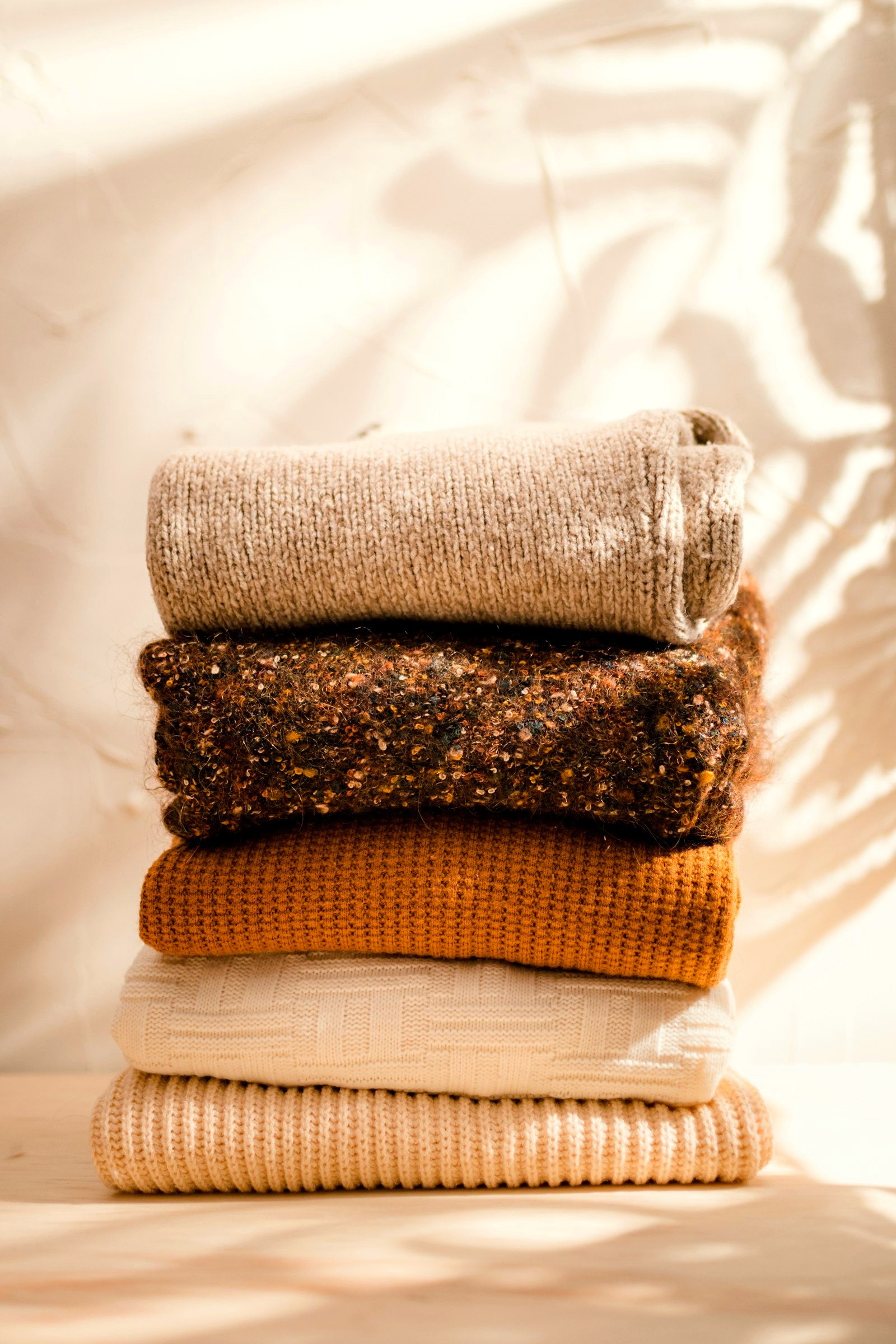
The layers the garment is posted among, folded, captioned as exactly that: knitwear in earth tones. The gilet's whole argument is positional, a torso of insulation worn over these knits or under the coats they serve, and our bank holds no photograph of a vest or gilet in any species, so this page opens on the stack rather than dress a jacket as its subject. The care section prints that gap and the harvest list.
Checked and updated October 2026
The ruling, up front: the vest or gilet is the stack's warmth with the sleeves removed: it warms the core and frees the arms, and that trade is its design, not its defect. It holds two honest postings, over a knit as the active day's outer layer, and under a coat as the stack's insulation, and it is the most mis-worn garment in the wardrobe because it is constantly posted at a third, dishonest one: worn as a jacket substitute, standing in real cold, by a man whose torso is insulated and whose arms are in a shirt. One verdict stands over this whole brief and is not repealed by it. No. 34 names the fleece vest over a dress shirt as a failure, a warmth layer with its warmth removed, worn as an employer's badge. That verdict is this brief's starting point, not its target: the page exists to draw the line it implies, between the gilet as equipment, chosen and posted where its trade pays, and the vest as uniform, issued and worn as a badge. One honesty entry before anything else: our jackets index files twelve types and this garment is not one of them. It owns no formality number and no warmth number there, and this brief assigns it none. A gilet is a posting, and this brief styles it as one, in its three species: the insulated gilet, the fleece gilet and the quilted country gilet.
This brief: the decisive rule · the three species, and the two garments that are not this one · the honest postings · trousers, colour and footwear · the ceiling, and the uniform line · the looks · the mistakes · care and our photography
The decisive rule: the core kept warm, the arms left free
Begin with what the garment is, mechanically, because every ruling in this brief is a consequence of one subtraction. A gilet is an insulated or fleeced torso with the sleeves removed. The removal is not an economy and it is not an oversight: it is a trade, struck deliberately, warmth concentrated on the core, where the body's organs and its largest muscles sit, in exchange for arms that move without a shell's drag, sweat without a sleeve's heat, and work without the cuff catching. The trade is old and it was struck by people whose cold was a working cold: the country liner that buttons into a waxed jacket, the military liner the field jacket of No. 32 was issued over, the shepherd's and the fisherman's sleeveless layers. In every one of those postings the pattern is the same: the body is moving, the movement itself warms the arms, and the garment's job is to stop the core paying for the whole body's weather while the arms are busy. That is this brief's decisive rule, printed as new: a gilet is warmth for a body in motion or a body in a stack. Its warmth is real, partial, and conditional, and the condition is printed on the garment, in the shape of the two armholes.
The condition can be priced, because this site has graded the insulation the gilet is cut from, and the numbers are not flattering to the jacket-substitute reading. On Verdict Card No. 53, the fullest published record in the light insulation field is a whole jacket, the Montbell Superior Down at 87, holding 800 fill power down at a published fill weight of 55 grams in a garment that weighs 203 grams entire, and the Card prints that assembly as a freezing-point layer over a base layer: a midlayer, worn under a shell at altitude, not a winter coat. The field behind it runs at 40 to 60 grams of synthetic fill per square metre, the Montane Prism at 86 and the Filson Ultralight at 82, and the Card's own warmth answer closes the question: no quilted jacket of this weight replaces a winter coat. On Verdict Card No. 46 the loft record runs higher, the Eos at 88 publishing 900-plus fill and 3.7 ounces of fill weight at $429, and even that field is graded as the coldest week's instrument with its sleeves on. A gilet carries a torso panel of the same class of cloth: a jacket's fill, minus the sleeves' share, minus the back's and shoulders' full coverage at the armhole's edge. The arithmetic is therefore not subtle. If the sleeved garment at a given fill is a layer, the sleeveless garment at less fill is a layer with a condition attached, and the man who wears it as a coat on a still February pavement has not found a loophole in the physics. He has found the condition, and it is collecting.
The sleeveless field has since been graded itself, and its finding confirms the arithmetic from inside the garment. On Verdict Card No. 55, three of eight makers publish how much insulation is inside the vest, two more publish how good the insulation is without how much, and not one of the eight publishes a warmth figure for the vest itself, so every warmth claim in the field is an adjective or an inheritance from the parent jacket. The winner makes the quantity argument at torso scale: the Rab Microlight Down Vest at 88 publishes 111 grams of 700 fill power down, while the runner-up's better down, the Montbell vest's 800 fill, arrives at 45 grams and finishes a point behind. A vest may not borrow its jacket's numbers, which is the Card's honesty test and this brief's decisive rule stated as a grading law: the warmth is the vest's own, it is partial, and it is printed or it is an adjective.
The garment, against the records of its neighbours:
| The garment | Its record | What it contributes | Its posting |
|---|---|---|---|
| The vest or gilet | No index row: a posting, not one of the twelve types, and this brief assigns it no number | Core warmth at a fraction of a jacket's fill and bulk, with the arms left free: the trade every ruling in this brief prices | The warmth posting, twice over: over the knit as the active day's outer layer, or under the coat as the stack's insulation |
| The quilted jacket | No index row either, styled in No. 33: the only insulated garment that layers in both directions | Insulation at cloth thickness, sleeves included, travelling inward under a coat as the liner species | Warmth layer or light outerwear: the gilet's sleeved sibling, and the build this brief's inward law is inherited from |
| The puffer jacket | Index formality 1, warmth 5; Verdict Card No. 46's field, the Eos at 88 | Warmth at full loft with its sleeves and its shell: the coldest-week instrument, graded on the fill numbers its makers publish or withhold | Weather layer: the garment the gilet defers to when the cold stops being a working cold, and the one garment never posted over it |
| The fleece jacket | No index row, styled in No. 34: the warmth layer of the outdoor stack, whose warmth is the stack's, not its own | Warmth at almost no weight in a brushed pile: the whole job, sleeves included, that this brief's second species does only the torso's share of | The warmth posting entire: the cloth the fleece gilet is cut from, and the brief that names the fleece vest's office failure whole |
| The waxed jacket | The Barbour ranking's record, styled in No. 28: Filson 85, Barbour 81, Sylkoil published to the ounce, the liner sold separately | Weather: a waxed cloth that sheds, carrying no insulation of its own, its cold setting supplied by the liner it sells beside the ticket | Weather layer of the country system: the coat the country gilet was drawn to disappear into |
| The tailored waistcoat | No brief of its own: tailoring's sleeveless garment, its button law printed in No. 03 beside the blazer's own | Formality: a storey of dress added under a jacket, warmth an accident of its cloth | Inside tailoring only, under a jacket that closes over it: a boundary garment, ruled out of this brief in the species section |
The three species, separated, and the two garments that are not this one
The rail sells three garments under this brief's name, and they share nothing but the armholes. Confusing them is the species error this brief exists to prevent, and the first of them carries a warning issued by another brief, which this page repeats rather than softens.
| Species | What it is | Its register | The ruling |
|---|---|---|---|
| The insulated gilet | A sleeveless torso of down or synthetic fill in a light shell, stitch-through or baffled, the sleeveless form of the garments Verdict Cards No. 46 and No. 53 grade with their sleeves on | Equipment, in the stack's own colours: the technical layer of the country and mountain systems alike | The stack species, and the first buy of the three. It is posted over the knit as the active day's outer layer and under the coat as the stack's insulation, the two postings of the decisive rule, and it is judged on its fill record the way its sleeved siblings are judged: a maker who publishes a fill weight or a grams-per-metre figure is selling warmth, and a maker who publishes only a fibre name is selling a silhouette, the Burberry lesson of No. 53 at $1,695 applied at torso scale. Matte is equipment and gloss is fashion, on No. 27's law, and in weather it is never the outermost layer, because it has no weather face: the shell goes over it, on the rain record of No. 44 |
| The fleece gilet | The torso of No. 34's cloth: a brushed polyester pile cut sleeveless, most often sold in a quarter-zip or full-zip front, and adopted entire by employers as issued dress | Two registers that share a rail and nothing else: a working layer in the yard and at the bench, and a uniform in the office | The warned species, carrying No. 34's verdict on its face. That brief prints it whole: a warmth layer with its sleeves, and therefore most of its warmth, removed, worn open over tailoring it cannot support, functioning purely as a badge of the firm that issued it. This brief does not unprint a word of it. The fleece gilet's honest civilian posting is the working one, over a work shirt or a henley with the arms actually working, in cool air that movement answers. Inside the building that issued it, it is work dress, and this brief does not grade work dress. As a chosen look over a dress shirt, in a street or a restaurant, it is the named failure, the uniform photographed outside its room, and no colour, fit or companion garment in this brief rehabilitates it, because the failure is not in the styling. It is in the posting. The vest Card has since graded the species' best garment, the Patagonia Better Sweater Vest at 74, and acquitted it as a garment on its published cloth weight, while repeating this verdict on the same card in its own words: the garment is honest, the uniform is the failure. That is this brief's line drawn from the other side, and the two records agree because they were never in conflict: one grades cloth, the other grades postings |
| The quilted country gilet | A diamond-quilted sleeveless layer in the country wardrobe's cloth, collared or bound at the neck, snap or zip fronted: the sleeveless form of No. 33's country species, and the part the waxed system sells as its liner | The field register civilised: the country layer, at home over flannel and knits, in town only at the civilised end of the field family | The system's species. On the Barbour record of Brands Like No. 30 and the waxed brief of No. 28, the founding house sells its liner separately beside the waxed ticket, and the purchase law is printed there: budget the jacket as a system, liner included, or the deep-cold version of it arrives as a surprise at a second till. Bought as that system's cold setting, the country gilet is not an improvisation but architecture. Bought alone, it is still the most wearable of the three species as an outer layer, over the ranked flannel and the mid-gauge knit, in the country colours, because its quilted face reads as a garment where the technical shell reads as equipment. It washes and is never re-waxed, on No. 33's washday boundary: the wax belongs to the jacket it serves, not to it |
The two garments that are not this one, ruled at the boundary. The first is the tailored waistcoat, and the boundary is direction. The waistcoat is tailoring's sleeveless garment: it is worn under a jacket, as a storey of the suit, and its laws live with tailoring's laws, the bottom button left open for the reason No. 03 prints beside the blazer's own stance, the back drawn in, the whole garment an instrument of formality whose warmth is an accident. It has no brief of its own on this site and this brief assigns it nothing, because everything this page rules runs the other way: the gilet is posted over knits and under coats as equipment, the waistcoat is posted under a jacket as dress. A gilet worn to borrow the waistcoat's register fails both garments at once, and a waistcoat worn as a warmth layer is a storey of tailoring doing a liner's job badly. The second is the sleeveless knit, the sweater vest, which our sweaters index files in its own family at formality 3 and warmth 2, over a collar, never worn alone, a formality tool that adds a storey without adding sleeves. It is a knit, and it is ruled by the knit briefs and by No. 01's record of the fine cardigan as the waistcoat's warmer understudy. This brief's species are stack garments; the knit vest is a wardrobe garment. The three sleeveless forms share a silhouette and divide the wardrobe between them, and a man who knows which one he is wearing has already avoided most of this garment family's mistakes.
The zip and fit law, printed once and applied by species. A gilet is bought over exactly one layer, the layer named in the stack section for its posting, and it is fitted to that layer and no other. The tests are the FAQ's three, and they are tests rather than impressions: zipped over the mid-gauge knit, it closes without strain at the zip and without pull at the armholes, because an armhole that binds is the trade refusing itself, a garment bought to free the arms and fitted to imprison them; the hem lands between the belt and mid-hip, the country species at the longer end of that band, the technical at the shorter, and anything below it reads as a tabard or as a waistcoat that has lost its jacket; and in the cold it was bought for it is worn closed, the open state reserved for mild air and hard movement, when the zip becomes the thermostat the field brief's engine uses its own closures for. The closure itself follows the species: a full zip on the technical and fleece forms, because a layer that must be pulled over the head is a layer that will be left on too long; snaps on the country form, over the flannel, where the snap front is the species' native hardware and opens one-handed at a gate. A gilet bought loose, to be safe, is the fit error entire: the insulation works by nearness, a torso of fill standing off the body in a bell of cold air is fill posted at the wrong address, and the size that feels generous in the shop is the size that fails at the bus stop.

The honest postings: over the knit, under the coat, and the technical assembly
The Fall Edit prints the order the whole wardrobe runs on: base, warmth, structure, weather. The gilet holds the warmth word of that sentence and, alone among warmth layers, it can also be the visible outside of the outfit on the days the stack stops at warmth. This section rules its three legal postings, and the two assemblies refused at the end of it.
First posting: over the knit, the active day's outer layer. This is the posting the garment is photographed in and the one its trade was struck for. The under-layer is one garment thick and named: the mid-gauge knit of No. 09's bands, 12 to 20, in town and in the country; the ranked flannel of Verdict Card No. 09, the L.L.Bean Scotch Plaid's class at 85, under the country species; a henley or a work shirt where the arms are the day's instruments. Posted here, the gilet is judged as the stack's answer to a moving day: the core held at temperature, the arms unencumbered and, in any real activity, self-warming, the zip worked as a thermostat at every stop. Its limits are the decisive rule's limits and they are printed, not discovered: in still air it is a shoulder-season garment; in wind its open armholes and unbaffled edges leak the warmth its fill makes, the sleeveless form of No. 34's examiner; and in rain it has no answer at all, which is the third posting's subject. The man whose day is standing still, at a platform, at a match, at a market stall he is visiting rather than working, is not in this posting whatever he is wearing: he is in the second posting's conditions without its coat, and the honest garment for him is the sleeved one.
Second posting: under the coat, the stack's insulation. No. 33 prints the two-way law for the quilted liner, the one insulated garment drawn to travel inward, and this brief inherits the law and extends it by one subtraction: the gilet is an even easier inward traveller than the liner, because it has no sleeves to bunch inside the coat's armholes and no collar to argue with the coat's own. The overcoat of No. 20 is bought on the index's rule whole, to fit over a blazer, and that allowance is the budget: posted in place of the day's heavier knit, over a fine-gauge layer of No. 09's 24 to 30 band, the gilet buys winter range for a coat whose own warmth stands at the index's 4, and it buys it invisibly, the under-coat test passed the way No. 33 passes it, the coat closes, its line unbroken, no fill printing through. Under the waxed jacket the posting is not a trick at all but the manufacturer's architecture, the liner sold separately on the Barbour record, the country system's cold setting entire. Under the field jacket it is the oldest form of the assembly on this site: No. 32's engine was issued over a liner, and the gilet is that liner's civilian descendant, the warmth the sateen shell climbs on. In every inward case the rule is No. 33's rule: the assembly is ruled by the coat, the gilet disappears, and what the street sees is a coat keeping its line in weather its own cloth could not have answered alone.
Third posting: the technical assembly, base under and shell over. This is the mountain form of the garment and the one where its under-layer changes species. Beneath the technical gilet goes the base layer itself, the merino crew of Verdict Card No. 45's field, the Icebreaker 200 Oasis class at 82, because in this posting the base layer's sleeves are the arms' whole dress: the arms are freed from insulation, not from cloth, and a tee under a technical gilet in cold air is the trade misread, the core dressed for the summit and the arms dressed for the valley. Above it, in any weather, goes the shell of Verdict Card No. 44, the Torrentshell class at 86, bought on the index's rain rule, taped seams and a named membrane. The shell brings warmth 1 by design and weather entire; the gilet brings the warmth; the base brings the skin's management, moisture moved and odour governed by the fibre physics No. 45 prints. It is the classic assembly with its middle term gone sleeveless, and it is the posting where the gilet is most purely itself: three garments, three jobs, no garment pretending at another's.
The refused assemblies, both of them category errors. The gilet under a puffer is the first: two warmth systems in one stack, the torso insulated twice and the arms once, bulk without a posting, refused on the same ground No. 33 refuses quilt under puffer. If the day needs the puffer's loft, the puffer's own record governs, and the layer under it is a knit or a base, not a second insulation. The gilet over a blazer is the second, and it is refused in the FAQ's arithmetic and the ceiling section's silhouette: the stack inverted, a lining posted outside a finished garment. Between those two refusals the garment's whole legal territory is drawn, and it is wide enough: over the knit, under the coat, inside the technical assembly, in the country system's cold setting. Four postings, one trade, no apologies.
Trousers, colour and footwear: the register, completed below the waist
The trousers follow the family the garment works in. In the field and technical postings the leg is the work family's own: the fatigue trouser of our pants index at formality 2, and the five-pocket leg, denim on No. 05's wash-break law, corduroy on No. 24's terms under the country species in the cold. In town, worn over a knit as the day's visible layer, the gilet takes the chino as its cleanest lender, the ranked class of No. 29's record, the Spier and MacKay high-rise at 84 as garment evidence, for the fleece brief's reason: a quiet garment reads at the register of its company. Pleated wool trousers are refused under every species worn as outerwear, and this brief prints no excepted case, because the exception belongs to another garment: the pleated trouser's sleeveless partner is the waistcoat, inside a suit, and that assembly is tailoring's, ruled in the species section's boundary. The dressed ceiling of the gilet worn outward is therefore No. 33's town row in sleeveless form: a fine-gauge knit, dark chinos, and the country gilet reading as the civilised end of the field family. It is a real ceiling and a low one, and reaching it is a matter of the company the garment keeps, never of dressing the gilet itself up.
The colour order, ruled by species, printed as new. The insulated gilet: matte navy and matte black first, the equipment colours, the shades in which a technical layer reads as kit rather than costume; olive second, the country crossover, the colour that lets the technical species sit over flannel and cord without changing its accent; and gloss refused at any position, on No. 27's law that gloss is fashion and matte is equipment, a shiny gilet announcing that its fill is a look. Brights are refused in town on No. 34's rule: signal colours are equipment declarations, honest on a ridge, costume on a pavement. The fleece gilet: heather and earth first, No. 34's order entire, moss and oat and charcoal heather, the colours its cloth was born in; navy second; black last, and knowingly, because black on a vest is the uniform colour entire, the shade of every issued garment in every lobby and loading bay, and a black fleece gilet is read as issued at fifty paces whatever its owner intends. The country quilted: olive, navy, brown, the waxed wardrobe's colours in that order, the shades of the system it serves, chosen to sit over the flannel's checks without arguing with them.
The footwear: boots at home, and the dressed shoe refused. The gilet stands over boots the way its whole family does: the plain work boot in the field and technical postings, the lug-soled Chelsea of No. 15's scale at 2.5 in its native ground, the suede Chelsea at 4 on dry town ground under the country species. The clean leather court shoe of No. 12's scale at 3 closes the town rows under the country and insulated species worn over a knit on mild days. The sleek calf Chelsea at 4.5 is refused under every species worn as outerwear, for No. 33's reason: a dressed shoe travelling down to visit, licensed only in the inward posting, where the shoe answers the coat and not the gilet. The dress shoe proper is refused outright, with the pleated trouser it would arrive with: both spend formality that a sleeveless warmth layer has no way to repay, above the waist or below it.
The ceiling: the trade's limits, and the uniform line
Plainly, as the garment's unnumbered state requires: the gilet's ceiling is set by its posting, and both of its honest postings cap below the rooms tailoring owns. Posted outward over a knit, its ceiling is the top of the casual and field registers: the country species at the civilised end of the field family, the technical species anywhere its system can stand, the fleece species at its bench and its yard. Posted inward, it has no ceiling of its own at all, which is the posting's virtue: under the overcoat it travels as high as the coat travels, invisible, its warmth spent inside an assembly whose register is the coat's. What it never does is stand between those postings as dressed outerwear. It stops at the tie, at the blazer it may not cover, at the dress shoe and the pleated trouser, and it stops at weather and at still cold, where the instruments are the ranked shell of No. 44 and the lofted field of No. 46. Inside its territory it is close to irreplaceable: no other garment buys core warmth at so little fill, bulk and money, and none other disappears into so many different coats. Its failures, like the fleece's, are never about the garment. They are about the posting, and one of them is about something else entirely, which this section now prints.
The uniform line, printed as plainly as No. 34 printed its half of it. No. 34 names the fleece vest over a dress shirt as the failure it is, and gives the mechanism: a warmth layer with its warmth removed, functioning purely as a badge of the firm that issued it. This brief, which exists because that garment has honest uses, prints the line that separates them, and the line is not fit, colour, cloth or company. The line is issue. The moment a vest is issued rather than chosen, it stops being clothing and becomes a badge, and no styling saves it, because a badge is not being worn as an outfit at all: it is being worn as an employment. The test is one question long, and it is asked of the garment, not the outfit: does it carry an employer's name, a firm's colours, a logo placed where a breast pocket would go? Then it is part of the job, judged as work dress inside its building and unjudged there by this brief, and everywhere else it is a uniform photographed outside its room, asking to be read as taste, which is the exact error No. 34 distilled from the quarter-zip's whole sad career. The chosen gilet fails that test on purpose and passes every other one in this brief: spec'd by its fill record, bought for a named posting, in the colours of its system, worn where its trade pays. Same armholes, same zip, opposite garments. The rail cannot tell them apart. The mirror can, at fifty paces, and so can every reader of this page, which is why the line is worth a section of the brief that finally gives the honest garment its due: the gilet did not earn its reputation. The badge borrowed it.
The looks: the sleeveless layer, worn
Four assemblies from this brief's rulings, each built on the records around the garment. No gilet is scored in this brief; the numbers in the judgments are the neighbours' records, reproduced from their own pages.
| Setting | The gilet | With | The judgment |
|---|---|---|---|
| The country's cold setting | Quilted country gilet in olive, snapped closed | The ranked flannel beneath it, five-pocket corduroy in a deep brown, plain work boots, the waxed jacket carried over the arm or worn open above the lot | The system's own architecture worn as an outfit: the liner the Barbour record sells separately, posted outward over the flannel class of No. 09's winner at 85, with its weather layer in reach. Every garment in the assembly is doing its own job, and the gilet is the warmth word of the stack made visible |
| The inward posting | Matte navy down gilet, zipped away, under a charcoal overcoat | A fine-gauge knit beneath it, wool trousers, the coat closed over all of it to No. 20's length floor | The second posting's proof: the overcoat bought over a blazer spends its allowance on the gilet instead, its fixed warmth extended into the cold months with no sleeveless layer in sight. The gilet is doing the most work in the outfit and, as with No. 33's liner, it is the part nobody sees |
| The technical assembly | Matte black insulated gilet over a merino base crew | Fatigue trousers, plain boots, the ranked shell worn or carried above the lot | The third posting entire: base, warmth, weather in the printed order, the base crew of the class of No. 45's winner at 82 dressing the arms the gilet frees, the shell of No. 44's class at 86 standing over both. The assembly for a day that is all movement, and the one outfit in this table where a tee under the gilet would be the error |
| The fleece gilet at its honest work | Heather fleece gilet, zipped, over a henley | Five-pocket denim, work boots, a bench, a yard, a market stall being built rather than browsed | The warned species in its one civilian posting: the arms working, the core warm, the cloth doing the torso's share of the whole job No. 34 assigns it. The same garment over a dress shirt at a desk is the ceiling section's badge; over a henley at a bench it is a working layer, and the difference is not the gilet. It is the posting, as it is everywhere in this brief |
The ruling
Buy the insulated gilet first if your cold is a stack cold: matte navy, close over one layer, judged on its maker's published fill the way Verdict Card No. 55 now judges the sleeveless field itself, a weight in grams or a grams-per-metre figure in print, and posted over the mid-gauge knit through the shoulder seasons and under the overcoat through the winter, where it buys a fixed-warmth coat a second season of range. Buy the country gilet with the waxed system, or for it: olive, snapped, over the flannel and the cord leg, its price counted inside the system's price the way No. 28 teaches, liner included, never as a surprise at a second till. Buy the fleece gilet last, and only for a working posting with your own name on the decision: heathered, zipped, over work cloth, never over a dress shirt, never as the office look, because No. 34 has already printed what that assembly is and this brief exists downstream of the printing. Refuse the jacket substitution, refuse the blazer beneath it, refuse the open zip in bought-for cold, refuse the employer's badge anywhere it is being read as a wardrobe. The test in the shop is the fleece brief's two questions with a third added for the armholes: what goes under it, what goes over it, and what are your arms doing while you wear it. The man who can answer all three has bought a gilet. The man who can answer only the first has bought a jacket with a defect and will spend the winter discovering the condition printed on it, in the shape of the two armholes, where it was always visible.
The mistakes
Bought as a jacket. The first and commonest error, and the decisive rule exists to prevent it. The fill arithmetic of the insulation Cards is the whole argument: the warmest sleeved light jackets this site has graded are printed as layers, and the sleeveless share of their fill is a layer with a condition. The man standing still at a February bus stop in a gilet over a sweater is wearing the middle of the stack as if it were the whole of it, his torso insulated and his arms in knit, taking his temperature at the uncovered parts. The fix is not a thicker gilet, which is only a warmer torso, but the honest postings: the coat over it, the shell over it, or the sleeved garment in its place.
Worn over a blazer. The stack inverted, and the most instructive failure in the family because both garments are good ones. The gilet drawn over a blazer traps the lapel, breaks the shoulder line its maker cut, and reads at once as a lining that escaped; the blazer beneath reads as upholstery. The sleeveless garment that belongs with a blazer exists, it is the waistcoat, and it goes underneath, where tailoring put it. A man who wants warmth over tailoring wants a coat; a man who wants the gilet's warmth with tailoring wants the inward posting, the gilet under the coat. The over-blazer assembly is the one arrangement in this brief with no posting to call home.
The issued vest, worn as a look. The ceiling section prints the line; the mistake is crossing it deliberately, the employer's fleece vest kept on past the door, over the dress shirt it was issued to cover, in rooms where no firm is paying for the advertising. It fails as warmth on No. 34's physics, it fails as register because it reads as an employer at fifty paces, and it fails the oldest test on this site, the issued-garments law in reverse: a garment whose every feature announces a workplace, worn where no work is being done, is a costume of employment. Inside its building it is work dress, and unjudged. The mistake is never the vest. It is the postcode it is photographed in.
Bought loose, and worn open. The twin state errors, and they compound: the gilet sized up for safety, then worn unzipped for ease, until the torso of fill stands off the body in a bell of cold air and the zip that is its thermostat hangs open in the cold it was bought for. Insulation works by nearness and by closure, and this garment has less of both to spare than any other in the stack. Fitted close over its one layer and closed against the day, the same gilet is the efficient warmth of the verdict section. The difference between the mistake and the garment is about an inch of cloth and the length of a zip, which is why this brief prints fit as a law and not as a preference.
Care, by species, and the two washday boundaries
The gilet's maintenance follows its fill, and each species keeps the law of the sleeved garment it was cut from. The down gilet keeps the down record's terms, printed on Verdict Card No. 46 from the makers' own pages: a low tumble dry with balls to re-loft the clusters after washing, and storage loose, never stuffed, because loft dies compressed a season at a time; a torso of down stored crushed in a drawer all summer comes back as a torso of cloth. The synthetic and country species wash, on the quilted record of No. 33: the founding country house's published care for its quilted line reads machine wash at 30, wash separately, and the gilet in that cloth follows it whole. The fleece gilet carries the smell clock, the fibre physics of No. 45 and No. 34 applied at torso scale: polyester is oleophilic, skin oils and their byproducts bind to it and survive ordinary washing, so the garment is aired after wear, washed before the clock compounds, and stored clean at the season's turn; no bench repairs a smell, in a vest any more than in a jacket. Two boundaries close the section, both inherited. The country gilet is washed and never re-waxed: the wax is the jacket's, renewed on the jacket's bench cycle of No. 28, and a reproofing spray sold for the liner is the waxed garment's maintenance mis-sold to its tenant. And the gilet is never stored inside the coat it serves, crushed in the coat's own bag or under its weight on the rail: it is hung by its shoulders or folded with its loft loose, the layer kept ready to disappear again.
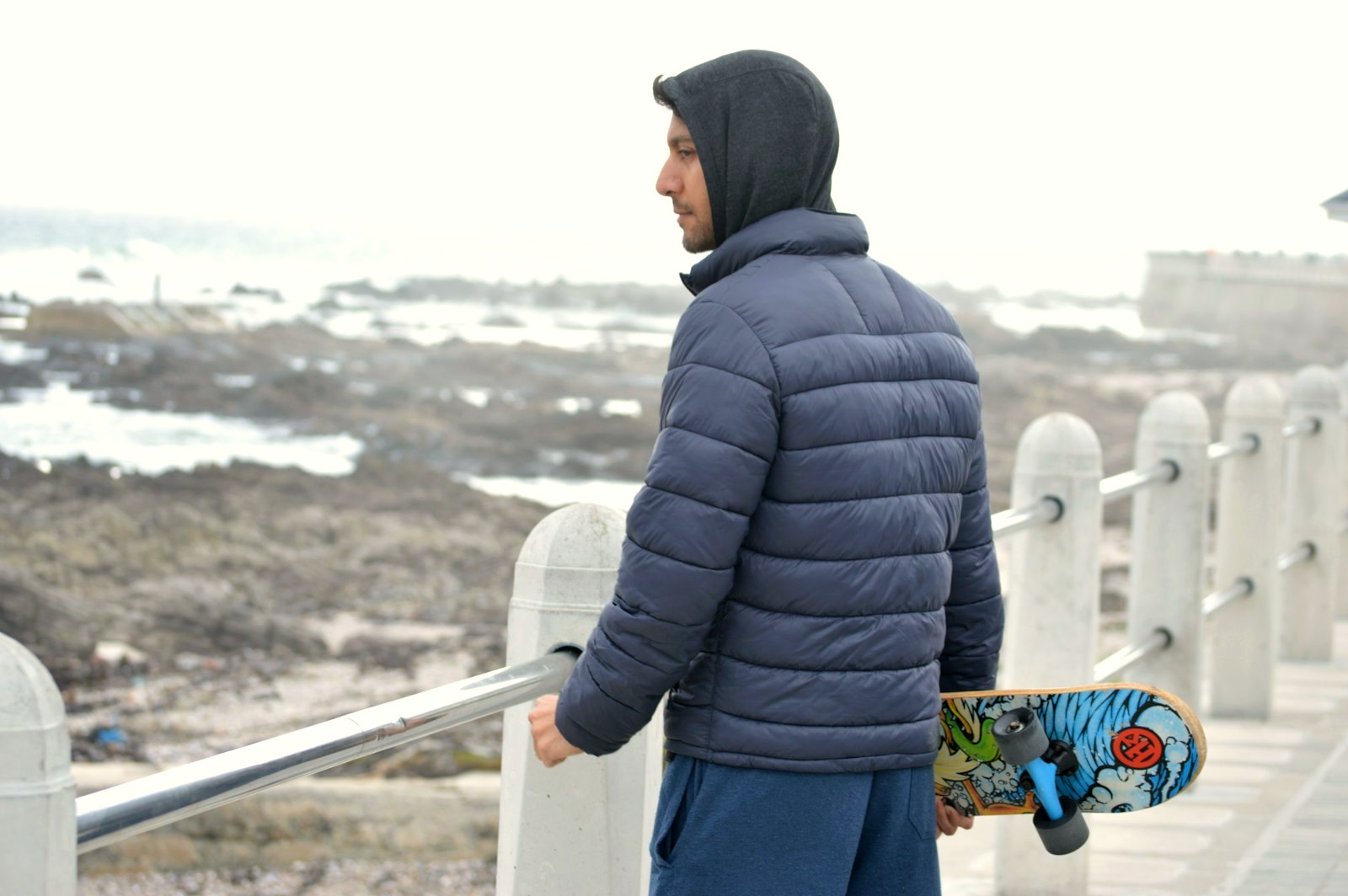
A note on our own photography: our photo bank holds no vest or gilet frame in any species. There is no down gilet over a flannel in field light, no country gilet snapped over a knit, no sleeveless layer zipped away under an overcoat with the coat half open, no fleece gilet at a workbench, no armhole and zip at macro range. The hero is the folded layers the garment is posted among, captioned as layers; the figures inside are the flannel it is worn over and the sleeved puffer it is not, captioned as a shirt and as a jacket. This page will not caption a puffer, a quilted jacket or a fleece jacket as the gilet to fill the slot, and it will take the harvest frames the week they exist: the country gilet over a checked flannel with the waxed jacket over the arm, the down gilet disappearing under a charcoal overcoat at the coat's edge, and the zip and armhole of a technical gilet at the range where the fit law of this brief can actually be seen.
Questions, answered
What is a gilet, and is it the same as a vest?
One garment under two trade names, with a third meaning to keep out of it. Gilet is the country and outdoor trade's word for the sleeveless insulated layer, a jacket's warmth with the sleeves removed, worn over a knit or under a coat. Vest is the American word for the same layer, and it is overloaded: in America it also names the tailored waistcoat, and in British English it names the sleeveless cotton undershirt, the naming debt our tank ranking pays when the Sunspel Superfine Cotton Vest wins it at 84. The waistcoat and the undershirt are ruled out of this brief in its species section. What remains is one garment, and it is a posting rather than a type: our jackets index files twelve types and no sleeveless one, so the gilet owns no formality number and no warmth number there, and this brief assigns it none.
Is a vest warm enough to wear instead of a jacket?
No, and the insulation rankings print the arithmetic it fails. The fullest light-jacket record this site has graded, on Verdict Card No. 53, is a whole jacket holding 55 grams of 800 fill power down, and that Card prints it as a freezing-point layer over a base layer: a midlayer, not a winter coat. A gilet carries a torso panel of the same class of fill, a jacket's fill minus its sleeves. If the sleeved garment at that fill is a layer, the sleeveless one is a layer with a condition attached, and the condition is movement or a coat over it. A gilet warms the core and frees the arms; standing still in real cold, the arms are in shirt cloth while the torso is in insulation, and the body's coldest reading is taken at the uncovered parts. Its honest postings are activity and layering. Posted as a jacket substitute on a still, cold day, it is the specification error this brief opens with.
What do you wear under a gilet?
One layer: the layer it was bought over. In town, the mid-gauge knit of No. 09's bands, 12 to 20, sized as the gilet's under-layer rather than swallowed by it. In the inward posting, under a coat, the fine gauge, 24 to 30, because the stack there has no room to waste. Under the country species, the ranked flannel, the class of the L.L.Bean Scotch Plaid that won Verdict Card No. 09 at 85, or a woven work shirt in the same register. Under the technical species, the merino base crew, the class of No. 45's winner at 82, whose sleeves are the arms' whole dress in that posting, which is why the technical under-layer is a long-sleeved base and not a tee. Refused beneath it: two full layers at once, which is bulk without a posting, and the dress shirt and tie assembly, which belongs to the waistcoat's outfit. The fleece species over a dress shirt, worn as an office look, is the failure No. 34 names whole, and this brief does not unname it.
Can you wear a gilet under a coat?
Yes: it is one of its two honest postings, and the law is the two-way law No. 33 prints for stitch-through insulation. The quilted liner travels inward because it is thin; the gilet is thinner still, a torso panel with no sleeves to bunch inside the coat's armholes, which makes it the easiest inward traveller in the stack. The overcoat it serves is bought on the jackets index's rule, to fit over a blazer, and the gilet spends part of that layering allowance in place of the day's heavier knit. Under the waxed country coats the posting is the manufacturer's own architecture, the liner the waxed record prints as sold separately beside the jacket. Rule the assembly by the coat, as No. 33 rules it: the gilet disappears, the coat keeps its line, and the stack keeps the Fall Edit's order, base, warmth, structure, weather, with the gilet posted as the warmth layer.
Can you wear a gilet over a blazer, or with a tie?
Never over a blazer. A sleeveless layer drawn over a finished tailored garment inverts the stack: the blazer's shoulder and lapel are trapped under a shell built to sit against a knit, the gilet reads as a lining worn outside its coat, and the blazer reads as the gilet's mistake; both garments are demoted in the same outfit. The sleeveless garment tailoring owns is the waistcoat, and it travels the other way, under the jacket, on the tailoring briefs' laws; the gilet borrows none of its register and lends it none. The tie is refused over every species in this brief, on the same arithmetic as the quilted and fleece briefs: it lives at the index's formality 4 and above, and no sleeveless stack layer files there. Near tailoring the gilet owns exactly one move, and it is the inward one: zipped away under the coat, invisible, the previous answer's posting.
How should a gilet fit?
Close, over exactly one layer, because the fit is the posting made visible. The tests are three. It closes over the mid-gauge knit it was bought over without strain at the zip and without pull at the armholes; a gilet that needs a size up to swallow a second knit is a jacket being evaded. The hem lands between the belt and mid-hip; longer reads as a tabard, or as a waistcoat that has lost its jacket, and both readings are costumes. And in the cold it was bought for, it is worn closed: an open gilet on a cold day is a warmth layer declining to warm, the feature stopped working while still on the body. Buy it in the shop over the layer it will actually cover, and judge it zipped, standing and moving, the way the field brief's stack test judges its own garment.
Gilet or jacket: which should you buy first?
The jacket, in almost every wardrobe, on the fleece brief's rule: a layer worn as clothing must be doing the whole of its job, warmth included, and the sleeved garment is the one that can hold a posting alone in still air. The gilet is the second buy, bought for a named gap: the coat whose range needs extending inward in the cold months, the waxed system bought without its liner, the active days when the core is cold and the arms are working and a jacket is heat the body has to dump at every stop. Bought second, for its posting, it is the most efficient warmth in the stack, because it spends its fill only on the torso the knit and the coat leave to it. Bought first, as a jacket substitute, it is the error this brief opens with, and no fit law in it will save the purchase.
Has Young Cotton ranked vests or gilets?
Yes, since Verdict Card No. 55 ranked seven vests and gilets on their published fills, the Rab Microlight Down Vest winning at 88 on the field's fullest vest record, 111 grams of published fill weight under a 700 fill power down. This brief was drafted against the record that existed before the Card: what exists in print is the garment's record across the site: the jackets index files its twelve types with the sleeveless layer absent, a posting rather than a type; the insulation rankings grade the gilet's sleeved siblings and print the fill arithmetic its warmth is argued from, the quilted field on Verdict Card No. 53, where four of eight makers publish a fill weight, and the puffer field on No. 46, where two of eight do; the Barbour ranking prints the country system's liner, sold separately beside the waxed ticket, and grades the sleeved country quilt at 70; the fleece brief prints the office species' verdict whole, the vest over a dress shirt named as a badge of the firm that issued it, a verdict the Card repeats on its own fleece card while acquitting that garment itself, which is this brief's line drawn from the other side; and this brief is the wearing system those records imply, the three species, the honest postings, the fit law and the outfit matrix, printed so any gilet can be judged on the wearing, with the Card now judging the buying.
Next
The garment's absence from the twelve types, and the ladders it is argued against, are printed whole in the jackets index. The garment itself is ranked in Verdict Card No. 55, and the insulation it is cut from in Verdict Card No. 53 and Verdict Card No. 46, the shell that completes its technical assembly in Verdict Card No. 44, and the layer beneath that assembly in Verdict Card No. 45. Its sleeved siblings are styled in How to Wear No. 33 and No. 27, the cloth of its warned species in No. 34, the engine it was first issued under in No. 32, and the country system that sells it as a liner in No. 28 and Brands Like Barbour. The stack all three postings belong to is ordered in the Fall Edit; the knit beneath it is styled in No. 09, and the coat it disappears under in No. 20.