

The pocket itself, at the distance outfits are judged at, and empty: the bank holds no frame of a square worn in a breast pocket at reading size, in any cloth or any fold, and the care section prints that absence rather than dressing another garment as this one's evidence. The frame is carried here under the cross-page sharing our credits log records.
Checked and updated October 2026
The ruling, up front: the pocket square is the suit’s one unruled inch, the only article in the dressed outfit with no job to do, and it is still ruled, by cloth, by fold and by budget. By cloth: white linen is the default and the formal ceiling, silk the sheen licence, cotton and wool by their seasons. By fold: the straight edge stands at the ladder’s top, the puff is the middle licence, and the multi-point folds are refused as origami. And by the pattern budget that How to Wear No. 64 prints for shirt, suit and tie: the square never matches the tie, it echoes at most one colour in it, and in the rooms where Nos. 62 and 64 require formality it shrinks to white linen and a straight edge, and in the sombre rooms it is refused entire. On scores: no garment is scored here, and no Card grades the square; the numbers quoted are the tree’s, cited as what they are.
This brief: the decisive rule · the cloths · the fold ladder · size as printed fact · the pairing rules · the rooms · the looks · the mistakes · care and our photography
The decisive rule: the unruled inch, ruled three ways
Every other article in the dressed outfit is hired. The tie draws the vertical line, tensions the collar and banks the formality, No. 62’s inventory, and No. 64 grades it on three measurements it must satisfy or fail. The shirt is a field and a frame. The shoe keeps or spends the suit’s formality at the ground. The pocket square is hired for nothing. It warms nothing, closes nothing, holds nothing up, and a suit is complete, in every structural sense the word carries, with the breast pocket empty. That is precisely why the square is the outfit’s most-read inch. An article with no function is read as pure intention: everything it does, its cloth, its fold, its colour, its height above the welt, is a decision the wearer cannot blame on necessity, and rooms grade decisions more strictly than they grade equipment. The man whose measurements are all correct and whose square is a matched, puffed, five-pointed performance has passed every test the outfit sets and failed the one it merely implies, which is the test of whether the discipline is a system or a costume.
So the decisive rule is printed as three rulings over one inch. The square is ruled by cloth: linen first, the matte cloth that holds an edge, silk under its licence, cotton and wool in their seasons, and the cloth’s choice made before the colour’s, because the cloth sets the register the colour is read in. It is ruled by fold: the fold is a formality ladder with a straight edge at its top and a refusal at its bottom, and the fold worn is a statement of the room’s register as legible as the tie’s knot species are in No. 64. And it is ruled by the budget: the square is the fourth station of the dressed outfit, after shirt, suit and tie, and it draws on the same pattern allowance the tie brief prints for the three, never matching the tie it stands four inches from, echoing at most one colour in it. The three rulings meet in the ceiling, which is this brief’s title’s third clause: in the rooms where No. 62 and No. 64 require formality, the uniform’s and the ceremony’s, the square’s whole range collapses to its first term, white linen and a straight edge, or to absence, which at the ceiling is the same ruling stated negatively. The inch is unruled by function. It is ruled entire by everything else.
The standing record around the inch is the family’s, and this brief gathers it rather than re-deriving it. How to Wear No. 62 gives the square its hardest employment: under the open collar it is the replacement colour instrument, the outfit’s one remaining deliberate colour decision, licensed on that ground and disciplined harder than the tied version, white linen in a straight fold its default, the theatrical square, puffed, pointed and patterned at once, refused, and the square’s reading position fixed: second in the outfit, after the collar. How to Wear No. 64 gives it its budget: one pattern at a time among shirt, suit and tie, two the licensed maximum, the third station plain, and the scale rule over the licensed two. How to Wear No. 04 gives it its rows, printed in the outfit matrix before either of the others existed: the boardroom’s square white, if one is worn at all; the evening’s dark tie, or none with a white square; the wedding guest’s summer version, an open collar with a square. What no page has yet given it is a brief of its own, with its cloths, folds and sizes ruled as subjects rather than as other garments’ conditions. That is this page’s jurisdiction. The garments around the inch are scored, the tie at Verdict Card No. 40, the Sam Hober grenadine at 91, the suit at Verdict Card No. 64, the Core Suit at 85, the shirt at the Oxford Verdict ranking, the Kamakura at 93. The square itself carries no score on this site and this brief invents none. Its law is stated as law, from the outfit’s arithmetic, and the honesty of that position is printed in the questions at the page’s foot.
The cloths: linen first, and the ceiling is linen
The cloth is graded before the colour because the cloth is what the fold is made of and what the light reads: the same white in linen and in silk is two different squares, the first a ruled matte edge, the second a soft gleam, and the rooms they belong to are not the same rooms. Linen is the default and the formal ceiling in one cloth. Its virtues are mechanical before they are aesthetic. It is matte, so it does not compete with the tie’s silk for the light. It is crisp-bodied, so it holds a fold’s architecture, an edge staying an edge and a point staying a point from morning to evening. And its white is the wardrobe’s working white, the white of the shirt’s cuff and collar, which the straight-folded linen square rhymes with, in No. 62’s sentence, the ruled edge at the pocket answering the sliver at the wrist. A wardrobe that owns one square owns a white linen one, and a wardrobe that owns a second owns it after the first is worn to softness, linen’s one concession to age, which the care section prices.
Silk is the sheen licence. Silk will not hold an edge; its folds are soft by construction, which is why its native fold is the puff, and its gift is light: a silk square catches it and returns it, a small brightness at the chest that linen refuses to give. The licence is therefore a register’s: silk steps any square down one deliberate notch from linen’s formality at the same colour, licensed across the wide middle, the dinners, the evenings and the summer rows, and refused at the ceiling, where its softness reads as relaxation in a room that asked for none. The printed silk square is silk’s commonest form and its own register within the licence: the pattern printed on the cloth, borders and medallions and neat geometries, the square’s standard grammar in a way print is not the tie’s, No. 64’s weave-over-print doctrine being a law of ties, whose pattern must survive at the throat’s distance in the outfit’s line. A square is read at a pocket’s distance as colour and scale more than as weave, and its print is graded there, under the pairing section’s scale rule, rather than under the tie’s doctrine. What the printed silk square owes is the hand-rolled edge, the construction fact its makers print and this brief adopts as its quality line: edges rolled and stitched by hand stand soft and rounded against the pocket’s welt, and a machine-hemmed printed square at the same pattern is the same picture on a cheaper object, graded here as the object is the grading this site performs everywhere else.
Cotton and wool are the seasonal citizens. Cotton is the working middle: plainer than linen, softer in the edge, cheaper in the rail, the square of the everyday office rows and the summer’s second cloth, its white a step below linen’s in crispness and its colours a step quieter than silk’s, licensed wherever linen is and read a half-notch below it, which in the middle rows is no reading at all. Wool is the winter’s, matte and dry-surfaced like the flannel it is worn against, its colours deep and its patterns, the checks and the madder tones, scaled for the season’s cloths; a wool square in a worsted summer suit is two seasons arguing in one pocket, and a silk puff in a flannel suit is the same argument with the terms exchanged. The cloth table compresses to the rail’s order: white linen first, the ceiling and the default; a plain silk for the evenings; a printed silk for the summer and creative rows; cotton for the working week; wool for the cold months. Every square after the first is a licence purchased against a named row of the wardrobe’s year, and a rail of squares without rows to wear them in is a collection, which is a different hobby with the same shops.
The folds: a formality ladder with a refusal at its foot
The fold is the square’s knot: the operation that converts a flat cloth into the outfit’s article, graded by size against its station, and like the knot species in No. 64 the folds divide into a ladder with a default, licensed steps, and a reserved bottom that is in fact a refusal. The straight fold stands at the top, the presidential fold, the TV fold of the broadcast era that named it for its plainness under lights: the square folded to a flat band, its edge parallel to the pocket’s welt, showing a ruled line of cloth above it. It is the default on three grounds. It is the most formal, the fold of the ceiling’s white linen and the boardroom row’s whole licence. It is the most stable, a flat band having nowhere to migrate to in the course of a day. And it is the least performed, a straight edge making no claim on the eye beyond its own straightness, which under this brief’s decisive rule is the square’s virtue stated as a fold: intention without theatre.
The ladder descends by added architecture. The one-point and two-point folds are the licensed step down: the square folded so a single peak, or a pair, stands above the welt, a small geometry at the pocket licensed in the office rows, the dinners and the dressed middle entire, in linen or cotton, whose body holds a point’s shape. A point is a measured claim, more deliberate than the edge and less relaxed than the puff, and its discipline is symmetry and restraint: the points low, even, and few. The puff is the middle licence, silk’s native fold and the summer’s: the square lifted by its centre and set into the pocket so a soft crown shows, no edge, no point, the cloth’s sheen doing the work its folds decline to. The puff is licensed where the register has already stepped down, the summer rows, the creative rows, the tieless outfit of No. 62 in its evening and summer form, and its discipline is size: a crown, not a sail, the soft dome of cloth that reads as ease at a glance and as upholstery at twice the volume. The ladder’s foot is a refusal: the multi-point folds, the crowns, the staircases, the four and five points arranged like a hand of cards, are refused as origami. The refusal’s ground is the decisive rule’s, not taste’s: a fold that takes minutes and a mirror to build has converted the outfit’s smallest article into its largest performance, and the square that is read first, before collar, tie and suit, has inverted the outfit’s order at the pocket, the failure No. 62 prices for the tieless square and this brief prices for all of them. The cloth pairing closes the ladder, because folds are cloth-specific and the wrong pairing is a slow failure rather than a wrong look: linen and cotton hold the edge and the points; silk takes the puff and refuses the edge, its straight fold sliding down the pocket’s silk-smooth interior by noon; wool holds a point in winter weight and is too much cloth for a puff at any size the pocket accepts.
Size as printed fact: the square against the pocket
The square’s one measurement is its own dimension against the pocket’s depth, and it is ruled as printed fact because makers print the dimension on the product and the failure modes are arithmetic. A jacket’s breast pocket is a shallow bag sewn to hold almost nothing, its depth a hand’s breadth, and the square must fill its base closely enough that friction and body hold the fold at the height the morning set. The working band is about 30 to 45 centimetres square, thirteen to eighteen inches in the sizes the rails print, and the band is read against the cloth, because cloth is what the dimension is spent on. Linen and cotton work at the band’s lower half, about 30 to 33 centimetres: their body fills the pocket at that size, their folds are economical of cloth, and the straight edge and the points stand all day on a linen square of thirteen inches. Silk works at the band’s upper half, about 40 to 45 centimetres, because the puff spends cloth in volume and the point folds spend it in layers, and a silk square of linen’s size has nothing to spend, arriving at the pocket already insolvent.
The failures at the band’s two ends are the mistakes section’s quieter entries and are ruled here at their cause. Below the band, the square drowns. Too little cloth grips too little pocket; the fold rides down under the day’s ordinary mechanics, sitting, reaching, the jacket taken off and put on, and by noon the pocket reads empty with a rumour of colour at its welt, the outfit’s smallest article become its untidiest, a decision visibly unmade. The drowning square is misread as carelessness and is in fact a purchase error, the decorative small sizes, the 25-centimetre squares sold as a first square, being too small for any pocket cut for a man’s jacket. Above the band, the square bulks. Too much cloth wadded into too shallow a bag distorts the chest’s line over it, the suit’s cleanest surface gaining a soft lump at its most-read station, the welt straining and the pocket’s mouth gaping by the season’s end. The display heights the size buys are the fold section’s residue and are printed here as the check: the straight edge shows roughly a centimetre of band, a quarter to a half inch, level and parallel; the points show their peaks a little higher by design; the puff shows its crown. A square that cannot hold those heights in its size and cloth is not a fold problem to be solved at the mirror every hour. It is the wrong square, and the ruling is to replace it, at a cost lower than the suit’s cleaning bill, which is the size law’s whole practical content.
The pairing rules: echo, never match, and the budget at the fourth station
The square stands four inches from the tie and in its sightline, and the pairing of the two is governed by one law with a negative and a positive term. The negative term: the square never matches the tie. Not its cloth, not its pattern, not its colour entire. The matched set, tie and square sold as one product in one printed silk, is refused at this law before it is refused in the mistakes, because its failure is constitutional: it announces that the outfit’s two most-read decisions were made once, by a merchandiser, in a bundle, and the square’s whole evidentiary value, an article with no function worn as pure intention, is spent proving the wearer had none. The positive term: the square echoes. It may take up one colour that stands somewhere in the outfit, in the tie first, or in the shirt, or in the suit’s cloth, and carry that colour at a different scale and usually at a quieter intensity, so the pocket answers the throat the way a rhyme answers a line, by resemblance under difference. A navy tie with a small burgundy figure takes a square with burgundy in its border and navy nowhere or almost nowhere. A plain grenadine, No. 64’s texture licence, takes a printed square as its partner at the chest, the woven solid at the throat having spent nothing the square needs to echo, which is why the grenadine and the printed square are the dressed wardrobe’s standing couple. And where no echo offers itself honestly, the square defaults to white linen, which echoes the shirt, the one partner every dressed outfit already contains, and asks nothing of the tie at all.
The budget is No. 64’s, extended by one station, and the extension is marked as this brief’s own because the tie brief prints its law for three. The standing prose stands: one pattern at a time among the outfit’s stations, two the licensed maximum, the rest held plain, and the licensed patterns’ scales required to differ. The square is the fourth station, and this brief rules that it draws on the same allowance rather than opening a second one, a fourth station with a free pattern being an arithmetic no outfit survives, four patterns being an argument at any quality. The working cases print the extension in operation. Shirt, suit and tie all plain, the grenadine’s case: the square may carry the outfit’s one pattern entire, the printed silk in the puff or a point, and it becomes the outfit’s colour decision in the way No. 62’s square is under the open collar, by inheritance rather than by vacancy. One pattern standing, a striped shirt under plain tailoring and a plain tie: the square may be plain, white or a solid echo, and spends nothing further. Two patterns standing, the licensed maximum spent at shirt and tie: the square is plain or absent, and a patterned square there is the budget’s breach, however quiet its print, because the allowance is a count before it is a volume. The no-tie case is read against No. 62 in closing, because it is the case where this section and that brief share a pocket. With the tie gone the square inherits the colour decision entire and its discipline doubles in the specific form No. 62 prints: the square will be read second in the outfit, after the collar, with no tie’s field between them to share the eye’s work, so the licensed coloured or patterned square is kept quieter than its tied counterpart at the same row, in the cloth’s family, folded flat rather than built, and the theatrical square, puffed, pointed and patterned at once, is refused there hardest of all, spending in one pocket the formality the open collar is banking at the throat.
The rooms: white linen’s ceiling, the licensed middle, and the sombre refusal
The rooms are printed in three classes, in the family’s standing form, and the square’s classes are set by the ceilings its companion briefs already print. The first class is the ceiling’s rooms, where the square shrinks to white linen and a straight edge. These are the rooms where No. 64 requires the tie and No. 62 bars its absence: the strict boardroom, the court, the proceeding where the dressed outfit is a uniform of the business, and the ceremony’s formal rows, where a host’s code is the guest’s agreement. In those rooms the square’s register is No. 04’s boardroom line entire, the square white, if one is worn at all: white linen, straight fold, a centimetre of ruled edge, or the pocket empty, the two being the ceiling’s equally correct answers. Silk is refused there on the cloth law, a point or a puff on the fold law, and colour on the budget’s, not because any of them is wrong elsewhere but because the ceiling’s rooms grade compliance, and compliance at the pocket is read in exactly one cloth and one fold.
The second class is the licensed middle entire: the office rows below the strict boardroom, the dinners, the evening events, the wedding’s guest rows under the invitation’s terms, the summer assemblies, where the square’s full ladder is in play under the pairing section’s budget. In the middle the square at its best does what No. 62 prints of the whole tieless outfit in its rooms: it is read as a decision, frequently the smallest and most legible one in the outfit, the inch where a careful man’s care is visible at conversational distance. The third class is the refusal, and it is printed plainly because it is the one this garment’s enthusiasts most often get wrong: the sombre rooms refuse the square entire. At the funeral, at the mourning call, in the rooms where the assembly’s business is grief, the decorative square is out of the outfit’s vocabulary: not the printed silk, not the puff, not the points, and not colour in any cloth. The outer limit of the licence is white linen in a straight fold, worn as the shirt’s white continued, and the safer ruling, the one this brief prints as its advice, is the empty pocket, because at a funeral the square’s whole nature, an article of pure intention with no function, works against its wearer: the one thing it can announce there is that its wearer dressed with an eye to effect in a room that had gathered for the opposite. The square’s last refusal is of housing rather than of register, and it closes the classes: the square belongs to tailoring’s breast pocket, and outside it, on the knit, on the shirt worn alone, on any garment without the pocket the fold is built for, it is not informal or formal. It is unhoused, No. 64’s word for the tie outside its rooms, and it applies to the smaller article with the same finality.
The looks: four assemblies the brief licenses
| Setting | The assembly | The square and the fold | The judgment |
|---|---|---|---|
| The required form | Charcoal or navy boardroom worsted; white poplin shirt, moderate spread; navy grenadine per No. 64; black Oxfords | White linen, straight fold, a ruled centimetre of edge; the ceiling’s whole licence | The uniform kept entire at the pocket: No. 04’s boardroom row with its square clause obeyed literally, white, if one is worn at all |
| The office standard | Navy or mid-grey suit; pale blue Oxford; burgundy woven twill tie per No. 64 | Plain linen or cotton in a quiet echo of the tie’s burgundy, one-point fold, low and even | The echo law in the working week: the pocket answering the throat by resemblance under difference, the budget spent at one pattern and the square plain |
| The tieless evening | Dark navy or midnight suit; the whitest poplin shirt, collar standing per No. 62; no tie; black Oxfords polished | White linen, straight fold, as No. 04’s evening row prints for the tieless version, none with a white square | The replacement instrument at its default: the square carrying the outfit’s finish alone, read second after the collar and kept at the collar’s discipline |
| The summer form | Linen or fresco suit in stone or light grey; white linen or Oxford shirt; knit tie or none; suede loafers per No. 63 | Printed silk, quiet scale, in a puff; or white linen straight where the knit tie is worn and the pattern budget is spent at the throat | The sheen licence in its rows: silk’s one season at full play, the budget deciding between the throat and the pocket which one carries the pattern |
The ruling
Wear the square as the outfit’s smallest finished decision. By cloth: white linen the default and the ceiling, silk the sheen licence, cotton for the working week, wool for the cold months, the printed silk graded at the pocket’s distance under the scale rule. By fold: the straight edge the default, the one and two points the measured step down, the puff silk’s middle licence, the multi-point folds refused as origami. By size: 30 to 45 centimetres against the pocket, linen low in the band and silk high, so the fold set in the morning is the fold read at evening. By pairing: never a match, at most an echo, one colour carried at a different scale, and the pattern budget of No. 64 drawn on by a fourth station rather than doubled. Keep it in its rooms: white and straight at the ceiling, licensed across the middle, and out of the sombre rooms entire. Ruled so, the square is not the suit’s decoration. It is the suit’s discipline, demonstrated in one inch, and it shows.
Where the pocket square goes wrong
The matched set. The capital failure, and the pairing law’s reason for existing: tie and square in one cloth, one pattern, one colour, bought as a bundle and worn as one. It fails before it is read as a style, because it falsifies the square’s evidence: an article with no function is worn to show intention, and the matched set shows a decision taken by the shop’s merchandising department, at a discount, in a box. The two stations are also technically worse for the marriage, the tie’s pattern at the pocket’s scale being too large or too small by the scale rule’s arithmetic, so the set fails the budget while it is failing the intention. The fix costs one plain square: white linen, which matches nothing and echoes the shirt, worn against any tie the rail holds.
The square that is read first. The size of the failure is the outfit’s order inverted: the square in a saturated colour, a large print and a built fold, drawing the eye before the collar, the tie and the cloth have been read, the smallest article outshouting the garment it decorates. No. 62 prints the test for the tieless outfit and it governs the tied one with the same arithmetic: the square is read second at best, after the throat’s architecture, and a square read first has mispriced itself, however fine its silk. It is the compensation failure in the square’s own currency, notice bought where the outfit’s discipline is spent on quiet, and rooms grade it as they grade the chain over the open collar, as an apology at volume.
The fold that performs. The crown of four or five points, the staircase, the arranged fan: the fold section’s refusal worn in the wild. Its failure is one of labour made visible, the minutes and the mirror standing behind the pocket in the room’s imagination, and it is charged separately from the matched set because its wearer usually chose the square well and ruined it at the last operation. A fold is the square’s knot, and No. 64’s sentence about the knot applies entire: it is sized to its station and finished without display, and the man whose fold needs an audience has mistaken the pocket for a stage.
The drowning square. The small square, or the silk square built on a linen size, sunk below the welt by noon and read as an untidy pocket with a rumour in it. It is the size law’s failure and it is charged here because it presents as carelessness and is diagnosed as arithmetic: too little cloth against the pocket’s depth, the fold’s height unheld by any friction the bag can offer. Its mirror is the wad, the oversized square crammed until the chest’s line lumps, and the two share one cure, the working band of the size section, bought once and correctly.
The working square. The square used: drawn out for a pair of glasses, a spill, a brow, and reinserted in a crush, or worn by a man who keeps it as his handkerchief of record. The breast-pocket square is a dressed article and its fold is its finish; the working handkerchief is a different article with a different home, the trouser pocket or the jacket’s inside pocket, in plain cotton, and the two are confused at the outfit’s cost, because a square that has been used reads used, its edge gone and its fold a memory, at the station the outfit keeps for its smallest demonstration of care. The ruling is a division of labour and it is absolute: the square in the breast pocket is never the one that works.
Care, honestly, and our photography
The square’s care is the care of a small cloth whose whole value is its edge and its fold, and it begins, like the tie’s, the moment it comes off. Take it out of the pocket after wearing. A square left living in the pocket takes the pocket’s shape as a permanent set, its fold’s creases hardening into the cloth’s memory and its exposed edge fading and polishing against the welt at a rate the covered cloth does not, so that within a season the square is two squares, a bright band over a dull field. Out of the pocket it rests flat or rolled, in a drawer, unfolded or folded once loosely; rolled storage, from one corner, is the rail’s kinder form for silk, whose creases are its enemy, while linen takes a flat fold and a drawer’s weight without complaint. The wash is ruled by cloth. Linen and cotton squares are washed as the shirt’s fine laundry is washed, cool water, no violence, and ironed flat and true, because linen’s crispness is its working property and the iron is what restocks it; a linen square that has gone soft with age and washing is not ruined but demoted, retired from the straight fold’s service to the softer folds its body can still hold. Silk is washed seldom and by hands that know it, or cleaned, and never wrung, its sheen being a surface that abrasion spends; wool is rested and brushed like the knitwear it resembles. The fold itself is rebuilt at each wearing, never stored in it, the point and the puff being arrangements of the morning rather than properties of the cloth, and the straight fold’s band is pressed into the linen at the iron, not creased into permanence, so the edge can be set at the pocket’s height the day asks for.
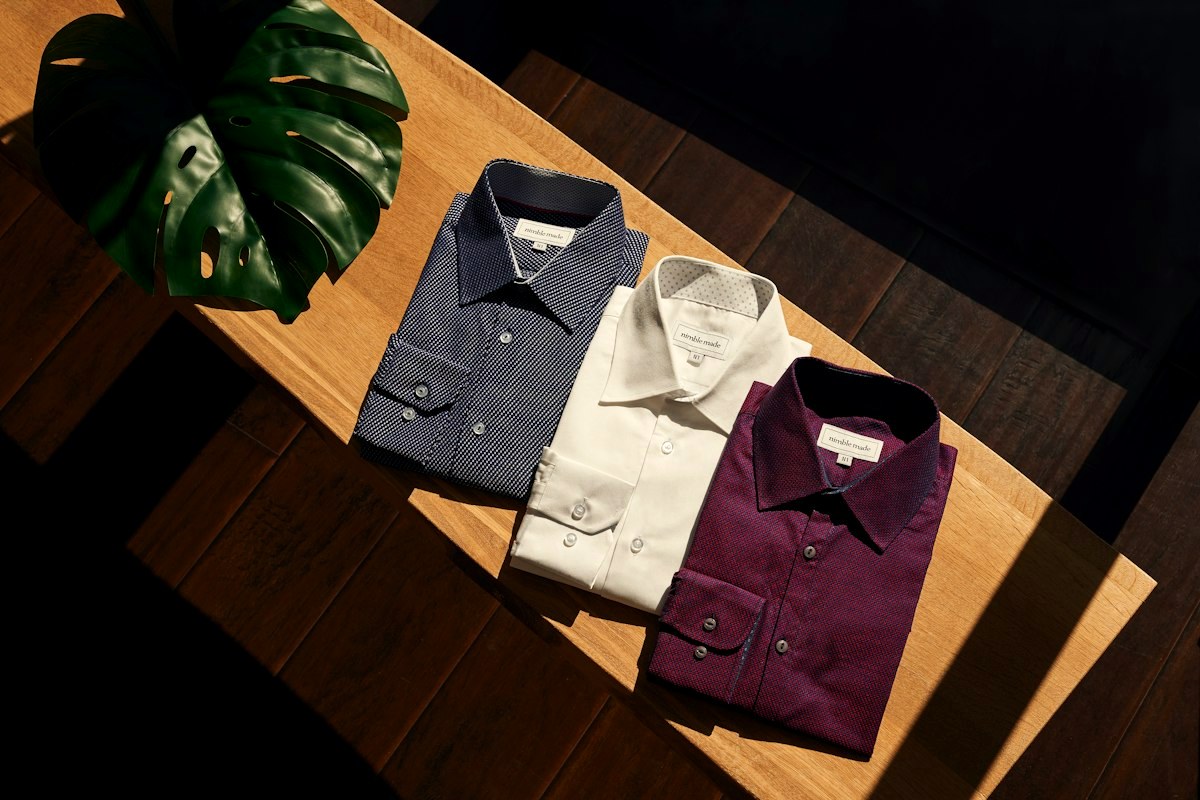
The photography, stated plainly, because this page’s exact subject is absent from our bank entire. The bank holds no frame of a pocket square worn in a breast pocket at reading size: no white linen edge above a worsted’s welt, no puff in a summer jacket, no points standing in a dinner’s rows, in any cloth or register, and no frame of a square being folded, rolled or drawn from a drawer. The hero is therefore the pocket itself, a checked suit’s breast pocket at street distance, empty, captioned as the inch unfilled rather than as the article; the figure in the cloth section is folded cloth, the square’s material in its shirt form, in the three colours the pairing section works with. No frame has been captioned as showing a fold, an echo or a ceiling, because none shows any of them at the size they are judged at. The harvest list this page is waiting for, in order: first, the ceiling photographed, a white linen square in a straight fold above a boardroom worsted’s welt, the sliver level with the cuff’s, the ruling in one frame; second, the ladder in one pocket, the same linen square straight, pointed and the silk puff beside it, the folds’ registers read side by side; third, the rail, a drawer of squares rolled, linen whites at one end and printed silks at the other, the cloth table as a collection kept honestly.
Questions, answered
How do you wear a pocket square?
By three rulings, because the square is the suit's one unruled inch and is still ruled. By cloth: white linen is the default and the formal ceiling, silk the sheen licence, cotton and wool by season. By fold: the straight edge stands at the top of the ladder, the puff is the middle licence, and the multi-point folds are refused as origami. And by the pattern budget: the square never matches the tie, it echoes at most one colour in it, and it spends from the same allowance How to Wear No. 64 prints for shirt, suit and tie, as a fourth station drawing on that budget rather than a free one outside it. A square obeying the three is the outfit's smallest finished decision. A square obeying none of them is the loudest thing in it.
Should a pocket square match the tie?
Never match; echo at most. A square cut from the tie's own cloth, in its pattern and its colour, is a matched set, and it is refused entire: it converts two decisions into one purchase and tells the room both were made by a shop assistant's bundle rather than by the wearer. The law is echo, not identity: the square may take up one colour that stands in the tie, or in the shirt or the suit, and carry it at a different scale and usually at a quieter intensity, so the two stations rhyme without repeating. Where no echo offers itself honestly, the square is white linen, which echoes the shirt's cuff and collar and needs no partner at the throat at all.
What is the most formal pocket square?
White linen, in a straight fold: a ruled white edge standing a measured sliver above the pocket, no points, no puff, no pattern. It is the square of the formal ceiling, the one How to Wear No. 04's boardroom row prints, the square white, if one is worn at all, and the one How to Wear No. 62 prints as the tieless outfit's default, rhyming with the sliver of shirt cuff at the wrist. Linen is the formal cloth because it is matte and holds an edge; silk's sheen and softness step the same square down a register however plain its colour. At the ceiling the choice is binary and small: white linen straight, or no square at all, and both are correct.
Which pocket square fold should I use?
The fold is a formality ladder, and it is climbed down from the top. The straight fold, the presidential or TV fold, is the top rung and the default: a flat edge of cloth parallel to the pocket's top, formal enough for every room this brief licenses and plain enough for all of them. The one-point and two-point folds are the measured step down, a small architecture licensed in the office and dinner rows. The puff is the middle licence, silk's own fold, softer and rounder, at home in the summer rows and under the open collar. The multi-point folds, the crowns and the staircases of four and five points, are refused: a fold that performs has stopped dressing the outfit and started auditioning beside it. The cloth chooses with the fold: linen holds an edge and a point, silk takes the puff and will not hold an edge all day.
How much of the pocket square should show?
A measured sliver, set in the morning and still there at evening, which is a size ruling as much as a display one. The straight fold shows a flat band of cloth, roughly a centimetre, a quarter to a half inch, above the pocket's welt, level with it and parallel. The point folds show their points a little higher by design, and the puff shows its crown only, a soft dome rather than a sail. What all three refuse is drift: a square that rides up into a display or sinks out of sight by noon has failed at the pocket, not at the mirror, and the failure is almost always the square's size against the pocket's depth, ruled in this brief's size section. The display is the residue of a fit, and it is graded that way.
What size pocket square should I buy?
Big enough to fill the pocket's base and stay where the morning put it, which in the sizes makers print means the working band of about 30 to 45 centimetres square, read against the cloth. Linen and cotton squares work at the band's lower half, about 30 to 33 centimetres, because their body fills a pocket without bulk and their folds hold. Silk needs the band's upper half, about 40 to 45 centimetres, because the puff and the point folds spend cloth and a small silk square has nothing to spend. Below the band the square drowns: too little cloth to grip the pocket, gone below the welt by noon. Above it the square bulks: the chest's line distorts over a wadded pocket and the welt strains, a fit failure printed on the suit's cleanest surface.
Can you wear a pocket square without a tie?
Yes, and under a stricter discipline than the tied version, as How to Wear No. 62 rules for the open-collar suit: with the tie gone, the square inherits the outfit's one deliberate colour decision entire, which is an argument for wearing one and a stricter argument for restraining it. The default is unchanged, white linen in a straight fold, the square No. 04's evening row prints for the tieless version, none with a white square. A coloured or patterned square is licensed in the evening and summer rows, kept quiet and in the cloth's family, because there is no tie to share the reading and the square will be read second in the outfit, after the collar, with nothing between them. Theatrical folds are refused harder here: puffed, pointed and patterned at once spends in one pocket the formality the collar is trying to bank.
Has Young Cotton ranked pocket squares?
No, and the absence is printed rather than papered over. No Verdict Card grades the square as an object, and this brief scores none: the square is the one station of the dressed outfit this site rules without a ranking behind it, its law standing in the briefs that govern the stations around it, No. 04's outfit matrix, No. 62's repayment discipline and No. 64's pattern budget, gathered and extended here. The garments it is worn with are scored: the tie at Verdict Card No. 40, the Sam Hober grenadine winning at 91; the suit at Verdict Card No. 64, the Spier & MacKay Core Suit at 85; and the shirt at the Oxford Verdict ranking, the Kamakura at 93. When the desk grades the square shelf on its makers' published records, this page's rulings will be re-argued from that Card.
Next
The family this brief completes stands around it: How to Wear No. 64, a tie, the companion brief, whose pattern budget this page extends to the fourth station and whose texture licence, the grenadine, is the square’s standing partner at the chest; How to Wear No. 62, a suit without a tie, which gives the square its hardest employment as the open collar’s replacement colour instrument and its discipline of being read second; How to Wear No. 04, the suit, whose outfit matrix printed the square’s rows before any brief ruled them, white in the boardroom if one is worn at all, and the white square as the tieless evening’s licence; How to Wear No. 63, loafers with a suit, the pairing brief before the tie’s, the formality scale met at the ankle where this brief meets it at the pocket; and How to Wear No. 60, the turtleneck with a suit, whose ceilings, the uniform and the ceremony, are this brief’s first room class read from the other side. The buying behind the outfit is scored at Verdict Card No. 40, where the Sam Hober grenadine’s 91 stands, at Verdict Card No. 64, where the Core Suit’s 85 stands, and at the Oxford Verdict ranking, where the Kamakura’s 93 heads the shelf the square’s white echoes. The full series lives in the How to Wear index, and how every score behind those pages is built stands on our methodology page.