
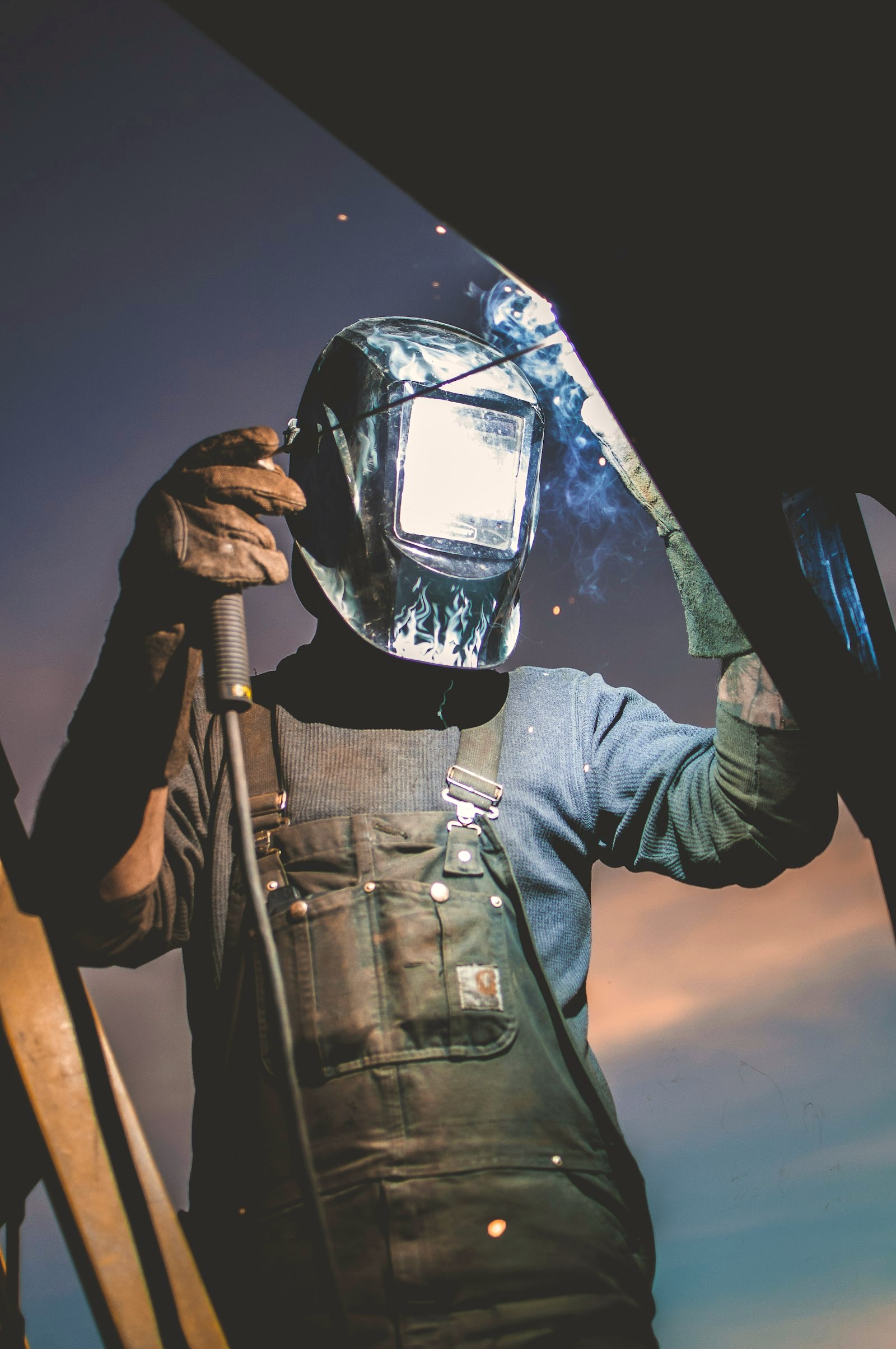
The work species at work: overalls under arc light in a workshop. The bank holds no chore pant on a body, a gap this page admits rather than covering with a borrowed shot; no ranked trouser is pictured anywhere on this page.
Checked and updated October 2026
The verdict, up front: eight chore pants scored out of 100 on the house basis for the garment: cloth and weight honesty 30, reinforcement and construction record 20, fit and range 20, value 15, longevity and service 15. The Carhartt Firm Duck Double-Front Dungaree, the B01, wins at 89: 12 ounces of ringspun cotton duck with its weight and fibre printed, a double front with cleanout openings, triple-stitched seams and reinforced pockets, made in the United States at $64.99. The Stan Ray Double Knee Painter Pant follows at 82, the fullest reinforcement record in the field published entire at £130. The Imogene + Willie Hencye is third at 78, the field's only named mill and only full measurement table, at $235. And the pair sent home, at 40, is a double knee sold by a fashion chain at $20 more than its own house's honest work pant, with the weight unpublished, the pockets uncounted and the break-in applied at the factory. The field's own question runs through every card: of eight trousers, all eight publish a composition, five publish a weight, three name a stitch, and two publish the pocket inventory the species is named for.
First, know which species you are in
The chore pant is a working trouser before it is a style, and this ranking prints the boundary before it grades anything, because two neighbouring records already own pieces of this rail. The chore pant, as this Card prints it: the civilian trade's trouser, a heavy woven work cloth, duck, canvas, drill, moleskin or work twill, carrying the trade's architecture, a reinforced front where the work loads the garment, at the knee above all, or a pocket set built for the trade's tools, tool, ruler and brush pockets and a hammer loop, on a straight working leg cut to move in. The carpenter and painter cuts are this species specified by their pockets, and both are graded here as chore pants.
The neighbours, ruled the way this site rules them. Against the chino, ranked in Verdict Card No. 04: the chino is the same cotton twill family with the trade removed, no reinforced front, no tool architecture, a trouser dressed for the middle of everything at formality 3, and the two are separated by exactly what the chore pant keeps and the chino spends. Against the fatigue, filed in our trouser index: the fatigue is the soldier's issue pattern, cotton sateen, flat patch pockets front and back, formality 2, a trouser whose pockets were built for rations and maps. The chore pant is its civilian brother: its pockets hold tools, its reinforcement sits at the knee where the trade kneels, and its cloth is the heavier work weave rather than the issue sateen. The index holds no chore entry of its own; its work inheritance judges the issued types by the law this Card adopts entire, the features are tools, and a feature that stops working is a costume. This Card files the chore pant inside that inheritance at formality 2, beside the fatigue. Against the pale colourways, ranked in Verdict Card No. 73: the work species in natural and ecru was graded there as ecru trousers, the Stan Ray OG Painter Pant at 78, the Carhartt WIP Single Knee Pant at 83 and the orSlow French Work Pant at 74. Those grades stand; this Card cross-references them and grades the species in its working colours, honouring No. 73's own printed rule that one garment earns one grade whatever the colour name.
How the scores work
Every trouser is scored out of 100 on the same five rows, settled from the trouser Cards' shape, No. 73's basis adapted so the second row carries this garment's signature. Cloth and weight honesty (30) reads the cloth record first: the fibre named and its composition in percentages, the weight printed in numbers or carried by an adjective, and the mill named or silent. Reinforcement and construction record (20) reads the species' defining facts as published: the double front or double knee stated, the stitch construction named, rivets and bar tacks stated or absent, knee-pad openings published or not. Fit and range (20) is scored on the working fit and the size library behind it, the rises, waists and inseams a trade actually orders from. Value (15) is the score divided by the bill. Longevity and service (15) is the life the construction can hold and the candour of the record behind it. One discipline governs the whole page: scores held elsewhere are evidence about houses, never garment scores here. Stan Ray stands at 80, Carhartt at 77, Dickies at 72 and Ben Davis at 70 in the Brands Like family; the OG Painter stands at 78 on No. 73. Every trouser below is graded on its own published record.
The ranking
Carhartt Firm Duck Double-Front Dungaree (B01)
Price at last check: $64.99 through the maker's retail listings, on the record Tractor Supply Co. carries below.
Buy it on the fullest work record in the field: a weighed, ringspun duck, a double front with pad openings, triple stitching and reinforced pockets, made in the United States.
The cloth: a 12 ounce, firm-hand, 100 percent cotton ringspun duck, the weight, the fibre and the yarn all printed in the maker's copy as its retailers carry it: one of three 12 ounce records in the field and the reference cloth of the American work trouser since this pattern was introduced in 1939. The cloth row's 26 credits the complete fibre and weight publication and charges the one silence beside it: the mill is not named on this garment's own record, though the house's duck is woven for it in Georgia, a fact the trouser's page leaves to the house's general copy.
The reinforcement and the pockets: the field's benchmark, and the standard the rest of the page is measured against. A double front, the whole front leg doubled, with cleanout openings at the bottom that accommodate knee pads and shake out the day's dirt, one of two pad openings in the field. Triple-stitched main seams, stated. Stronger sewn-on-seam belt loops, stated. Heavy-hauling reinforced back pockets, stated. Multiple tool and utility pockets and a left-leg hammer loop complete the architecture, and the reinforcement row's 19 charges only what the record omits around them: no rivet or bar-tack statement, and the tool pockets sold in the plural rather than counted. The house stands at 77 in the Brands Like family; this garment's 89 is earned here, on this record, by the pattern the family page itself calls the value benchmark of the whole work category.
Stan Ray Double Knee Painter Pant
Price at last check: about $169 (£130) at the maker's own store.
Buy it on the fullest reinforcement record published in the field: triple-needle construction, rivets and bar tacks, flat-felled seams, made in the United States.
The cloth: 100 percent cotton, stated, in a heavyweight construction the maker names across the garment's colourways, with the weight carried in the open on the reading graded here: the indigo denim colourway is sold under the figure 10oz in the product's own name, a Mount Vernon Mills denim in the garment's published coverage. The cloth row's 24 credits a fibre printed entire and a weight printed where the buyer reads the name, and charges the asymmetry: the duck and drill colourways of the same pattern are sold as heavyweight, a word, where the denim is sold as a number.
The reinforcement and the pockets: the fullest construction publication on this page, and the reinforcement row's only full mark. Heavyweight triple-needle construction, stated. Riveted and bar-tacked stress points, both named, the only garment here that names both. Double-layer front leg panels, the painter's double knee. Flat-felled seams, stated. A reinforced riveted shank button, stated. Tool pockets and a hammer loop complete the painter's architecture, and the charges are the record's two remaining silences: the pockets are named as a class and not counted, and no knee-pad opening is stated behind the double layer. The garment is made in the United States at the house's Texas factory, printed on its page. Its single-layer brother, the OG Painter Pant, stands at 78 on Verdict Card No. 73 in natural; this burlier cousin earns its own 82 here, and the house stands at 80 in the Brands Like family, the winner of that page, as evidence only.

Imogene + Willie Hencye Canvas Workpant
Price at last check: $235 at the maker's own store; the natural colourway showed sold out at this check.
Buy it on the field's only named mill and only full measurement table: 12 ounces of Mount Vernon duck, cut and sewn in the United States, every fit number published.
The cloth: the fullest cloth publication in the field. A 12 ounce duck cotton canvas, 100 percent cotton, from Mt. Vernon Mills, the mill named on the product page, the only maker here who names one; each pair patterned, cut and sewn in the United States, printed with it. The cloth row's 27 is the ratio of that record to the field's: a weight, a percentage and a mill, the three facts this Card's first row exists to ask for, published by the field's smallest house at its highest price.
The reinforcement and the fit: the record splits in two, and the rows price the split honestly. The reinforcement is named and no more: a tough double-knee, patch-pocket workpant is the whole construction publication, no stitch, rivet or bar-tack statement anywhere on the page, which the reinforcement row's 13 charges against the Stan Ray's full publication at the same pattern. The fit record is the field's best by a distance no other garment closes: a full garment measurement table, waist, hip, front rise, thigh and leg opening for twelve sizes, printed on the page, with a custom inseam service offered beside it and a wear test published by the house on the same garment. The fit row's 19 credits the only trouser here a buyer can measure before it ships.
Le Laboureur French Moleskin Work Pant
Price at last check: $148 at Gardenheir, the maker's US stockist.
Buy it for the French pattern entire: a weighed moleskin, a triple-stitched crotch and every pocket named, from the family house that has cut it since the 1950s.
The cloth: a 12 ounce moleskin at 67 percent cotton and 33 percent polyester, both figures printed on the stockist's page as the maker supplies it: a weight and a full percentage split, one of the field's complete cloth publications. The cloth row's 25 credits the honesty entire and charges the fact it honestly prints: the reference French work cloth is a cotton cloth, and a third of this garment is polyester, a trade the page makes in the open and a buyer should make knowingly. No mill is named. The trouser is made in Tunisia, printed on the same page, the French pattern sewn where the house's production now sits.
The reinforcement and the pockets: the French answer to wear, published entire. Where the American pattern doubles the knee, this pattern triple-stitches the crotch, stated, the seam its own trade's posture loads, and the general copy adds reinforced stitching without naming where else it falls, which the reinforcement row's 14 charges alongside the absence of any knee reinforcement at all: a kneeling trade would find this trouser's front a single layer. The pocket record is the field's most complete naming: two deep side pockets, one gusset pocket, one ruler pocket, one buttoned back pocket, five pockets each given its name and trade, one of two entire inventories on this page. The waistband is elasticated at the back with belt loops, under a button fly with the traditional metal hook, and the fit guidance is printed by the seller in plain terms: they run lean, size up one.
Dickies Loose Fit Double Knee Work Pant (85283)
Price at last check: $34.99 at the maker's own store.
Buy it as the honest floor of the whole species: its weight and blend printed, its double knee stated, its size library the widest in the field, at $34.99.
The cloth: an 8.5 ounce twill at 65 percent polyester and 35 percent cotton, the weight and the split both printed in the maker's published specification: the lightest cloth in the field and the only majority-polyester one, which the cloth row's 20 prices as the trade it is, a uniform cloth bought for stain release and wrinkle resistance, both claimed on the same specification, against the 12 ounce cottons ranked above it. What the row credits without reservation is that the trade is printed: a buyer knows the ounces and the blend before the money moves, which is more than three ranked trousers above this one offer on cloth alone.
The reinforcement and the fit: the double knee is stated in the specification's own words, reinforced knees for added years of wear, and nothing stands behind the statement: no stitch construction, no rivet, no bar tack, no pad opening, which the reinforcement row's 12 charges as the distance between naming a reinforcement and publishing one. The pockets are partly named, an easy-access multi-use pocket on the right leg and dual back welt pockets beside the front pair, and the house's signature tunnel belt loops are stated. The fit row's 18 is the field's library argument: the pant sits at the waist in a loose, roomy cut, in waists from 28 to 58 across three inseams in the maker's published grid, the widest size library any trouser here offers the trade that orders from it. The house stands at 72 in the Brands Like family; this garment's 73 rests on this specification alone.
Ben Davis Canvas Double Knee Carpenter Pants
Price at last check: $59 at the maker's own store.
Buy it on a counted record: six pockets named, brass rivets at the stress points, pad openings behind the double layer, in a 100 percent cotton duck.
The cloth: a 100 percent cotton washed duck canvas, the fibre and the weave both printed on the maker's page, and the weight nowhere: the cloth row's 18 sets the two facts side by side, a full fibre publication and a missing number, on a duck whose rivals at this end of the field print 12 ounces as a matter of course. The wash is disclosed in the name itself, washed duck, a softening the maker declares rather than a factory age it performs, and the row credits the distinction the skip below fails.
The reinforcement and the pockets: the strongest record in the field's lower half. Brass rivets at stress points, the metal named, one of two rivet publications here. Double-layer knees with openings for knee pads, the field's second pad opening. And the pocket record counted entire on the maker's page: two front slash pockets, two back patch pockets, two utility pockets and a hammer loop, six pockets and a loop, one of two complete inventories in the field. The reinforcement row's 16 charges the one silence in an otherwise stated construction: no stitch construction is named. The house is San Francisco workwear since 1935 and stands at 70 in the Brands Like family; this garment's 69 is its own, and it is the cheapest trouser here whose pockets can be counted from its page.
Dickies Double Knee Painter's Pants
Price at last check: $45 at the maker's own store.
Buy it as the painter's institution at a working price, knowing its maker publishes almost none of the record its rivals print: no weight, no count, no stitch.
The cloth: the whole cloth publication on the maker's own product page is one phrase, 100 percent cotton fabric. No weight, though the drill this pattern is cut from has been weighed in the garment's test coverage for years; no weave name; no mill. The cloth row's 15 prices the distance between an institution and its record: the Stan Ray painter at No. 2 publishes its construction entire and sells its denim under a weight, while the painter the trade actually buys by the thousand is sold by its own maker on a fibre and a reputation. The fibre, to be plain, is the right one, and $45 is an honest price; neither fact is a publication.
The reinforcement and the pockets: a double knee reinforcement, stated in four words, with no construction behind it: no stitch named, no rivet, no bar tack, no opening. The pocket record is a gesture, utility pockets in various sizes to accommodate small tools and essentials, a low-profile hammer loop beside them: the pockets are neither counted nor named, one of the field's plural plurals. The reinforcement row's 10 and the fit row's 14 together price a garment whose wearing record, decades of painters, is longer than its published one, and this desk grades the published one: a relaxed fit and straight leg across waists 28 to 48 and inseams to 34, as the maker's own variant table prints them. The house's honest specification stands five places above this card, on the 85283; the painter is the same house declining to write one.
Dickies Worn In Double Knee Work Pants
Price at last check: $54.99 at Tillys. It ships without a buy link, the way this desk sends home the garments it convicts.
Leave it. The honest garment's own silhouette, sold back at $20 more with the weight unpublished, the pockets uncounted and the break-in done at the factory.
The cloth: the retailer's whole cloth record is two facts: 100 percent cotton, and a finish. No weight is published anywhere in the listing, no weave is named, and what is sold in place of the record is a feeling: the pants feel broken-in from day one, saving you weeks of stiffness. Read that sentence the way this site's chore coat brief taught the rail to read it: the break-in of a work cloth is its first chapter of wear, the record a garment writes on itself, and this line performs that chapter at the factory and charges $54.99 for the performance, $20 more than the same house's 85283, whose page prints its ounces and its blend at $34.99.
The reinforcement, and the conviction: the double knee exists here as an adjective, rugged double knee construction, with no stitch, rivet, bar tack or opening published, no pocket counted or named, and no size library beyond a fashion retailer's rack. The fit row's 11 credits the one published fact, a loose fit, and the value row's 4 is the arithmetic printed above: a fifth again the price of the honest garment, for a thinner record and a pre-spent cloth. The house is not on trial; its specification for the working version of this same pant stands at No. 5 on this page, and the conviction is the fashion line's: a work garment sold as a look, its durability described in the language of comfort. Buy the 85283 and spend the weeks yourself.
The cloth, reinforcement and pocket table
Every entry below is the maker's own published record for the garment, checked against the maker's pages or their published listings in October 2026. Where the record is silent, the table prints the silence: on a chore pant, the missing entries are the cloth's weight, the stitch behind the double knee and the count of the pockets, and those are the garment.
| Trouser | Cloth, as published | Weight & composition, as published | Reinforcement & pockets, as published |
|---|---|---|---|
| Carhartt Double-Front Dungaree (B01) | Firm-hand ringspun cotton duck; made in the USA | 12 oz; 100% cotton; mill not named on the garment's record | Double front with cleanout openings for knee pads; triple-stitched main seams; reinforced back pockets; stronger sewn-on-seam belt loops; multiple tool and utility pockets, uncounted; left-leg hammer loop |
| Stan Ray Double Knee Painter Pant | Cotton, heavyweight construction; made in the USA | 100% cotton; 10 oz on the denim colourway, in the product's own name; other colourways sold as heavyweight | Triple-needle construction; riveted and bar-tacked stress points; double-layer front panels; flat-felled seams; reinforced riveted shank button; tool pockets and hammer loop, uncounted |
| Imogene + Willie Hencye Workpant | Duck cotton canvas; patterned, cut and sewn in the USA | 12 oz; 100% cotton; mill named, Mt. Vernon Mills | Double knee and patch pockets named; no stitch, rivet or bar-tack record published; full garment measurement table, twelve sizes |
| Le Laboureur Moleskin Work Pant | Moleskin; made in Tunisia | 12 oz; 67% cotton, 33% polyester; no mill named | Triple-stitched crotch; no knee reinforcement; two deep side pockets, one gusset pocket, one ruler pocket, one buttoned back pocket, each named |
| Dickies Double Knee Work Pant (85283) | Work twill, stain release and wrinkle resistant as claimed | 8.5 oz; 65% polyester, 35% cotton | Double knee stated, no construction behind it; multi-use pocket on right leg; dual back welt pockets; tunnel belt loops |
| Ben Davis Canvas Double Knee Carpenter | Washed duck canvas, the wash disclosed in the name | 100% cotton; no weight published | Brass rivets at stress points; double-layer knees with openings for knee pads; two front slash, two back patch, two utility pockets and a hammer loop, counted entire |
| Dickies Double Knee Painter's Pants | Cotton, in the maker's phrase, 100 percent cotton fabric | 100% cotton; no weight, no weave name published | Double knee reinforcement, in the maker's phrase; utility pockets in various sizes, uncounted and unnamed; low-profile hammer loop |
| Dickies Worn In Double Knee (the skip) | Cotton, sold on its finish: broken-in from day one | 100% cotton; no weight published | Rugged double knee construction, in the retailer's phrase; no stitch, rivet or pocket record published |
Read the table as the ranking does. The cloth column, this Card's first finding: a composition stands on all eight records, the one fact labelling law and habit together guarantee, while a weight in numbers stands on five, three at 12 ounces, one at 10 and one at 8.5, and the species that sells durability withholds its weight three times in eight, including from its most famous painter. A mill is named on the maker's own page by one of the eight. The reinforcement column: the panel is nearly universal, a double front or double knee stated by seven of the eight, the French pattern reinforcing at the crotch instead, but the construction behind the panel is the field's silence: a stitch named by three, rivets or bar tacks by two, knee-pad openings by two. The pocket column: an entire inventory, every pocket named or counted, is published by two of the eight, a French family house and a San Francisco one, while the field's institutions sell their pockets in the plural, multiple, various, utility, and stop. The counts are the ranking: the garments that publish are the garments that place.
Cost per wear, printed in the open
The assumption, printed before the numbers: a work trouser in rotation is worn about 40 times a year, the working leg of the wardrobe our trouser index describes. The life column is the service life our longevity row scores for, counted in years on the construction and service record published. One trouser stands priced through a retail listing and one in pounds; the table costs every trouser on its published asking price, converted where the card prints a conversion, and the sources are printed on the cards.
| Trouser | Price | Scored life | Cost per wear |
|---|---|---|---|
| Carhartt Double-Front Dungaree (B01) | $64.99 | 15 years | $0.11 |
| Stan Ray Double Knee Painter Pant | £130 (about $169) | 12 years | $0.35 |
| Imogene + Willie Hencye Workpant | $235 | 12 years | $0.49 |
| Le Laboureur Moleskin Work Pant | $148 | 10 years | $0.37 |
| Dickies Double Knee Work Pant (85283) | $34.99 | 6 years | $0.15 |
| Ben Davis Canvas Double Knee Carpenter | $59 | 8 years | $0.18 |
| Dickies Double Knee Painter's Pants | $45 | 6 years | $0.19 |
| Dickies Worn In Double Knee (the skip) | $54.99 | 3 years, generous | $0.46 |
The table's shape is the field in miniature. The cheapest wear on the page belongs to the fullest record: the weighed, triple-stitched, American-made duck at 11 cents, which is what a published cloth and a published construction buy a buyer, a denominator that can be believed. The attainable Dickies wears at 15 cents on a printed specification, and the counted Ben Davis at 18. The skip wears at 46 cents, the second-dearest figure on the page, three cents behind the $235 Hencye and dearer than the other six ranked trousers, the Stan Ray's full publication included. An unpublished cloth earns an unpublished life, and the arithmetic prices the silence exactly.
Which chore pant to buy
If you buy one: the Carhartt B01, the fullest work record in the field at $64.99. If you buy the reinforcement record: the Stan Ray Double Knee Painter, the only trouser here that publishes its rivets, its bar tacks and its seams. If you buy the cloth: the Hencye, the named mill and the measurement table, at the field's premium. If you buy the French pattern: the Le Laboureur, every pocket named and the weight printed, bought knowing its moleskin is a third polyester. If the money is the argument: the Dickies 85283, the honest floor of the species at $34.99, its weight and blend on the page. The species' upper half is ranked in Verdict Card No. 47, its pale colourways in No. 73, its dressed brother in No. 04, and the leg's whole ladder is mapped in the trouser index.
Questions, answered
What are the best chore pants for men?
The Carhartt Firm Duck Double-Front Dungaree, the B01, scored 89 out of 100: a 12 ounce, 100 percent cotton ringspun duck with its weight and composition printed, a double front with cleanout openings for knee pads, triple-stitched main seams and reinforced pockets, made in the United States at $64.99. The Stan Ray Double Knee Painter Pant follows at 82, the field's fullest reinforcement record published entire, at £130. The Imogene + Willie Hencye is third at 78, the field's only named mill and only full measurement table, at $235. The pair sent home, at 40, is a double knee from the house of the trouser at No. 5, sold through a fashion chain at $20 more than that house's honest work pant, with the record removed and the break-in done at the factory.
What counts as a chore pant?
The civilian trade's trouser: a heavy woven work cloth, duck, canvas, drill, moleskin or work twill, carrying the trade's architecture, a reinforced front at the knee or a pocket set built for tools, ruler and brush pockets, a hammer loop, on a straight working leg. Against the chino of Verdict Card No. 04, the same twill family with no reinforcement and no tool architecture, dressed for the middle of the week at formality 3. Against the fatigue of our trouser index, the soldier's issue pattern in sateen, whose flat patch pockets hold rations and maps: the chore pant's pockets hold tools, and its second layer of cloth sits where the trade kneels. Our index files the species inside its work inheritance at formality 2, beside the fatigue.
Chore pants, carpenter pants and painter pants: what is the difference?
One species, three trade cuts. The chore pant is the general work trouser, named for the French corvee tradition and its American descendants. The carpenter pant is the chore pant specified by its pockets: a hammer loop and rule and tool pockets on the leg, built for the man who carries his bench on his thigh. The painter pant is the same architecture cut in a pale drill or duck the trade can bleach and read stains on, with brush pockets where the carpenter keeps his rule. All three are graded on this Card on one ruler, because the rail sells them side by side and the records they publish are directly comparable: the fullest record in the field belongs to a painter, the Stan Ray, and the thinnest to another painter, its namesake from Dickies.
Who publishes the cloth weight, the reinforcement and the pocket count?
Of the eight trousers graded here, every maker publishes a composition in percentages, and five publish a cloth weight in numbers: 12 ounces three times, 10 ounces once and 8.5 once. A mill is named on the maker's own page by one of the eight. The reinforcement record is thinner: a double front or double knee is stated by seven of the eight, but a stitch construction is named by only three, rivets or bar tacks by two, and knee-pad openings by two. The pocket record is thinnest of all: an entire inventory, every pocket named or counted, is published by two of the eight, and the rest sell utility in the plural. The species sells durability; its durability facts are the ones it publishes least.
What is the difference between a double knee and a double front?
Coverage. A double knee is a second layer of cloth over the knee alone, the panel that meets the ground when the wearer kneels. A double front carries the second layer from the waist or thigh to below the knee, the whole front leg doubled, as on the winning Carhartt, whose double front adds cleanout openings at the bottom so knee pads can be fitted and the dirt shaken out. The French pattern in this field reinforces neither: it triple-stitches the crotch instead, the seam its own trade's posture loads. All three are honest answers to wear; what this Card grades is whether the maker states which one it built, and three of the eight graded trousers state no construction at all beyond the panel's name.
How much should a good chore pant cost?
The ranked field runs from $34.99, the Dickies double knee with its weight and blend printed, to $235 for the Imogene + Willie Hencye, with the fullest record in the field standing at $64.99, the Carhartt B01. Cost per wear rearranges the middle, not the ends: at forty wears a year the Carhartt wears at about 11 cents across fifteen years and the Dickies at about 15 cents across six, while the pair sent home, costed at $54.99 across a generous three years, wears at about 46 cents, second only to the $235 pair and dearer than the six ranked trousers behind it.
How this ranking stays honest
Rests, boundaries and door notes, printed. Round House's Double Front Dungarees were rested: the Shawnee, Oklahoma house, making workwear since 1903, publishes a record that stands complete in its retail listings, chap-style full double knees, triple-stitched seams, reinforced pockets, three rule and pliers pockets and a hammer loop at $79.95, except for the one figure this Card prices first, a weight, which its listing carries as the words heavy weight. It is first on the November capture list, beside the maker's own store. Duluth Trading's DuluthFlex Fire Hose Carpenter Pants were rested on the same rule in reverse: the blend, the rivets and the triple stitching are all published, and the cloth's weight is a comparison without a figure, thirty percent lighter than an original whose ounces the page does not restate; the house stands at 68 in the Brands Like family. Vetra was rested as it was on the chore coat Card: the French seat is taken by Le Laboureur's fuller published record, and two French work trousers would crowd out a species. Le Mont St Michel's trousers were not graded: the house's garment on this site is the work jacket of No. 47, and no current work-trouser record on the maker's own store could be pinned to this desk's standard in this pass. L.C. King's Pointer Brand trousers stand in its stockists' listings as carpenter and work jeans; the house's ranked garment here remains the chore coat that won No. 47. Carhartt WIP's readings of the species are the fashion arm's, answered by No. 73's grading of its Single Knee on a published 12 ounce record and by the arithmetic on the Carhartt family page, and are not re-tried here. H&M was rested deliberately, and no H&M garment is engaged or scored on this page. On doors: seven cards carry a buy link. Five link the makers' own product pages; the Carhartt links Tractor Supply Co.'s exact-product page, which carries the maker's specification entire, with its price taken from the maker's retail listings at $64.99 and printed on the card, the precedent the barn jacket Card set for this house; the Le Laboureur links Gardenheir, the maker's US stockist whose page carries the maker's record, and the Dickies painter links the maker's own storefront page for the garment, at the $45 its own listing prints. The skip ships without a link, as convicted garments do. On photography: this page uses workshop, boot and rail studies from the magazine's own bank, no product photography, and the bank holds no chore pant on a body in any colourway, a gap this page repeats rather than covering with a mislabelled picture; the harvest list names what is missing, in order: a double-knee work trouser worn at work, a moleskin trouser in daylight, a bar-tacked pocket in close-up. Prices and records were checked against the makers' own listings in October 2026; where a figure rests on a retail listing or a stockist's page, the card or this section says so, and the next data pass owes the Round House a maker's-store weight, the Carhartt a maker's-store US price on its own page, and the Hencye a stock check on its natural colourway. The full method is written out on the methodology page.