
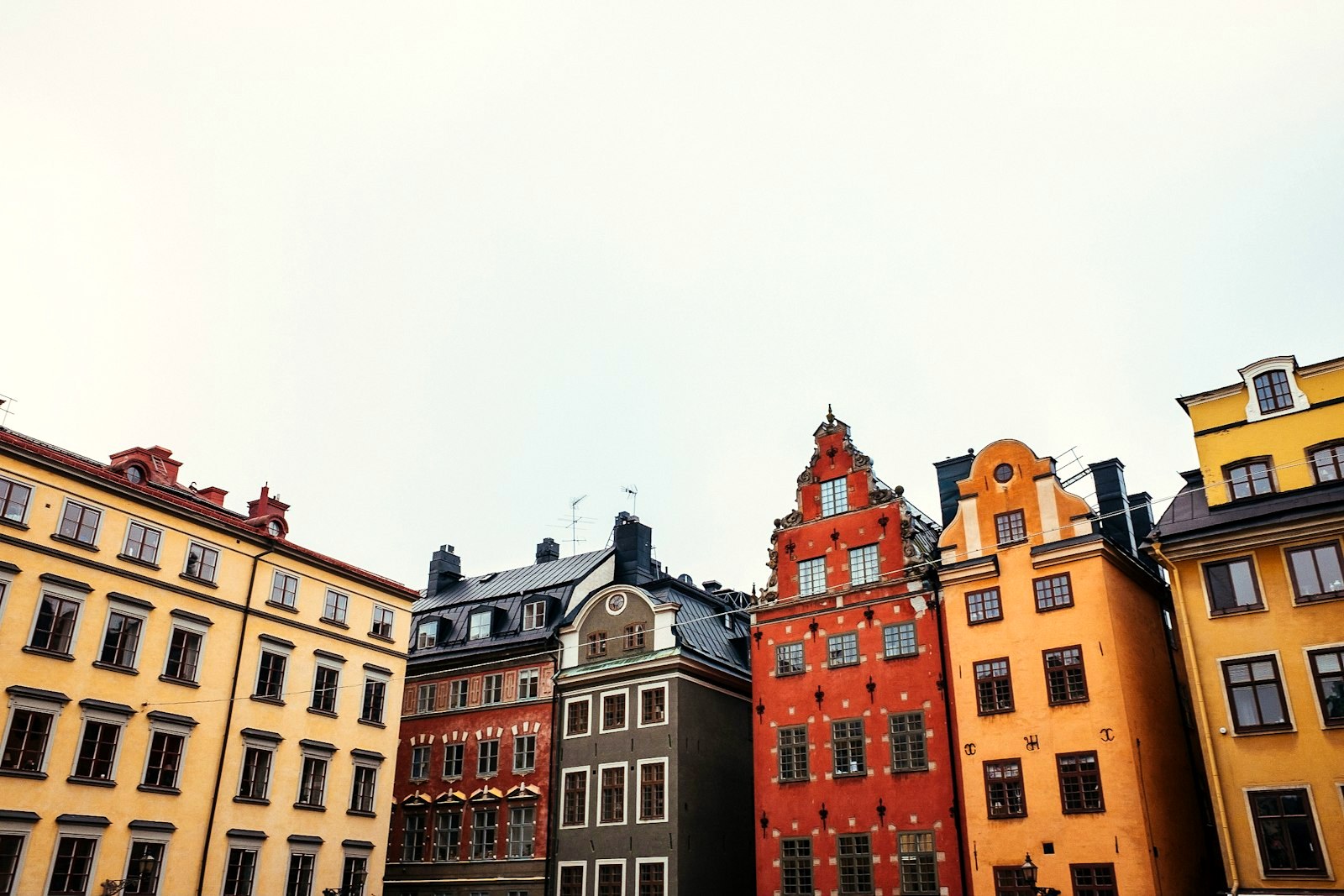
The register's palette, captioned as exactly that: Gamla Stan facades in ochre, rust and cream, Stockholm standing in for the region, because our bank holds no Copenhagen frame and no photograph of a Norse Projects garment, worn or folded, so no frame on this page is captioned as one. The ranking below is built from the published records of the seven houses: the Scandinavian ranking where the anchor's score was set, this series' own pages where the rows around it are printed, the makers' stores where the prices and fabric lines were checked, and, for the two houses scored new here, the makers' own product pages and trade catalogue, read for this ranking.
Checked and updated October 2026
The verdict, up front: the anchor holds its number and takes its honest seat. Norse Projects keeps its standing 85, audited in the open below against its published record: the decade knit, mill countries named, fits published plainly, the crewneck still inside the band its scoring page printed. Above it, Asket keeps 92, carried on the family split this series prints, and Our Legacy keeps 86. Below it, mfpen keeps 84, and a tie at 70 is ruled down the rows: COS keeps its standing 70 and takes the seat on construction, 14 to 13, over Samsøe Samsøe, scored new on this page at 70 from its own store's record. The skip is also scored new here, derived in the open from its own published record: Les Deux, at 56, the Copenhagen look at Copenhagen prices, with a logo where the cloth argument should be.
What people actually want from Norse Projects
Nobody searches for brands like Norse Projects because they need a sweater either. They search because the Copenhagen house is the proof that a knit can be a decade decision: one lambswool crewneck, bought once, in a palette that never moves, from a house that began as a shop in 2004 and has been repeating the same good answer ever since. The want is that discipline without the leap of faith: cloth with its origin printed, fits that run true and say so, and a price that buys winters rather than a season.
The ceiling is real, and this page names it before the anchor's card can be accused of hiding it. The house develops no cloth of its own, publishes no garment weights, and shares its city with a neighbour selling a certified merino crewneck for two thirds of its price, which is why the alternatives below are graded on the three tests this search is really asking, the same tests this series runs in every register. Is the cloth the product: fibres named, mills identified, certifications printed, or a standard asserted in the marketing and nowhere else? Is the record deeper than one line: a gauge, a weight, a size table, or a fibre name and a photograph? And does the price survive arithmetic: a decade of wear at the printed price, or a logo's rent spread over a season? Norse Projects set the first of those tests for the whole Copenhagen school. This page runs all three on Norse Projects first.
How the scores work
Every brand here is scored on the house basis for this series: fabric and cloth out of 30, construction and craft out of 20, fit range and sizing honesty out of 20, value out of 15, longevity out of 15. Five of the seven scores on this page are standing scores, reproduced with their rows: the anchor's 85, Our Legacy's 86 and mfpen's 84 from our Scandinavian ranking; Asket's 92 on the family split this series prints, ruled on below; and COS's 70 from its own page in this series. Two scores are new: Samsøe Samsøe's 70 and the skip's 56, each derived in the open from its maker's own published record, and labelled as derived wherever it appears. The audit the page owes, the anchor's, is run in the open below.
The audit of the anchor, then, from its record, because an anchor in this series is audited where it stands. The 85 was set in our Scandinavian ranking, where the house finished third of twenty, and no garment of its has ever been ranked individually in this magazine; the crewneck that rides at 85 in our Fall Edit does so at the brand score, labelled as such, and this audit treats it the same way, as the brand's evidence, not a garment verdict. The audit rebuilds the brand rows from the published record. Fabric 24: lambswool, merino and alpaca worked with Italian and British mills, the ranking's record, and the maker's store still organises its range by material today, wool the largest family on the rail; the current crewneck's yarn is Italian and its gauge is in print in the trade record, 7 gauge, one ply. The six points below the summit are the programme gap: the house buys excellent cloth and says whose, and develops none of it and weighs none of it in public. Construction 17: a fully fashioned knit record, the crewneck knit in Italy, sound and printed, a step below the houses that publish a bench or a covenant. Fit 18: fits run true and the size information is published plainly, the courtesy our ranking counted at the time, and the maker's store today names the fit of every garment in its own taxonomy, regular, relaxed, boxy, across extra small to double extra large; the joint-highest welcome in this cluster. Value 12: the lambswool crewneck reads 1,600 kroner on the maker's own store at this check, about $250, inside the $225 to $325 band its scoring page printed, and a point above Our Legacy's 11 because the key piece costs less for the same decade. Longevity 14: the same crewneck carried season after season since the label's first years, the decade knit as a stocking policy rather than a slogan, held below the perfect row because no lifetime guarantee or repair covenant of the covenant houses' kind is published. Add them: 24, 17, 18, 12, 14. The audit lands where the number stands. The brand score is 85, and this desk commits in print to re-running the audit when the record moves, and to moving the rows in the open if they move.
Three pieces of bookkeeping belong in the open, because a reader checking our pages will look for them. First, the anchor's own rows do not diverge: the Scandinavian ranking prints 24, 17, 18, 12, 14 inside the anchor's own entry, and the two family cards that have carried this house since, on the Our Legacy and Auralee pages of this series, print the same five rows for the same 85, so there is no split for this page to rule on. Second, a neighbour's split does diverge, and this page rules on it the way this series rules: on the family split. Asket's 92 is printed in the Scandinavian ranking as 25, 18, 20, 14, 15 and on its own page of this series as 28, 19, 20, 12, 13; the family split is carded below, because the family page is where the house was audited garment by garment. Its tee carries the same drift in miniature: the ranking's table prints $70, the family page's check of the maker's store printed $65, and the family figure stands. Third, the tie at 70 is ruled the way this series rules its ties, down the rows until they separate: fabric levels at 20, construction separates them, COS 14 to the derived house's 13, and the seat goes to the standing score. Both cards print the ruling.
The rest of the register is answered in the open rather than ranked, with its numbers untouched. Auralee keeps 94 and Lemaire keeps 90, the register's two summits, anchored on their own pages of this series. Studio Nicholson keeps 86, the volume drawn in London. Sunspel keeps 85 from the Index, the door into the register's drawer. Houdini keeps 84, the Scandinavian ranking's circular outdoor pick. Another Aspect keeps 83, Copenhagen's staples lab, and NN07 keeps 83, the chino solved, wardrobe infrastructure at honest prices; both are this page's nearest neighbours, and both rest here because seven seats are seven seats. A Day's March keeps 82, attainable Stockholm, Séfr keeps 81, the Swedish romantic cousin, Tiger of Sweden keeps 80, the 1903 tailoring institution, and Filippa K keeps 79, minimalism's elder, each answered on its scoring page. Acne Studios keeps 74, sent home on the Our Legacy page of this series on its ranking's own conviction, and is not re-tried here. Peak Performance keeps 66, the Scandinavian ranking's own skip, a ski conviction that is not this page's to re-try. And Moncler, at 55, holds this site's Logo Tax Award on the awards page: the family's standing anti-award, cited here as the register's cautionary tale and not re-tried.
The region's giant copy is answered the way this series always answers it, in prose, because its brand number is a living derivation maintained on the H&M page of this series, from that house's ranked garments, and this page does not borrow it, restate it or re-derive it. Its method here is its method everywhere: the anchor's outline copied within the season, the fisherman rib and the fine gauge printed on cloth that thins and shines where the decade knit is lambswool from named mill countries, because a gauge is a fabric behaviour before it is a photograph. On this page the copy worth pricing is not the cheapest one. It is the skip below, the hometown look sold back to its own city with the argument left off.
The disclosure ledger, read from the houses' own published records, is the spine of the ranking, so it is printed before the cards. Read down the cloth column and the ladder below explains itself: at the top, houses that publish costs, provenance and licence numbers; at the bottom, a house whose product page publishes a logo and a line.
| House | The cloth record, as published | The signal on the garment |
|---|---|---|
| Asket | Every garment carries a published breakdown of what it cost to make and where it was made; the T-Shirt's cloth, cost and margin are printed beside its price. | None on the core |
| Our Legacy | Portuguese cottons and treated wools with the mills' countries named; deadstock and upcycled cloth worked into the main line and labelled as such. | None on the core |
| Norse Projects | Lambswool, merino and alpaca with the mill countries named; the current crewneck's yarn is Italian and its gauge is in print; no garment weights published. | A tab the size of a stamp |
| mfpen | Deadstock provenance is the product: surplus European mill cloth, bought as found and sewn as a collection, with the runs' ends admitted on the record. | None |
| COS | Compositions published on every garment; the cloth is the group's, specified to a price the silhouette does not advertise. | None on the core |
| Samsøe Samsøe | The fibre is named on the rail itself, the composition is printed on the product page, and the merino carries an RWS certificate with the certifier and licence number. No weight, no gauge, no mill anywhere read. | Near none on the knits |
| Les Deux | One line per garment on its own store; the signature trouser in the maker's own trade catalogue is 63 percent polyester; the design content, in its own copy, is a large embroidered logo. | The logo, embroidered, at the chest |
Seven brands like Norse Projects, ranked
Asket
US prices at last check: the T-Shirt $65 at the maker's store; the range runs $65 to $680.
Keeps its standing 92 from our Scandinavian ranking, on the family split this series prints: the permanent collection, the cost of every garment published, and the only perfect fit score in this magazine.
The winner, keeping the 92 from our Scandinavian ranking on the family split its own page of this series prints, 28, 19, 20, 12, 13, audited in the open on its own page, where it also won. The Stockholm house refuses the mechanics of fashion outright: no seasons, no drops, one permanent collection improved garment by garment, every piece carrying a published breakdown of what it cost to make and where, and sizing honest enough to hold the only perfect fit score in this magazine. Read against the anchor, this is the discipline the anchor practises, taken to its logical end and priced below it: the anchor repeats a good answer, and this house publishes the answer's receipts.
What the seven-point gap buys is printed in the rows. Fit is a perfect 20 against the anchor's 18, dozens of sizes with short, regular and long lengths. Fabric is 28 to 24, a standing programme of specified cloth with its costs attached, against honest cloth bought from named mill countries. And value is level at 12 while the entry garment, the T-Shirt at $65, costs a quarter of the anchor's crewneck, which is the ranking's whole argument in one comparison: the winner of this page is also its attainable pick. The deduction its own page prints stands: the design hand is deliberately plain, and the cloth is very good rather than sublime. Buy the base wardrobe here first. The anchor is what you add when the base is built and the knit is the point.

Our Legacy
US prices at last check: the Borrowed Shirt $371 at Farfetch; the range runs $150 to $1,200.
Keeps its standing 86 from our Scandinavian ranking, audited in the open on its own page of this series: the relaxed wardrobe with a pulse, deadstock and upcycled cloth in the main line.
The design pulse, keeping the 86 and the rows from our Scandinavian ranking, where it finished second of twenty, audited in the open on its own page in this series. The Stockholm house began in 2005 as a graphic T-shirt project and grew into the region's most influential label: familiar garments, a shirt, a jean, a boot, cut a few degrees off normal, in fabrics that include deadstock and upcycled cloth worked into the main line rather than a capsule. Read against the anchor, this is the same weather answered with the opposite temperament: where the anchor removes strangeness until only the knit remains, this house adds a degree of it back, on purpose, every season.
The one-point gap to the anchor is printed in the rows, and it runs in both directions. Fabric is 27 to 24 and construction 18 to 17: a sourcing story with a pulse beats honest cloth bought well. The anchor wins fit back, 18 to 16, true fits and plain size information against a range cut for one body it knows, and value, 12 to 11: the Borrowed Shirt at $371 is designer money for a shirt, and the anchor's key piece costs $120 less for the same decade. Longevity is level at 14. The verdict its own page prints stands as this page's: buy the core silhouettes and the shirts, and let the experiments date without you. The reader who wants the region's discipline with its hand off the brake reads this card. The reader who wants the brake is the anchor.
Norse Projects
Price checked today on the maker's own store: the lambswool crewneck 1,600 kroner, about $250; the range runs $90 to $700.
The anchor, at its standing 85 from our Scandinavian ranking, audited in the open above: the decade knit, honest cloth from named mill countries, and the plainest size information in the cluster.
The anchor, keeping the 85 and the rows from our Scandinavian ranking, where the audit above rebuilt them from the house's published record and landed where they stand. Norse Projects started as a Copenhagen shop in 2004 and launched its own label five years later under a motto that doubles as a quality claim: created for life, good for all seasons. The knitwear is the heart of it, lambswool, merino and alpaca worked with Italian and British mills into fisherman ribs and fine gauges that layer without bulk. Nothing chases a trend and nothing is precious; the tab logo is the loudest thing the house makes, and it is the size of a stamp.
Read against the field, the seat is honest and so is the altitude. The winner above publishes its costs; the pulse above it designs; the deadstock house below it starts from rarer cloth. What the anchor holds against everyone is the combination nobody else in this cluster quite matches: fit 18, the joint-highest welcome on the page, on cuts that run true with the size information in plain language; value 12 on a crewneck that has stayed inside its printed band; and a longevity record built from repetition, the same garment, carried and re-carried, which is what a decade knit means when it is a stocking policy rather than a slogan. The Scandinavian ranking's verdict stands as this page's: if you buy one Scandinavian knit, buy it here. It will outlast the argument about which one to buy.
mfpen
US prices at last check: the Examination Shirt $180 to $260; the range runs $130 to $500.
Keeps its standing 84 from our Scandinavian ranking: a whole collection built from European deadstock, tailored calm, at half the anchor's shirt money.
The anchor's closest relative, keeping the 84 and the rows from our Scandinavian ranking. Sigurd Bank founded mfpen in Copenhagen in 2015 on a constraint that became a signature: the collections are built substantially from deadstock fabrics, surplus cloth from European mills that would otherwise be wasted. Because the fabric comes first the design stays calm: generous shirts, easy blazers, trousers with drape, a palette of washed neutrals. It reads like Italian soft tailoring filtered through Danish restraint. Read against the anchor, the kinship is the city and the calm; the difference is the starting point, a found cloth roll against a standing knit programme, and the wardrobe it builds is the anchor's dressed register rather than its weather register.
The one-point gap to the anchor is a welcome gap and a weather gap, and the rows say which is which. Fabric is a point ahead, 25 to 24: deadstock is a real cloth story, graded above the anchor's because each run's provenance is the garment's own. Construction is level at 17. Fit is 16 to the anchor's 18, the narrow range being the shared tax of small houses designing for one body they know, charged harder here because the anchor proves a small house can publish its way out of it. Value is level at 12 and longevity level at 14. The catches are the ones its scoring page prints: deadstock runs end, so the fabric you want may not exist in your size next month, and distribution is still catching up with the reputation. The verdict stands: the insider's shirt brand of the Scandinavian ranking. When your size exists in a fabric you like, the decision is already made.
COS
US prices at last check: shirts and knits typically $99 to $150.
Keeps its standing 70 from its own page in this series: the best silhouettes on the high street, over the cloth of the group that owns it. In the tie at 70 it takes the seat above the derived house on the construction row, 14 to 13.
The mall altitude, keeping the 70 and the rows from its own page in this series. COS is the H&M group's architecture line: the Copenhagen silhouette, wide trousers, boxy shirting, muted everything, drawn well and sold in every capital at $99 to $150. Read against the anchor, this is the register with the weather removed: the shapes survive the descent intact, and the cloth does not, group fabric specified to a price the silhouette never mentions. Its compositions are published on every garment, which is more than the skip below prints, and its construction is a point better than the derived house beside it, which is the whole of the tie ruling and printed here rather than buried.
The fifteen-point gap to the anchor is printed in the rows. Fabric is 20 to 24 and longevity is 8 to 14: the silhouette is a decade shape sewn to a season's cloth life, and the two rows together are the page's arithmetic of descent. Fit is 16, a genuinely wide welcome, and value is level at 12, the honest half of the card: at a third of the anchor's prices, the arithmetic nearly argues back. Buy the trousers and the shirting when the shape is the point and the decade is not. The reader who wants the anchor's actual argument, cloth first and repeated for ten winters, has three cards above this one and a neighbour below it.
Samsøe Samsøe
Prices checked today on the maker's own store: the Isak merino crewneck 1,500 SEK, about $160; the Sarick sweater 1,900 SEK, about $200; knits run 1,200 to 3,200 SEK.
Scored new on this page, derived in the open from the maker's own published record: Copenhagen's other knit house, certified merino with the licence printed, at two thirds of the anchor's price.
The derivation first, because this card sets a number and says so. Samsøe Samsøe has no standing score in this magazine; the 70 is derived here, in the open, from the maker's own published record, checked for this page, and every row below is argued from that record and nothing else. The house is the anchor's hometown neighbour and its most direct cross-shop: a Copenhagen knit rail where the fibre is named on the tile itself, 100 percent merino wool printed beside the Isak crewneck's price, 1,500 kronor, about $160. Its product pages carry the record deeper than most of this cluster's: the Sarick sweater's page prints its composition in prose, names its fit, gives the model's height and the size he wears, and prints an RWS certificate for the wool with the certifier and the licence number, Control Union 1009799. A checkable claim, printed where the garment is sold, is exactly what this magazine's fabric row exists to reward.
The rows follow from that record. Fabric 20: certified fibre with the licence in print, level with the mall house above it and for the opposite reason, a real certificate over a record that stops at one garment's depth: no weight, no gauge, no mill named anywhere this desk read. Construction 13: rib-knitted trims and fully fashioned details claimed in its category copy, nothing graded beyond the claim, and it is this row, 13 to the standing house's 14, that seats this card below the tie. Fit 15: the fit named per garment and the model's measurements printed, a courtesy above the cluster's floor and below the anchor's plain-language standard. Value 12: the certified merino crewneck at about $160 undercuts the anchor's $250 outright, level with the anchor's row because the rail also runs to 3,200 kronor and the sales cadence is a season's. Longevity 10: numbered core styles carried across seasons inside a seasonal collection, a collaboration capsule on its own site at this check, and no repair programme published. Add them: 20, 13, 15, 12, 10. The total is 70. The fairness is printed with the grade: this is the honest cheap seat in the Copenhagen cluster, and a reader whose budget ends at $200 should buy its merino without a flicker of this page's doubt. What the fifteen points to the anchor buy is depth of record and a decade of the same garment, and readers who do not need either should not pay for them.
Les Deux
Prices checked today: the embroidered-logo rugby sweatshirt €139, about $160, on the maker's own store; graphic tees $65 to $79 and knits to $279 at its stockists. This card ships without a buy link, and the honesty section prints why.
Scored new on this page, derived in the open from the maker's own published record: the Copenhagen look with a logo where the cloth argument should be, at the anchor's prices.
The derivation first, because this card sets a number and says so. Les Deux has no standing score in this magazine; the 56 is derived here, in the open, from the maker's own published record, checked for this page, and every row below is argued from that record and nothing else. The house is Copenhagen's prep-and-street name, founded on a duality its own copy states, preppy meets street, and it sells this page's exact silhouette, clean knits, rugby sweatshirts, tailored trousers, at this page's exact prices: the rugby sweatshirt at €139 on its own store, knits to $279 at its American stockists, a wool coach jacket at $525. What its own pages publish about the cloth is the whole conviction. The rugby sweatshirt's product page leads, in the maker's own words, with a large embroidered logo on a contrasting chest panel, and its fabric record is one line: 100 percent cotton, organic. No weight, no gauge, no mill, on garment after garment. And in the maker's own trade catalogue, the garment the house is known for, the Como suit pant, its signature trouser, is published as 63 percent polyester, 32 percent viscose and 5 percent elastane, a majority-plastic cloth under a tailored silhouette, at tailored prices.
The rows follow from that record. Fabric 16: one-line records everywhere the garments are sold, the organic cotton credited, the signature trouser's split charged, against an anchor that names its mill countries on a $250 crewneck. Construction 11: nothing published beyond ribbed trims and embroidery, no seam, no gauge, no make claim to grade. Fit 14: the fit named per garment and a size guide offered, an ordinary welcome honestly graded. Value 7: anchor prices for one-line receipts, the design budget spent where the customer can see it, on the chest. Longevity 8: seasonal chapters and graphic product that dates by design, its never-out-of-stock core credited in the row, and no repair programme published. Add them: 16, 11, 14, 7, 8. The total is 56, one point below the Gap score this series derived on the Taylor Stitch page, and the page prints that comparison because it is the whole warning: the mall copy of the American uniform and the hometown copy of the Copenhagen one land in the same place, except that this one charges Copenhagen prices for it. The fairness is printed with the conviction: the fits are friendly, the organic cotton is a real fibre, and the prep half of the rail is pleasant clothing. What is sold at these prices is the anchor's look with the anchor's argument removed, the cloth named in one line and the logo in large embroidery. Buy the look from the six houses above it, whose pages argue about fibre.
The pattern under the ranking
Read the ladder as one argument about what a receipt is worth. At the top, the receipt is the product: a cost breakdown published beside the price in Stockholm, deadstock provenance sewn into a collection in Copenhagen. In the middle, it is a habit: mill countries named, size information in plain language, a certification licence printed on a product page, the receipts getting shorter as the prices get more ordinary. And at the bottom, it is a logo: one line of fibre under a large embroidery, the record ending exactly where the questions start. The ranking is the audit of those three answers, and the audit is reproducible: find the fabric line, count what stands behind it, and the score follows.
The second pattern is the neighbour problem, and it is this page's reason for existing. Copenhagen sells the same clean silhouette at three altitudes within a few streets of itself: the decade knit at about $250 with its origins printed, the certified merino at about $160 with its licence printed, and the embroidered sweatshirt at about $160 with a logo printed. Two of those three records survive this page's audit and one does not, and the difference was never the silhouette, which all three draw well. The reader this page exists for is the one holding the anchor's crewneck in one tab and the neighbour's in the other, wondering what the $90 buys. The rows above are the answer, printed in numbers instead of adjectives: mill countries, a gauge, a decade of the same garment, and a fit welcome graded a courtesy. The licence number, it turns out, was worth most of the difference, and the house that printed it is not the famous one.
| Brand | Score | The piece to buy | Price |
|---|---|---|---|
| Asket | 92 | The T-Shirt | $65 |
| Our Legacy | 86 | The Borrowed Shirt | $371 |
| Norse Projects | 85 | The lambswool crewneck | About $250 |
| mfpen | 84 | The Examination Shirt | $180 to $260 |
| COS | 70 | The wide trouser | $99 to $150 |
| Samsøe Samsøe | 70 | The Isak merino crewneck | About $160 |
| Les Deux | 56 | None | €139, for the sweatshirt |
The one to skip: Les Deux
The skip: Les Deux, scored new on this page at 56, derived in the open from its maker's own published record. The conviction rests on that record and nothing else: a flagship sweatshirt whose own product copy leads with its large embroidered logo and whose fabric record is one line; a graphic rail of tees named for their prints at $65 to $79; knits at $279 at its stockists with the same one-line record; and a signature trouser, the garment the house is known for, published in the maker's own trade catalogue as 63 percent polyester. The fairness is printed with the conviction: the organic cotton is honest fibre, the fits are friendly, the never-out-of-stock core is a real attempt at permanence, and the prep half of the rail is pleasant clothing that harms nobody. What is sold at the anchor's prices is the anchor's city and the anchor's silhouette with the anchor's argument removed, the mills, the gauge and the decade, and under a rubric that pays for those three things, that mix lands where it lands. Buy the Copenhagen look from the six houses ranked above it, two of which sell it for less.
Which one to buy
Buy Asket for the discipline at full strength: the base wardrobe, bought once, with every cost published and the widest fit welcome in menswear. Buy Our Legacy for the region with a pulse: the Borrowed Shirt and the core silhouettes, familiar garments cut a few degrees off normal. Buy Norse Projects for the knit itself: the lambswool crewneck at about $250, true fits, plain size information, ten winters of the same good answer. Buy mfpen for the insider's rail: the Examination Shirt and the deadstock tailoring, when your size exists in a fabric you like. Buy COS for the silhouette at mall altitude: the wide trouser and the boxy shirting, when the shape is the point and the decade is not. Buy Samsøe Samsøe for the honest cheap seat: the certified merino crewneck at about $160, the licence number printed on the page, the anchor's city at two thirds of the anchor's price. Skip Les Deux at these prices, and let the six houses above it sell you Copenhagen with its receipts attached.
Questions, answered
What brand is most like Norse Projects?
mfpen, at 84 out of 100 in this ranking, and it is the same kind of answer: the other Copenhagen house that starts from cloth, a whole collection built from European deadstock, tailored calm at $130 to $500. Above the anchor, Our Legacy at 86 is the same region answering the same weather with a pulse, and Asket at 92 is the summit of the discipline, one permanent collection with the cost of every garment published. Below the anchor, Samsøe Samsøe, scored new on this page at 70, is the attainable neighbour: a certified merino crewneck at about $160 against the anchor's $250. The anchor's own verdict, from our Scandinavian ranking, is the piece to start with: the lambswool crewneck, the decade knit.
Is Norse Projects worth the money?
On the record this page audits, yes, at the knit, with the deductions printed. Fabric is 24 of 30: lambswool, merino and alpaca worked with Italian and British mills, the current crewneck's yarn Italian and its gauge in print, graded below the summit because the house buys excellent cloth rather than developing it and publishes no garment weights. Fit is 18 of 20, the joint-highest welcome in this cluster: fits run true, the size information is published plainly, and the maker's store names the fit of every garment. Value is 12 of 15: the crewneck reads about $250 on the maker's own store at this check, inside the $225 to $325 band its scoring page printed. Buy the crewneck first. It is the garment the whole score is about.
Norse Projects or Samsøe Samsøe: which should I buy?
Norse Projects, for the decade, and Samsøe Samsøe, for the budget, and the fifteen points between them are printed in the rows. The neighbour's record is real: its knit rail names the fibre on the tile, and its merino crewneck carries an RWS certificate with the certifier and licence number printed on the product page, at 1,500 SEK, about $160. What it does not publish is anything deeper: no weight, no gauge, no mill, and a seasonal cadence around a numbered core. The anchor publishes mill countries, a crewneck carried season after season, and the plainest size information in the cluster, at about $250. If the budget is the argument, the neighbour is the honest cheap seat in this cluster, which is why this page scored it instead of skipping it. If the ten winters are the argument, the anchor.
How does the anchor finish third on its own page?
Because this series reproduces standing scores instead of flattering its anchors, and two houses stand above this one on numbers set elsewhere. Asket's 92 and Our Legacy's 86 were set in our Scandinavian ranking and audited on their own pages of this series; they are carried here unchanged, on the family split for Asket, which the method section prints. Third of seven, behind the ranking's winner and the region's design pulse, is the honest shape of this cluster: the anchor is the knit institution of Copenhagen, not its summit, and its 85 survives its audit below intact. A page in this series that moved its anchor up the ladder would be advertising.
Why is Les Deux the skip?
Because of what its own pages publish, checked for this page. Les Deux sells this page's city and this page's clean silhouette, at this page's prices: an embroidered-logo rugby sweatshirt at €139 on its own store, graphic tees at $65 to $79, knits to $279 at its stockists. Its own product copy leads with the large embroidered logo at the chest, and its fabric record, on garment after garment, is one line: a fibre name, no weight, no gauge, no mill. In the maker's own trade catalogue, its signature trouser, the product the house is known for, is published as 63 percent polyester, 32 percent viscose and 5 percent elastane. Scored new on this page and derived in the open from that record, it totals 56: one point below the Gap score the Taylor Stitch page derived last week, at Copenhagen prices instead of mall ones. The look is faithfully Copenhagen. The receipts are a logo and a line. Buy the look from the six houses ranked above it, whose pages argue about cloth.
How this ranking stays honest
Every score on this page but two is a standing score, and its home is printed on its card: Norse Projects' 85, Our Legacy's 86 and mfpen's 84 from our Scandinavian ranking, with the anchor's 85 audited in the open above; Asket's 92 on the family split this series prints, the ruling and both arithmetics stated in the method section, because the ranking's split for that house differs from the split its audited family page set and this page follows the family; and COS's 70 from its own page in this series. Two scores are new, and they are labelled wherever they appear: Samsøe Samsøe's 70 and Les Deux's 56 are derived on this page from those makers' own published records, their product pages' fabric lines, prices and, for the skip, its own trade catalogue's composition for its signature trouser, checked for this ranking, because neither house had a standing score and the search this page answers is incomplete without the street priced. The tie at 70 is ruled in the open, down the rows: fabric level at 20, construction to the standing house, 14 to 13. No other number was derived, moved or rounded for this page. And our cool brands ranking scores on a different basis, design language rather than this series' five rows: it prints the anchor at 90 there, a number that belongs to that page and is never carried onto this one, and this page's numbers should not be carried back.
On doors: the Asket card links the exact T-Shirt product page our Scandinavian ranking prints, on the maker's own domain; the Our Legacy card links the exact Borrowed Shirt page at Farfetch that the Our Legacy page of this series prints; the Norse Projects card links the merchant search door its scoring page prints, on the maker's own domain, logged here as the deepest door this desk has verified for that house; the mfpen card links the merchant search door its scoring page prints, on the maker's own domain; the COS card links the men's shirts department its own page of this series prints; and the Samsøe Samsøe card links the maker's own men's knitwear department, the door read for this page, on the maker's Swedish storefront, which is why its prices are printed in kronor with the dollar conversions beside them. The Les Deux card ships without a buy link, the way this site's convicted cards do: this desk does not link what it sends home, and the skip's prices and fabric lines above were verified on the maker's own store and its own trade catalogue for this ranking. On photography: the magazine's bank holds no photograph of any ranked house's garment, and no frame on this page is captioned as one; the hero is Stockholm's old town facades, the region's palette, standing in for a Copenhagen the bank cannot yet show, the cards carry the tee, the rail, the folded knits and the shirts of the register, each captioned for exactly what it shows, and the harvest list names what is missing: a lambswool crewneck on a body in Copenhagen daylight, a Nyhavn rail in winter, and certified merino at macro range with the licence card in the caption. Prices and records were checked against the pages cited in October 2026; the full method is written out on the methodology page.