
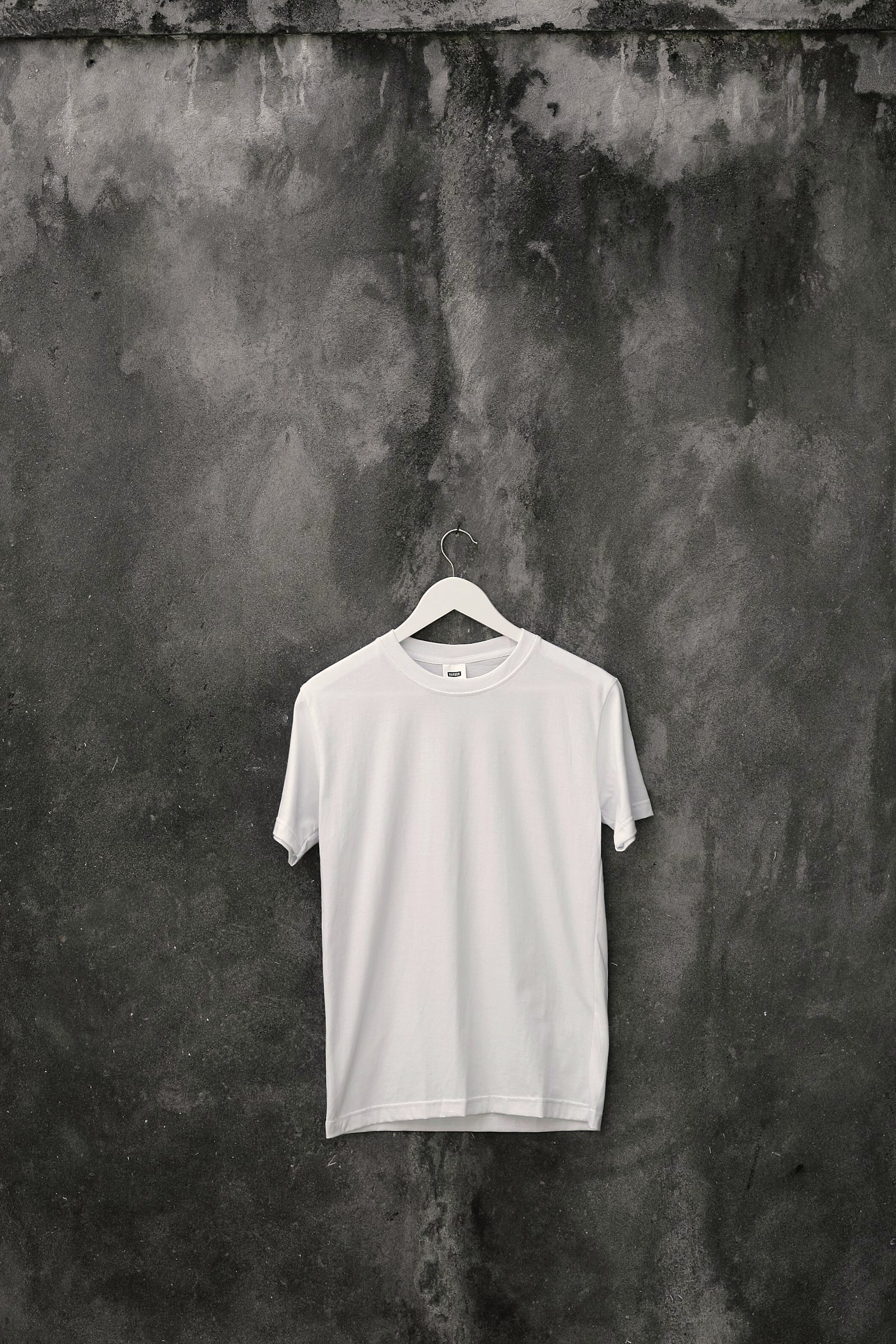
The plain white tee: the garment every claim on the underarm shelf is finally made against, hung up at the end of the day it was graded on. It stands here because the photo bank holds no deodorant product photography and no bathroom shelf, the same gap the deodorant ranking names on its own page, and the gap is admitted in the honesty section below rather than filled with a borrowed product shot or a face.
Checked and updated October 2026
The thesis, up front: the missing number on the natural deodorant shelf is not a conspiracy, and it is not a virtue. It is a labelling rule. An antiperspirant is a drug, and the law makes it print the strength of its active ingredient on a Drug Facts panel; a deodorant is a cosmetic, and the law asks only that its ingredients be listed in descending order, with no quantity for anything. Counted across the field our deodorant ranking graded, an active percentage is printed by 4 of 4 antiperspirants and 0 of 4 deodorant-only products. This Take argues both halves of that sentence. The silence is structural, built into the rules rather than chosen stick by stick. And structural is not the same as harmless: a shelf where nothing prints a strength cannot be compared on strength, and the one outright failure in the field, two different ingredient panels under one product name in the same week, is a record failure a brand could fix tomorrow. The fix this page argues for is not a new ingredient. It is a printed percentage, and the first natural brand to print one wins the column.
In this issue
The thesis: the silence is structural
This is the Take the first issue left blank. Grooming Take No. 1 argued that grooming is sold by the step and works by the habit, priced the smallest kit its records supported, and then stopped at one line of the kit and printed a gap instead of a product: no page on this site had graded a deodorant, and the desk would not fill the space with an opinion dressed as a record. The record now exists. Verdict Card No. 65 graded eight underarm products on their published ingredient lists and priced evidence, and this issue argues what that record adds up to, the way the first issue argued from its four desks. Nothing below is scored here. Every number is the Card's, reproduced exactly, and the argument is built out of them and nothing else.
Start with the two species, because the shelf hides the distinction and the whole question turns on it. An antiperspirant is an over-the-counter drug. It carries an aluminum active, it must print that active and its percentage on a Drug Facts panel, and the claim it is permitted to make is the reduction of underarm wetness. A deodorant is a cosmetic. It carries an ingredient list in descending order of concentration, it is not required to print a percentage for anything in it, and its claim is odor, only odor. Neither species is the honest one. They are regulated differently, and the regulation writes the label. That is the structural half of the thesis, and it matters because it acquits most of the natural shelf of the charge usually levelled at it. A natural stick that prints no percentage is not withholding a number its maker measured and hid. In most cases the number was never going to be printed, because no rule asks for it and the format of the list has no place to put it.
The second half is the one the acquittal does not cover. A rule can explain a silence without making the silence free. What the cosmetic rule produces, shelf-wide, is a category where strength cannot be compared because strength is never stated: two sticks side by side offer two ordered lists, and order is a trace of concentration, not a measure of it. First on the list might mean forty percent or fourteen. The buyer is asked to choose on scent names, absence claims and hours printed as marketing, while the one figure that would anchor the comparison sits in a formula file he will never see. Structural, then. And not harmless. Both halves are the Take, and printing only the first would be the shelf's own marketing, repeated by a magazine.
The record, counted
The finding first, in the Card's own count. An active percentage is printed by 4 of 4 antiperspirants in the field and 0 of 4 deodorant-only products. The drug side's numbers: aluminum chloride at 12.0 percent in the Certain Dri roll-on, the ranking's winner at 86; aluminum zirconium tetrachlorohydrex GLY at 20.0 percent in the Degree Men Clinical Protection, the field's highest printed percentage, at 83; the same active at 15.2 percent in the Dove Men+Care Clean Comfort at 84; and at 15 percent in the Old Spice Fiji stick at 78. The cosmetic side's numbers: none. Not for the odor active, not for anything, on any of the four lists, in either of the two versions of the list that one brand managed to circulate at once. The fourth column of the ranking's comparison table is full on one side and empty on the other, and the emptiness is legal, which is precisely why what a maker does inside the permission is the thing worth grading.
Because the permission can be spent well, and the field contains the proof. The highest deodorant-only product on the Card, the Schmidt's Bergamot and Lime stick at 82, prints a full ingredient list with its odor active, magnesium hydroxide, in first position, ahead of the oils and butters. Its baking soda, the ingredient this shelf usually whispers, sits sixth, named, and the maker's own FAQ states in plain language that its signature formula uses primarily magnesium and some baking soda. Its claim is 24 hours, the most modest hour figure in the field. It sells a separate sensitive collection with the baking soda removed entirely, and its certified-natural claim names a certifier, Ecocert, rather than an adjective. None of that required a rule change. It is what the existing rules allow a maker to say when the maker decides the list is the specification. The ranking's other honest natural records make the same point at lower scores: the MALIN+GOETZ stick at 70, ten ingredients published in full, a 12-hour claim, and a sentence on the maker's own site stating plainly that the product is not an antiperspirant and will not prevent sweating. Species clarity does not get plainer than a maker declining the other species' job in print.
And the permission can be spent on atmosphere instead, which is the field's one conviction. The Native Classic, sent home at 59, is the natural shelf's biggest name, and its maker's own product page, as the desk captured it, printed no ingredient list at all: an aluminum-free claim, a 72-hour claim described as clinically proven, and a formula said to be fighting odor in five ways the page does not enumerate. To read what is in the stick, the record has to be assembled at retailers, and in the week the Card was checked it assembled two different ways. At Target and at Publix, one panel: sodium bicarbonate fourth, ozokerite third. At Food Lion and at Balducci's, a different formula under the same name: magnesium oxide third, piroctone olamine among the actives, and neither of those two ingredients anywhere. The desk prints both panels because both are published, and grades the situation rather than either formula: the new panel may well be the better recipe, and the Card says so. What cannot be defended is a record in two versions with the absence claim doing the specification's work on both of them.
Fairness requires the drug side's own drift to be printed beside that, and the Card prints it. Two current Drug Facts labels circulate under the one Old Spice Fiji scent name: the label the desk graded, updated at the end of December 2025, prints the active at 15 percent; a second label under the same name, updated in April 2026, prints 17 percent. A range that splinters is not a natural-shelf monopoly. But notice what makes the drift visible at all: both labels print a number, so the disagreement between them can be caught, dated and priced into a score. The cosmetic side's two panels disagree about ingredients wholesale, and there is no figure anywhere on either of them by which the difference could even be expressed. Numbers do not prevent drift. They make drift detectable, which is the first thing a record is for.
The baking soda paragraph, because it is where the missing number does its quietest damage. Sodium bicarbonate is the traditional odor active of the natural shelf, listed at an unpublished strength in every formula that uses it. The published record around it, as the Card assembles it: two of the four deodorant-only records in the field were reformulated to remove it; the Ursa Major house, whose reformulated stick stands at 65, states on its own page that baking soda is potentially irritating to some skin, in the maker's words, and built the current product without it; and the category's makers, the biggest brand included, sell separate sensitive lines with the ingredient removed. Read that record as a buyer. The ingredient the category itself treats as the sensitive one is present, or absent, at a strength nobody prints, in the main lines of the very brands that sell the workaround beside them. This desk prints the record and grades no skin. But a shelf that cannot say how much of its most-discussed ingredient is in the stick has not finished describing the stick.
The aluminum question, in its place
One neighbouring argument has to be handled before the cost of the silence can be, because it is usually allowed to swallow the whole subject. This page takes no position on aluminum beyond what the published record supports, and prints the record the way the Card prints it, in its parts. What the makers print: every antiperspirant in the field names its active and its percentage on a Drug Facts panel, because the Food and Drug Administration's over-the-counter drug framework requires the active and its strength on the label. What the regulators print: assessments, including the European Commission's Scientific Committee on Consumer Safety opinions on aluminum in cosmetic products, published in 2020 and again in 2024, setting out the levels the committee considers safe for antiperspirant use. What nobody in the field prints: a maker-side safety dossier of any kind. The clinical labels carry drug warnings; the natural labels carry an absence. The absence claims on the natural shelf are marketing statements, not regulatory findings, and this desk issues no safety verdict of its own, here or anywhere. The documents in this debate that carry numbers are the drug panel and the committee opinions. The loudest document in it carries an adjective. That observation is about records, and it is the only one this page makes on the subject.
What the missing number costs
The cost is not danger, and this page does not pretend otherwise. The cost is comparability, which sounds abstract until it is standing in an aisle rendered as two sticks and no way to choose between them on the axis the products exist on. A deodorant's job is done by its odor active. The strength of that active is the product's central specification, the equivalent of a shoe's size or a jacket's cloth weight, and on the cosmetic side of this shelf it is the one specification that is never printed. What is printed instead is position, and position is evidence of a weaker kind: it ranks ingredients against each other inside one formula and says nothing across formulas. Magnesium hydroxide first on one list and third on another might describe the same concentration or a threefold difference. There is no way to know, and no way to know is the whole finding.

The second cost is drift without a tripwire. Formulas change, and change is not a scandal: two makers in this small field reformulated inside the record's own window, both times in the direction of gentleness. The scandal is that the record gives a buyer no instrument for noticing. Native's two panels were catchable only because ingredient lists exist at all and somebody read four retailers in one week. Had the difference been a strength change inside the same list, a halving of the lead active, say, nothing on either package would have changed at all. A percentage is a tripwire precisely because it is a number: it can move, and its movement can be seen. A list in order can be quietly re-proportioned forever and read identically every time.
The third cost is the one the shelf charges its own honest makers. Schmidt's does everything the current rules allow: the active first, the difficult ingredient confessed, the modest claim, the named certifier. And its reward, under those rules, is to be indistinguishable at a glance from a stick that prints none of that, because the shelf has no shared unit in which its honesty can be denominated. A printed percentage is that unit. It would not make the honest stick better. It would make its honesty legible in the one figure a buyer can carry from one package to the next, which is what a specification is. Markets grade what they can measure, and a category that refuses to state its central quantity should not be surprised when it is bought on scent names and adjectives instead.
The other side, stated fairly
The case against the number, stated as strongly as it can be. First: a percentage is not performance. Strength of an active is not effect on a body, and a shelf that printed percentages would invite the crudest possible misreading, the bigger number taken as the better stick, across different actives that are not comparable at all. Second: a natural formula is a system, not a single active. The Ursa Major record is thirty-one ingredients long, a ferment and hops blend with absorbents, and pinning one number to its lead ingredient would misdescribe how the maker says it works. Third: an exact percentage is formula intelligence, handed free to every competitor with a label printer, and small makers are entitled to keep some of their recipe theirs. All three points are true, and this page concedes them in full.
They are answered by the discipline the ranking already prints, not by enthusiasm. To the first: this desk has never graded a percentage as performance. On the Card, percentages are graded as specifications, checkable facts, and performance is graded separately, as the makers' claims, labelled as claims, with bounded claims scoring above unbounded ones. The 20.0 percent in the Degree stick and the 12.0 percent in the Certain Dri roll-on are different actives, different instruments, and the Card says so on both cards; nobody reading the record is invited to league-table them. A number that can be misread is not an argument for printing no numbers, or the drug side's forty years of panels would be a cautionary tale instead of the field's cleanest records. To the second: a system can print the strength of its lead active without printing its recipe, and the distance between position and percentage is not the distance between mystery and disclosure. Schmidt's already publishes its whole list and its reasoning in its own FAQ; the ask is one figure more, not the formula file. To the third: the figure requested is a single strength for a single active, the datum the drug side has printed under compulsion for decades without the sky falling on anyone's trade secrets. What is actually being protected, in most cases, is not the recipe. It is the option to reformulate without the record moving, and that option is the buyer's cost, itemised in the section above.
One more concession, because the steelman deserves its strongest form. There is a respectable version of the natural shelf's position: that the percentage fetish is itself a drug-shelf habit, that odor is a modest cosmetic job, and that a full list honestly ordered is description enough for a product that promises nothing medical. The ranking's own grades half agree: the honest natural records score in the eighties and seventies on lists alone, and the Card acquits the species as a species, grading each product against its own claim. Where the respectable version fails is at the shelf's own till. The same makers who argue the list is enough also print 72 hours and clinically proven on the front of the box, in the type size of a drug claim, and a category that markets in the drug register has volunteered for the drug standard of evidence. Print modest claims and the list may be enough. Print 72 hours and the percentage is owed.
The Take Rule
An ingredient list with no number in it is a table of contents, not a specification. The fix is not a new ingredient; it is a printed percentage. The first natural brand to print one wins this column.
The picks: what the record supports
No new verdicts have been minted for this page. Every line below is Verdict Card No. 65's own ruling, with its score and its price as the Card publishes them, and the skip is printed in the same table because a record with the loser left off it is the shelf's format, not this site's.
| Item | The record | Price, as published |
|---|---|---|
| Certain Dri Prescription Strength Clinical Roll-On | The deodorant ranking's winner, 86: aluminum chloride at 12.0 percent on the FDA label, a bedtime protocol instead of a slogan | $19.99 for a 3-pack of 1.2 fl oz roll-ons at Target |
| Dove Men+Care Clean Comfort Antiperspirant | The everyday answer, 84: the mainstream stick with the field's most complete panel at its price, 15.2 percent printed | $7.99 for 2.7 oz at Target |
| Degree Men Clinical Protection | The strongest stick, 83: 20.0 percent, the highest active percentage in the field, before bed at two clicks | $8.99 for 1.6 oz at Target |
| Schmidt's Bergamot and Lime Deodorant Stick | The natural brief, honestly held, 82: magnesium hydroxide first on the list, baking soda sixth and confessed in the maker's own FAQ | $9.99 for 2.65 oz at Meijer |
| Native Classic Deodorant | Sent home, 59: two ingredient panels under one name in the same week, and no list at all on the maker's own page as captured | $14 for 2.65 oz at Native |
The species advice, exactly as the Card prints it. For heavy sweating, the clinical end of the drug shelf, the winner or the Degree stick, both graded on their printed protocols and percentages; a deodorant-only product makes no wetness claim at all and is not a substitute. For the natural brief, the Schmidt's stick, and it is not close. And the application rule for the clinical end, stated the way both clinical labels state it: at night, on dry skin. A clinical antiperspirant applied to damp skin in the morning rush is the category's most common self-inflicted failure, and on the record it is a reading failure before it is a product failure, which is the most this magazine ever asks of anyone: read the panel. The panels, on one side of this shelf, reward it. The argument of this issue is that the other side should too.
What this page does not claim
Four limits, printed rather than implied. First, the evidence: this Take scores nothing, ranks nothing and wears nothing. This desk runs no wear trial and no test panel; every score, price and percentage above is Verdict Card No. 65's, reproduced exactly, and wherever a sentence reports hours of protection or strength of effect, it is reporting a maker's printed claim, graded as a claim on the Card, never this page's finding. Where this page argues, it argues about records: what is printed, what is missing, and what the missing pieces cost a comparison.
Second, the medicine: none. The aluminum passage above prints what makers and regulators publish and adds no verdict of this desk's, and the absence claims on the natural shelf are treated throughout as marketing statements, not as findings in either direction. The baking soda passage likewise prints the makers' own record, their reformulations, their sensitive lines and one maker's own printed words about irritation, attributed to the maker. This desk grades published lists. It does not grade skin, and nothing on this page treats, prevents or diagnoses anything.
Third, the scope. The debate in the desk's research queue, in the form it is searched, is about shaving. This page rules on the shelf, not the razor: it takes no position on the razor question itself, because the published record this Take is built on grades products, not preferences, and a verdict the evidence has not earned is the failure the first issue's blank was printed to avoid. What the record can settle, it has settled here: which species a product is, what its makers print, and what the winner is. The rest of the argument belongs to a page with different evidence.
Fourth, the photographs, and the moving record. The bank this page draws on holds no deodorant product photography, no bathroom shelf and no stick beside a folded tee; the category's product frames are its standing harvest gap, named on the Card as well. The hero is the garment the claims are made against and the figure is the same garment worn, both captioned for exactly what they show, and no ranked product is pictured anywhere on this page rather than borrowed to fill the space. And the record itself will move: Native's newer panel may be the better formula, as the Card already concedes, and any maker in the field can print a percentage the week after this page is checked. If one does, the column reopens, and the stamp at the top of this page will say when it was last argued.
FAQ
Why do antiperspirants print a percentage and natural deodorants do not?
Because the law asks one of them to. An antiperspirant is an over-the-counter drug, and the Drug Facts panel is a regulatory requirement, so every antiperspirant in our deodorant ranking prints its active and its strength: 4 of 4. A deodorant is a cosmetic, and a cosmetic ingredient list is required to name ingredients in descending order of concentration, not to quantify them, so every deodorant-only product in the field prints no percentage for anything: 0 of 4. On the natural shelf, position on the list is the only concentration evidence available, which is why the ranking prints positions.
What is the best deodorant on this site's record?
The Certain Dri Prescription Strength Clinical Roll-On, 86 out of 100 on Verdict Card No. 65: the only aluminum chloride in the field, 12.0 percent printed on its FDA Drug Facts label, an inactive list three ingredients long, and a bedtime protocol printed on the label instead of a slogan. The Dove Men+Care Clean Comfort antiperspirant is second at 84, and the Schmidt's Bergamot and Lime stick is the highest deodorant-only product at 82, the natural answer on the record: its odor active sits first on its published list and its maker confesses its baking soda in its own FAQ.
Is the natural shelf hiding its ingredients?
No, and this Take does not argue that it is. Cosmetic ingredient lists are published, in descending order, as the labelling rules require; what the rules do not require is a quantity for anything. The silence about strength is structural, permitted by the rules rather than chosen product by product. The failure the deodorant ranking actually convicts is a different one: the Native Classic, sent home at 59, whose maker's own product page printed no ingredient list as captured, while two mutually exclusive panels circulated at major retailers in the same week. A missing list and a doubled list are record failures. A missing percentage is a rule.
Does a bigger percentage mean a better product?
No, and the ranking does not grade it that way. A percentage is the printed strength of one active ingredient, and different actives are different instruments: 12.0 percent aluminum chloride and 20.0 percent aluminum zirconium tetrachlorohydrex GLY are not two scores in the same league. This desk grades the percentage as a specification, a checkable fact a buyer can compare like for like within one active, and it grades performance only as the makers' printed claims, because it runs no wear trial of its own. The number's value is that it can be checked at all.
What does the published record say about aluminum in antiperspirants?
Two things, printed without a third added. The makers print percentages because the Food and Drug Administration's over-the-counter drug framework requires the active and its strength on the label. The regulators print assessments: the European Commission's Scientific Committee on Consumer Safety has published opinions on aluminum in cosmetic products, in 2020 and again in 2024, setting out the levels it considers safe for antiperspirant use. This desk grades published records and issues no safety verdict of its own, and the absence claims on the natural shelf are marketing statements, not regulatory findings.
What would change the verdict on the natural shelf?
One printed number. The first natural maker to print the strength of its lead odor active, on the package or the product page, turns its list from a table of contents into a specification, and this column gets re-argued the day it happens. Until then, the honest end of the shelf is graded on what it does print: position on the list, a full list published in full, a modest claim and a named certifier, which is the record that put the Schmidt's stick at 82, the highest any deodorant-only product scored.
Next
The record this Take argues from, and the issue it completes: the deodorant ranking, Verdict Card No. 65, where every score quoted here was earned, and Grooming Take No. 1, which left the deodorant line of its kit blank rather than fill it with an opinion and argued the small kit across skin, hair, scent and brows. The neighbouring records: the skincare Decoder, the fragrance ranking, the scent a strongly fragranced stick will argue with all day, and the dopp kit ranking the winning stick travels in. How any of it is graded is on the Methodology page. The Takes continue by number: The Grooming Take No. 3 takes the morning step, where one tube carries two honesties.