
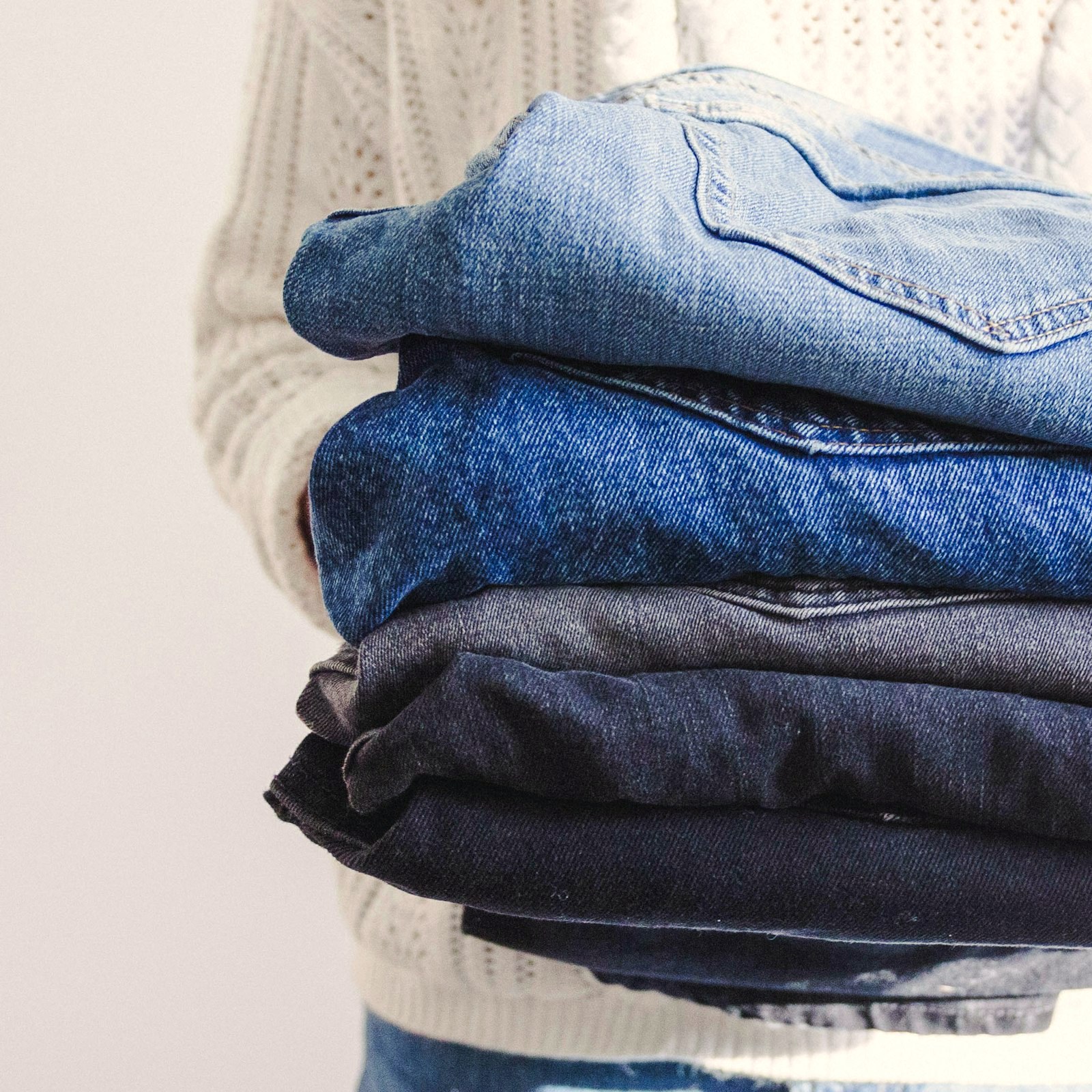
The catalogue basic, photographed plainly: folded tees on wood. Our bank holds no photograph of a Lands' End garment, so no frame on this page is captioned as one.
The short answer: Lands’ End was derived at 75 on our L.L.Bean page as the covenant keeper, the house that still printed Gary Comer’s sentence, return it at any time, when every rival had retreated. This page audits the anchor against the house’s current published record and the number moves to 72, on one row. The sentence fell: the consumer store’s published terms now run to ninety days for a refund, credit beyond it, and in April 2026 the house sold half its name into a licensing joint venture. Longevity goes 13 to 10 and the rest of the record stands entire, value verified to the dollar. Above it: L.L.Bean at 87, Brooks Brothers at 77 and J.Crew at 73, the eye passing the catalogue the year the catalogue’s promise fell. Below it: Duluth Trading audited at 68 and Eddie Bauer at 56. Zara, at 48, standing from its own page, is the skip: the anchor’s founding garment sold with its fibre line missing.
What people actually want from Lands’ End
The want under this search is the catalogue promise kept: a household’s basics, shirts, swim, sleep and school clothes, published plainly and priced fairly, in sizes other houses abandon, from a company that answers for what it sells for as long as you own it. Lands’ End was founded in Chicago in 1963 by Gary Comer, selling sailboat hardware by mail before it sold clothes, its very name a misprint the founder kept, and it spent sixty years as the other catalogue, the one compared to L.L.Bean in every particular. The comparison usually ended with the garments, where Bean’s icons are stronger, and began with the sentence, where the anchor’s was stronger: Bean cut its guarantee in 2018 and Duluth cut its own a year later, and the imitator kept the original covenant through a Sears acquisition, a spin-off and every fashion cycle since. The derivation this page audits was set inside that comparison, on the Bean page, where the anchor sat fourth in a field of covenant houses and was graded through its ranked garments and the sentence that had not changed since 1963. The audit owed the record a reading on its own terms: what does the house publish now, about the cloth, the price, the fit and the promise, and which of the derivation’s five reasons survive the year the sentence fell?
The answer is a house whose garments did not move and whose paperwork did, in the two particulars its best row was priced on. The audit treats those facts in the row they belong to and leaves the other four where the derivation put them.
How the scores work
Same ruler as every page in this series: fabric and specification record out of 30, construction 20, fit and size range 20, value 15, longevity and repair 15. One row on this page moves, and the move is argued below at the size a move gets; every other number already stands in this series, and each card names its home. The skip’s 48 was set as the anchor of its own page and is restated here, not re-derived.
The standing record, in full. The L.L.Bean page of this series derived the anchor’s score in the open, from three ranked garments and the sentence: fabric 19, construction 14, fit 17, value 12, longevity 13. Add them: the brand score was 75, and the Duluth Trading page reproduced it exactly, the Filson, Patagonia and Arc’teryx pages rested it in prose, and our barn jacket ranking cited it as evidence. This page audits each row against the maker’s current record.
Fabric, 19, stands. The derivation rested on a real programme and an honest habit: the Supima cotton programme and the Oxford cloth heritage at the top of the range, fibre lines published on the garments this site ranked, docked for the thinning of the Sears years and for a swim fibre line our ranking could not capture from the maker’s own page. Nothing published since moves the grade in either direction. The catalogue’s centre still publishes what a thing is made of, garment by garment, without publishing what it weighs, which is the record the derivation graded; the licensed expansion announced under the joint venture is a direction of travel for other makers’ goods under this name, not yet a change in the record of the goods this house sells itself, and it is charged where it belongs, in the longevity audit below, rather than double-counted here. The 19 stands on the derivation’s evidence, verified.
Construction, 14, stands. The derivation graded competent catalogue making throughout: the pajama set the honest baseline of our pajamas ranking at 66, the gloves at 63 in our gloves ranking carrying a published lining failure, nothing bench-grade and nothing pretending to be. The making behind the catalogue is the making the derivation read, neither a new bench nor a new shortcut published in the interval, and the garments’ ranked records stand where their pages put them. The 14 stands.
Fit, 17, stands. The derivation credited the library as the house’s genius: three inseam lengths inside a pajama set, the widest length library at the price in our swim ranking, big and tall without apology, second only to the Bean library in its field. That library is the house’s operating core, the school and household business the joint venture leaves in the operator’s hands, and nothing in the current published record narrows it. The 17 stands.
Value, 12, stands, verified to the dollar. The row was argued on fair list prices and docked for the code culture our swim ranking printed in the open, the list a reference figure and the promoted price the real one most weeks. Both halves verify at this check on the maker’s own product page: the costed garment of the derivation’s door, the men’s short sleeve knit jersey pajama set, stands at $69.95 list with $31.47 printed under the house’s standing promotion beside it, the two figures exactly where the derivation and the pajamas ranking left them. Where audits in this series moved a value row, they moved it on the maker’s own new price; this maker’s costed price has not moved, and the duality the row docked is printed on the same page at the same size, the promotion running at 55 percent under list on the day of this check. The credit and the dock stand together: the 12 stands.
Longevity, 13 to 10, moves. The derivation priced this row on a sentence and a survival: founded 1963, spun out of Sears in 2014, the guarantee unretreated through every owner, the garments honestly mid-life. Read the maker’s current published record entire and both pillars have moved, in the same season, and the audit prints them at full size. First, the sentence. The consumer store’s published terms no longer read return it at any time. They read: inside ninety days of purchase, with proof of purchase, a refund to the original payment; beyond the window, or without proof, the refund arrives as merchandise credit; the return label costs $6.95, waived when the refund is taken as that credit; and Final Sale items cannot be returned at all. The maker’s own customer-care replies, published under its products in August 2026, print the operative words: Lands’ End offers returns within 90 days of purchase, and return shipping is free when you choose a merchandise credit. A buyer report from February 2026 records the window enforced, a broken zipper on a year-old backpack refused because the product cannot be returned after 90 days. The old sentence survives in exactly one channel’s copy, the school uniform business, which still accepts any return for any reason, even washed, worn or logo’d, and the audit prints that survival whole: it proves the house knows what the covenant was, and that the consumer store no longer offers it. Second, the name. In January 2026 the house announced a joint venture with WHP Global, and on April 1, 2026 the deal closed: all of the brand’s intellectual property and its licensing business moved into a new venture, and WHP paid $300 million for a 50 percent controlling stake in it. The venture is the name’s owner now. WHP leads its licensing strategy, with an announced aim of accelerating category expansion through licensees; the operating company keeps its stores, its catalogue and its direct business, and sells under a long-term licence from the venture, paying royalties with guaranteed minimums starting at $50 million a year for the use of its own name. The credit is printed at the same size as the charge: the proceeds repaid the house’s term loan of about $234 million in full, which leaves the operating business stronger on paper than the derivation found it, and the company’s own statements promise customers, products and channels unchanged. The audit weighs both. The row falls two points for the sentence, not the three a full abolition would cost, because the credit beyond the window carries no expiry of its own and the uniform channel keeps the old covenant in print; and one point for the name, because a house that licenses its name from a licensing firm has changed what stands behind the garments even when the garments have not changed yet, and the partner’s trade is the wider licensing of exactly this name. Longevity stands at 10: below Bean’s 14, whose retreat stopped at a year, and Orvis’s audited 11, whose covenant, whatever else the retrenchment cost it, still stands; above Duluth’s 9, whose promise was younger and thinner when it acquired its calendar; and the total with it at 72, derived on the L.L.Bean page, reproduced on the Duluth Trading page, rested on the Filson, Patagonia and Arc’teryx pages, audited here.
The bookkeeping, printed: L.L.Bean’s 87, Brooks Brothers’ 77, J.Crew’s 73, Duluth Trading’s 68, Eddie Bauer’s 56 and Zara’s 48 are standing scores from their pages in this series, reproduced with their rows; nothing here re-derives them. Two consequences of the move are printed rather than left to arithmetic. The tie the Duluth Trading page ruled at 75, Flint and Tinder’s audited 75 against this anchor’s derived 75 on the fabric row, dissolves: the retailer’s label now stands three points clear, and its page’s ruling is superseded by the fact, not reversed. And the verdict our L.L.Bean page printed, that the anchor kept the stronger sentence and was the honest buy on the promise, is superseded by this page’s record; the L.L.Bean page remains the derivation’s home and this page is the ruling’s home, and where the two disagree the audit governs. Two garment-level facts are cited on this page as evidence and move no brand number: the pajama set’s price, verified at its derivation figures on the maker’s own page at this check, and the barn jacket’s clearance record our barn jacket ranking printed, $129.95 list cut to $58.47, the transaction that page graded. What would move this number back is printed so the maker can act on it: restore the sentence, or a term measured in years rather than days, and the row rises toward what it was; publish the first licensed line under the venture with the fibre lines this house prints on its own goods, and the fabric row’s ceiling holds. Until then the house sits fourth, at an audited 72, a good catalogue whose paperwork became ordinary, verified.
Rested, with their standing numbers: Buck Mason at 90, the iterated American standard, above this page’s ceiling and graded on its own page. Filson at 85 and Patagonia at 83, the step up and the repair covenant, graded where the waxed and technical registers are graded; the reader whose want is the ceiling or the repair bench should read those pages. Tom Beckbe, audited at 75 on its own page, and Orvis, audited at 69 on its own page, rest with the sporting field they were graded in; neither is a catalogue house a Lands’ End shopper is weighing at the same till. Eddie Bauer is carded below rather than rested, because its derivation shares this anchor’s home page and its sentence is this page’s ledger’s last row.
One more house belongs in prose. H&M sells the classic silhouette at prices that undercut every card on this page, and this series derives its brand score from its ranked garments on its own page rather than borrowing one; nothing here restates or re-derives that number, and no H&M garment is scored on this page. The L.L.Bean and Duluth Trading pages answered that house the same way, and the reader cross-shopping the anchor against the high street should read those pages. The derivations there are untouched by this one.
The disclosure ledger
What each house publishes, in its own words where words exist. The audit reads this table before it reads any marketing.
| House | The fabric record, as published | The afterlife, as published |
|---|---|---|
| L.L.Bean | The deepest garment record on this site: the boot sewn in Maine, the tote’s 24-ounce canvas and 500-pound handle test printed by the maker | One year for a refund since February 2018, defective items considered after that: the famous retreat, printed by the house that made it |
| Brooks Brothers | The benchmark Oxford and the 1818 tailoring publish their cloth; beside them an outlet-made line on thinner cloth under the same name, and a resin non-iron finish spending the Oxford’s breath | No covenant published: the register’s founding tailor answers with an ordinary returns window, measured in days like everyone else’s |
| Lands’ End | A household’s basics published plainly, garment by garment, fibre lines printed where the buyer reads them and weights almost nowhere | The strongest sentence in the business, from 1963 to 2026: return it at any time. What stands now: ninety days for a refund with proof of purchase, merchandise credit beyond it, and a $6.95 label waived only for credit |
| J.Crew | The eye publishes taste, not specifications: cloth rarely better than good, a lambswool blend whose proportions move by season | No covenant published: a returns window and a perpetual promotion, the price and the promise both negotiable |
| Duluth Trading | 8-ounce Fire Hose canvas with its split printed on the product page, 97 percent cotton and 3 percent spandex in the flex version | One year for a refund, defects considered after that, an exclusion list printed beside the promise, and purchases before August 7, 2019 grandfathered out of the limit |
| Eddie Bauer | A century of down knowledge in the core line, a published 650 fill at $149; commodity fleece and tees with nothing published around it | Thirty days, items unused, unworn and unwashed with tags attached, and a $10 restocking fee: the trademarked unconditional guarantee’s current form |
| Zara | “Crafted from cotton with an oxford texture,” over a washed finish; the pocket Oxford beside it prints no composition at all | A longevity row of 3: nothing is published behind the returns window, and a washed finish has no renewal mechanism |
Seven brands like Lands’ End, ranked

L.L.Bean
US prices at last check: Bean Boots from $140 at the maker's store, the 8 inch at $150; the Scotch Plaid flannel $59.95; the Boat and Tote $59.95.
Keeps its standing 87 and its rows, set in the American ranking and audited on its own page of this series: ten ranked garments, three category winners, and a guarantee whose retreat is charged on its own card.
Bean wins this page the way it wins its own: on the file. No house on this site has been graded garment by garment as often, and the grades hold up under the accumulation: the Scotch Plaid flannel a winner at 85, the Chamois overshirt at 83, the Wicked Good slippers at 88, a tote whose 24-ounce canvas and 500-pound handle test are printed by the maker, and a boot still sewn in Maine 113 years after Leon Leonwood Bean refunded the first hundred buyers out of his own pocket and fixed the design. This is the page the anchor was derived against, and the fifteen points between the two houses now measure two things at once: ten ranked garments across five categories against an honest household catalogue, and a promise cut to a year in 2018 against a promise cut to ninety days in 2026. The anchor once won the second of those comparisons outright; it no longer does, and this page’s audit is where that change is recorded. Fabric 23, construction 16, fit 19, value 15, longevity 14: 87, set in the American ranking and audited on its own page of this series.
Buy the icons first and the catalogue carefully: the boot, the flannel, the chamois, the tote, the slippers. Its value row is a perfect 15, because almost nothing in the store charges you for the story, and after this audit its guarantee is, again, the longer of the two catalogue promises. The sentence the anchor kept for sixty-three years was the reason to read this comparison the other way. That reason is retired, and the card above the anchor’s prints the new order without pleasure: Bean first, on the garments and on the paperwork both.
Brooks Brothers
US price at last check: the Original Polo Button-Down Oxford about $120 at full price, as printed in our Oxford ranking.
Keeps its standing 77 and its rows from its own page of this series: the benchmark Oxford and honest tailoring up top, an outlet-made range and a resin finish doing the quiet damage below.
The house that wrote the register this page grades. The Original Polo button-down Oxford remains the garment the classic wardrobe is measured by: 84 as a garment in our Oxford ranking, its collar a perfect 20, because the house invented the button-down in 1900 and two centuries of practice show in the roll of it. The 1818 tailoring still carries the American soft shoulder properly. Against the anchor, the comparison is the dressed half of the catalogue want: where the anchor publishes a household’s basics plainly, this house publishes the shirt and the suit at a standard the anchor never attempted, and its fabric and construction rows, 22 and 17, are a mainline tailor’s honest numbers. Fabric 22, construction 17, fit 17, value 10, longevity 11: 77, set as the anchor of its own page of this series.
The ceiling is the one its own page printed. The value row is 10 because the range is split: alongside the mainline sits a line made for the outlet channel, echo silhouettes on thinner cloth under the same name, and a shopper without a decoder ring cannot tell the two houses apart by the label; and the famous non-iron finish is a resin that buys a smooth morning by spending the Oxford cloth’s breath and hand. Buy the icons selectively, the untreated Oxford and the 1818 tailoring, on promotion, and read the label the way this series reads every label: as a claim the garment has to cash.
J.Crew
US list price at last check: the Secret Wash shirt about $90 at the maker's store, before the promotions that run most weeks.
Keeps its standing 73 and its rows from its own page of this series: the eye is real, the variance around it is real, and the longevity row is the weakest on this page above the skip.
The catalogue want, answered by a stylist instead of a merchant. The case for the house is the eye, and it is real: the Ludlow Oxford at 78 in the top half of our Oxford ranking, proportions chosen by people with taste, a rail that taught a generation what the classic register looks like worn now. The case against is the variance around that eye, printed on its own page: a lambswool crew at 62 whose blend proportions move by season, a performance polo at 63 built for the golf register and scored in the wardrobe one, cloth rarely better than good under the photography. Against the anchor a point below it, the split is the fit library and the patience: the anchor sizes a household and stands behind a season’s basics at verified prices, where this house curates a look and lets the record vary garment by garment. The crossing is the audit’s, and it is printed rather than left to the ladder: when the anchor was derived it stood two points above this house, carried by a sentence; the sentence is priced on this page at what it now says, and the eye’s cloth carries the point instead. Fabric 21, construction 15, fit 17, value 12, longevity 8: 73, set in our American ranking and argued as the anchor of its own page of this series.
Buy Wallace & Barnes and the Ludlow, on sale, with your eyes open. The longevity row of 8, the weakest above the skip on this page, is the honest summary of the method: too much of the line is built to a price and a season, and no covenant stands behind any of it. The anchor below it, even audited, even fallen, publishes the plainer record and the longer window, and still stands a point under the eye: that is what the fallen sentence was worth in this register, and what one point looks like.
Lands' End
US prices at last check: the knit pajama set $69.95 list and $31.47 under the standing promotion, verified on the maker's own page at this check; the Volley swim trunk $49.95 before the code.
Audited at 72 on this page: the garments, the library and both costed prices stand entire, and the sentence the derivation priced the house on fell in 2026, with half the name sold into a licensing venture beside it.
The house first, stated plainly. Lands’ End began in Chicago in 1963 selling sailboat hardware by mail, Gary Comer’s joke of a misprint in its own name, and became the catalogue that spent sixty years being compared to Bean. Its garment evidence on this site is honest and mid-table, cited here as evidence and never blended into this number: the Volley swim trunk at 68 in our swim ranking, the honest family trunk in the field’s widest length library; the knit pajama set at 66, the baseline of our pajamas ranking; the gloves at 63, carrying a published lining failure; the Squall at 61 and the Canvas Barn Jacket at 59, the catalogue coat our barn jacket ranking priced at its clearance. The audit’s credits are the derivation’s, re-read at this check: a Supima programme and published fibre lines at the catalogue’s centre, a fit library that runs to big and tall without apology, list prices verified to the dollar on the maker’s own page, $69.95 and $31.47, unmoved. Fabric 19, construction 14, fit 17, value 12.
The move is the audit’s, printed at the same size a standing would get. The derivation priced longevity at 13 on the sentence, and the sentence is gone from the consumer store’s terms: ninety days for a refund with proof of purchase, merchandise credit beyond it, a $6.95 label waived only for credit, the maker’s own care replies printing the window under its products in August 2026. It priced the row, too, on a house that had kept that sentence through every owner, and in April 2026 the house’s name passed into a joint venture half owned by WHP Global, a brand-management firm whose announced trade is the wider licensing of the names it holds; the operating company, its loan repaid from the proceeds and its stores and catalogue intact, now sells under licence from its own name. Neither fact touches cloth, seams, sizes or prices, and no other row moves. Longevity stands at 10. The brand score is 72, derived on the L.L.Bean page, reproduced on the Duluth Trading page, rested on the Filson, Patagonia and Arc’teryx pages, audited and moved here.
Buy the basics the way the derivation advised, on the code, in the library’s full range, for a household that wears them out by size rather than by fashion: the garments earn that advice as much as they ever did, and the promoted prices are verified on this page to the dollar. What has changed is the receipt you no longer need to keep. For sixty-three years the advice was to keep nothing, because the house kept its word without one. Keep the receipt now. The promise that made the receipts unnecessary is the one thing this catalogue no longer sells.
Duluth Trading
US prices at last check: the DuluthFlex Fire Hose cargo pants $84.95 at the maker's store, with clearance colourways printed at $40.99 on the same product page.
Audited at 68 on its own page in this series: the whole published record re-read and standing, the cloth, the seams, both prices and the guarantee sentence unchanged.
The youngest house here by generations, founded in 1989 in Duluth, Minnesota, selling organisers to tradesmen before it sold them clothes, and famous since for cartoon beavers over the most spec-sheet behaviour at its end of the market. Its audit, the standing immediately before this one, is the control experiment for the audit above: the same five rows re-read against the current record, and the record had not moved, $84.95 with clearance at $40.99, 8 ounces and a 97 to 3 split on the product page, triple-stitched seams and riveted stress points, the guarantee sentence unchanged word for word from the derivation. Set the two audits side by side and the series’ method explains itself: a number stands when the record stands, and the anchor above never got the chance to stand, because its record moved first. Fabric 19, construction 15, fit 14, value 11, longevity 9: 68, derived on the L.L.Bean page and audited on its own page of this series.
Buy the Fire Hose pants for the 8-ounce canvas and the printed seams, at the clearance figure especially. Its guarantee made the famous retreat a year after Bean’s, in nearly Bean’s words, and its longevity row of 9 now stands one point below the anchor’s fallen 10: the anchor kept the longer promise for six decades before it fell, and the row remembers the keeping as well as the fall. Read both guarantees the way this series reads them, in the small print, where each keeps its calendar.

Eddie Bauer
US price at last check: the CirrusLite down hooded jacket, 650 fill, $149 at the maker's store.
Keeps its standing 56 and its rows, derived on the L.L.Bean page of this series: the house that patented America's first down jacket and trademarked the unconditional guarantee, graded on what its own pages publish today.
This card is the audit above, run thirty years further. Eddie Bauer founded his Seattle shop in 1920, nearly died of hypothermia in 1936, and answered in 1940 with the Skyliner, the first patented down jacket in America; the house then made its guarantee a trademark, every item we sell will give you complete satisfaction or you may return it for a full refund, the strongest sentence in American retail for most of a century. The derivation on the L.L.Bean page graded what publishes today instead: thirty days, items unused, unworn and unwashed with tags attached, a $10 restocking fee deducted from the refund, from a house passed through bankruptcy and a line of owners into a retail holding group. Fabric 17, construction 12, fit 14, value 8, longevity 5: 56, derived on the L.L.Bean page of this series, where it stands as that page’s skip.
It is carded here, a place above this page’s skip, because the comparison is the warning the anchor’s audit needs. The anchor’s sentence fell to ninety days and its name passed to a licensing venture in the same season, and nothing about that pairing is new in this register: it is the first chapter of the story this card finishes. The distance between the two houses is still eighteen points and one crucial difference, which the rows print: the anchor’s garments, library and prices verified entire at this check, its operating business intact and its credit carrying no expiry, against a house whose expertise survives as a core line inside a portfolio. Buy the down jacket on promotion if you want it. Read the anchor’s new paperwork with this card open beside it.
Zara
US prices at last check: the Oxford Pocket Shirt $25.90 and the licensed Fruit of the Loom striped Oxford $79.90 at the maker's store. This card ships without a buy link, and the honesty section prints why.
Standing at 48 from its own page in this series, and the skip here, its conviction restated and re-verified on this page's own rail: the classic register copied at speed, with the fibre line left out of the copy.
The charge is read off the maker’s own record, on this register’s own rail, re-verified at this check rather than trusted from the file: the maker’s American store sells the Oxford Pocket Shirt at $25.90, the founding garment of the classic wardrobe, and its listing copy in full is a classic collar, long sleeves, a front button closure and a chest patch pocket. No composition is printed. The cloth the garment is made of does not appear in the words selling it. Beside it, a striped Oxford sold under a licensed Fruit of the Loom name at $79.90 carries its entire cloth record in one clause, crafted from cotton with an oxford texture, finished with a washed finish, the anchor’s heritage garment rented from a basics label and sold on its texture. The rows are the house’s standing rows, reproduced exactly as this series prints them: fabric 13, construction 8, fit 15, value 9, longevity 3: 48, set as the anchor of its own page. The test this page set for a fresh conviction is printed in the questions below: a thinner classic record than a founding garment with its fibre line missing, and no candidate on the fashion rail published one; Gap, the standing skip of the American uniform pages at 57, was considered and stands higher on its own derivation, its fabric lines naming their blends.
Set it beside the anchor three places above it. The anchor’s guarantee fell this year, its name is half sold, and it is, this season, the easiest target in American retail to write a sentence about. It still publishes what every garment it sells is made of, garment by garment, at prices this page verified to the dollar. The skip publishes the outline of the garment and omits the garment. Buy the shape if the shape is what you want, eyes open, as a fashion shirt with a season in it. Do not buy it as the classic it is photographed as. The maker, to its credit, never quite said it was.

The pattern under the ranking
Read the ladder as one argument about what a catalogue house is. The top answers with objects: a boot sewn in Maine and a tote costed over twenty years, the benchmark Oxford on a rail in the dressed register, garments whose records deepen every time this site grades another one. The middle answers with paperwork in three states of repair: an eye with no covenant at all, a covenant fallen to ninety days over an honest household catalogue, and a spec sheet under a comedy act whose own sentence stopped at a year. The bottom answers with a trademark and a texture: a guarantee that used to be the strongest in retail, now thirty days and a fee, and a founding garment sold with its fibre line missing. The scores are that argument measured seven times: in this category the product is a cloth and a covenant, and everything else is a photograph of them.
The second pattern is the year itself, and this page is where the series records it. In February 2018 the field’s most famous guarantee became one year; in August 2019 the workwear house’s did the same; and in 2026 the last no-expiry sentence in the catalogue business became ninety days, in the same season its house sold half its name to a licensing firm. The retreat is now complete at every house on the L.L.Bean page’s ledger except one: Orvis, the sporting elder, still prints anytime, for any reason, and it stands fifth in its own cluster with a retrenchment priced into its rows. What the completed retreat means for a buyer is printed in the anchor’s card: the promise no longer differentiates the catalogue houses, so the garments have to, and on the garments the order at the top of this page is the order the files have supported all along. A guarantee costs nothing to print and a fortune to honour. For sixty-three years the anchor paid the fortune. The scores grade the honouring, and this year the honouring changed.
The ranking at a glance
| Brand | Score | The piece to buy | Price |
|---|---|---|---|
| L.L.Bean | 87 | Bean Boots, the 6 inch | $140 |
| Brooks Brothers | 77 | The Original Polo Button-Down Oxford | $120 |
| J.Crew | 73 | The Secret Wash shirt, on sale | $90 |
| Lands’ End | 72 | The knit pajama set | $69.95 |
| Duluth Trading | 68 | The DuluthFlex Fire Hose Cargo | $84.95 |
| Eddie Bauer | 56 | The CirrusLite down jacket, on promotion | $149 |
| Zara | 48 | None | $25.90 not spent |
The verdict: skip Zara
Zara is this page’s named loser, and the charge is the shape of its record on this register’s own rail, set on its own page in this series and re-verified at this check. It sells the founding garment of the classic wardrobe, the Oxford shirt, in listing copy that never mentions what the shirt is made of, and it sells a second Oxford under a licensed basics name whose whole cloth record is a texture and a washed finish. Its prices are honest only about being low, and behind the garment there is no repair, no resale and no published guarantee, only a returns window and next season’s version of the same photograph. Every house above it publishes more, including the anchor of this page in the year its own sentence fell: the fibre lines stand, the prices verified to the dollar, the library intact. Buy the register with the truth printed on it.
Which one to buy
For the institution: L.L.Bean, 87. The boot, the flannel and the tote, icons bought once and handed down, under a promise that again runs longest of the catalogues’.
For the dressed register: Brooks Brothers, 77. The untreated Oxford and the 1818 tailoring, bought selectively and on promotion.
For the eye: J.Crew, 73. Wallace & Barnes and the Ludlow, on sale, garment by garment.
For the household’s basics: Lands’ End, 72. Swim, sleep and school clothes in the full size library, on the code, with the receipt kept.
For the working trouser: Duluth Trading, 68. The Fire Hose cargo at $84.95, its ounces printed and its guarantee read in the small print.
For the down jacket, on promotion only: Eddie Bauer, 56. A century of insulation craft at $149, and nothing else on the card at list.
To skip: Zara, 48. The photograph of the classic, over a garment the copy declines to describe.
Questions, answered
What brand is most like Lands’ End?
L.L.Bean, at 87, and the comparison is the one this house was founded inside: the same catalogue wager, a fair price, a fit library that runs to big and tall, and garments costed over decades rather than seasons. Bean wins it on the file, ten ranked garments and three category winners against the anchor’s honest mid-table record, and it wins it now on the promise as well, which was not true when the anchor’s score was derived: Bean’s guarantee, cut in 2018, runs to one year, and the anchor’s published refund window now runs to ninety days. Brooks Brothers, at 77, is the classic register’s other answer, the benchmark Oxford and the tailoring, bought selectively. J.Crew at 73 stands a point above the anchor on this page, the eye passing the catalogue the year the catalogue’s promise fell, and Duluth Trading, audited at 68, offers the published specification at the workwear end. The honest summary: the anchor is no longer the promise with basics attached; it is a good catalogue whose promise became ordinary, and the page grades what is left, which is still considerable.
Why did Lands’ End’s score move in the audit?
One row moved, longevity, 13 to 10, and the total with it, 75 to 72. The derivation priced that row on two facts: a guarantee sentence that had not retreated since 1963, and a house that had kept it through every change of owner. Both facts changed in 2026. The consumer store’s published terms now run to ninety days for a refund, with merchandise credit beyond the window and a label fee waived only for credit; the maker’s own customer-care replies print the ninety-day sentence under its products. And in April 2026 the house closed a joint venture that moved its name and its licensing business into a vehicle half owned by WHP Global, a brand-management firm, leaving the operating company to sell under licence from its own name. The other four rows were re-read and stand: the cloth record is unchanged in kind, the making is unchanged, the fit library is unchanged, and value verifies to the dollar, the costed pajama set still $69.95 at list and $31.47 under the standing promotion on the maker’s own page. The number moved because the record moved, in the row the record moved in.
Is the Lands’ End lifetime guarantee still in effect?
No, not in the form this site’s L.L.Bean page quoted. The sentence, if you are not satisfied with any item, return it at any time for an exchange or refund of its purchase price, stood from 1963 and was still the strongest promise in the catalogue business when the anchor’s score was derived on that page. The consumer store’s published terms at this check give ninety days from purchase, with proof of purchase, for a refund to the original payment; after the window, or without proof, the refund comes as merchandise credit, which carries no expiry of its own; the return label costs $6.95 unless the refund is taken as credit; and items marked Final Sale cannot be returned. One channel still prints the old covenant in substance: the school uniform business accepts any return for any reason, washed, worn or logo’d. A guarantee costs nothing to print and a fortune to honour, and the audit grades the honouring as published: what fell was the refund’s term, from no expiry to a season, and the longevity row prices the fall.
Lands’ End or L.L.Bean: which catalogue house should I buy?
Bean for the garments and, since this audit, for the guarantee too, and the scores print the split: 87 to 72. Bean’s ranked record is deeper and its icons are stronger, the Maine-made boot, the flannel in the line since 1936, the tote sewn the same way since 1944, and its promise, cut in 2018, still runs to a year with defects considered after it. The anchor’s case is now the catalogue itself: a household’s basics published plainly, a fit library that runs to big and tall, fair list prices the standing promotion cuts most weeks, and a refund window of ninety days with credit after it. When the anchor’s score was derived, the advice ran the other way on the promise, and this page supersedes that advice in the open: if the purchase is a boot or a flannel, buy Bean; if it is a decade of basics for a household, the anchor still sells them honestly, and its 72 is a good score honestly arrived at. What it no longer sells is the sentence.
Why is Zara the skip on a page about catalogue classics?
Because the skip’s conviction is this register’s own charge, set on the skip’s own page in this series and re-verified at this check on the classic rail itself, not the workwear rail the Duluth Trading page checked. The test is printed on this page: a fresh conviction must publish a thinner record on the classic garments than the standing skip’s, and none did. The maker’s American store sells the Oxford Pocket Shirt at $25.90, the anchor’s founding garment, with no composition printed in its listing copy at all: a collar, sleeves, a button closure and a pocket, and the cloth nowhere. Beside it a striped Oxford under a licensed Fruit of the Loom name at $79.90 carries its whole cloth record in one clause, crafted from cotton with an oxford texture, over a washed finish. Every house above it publishes a fibre line, a weight or a covenant. The anchor, audited on this page with its fallen sentence priced in full, still publishes what its garments are made of, garment by garment. The skip publishes the silhouette of the garment and leaves the garment out.
The honesty section
Six scores on this page already stand in this series, and each card names its home: L.L.Bean set at 87 in our American ranking and audited on its own page; Brooks Brothers set at 77 as the anchor of its own page; J.Crew set at 73 in the American ranking and argued on its own page; Duluth Trading derived at 68 on the L.L.Bean page and audited on its own page; Eddie Bauer derived at 56 on the L.L.Bean page; and Zara set at 48 as the anchor of its own page. The anchor’s 75 was derived in the open on the L.L.Bean page and reproduced exactly, rows and all, on the Duluth Trading page, rested in prose on the Filson, Patagonia and Arc’teryx pages, and cited as evidence on our barn jacket ranking; this page audits it against the maker’s current published record and moves one row, longevity, 13 to 10, on the two dated facts argued in the audit. The pages printed earlier in this series carry the derivation’s number and, on the L.L.Bean page, a verdict built on the sentence that has since fallen; the audited rows are 19, 14, 17, 12, 10, recorded here, and this page is the ruling’s home. One sourcing limit is printed rather than smoothed over: the maker’s returns page would not render entire through this desk’s fetch routes at this check, so the guarantee finding rests on the maker’s own customer-care sentence, published under its products in August 2026 and repeated across them, on the school uniform channel’s surviving covenant text, and on the convergent current readings of the maker’s published terms, each of which agrees on the ninety-day window, the proof of purchase, the credit beyond it and the label fee. The joint venture’s terms are a matter of the house’s own filings and the trade record of the deal: $300 million for a 50 percent controlling stake, closed April 1, 2026, operational control retained, royalties with guaranteed minimums from $50 million. Prices and programmes were checked in October 2026 against the makers’ own published pages and current retail listings, following the method on our methodology page.
Buy links follow the deep-link rule: each card keeps the door its scoring page established, the maker’s own product page where that page used one and its established retail or category door where it did not. Two doors are printed as the exceptions they are: Brooks Brothers at the maker’s storefront, the door its own page established, and Duluth Trading at the maker’s storefront, the logged exception its audit re-tested. The anchor’s door is the exact product page our pajamas ranking verified, re-verified live at this check. The skip ships without a buy link because the desk does not link what it sentences. Photographs come from the bank credited in CREDITS.md; the bank holds no photograph of a Lands’ End garment and no frame of any ranked house’s garment, the same gap our L.L.Bean and Duluth Trading pages admitted, and the cards run on the bank’s street, stack and profile frames rather than on borrowed product photography. The anchor’s card frame is the one its derivation used, a folded stack of Oxford shirts; no frame on this page is captioned as a garment it does not show.