
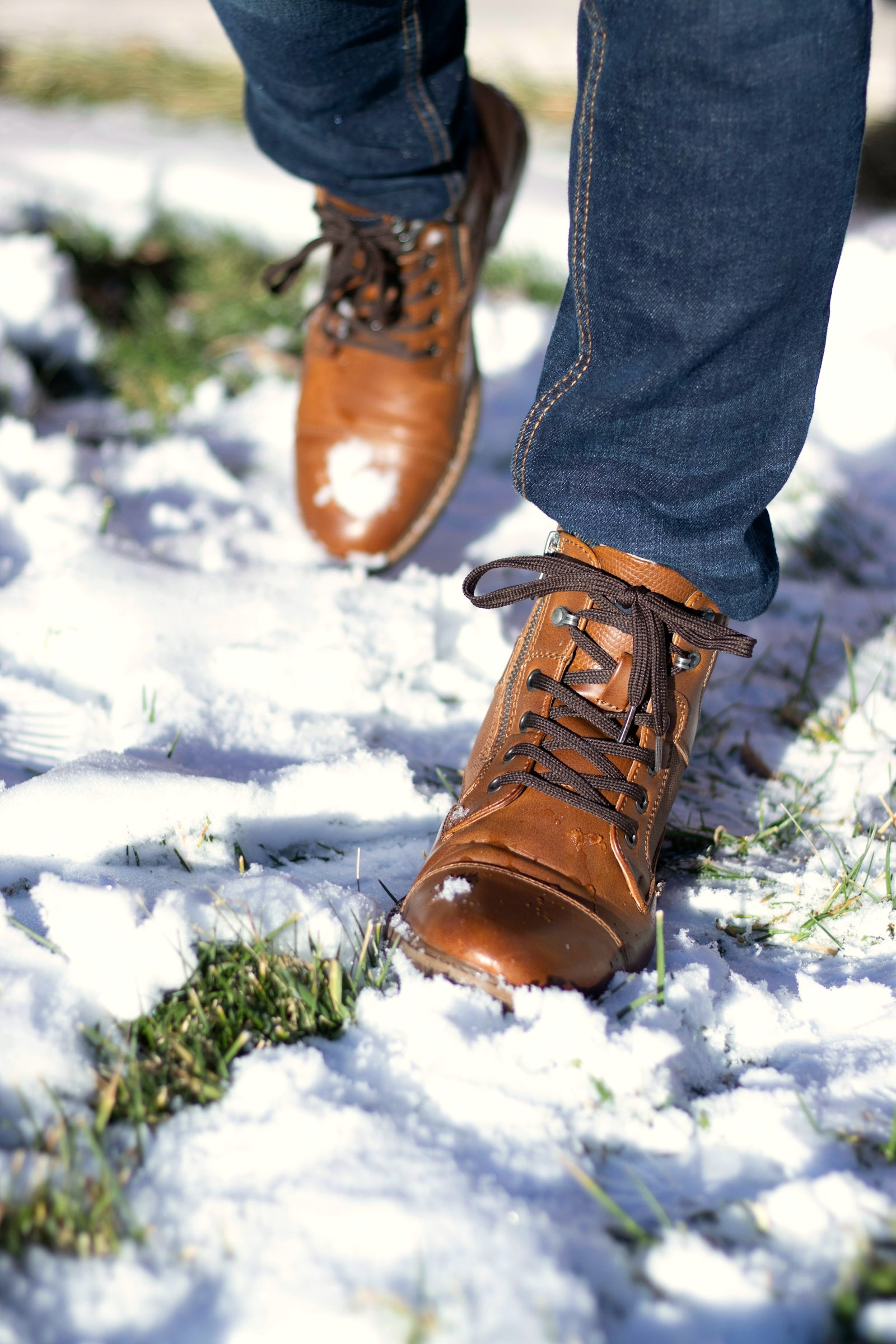
Worn boots, the footwear end of the arrangement every house on this page sells. This page grades what the Manchester house publishes behind its price. Our bank holds no photograph of a waxed jacket, so no frame on this page is captioned as one.
The short answer: Peregrine is the Barbour recipe read off a smaller Manchester label, and its 76 was derived on our Barbour page from a record with two errors in it: the wrong mill and a listing price. This page audits the anchor against the maker’s current published record and the number stands at 76: two rows move in opposite directions and cancel. Construction falls one point, because the maker’s own page prints the Bexley’s making as a Smethwick partner’s work where the derivation graded the firm’s own factory; value rises one point, because the maker’s own store price is £275 where the derivation costed $440. Above it: Filson at 85 and Barbour at 81. Below it: Flint and Tinder at 74, Tom Beckbe at 72 and Belstaff at 69. Zara, at 48, standing from its own page, is the skip: the waxed silhouette sold under a name that confesses the finish is an effect.
What people actually want from Peregrine
The want under this search is the founding recipe without the founding price or the founding fame: a waxed cotton jacket made in England, in a named cloth, by a house old enough to mean it, bought once and re-waxed for decades. Peregrine is built from a real place: J.G. Glover of Manchester, founded by Thomas Glover in 1796, eight generations of the same family, its flagship Bexley sewn in England in 8 ounces of waxed cotton. The line was, when this series derived its score, a settled record with two loose threads inside it: the derivation named the cloth’s mill from a secondary account, and it costed the jacket from a listing rather than the maker’s own store. This page exists because the anchor’s number was derived on another house’s brief, the Barbour page, and the audit owed the record a reading on its own terms: what does the maker publish now, about the cloth, the making and the price, and which of the derivation’s five reasons survive being read in the maker’s own words?
The answer is a house whose cloth story is better published than the derivation knew, whose making is differently published than the derivation said, and whose price is lower than the derivation charged it. The audit treats those facts in the rows they belong to, and they do not all point the same way, which is what an audit is for.
How the scores work
Same ruler as every page in this series: fabric and specification record out of 30, construction 20, fit and size range 20, value 15, longevity and repair 15. Two rows on this page move, the anchor’s construction and value, in opposite directions, and the moves are argued row by row below; every other number already stands in this series, and each card names its home. The skip’s 48 was set as the anchor of its own page and is restated here, not re-derived.
The standing record, in full. The Barbour page of this series derived the anchor’s score in the open, from the published record: fabric 23, construction 17, fit 13, value 12, longevity 11. Add them: the brand score was 76, and the Filson and Belstaff pages reproduced it exactly, rows and all. This page audits each row against the maker’s current record.
Fabric, 23, stands. The derivation rested on a named mill and a published weight: an antique 8-ounce waxed cotton from British Millerain, the mill named. At this check the record has corrected itself in one half and held in the other. The mill is not Millerain. Our waxed ranking read the maker’s care page and corrected the cloth house to Halley Stevensons of Dundee, and at this check the maker names the house in its own words on two of its own pages, the care page (“All our Wax Jackets are made using Halley Stevenson’s fabrics”) and the sustainability page, where it names Halley Stevensons as the supplier behind the wax collection. A cloth story corrected by the maker itself, and now published by the maker itself, is worth what the derivation paid for it. The weight half is the standing caveat, printed by the ranking and repeated here: the maker’s product page prints “100% wax cotton” and no weight, and the 8 ounces stands on this desk’s record, not on the maker’s page. Against both stands what stood before: the line is one cloth story deep where the anchor’s great rival publishes a ladder of weights and finishes. The 23 stands, better evidenced and no better in kind.
Construction, 17 to 16, moves. The derivation graded the making in one sentence: English manufacture in the maker’s own mill building, small runs, hardware that is metal where the fashion end of this category uses plastic. The maker’s own product page at this check prints a different making record, in its own manufacturing tab, and the audit prints it in the maker’s words: “Made in Smethwick, West Midlands. Established in 1978, our Wax Jacket & T-Shirt manufacturer has been supplying hand-crafted, premium clothing production for over 40 years.” The Bexley is made for the house, by a specialist partner manufacturer in the West Midlands, not on the firm’s own factory floor in Manchester. Read the correction at its true size. The making is still English, still hand-crafted, still small-run, still the work of a maker with forty years in the trade, and the hardware record is unchanged. What has gone is the own-factory premise the row was argued on, the vertical romance of the mill building, and a row argued on a premise the maker’s own page contradicts falls one point on the correction: the row falls to 16.
Fit, 13, stands. The derivation charged a narrower library than the founding rival’s numbered chest sizes, and the audit re-read the library on the maker’s own page. At this check the Bexley is published in five colourways across eight sizes, XS to XXXXL, with the tailored fit stated in the description and the maker’s own advice printed beside it, that the jacket is a tailored fit and the buyer should size up for comfort. That is a wide welcome in sizes and a narrow one in information: alpha sizing throughout, no garment measurements published, and a fit the maker itself warns about. The evidence is the derivation’s evidence, verified in the maker’s current words, and the 13 stands on it.
Value, 12 to 13, moves. The row was costed on a listing and a comparison: $440 for the Bexley, read off a retail record, called Bedale money because it stood inside fifteen dollars of the Bedale’s $425. The listing figure is superseded, and it resolved downward. The maker’s own store price, pinned by our waxed ranking and verified in stock on the maker’s own product page at this check, is £275, about $350 at this desk’s standing conversion. At £275 the costed garment does not stand beside the Bedale’s price; it stands below it, for a heavier cloth, made in England, with its mill named in the maker’s own words. The exchange the row grades is better than the exchange the derivation priced, and the row records the maker’s own price, not the listing’s: the row rises to 13. It rises one point and no further: the maker keeps no American door of its own, the price is read in sterling at a converted figure, and the service ceiling charged in the longevity row is untouched by the saving.
Longevity, 11, stands. The derivation priced the oldest founding date on the page, a firm family-run since 1796, jackets built to be re-waxed for decades, and no repair department: the ledger, in its phrase, is a tin of wax and the owner’s own hands. The care page read at this check is that ledger entire, in the maker’s own furniture: a step-by-step rewaxing guide published by the maker, the cloth maker’s own care products sold beside the jacket, and professional rewaxing routed to a named specialist, Mallin & Son, for owners who would rather send the jacket away. Against it stands what stood before: no repair department in the maker’s published record, no rewaxing interval printed where the founding rival prints an annual one, and no guarantee term behind the garment. The house’s own longevity facts stand as derived, eight generations on the product page itself. Nothing published moves the grade in either direction, and the row stands at 11, and the total with it at 76, derived on the Barbour page, reproduced on the Filson and Belstaff pages, audited here.
The bookkeeping, printed: Filson’s 85, Barbour’s 81, Flint and Tinder’s 74, Tom Beckbe’s 72, Belstaff’s 69 and Zara’s 48 are standing scores from their pages in this series, reproduced with their rows; nothing here re-derives them. One garment-level fact is cited on this page as evidence, the Bexley garment’s 79 on our waxed ranking, where it was graded on its care record and its corrected mill; it belongs to its garment and moves no brand number by itself. Two corrections to the derivation’s record are printed in the open in the audit above rather than carried silently: the cloth house, corrected to Halley Stevensons on the evidence of the maker’s care page as our waxed ranking recorded it, and the making record, corrected to a Smethwick partner manufacturer on the evidence of the maker’s own product page at this check. The anchor’s audit has one consequence the page prints rather than leaves to implication: the Barbour, Filson and Belstaff pages and our waxed styling brief carry the derivation’s rows and its $440 costing, and the audited rows are the ones recorded here, 23, 16, 13, 13, 11, on this page, which is the ruling’s home. The total they reconcile to is the total they already print: 76.
Rested, with their standing numbers: AllSaints at 67, audited on its own page, the leather rail of this register, carded a page ago on the Belstaff page and rested here because this page’s cluster is wax and wool; and Montbell at 73, audited on its own page, the technical register’s bench, a different argument about weather graded where it stands. Private White V.C. is named without a number, as the Barbour and Belstaff pages named it: the Manchester bench is the connoisseur’s other answer to this search, its cloth is Ventile with a water-repellent finish rather than a waxed cotton, and this site holds no brand score for the house and does not invent one here.
One more house belongs in prose. H&M sells the waxed silhouette at prices that undercut every card on this page, and this series derives its brand score from its ranked garments on its own page rather than borrowing one; nothing here restates or re-derives that number, and no H&M garment is scored on this page. The Barbour page answered that house the same way, and the reader cross-shopping the anchor against the high street should read those pages. The derivations there are untouched by this one.
The disclosure ledger
What each house publishes, in its own words where words exist. The audit reads this table before it reads any marketing.
| House | The fabric record, as published | The afterlife, as published |
|---|---|---|
| Filson | Tin cloth and Mackinaw wool, weights and finishes published by the maker; the heaviest shells in the field | A lifetime guarantee against failure of materials and workmanship, with a working repair department behind it |
| Barbour | 6-ounce Sylkoil waxed cotton printed on the product page, the finishes named and the method published by the maker | A staffed re-wax, repair and alteration bench, at any time, with published turnaround targets and a resale programme for restored jackets |
| Peregrine | 8 ounces of waxed cotton on this desk’s standing record, the product page printing 100 percent wax cotton and no weight; the cloth house, Halley Stevensons, named in the maker’s own words on its care and sustainability pages | A step-by-step rewaxing guide published and the cloth maker’s care products sold, with professional rewaxing routed to a named specialist, Mallin & Son; no repair department, no published interval, no guarantee term |
| Flint and Tinder | 7-ounce Martexin Original Wax sailcloth from Fairfield Textile, named in the product copy with the finish named beside it | A re-waxable exterior printed in the maker’s own product copy, behind a retailer’s returns and exchange policy; no bench, no service department |
| Tom Beckbe | 8-ounce waxed shelter cloth with its mill, Halley Stevensons, named on the product page itself | Reproofing wax sold by the maker and the full care ritual printed on the product page; no bench, and a house a decade old |
| Belstaff | British Millerain 8-ounce Ultracore waxed cotton, printed on the maker’s own pages, with the interlayered waterproof membrane printed beside it | A repairs service advertised on the maker’s own site and a 24-month guarantee in its terms, with paid repair offered beyond it; the wax is renewable, the waterproofing is not |
| Zara | “Cotton fabric with a waxed-effect finish”: the whole cloth story in one phrase, printed by the maker under the product name itself | A longevity row of 3: nothing is published behind the returns window, and an effect has no renewal mechanism |
Seven brands like Peregrine, ranked
Filson
US price at last check: the Wool Jac-Shirt $349 at the maker's store; the Mackinaw Wool Cruiser about $550.
Keeps its standing 85 and its rows from the Carhartt page of this series: the heaviest cloth in the field and a lifetime guarantee, at two to four times the anchor's prices.
Filson wins this page the way it won the Barbour and Belstaff pages: on weight and on paperwork. C.C. Filson opened in Seattle in 1897 to outfit prospectors heading for the Klondike, and the house has never entirely stopped designing for them: tin cloth, a waxed canvas finished until it sheds water like a roof, Mackinaw wool woven to a density modern mills rarely attempt, bridle leather in the bags. Its guarantee is the strongest instrument in the ledger above, a lifetime promise against failure of materials and workmanship with a repair department behind it that works on garments decades out of production. Its garment evidence matches the brand: the Rugged Twill briefcase won our bags ranking at 86, and its waffle henley won the henley ranking at 84. Fabric 27, construction 19, fit 15, value 9, longevity 15: 85, set on the Carhartt page of this series.
What the win means for the anchor is the page’s argument in one comparison. Peregrine’s founding garment is a renewable finish maintained by its owner; Filson’s is a cloth so heavily finished it behaves like a roof, behind a promise with no expiry date. Nine points is that distance measured. Buy the tin cloth if the jacket is for weather and decades. The house is built to receive it back.
Barbour
US prices at last check: the Bedale $425 and the Beaufort $450 at the maker's store.
Derived in the open at 81 on its own page in this series: the house that invented the maintained jacket, and still runs the service it invented.
The head-to-head is the comparison this whole cluster turns on, because the two houses sell the same recipe at two scales. Barbour’s is the arrangement the category runs on: the Bedale, designed in 1980 and still sewn at the Simonside factory in South Shields, in a 6-ounce Sylkoil cloth whose weight the maker prints on the product page, and behind the garment a standing offer to take it back at any time to be re-waxed, repaired or altered, with turnaround targets published by season and some 13,000 jackets a year through the benches, by the maker’s account. Against the anchor it wins on the department and the system: numbered chest sizes, published intervals, a resale programme for restored jackets. Fabric 24, construction 16, fit 15, value 12, longevity 14: 81, derived in the open on its own page, where the anchor below was first graded as its third card.
Buy the Bedale or the Beaufort, and register the purchase in your mind as a thirty-year arrangement. It is the lighter cloth at the higher price, carried by the heaviest institution in the category, and on this page’s basis it beats the anchor by five points, every one of them in the service rows.

Peregrine
Price at last check: the Bexley £275 at the maker's store.
Audited at 76 on this page: the mill corrected to Halley Stevensons in the maker's own words, the making corrected to a Smethwick partner's bench, and the maker's own £275 raising the value row, two reasons replaced and the number standing.
The history first, because this card only makes sense against it. The firm behind Peregrine, J.G. Glover of Manchester, was founded by Thomas Glover in 1796 and is run today by the eighth generation of the family; its flagship Bexley is built the way the recipe reads, 8 ounces of waxed cotton made in England, with a moleskin-lined collar, a step-by-step rewaxing guide published by the maker and the cloth maker’s own care products sold beside the jacket. The audit’s credits are real. The mill correction has completed its journey into the maker’s own words: Halley Stevensons is now named by the maker on its care page and its sustainability page alike, where the derivation had to take a secondary account’s word, and took the wrong name from it. The price is the maker’s own, £275, verified in stock at this check, below the Bedale it was costed beside. Fabric 23, fit 13, longevity 11.
The charges are the audit’s, printed at the same size. The derivation graded the making as the firm’s own factory floor; the maker’s own product page prints a specialist manufacturer in Smethwick, established in 1978, as the Bexley’s maker, and construction falls to 16 on the corrected premise, the English making itself uncharged. The product page still prints no cloth weight, and the 8 ounces stands on this desk’s record, printed as such, where the founding rival prints its 6 ounces on the page. And there is still no department: professional rewaxing is routed to a named specialist, Mallin & Son, and repairs are nobody’s published offer. Value rises to 13 on the maker’s own price. The brand score is 76, derived on the Barbour page, reproduced on the Filson and Belstaff pages, audited and held here.
Buy the Bexley if the jacket will be worn hard and re-waxed at home: at £275 it is the fullest specification on this page per pound spent, a heavier cloth than the founding rival’s at a lower price, from the oldest firm in the field. If the jacket will be sent away to be maintained by the people who made it, that arrangement exists at the two houses above this one, and Peregrine, to its credit, does not pretend to be either of them.

Flint and Tinder
US price at last check: the Flannel-Lined Waxed Trucker $298 at Huckberry.
Derived in the open at 74 on the Barbour page: the cheapest jacket here, seated as the test of whether the word waxed means anything at $298. It does.
This card exists to grade a claim, as it did on the page that derived it. The attainable end of the waxed market is where the word usually goes to die, in coated cloth and printed finishes, so the desk put the best-known attainable jacket through the cluster’s three tests and prints the results in order. Is the cloth published? Yes, completely: a 7-ounce Martexin Original Wax sailcloth from Fairfield Textile of Bridgeton, New Jersey, a mill weaving weather cloth since 1930, named in the product copy with the finish named beside it. Is the finish renewable? Yes: the shell is waxed on both sides and the maker’s copy prints re-waxable as a property of the garment. Is it made where the story says? Yes: cut and sewn in Los Angeles from American cloth. Fabric 21, construction 15, fit 17, value 13, longevity 8: 74, derived on the Barbour page.
Read the 74 against the anchor two places above it, because the comparison is this page’s second argument. A $298 trucker from a retailer’s own label stands two points below a firm founded in 1796, and it does so on publication alone: a named mill, a printed weight, a renewable finish, the widest size library in the field. What it cannot do is be maintained by its maker, and the longevity row of 8 is that fact priced, eight points of the anchor’s own row structure spent the same way. The jacket is the honest floor of the category: everything the word waxed promises, at the lowest price the promise can currently be kept for, with the service left as an exercise for the owner.

Tom Beckbe
US price at last check: the Tensaw $495 at the maker's store.
Derived in the open at 72 on the Barbour page: the founding recipe rebuilt in Alabama, heavier cloth and a modern pattern, from a house a decade old.
Tom Beckbe is what the Peregrine want becomes when an American sporting house rebuilds it without nostalgia. The Tensaw, its flagship, is specified the way this page wishes every jacket were specified, on the maker’s own product page: a weatherproof 8-ounce waxed shelter cloth with its mill named in the description, Halley Stevensons of Scotland, the same Dundee house the anchor’s audit corrected its own record to. Around the cloth, a pattern drawn for the field rather than the café: set-in sleeves, gusseted underarms, a bi-swing back, a stand collar lined with Bedford corduroy, bellows pockets and a hidden Napoleon pocket, made in the U.S.A. with imported materials, in the maker’s own words. Fabric 22, construction 16, fit 15, value 10, longevity 9: 72, derived on the Barbour page.
The buy is the pattern, and the ask is faith: the house is barely a decade old, founded in Birmingham, Alabama, it sells reproofing wax and prints the full care ritual on the product page, and there is no repair bench and no fleet of thirty-year-old jackets yet. On this page’s tests, a published mill and a renewable finish already outrank a membrane behind a famous name, and they stand four points below the anchor on the strength of the anchor’s two centuries and its lower price.

Belstaff
US price at last check: the Trialmaster $795 at the maker's US store; £595 in the UK, cut from £650.
Audited at 69 on its own page in this series: the cloth story now printed by the maker itself, the repairs service standing in the maker's own furniture, and the value row down one point on the maker's own American price.
The other founding house of the waxed jacket, seated below the anchor it once would have considered a footnote, and the audit trail is the reason. Belstaff was founded in Staffordshire in 1924 and carried the belted waxed pattern into the motorcycle trials world, where the Trialmaster of 1948 became the species’ other founding document. Its own audit, a page ago in this series, credited a cloth story now printed by the maker itself, British Millerain, 8 ounces of Ultracore, the membrane and the D3O armour in the maker’s own words, and a repairs service and 24-month guarantee new in its record. The charges stood at the same size: the waterproofing is a membrane, which no bench can re-wax; the maker’s own American store prints $795 for the jacket its derivation costed at about $675; and a sportswear group became the house’s fifth owner in August 2025. Fabric 22, construction 15, fit 13, value 6, longevity 13: 69, derived at 70 on the Barbour page and audited on its own page.
Buy the Trialmaster if you ride: it is a better riding jacket than it has ever been, lighter, armoured and properly waterproof in the modern sense, bought as motorcycle equipment with eyes open about which technology is keeping you dry. Readers who want the heritage garment, the wax as the waterproofing and a renewable finish, should read the rows above; the anchor beats it by seven points on exactly that ground.
Zara
US prices at last check: the waxed-effect pocket jacket $179 and the regular fit waxed-effect jacket $149 at the maker's store. This card ships without a buy link, and the honesty section prints why.
Standing at 48 from its own page in this series, and the skip here, its conviction restated from the Barbour page: the waxed look, sold under a name that confesses it.
The charge is read off the maker’s own record, as it was on the Barbour page, and this audit re-read the record rather than trusting the file: at this check the maker’s American store still sells the rail under the names waxed-effect pocket jacket, at $179, and regular fit waxed-effect jacket, at $149, beside a collaboration waxed-effect jacket at $169, and the descriptions complete the sentence the names begin, in full, “cotton fabric with a waxed-effect finish”. No mill is named, because there is no mill story. No weight is published, because the cloth is not the product. No wax is specified, because, by the maker’s own wording, there is an effect where the wax should be. The rows are the house’s standing rows, reproduced exactly as this series prints them: fabric 13, construction 8, fit 15, value 9, longevity 3: 48, set as the anchor of its own page. The test this page set for a fresh conviction is printed in the questions below: a thinner record for this silhouette than a confession in the product name itself, and no candidate on the fashion rail published one.
Set it beside the anchor three places above it. The anchor’s derivation carried two errors, and this page corrected both in the open, at the cost of a construction point; but the anchor publishes its cloth house in its own words, a rewaxing ritual and a named specialist behind the garment, at £275. The skip publishes a resemblance and nothing behind it at all, at $179. Buy the shape if the shape is what you want, eyes open, as a fashion jacket with a season in it. Do not buy it as a waxed jacket. The maker, to its credit, never quite said it was one.
The pattern under the ranking
Read the ladder as one argument about what a waxed jacket is. The top of the page answers with machinery: cloth at 27 behind a lifetime guarantee, and the founding service itself, staffed, published and priced, at 81. The middle answers with specification: three small makers, in Manchester, Los Angeles and Alabama, printing a mill’s name and an ounce weight on the product page and taking their scores on the strength of it. The second founding house answers with a membrane and a fifth owner. And the bottom answers with a word, effect, printed in its own product names. The scores are that argument measured seven times: in this category the product is a cloth and a service, and everything else is a photograph of them.
The second pattern is the audit’s own, and this page is its clearest case in the series so far. The anchor’s number did not move, and almost everything underneath it did: its mill changed names, its making changed buildings, its price changed currency and fell, and its derivation’s two errors cancelled each other to the point. A standing score is not a claim that nothing has changed; it is a claim that the changes, read in the maker’s own words, sum to the number already printed, and this page prints the sum so the reader can re-derive it. What would move the number is printed so the maker can act on it. Print the cloth’s weight on the product page, where the founding rival prints its 6 ounces, and the fabric row’s standing caveat closes; publish a rewaxing interval, or bring the professional route in-house as a department with prices, and the longevity row rises toward the programme’s real weight; the making record is now honest, and honesty is what the construction row buys. Until then, the recipe is sold most completely by the rival that invented its service, and the anchor sits third, at an audited 76, with the heaviest cloth per pound in the field and the paperwork to prove almost all of it.
The ranking at a glance
| Brand | Score | The piece to buy | Price |
|---|---|---|---|
| Filson | 85 | The Lined Tin Cloth Cruiser | About $429 |
| Barbour | 81 | The Bedale | $425 |
| Peregrine | 76 | The Bexley | £275 |
| Flint and Tinder | 74 | The Flannel-Lined Waxed Trucker | $298 |
| Tom Beckbe | 72 | The Tensaw | $495 |
| Belstaff | 69 | The Trialmaster, if you ride | $795 |
| Zara | 48 | None | $179 not spent |
The verdict: skip Zara
Zara is this page’s named loser, and the charge is the shape of its record, set on its own page in this series, argued on the Barbour page and re-verified at this check. It sells the founding silhouette of this category, the belted waxed jacket, under product names that confess the finish is an effect; its cloth story is one phrase long; its prices are honest only about being low; and behind the garment there is no repair, no resale and no published guarantee, only a returns window and next season’s version of the same photograph. Every house above it publishes more, and the anchor of this page, corrected on this page on its mill, its making and its price, still publishes its cloth house in its own words and a rewaxing ritual behind the garment. Buy the register with the truth printed on it.
Which one to buy
For the cloth and the covenant: Filson, 85. The tin cloth, and the repair service when the decade asks.
For the original arrangement: Barbour, 81. The Bedale at $425, and send it home for wax when the year asks.
For the recipe at the price: Peregrine, 76. The Bexley at £275, 8 ounces of named cloth made in England, re-waxed at home.
For the honest floor: Flint and Tinder, 74. The waxed trucker at $298, the full specification, and re-wax it yourself.
For the field pattern: Tom Beckbe, 72. The Tensaw at $495, for the shoulders and the movement built into it.
For the ride: Belstaff, 69. The Trialmaster at $795, armour and membrane, eyes open about which technology is keeping you dry.
To skip: Zara, 48. The photograph of the register, over cloth that will not hold it, with nothing behind it.
Questions, answered
What brand is most like Peregrine?
Barbour, at 81, is the head-to-head: the same recipe, a waxed cotton field jacket made in England, sold by the house that invented the arrangement behind it, a staffed re-wax and repair bench with published turnaround targets, at $425. Peregrine, audited at 76 on this page, is the recipe read off the smaller label: a heavier cloth, 8 ounces against the Bedale’s 6, its mill named in the maker’s own words, at £275, and no department behind it, the ledger kept in a tin of wax and the owner’s own hands. Above both, Filson at 85 is the step up, heavier cloth again and a lifetime guarantee. Below the anchor, Flint and Tinder at 74 is the honest floor, the full specification at $298. The honest summary: nobody here beats Peregrine at being Peregrine; the argument is about which part of the recipe you want more of, the cloth, the saving or the service.
Why did Peregrine’s rows move but its score stay at 76?
Because the audit found one of the derivation’s reasons superseded in each direction, and the two movements cancel. The derivation, set on our Barbour page, graded construction at 17 on English manufacture in the maker’s own factory; the maker’s own product page now prints the Bexley’s making as the work of a specialist manufacturer in Smethwick, West Midlands, established in 1978, and the row falls one point on the corrected premise, the making itself unchanged in kind. The same derivation costed value at 12 on a $440 listing and called it Bedale money; the maker’s own store price is £275, verified in stock at this check, below the Bedale’s $425, and the row rises one point on the maker’s own price. Fabric, fit and longevity verify as scored, longevity on a care page that is the derivation’s ledger entire. The number’s status changes with the audit: derived on the Barbour page, audited here, at the same 76.
Peregrine or Barbour?
On the basis this series grades, Barbour, and the rows say why: Barbour 81, Peregrine 76. Barbour wins the service argument outright, a staffed bench with published prices and turnaround targets against a rewaxing guide and a named specialist; the sizing argument, numbered chest sizes against an alpha library, however wide; and the publication argument on weight, its 6 ounces printed on the product page where Peregrine’s 8 ounces stands on our record rather than the maker’s page. Peregrine wins the cloth-per-pound argument and the price argument: a heavier cloth, its mill named in the maker’s own words, made in England at £275 against $425. Buy the Bexley if the jacket will be worn hard and re-waxed at home and the saving is real money. Buy the Bedale if the jacket will be sent away to be maintained by the people who made it; that arrangement is Barbour’s, and Peregrine, to its credit, does not pretend otherwise.
Can a Peregrine jacket be re-waxed, and does Peregrine repair jackets?
Re-waxed, yes, and the maker publishes the whole arrangement: a step-by-step rewaxing guide on its own care page, the cloth maker’s own care products sold beside the jacket, and professional rewaxing routed to a named specialist, Mallin & Son, for owners who would rather send the jacket away. Repaired, no, not by the house: no repair department appears in the maker’s published record, no rewaxing interval is printed where Barbour prints an annual one, and no guarantee term stands behind the garment beyond the statutory. That ledger is the anchor’s longevity row of 11, printed exactly: the finish is renewable for decades and the renewal is the owner’s work, with a named professional for the owners who want one. Houses that keep a bench score higher on this row, and the two above the anchor on this page are the proof.
Why is Zara the skip on a page about the British waxed houses?
Because the skip’s conviction is this cluster’s own charge, set on the Barbour page of this series and re-verified at this check. The test is printed on this page: a fresh conviction must publish a thinner record for the waxed silhouette than the standing skip’s, and none did. The maker’s own American store still sells the rail under the names waxed-effect pocket jacket at $179 and regular fit waxed-effect jacket at $149, and the descriptions print the whole cloth story in one phrase, cotton fabric with a waxed-effect finish. No mill, no weight, no wax, and nothing to renew when the effect wears, because an effect is a surface, not a substance. Every house above it publishes a mill, a weight or a bench. The anchor, for all the corrections this page prints against its derivation, publishes its cloth house in its own words and a rewaxing ritual behind it. The skip publishes a resemblance.
The honesty section
Six scores on this page already stand in this series, and each card names its home: Filson set at 85 on our Carhartt page; Barbour derived in the open at 81, Flint and Tinder at 74 and Tom Beckbe at 72 on our Barbour page; Belstaff derived at 70 on the Barbour page and audited at 69 on its own page; and Zara set at 48 as the anchor of its own page. The anchor’s 76 was derived in the open on the Barbour page and reproduced exactly, rows and all, on the Filson and Belstaff pages; this page audits it against the maker’s current published record, its product page, care page and sustainability page read at this check, and holds the total while moving two rows, construction down one on the corrected making record and value up one on the maker’s own price. The pages printed earlier in this series carry the derivation’s rows and its $440 costing; the audited rows are 23, 16, 13, 13, 11, recorded here, and this page is the ruling’s home. The audit records three corrections to standing descriptions, printed in the audit rather than carried silently: the anchor’s cloth house, corrected to Halley Stevensons on the evidence of the maker’s care page as our waxed ranking recorded it; its making record, corrected to a Smethwick partner manufacturer on the evidence of the maker’s own product page; and its costed price, corrected to the maker’s own £275. Prices and programmes were checked in October 2026 against the makers’ own published pages and current retail listings, following the method on our methodology page.
Buy links follow the deep-link rule: each card keeps the door its scoring page established, the maker’s own product page where that page used one and its established retail door where it did not; the anchor’s door is the exact Bexley product page our waxed ranking pinned, replacing the storefront door the Barbour page logged as its one homepage exception, because the desk does not guess at addresses and no longer needs to. The skip ships without a buy link because the desk does not link what it sentences. Photographs come from the bank credited in CREDITS.md; the bank holds no photograph of a waxed jacket, the same gap our Barbour and Belstaff pages admitted, and the cards run on the bank’s boot, street and profile frames rather than on borrowed product photography. The anchor’s card frame is the one its derivation used, a man in a pale jacket in profile; no frame on this page is captioned as a garment it does not show.