
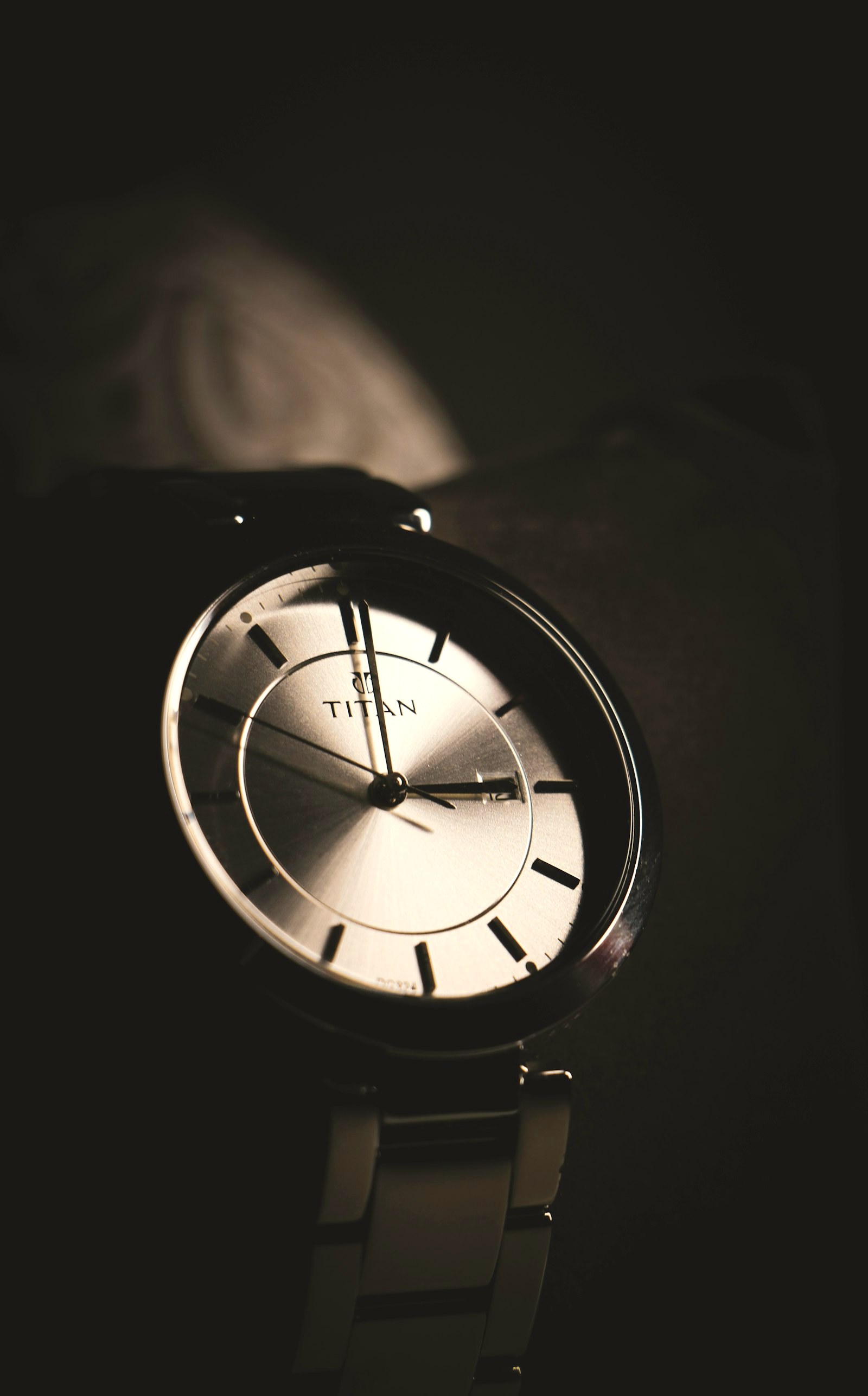
The occupied station, photographed in the word's senior sense: a watch on its steel bracelet, the metal band No. 53 fits to the seat behind the wrist bone. No jewellery bracelet is pictured, because the bank holds no jewellery bracelet frame in any species, and this page's first ruling is that the seat in the frame is taken. The gap and the harvest list are named in the care section below.
Checked and updated October 2026
The ruling, up front: the bracelet is the wrist’s second instrument, and it is admitted on the senior instrument’s terms. The watch already owns its wrist by No. 53’s law, sized to the wrist and seated by the suit, its case on the flat behind the wrist bone, worn on the non-dominant wrist by a convention of logistics. The bracelet therefore takes the other wrist, alone: one piece as the standard, its scale subordinate to the watch and the cuff, its metal inside the outfit’s one family under No. 62’s law of metals kept quiet and matched, the same law that prints this site’s standing refusal, no bracelet stack at the cuff. The species are registers: the metal cuff the tailored default, the fine chain the classic second, the bead and the leather band the untailored registers, the woven cord the last register, refused in the office and refused entire at black tie, where No. 67’s grammar has already furnished the wrist. On scores: no Card grades bracelets as jewellery, and this page invents none.
This brief: the decisive rule · the garment’s record · the pairing law · the rooms and hours · the looks · the ruling · the mistakes · care, the keeping, and our photography
The decisive rule: the second instrument, admitted on the first instrument’s terms
Begin with the wrist, because the bracelet is unintelligible without the law that already governs it. This family has measured the wrist once, thoroughly, at No. 53, and its findings are the ground this brief stands on. The watch is sized to the wrist and seated by the suit: the case stands on the flat of the wrist just behind the wrist bone, fitted by its footprint, lug-to-lug inside the wrist’s width, its strap fitted to the seat so the case does not travel when the arm swings. It is worn on the non-dominant wrist by a convention whose reasoning No. 53 prints exposed: that wrist writes less, lifts less and knocks into less, so the instrument survives, and the crown can be worked by the dominant hand. And it passes under the shirt cuff its day requires, the tailoring seating the finished wrist entire. That is a complete jurisdiction. One wrist is occupied by an instrument under a fit law; the other is bare by the same convention that placed the watch. The decisive rule follows from the occupation: the bracelet is the wrist’s second instrument, admitted on the senior instrument’s terms, and its whole discipline, its wrist, its number, its scale and its metal, is the senior instrument’s law applied to a guest. A watch is fitted. A bracelet, in the trade’s ordinary form, is merely sized to pass the hand and left loose on the wrist it lands on. Everything this brief rules is the correction of that looseness by the measured station’s standards.
The rule’s clauses follow in order. The wrist is the free one. The watch’s wrist is refused to the bracelet on mechanism, argued in the pairing law below: the seat is a fitted hold, a bracelet is an unfitted traveller, and the two objects on one wrist spend the day striking each other at the station both were bought to ornament. The bracelet goes where the convention left room, the dominant wrist for most wearers, and it prices that wrist’s working life into its species, as No. 53’s own survival reasoning requires. The number is one. One piece is the standard entire; a second is a rationed exception with conditions, argued in the questions, and the stack as a style is refused by the site’s standing law rather than by this brief’s taste, No. 62 having printed the refusal at the cuff before this brief existed. The scale is subordinate. The bracelet is read against two seated objects, the watch across the body and the cuff above it, and its presence is kept under both, by No. 53’s sizing law transposed once and marked in the pairing section. The metal is the family’s. A bracelet is a fourth station of metal in an outfit whose other stations No. 62 and No. 63 already govern, and it joins their family or it does not get worn. What the discipline buys is the thing the measured wrist itself buys: an outfit whose smallest stations were decided once, consistently, and then left alone.
One preliminary distinction, because the word carries it through this site’s own pages. On this tree, bracelet has a senior sense: the metal band a watch case is carried on, the strap register No. 53 calls the working week’s metal and Verdict Card No. 02 grades inside its watch records. That bracelet is part of the watch, fitted with it, sized with it, and ruled by No. 53 entire; nothing in this brief amends it. The bracelet of this brief is the word’s other sense, the independent band worn as jewellery, which has stood on this site only inside other garments’ rulings: counted, stacked and refused, but never seated. This brief seats it. It does so without a single score, because no Card grades the jewellery shelf, and with the standing rulings cited entire wherever they bear, because three of them bear directly and a brief that ignored them would be inventing a law the site has already printed.
The garment’s record: five species, one wartime document, and three rulings already standing
The instrument first, in its species, because each is a different answer to the same loose fit. The metal cuff is one solid band of metal, sprung open at the back or closed entire: the only species that holds a position on the wrist without a fitted hold, its own stiffness doing the strap’s work, which is why it is the tailored default below. The chain is fine links with a clasp, sized to pass the hand and therefore loose by construction: it travels, settles where gravity puts it, and moves against the skin as the wrist moves. Within the species stands the identification bracelet, a chain carrying a flat name plate, the one form of the garment with a document’s history: issued and worn as identification in the wartime decades, it is the bracelet as a record of its wearer rather than an ornament, and the plate’s plainness is the species’ permanent lesson in what a face at the wrist is for. The bead is stone, wood or glass spheres strung on cord or elastic: the bulkiest species per unit of presence, and the only one whose fastening is a knot or a stretch. The leather band is a strap, a plait or a thong, buckled or tied: soft, light, and mortal, absorbing water and sweat and darkening with both. The woven cord is textile entire, plaited or knotted, the friendship and festival species: it has no clasp to fail and no register above the rooms that issued it.
The record of the garment, printed as the published record tells it. The band worn at the wrist as ornament is among the oldest garments there are, older than the tailored wardrobe by millennia, and its modern men’s history is narrower than its ancient one: the tailored centuries pushed men’s jewellery steadily off the wrist and into the few stations the codes enumerate, the ring, the watch, the links and studs of the evening grammar, and the independent bracelet survived those centuries at the margins, in the military’s identification plate, in the medical alert band, in the summer and seaside registers where tailoring relaxes. Its recent return to the ordinary wrist is a return into a jurisdiction it predates: the wrist it comes back to has been measured, seated and legislated by the watch’s brief in the meantime, and the friction between the returning garment and the standing law is this page’s whole subject. The bracelet’s record on this site is three rulings inside other garments’ briefs, and they are this page’s foundation rather than its competition. No. 62, ruling the tieless suit’s remaining metal, refuses among its compensations no bracelet stack at the cuff, four words that carry the species’ number law entire. No. 70, grading the hardware stack under No. 63’s law for the horsebit, counts a bracelet bidding at a fourth station among the outfit’s metals spent three and four times in one claim. And the loafers brief’s ornament stack names the bracelet at the cuff as one jewel among several, each defensible alone and together a furnishing. Stacked, bidding, furnishing: the site has met the bracelet three times, always as a symptom. This brief is the garment’s own ruling, and it keeps all three verdicts standing inside it.
The pairing law: the free wrist, the seat’s refusal, and the fourth station
The pairing law’s first principle is that the bracelet pairs with the wrist the watch declined, and the declension is No. 53’s. The convention seats the watch on the non-dominant wrist, for logistics: survival and the crown. The bracelet takes the dominant wrist, and the same logistics price the choice honestly, as the questions print: the dominant wrist is the working wrist, the one that reaches into engines and door frames, carries the case and strikes the desk’s edge, so the guest on that wrist lives harder than the instrument it mirrors, and its species is chosen for the life, the solid cuff and the fitted chain ahead of the elastic-strung bead and the absorbent cord. The left-handed wearer mirrors the system entire. What the pairing refuses is the consolidation, both instruments on one wrist and the other bare, because the system’s sense is distributional: the measured station occupied by its instrument, the free station carrying the single guest, the body’s metal read as two quiet facts rather than one loud one.
The watch’s wrist is refused on mechanism, and the mechanism is the seat. No. 53’s fit law is a hold: the strap fitted so the case stays on the flat behind the wrist bone through the arm’s swing and the wrist’s turn. A bracelet holds nothing. It is made to pass the hand, so it is loose on every wrist it will ever meet, and loose objects on a wrist travel: down to the hand, up the forearm, and across the case of any watch sharing the station, link against lug and band against crystal edge, in small strikes repeated all day. Both finishes pay, the case’s polished flank and the bracelet’s own, at the one station where the outfit’s surfaces are compared at reading range. The seat pays too: a chain settled below the case levers it off its flat; a cuff above it buries it. The arrangement survives in photographs because a photograph is a wrist held still by its owner for one second, and the wearing is eight hours of the opposite. The rule costs the wearer nothing, which is the test of a mechanism ruling in this family: the other wrist is empty, and it is the same distance from the eye.
The metal family is the pairing’s centre, and the law is borrowed standing, twice over. No. 62 prints it for the tailored outfit: the metals are kept quiet and matched, the buckle, the watch case and the cufflinks in one family where the eye can compare them. No. 70 prints the bracelet’s place inside that law from the failure side: in the hardware stack, the bracelet is the metal bidding at a fourth station, after the buckle, the watch and the shoe’s bit have already spent the outfit’s claim. A fourth station is not forbidden; it is budgeted. The bracelet that joins the family, silver-toned under a steel watch, gold under gold, its finish at the family’s polish or below it, spends little, because it reads as the same decision continued to the other wrist. The bracelet in a family of its own, a bright yellow band under a steel watch and a silver buckle, spends the whole budget at once, because it reads as a second outfit’s metal worn over the first. The bead and the leather answer the law in their own currencies: their stones, woods and hides are kept inside the outfit’s palette and register, a black stone behaving as a dark metal does, a tan hide answering the shoes’ family as a strap does at No. 53.
The scale is ruled by No. 53’s sizing law, transposed once and marked as a transposition. No. 53 sizes the watch to the wrist: the case’s footprint inside the wrist’s flat width, diameter chosen as proportion inside the matrix and never above its ceiling. The bracelet has no footprint to fit, so the transposition governs presence instead: as the case answers the wrist’s width, the bracelet’s width and weight answer the same wrist at a subordinate station, present to a viewer looking for it and unremarkable to a viewer looking at the man. In practice the species that survive a tailored room run narrow: the cuff’s band in the range of a shirt cuff’s own hardware, millimetres rather than centimetres; the chain fine enough to settle rather than pool; the beads at the small end of the trade’s sizes. The check is the mirror’s, and it is the cufflink face’s check from No. 79 at a neighbouring station: the bracelet should be found by a viewer looking for it, not met by a viewer looking at the man. A band that outweighs the watch across the body, or that competes with the cuff it must pass under, has inverted the station’s arithmetic exactly as the oversized watch inverts it at No. 53, as a proportion error before it is a taste error.
The rooms and hours: the tailored day, the open registers, and the evening’s closed door
The bracelet’s rooms divide by the outfit’s register, and the division is the species list read as a map. The tailored day is the narrow room: under a suit or a blazer, the metal cuff and the fine chain in the outfit’s family are licensed, single, quiet and subordinate, read at the handshake and the desk exactly as the cufflink’s face is read at No. 79. The bead is refused in this room on mechanism rather than on taste: a shirt cuff is a fitted passage, sized by the tailoring to the wrist and the watch it must clear, and a string of beads at eight or ten millimetres is a second, larger wrist inside that passage, jamming the cuff’s seat, wearing its edge, and announcing itself at every gesture the cuff was cut to quiet. The leather wrap and the woven cord are refused with tailoring at any hour, their registers being the registers tailoring exists to leave. The untailored day is the open room: the knitwear day, the open collar, the summer’s short sleeves, where bead and single leather band stand licensed in their order, the rationed second piece is available under its conditions, and the cord is at home in the rooms that issued it.
The evening is No. 67’s room, and the door is closed by the grammar rather than by this brief. Black tie prints its uniform as a fixed set of elements whose whole virtue is that the decisions were made before the invitation arrived, and its wrist is furnished inside the set: the dress shirt’s studs and cufflinks, ruled at No. 79 as components rather than accessories, and the watch. A bracelet is an element the grammar does not contain, in any species, at any scale, and the tailored evening below black tie inherits the refusal in proportion: the dressed dinner’s wrist is the day’s narrow room narrowed further, the single metal species at its quietest. The working room of the hands refuses the guest before it refuses anything else, and the refusal is No. 53’s survival logic read from the dominant wrist’s side: the bench, the kitchen, the site and the surgery are rooms where loose metal at a working wrist is a hazard before it is a style, and the bracelet comes off there as the watch itself comes off in the rooms No. 53 names, without either garment being blamed for the room. And the desk’s long hour is the chain’s one friction in its licensed rooms, printed fairly: a loose chain at a typing wrist strikes the desk’s edge in small repeated blows all day, which is the fitted cuff’s honest case in the tailored register and the close-fitted chain’s, and is a comfort fact to be managed by species and fit, not a defect in the garment’s idea.
The looks: four assemblies the brief licenses
| Setting | The assembly | The details | The judgment |
|---|---|---|---|
| The tailored default | One metal cuff in the outfit’s metal family, on the free wrist, under a suit or blazer | The band narrow and plain, its finish at or below the watch’s polish, sitting still at the seat while the watch works across the body | The guest at its best behaviour: a second quiet fact at the body’s other measured station, read as the same decision continued |
| The classic second | A fine chain, fitted close, on the free wrist, with tailoring or a dressed knit | Links small enough to settle rather than pool, the clasp sound, the metal in the buckle’s and the watch’s family entire | The oldest licensed form in its register: movement and light admitted, at the price of the desk’s small strikes, priced in the rooms section |
| The soft register | One bead bracelet of small matte stones, or one leather band, on the free wrist, in the untailored rooms | No cuff to jam and no tailoring to answer, the tones inside the outfit’s palette, the watch still alone on its own wrist | The casual species done honestly: softness chosen as a register rather than drifted into, and retired at the tailored door |
| The rationed pair | Two pieces in one metal family on the free wrist, untailored rooms only, the watch’s wrist untouched | Combined width still subordinate to the watch’s case, both pieces quiet, the second piece earning its place rather than accompanying the first by habit | The ceiling of the number law, not its standard: licensed by the ration in the questions, and the first thing this brief withdraws when the room dresses |
The ruling
Put the bracelet on the other wrist. The watch’s wrist is fitted, occupied and closed; the free wrist carries one piece, at a scale a viewer finds rather than meets, in the metal family the buckle and the watch already established. Wear the metal cuff where the suit is worn, the fine chain where it dresses, the bead and the leather band where the day untailors, and the woven cord only in the rooms that issued it, retired when they close. Refuse the stack at the cuff, because the site refused it before this page; refuse the shared wrist, because loose metal and a fitted case spend the day striking each other; refuse the fourth station in a foreign metal, because the outfit’s budget was spent by the stations ahead of it. At black tie, wear nothing the grammar did not issue. The bracelet is an old garment returning to a measured station, and it is worn well exactly when it accepts the measurement: one guest, on the free wrist, in the family’s metal, quiet enough that the wrist’s senior instrument is never upstaged by its junior.
Where the wearing goes wrong
The stack at the cuff. The number failure, and the site’s standing refusal before it is this brief’s: No. 62 prints no bracelet stack at the cuff among the tieless suit’s refused compensations, and the mechanism is arithmetic, each added piece multiplying metal families, travel and noise at a station fitted for one instrument and a sliver of shirt. The stack’s wearers usually own one good bracelet and several souvenirs of it, and the repair is subtraction to the one, worn at the standard this page prints.
The shared wrist. The seat failure: the bracelet threaded onto the watch’s wrist, above or below the case, in the arrangement every photograph licenses and no wearing survives. It fails mechanically, the loose piece travelling into the fitted one in small strikes all day, both finishes wearing at the contact, the case levered off the flat No. 53 seats it on; and it fails in the read, the watch demoted to the largest element of a wrist collection. The repair costs nothing and is total: move the piece to the wrist that is empty.
The fourth station in a foreign metal. The family failure, No. 70’s hardware stack with the bracelet in its named place: the bright buckle, the bright watch, the bright shoe, and a bracelet bidding at a fourth station in a metal none of them speak. Each piece is defensible alone, which is what makes the failure a set’s failure rather than a piece’s, and the repair is the family discipline: the bracelet bought in the watch’s metal, or not bought.
The band kept on past its rooms. The signage failure, graded by No. 78’s arithmetic as the cap’s flat brim and the cufflink’s novelty face are graded: the festival cord, the holiday weave, the event band, worn into the office and the month after, announcing where the wearer was to everyone who reads wrists. A band that carries an occasion is a souvenir; a souvenir worn as jewellery is signage; and signage at the wrist is read at handshake range, the closest range the outfit has. Retire the band with the occasion, and let the metal species, which announce nothing, carry the ordinary days.
The wrap counted as one. The accounting failure: the leather band wound three or four times around the wrist and entered in the wearer’s ledger as a single bracelet, where this brief’s count, and No. 62’s refusal, count coils. A wrap is a stack that has been sewn together, its combined width and travel graded under the same ceiling as any two or three pieces, and in the tailored rooms it fails with the rest of its species. Worn single, in the untailored rooms, the same band is an honest soft register, which is the whole of the distinction: the garment is graded by what arrives at the wrist, not by what the receipt called it.
Care, the keeping, and our photography
A band at a working wrist is kept as the working wrist requires. The clasp and the links are the chain’s keeping: a clasp that has loosened until it opens under the desk’s ordinary strikes is a bracelet at the end of its service, repaired before it retires itself onto a pavement, and the links are inspected at the clasp’s ends, where the travel concentrates the wear. The cuff is kept from the desk’s edge, its underside being the surface the dominant wrist rests and slides on all day: scratches there are the species’ honest patina, printed as such, and the wearer who cannot abide them is told by this brief to choose the chain’s higher seat or another register, not to polish a working surface weekly. The bead’s elastic is its mortality: it tires invisibly and fails entire, scattering the species across a floor, and it is restrung on a schedule rather than on the evidence. Leather is kept dry, fed rarely, and retired when the sweat of summers has stiffened it past suppleness; woven cord is washed or retired, its low price making retirement the honest maintenance, as it is for the silk knot at No. 79. Storage is the box the links live in, pieces apart, the chain laid flat rather than coiled, the cuff’s spring never stored stretched over a form wider than the wrist it serves.
The rulings this brief prints beyond the tree’s standing record are gathered here once, the way the family gathers its extensions. The family’s are cited as theirs: No. 53’s seat, sizing and which-wrist convention, the watch sized to the wrist and seated by the suit on the non-dominant wrist for logistics, adopted entire; No. 62’s metals law, quiet and matched, with its printed refusal of the bracelet stack at the cuff, adopted entire; No. 63’s metals law as No. 70 applies it, the bracelet as a fourth station inside a budgeted set, adopted entire; No. 67’s evening grammar, which furnishes the wrist from a fixed set, adopted entire; No. 78’s signage arithmetic, standing behind the kept-on band’s refusal. This brief’s own are: the decisive rule itself, the second instrument admitted on the first’s terms; the free-wrist placement, with the dominant wrist’s working life priced into the species; the shared wrist refused on the seat’s mechanism; the species read as registers, cuff, chain, bead, leather and cord; the stacking ration, two pieces in one family on the free wrist in the untailored rooms, one under tailoring, zero on the watch’s wrist; the multi-wrap band counted by its coils; the bead’s refusal under a tailored cuff, on the passage’s mechanism; and black tie’s refusal stated as the grammar’s application rather than as a new rule. Nothing scored stands behind any of them: no Card grades this garment as jewellery, and the bracelet carries no number of its own because none has been graded.
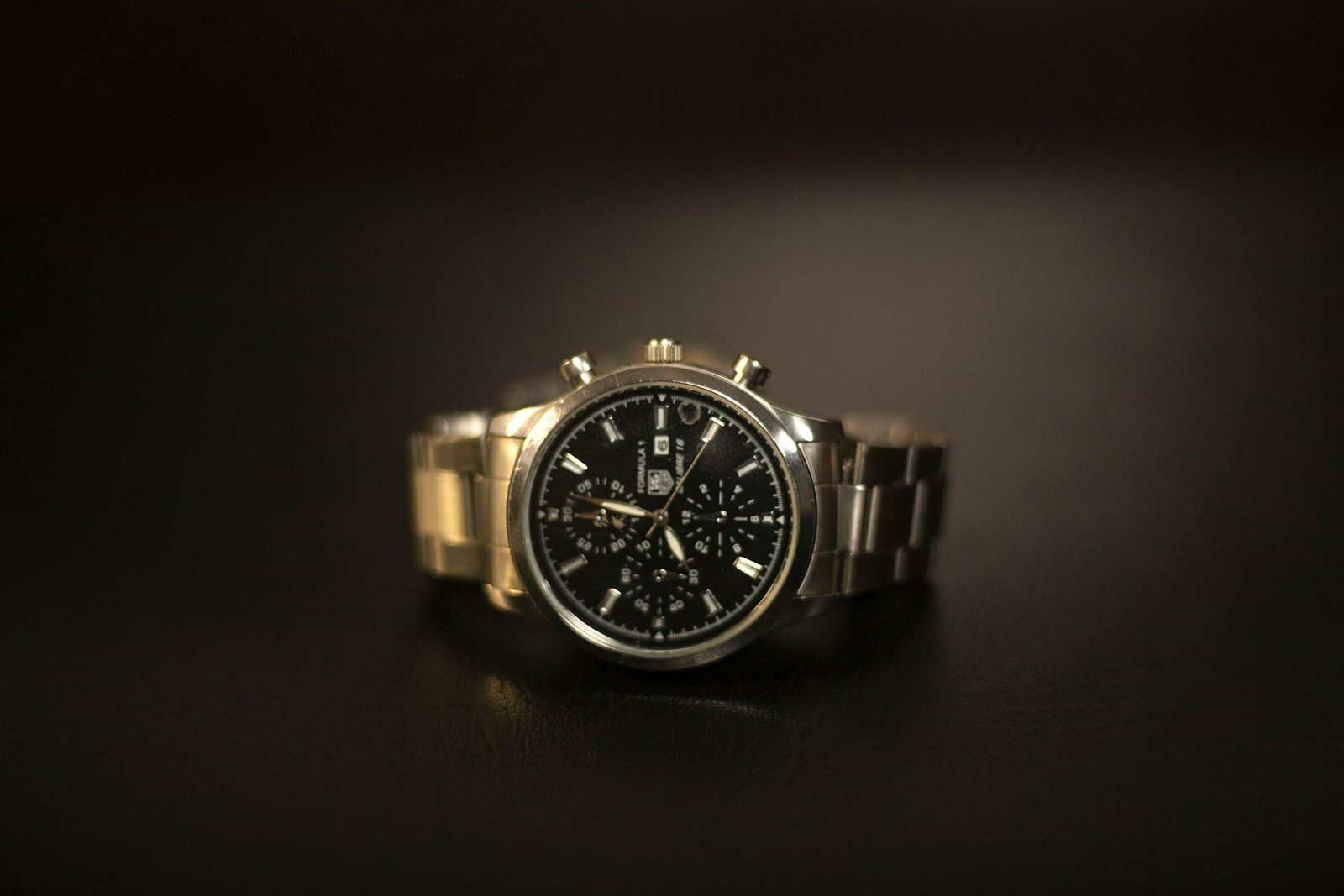
The photography, stated plainly, because this page’s garment is the second in succession that the bank cannot picture in its own sense. The bank holds no jewellery bracelet in any species: no metal cuff on a wrist, no chain fitted at a seat, no bead or leather or cord band worn, in any frame, a result confirmed by the search of the bank and of CREDITS.md made before this page was written. What the bank holds richly is the word’s senior sense, the watch’s own bracelet, and the page is illustrated from that shelf with the captions carrying the distinction in the open: the hero is a slim watch on its steel bracelet at macro range, the occupied station; the figure in the record is the integrated bracelet as an object on a dark surface. What the page needs, and has not got, is named in the harvest list, in order: first, a plain metal cuff worn on a bare wrist beside a shirt cuff, the tailored default in its room; second, a fine chain fitted close at the seat behind the wrist bone, the classic second as it is actually worn; third, the bead, leather and cord species laid beside a metal cuff, the register ladder in one frame; fourth, both wrists in one frame, the watch seated on its wrist and the single bracelet on the free one, the two-wrist system this brief rules, entire. Until that pass runs, the brief about the wrist’s guest is illustrated by the wrist’s owner, which is, by this page’s own ruling, the correct order of precedence in any case.
Questions, answered
What is the one rule of wearing a bracelet?
That the bracelet is the wrist’s second instrument, and it is admitted on the senior instrument’s terms. The wrist is already governed on this site: No. 53 rules the watch sized to the wrist and seated by the suit, its case on the flat behind the wrist bone, worn on the non-dominant wrist by a convention of logistics. A bracelet does not repeal any of that. It takes the other wrist, the one the convention leaves bare; it stands alone there, one piece as the standard; its scale stays subordinate to the watch’s case and to the cuff it must pass; and its metal joins the outfit’s one metal family, kept quiet and matched under the law No. 62 prints for the buckle, the watch and the links. The species are registers of that admission: the metal cuff the tailored default, the fine chain the classic second, the bead and the leather band the untailored registers, the woven cord the last register, refused where the suit is worn. A bracelet worn against those terms, stacked at the cuff, sharing the watch’s wrist, bidding as a fourth metal, is not a bolder bracelet. It is a second instrument refusing the first instrument’s law, at the one station of the body this family has already measured.
Which wrist should a bracelet go on?
The free one: the wrist the watch is not on. No. 53 prints the convention and its reasoning entire: the watch goes on the non-dominant wrist because that wrist writes less, lifts less and knocks into less, so the case survives and the crown can be worked by the dominant hand. The bracelet inherits the remainder. For most wearers that is the dominant, right wrist, and the inheritance carries the convention’s own caveat in reverse: the dominant wrist is the working wrist, the one that reaches, carries and strikes, so a bracelet worn there lives the harder life the watch was spared, and the species choice should price that in, the solid cuff and the fitted chain surviving the desk and the door handle better than beads on elastic or a cord. Left-handed wearers mirror the whole arrangement, watch on the right, bracelet on the left. What the arrangement never licenses is both instruments on one wrist and none on the other: the two-wrist system is the point, one measured station occupied, the other carrying the single admitted guest, and a bare pair of wrists remains, as it has always been in this family, a complete answer.
Can a bracelet be worn on the same wrist as a watch?
No, and the refusal is mechanical before it is visual. No. 53 seats the watch by a fitted hold: the strap is fitted to the seat so that the case stays on the flat behind the wrist bone when the arm swings and the wrist turns, neither travelling over the bone nor sliding down the hand. A bracelet is not fitted to anything. It is sized to pass the hand, so on the wrist it travels, up the forearm and down to the case, all day, and where it lands it strikes: metal against the case’s flank and the crystal’s edge, link against lug, each piece wearing the other’s finish at exactly the station both were bought for. The pairing also breaks the seat’s arithmetic from the other side, the case pushed off its flat by the band below it or buried under the chain above it, the watch demoted to the largest bead in a stack. The photograph this arrangement is usually copied from is a photograph: the wrist was arranged for the frame and relieved of the arrangement immediately after. In the wearing, the watch’s wrist carries the watch, and the bracelet takes the other one, which is empty and has been waiting for exactly one guest.
Cuff, chain, bead, leather or woven: which bracelet should I wear?
The species are registers, and the register is chosen by the room, as every register in this family is chosen. The metal cuff, one solid band, open or closed, is the tailored default and the dressed end: it sits still at the seat, does not travel, is read as a single decision, and is the only species this brief licenses under a suit without argument. The chain, fine links fitted close, is the classic second: it moves as the wrist moves and catches light as it does, which is its pleasure and its price, and it includes the identification form, the one species with a document’s history behind it. The bead, stone or wood on a cord or elastic, is the casual register: quiet when the beads are small and matte, licensed in the untailored rooms, and refused under a tailored cuff, where its bulk jams the cuff’s seat and announces itself at every gesture. The leather band is the soft register, a single strap or plait that ages with its wearer and stays out of the tailored rooms on the same arithmetic as the bead. The woven cord is the last register, the holiday and festival species: worn where it was acquired, in the rooms that issued it, and retired when those rooms close, because a band kept on past its occasion has become signage, and signage is graded at No. 78. One species as the wardrobe’s default, worn well, outranks a drawer of registers worn at random.
Can bracelets be stacked?
At the cuff, no, and the refusal is this site’s standing law rather than this brief’s invention. No. 62, ruling the tieless suit’s metals, prints the sentence entire among its compensations refused: no bracelet stack at the cuff. The mechanism generalises beyond the tieless case. A wrist is a measured station on this site, fitted by No. 53 to one instrument; each added bracelet multiplies the metal families in play, the travel and striking of loose pieces against each other, and the total width competing with the cuff’s sliver, until the station reads as a collection rather than a decision. This brief’s ration, printed as its own extension and marked as one, is narrow: on the free wrist, in the untailored rooms, a second piece in the same metal or material family as the first, the pair’s combined presence still subordinate to the watch across the body. That is the ceiling. On the watch’s wrist the ration is zero, for the seat reasons the same-wrist answer prints; under tailoring the ration is one, the single cuff or chain; and the multi-wrap leather band is counted as what it is, a stack that has been sewn together, and graded under the same ceiling.
Should a bracelet match the watch and the other metals?
Yes, under the same standing law that governs every other metal in the outfit, cited here rather than reinvented. No. 62 keeps the tailored outfit’s metals quiet and matched: the belt buckle, the watch case and the cufflinks where the shirt carries them in one family where the eye can compare them, matched or deliberately quiet, with nothing added to compensate elsewhere. No. 70, the monk strap brief, prints the failure from the other side under No. 63’s law for the horsebit: the hardware stack, a bright buckle, a bright watch, a bright shoe, and a bracelet bidding at a fourth station, the outfit’s metal budget spent three and four times in the same claim. The bracelet is that fourth station whenever it is worn, which is the whole of its metals law: it does not get its own family. Silver-toned with a steel watch and a silver buckle, gold with gold, dark and matte where the outfit’s metals are dark and matte, and the bead and leather species answer the law in their own materials, their tones kept inside the outfit’s palette rather than against it. A bracelet in a metal family of its own is not an accent. It is a second decision the outfit never made, worn at the wrist where decisions are compared.
Can a bracelet be worn in the office, or at black tie?
The two rooms have different answers, and both are printed plainly. The office divides by its dress: in the tailored office, the metal cuff and the fine chain in the outfit’s own metal family pass, being quiet, single and subordinate; the bead is refused under a shirt cuff on mechanism, its bulk jamming the cuff’s seat; the leather wrap and the woven cord are refused with a suit at any hour. In the untailored office the registers open in their order, bead and single leather band admitted, the cord still the last register. Black tie refuses the bracelet entire, and the refusal is the grammar’s rather than the brief’s: No. 67 prints the evening uniform as a fixed grammar whose metal is enumerated, the dress shirt’s studs and cufflinks and the watch, and a bracelet is an element the uniform does not contain. Nothing in the grammar is improvised, which is its whole virtue: the decisions were made before the invitation arrived. The bracelet’s rooms are the day’s rooms. The evening wrist is already fully furnished, and it is furnished by the code.
Has Young Cotton ranked bracelets?
No, and the absence is printed rather than papered over, as it is at No. 77 for braces, No. 78 for the cap and No. 79 for cufflinks. No Verdict Card grades bracelets as jewellery, no index on the tree scores one, and this brief invents no score and names no maker as a pick. The word’s senior sense on this site is graded, and the distinction is printed so the record is not misread: the bracelet as a watch strap, the metal band a case is carried on, stands inside Verdict Card No. 02’s watch records and No. 53’s strap registers, where it is the working week’s metal. The jewellery this brief rules has no such document behind it. What stands behind the rulings here is the wrist’s standing law where it genuinely bears: No. 53’s seat, sizing and which-wrist convention; No. 62’s metals law and its printed refusal of the bracelet stack at the cuff; No. 70’s fourth station, under No. 63’s law; No. 67’s evening grammar; and No. 78’s signage arithmetic. When the desk grades the bracelet shelf on its makers’ published records, metals, mechanisms, dimensions and terms, this page’s rulings will be re-argued from that Card.
Next
The family this brief stands in: No. 53, the watch, the wrist’s senior instrument, whose seat, sizing law and which-wrist convention this brief adopts entire and whose station it refuses to share; No. 62, the suit without a tie, whose metals law keeps this page’s metal in the family and whose four words, no bracelet stack at the cuff, stand as the number law’s foundation; No. 79, cufflinks, the brief before this one, the wrist’s other admitted metal, whose face’s field arithmetic this page’s scale ruling answers at the neighbouring station; No. 70, monk straps, whose hardware stack counts the bracelet bidding at a fourth station, the metals budget this page spends carefully; and No. 67, black tie, whose grammar furnishes the evening wrist from a fixed set and closes that room to this garment entire. The brief before this one stands at No. 79; the series began with the cardigan and the full run lives in the How to Wear index. How every score behind those pages is built stands on our methodology page.